Immunohistochemistry (IHC)
:
The principleof IHC has been known since the 1930s,
but it was not until 1942 that the first IHC study was
reported. Coons et al. (1942) used FITC-labeled
antibodies to identify Pneumococcal
األجسام استخدم
المسماة المضادة
FITC
المكورات المستضدات لتحديد
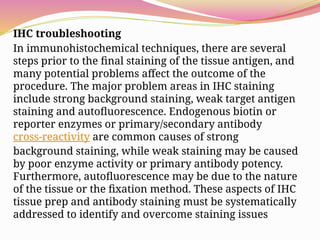
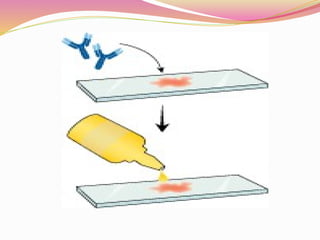
المصاب النسيج في الرئوية
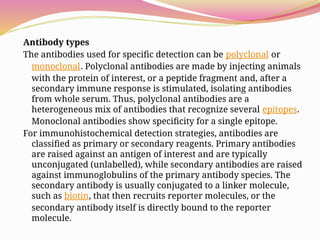
antigens in infected tissue.
Since then, improvements have been made in
protein conjugation, tissue fixation methods,
detection labels and microscopy, making
immunohistochemistry a routine and essential tool
in diagnostic and research laboratories
.
3.
Immunohistochemistry (IHC) refersto the process of detecting
antigens (e.g. proteins) in cells of a tissue section by exploiting
the principle of antibodies binding specifically to antigens in
biological tissues. IHC takes its name from the roots "immuno",
in reference to antibodies used in the procedure, and "histo,"
meaning tissue (compare to immunocytochemistry)
.
Immunohistochemistry (IHC) combines anatomical,
immunological and biochemical techniques to identify discrete
tissue components by the interaction of target antigens with
specific antibodies tagged with a visible label. IHC makes it
possible to visualize the distribution and localization of specific
cellular components within cells and in the proper tissue
context. While there are multiple approaches and
permutations in IHC methodology, all of the steps involved are
separated into two groups: sample preparation and labeling
.
4.
Applications
IHC is usedfor disease diagnosis, drug development and
biological research. Using specific tumor markers,
physicians use IHC to diagnose a cancer as benign or
malignant, determine the stage and grade of a tumor,
and identify the cell type and origin of a metastasis to
find the site of the primary tumor
.
Samples are prepared on individual slides, or multiple
samples can be arranged on a single slide for
comparative analysis, such as with tissue microarrays.
IHC slides can be processed and stained manually, while
technological advances now provide automation for
high-throughput sample preparation and staining.
Samples can be viewed by either light or fluorescence
microscopy
.
5.
Tissue Collection
:
Patient oranimal biopsies, or whole animal organs,
are collected for preservation and IHC analysis,
depending on the requirements of the assay. Tissue
must be rapidly preserved to prevent the
breakdown of cellular protein and tissue
architecture. Often, the tissue is perfused, or rinsed
of blood, prior to preservation to prevent the
detection of hematologic antigens that may
interfere with the detection of target antigens
.
6.
Tissue Fixation
Fixation chemicallycrosslinks proteins or reduces
protein solubility, which can mask target
antigens during prolonged or improper fixation.
Therefore, the right fixation method must be
optimized based on the application and the
target antigen to be stained
.
The most common fixative is formaldehyde, a
semi-reversible, covalent crosslinking reagent
that can be used for perfusion or immersion
fixation for any length of time, depending on the
level of fixation required. Other fixatives are
available, and their use depends on the antigens
that are being sought
.
7.
Tissue Embedding
Fixed tissuesamples are embedded in paraffin to
maintain the natural shape and architecture of the
sample during long-term storage and sectioning for
IHC
.
Samples too sensitive for either chemical fixation or
the solvents used to remove the paraffin are encased
in cryogenic embedding medium and then snap-
frozen in liquid nitrogen
.
8.
Sectioning and Mounting
Thedecision to section tissue is dependent upon the application used; for
example, whole mount IHC, with sample thickness up to 5 μm, does not
require sectioning, while small samples for which multiple staining
procedures are needed may require sectioning
.
Formalin-fixed, paraffin-embedded tissues are sectioned into slices as thin
as 4 to 5μm with a microtome. These sections are then mounted onto
glass slides that are coated with an adhesive. This adhesive is commonly
added by surface-treating glass slides with 3-aminopropyltriethoxysilane
(APTS) or poly-L-lysine, which both leave amino groups on the surface of
the glass to which the tissue directly couples. Alternatively, slides may be
coated with physical adhesives, including gelatin, egg albumin or
Elmer's glue. After mounting, the sections are dried in an oven or
microwave in preparation for deparaffinization
.
Frozen sections are cut using a pre-cooled cryostat and mounted to
adhesive glass slides. These sections are often dried overnight at room
temperature and fixed by immersion in pre-cooled (-20°C) acetone,
although the drying step is sometimes skipped depending on the target
antigens and tissue used
.
9.
Epitope (Antigen) Recovery
Theparaffin from formalin-fixed, paraffin-embedded
sections must be completely removed for the
antibodies to reach the target antigens. Xylene, a
flammable, toxic and volatile organic solvent is
commonly used to remove the paraffin from IHC
slides, although commercial alternatives are available
.
Formaldehyde fixation generates methylene bridges
that crosslink proteins in tissue samples; these bridges
can mask antigen presentation and prevent antibody
binding. Formalin-fixed, paraffin-embedded sections
commonly require a treatment to unmask the
antibody epitopes, either by heat (heat-induced
epitope retrieval; HIER) or enzymatic degradation
(proteolytic-induced epitope retrieval; PIER)
.
10.
Immunohistochemical staining iswidely used in the
diagnosis of abnormal cells such as those found in
cancerous tumors. Specific molecular markers are
characteristic of particular cellular events such as
proliferation or cell death (apoptosis).
Immunohistochemistry is also widely used in basic
research to understand the distribution and localization
of biomarkers and differentially expressed proteins in
different parts of a biological tissue
.
Visualising an antibody-antigen interaction can be
accomplished in a number of ways. In the most common
instance, an antibody is conjugated to an enzyme, such as
peroxidase, that can catalyse a colour-producing reaction.
Alternatively, the antibody can also be tagged to a
fluorophore, such as fluorescein or
rhodamine
11.
Antibody types
The antibodiesused for specific detection can be polyclonal or
monoclonal. Polyclonal antibodies are made by injecting animals
with the protein of interest, or a peptide fragment and, after a
secondary immune response is stimulated, isolating antibodies
from whole serum. Thus, polyclonal antibodies are a
heterogeneous mix of antibodies that recognize several epitopes.
Monoclonal antibodies show specificity for a single epitope.
For immunohistochemical detection strategies, antibodies are
classified as primary or secondary reagents. Primary antibodies
are raised against an antigen of interest and are typically
unconjugated (unlabelled), while secondary antibodies are raised
against immunoglobulins of the primary antibody species. The
secondary antibody is usually conjugated to a linker molecule,
such as biotin, that then recruits reporter molecules, or the
secondary antibody itself is directly bound to the reporter
molecule.
12.
IHC troubleshooting
In immunohistochemicaltechniques, there are several
steps prior to the final staining of the tissue antigen, and
many potential problems affect the outcome of the
procedure. The major problem areas in IHC staining
include strong background staining, weak target antigen
staining and autofluorescence. Endogenous biotin or
reporter enzymes or primary/secondary antibody
cross-reactivity are common causes of strong
background staining, while weak staining may be caused
by poor enzyme activity or primary antibody potency.
Furthermore, autofluorescence may be due to the nature
of the tissue or the fixation method. These aspects of IHC
tissue prep and antibody staining must be systematically
addressed to identify and overcome staining issues
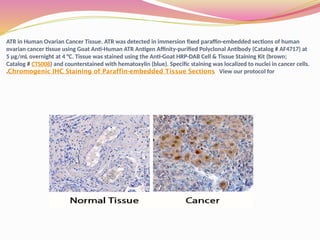
ATR in HumanOvarian Cancer Tissue. ATR was detected in immersion fixed paraffin-embedded sections of human
ovarian cancer tissue using Goat Anti-Human ATR Antigen Affinity-purified Polyclonal Antibody (Catalog # AF4717) at
5 µg/mL overnight at 4 °C. Tissue was stained using the Anti-Goat HRP-DAB Cell & Tissue Staining Kit (brown;
Catalog # CTS008) and counterstained with hematoxylin (blue). Specific staining was localized to nuclei in cancer cells.
View our protocol for
Chromogenic IHC Staining of Paraffin-embedded Tissue Sections
.
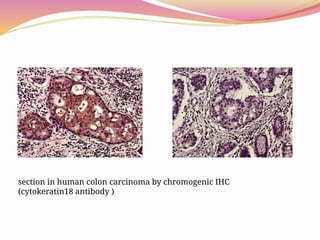
section in humancolon carcinoma by chromogenic IHC
(cytokeratin18 antibody )
18.
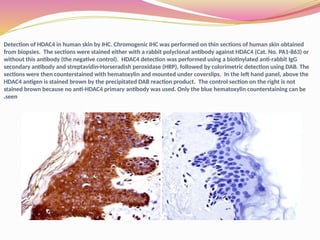
Detection of HDAC4in human skin by IHC. Chromogenic IHC was performed on thin sections of human skin obtained
from biopsies. The sections were stained either with a rabbit polyclonal antibody against HDAC4 (Cat. No. PA1-863) or
without this antibody (the negative control). HDAC4 detection was performed using a biotinylated anti-rabbit IgG
secondary antibody and streptavidin-Horseradish peroxidase (HRP), followed by colorimetric detection using DAB. The
sections were then counterstained with hematoxylin and mounted under coverslips. In the left hand panel, above the
HDAC4 antigen is stained brown by the precipitated DAB reaction product. The control section on the right is not
stained brown because no anti-HDAC4 primary antibody was used. Only the blue hematoxylin counterstaining can be
seen
.
19.
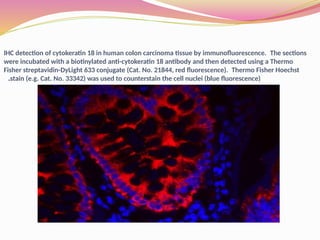
IHC detection ofcytokeratin 18 in human colon carcinoma tissue by immunofluorescence. The sections
were incubated with a biotinylated anti-cytokeratin 18 antibody and then detected using a Thermo
Fisher streptavidin-DyLight 633 conjugate (Cat. No. 21844, red fluorescence). Thermo Fisher Hoechst
stain (e.g. Cat. No. 33342) was used to counterstain the cell nuclei (blue fluorescence)
.

![Immunohistochemistry-Paraffin: Somatostatin Receptor 2 Antibody [NB300-157] - IHC
staining of Somatostatin Receptor 2 in mouse pancreas using DAB with hematoxylin
counterstain.](https://image.slidesharecdn.com/1585072503-250726114612-c18d987f/85/Introduction-to-Immunohistochemistry-IHC-16-320.jpg)