Screw press and its performance

Pragati Singham
M.Tech (FPEM)
CONTENTS
•
•
•
•
•
•

Introduction
Types
Construction & working
Principle
Performance(design)
References
INTRODUCTION
• It is the simplest machine for separation of solids and liquids.
• It is a cage style press.
• It is used for separation of –
– Oils from various oilseeds
– Fruit juices
• Screw pressing is a continuous operation, hence these are
also known as “expellers”
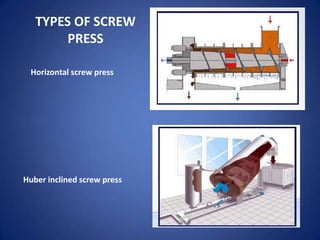
TYPES OF SCREW
PRESS
Horizontal screw press

Huber inclined screw press
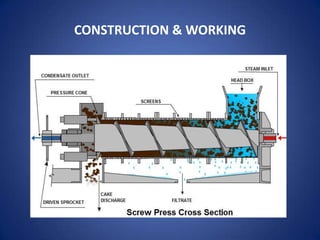
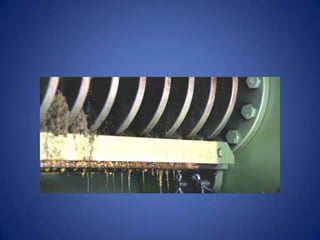
CONSTRUCTION & WORKING
PRINCIPLE
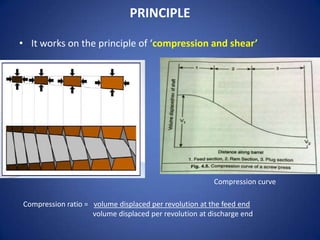
• It works on the principle of ‘compression and shear’.

Compression curve
Compression ratio = volume displaced per revolution at the feed end
volume displaced per revolution at discharge end
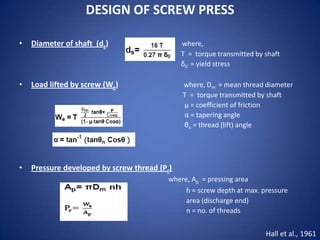
DESIGN OF SCREW PRESS
•

Diameter of shaft (ds)

where,
T = torque transmitted by shaft
δ0 = yield stress

•

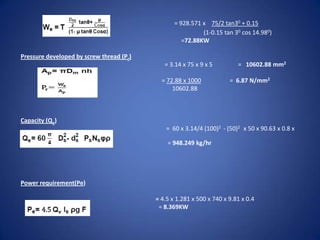
Load lifted by screw (We)

where, Dm = mean thread diameter
T = torque transmitted by shaft
µ = coefficient of friction
α = tapering angle
θn = thread (lift) angle

•

Pressure developed by screw thread (Pr)
where, Ap = pressing area
h = screw depth at max. pressure
area (discharge end)
n = no. of threads

Hall et al., 1961
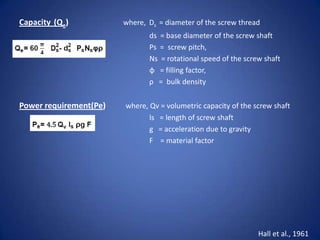
Capacity (Qe)

where, Ds = diameter of the screw thread
ds = base diameter of the screw shaft
Ps = screw pitch,
Ns = rotational speed of the screw shaft
φ = filling factor,
ρ = bulk density

Power requirement(Pe)

where, Qv = volumetric capacity of the screw shaft
ls = length of screw shaft
g = acceleration due to gravity
F = material factor

Hall et al., 1961
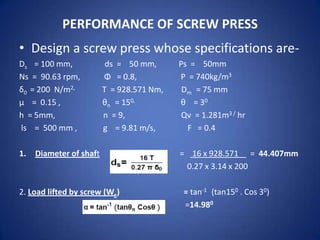
PERFORMANCE OF SCREW PRESS

• Design a screw press whose specifications areDs = 100 mm,
Ns = 90.63 rpm,
δ0 = 200 N/m2,
µ = 0.15 ,
h = 5mm,
ls = 500 mm ,
1.

ds = 50 mm,
Φ = 0.8,
T = 928.571 Nm,
θn = 150,
n = 9,
g = 9.81 m/s,

Diameter of shaft

2. Load lifted by screw (We)

Ps = 50mm
Ρ = 740kg/m3
Dm = 75 mm
θ = 30
Qv = 1.281m3 / hr
F = 0.4
= 16 x 928.571 = 44.407mm
0.27 x 3.14 x 200
= tan-1 (tan150 . Cos 30)
=14.980
= 928.571 x 75/2 tan30 + 0.15
(1-0.15 tan 30 cos 14.980)
=72.88KW
Pressure developed by screw thread (Pr)
= 3.14 x 75 x 9 x 5
= 72.88 x 1000
10602.88

Capacity (Qe)
740

= 10602.88 mm2
= 6.87 N/mm2

= 60 x 3.14/4 (100)2 - (50)2 x 50 x 90.63 x 0.8 x
= 948.249 kg/hr

Power requirement(Pe)
= 4.5 x 1.281 x 500 x 740 x 9.81 x 0.4
= 8.369KW
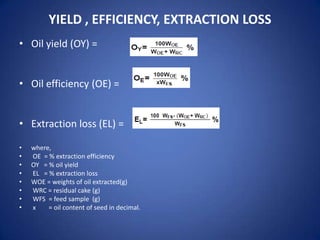
YIELD , EFFICIENCY, EXTRACTION LOSS
• Oil yield (OY) =
• Oil efficiency (OE) =
• Extraction loss (EL) =
•
•
•
•
•
•
•
•

where,
OE = % extraction efficiency
OY = % oil yield
EL = % extraction loss
WOE = weights of oil extracted(g)
WRC = residual cake (g)
WFS = feed sample (g)
x
= oil content of seed in decimal.
1. NUMERICAL
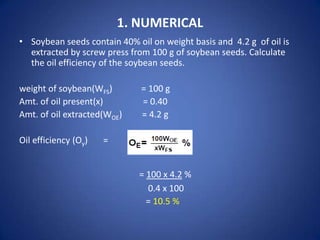
• Soybean seeds contain 40% oil on weight basis and 4.2 g of oil is
extracted by screw press from 100 g of soybean seeds. Calculate
the oil efficiency of the soybean seeds.
weight of soybean(WFS)
Amt. of oil present(x)
Amt. of oil extracted(WOE)
Oil efficiency (Oy)

= 100 g
= 0.40
= 4.2 g

=

= 100 x 4.2 %
0.4 x 100
= 10.5 %
2. NUMERICAL
•

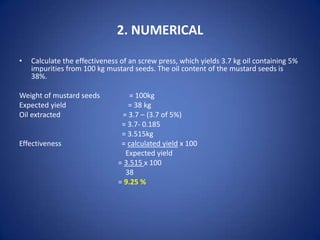
Calculate the effectiveness of an screw press, which yields 3.7 kg oil containing 5%
impurities from 100 kg mustard seeds. The oil content of the mustard seeds is
38%.

Weight of mustard seeds
Expected yield
Oil extracted

Effectiveness

= 100kg
= 38 kg
= 3.7 – (3.7 of 5%)
= 3.7- 0.185
= 3.515kg
= calculated yield x 100
Expected yield
= 3.515 x 100
38
= 9.25 %
REFERENCES
• Deli, S., Farah Masturah, M., Tajul Aris, Y. and Wan Nadiah, W. A.
The Effects of physical parameters of the screw press oil expeller on
oil yield from Nigella sativa L seeds. International Food Research
Journal 18(4): 1367-1373 (2011)
• Hall, A. S., Holowenko, A. E., & Laughlin, H. G. (2002). Schaum’s
outline series theory and problems of machine design. (1st ed.).
New York: McGraw-Hill Companies, Inc., (Chapter 12).
• Handbook of Food Processing Equipment by Geōrgios D.
Sarabakos, Athanasios E. Kosaropoulos

• http://www.reinartz.de/index.php?id=27&L=1
• http://www.fao.org/docrep/t0532e/t0532e04.ht
m
Screw press and its performance

Screw press and its performance

  • 1.
    Screw press andits performance Pragati Singham M.Tech (FPEM)
  • 2.
  • 3.
    INTRODUCTION • It isthe simplest machine for separation of solids and liquids. • It is a cage style press. • It is used for separation of – – Oils from various oilseeds – Fruit juices • Screw pressing is a continuous operation, hence these are also known as “expellers”
  • 4.
    TYPES OF SCREW PRESS Horizontalscrew press Huber inclined screw press
  • 5.
  • 7.
    PRINCIPLE • It workson the principle of ‘compression and shear’. Compression curve Compression ratio = volume displaced per revolution at the feed end volume displaced per revolution at discharge end
  • 8.
    DESIGN OF SCREWPRESS • Diameter of shaft (ds) where, T = torque transmitted by shaft δ0 = yield stress • Load lifted by screw (We) where, Dm = mean thread diameter T = torque transmitted by shaft µ = coefficient of friction α = tapering angle θn = thread (lift) angle • Pressure developed by screw thread (Pr) where, Ap = pressing area h = screw depth at max. pressure area (discharge end) n = no. of threads Hall et al., 1961
  • 9.
    Capacity (Qe) where, Ds= diameter of the screw thread ds = base diameter of the screw shaft Ps = screw pitch, Ns = rotational speed of the screw shaft φ = filling factor, ρ = bulk density Power requirement(Pe) where, Qv = volumetric capacity of the screw shaft ls = length of screw shaft g = acceleration due to gravity F = material factor Hall et al., 1961
  • 10.
    PERFORMANCE OF SCREWPRESS • Design a screw press whose specifications areDs = 100 mm, Ns = 90.63 rpm, δ0 = 200 N/m2, µ = 0.15 , h = 5mm, ls = 500 mm , 1. ds = 50 mm, Φ = 0.8, T = 928.571 Nm, θn = 150, n = 9, g = 9.81 m/s, Diameter of shaft 2. Load lifted by screw (We) Ps = 50mm Ρ = 740kg/m3 Dm = 75 mm θ = 30 Qv = 1.281m3 / hr F = 0.4 = 16 x 928.571 = 44.407mm 0.27 x 3.14 x 200 = tan-1 (tan150 . Cos 30) =14.980
  • 11.
    = 928.571 x75/2 tan30 + 0.15 (1-0.15 tan 30 cos 14.980) =72.88KW Pressure developed by screw thread (Pr) = 3.14 x 75 x 9 x 5 = 72.88 x 1000 10602.88 Capacity (Qe) 740 = 10602.88 mm2 = 6.87 N/mm2 = 60 x 3.14/4 (100)2 - (50)2 x 50 x 90.63 x 0.8 x = 948.249 kg/hr Power requirement(Pe) = 4.5 x 1.281 x 500 x 740 x 9.81 x 0.4 = 8.369KW
  • 12.
    YIELD , EFFICIENCY,EXTRACTION LOSS • Oil yield (OY) = • Oil efficiency (OE) = • Extraction loss (EL) = • • • • • • • • where, OE = % extraction efficiency OY = % oil yield EL = % extraction loss WOE = weights of oil extracted(g) WRC = residual cake (g) WFS = feed sample (g) x = oil content of seed in decimal.
  • 13.
    1. NUMERICAL • Soybeanseeds contain 40% oil on weight basis and 4.2 g of oil is extracted by screw press from 100 g of soybean seeds. Calculate the oil efficiency of the soybean seeds. weight of soybean(WFS) Amt. of oil present(x) Amt. of oil extracted(WOE) Oil efficiency (Oy) = 100 g = 0.40 = 4.2 g = = 100 x 4.2 % 0.4 x 100 = 10.5 %
  • 14.
    2. NUMERICAL • Calculate theeffectiveness of an screw press, which yields 3.7 kg oil containing 5% impurities from 100 kg mustard seeds. The oil content of the mustard seeds is 38%. Weight of mustard seeds Expected yield Oil extracted Effectiveness = 100kg = 38 kg = 3.7 – (3.7 of 5%) = 3.7- 0.185 = 3.515kg = calculated yield x 100 Expected yield = 3.515 x 100 38 = 9.25 %
  • 15.
    REFERENCES • Deli, S.,Farah Masturah, M., Tajul Aris, Y. and Wan Nadiah, W. A. The Effects of physical parameters of the screw press oil expeller on oil yield from Nigella sativa L seeds. International Food Research Journal 18(4): 1367-1373 (2011) • Hall, A. S., Holowenko, A. E., & Laughlin, H. G. (2002). Schaum’s outline series theory and problems of machine design. (1st ed.). New York: McGraw-Hill Companies, Inc., (Chapter 12). • Handbook of Food Processing Equipment by Geōrgios D. Sarabakos, Athanasios E. Kosaropoulos • http://www.reinartz.de/index.php?id=27&L=1 • http://www.fao.org/docrep/t0532e/t0532e04.ht m