Contraception- Barrier MethodsContraception- Barrier Methods
-Dr. Prachi Adsule
Assistant Professor
Dept. of Community Medicine
Contraceptive Methods:
Contraceptive methods are, by definition, preventive methods to
help women avoid unwanted pregnancies.
Cafeteria Choice:
Conventional Contraceptive:
Criterias for Ideal Contraceptive:
• Safe’
•Effective
• Acceptable
•Inexpensive
•Reversible
•Simple to administer
•Independent of coitus
•Long lasting enough to obviate frequent administration
•Requires little or no medical supervision
Types of ContraceptiveTypes of Contraceptive
Methods:Methods:
1. Spacing Methods
2. Terminal Methods
1. Spacing Methods-
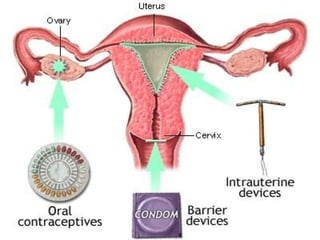
• Barrier Methods
• Intra-uterine devices
• Hormonal Methods
• Post-conceptional Methods
• Miscellaneous
2. Terminal Methods-
• Male sterilization
• Female Sterilization
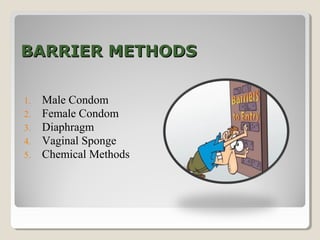
BARRIER METHODSBARRIER METHODS
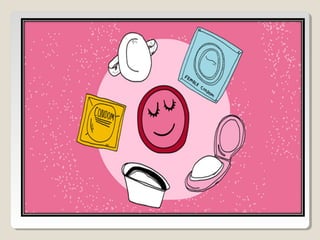
1. Male Condom
2. Female Condom
3. Diaphragm
4. Vaginal Sponge
5. Chemical Methods
BARRIER METHODBARRIER METHOD
Prevents pregnancy blocks the egg and sperm from
meeting
Barrier methods have higher failure rates than
hormonal methods due to design and human error
Barrier Method- AdvantagesBarrier Method- Advantages
Absence of side-effects
Protection from STDs
Reduction in incidence of PID
Protection from risk of Cervical cancer
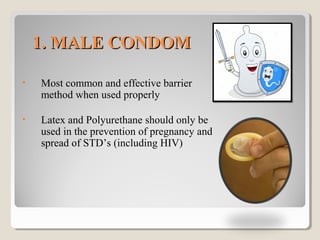
1. MALE CONDOM1. MALE CONDOM
• Most common and effective barrier
method when used properly
• Latex and Polyurethane should only be
used in the prevention of pregnancy and
spread of STD’s (including HIV)
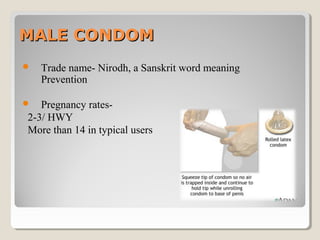
MALE CONDOMMALE CONDOM
 Trade name- Nirodh, a Sanskrit word meaning
Prevention
 Pregnancy rates-
2-3/ HWY
More than 14 in typical users
Advantages:Advantages:
1. Easily available
2. Safe & inexpensive
3. Easy to use
4. No side effects
5. Light, compact & disposable
6. Provides protection against STD
Disadvantages:Disadvantages:
1. May slip off or tear
2. Interferes with sex sensation locally
2. FEMALE CONDOM2. FEMALE CONDOM
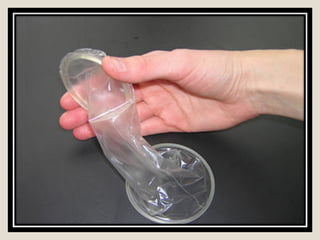
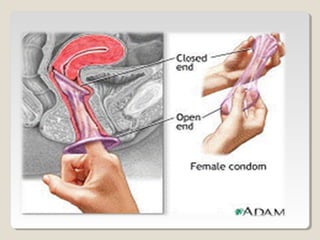
Made as an alternative to male condoms
Polyurethane
Physically inserted in the vagina
Prelubricated with silicon and spermicide need not
be used
Woman can use female condom if partner refuses
Problems- High cost and acceptability
Failure rates- 5/ HWY to 21 in typical users
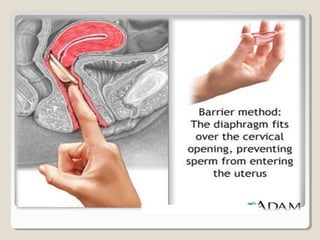
3. DIAPHRAGM3. DIAPHRAGM
Vaginal barrier
Invented by German physician in 1882
Also known as Dutch cap
Shallow cup made of synthetic rubber or plastic
Fitted by physician
Spermicidal jelly to be used before insertion
Inserted up to 18 hours before intercourse and can be left in
for a total of 24 hours (must remain in place for not less than 6
hrs after sexual intercourse)
Failure rate- 6-12 per HWY
DIAPHRAGMDIAPHRAGM
Advantages-
- Total absence of risk and medical contraindications.
Disadvantages-
- Practice at insertion
- Privacy for this
- Facility for washing and storing
- Remote possibility of TSS
DIAPHRAGMDIAPHRAGM
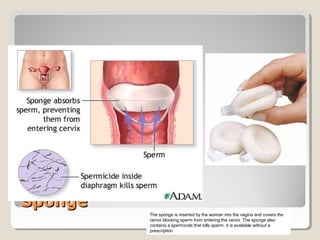
4. Vaginal Sponge:4. Vaginal Sponge:
Soaked in vinegar or olive oil
Commercially marketed in USA under trade name- TODAY
Small polyurethane foam sponge, saturated with spermicide-
nonoxynol-9
Far effective than Diaphragm
Failure rates- In parous women- 20-40
In nulliparous women- 9-20
SpongeSponge
The sponge is inserted by the woman into the vagina and covers the
cervix blocking sperm from entering the cervix. The sponge also
contains a spermicide that kills sperm. It is available without a
prescription
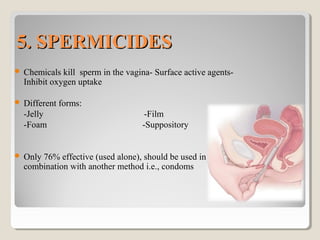
5. SPERMICIDES5. SPERMICIDES
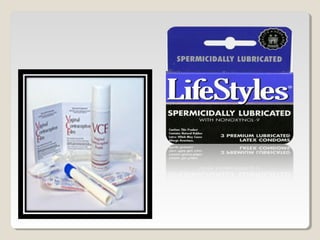
 Chemicals kill sperm in the vagina- Surface active agents-
Inhibit oxygen uptake
 Different forms:
-Jelly -Film
-Foam -Suppository
 Only 76% effective (used alone), should be used in
combination with another method i.e., condoms
Barrier methods of contraception

Barrier methods of contraception

  • 1.
    Contraception- Barrier MethodsContraception-Barrier Methods -Dr. Prachi Adsule Assistant Professor Dept. of Community Medicine
  • 3.
    Contraceptive Methods: Contraceptive methodsare, by definition, preventive methods to help women avoid unwanted pregnancies. Cafeteria Choice: Conventional Contraceptive:
  • 4.
    Criterias for IdealContraceptive: • Safe’ •Effective • Acceptable •Inexpensive •Reversible •Simple to administer •Independent of coitus •Long lasting enough to obviate frequent administration •Requires little or no medical supervision
  • 5.
    Types of ContraceptiveTypesof Contraceptive Methods:Methods: 1. Spacing Methods 2. Terminal Methods
  • 7.
    1. Spacing Methods- •Barrier Methods • Intra-uterine devices • Hormonal Methods • Post-conceptional Methods • Miscellaneous 2. Terminal Methods- • Male sterilization • Female Sterilization
  • 9.
    BARRIER METHODSBARRIER METHODS 1.Male Condom 2. Female Condom 3. Diaphragm 4. Vaginal Sponge 5. Chemical Methods
  • 11.
    BARRIER METHODBARRIER METHOD Preventspregnancy blocks the egg and sperm from meeting Barrier methods have higher failure rates than hormonal methods due to design and human error
  • 12.
    Barrier Method- AdvantagesBarrierMethod- Advantages Absence of side-effects Protection from STDs Reduction in incidence of PID Protection from risk of Cervical cancer
  • 13.
    1. MALE CONDOM1.MALE CONDOM • Most common and effective barrier method when used properly • Latex and Polyurethane should only be used in the prevention of pregnancy and spread of STD’s (including HIV)
  • 14.
    MALE CONDOMMALE CONDOM Trade name- Nirodh, a Sanskrit word meaning Prevention  Pregnancy rates- 2-3/ HWY More than 14 in typical users
  • 15.
    Advantages:Advantages: 1. Easily available 2.Safe & inexpensive 3. Easy to use 4. No side effects 5. Light, compact & disposable 6. Provides protection against STD
  • 16.
    Disadvantages:Disadvantages: 1. May slipoff or tear 2. Interferes with sex sensation locally
  • 17.
    2. FEMALE CONDOM2.FEMALE CONDOM Made as an alternative to male condoms Polyurethane Physically inserted in the vagina Prelubricated with silicon and spermicide need not be used Woman can use female condom if partner refuses Problems- High cost and acceptability Failure rates- 5/ HWY to 21 in typical users
  • 21.
    3. DIAPHRAGM3. DIAPHRAGM Vaginalbarrier Invented by German physician in 1882 Also known as Dutch cap Shallow cup made of synthetic rubber or plastic Fitted by physician Spermicidal jelly to be used before insertion Inserted up to 18 hours before intercourse and can be left in for a total of 24 hours (must remain in place for not less than 6 hrs after sexual intercourse) Failure rate- 6-12 per HWY
  • 22.
    DIAPHRAGMDIAPHRAGM Advantages- - Total absenceof risk and medical contraindications. Disadvantages- - Practice at insertion - Privacy for this - Facility for washing and storing - Remote possibility of TSS
  • 23.
  • 24.
    4. Vaginal Sponge:4.Vaginal Sponge: Soaked in vinegar or olive oil Commercially marketed in USA under trade name- TODAY Small polyurethane foam sponge, saturated with spermicide- nonoxynol-9 Far effective than Diaphragm Failure rates- In parous women- 20-40 In nulliparous women- 9-20
  • 25.
    SpongeSponge The sponge isinserted by the woman into the vagina and covers the cervix blocking sperm from entering the cervix. The sponge also contains a spermicide that kills sperm. It is available without a prescription
  • 26.
    5. SPERMICIDES5. SPERMICIDES Chemicals kill sperm in the vagina- Surface active agents- Inhibit oxygen uptake  Different forms: -Jelly -Film -Foam -Suppository  Only 76% effective (used alone), should be used in combination with another method i.e., condoms