T
S
@pati_gallardo
Linux Security
and the Chromium Sandbox
Patricia Aas, T S
NDC TechTown 2018
@pati_gallardo
T
S
Patricia Aas - Consultant
C++ Programmer, Application Security
Currently : T S
Previously : Vivaldi, Cisco Systems, Knowit, Opera Software
Master in Computer Science - main language Java
Pronouns: she/her T
S
@pati_gallardo
Remote Code Execution is what
browsers do.
Sandboxing
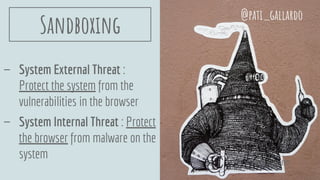
- System External Threat :
Protect the system from the
vulnerabilities in the browser
- System Internal Threat : Protect
the browser from malware on the
system
@pati_gallardo
@pati_gallardo
- Process Architecture
- Linux Security APIs
- The Initial Sandbox
- Shrinking the Sandbox
@pati_gallardo
Process
Architecture
@pati_gallardo
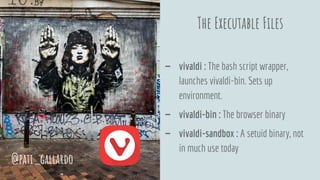
The Executable Files
- vivaldi : The bash script wrapper,
launches vivaldi-bin. Sets up
environment.
- vivaldi-bin : The browser binary
- vivaldi-sandbox : A setuid binary, not
in much use today
@pati_gallardo
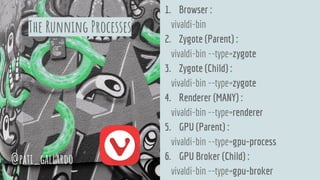
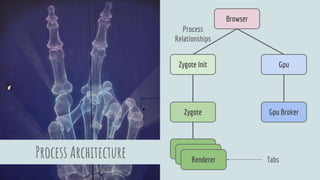
1. Browser :
vivaldi-bin
2. Zygote (Parent) :
vivaldi-bin --type=zygote
3. Zygote (Child) :
vivaldi-bin --type=zygote
4. Renderer (MANY) :
vivaldi-bin --type=renderer
5. GPU (Parent) :
vivaldi-bin --type=gpu-process
6. GPU Broker (Child) :
vivaldi-bin --type=gpu-broker
@pati_gallardo
The Running Processes
Process Architecture
Browser
Gpu BrokerZygote
Renderer
GpuZygote Init
Renderer
Renderer
Process
Relationships
Tabs
- Process Architecture
- Linux Security APIs
- The Initial Sandbox
- Shrinking the Sandbox
@pati_gallardo
Linux Security
APIs
@pati_gallardo
@pati_gallardo
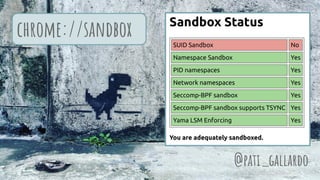
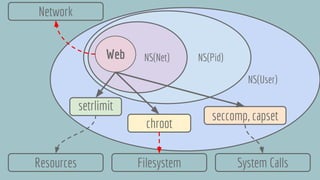
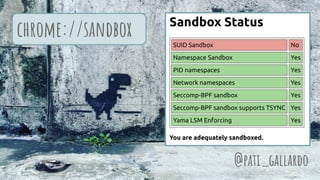
chrome://sandbox
NS(User)
NS(Pid)NS(Net)Web
Network
Filesystem System Calls
chroot
seccomp, capset
Resources
setrlimit
- Process Architecture
- Linux Security APIs
- The Initial Sandbox
- Shrinking the Sandbox
@pati_gallardo
The
Initial
Sandbox
@pati_gallardo
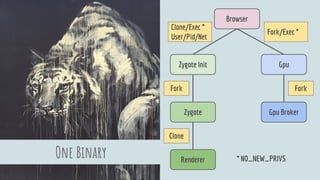
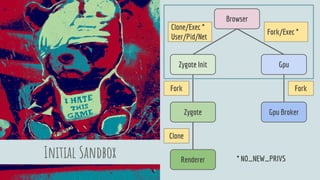
One Binary
Browser
Gpu BrokerZygote
Renderer
GpuZygote Init
Clone/Exec *
User/Pid/Net
Fork/Exec *
* NO_NEW_PRIVS
ForkFork
Clone
Initial Sandbox
Browser
Gpu BrokerZygote
Renderer
GpuZygote Init
Clone/Exec *
User/Pid/Net
Fork/Exec *
* NO_NEW_PRIVS
ForkFork
Clone
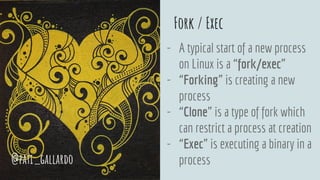
Fork / Exec
- A typical start of a new process
on Linux is a “fork/exec”
- “Forking” is creating a new
process
- “Clone” is a type of fork which
can restrict a process at creation
- “Exec” is executing a binary in a
process@pati_gallardo
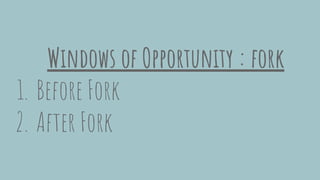
Windows of Opportunity : fork
1. Before Fork
2. After Fork
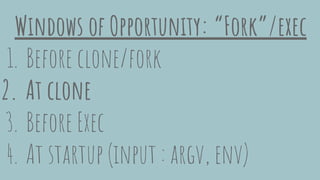
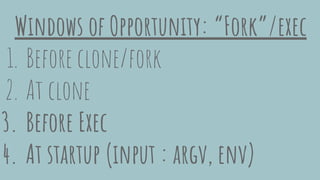
Windows of Opportunity: “Fork”/exec
1. Before clone/fork
2. At clone
3. Before Exec
4. At startup (input : argv, env)
Namespaces
@pati_gallardo
Namespaces
(Zygotes/Renderers)
Limits what a process can see
Api : clone/unshare @pati_gallardo
Namespaces in use
CLONE_NEWUSER
On some distributions a USER NS can be create
by an unprivileged user, and in one we can
create a PID NS.
CLONE_NEWPID
Same PID number can represent different
processes in different PID namespaces. One init
(PID 1) process per PID NS
CLONE_NEWNET
Isolate a process from network
@pati_gallardo
Zygote + Renderer
At Clone : Create NAmespaces
Clone flags define the process* created
and will create namespaces (NS) for it
1. Test which NS are available
2. Fail if not sufficient
3. Construct the biggest supported and
applicable set
Emulates fork with longjmp
* Also used to create threads
@pati_gallardo
Zygote + Renderer
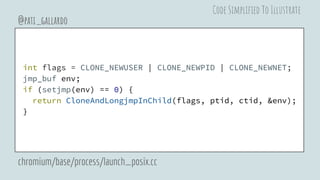
int flags = CLONE_NEWUSER | CLONE_NEWPID | CLONE_NEWNET;
jmp_buf env;
if (setjmp(env) == 0) {
return CloneAndLongjmpInChild(flags, ptid, ctid, &env);
}
@pati_gallardo
chromium/base/process/launch_posix.cc
Code Simplified To Illustrate
pid_t CloneAndLongjmpInChild(unsigned long flags,
pid_t* ptid,
pid_t* ctid,
jmp_buf* env) {
char stack_buf[PTHREAD_STACK_MIN];
void* stack = stack_buf + sizeof(stack_buf);
return clone(&CloneHelper,
stack, flags, env, ptid, nullptr, ctid);
}
@pati_gallardo
chromium/base/process/launch_posix.cc
Code Simplified To Illustrate
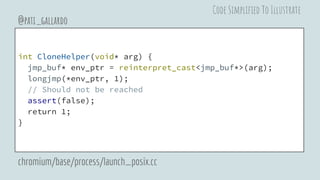
int CloneHelper(void* arg) {
jmp_buf* env_ptr = reinterpret_cast<jmp_buf*>(arg);
longjmp(*env_ptr, 1);
// Should not be reached
assert(false);
return 1;
}
@pati_gallardo
chromium/base/process/launch_posix.cc
Code Simplified To Illustrate
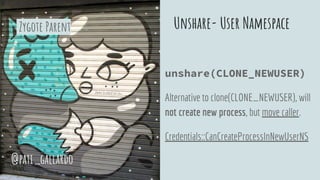
Unshare- User Namespace
unshare(CLONE_NEWUSER)
Alternative to clone(CLONE_NEWUSER), will
not create new process, but move caller.
Credentials::CanCreateProcessInNewUserNS
@pati_gallardo
Zygote Parent
Windows of Opportunity: “Fork”/exec
1. Before clone/fork
2. At clone
3. Before Exec
4. At startup (input : argv, env)
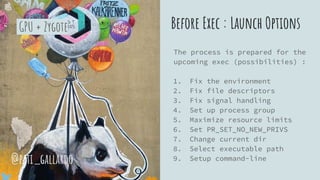
Before Exec : Launch Options
The process is prepared for the
upcoming exec (possibilities) :
1. Fix the environment
2. Fix file descriptors
3. Fix signal handling
4. Set up process group
5. Maximize resource limits
6. Set PR_SET_NO_NEW_PRIVS
7. Change current dir
8. Select executable path
9. Setup command-line@pati_gallardo
GPU + Zygote
- Process Architecture
- Linux Security APIs
- The Initial Sandbox
- Shrinking the Sandbox
@pati_gallardo
Shrinking
the Sandbox
@pati_gallardo
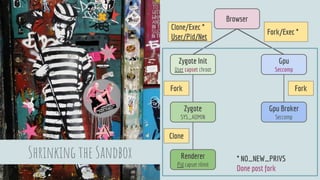
Shrinking the Sandbox
Browser
Gpu Broker
Seccomp
Zygote
SYS_ADMIN
Renderer
Pid capset rlimit
Gpu
Seccomp
Zygote Init
User capset chroot
Clone/Exec *
User/Pid/Net
Fork/Exec *
* NO_NEW_PRIVS
Done post fork
ForkFork
Clone
PR_SET_NO_NEW_PRIVS
prctl(PR_SET_NO_NEW_PRIVS)
Preserved across fork, clone and execve
“If no_new_privs is set, then operations
that grant new privileges (i.e. execve)
will either fail or not grant them. This
affects suid/sgid, file capabilities, and
LSMs.”
/usr/include/linux/prctl.h
@pati_gallardo
All except Browser
Seccomp
@pati_gallardo
Seccomp
(Renderers/GPU/Broker)
Limits which syscalls a process
can call and how these calls are
handled
Api : seccomp @pati_gallardo
Seccomp BPF Program
Program written in an assembly-like
language to filter system-calls.
Runs in a simple VM in kernel space. All
syscalls will be filtered by this program
TSYNC : Once a Seccomp Program is
installed it applies to all threads in a
process@pati_gallardo
Renderer + Gpu + Broker
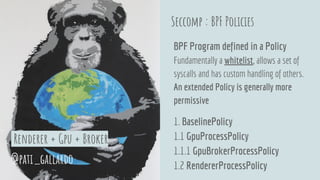
Seccomp : BPF Policies
BPF Program defined in a Policy
Fundamentally a whitelist, allows a set of
syscalls and has custom handling of others.
An extended Policy is generally more
permissive
1. BaselinePolicy
1.1 GpuProcessPolicy
1.1.1 GpuBrokerProcessPolicy
1.2 RendererProcessPolicy
@pati_gallardo
Renderer + Gpu + Broker
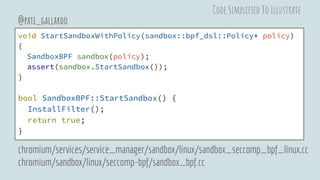
void StartSandboxWithPolicy(sandbox::bpf_dsl::Policy* policy)
{
SandboxBPF sandbox(policy);
assert(sandbox.StartSandbox());
}
bool SandboxBPF::StartSandbox() {
InstallFilter();
return true;
}
@pati_gallardo
chromium/services/service_manager/sandbox/linux/sandbox_seccomp_bpf_linux.cc
chromium/sandbox/linux/seccomp-bpf/sandbox_bpf.cc
Code Simplified To Illustrate
void SandboxBPF::InstallFilter() {
CodeGen::Program program = AssembleFilter();
struct sock_filter bpf[program.size()];
const struct sock_fprog prog =
{ static_cast<unsigned short>(program.size()), bpf };
memcpy(bpf, &program[0], sizeof(bpf));
assert(prctl(PR_SET_NO_NEW_PRIVS, 1, 0, 0, 0) == 0);
assert(seccomp(SECCOMP_SET_MODE_FILTER,
SECCOMP_FILTER_FLAG_TSYNC, &prog) == 0);
}
@pati_gallardo
chromium/sandbox/linux/seccomp-bpf/sandbox_bpf.cc
Code Simplified To Illustrate
Chroot
@pati_gallardo
Chroot
(Zygotes/Renderers)
Limits what a process can see of
the filesystem
Api : chroot @pati_gallardo
Chroot : Drop Access to FS
- clone(CLONE_FS) a child process
- Child chroot(”/proc/self/fdinfo/”)
- Child immediately does a chdir(“/”)
- Child does _exit(kExitSuccess)
You can see this by looking at
ls -l /proc/<pid>/root
Of the Zygote or any ancestor
Credentials::DropFileSystemAccess@pati_gallardo
Zygotes + Renderer
bool ChrootToSafeEmptyDir() {
pid_t pid = -1;
char stack_buf[PTHREAD_STACK_MIN];
void* stack = stack_buf + sizeof(stack_buf);
int clone_flags = CLONE_FS | LINUX_SIGCHLD;
pid = clone(ChrootToSelfFdinfo, stack, clone_flags, nullptr);
int status = -1;
assert(HANDLE_EINTR(waitpid(pid, &status, 0)) == pid);
return WIFEXITED(status) && WEXITSTATUS(status) == kExitSuccess;
}
@pati_gallardo
chromium/sandbox/linux/services/credentials.cc
Code Simplified To Illustrate
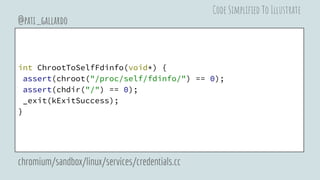
int ChrootToSelfFdinfo(void*) {
assert(chroot("/proc/self/fdinfo/") == 0);
assert(chdir("/") == 0);
_exit(kExitSuccess);
}
@pati_gallardo
chromium/sandbox/linux/services/credentials.cc
Code Simplified To Illustrate
Capabilities
@pati_gallardo
Capabilities
(Zygote/Renderers)
Limits what a process is
privileged enough to do
Api : capset @pati_gallardo
Drop Capabilities
Uses capset() to drop all or some
capabilities
“Linux divides the privileges traditionally
associated with superuser into distinct
units, known as capabilities, which can be
independently enabled and disabled.”
Man page for capabilities
Credentials::DropAllCapabilities@pati_gallardo
Zygotes + Renderers
Resource Limits
@pati_gallardo
Resource Limits
(Renderers)
Limits the access this process
has to platform resources
Api : setrlimit @pati_gallardo
Resource Limits : setrlimit
Limits using setrlimit:
1. RLIMIT_AS : Maximum size of the
process’ virtual memory (address
space) in bytes
2. RLIMIT_DATA : Maximum size of
the process's data segment
LinuxSandbox::LimitAddressSpace
@pati_gallardo
Renderer
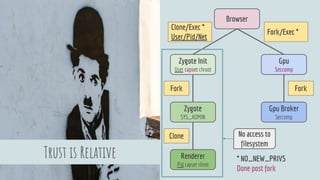
Trust is Relative
Browser
Gpu Broker
Seccomp
Zygote
SYS_ADMIN
Renderer
Pid capset rlimit
Gpu
Seccomp
Zygote Init
User capset chroot
Clone/Exec *
User/Pid/Net
Fork/Exec *
* NO_NEW_PRIVS
Done post fork
ForkFork
Clone No access to
filesystem
@pati_gallardo
chrome://sandbox
Sources
Chromium/Kernel source + Linux Man Pages + lwn.net
Michael Kerrisk
Book: The Linux Programming Interface
Course: Linux Security and Isolation APIs
All Errors Are My Own
Patricia Aas, Consultant
T S
C++ and Application Security
T
S
@pati_gallardo
T
SD P
@pati_gallardo
T
S
Appendix / Some Notes
@pati_gallardo
Other APIs
in use
@pati_gallardo
Not Used Much in Chromium, but...
YAMA LSM
Limits the access that other
process have to this process -
especially ptracing
Status is checked by reading :
/proc/sys/kernel/yama/ptrace_scope
@pati_gallardo
Setuid/setgid
(Legacy)
Increases what a process is
privileged enough to do, by
using the privilege of the
executables owner
Api : set*uid / set*gid @pati_gallardo
CGroups
(ChromeOS)
Limits the resources available to
a process. Used in ChromeOS -
not covered here.
/proc/<PID>/cgroup
/proc/cgroups
@pati_gallardo
Process Groups
(Chromedriver)
Can be used to treat a group of
processes as one.
Used with the ‘detach’ property
of Chromedriver
Api : setpgid @pati_gallardo
Challenges
@pati_gallardo
Debugging
@pati_gallardo
Crash Reporting @pati_gallardo
P f .
Patricia Aas, T S
@pati_gallardo
T
S
T
S
@pati_gallardo

Linux Security APIs and the Chromium Sandbox