Product mix pricing strategies
INTRODUCTION
• We need to set price when we have a new
  product, or when we enter a new market with
  an existing product
• How?
  – Need to decide what position you want your
    product to be in.


                                                 2
Why pricing strategies
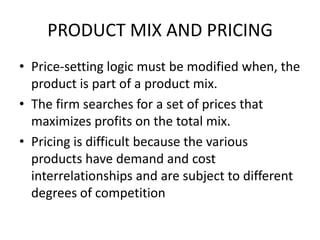
PRODUCT MIX AND PRICING
• Price-setting logic must be modified when, the
  product is part of a product mix.
• The firm searches for a set of prices that
  maximizes profits on the total mix.
• Pricing is difficult because the various
  products have demand and cost
  interrelationships and are subject to different
  degrees of competition
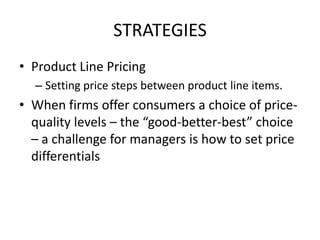
STRATEGIES
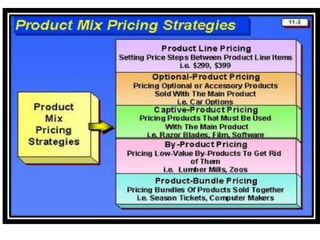
• Product Line Pricing
  – Setting price steps between product line items.
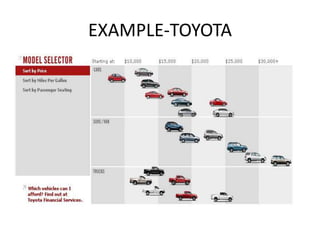
• When firms offer consumers a choice of price-
  quality levels – the “good-better-best” choice
  – a challenge for managers is how to set price
  differentials
EXAMPLE-TOYOTA
• Optional-Product Pricing
  – Pricing optional or accessory products sold with
    the main product
  – EXAMPLE
  – RESTAURANTS
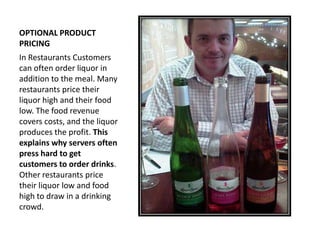
OPTIONAL PRODUCT
PRICING
In Restaurants Customers
can often order liquor in
addition to the meal. Many
restaurants price their
liquor high and their food
low. The food revenue
covers costs, and the liquor
produces the profit. This
explains why servers often
press hard to get
customers to order drinks.
Other restaurants price
their liquor low and food
high to draw in a drinking
crowd.
• Captive-Product Pricing
  – Pricing products that must be used with the main
    product
  – High margins are often set for supplies


• EXAMPLE
• Cellular service operators
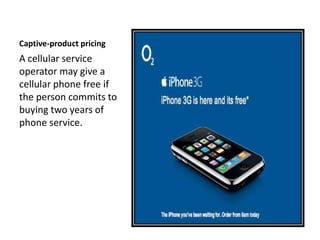
Captive-product pricing
A cellular service
operator may give a
cellular phone free if
the person commits to
buying two years of
phone service.
Service:- two-part pricing strategy
     • Fixed fee plus a variable usage rate
     EXAMPLES
     • Amusement parks
     • Telecom operators

• The service firm faces a problem similar to
  captive -product pricing-namely, how much to
  charge for the basic service and how much for
  the variable usage
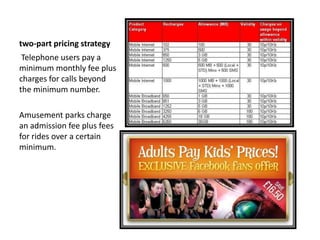
two-part pricing strategy
 Telephone users pay a
minimum monthly fee plus
charges for calls beyond
the minimum number.

Amusement parks charge
an admission fee plus fees
for rides over a certain
minimum.
• By-Product Pricing
   – Pricing low-value by-products to get rid Of them or to
     earn extra margin in profit.
• If the by-products have value to a customer
  group, they should be priced on their value. Any
  income earned on the by-products will make it
  easier for the company to charge a lower price on
  its main product if competition forces it to do so.
• EXAMPLE
• In the timber industry
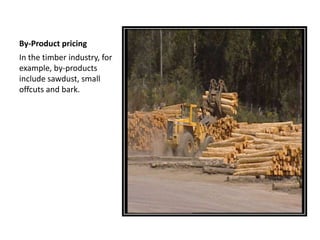
By-Product pricing
In the timber industry, for
example, by-products
include sawdust, small
offcuts and bark.
• Product Bundle Pricing
  – Pricing bundles of products sold together
• When offering a mixed bundle, the seller
  normally charges less for the bundle than if
  the items were purchased separately.
• Good way to test market for a new product or
  to clear the stock.
• EXAMPLES
• Resorts,Airfare deals etc.
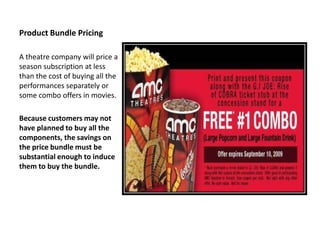
Product Bundle Pricing

A theatre company will price a
season subscription at less
than the cost of buying all the
performances separately or
some combo offers in movies.

Because customers may not
have planned to buy all the
components, the savings on
the price bundle must be
substantial enough to induce
them to buy the bundle.

Marketing mix pricing

  • 1.
  • 2.
    INTRODUCTION • We needto set price when we have a new product, or when we enter a new market with an existing product • How? – Need to decide what position you want your product to be in. 2
  • 3.
  • 4.
    PRODUCT MIX ANDPRICING • Price-setting logic must be modified when, the product is part of a product mix. • The firm searches for a set of prices that maximizes profits on the total mix. • Pricing is difficult because the various products have demand and cost interrelationships and are subject to different degrees of competition
  • 6.
    STRATEGIES • Product LinePricing – Setting price steps between product line items. • When firms offer consumers a choice of price- quality levels – the “good-better-best” choice – a challenge for managers is how to set price differentials
  • 7.
  • 8.
    • Optional-Product Pricing – Pricing optional or accessory products sold with the main product – EXAMPLE – RESTAURANTS
  • 9.
    OPTIONAL PRODUCT PRICING In RestaurantsCustomers can often order liquor in addition to the meal. Many restaurants price their liquor high and their food low. The food revenue covers costs, and the liquor produces the profit. This explains why servers often press hard to get customers to order drinks. Other restaurants price their liquor low and food high to draw in a drinking crowd.
  • 10.
    • Captive-Product Pricing – Pricing products that must be used with the main product – High margins are often set for supplies • EXAMPLE • Cellular service operators
  • 11.
    Captive-product pricing A cellularservice operator may give a cellular phone free if the person commits to buying two years of phone service.
  • 12.
    Service:- two-part pricingstrategy • Fixed fee plus a variable usage rate EXAMPLES • Amusement parks • Telecom operators • The service firm faces a problem similar to captive -product pricing-namely, how much to charge for the basic service and how much for the variable usage
  • 13.
    two-part pricing strategy Telephone users pay a minimum monthly fee plus charges for calls beyond the minimum number. Amusement parks charge an admission fee plus fees for rides over a certain minimum.
  • 14.
    • By-Product Pricing – Pricing low-value by-products to get rid Of them or to earn extra margin in profit. • If the by-products have value to a customer group, they should be priced on their value. Any income earned on the by-products will make it easier for the company to charge a lower price on its main product if competition forces it to do so. • EXAMPLE • In the timber industry
  • 15.
    By-Product pricing In thetimber industry, for example, by-products include sawdust, small offcuts and bark.
  • 16.
    • Product BundlePricing – Pricing bundles of products sold together • When offering a mixed bundle, the seller normally charges less for the bundle than if the items were purchased separately. • Good way to test market for a new product or to clear the stock. • EXAMPLES • Resorts,Airfare deals etc.
  • 17.
    Product Bundle Pricing Atheatre company will price a season subscription at less than the cost of buying all the performances separately or some combo offers in movies. Because customers may not have planned to buy all the components, the savings on the price bundle must be substantial enough to induce them to buy the bundle.