Centre for Gambling Education & Research
The stigma of problem gambling:
Public prejudice, private pain and
implications for public health
Professor Nerilee Hing
This study was funded by the Victorian Responsible Gambling Foundation
International Gambling Conference 10-12 February 2016, Auckland
1
Centre for Gambling Education & Research
Background
Recreational gambling is a popular, socially accepted and
normalised activity.
But problem gambling appears to be highly stigmatised.
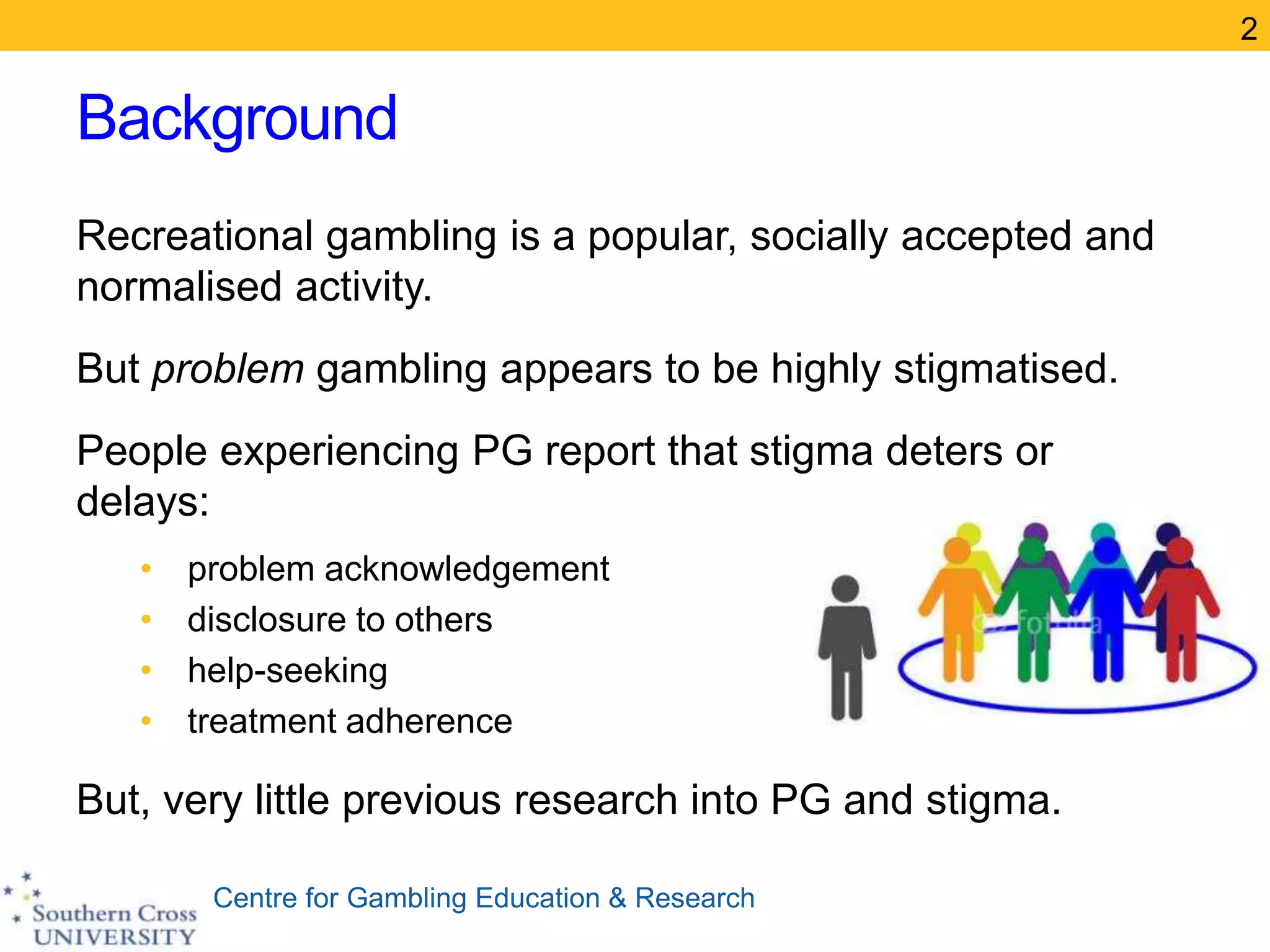
People experiencing PG report that stigma deters or
delays:
• problem acknowledgement
• disclosure to others
• help-seeking
• treatment adherence
But, very little previous research into PG and stigma.
2
Centre for Gambling Education & Research
What is stigma?
A social process which occurs when individuals are
devalued or discredited in a particular social context
because of a perceived negative attribute which
disqualifies them from full social acceptance.
(Goffman, 1963; Crocker, Major, & Steele, 1998)
• Reaction of others (labelling, stereotyping, judgment, prejudice)
• To an undesirable attribute (e.g., race, obesity, addiction, disability)
• Context specific (varies by culture, gender, time period, etc)
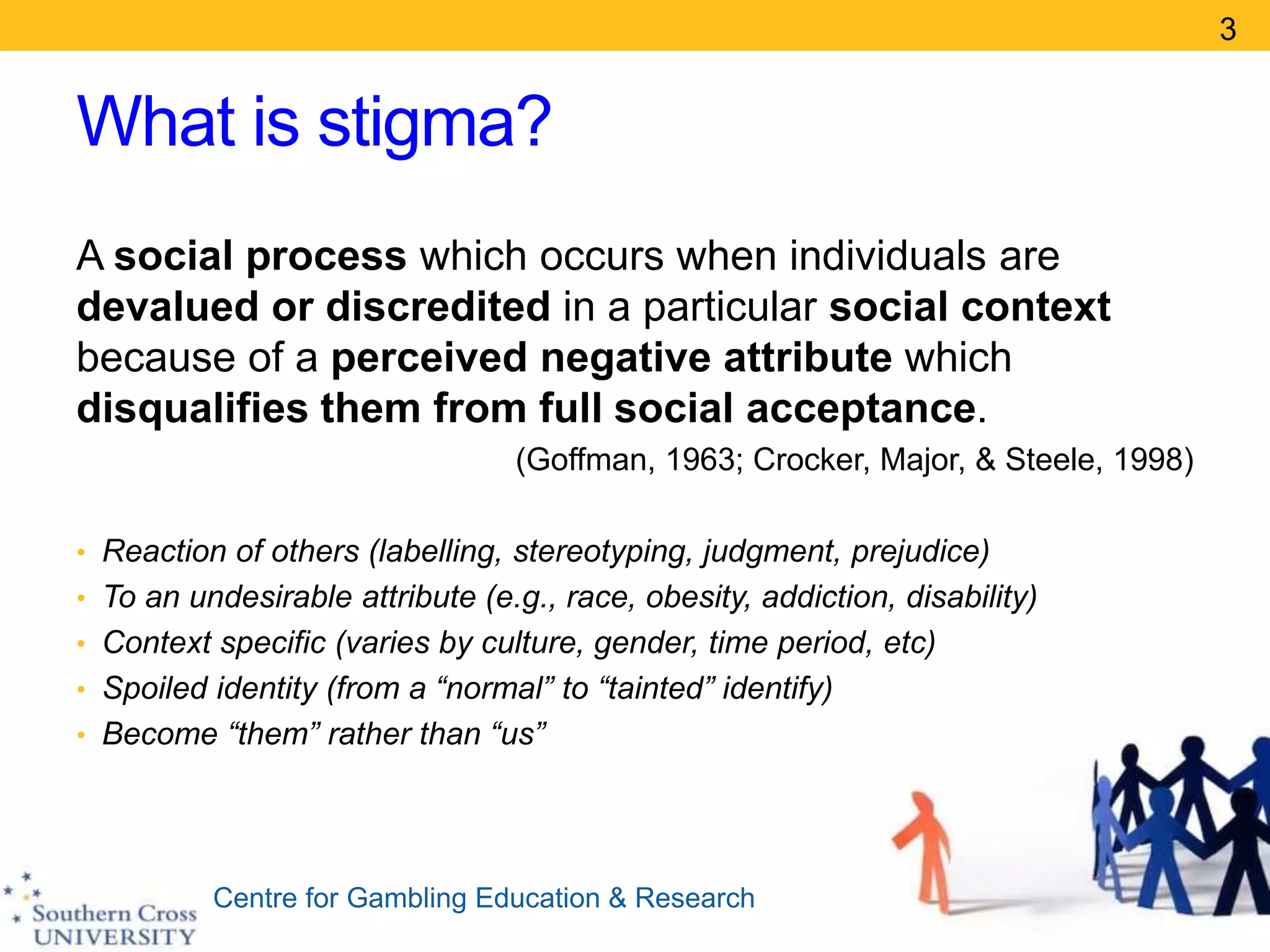
• Spoiled identity (from a “normal” to “tainted” identify)
• Become “them” rather than “us”
3
Centre for Gambling Education & Research
Types of stigma
Public stigma: the reaction of society to those with a stigmatising condition
and the formation of negative attitudes towards the stigmatised population
(Corrigan 2004).
Problem gamblers are stupid and irresponsible.
Perceived stigma: the belief that others have passed judgment and/or hold
stigmatising thoughts and ideas about a stigmatising condition (Barney et al.
2006).
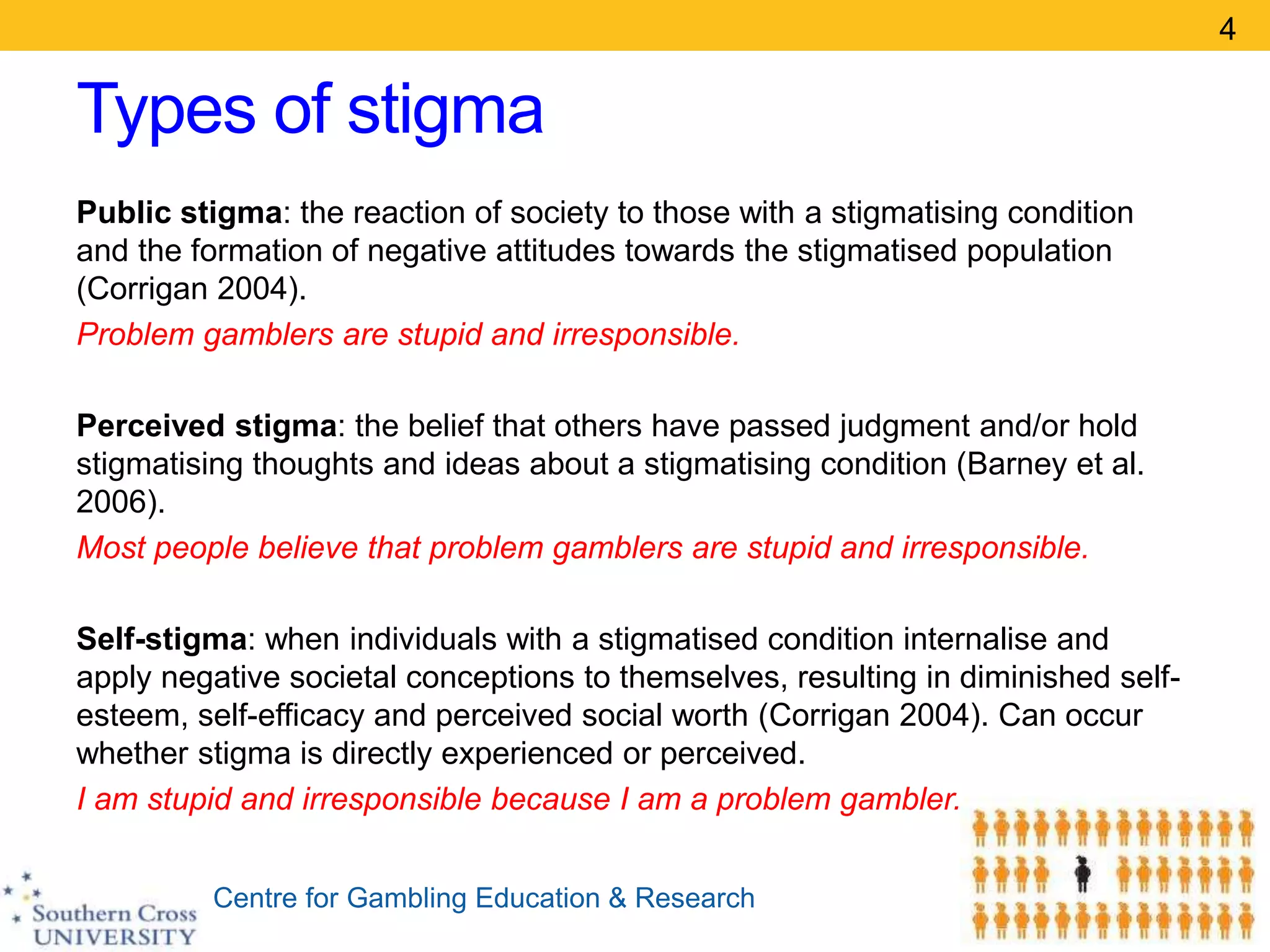
Most people believe that problem gamblers are stupid and irresponsible.
Self-stigma: when individuals with a stigmatised condition internalise and
apply negative societal conceptions to themselves, resulting in diminished self-
esteem, self-efficacy and perceived social worth (Corrigan 2004). Can occur
whether stigma is directly experienced or perceived.
I am stupid and irresponsible because I am a problem gambler.
4
Centre for Gambling Education & Research
Overall project aim
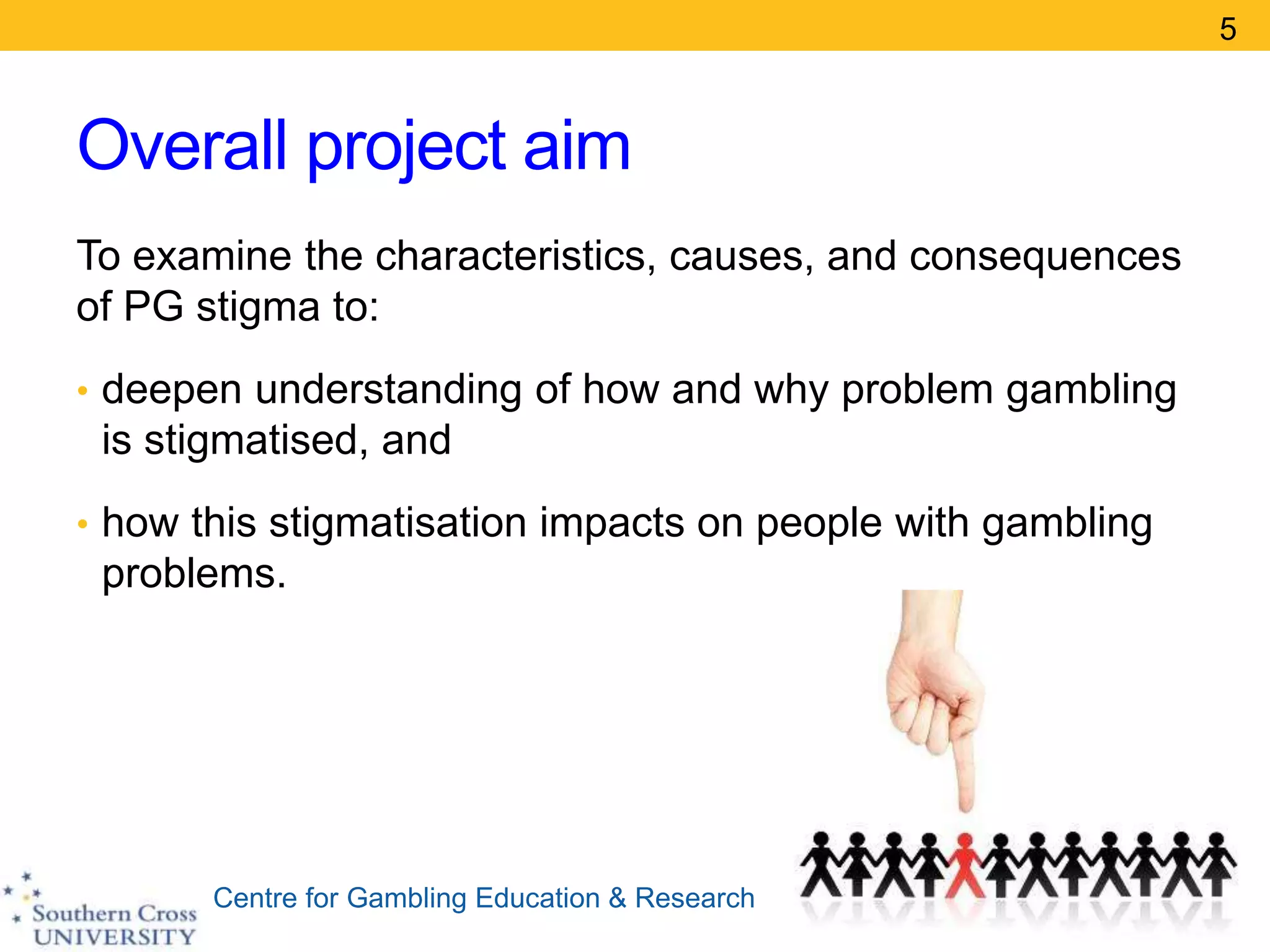
To examine the characteristics, causes, and consequences
of PG stigma to:
• deepen understanding of how and why problem gambling
is stigmatised, and
• how this stigmatisation impacts on people with gambling
problems.
5
Centre for Gambling Education & Research
Research approach
1. Literature review
2. Victorian adult survey (N = 2,000)
3. Survey of people with gambling problems (N = 203)
4. In-depth interviews with 44 people with problem gambling
5. In-depth interviews with 9 gambling counsellors
6
Centre for Gambling Education & Research
Stage 1: Literature review
• Not much!
• All previous studies based on student samples (Dhillon
et al., 2011; Feldman & Crandall 2007; Horch & Hodgins
2008, 2013) – except Horch & Hodgin 2015 on self-
stigma.
• Except a qualitative study (Carroll et al., 2014).
• We drew on literature, research designs and measures
for mental health stigma.
7
Centre for Gambling Education & Research
Stage 2: Victorian adult survey
8
Centre for Gambling Education & Research
Focus
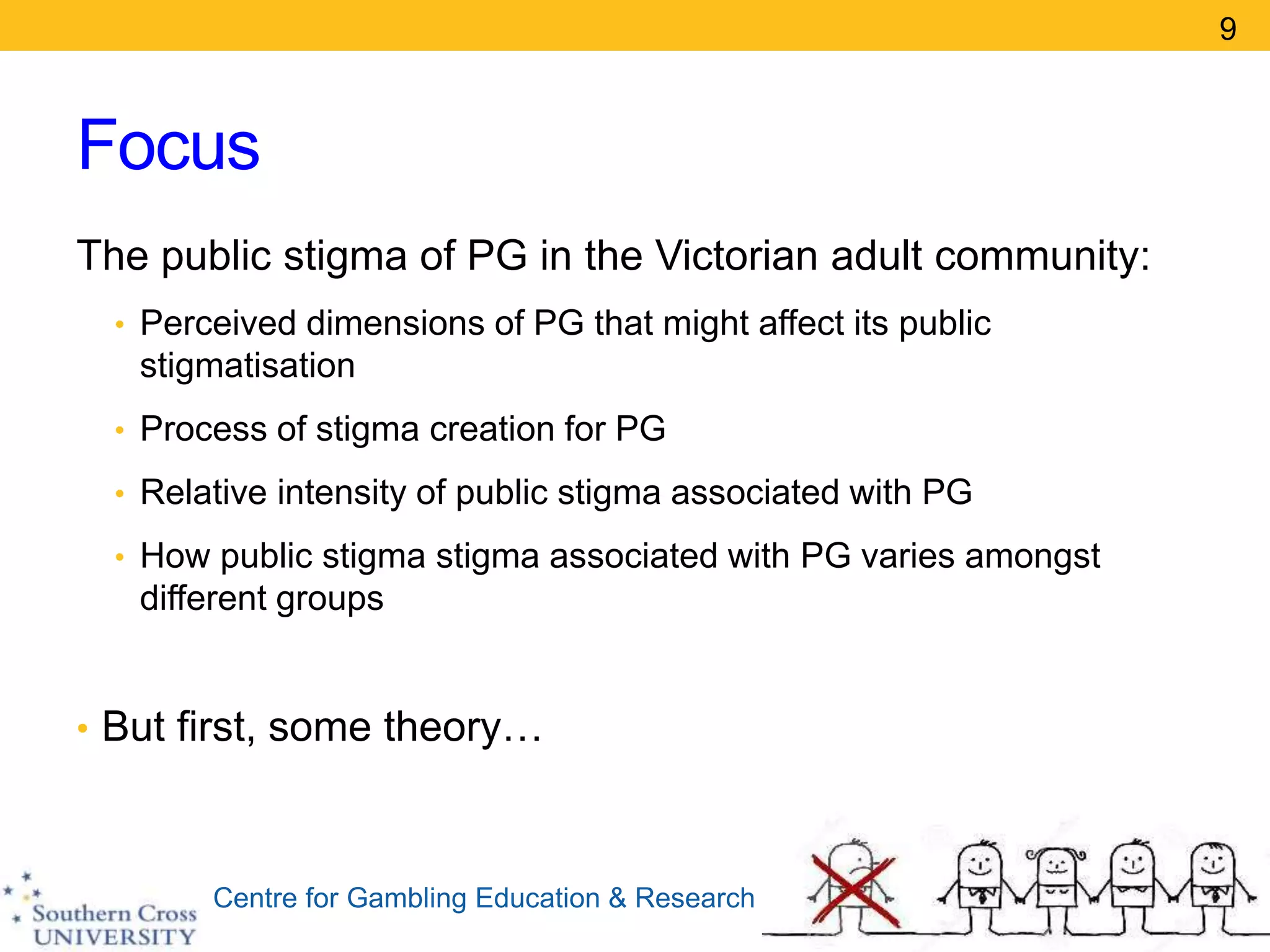
The public stigma of PG in the Victorian adult community:
• Perceived dimensions of PG that might affect its public
stigmatisation
• Process of stigma creation for PG
• Relative intensity of public stigma associated with PG
• How public stigma stigma associated with PG varies amongst
different groups
• But first, some theory…
9
Centre for Gambling Education & Research
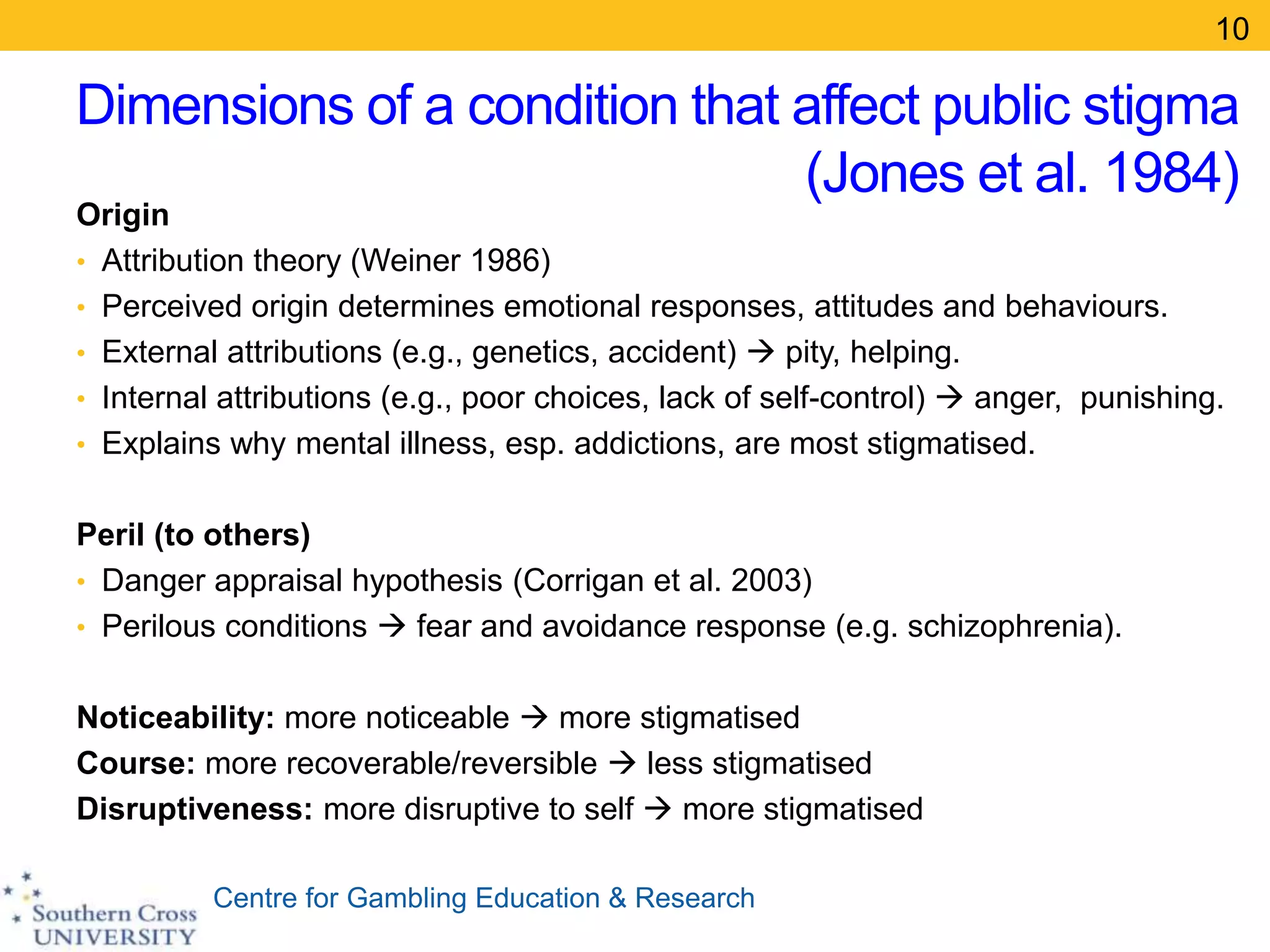
Dimensions of a condition that affect public stigma
(Jones et al. 1984)
Origin
• Attribution theory (Weiner 1986)
• Perceived origin determines emotional responses, attitudes and behaviours.
• External attributions (e.g., genetics, accident)  pity, helping.
• Internal attributions (e.g., poor choices, lack of self-control)  anger, punishing.
• Explains why mental illness, esp. addictions, are most stigmatised.
Peril (to others)
• Danger appraisal hypothesis (Corrigan et al. 2003)
• Perilous conditions  fear and avoidance response (e.g. schizophrenia).
Noticeability: more noticeable  more stigmatised
Course: more recoverable/reversible  less stigmatised
Disruptiveness: more disruptive to self  more stigmatised
10
Centre for Gambling Education & Research
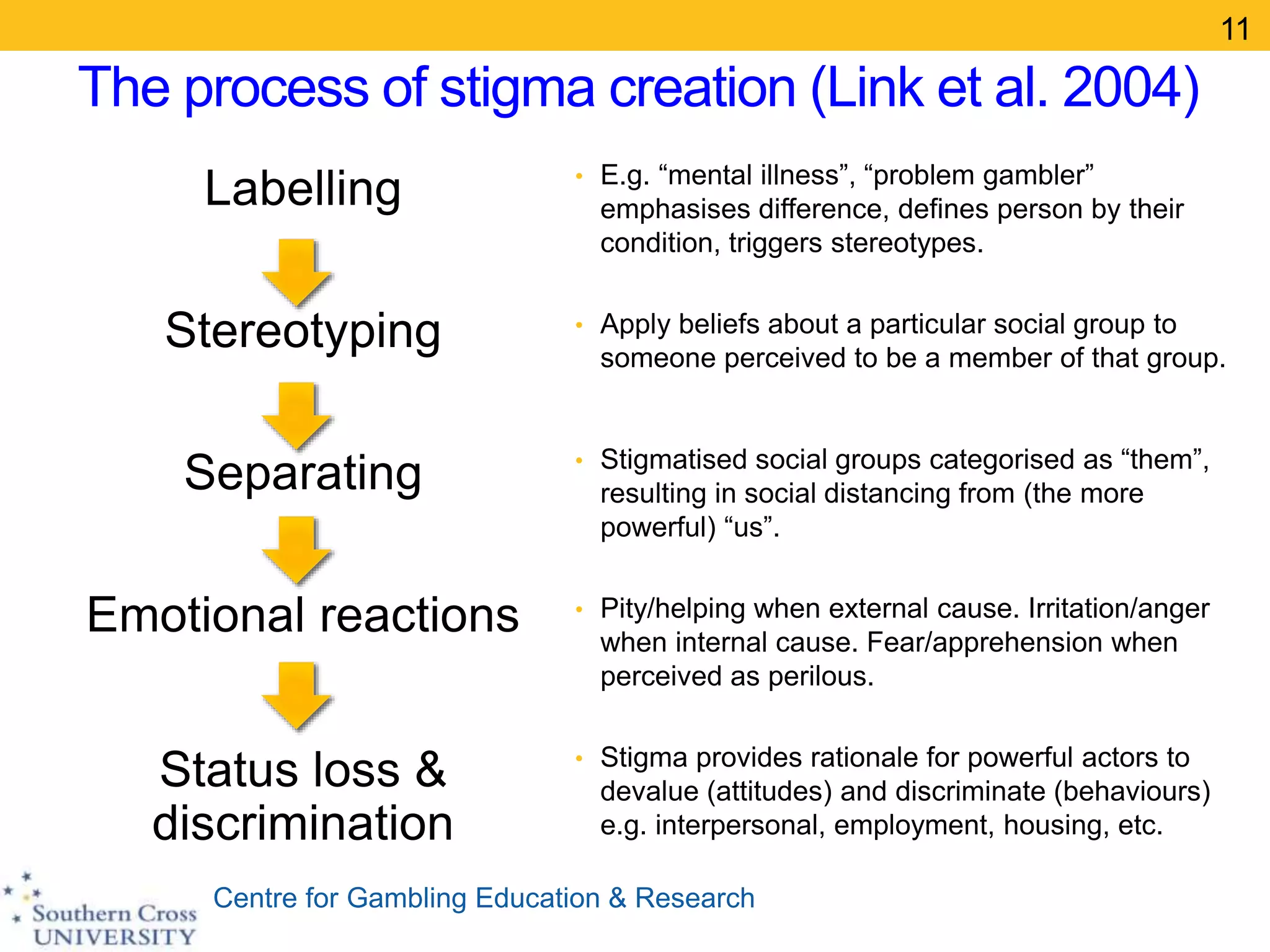
The process of stigma creation (Link et al. 2004)
Labelling
Stereotyping
Separating
Emotional reactions
Status loss &
discrimination
• E.g. “mental illness”, “problem gambler”
emphasises difference, defines person by their
condition, triggers stereotypes.
• Apply beliefs about a particular social group to
someone perceived to be a member of that group.
• Stigmatised social groups categorised as “them”,
resulting in social distancing from (the more
powerful) “us”.
• Pity/helping when external cause. Irritation/anger
when internal cause. Fear/apprehension when
perceived as perilous.
• Stigma provides rationale for powerful actors to
devalue (attitudes) and discriminate (behaviours)
e.g. interpersonal, employment, housing, etc.
11
Centre for Gambling Education & Research
Methods
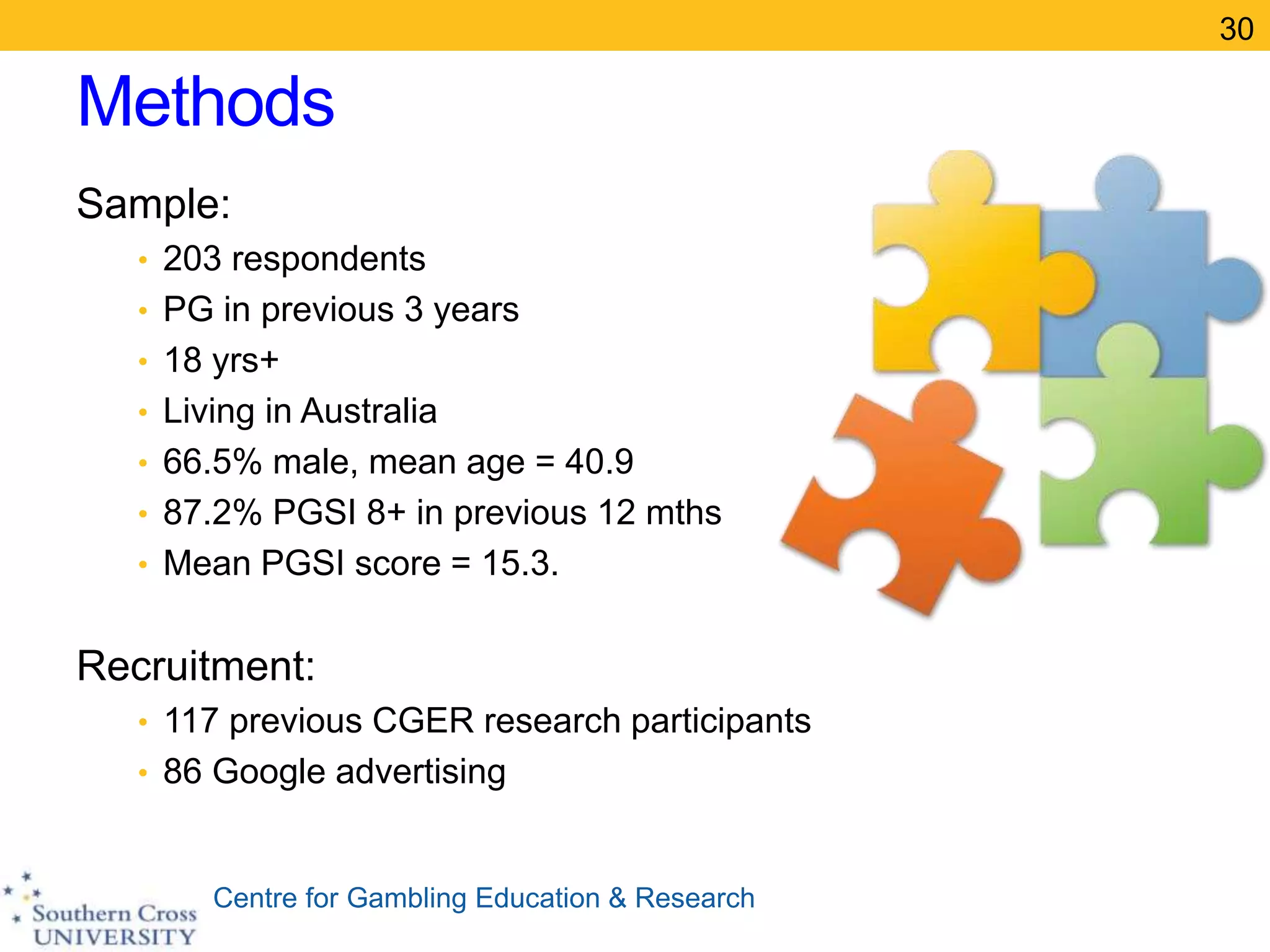
Sample:
• 2,000 adult residents of Victoria
• Recruited thru online panel provider
• Representative age, gender & location quotas
• Weighted to 2011 Census
Measures:
• based on responses to vignettes of PG
• and vignettes of other health conditions
• perceived dimensions of PG
• the process of stigma creation
• individual difference variables – demographics, gambling
involvement, PGSI, level of contact with PG
12
Centre for Gambling Education & Research
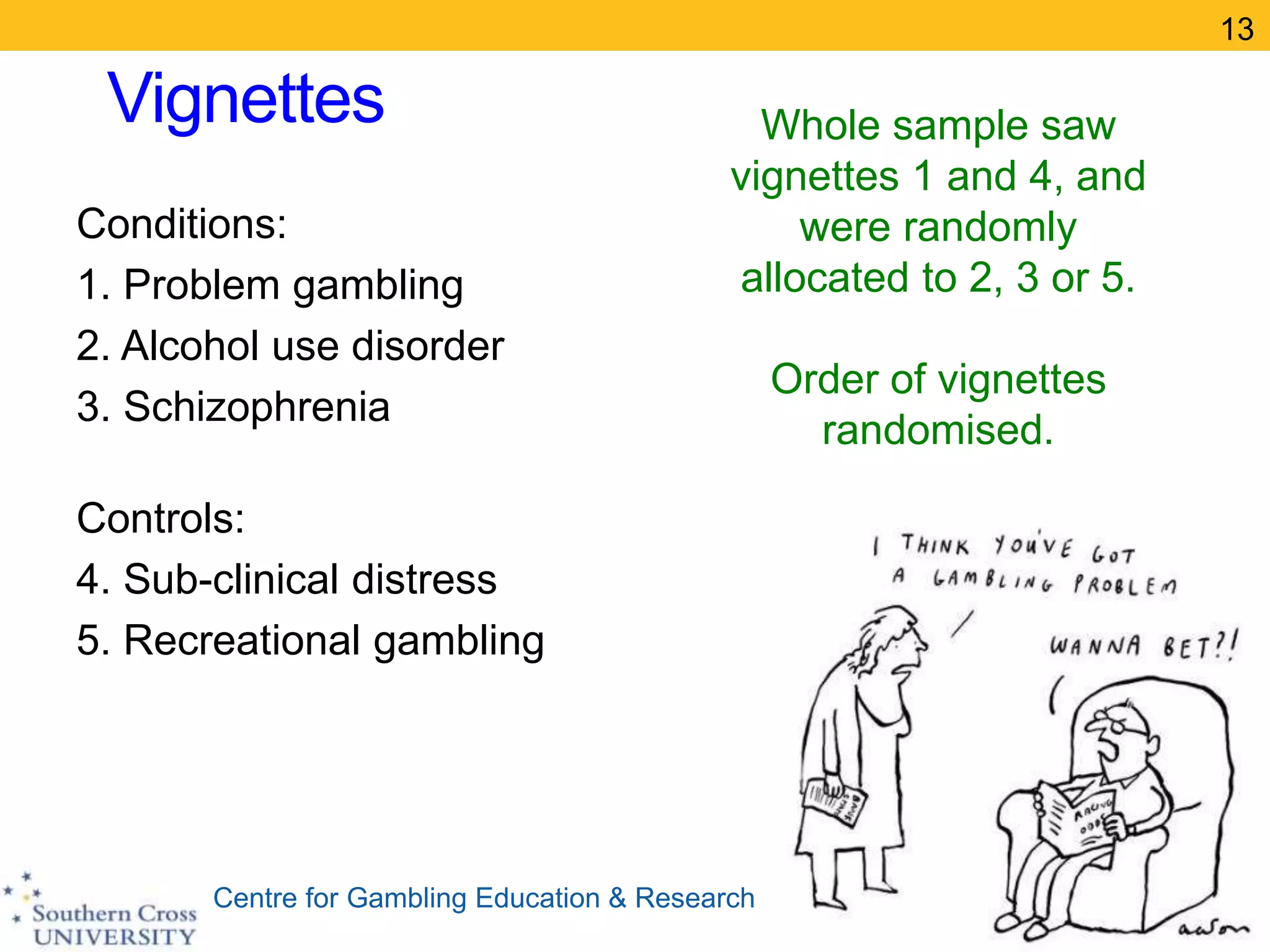
Vignettes
Conditions:
1. Problem gambling
2. Alcohol use disorder
3. Schizophrenia
Controls:
4. Sub-clinical distress
5. Recreational gambling
13
Whole sample saw
vignettes 1 and 4, and
were randomly
allocated to 2, 3 or 5.
Order of vignettes
randomised.
Centre for Gambling Education & Research
Example of vignette
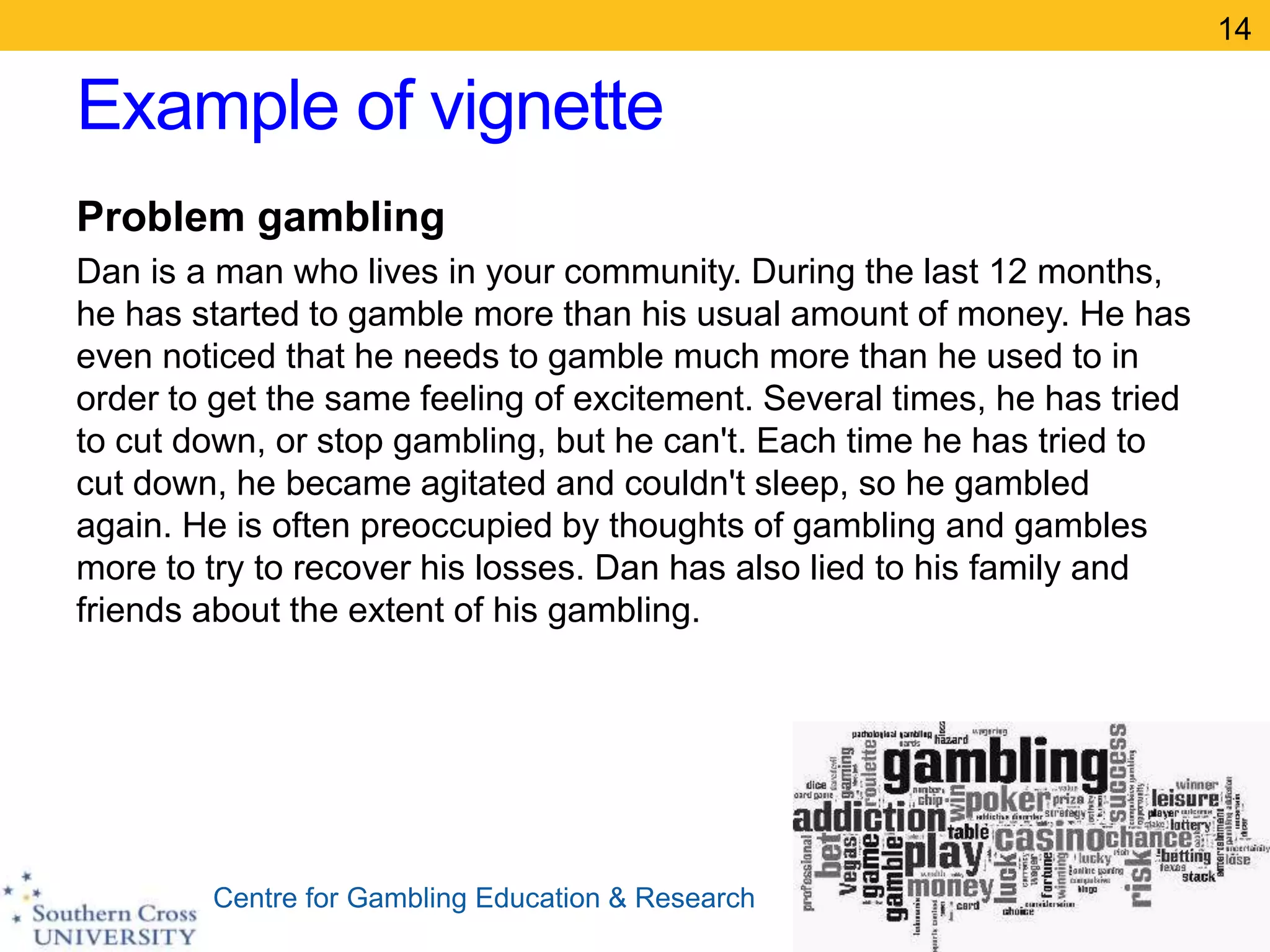
Problem gambling
Dan is a man who lives in your community. During the last 12 months,
he has started to gamble more than his usual amount of money. He has
even noticed that he needs to gamble much more than he used to in
order to get the same feeling of excitement. Several times, he has tried
to cut down, or stop gambling, but he can't. Each time he has tried to
cut down, he became agitated and couldn't sleep, so he gambled
again. He is often preoccupied by thoughts of gambling and gambles
more to try to recover his losses. Dan has also lied to his family and
friends about the extent of his gambling.
14
Centre for Gambling Education & Research
Perceived dimensions of PG
expected to affect its public
stigmatisation
15
Centre for Gambling Education & Research
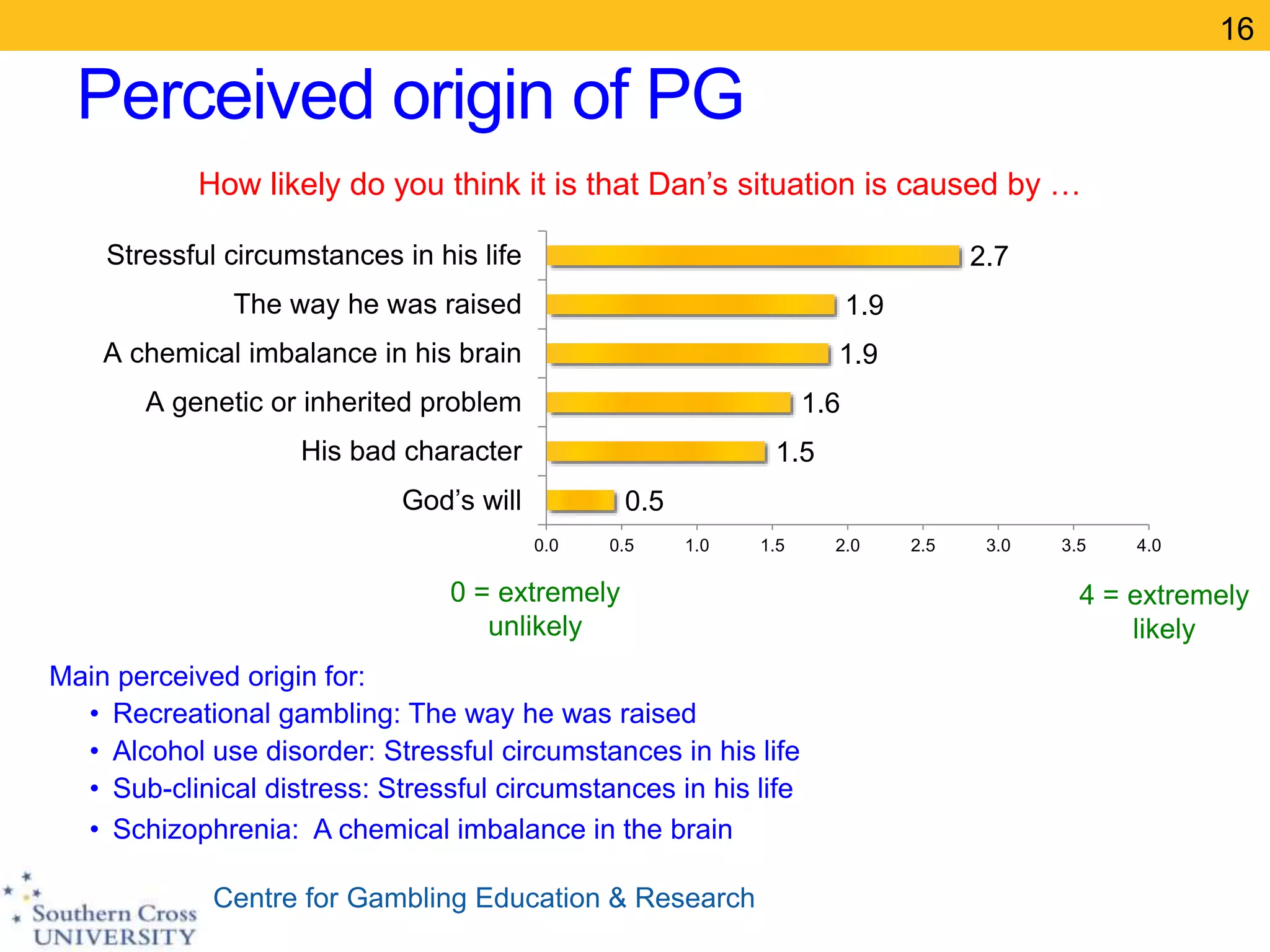
Perceived origin of PG
16
0.5
1.5
1.6
1.9
1.9
2.7
0.0 0.5 1.0 1.5 2.0 2.5 3.0 3.5 4.0
God’s will
His bad character
A genetic or inherited problem
A chemical imbalance in his brain
The way he was raised
Stressful circumstances in his life
0 = extremely
unlikely
How likely do you think it is that Dan’s situation is caused by …
4 = extremely
likely
Main perceived origin for:
• Recreational gambling: The way he was raised
• Alcohol use disorder: Stressful circumstances in his life
• Sub-clinical distress: Stressful circumstances in his life
• Schizophrenia: A chemical imbalance in the brain
Centre for Gambling Education & Research
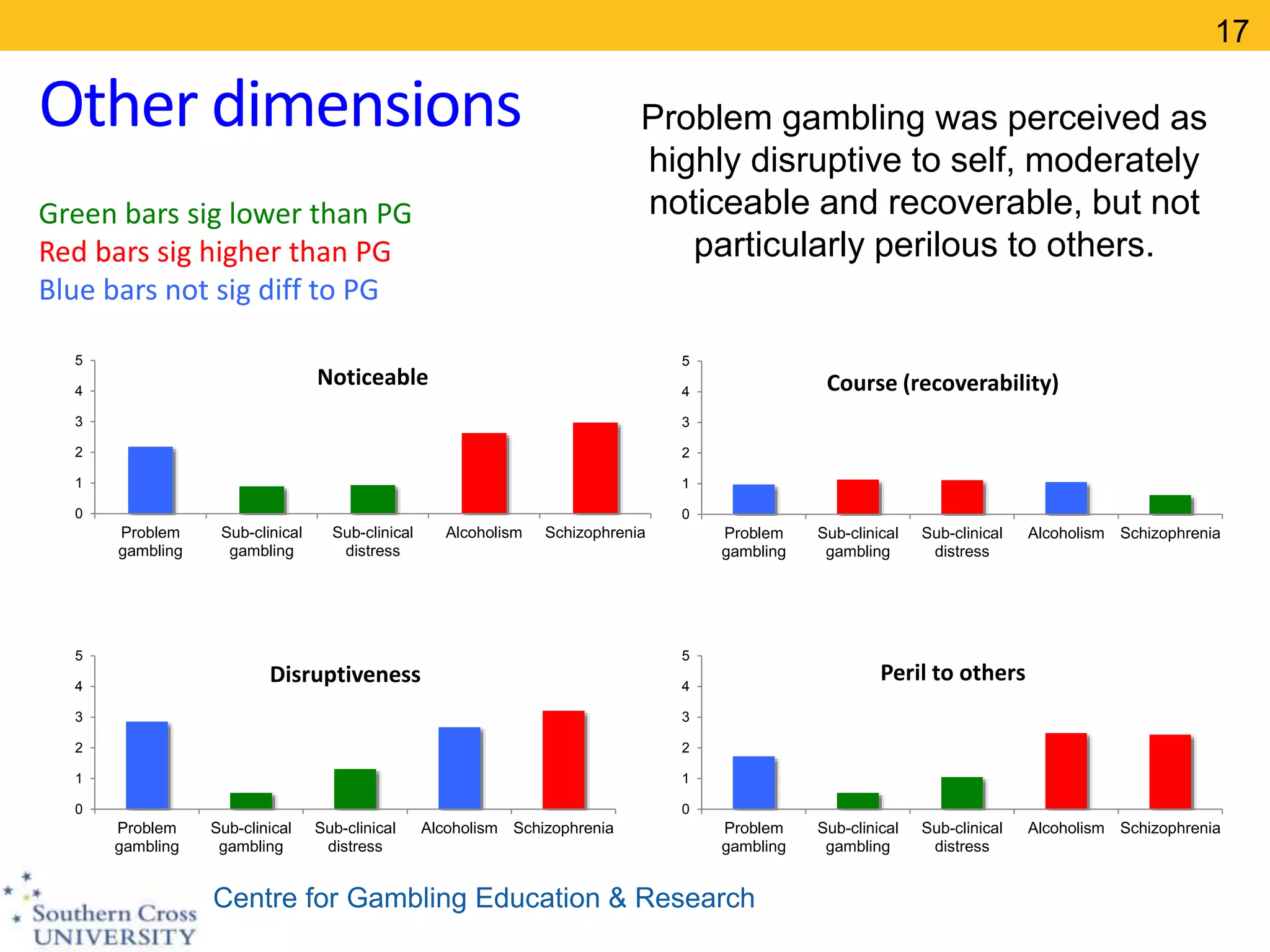
Other dimensions
0
1
2
3
4
5
Problem
gambling
Sub-clinical
gambling
Sub-clinical
distress
Alcoholism Schizophrenia
Noticeable
0
1
2
3
4
5
Problem
gambling
Sub-clinical
gambling
Sub-clinical
distress
Alcoholism Schizophrenia
Course (recoverability)
0
1
2
3
4
5
Problem
gambling
Sub-clinical
gambling
Sub-clinical
distress
Alcoholism Schizophrenia
Disruptiveness
Green bars sig lower than PG
Red bars sig higher than PG
Blue bars not sig diff to PG
0
1
2
3
4
5
Problem
gambling
Sub-clinical
gambling
Sub-clinical
distress
Alcoholism Schizophrenia
Peril to others
Problem gambling was perceived as
highly disruptive to self, moderately
noticeable and recoverable, but not
particularly perilous to others.
17
Centre for Gambling Education & Research
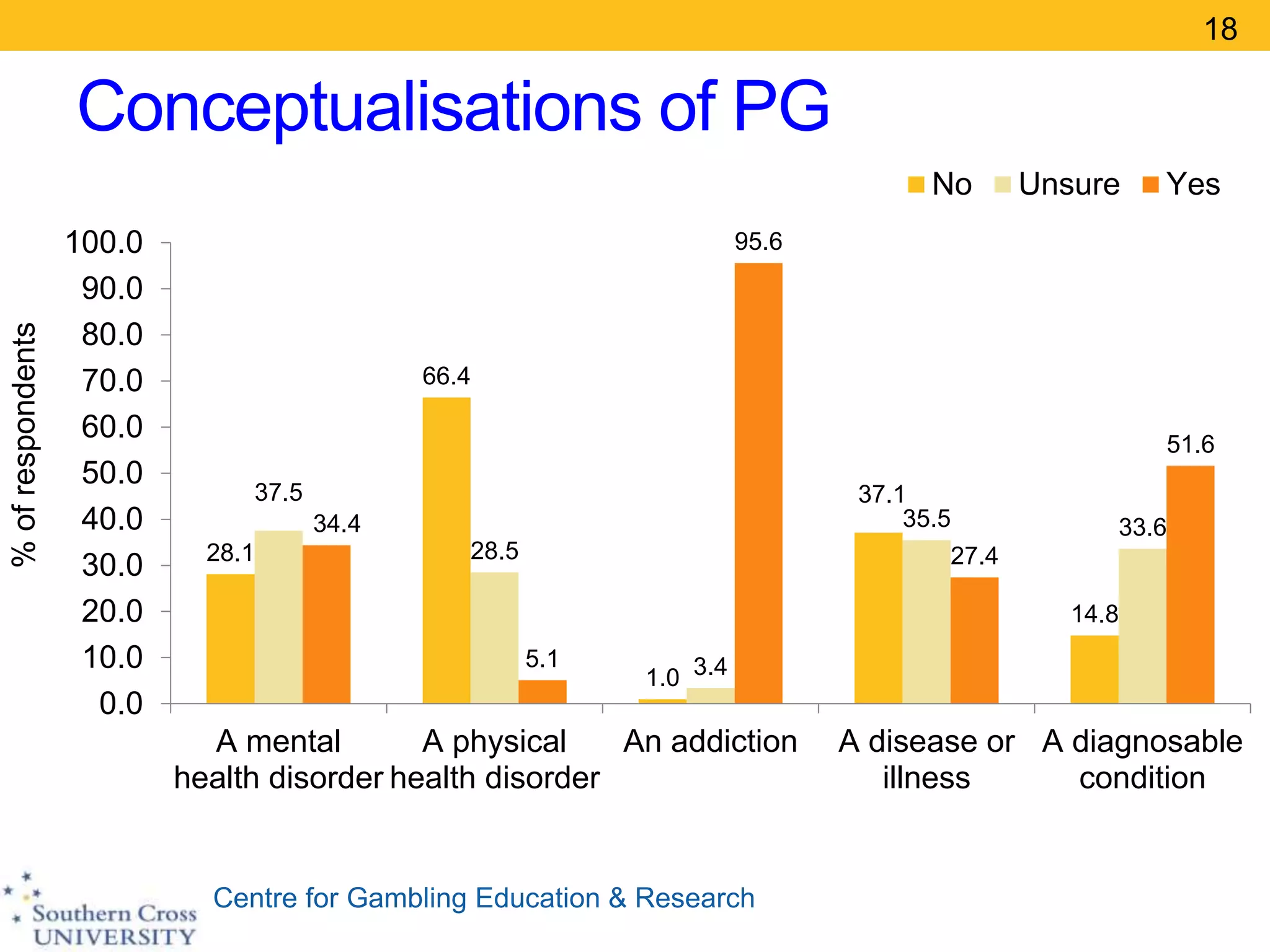
Conceptualisations of PG
18
28.1
66.4
1.0
37.1
14.8
37.5
28.5
3.4
35.5 33.634.4
5.1
95.6
27.4
51.6
0.0
10.0
20.0
30.0
40.0
50.0
60.0
70.0
80.0
90.0
100.0
A mental
health disorder
A physical
health disorder
An addiction A disease or
illness
A diagnosable
condition
%ofrespondents
No Unsure Yes
Centre for Gambling Education & Research
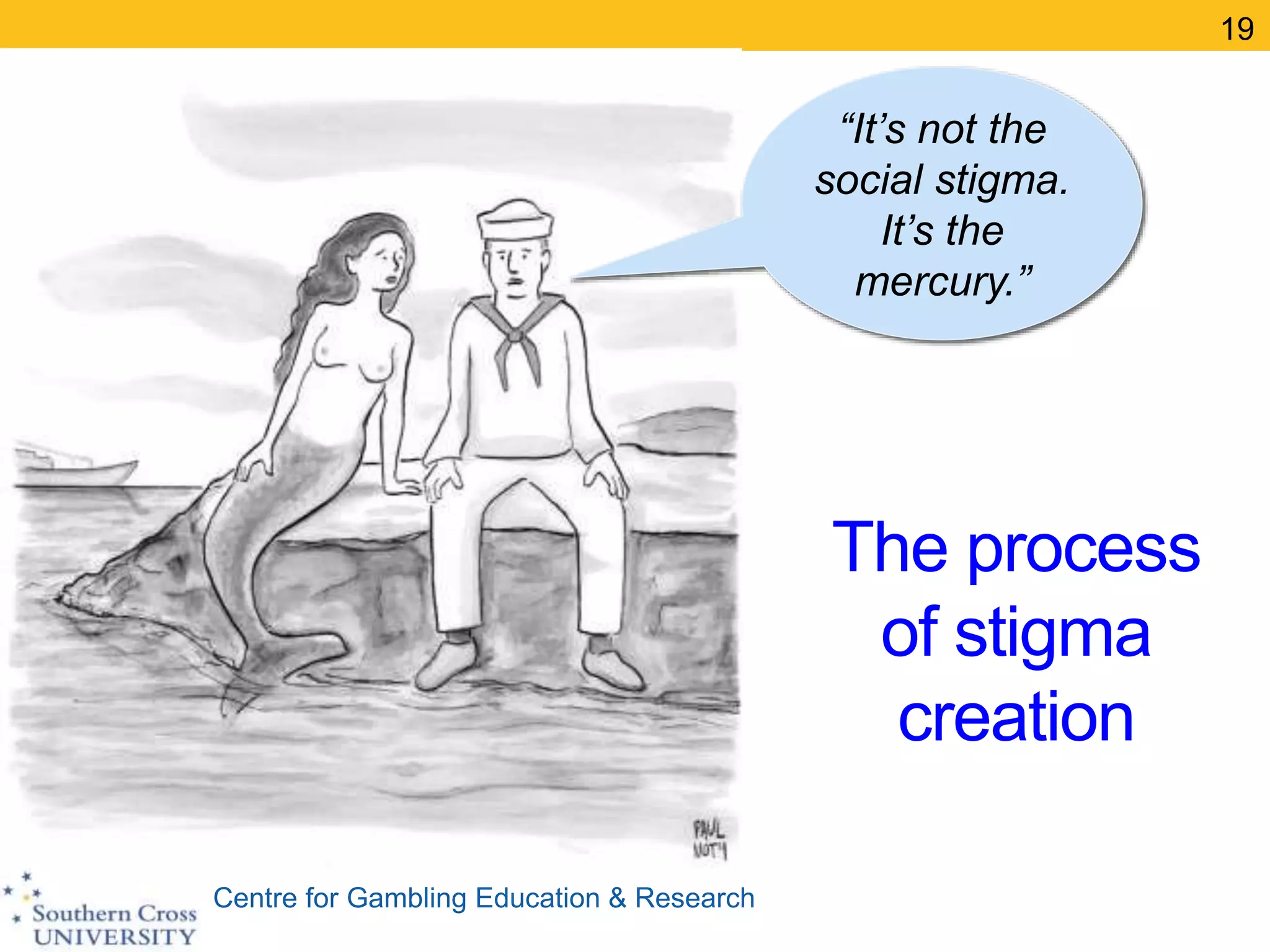
The process
of stigma
creation
19
“It’s not the
social stigma.
It’s the
mercury.”
Centre for Gambling Education & Research
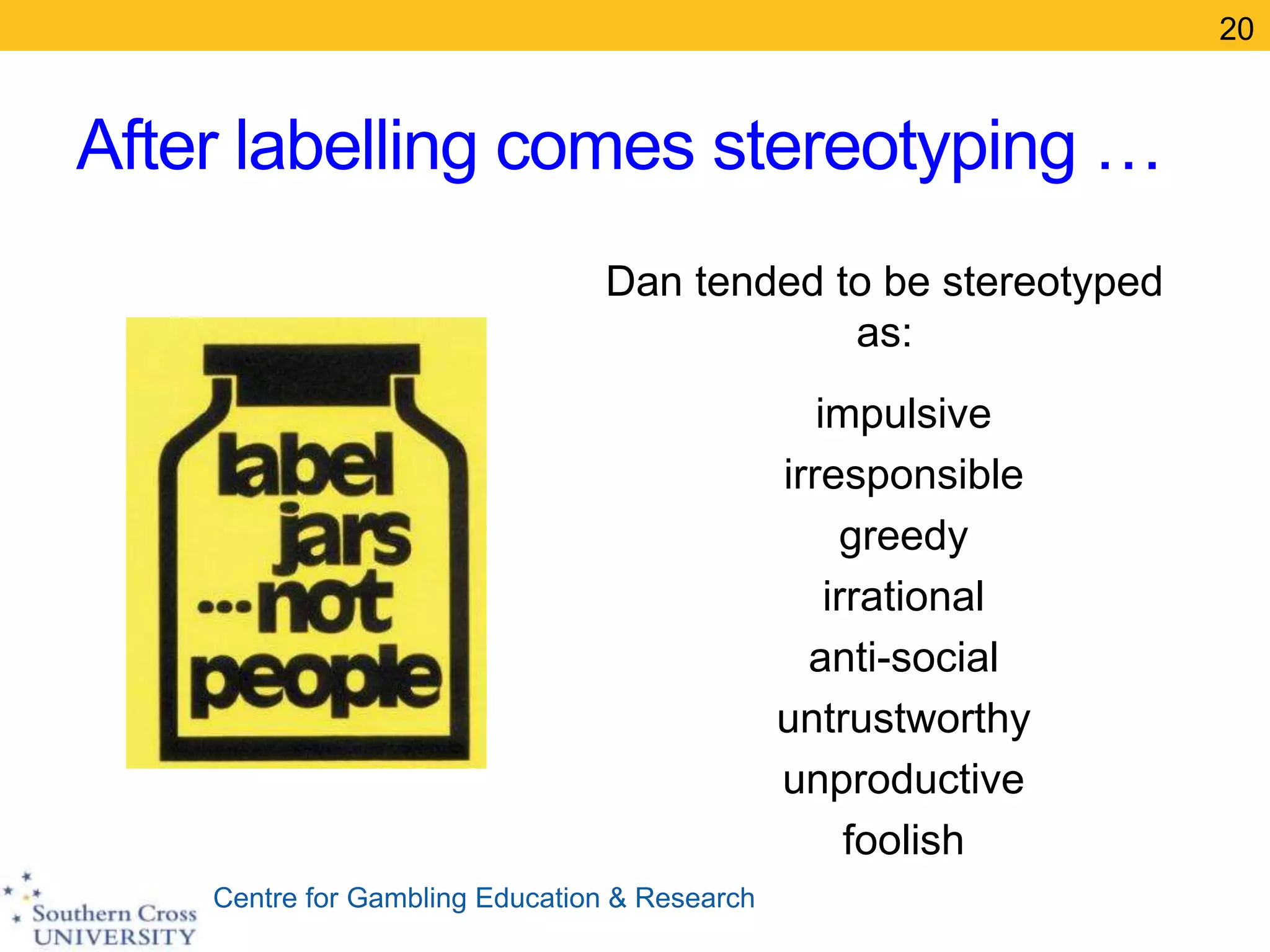
After labelling comes stereotyping …
Dan tended to be stereotyped
as:
impulsive
irresponsible
greedy
irrational
anti-social
untrustworthy
unproductive
foolish
20
Centre for Gambling Education & Research
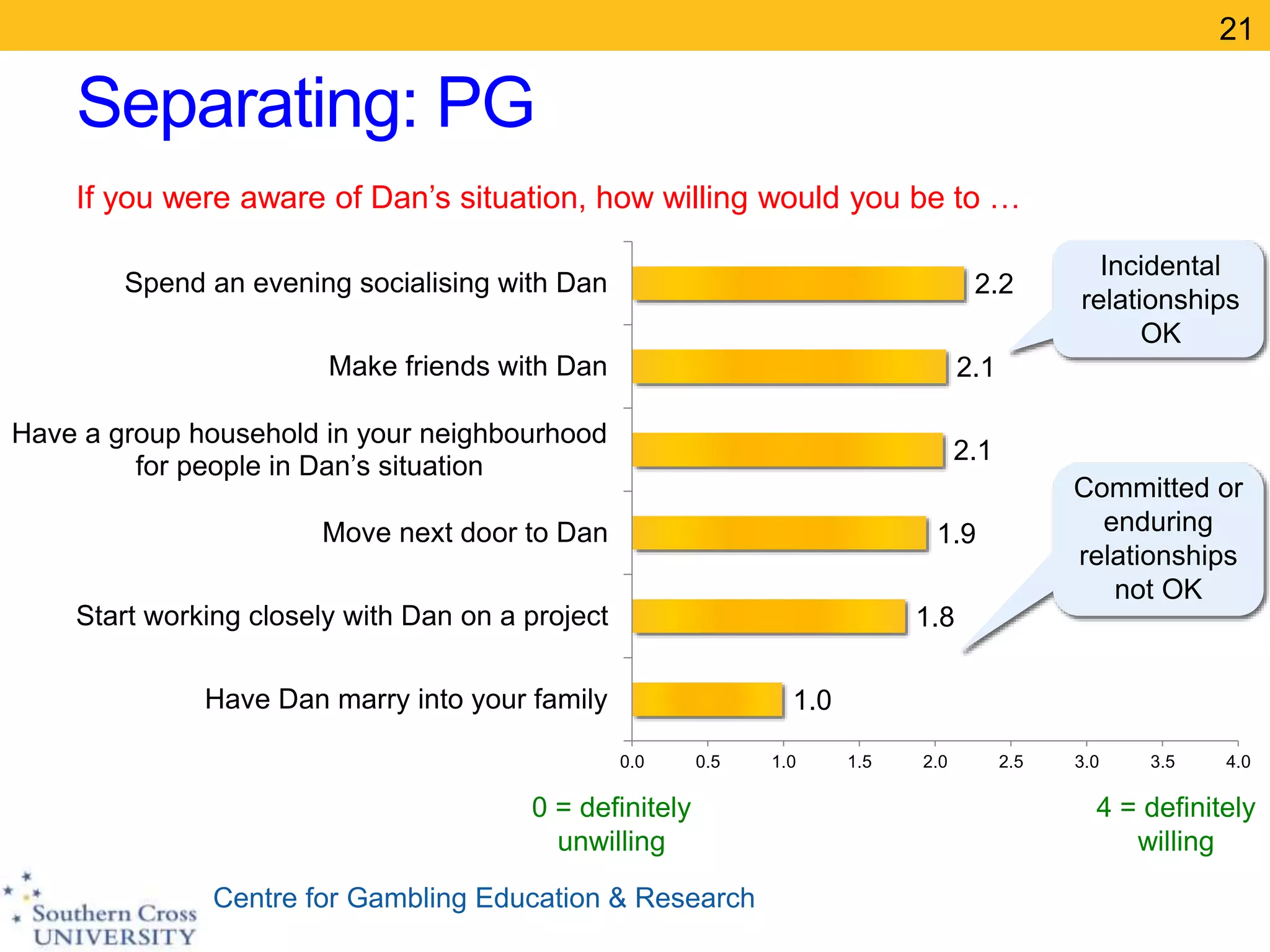
Separating: PG
21
1.0
1.8
1.9
2.1
2.1
2.2
0.0 0.5 1.0 1.5 2.0 2.5 3.0 3.5 4.0
Have Dan marry into your family
Start working closely with Dan on a project
Move next door to Dan
Have a group household in your neighbourhood
for people in Dan’s situation
Make friends with Dan
Spend an evening socialising with Dan
If you were aware of Dan’s situation, how willing would you be to …
0 = definitely
unwilling
Committed or
enduring
relationships
not OK
Incidental
relationships
OK
4 = definitely
willing
Centre for Gambling Education & Research
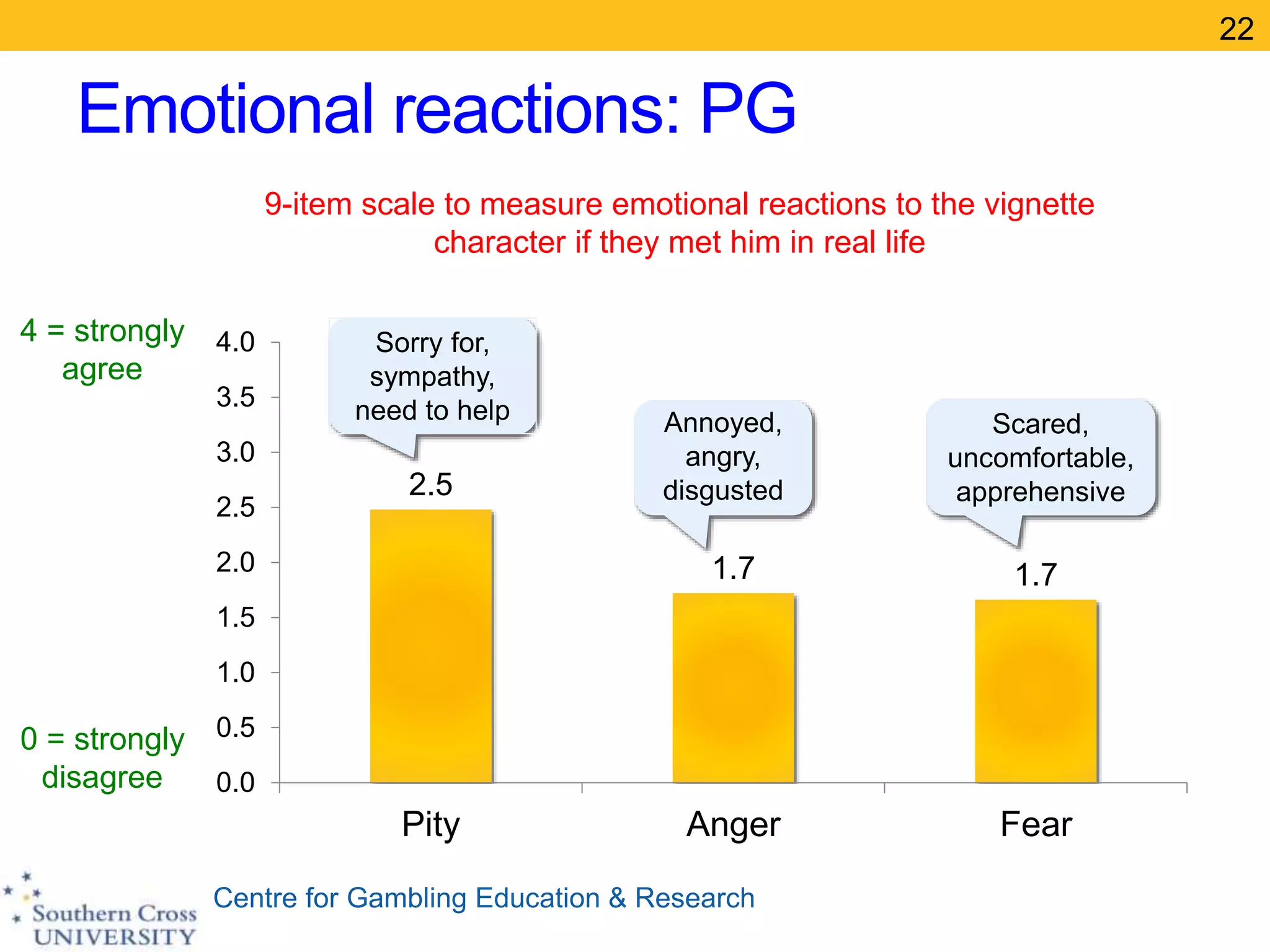
Emotional reactions: PG
22
2.5
1.7 1.7
0.0
0.5
1.0
1.5
2.0
2.5
3.0
3.5
4.0
Pity Anger Fear
9-item scale to measure emotional reactions to the vignette
character if they met him in real life
Sorry for,
sympathy,
need to help Annoyed,
angry,
disgusted
Scared,
uncomfortable,
apprehensive
4 = strongly
agree
0 = strongly
disagree
Centre for Gambling Education & Research
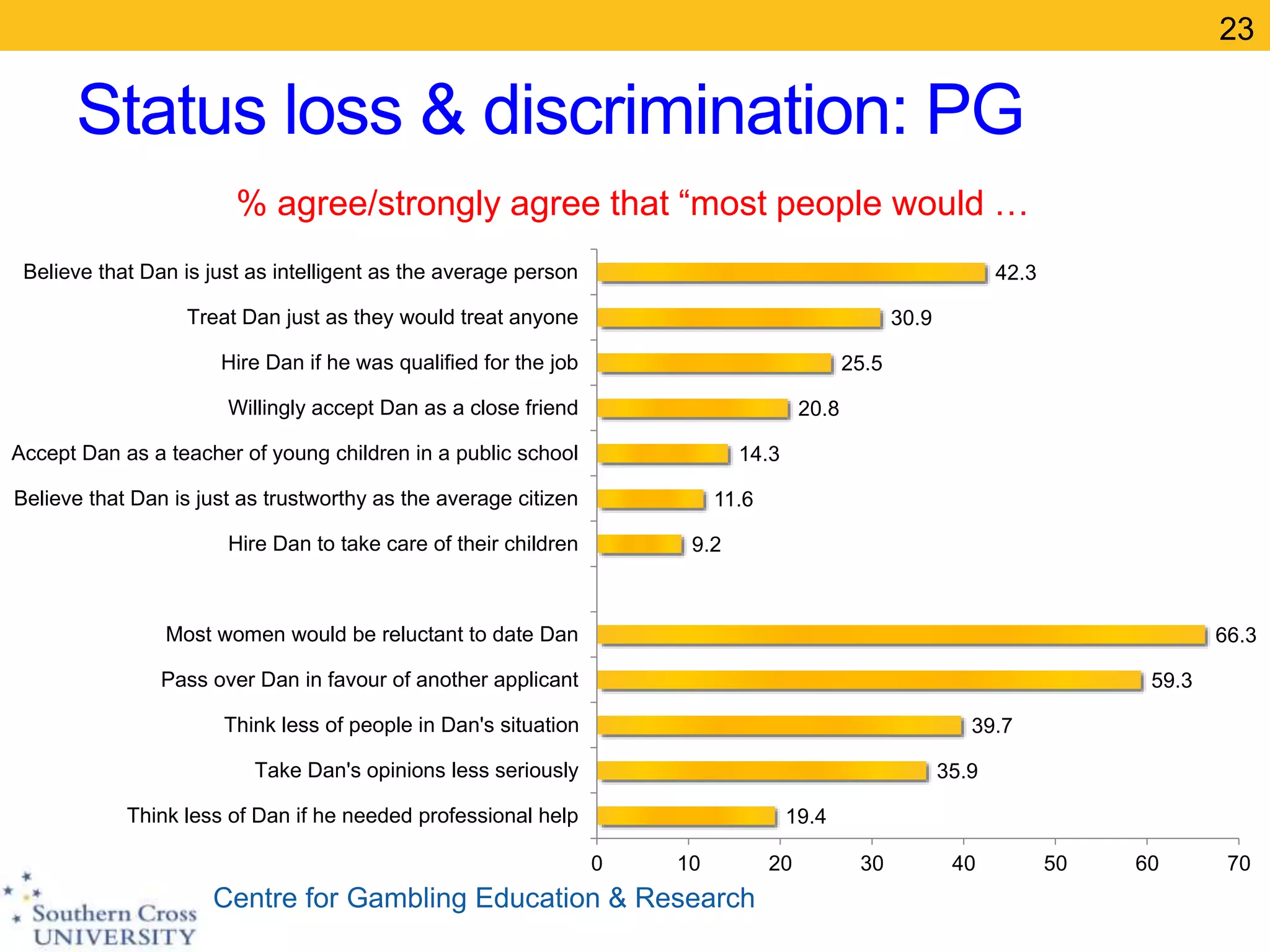
Status loss & discrimination: PG
23
% agree/strongly agree that “most people would …
19.4
35.9
39.7
59.3
66.3
9.2
11.6
14.3
20.8
25.5
30.9
42.3
0 10 20 30 40 50 60 70
Think less of Dan if he needed professional help
Take Dan's opinions less seriously
Think less of people in Dan's situation
Pass over Dan in favour of another applicant
Most women would be reluctant to date Dan
Hire Dan to take care of their children
Believe that Dan is just as trustworthy as the average citizen
Accept Dan as a teacher of young children in a public school
Willingly accept Dan as a close friend
Hire Dan if he was qualified for the job
Treat Dan just as they would treat anyone
Believe that Dan is just as intelligent as the average person
Centre for Gambling Education & Research
Relative intensity of public stigma
associated with PG
24
Centre for Gambling Education & Research
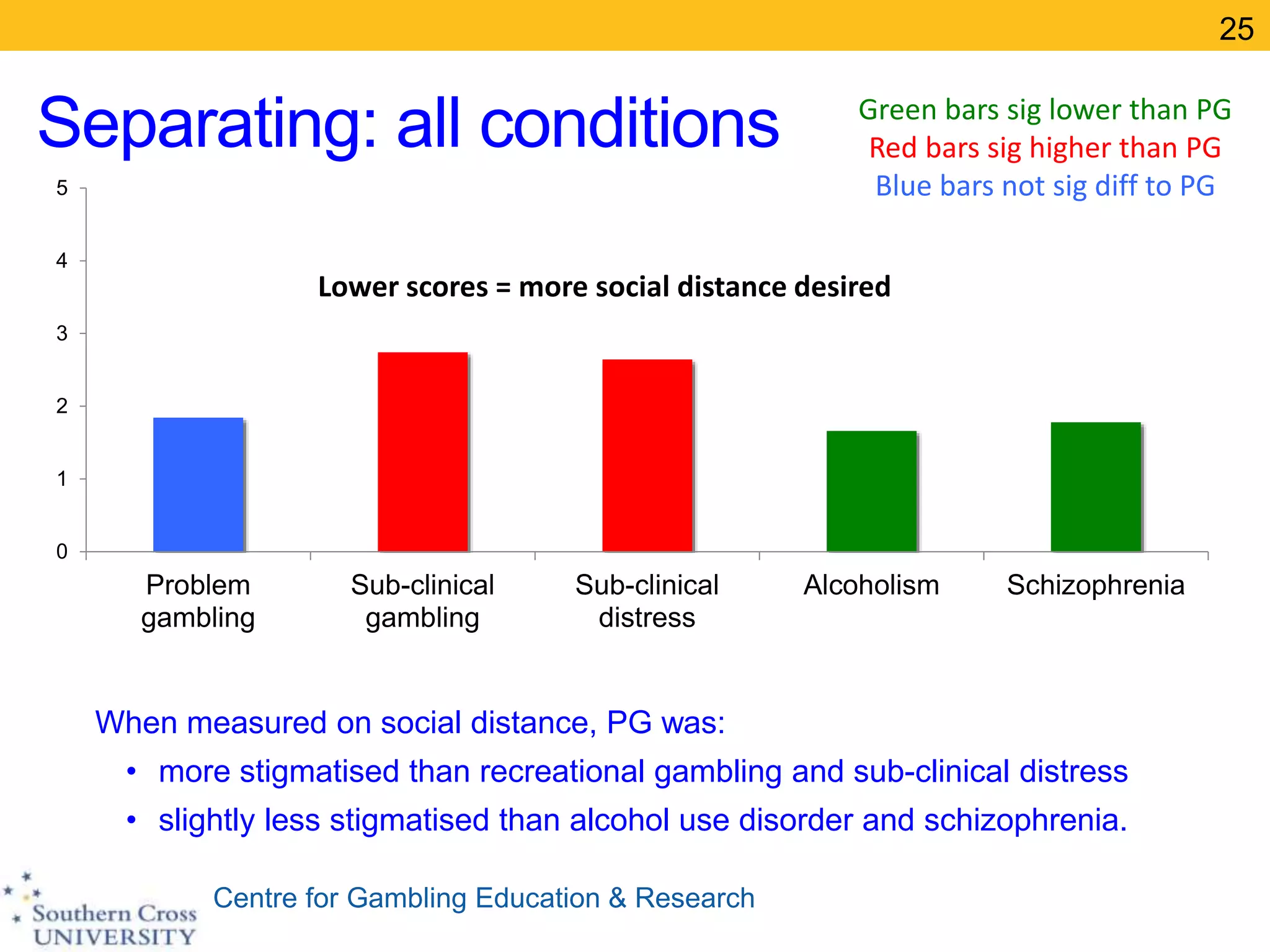
Separating: all conditions
25
0
1
2
3
4
5
Problem
gambling
Sub-clinical
gambling
Sub-clinical
distress
Alcoholism Schizophrenia
Lower scores = more social distance desired
Green bars sig lower than PG
Red bars sig higher than PG
Blue bars not sig diff to PG
When measured on social distance, PG was:
• more stigmatised than recreational gambling and sub-clinical distress
• slightly less stigmatised than alcohol use disorder and schizophrenia.
Centre for Gambling Education & Research
Status loss & discrimination: all conditions
26
0
1
2
3
4
5
Problem
gambling
Sub-clinical
gambling
Sub-clinical
distress
Alcoholism Schizophrenia
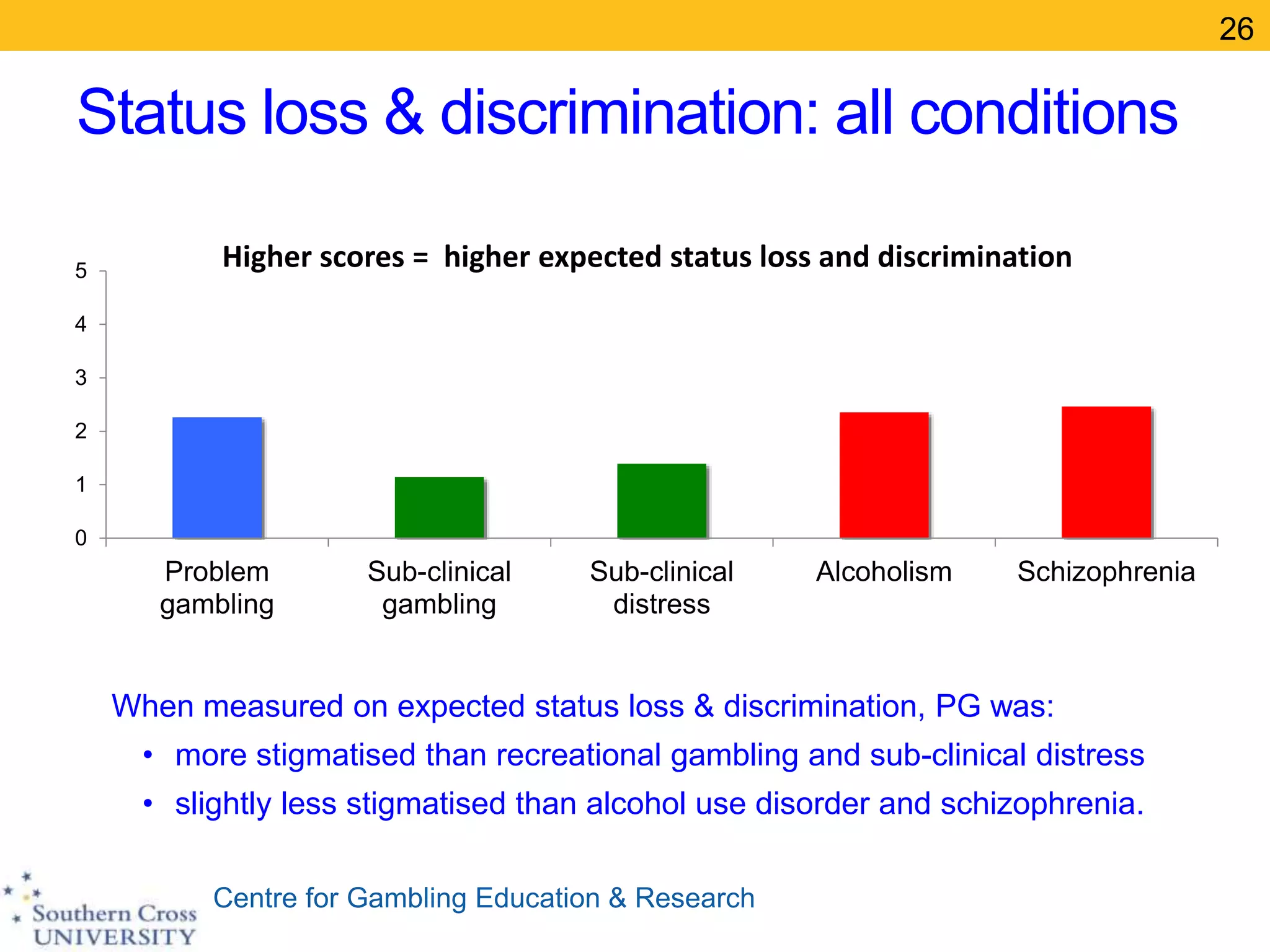
Higher scores = higher expected status loss and discrimination
When measured on expected status loss & discrimination, PG was:
• more stigmatised than recreational gambling and sub-clinical distress
• slightly less stigmatised than alcohol use disorder and schizophrenia.
Centre for Gambling Education & Research
Who stigmatises problem
gamblers? Implications for stigma
reduction
27
Centre for Gambling Education & Research
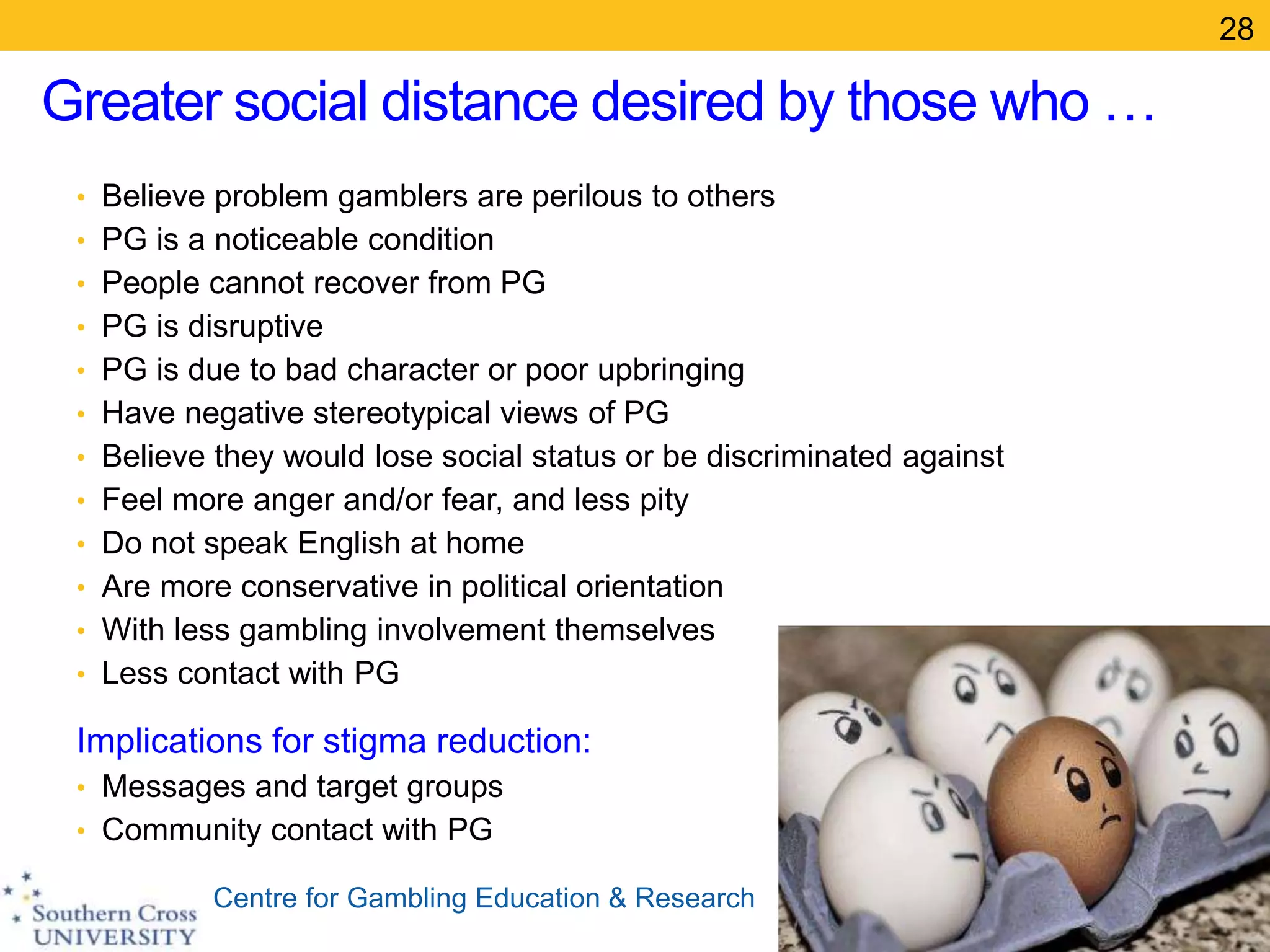
Greater social distance desired by those who …
• Believe problem gamblers are perilous to others
• PG is a noticeable condition
• People cannot recover from PG
• PG is disruptive
• PG is due to bad character or poor upbringing
• Have negative stereotypical views of PG
• Believe they would lose social status or be discriminated against
• Feel more anger and/or fear, and less pity
• Do not speak English at home
• Are more conservative in political orientation
• With less gambling involvement themselves
• Less contact with PG
Implications for stigma reduction:
• Messages and target groups
• Community contact with PG
28
Centre for Gambling Education & Research
Stage 3: Survey of people with
gambling problems
Experiences of and responses to public stigma
amongst those with gambling problems
29
Centre for Gambling Education & Research
Methods
Sample:
• 203 respondents
• PG in previous 3 years
• 18 yrs+
• Living in Australia
• 66.5% male, mean age = 40.9
• 87.2% PGSI 8+ in previous 12 mths
• Mean PGSI score = 15.3.
Recruitment:
• 117 previous CGER research participants
• 86 Google advertising
30
Centre for Gambling Education & Research
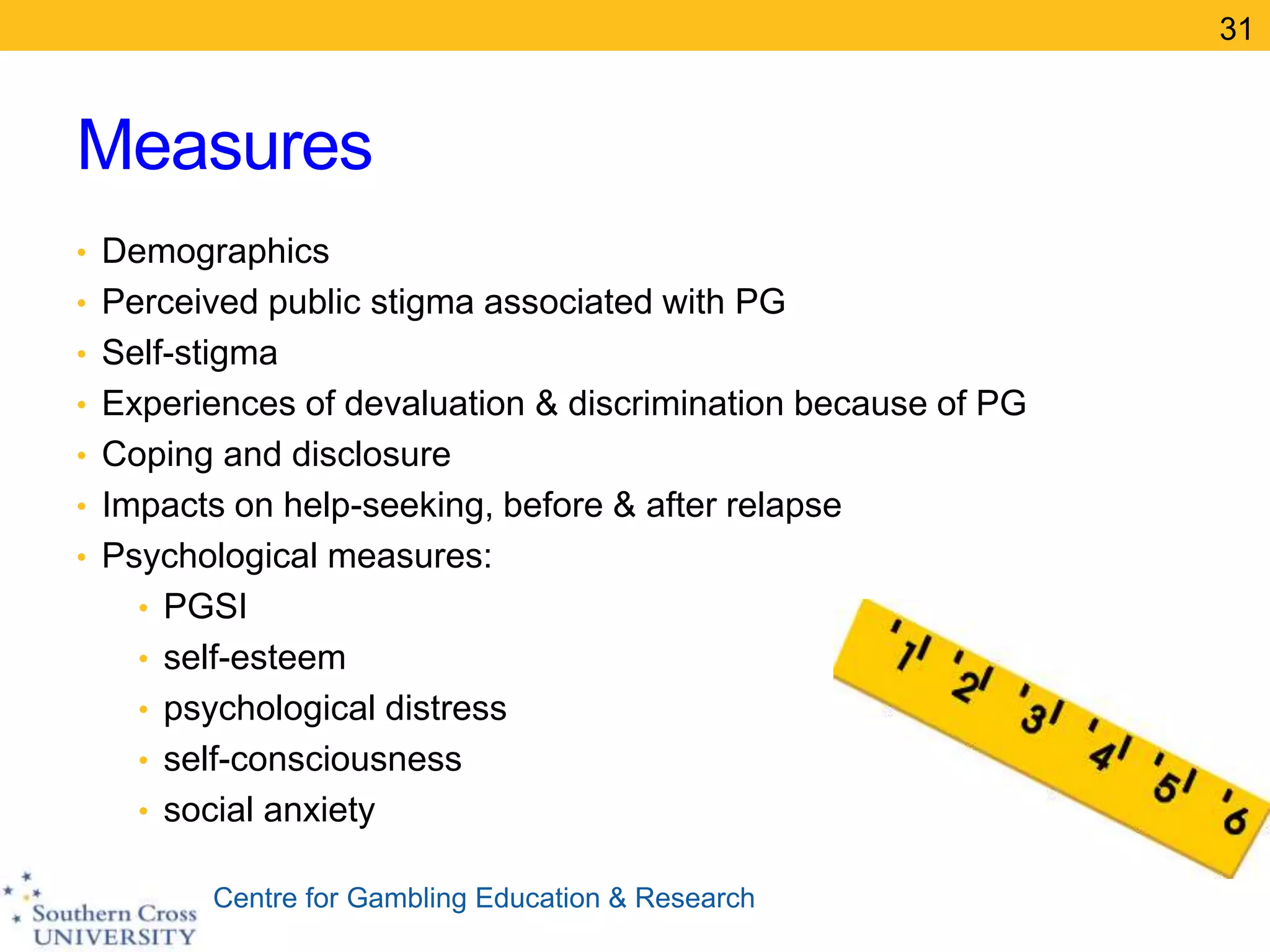
Measures
• Demographics
• Perceived public stigma associated with PG
• Self-stigma
• Experiences of devaluation & discrimination because of PG
• Coping and disclosure
• Impacts on help-seeking, before & after relapse
• Psychological measures:
• PGSI
• self-esteem
• psychological distress
• self-consciousness
• social anxiety
31
Centre for Gambling Education & Research
Perceived stigma – how did our
gambler respondents perceive the
public stigma associated with PG?
32
Centre for Gambling Education & Research
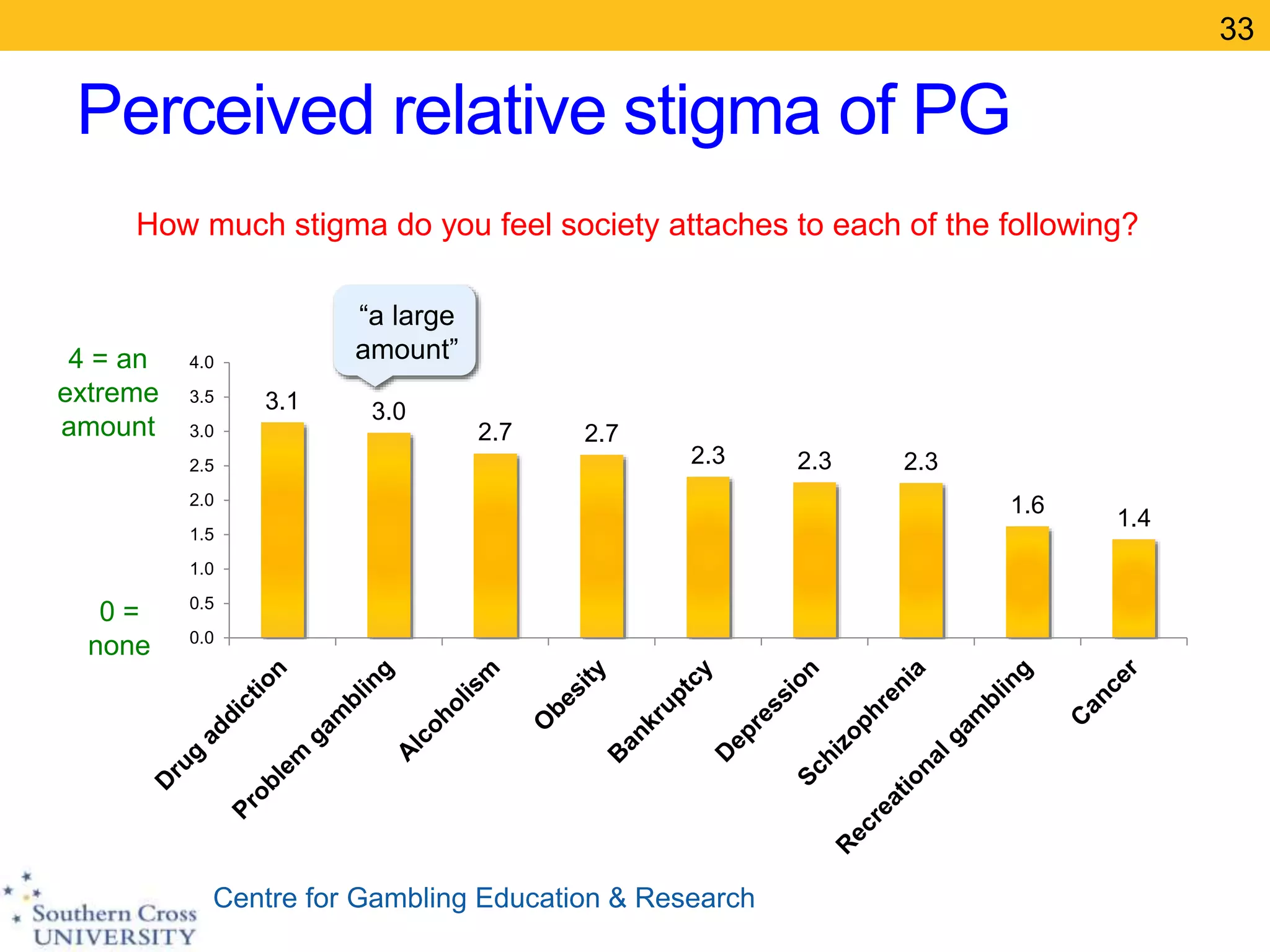
Perceived relative stigma of PG
33
3.1 3.0
2.7 2.7
2.3 2.3 2.3
1.6
1.4
0.0
0.5
1.0
1.5
2.0
2.5
3.0
3.5
4.04 = an
extreme
amount
0 =
none
How much stigma do you feel society attaches to each of the following?
“a large
amount”
Centre for Gambling Education & Research
Perceived stigma
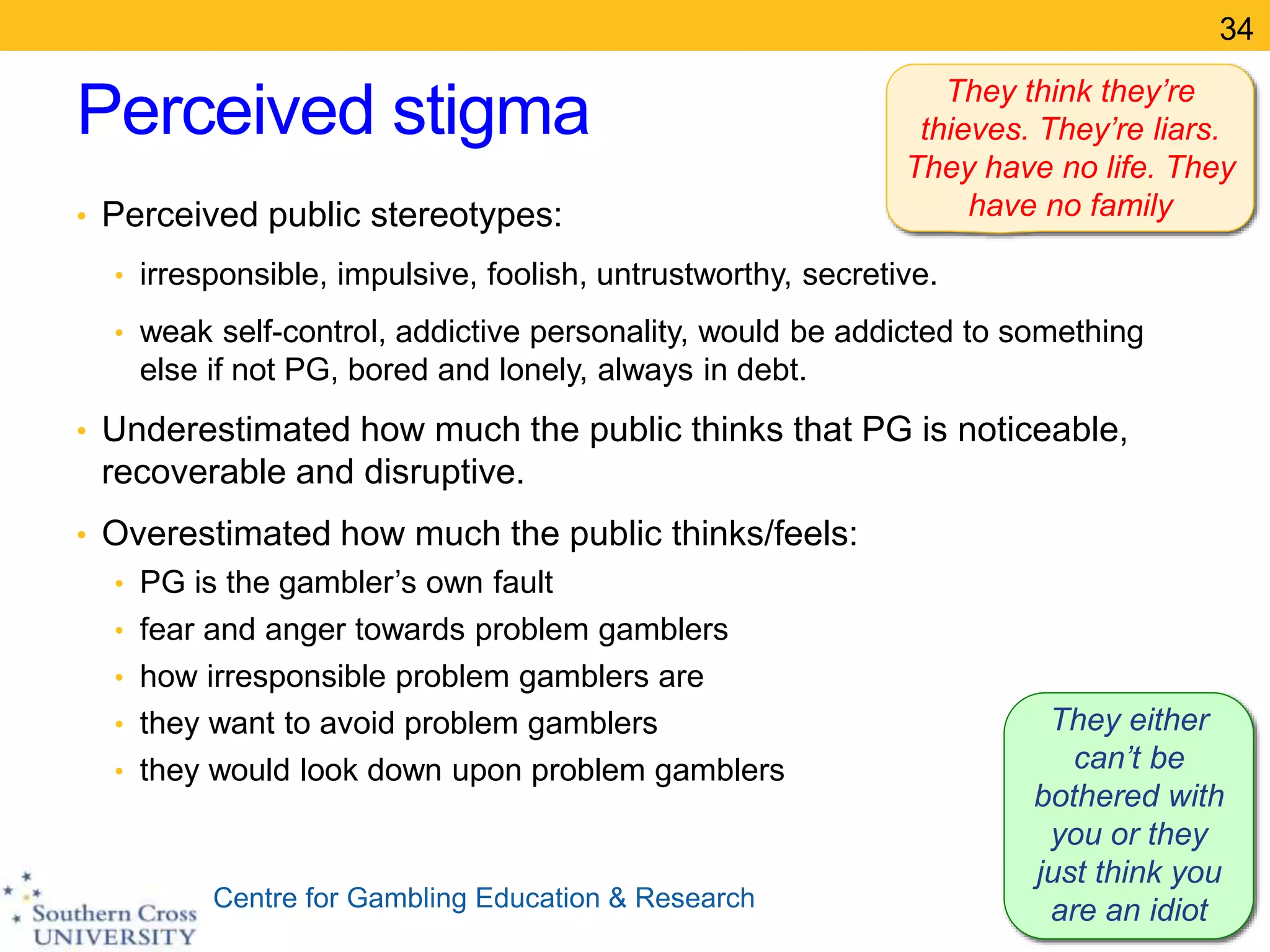
• Perceived public stereotypes:
• irresponsible, impulsive, foolish, untrustworthy, secretive.
• weak self-control, addictive personality, would be addicted to something
else if not PG, bored and lonely, always in debt.
• Underestimated how much the public thinks that PG is noticeable,
recoverable and disruptive.
• Overestimated how much the public thinks/feels:
• PG is the gambler’s own fault
• fear and anger towards problem gamblers
• how irresponsible problem gamblers are
• they want to avoid problem gamblers
• they would look down upon problem gamblers
34
They either
can’t be
bothered with
you or they
just think you
are an idiot
They think they’re
thieves. They’re liars.
They have no life. They
have no family
Centre for Gambling Education & Research
Self-stigma – how did our gambler
respondents feel about themselves
because of their gambling?
35
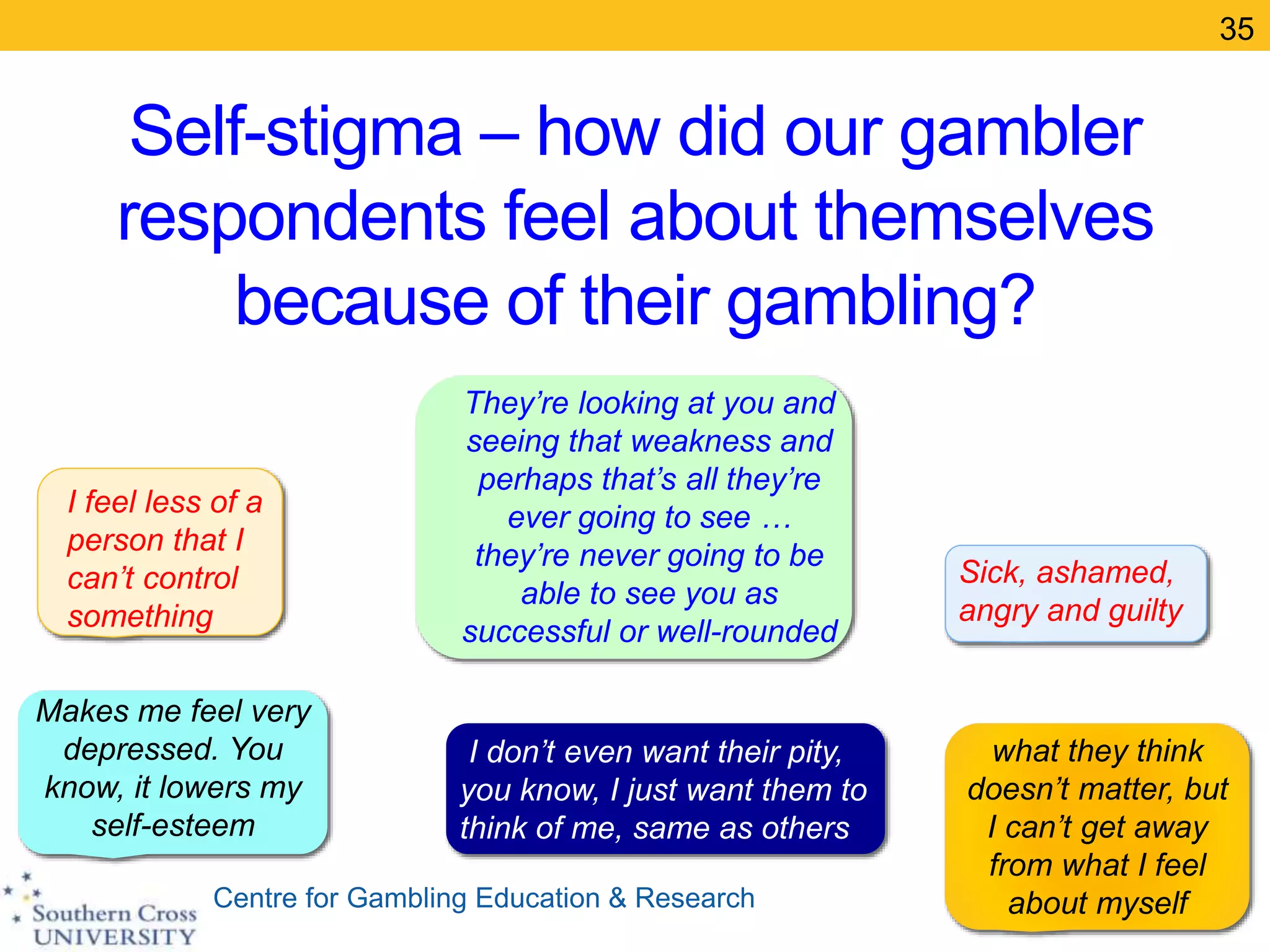
Sick, ashamed,
angry and guilty
I feel less of a
person that I
can’t control
something
They’re looking at you and
seeing that weakness and
perhaps that’s all they’re
ever going to see …
they’re never going to be
able to see you as
successful or well-rounded
what they think
doesn’t matter, but
I can’t get away
from what I feel
about myself
Makes me feel very
depressed. You
know, it lowers my
self-esteem
I don’t even want their pity,
you know, I just want them to
think of me, same as others
Centre for Gambling Education & Research
Self-stigmatising beliefs
36
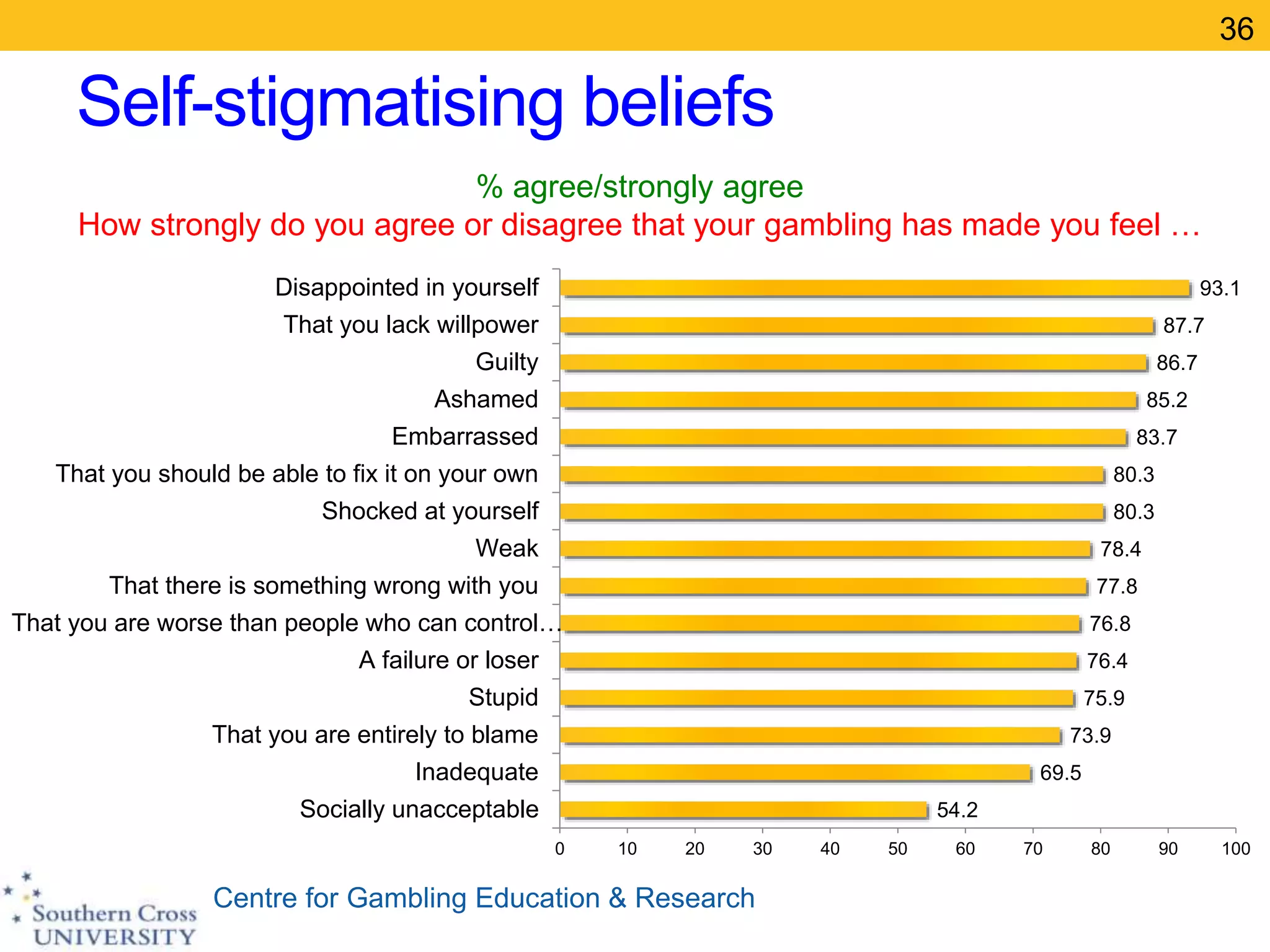
54.2
69.5
73.9
75.9
76.4
76.8
77.8
78.4
80.3
80.3
83.7
85.2
86.7
87.7
93.1
0 10 20 30 40 50 60 70 80 90 100
Socially unacceptable
Inadequate
That you are entirely to blame
Stupid
A failure or loser
That you are worse than people who can control…
That there is something wrong with you
Weak
Shocked at yourself
That you should be able to fix it on your own
Embarrassed
Ashamed
Guilty
That you lack willpower
Disappointed in yourself
% agree/strongly agree
How strongly do you agree or disagree that your gambling has made you feel …
Centre for Gambling Education & Research
Experiences of devaluation and
discrimination
37
Centre for Gambling Education & Research
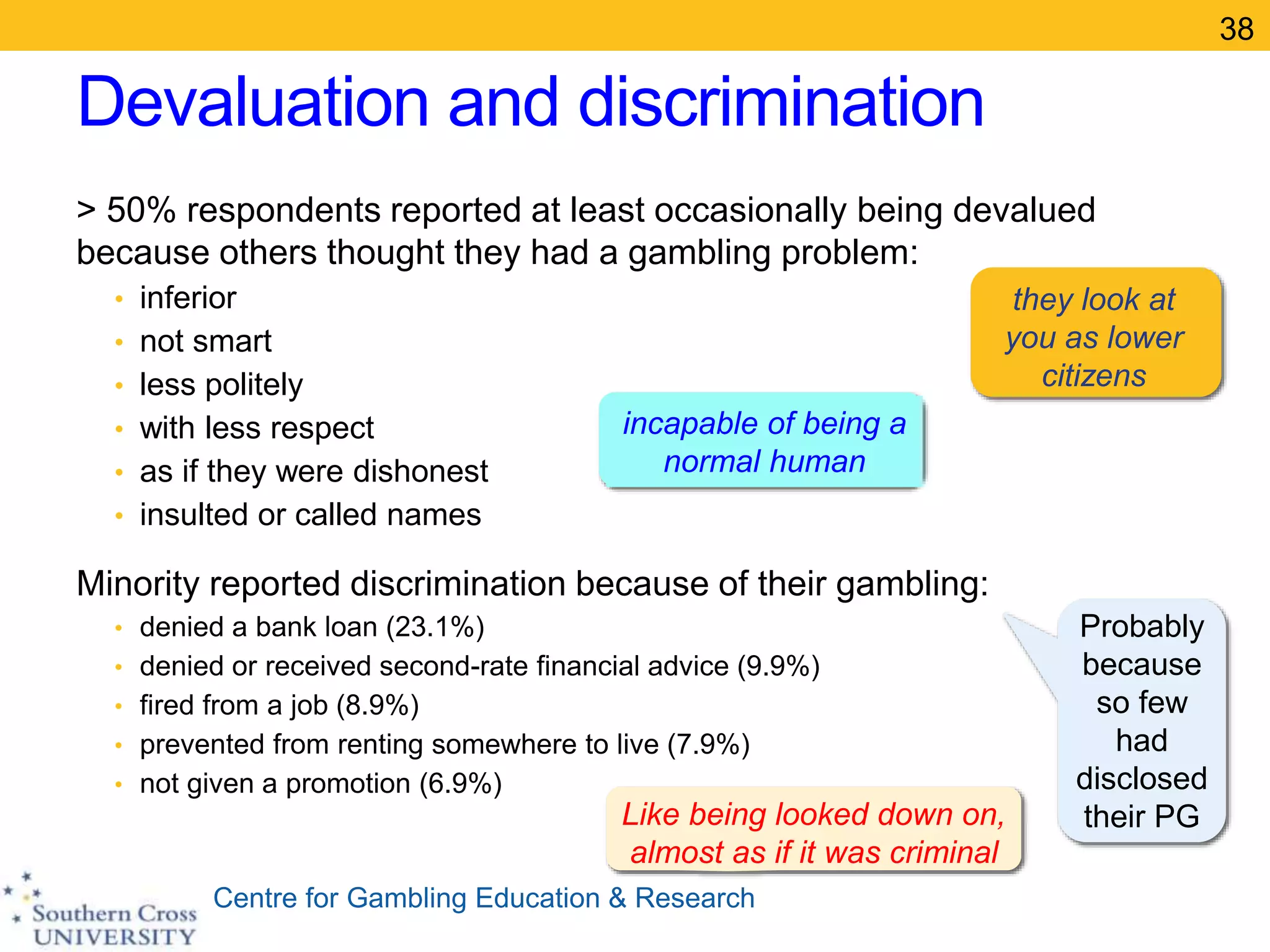
Devaluation and discrimination
> 50% respondents reported at least occasionally being devalued
because others thought they had a gambling problem:
• inferior
• not smart
• less politely
• with less respect
• as if they were dishonest
• insulted or called names
Minority reported discrimination because of their gambling:
• denied a bank loan (23.1%)
• denied or received second-rate financial advice (9.9%)
• fired from a job (8.9%)
• prevented from renting somewhere to live (7.9%)
• not given a promotion (6.9%)
38
Probably
because
so few
had
disclosed
their PG
they look at
you as lower
citizens
incapable of being a
normal human
Like being looked down on,
almost as if it was criminal
Centre for Gambling Education & Research
Coping with stigma
39
Centre for Gambling Education & Research
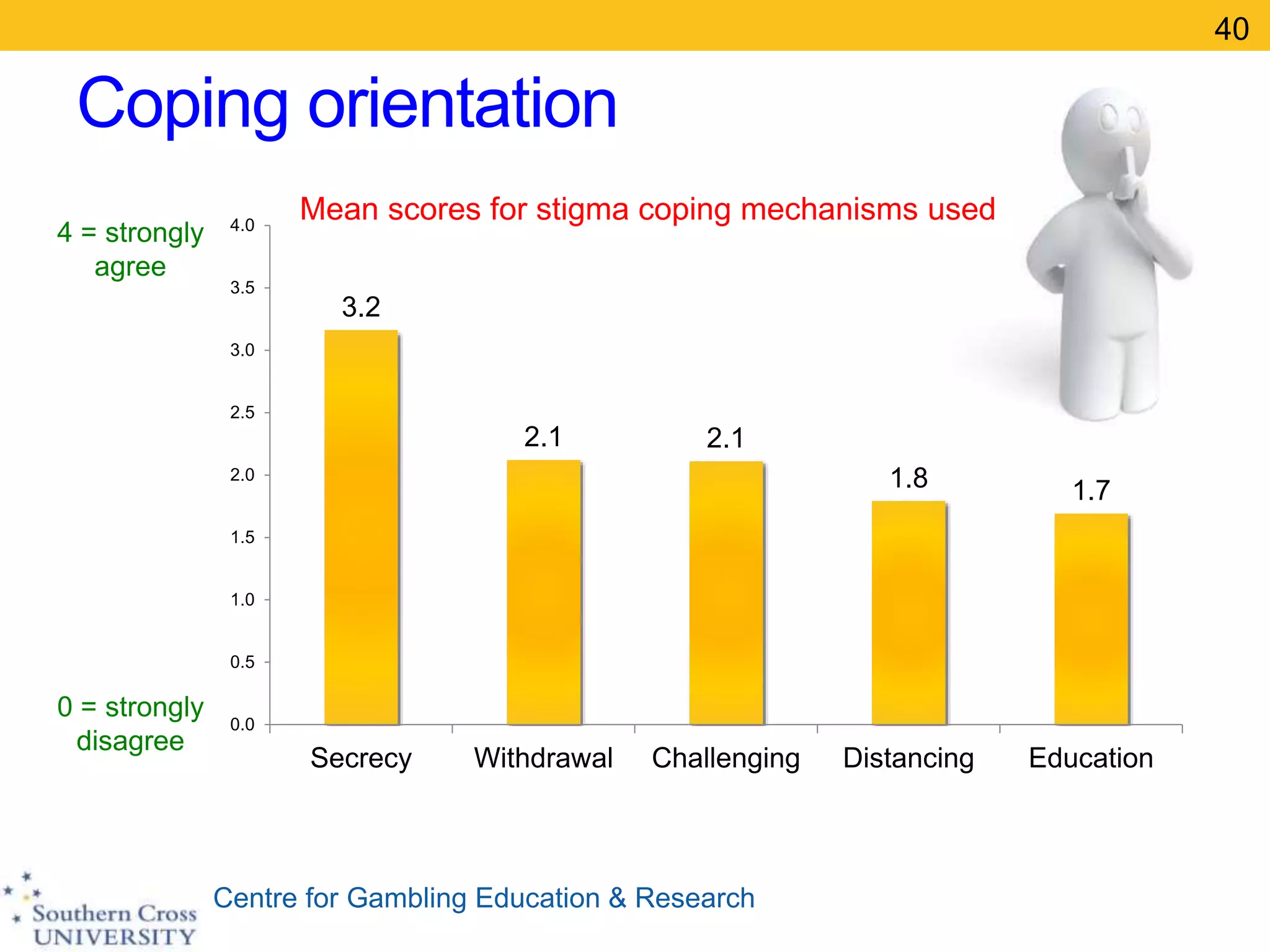
Coping orientation
40
3.2
2.1 2.1
1.8 1.7
0.0
0.5
1.0
1.5
2.0
2.5
3.0
3.5
4.0
Secrecy Withdrawal Challenging Distancing Education
4 = strongly
agree
0 = strongly
disagree
Mean scores for stigma coping mechanisms used
Centre for Gambling Education & Research
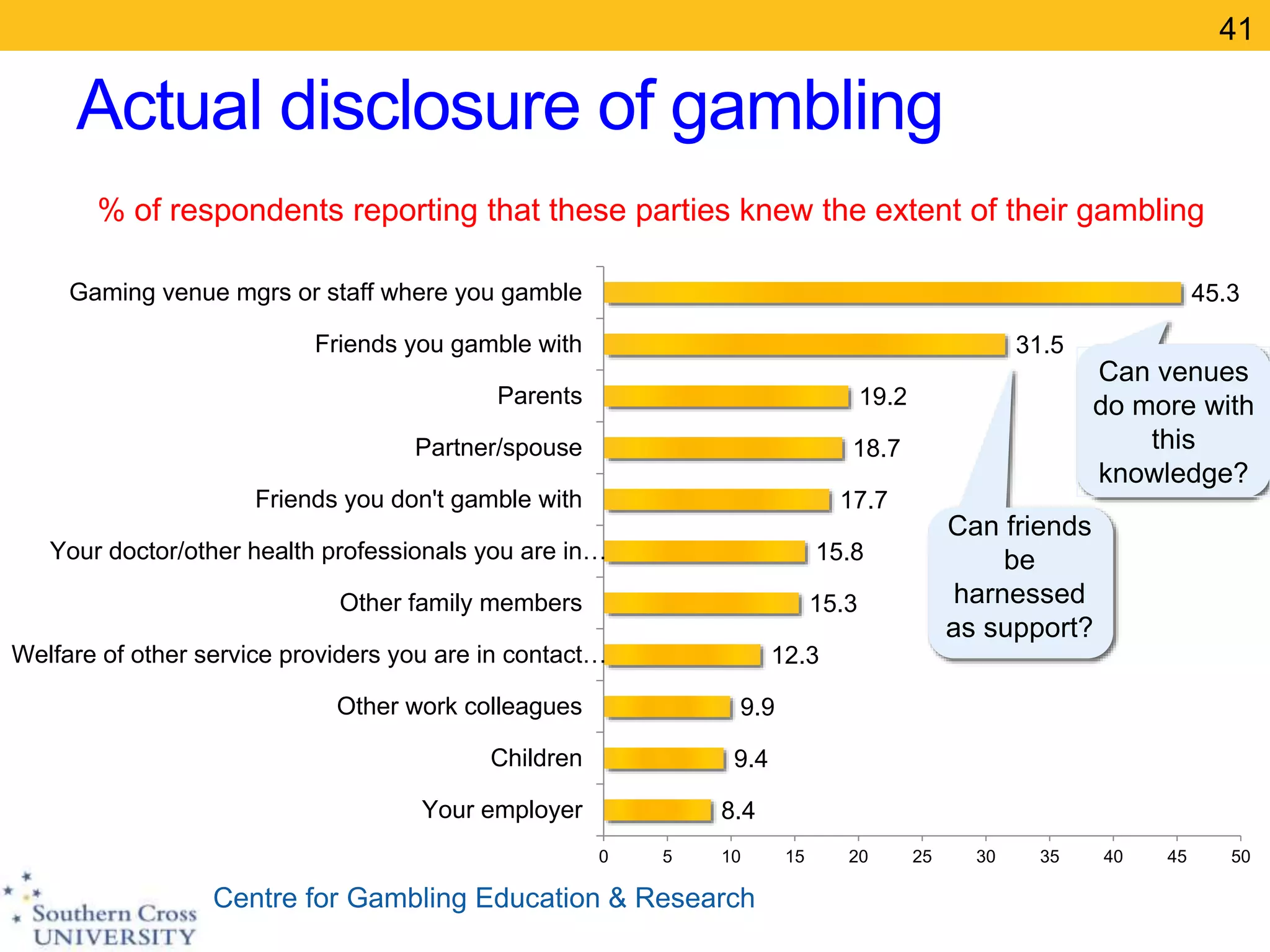
Actual disclosure of gambling
41
8.4
9.4
9.9
12.3
15.3
15.8
17.7
18.7
19.2
31.5
45.3
0 5 10 15 20 25 30 35 40 45 50
Your employer
Children
Other work colleagues
Welfare of other service providers you are in contact…
Other family members
Your doctor/other health professionals you are in…
Friends you don't gamble with
Partner/spouse
Parents
Friends you gamble with
Gaming venue mgrs or staff where you gamble
% of respondents reporting that these parties knew the extent of their gambling
Can friends
be
harnessed
as support?
Can venues
do more with
this
knowledge?
Centre for Gambling Education & Research
Stigma, help-seeking and relapse
42
Centre for Gambling Education & Research
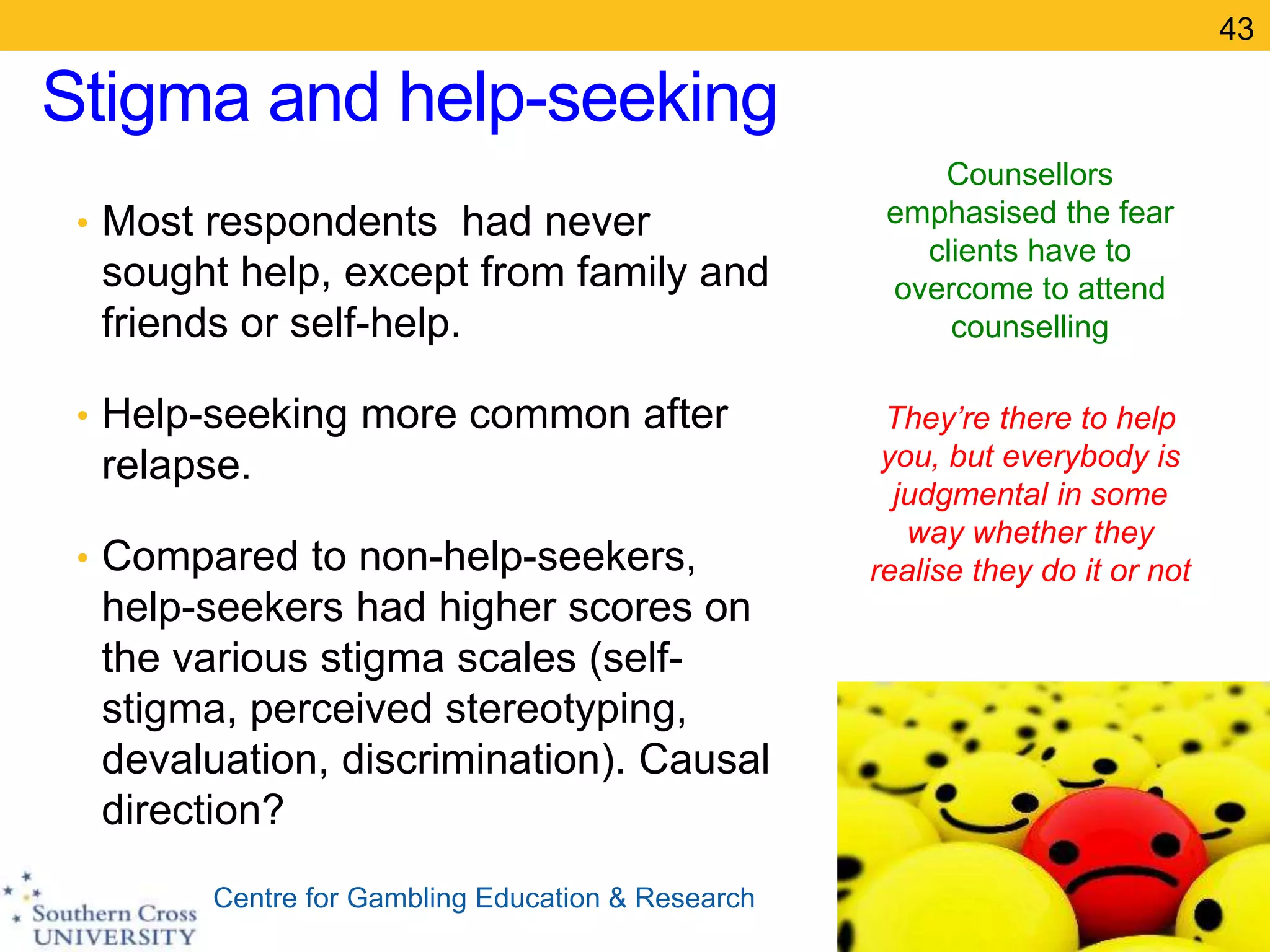
Stigma and help-seeking
• Most respondents had never
sought help, except from family and
friends or self-help.
• Help-seeking more common after
relapse.
• Compared to non-help-seekers,
help-seekers had higher scores on
the various stigma scales (self-
stigma, perceived stereotyping,
devaluation, discrimination). Causal
direction?
Counsellors
emphasised the fear
clients have to
overcome to attend
counselling
They’re there to help
you, but everybody is
judgmental in some
way whether they
realise they do it or not
43
Centre for Gambling Education & Research
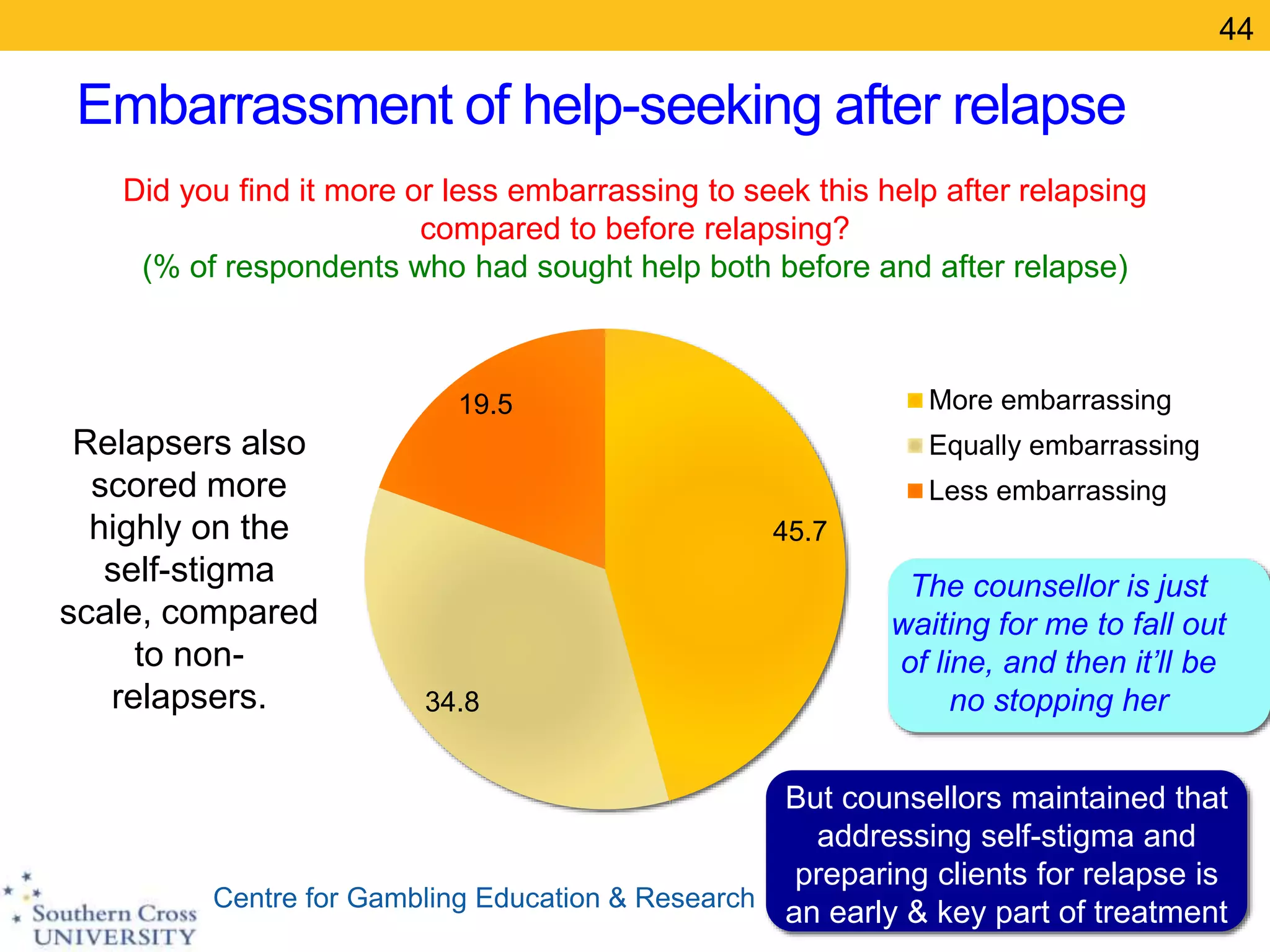
Embarrassment of help-seeking after relapse
44
45.7
34.8
19.5 More embarrassing
Equally embarrassing
Less embarrassing
Did you find it more or less embarrassing to seek this help after relapsing
compared to before relapsing?
(% of respondents who had sought help both before and after relapse)
Relapsers also
scored more
highly on the
self-stigma
scale, compared
to non-
relapsers.
The counsellor is just
waiting for me to fall out
of line, and then it’ll be
no stopping her
But counsellors maintained that
addressing self-stigma and
preparing clients for relapse is
an early & key part of treatment
Centre for Gambling Education & Research
Who feels the most self-stigma due to
their gambling?
45
Centre for Gambling Education & Research
Scores on the self-stigma scale highest for…
• Females
• Those whose most problematic form was EGMs
• Higher psychological distress
• Higher public self-consciousness
• Higher social anxiety
• Lower self-esteem
• Higher PGSI scores
• Help-seekers
• Relapsers
46
Well, I thought they’d support me but they haven’t
… I’ll say, ‘Look, I enjoy going to the club’, and
then I can see the look of disdain in their faces.
You know, can’t you do something better like
clean your house instead of spending all the time
at [the club]? (8, F, 55-64).
It’s probably more
acceptable in the
male community …
women who play
the pokies … it’s
the lowest form (46,
F, 45-54).
Centre for Gambling Education & Research
Concluding comments
47
Centre for Gambling Education & Research
Summary
• Public stigma of PG is alive and well. Why?
• PG perceived as mainly due to poor coping with stressful life circumstances
(blame?) and as highly disruptive to self and others.
• Easier to blame and stereotype than to understand how difficult it is to “just stop”
when addicted.
• PG not quite as heavily stigmatised as alcoholism and schizophrenia, but
people with gambling problems think it is more stigmatised.
• How does this stigma impact on them?
• Encourages secrecy
• Delays and deters help-seeking
• Undermines treatment adherence, esp. after relapse
• Leads to self-stigmatising beliefs
• Which diminish self-esteem and self-efficacy
• Adds a double burden
• Worse for some groups (e.g. female, EGMs, high psych. distress, anxiety, PGSI)
48
Centre for Gambling Education & Research
Implications
• Treatment needs to help clients overcome self-stigmatising beliefs:
• restore self-esteem
• enhance stigma coping skills
• foster a belief that recovery is possible
• prepare clients for relapse
• Addressing public stigma of PG is critically important.
• Lowering public stigma requires improving:
• knowledge (about PG, its dimensions, struggling with an addiction rather than weak)
• language (labels)
• attitudes (stereotypes, emotional reactions, devaluation)
• behaviours (social distancing, discrimination)
• Public education strategies needed; careful not to stigmatise further.
• Increasing community contact with PG a promising strategy.
• Research needed into optimal stigma reduction strategies.
49
Centre for Gambling Education & Research
References
Carroll, A., Rodgers, B., Davidson, T., & Sims, S. (2013). Stigma and help-seeking for gambling problems.
Canberra: Australian National University.
Corrigan, P.W. (2004). How stigma interferes with health care. American Psychologist, 59(7), 614-625.
Corrigan, P.W., Markowitz, R.E., Watson, A., Rowan, D., & Kubiak, M.A. (2003). An attribution model of
public discrimination towards persons with mental illness. Journal of Health and Social Behavior, 44,
162–179.
Crocker, J., Major, B., & Steele, C. (1998). Social stigma. In D. T. Gilbert, S. T. Fiske & G. Lindzey (Eds.),
The Handbook of Social Psychology: Vol. 2. (4th ed., pp. 505–553). New York, NY: McGraw–Hill
Companies, Inc.
Dhillon, J., Horch, J.D., & Hodgins, D.C. (2011). Cultural influences on stigmatization of problem gambling:
East Asian and Caucasian Canadians, Journal of Gambling Studies, 27(4), 633-647.
Feldman, D.B., & Crandall, C.S. (2007). Dimensions of mental illness stigma: What about mental illness
causes social rejection? Journal of Social and Clinical Psychology, 26, 137–154.
Goffman, E. (1963). Stigma: Notes on the management of spoiled identity. London: Penguin.
Horch, J. & Hodgins, D. (2008). Public stigma of disordered gambling: Social distance, dangerousness, and
familiarity. Journal of Social and Clinical Psychology, 27(5), 505-528.
Horch, J., & Hodgins, D. (2013). Stereotypes of problem gambling. Journal of Gambling Issues, 28, 1-19.
Jones, E.E., Farina, A., Hastorf, A.H., Marcus, H., Miller, D.T., & Scott, R.A. (1984). Social stigma: The
psychology of marked relationships. New York, NY: Freeman and Company.
Link, B.G., Yang, L.H., Phelan, J.C., & Collins, P.Y. (2004). Measuring mental illness stigma. Schizophrenia
Bulletin, 30(3), 511-541.
Weiner, B. (1986). An attributional theory of motivation and emotion. New York, NY: Springer-Verlag.
50

The stigma of problem gambling: Public prejudice, private pain and implications for public health

  • 1.
    Centre for GamblingEducation & Research The stigma of problem gambling: Public prejudice, private pain and implications for public health Professor Nerilee Hing This study was funded by the Victorian Responsible Gambling Foundation International Gambling Conference 10-12 February 2016, Auckland 1
  • 2.
    Centre for GamblingEducation & Research Background Recreational gambling is a popular, socially accepted and normalised activity. But problem gambling appears to be highly stigmatised. People experiencing PG report that stigma deters or delays: • problem acknowledgement • disclosure to others • help-seeking • treatment adherence But, very little previous research into PG and stigma. 2
  • 3.
    Centre for GamblingEducation & Research What is stigma? A social process which occurs when individuals are devalued or discredited in a particular social context because of a perceived negative attribute which disqualifies them from full social acceptance. (Goffman, 1963; Crocker, Major, & Steele, 1998) • Reaction of others (labelling, stereotyping, judgment, prejudice) • To an undesirable attribute (e.g., race, obesity, addiction, disability) • Context specific (varies by culture, gender, time period, etc) • Spoiled identity (from a “normal” to “tainted” identify) • Become “them” rather than “us” 3
  • 4.
    Centre for GamblingEducation & Research Types of stigma Public stigma: the reaction of society to those with a stigmatising condition and the formation of negative attitudes towards the stigmatised population (Corrigan 2004). Problem gamblers are stupid and irresponsible. Perceived stigma: the belief that others have passed judgment and/or hold stigmatising thoughts and ideas about a stigmatising condition (Barney et al. 2006). Most people believe that problem gamblers are stupid and irresponsible. Self-stigma: when individuals with a stigmatised condition internalise and apply negative societal conceptions to themselves, resulting in diminished self- esteem, self-efficacy and perceived social worth (Corrigan 2004). Can occur whether stigma is directly experienced or perceived. I am stupid and irresponsible because I am a problem gambler. 4
  • 5.
    Centre for GamblingEducation & Research Overall project aim To examine the characteristics, causes, and consequences of PG stigma to: • deepen understanding of how and why problem gambling is stigmatised, and • how this stigmatisation impacts on people with gambling problems. 5
  • 6.
    Centre for GamblingEducation & Research Research approach 1. Literature review 2. Victorian adult survey (N = 2,000) 3. Survey of people with gambling problems (N = 203) 4. In-depth interviews with 44 people with problem gambling 5. In-depth interviews with 9 gambling counsellors 6
  • 7.
    Centre for GamblingEducation & Research Stage 1: Literature review • Not much! • All previous studies based on student samples (Dhillon et al., 2011; Feldman & Crandall 2007; Horch & Hodgins 2008, 2013) – except Horch & Hodgin 2015 on self- stigma. • Except a qualitative study (Carroll et al., 2014). • We drew on literature, research designs and measures for mental health stigma. 7
  • 8.
    Centre for GamblingEducation & Research Stage 2: Victorian adult survey 8
  • 9.
    Centre for GamblingEducation & Research Focus The public stigma of PG in the Victorian adult community: • Perceived dimensions of PG that might affect its public stigmatisation • Process of stigma creation for PG • Relative intensity of public stigma associated with PG • How public stigma stigma associated with PG varies amongst different groups • But first, some theory… 9
  • 10.
    Centre for GamblingEducation & Research Dimensions of a condition that affect public stigma (Jones et al. 1984) Origin • Attribution theory (Weiner 1986) • Perceived origin determines emotional responses, attitudes and behaviours. • External attributions (e.g., genetics, accident)  pity, helping. • Internal attributions (e.g., poor choices, lack of self-control)  anger, punishing. • Explains why mental illness, esp. addictions, are most stigmatised. Peril (to others) • Danger appraisal hypothesis (Corrigan et al. 2003) • Perilous conditions  fear and avoidance response (e.g. schizophrenia). Noticeability: more noticeable  more stigmatised Course: more recoverable/reversible  less stigmatised Disruptiveness: more disruptive to self  more stigmatised 10
  • 11.
    Centre for GamblingEducation & Research The process of stigma creation (Link et al. 2004) Labelling Stereotyping Separating Emotional reactions Status loss & discrimination • E.g. “mental illness”, “problem gambler” emphasises difference, defines person by their condition, triggers stereotypes. • Apply beliefs about a particular social group to someone perceived to be a member of that group. • Stigmatised social groups categorised as “them”, resulting in social distancing from (the more powerful) “us”. • Pity/helping when external cause. Irritation/anger when internal cause. Fear/apprehension when perceived as perilous. • Stigma provides rationale for powerful actors to devalue (attitudes) and discriminate (behaviours) e.g. interpersonal, employment, housing, etc. 11
  • 12.
    Centre for GamblingEducation & Research Methods Sample: • 2,000 adult residents of Victoria • Recruited thru online panel provider • Representative age, gender & location quotas • Weighted to 2011 Census Measures: • based on responses to vignettes of PG • and vignettes of other health conditions • perceived dimensions of PG • the process of stigma creation • individual difference variables – demographics, gambling involvement, PGSI, level of contact with PG 12
  • 13.
    Centre for GamblingEducation & Research Vignettes Conditions: 1. Problem gambling 2. Alcohol use disorder 3. Schizophrenia Controls: 4. Sub-clinical distress 5. Recreational gambling 13 Whole sample saw vignettes 1 and 4, and were randomly allocated to 2, 3 or 5. Order of vignettes randomised.
  • 14.
    Centre for GamblingEducation & Research Example of vignette Problem gambling Dan is a man who lives in your community. During the last 12 months, he has started to gamble more than his usual amount of money. He has even noticed that he needs to gamble much more than he used to in order to get the same feeling of excitement. Several times, he has tried to cut down, or stop gambling, but he can't. Each time he has tried to cut down, he became agitated and couldn't sleep, so he gambled again. He is often preoccupied by thoughts of gambling and gambles more to try to recover his losses. Dan has also lied to his family and friends about the extent of his gambling. 14
  • 15.
    Centre for GamblingEducation & Research Perceived dimensions of PG expected to affect its public stigmatisation 15
  • 16.
    Centre for GamblingEducation & Research Perceived origin of PG 16 0.5 1.5 1.6 1.9 1.9 2.7 0.0 0.5 1.0 1.5 2.0 2.5 3.0 3.5 4.0 God’s will His bad character A genetic or inherited problem A chemical imbalance in his brain The way he was raised Stressful circumstances in his life 0 = extremely unlikely How likely do you think it is that Dan’s situation is caused by … 4 = extremely likely Main perceived origin for: • Recreational gambling: The way he was raised • Alcohol use disorder: Stressful circumstances in his life • Sub-clinical distress: Stressful circumstances in his life • Schizophrenia: A chemical imbalance in the brain
  • 17.
    Centre for GamblingEducation & Research Other dimensions 0 1 2 3 4 5 Problem gambling Sub-clinical gambling Sub-clinical distress Alcoholism Schizophrenia Noticeable 0 1 2 3 4 5 Problem gambling Sub-clinical gambling Sub-clinical distress Alcoholism Schizophrenia Course (recoverability) 0 1 2 3 4 5 Problem gambling Sub-clinical gambling Sub-clinical distress Alcoholism Schizophrenia Disruptiveness Green bars sig lower than PG Red bars sig higher than PG Blue bars not sig diff to PG 0 1 2 3 4 5 Problem gambling Sub-clinical gambling Sub-clinical distress Alcoholism Schizophrenia Peril to others Problem gambling was perceived as highly disruptive to self, moderately noticeable and recoverable, but not particularly perilous to others. 17
  • 18.
    Centre for GamblingEducation & Research Conceptualisations of PG 18 28.1 66.4 1.0 37.1 14.8 37.5 28.5 3.4 35.5 33.634.4 5.1 95.6 27.4 51.6 0.0 10.0 20.0 30.0 40.0 50.0 60.0 70.0 80.0 90.0 100.0 A mental health disorder A physical health disorder An addiction A disease or illness A diagnosable condition %ofrespondents No Unsure Yes
  • 19.
    Centre for GamblingEducation & Research The process of stigma creation 19 “It’s not the social stigma. It’s the mercury.”
  • 20.
    Centre for GamblingEducation & Research After labelling comes stereotyping … Dan tended to be stereotyped as: impulsive irresponsible greedy irrational anti-social untrustworthy unproductive foolish 20
  • 21.
    Centre for GamblingEducation & Research Separating: PG 21 1.0 1.8 1.9 2.1 2.1 2.2 0.0 0.5 1.0 1.5 2.0 2.5 3.0 3.5 4.0 Have Dan marry into your family Start working closely with Dan on a project Move next door to Dan Have a group household in your neighbourhood for people in Dan’s situation Make friends with Dan Spend an evening socialising with Dan If you were aware of Dan’s situation, how willing would you be to … 0 = definitely unwilling Committed or enduring relationships not OK Incidental relationships OK 4 = definitely willing
  • 22.
    Centre for GamblingEducation & Research Emotional reactions: PG 22 2.5 1.7 1.7 0.0 0.5 1.0 1.5 2.0 2.5 3.0 3.5 4.0 Pity Anger Fear 9-item scale to measure emotional reactions to the vignette character if they met him in real life Sorry for, sympathy, need to help Annoyed, angry, disgusted Scared, uncomfortable, apprehensive 4 = strongly agree 0 = strongly disagree
  • 23.
    Centre for GamblingEducation & Research Status loss & discrimination: PG 23 % agree/strongly agree that “most people would … 19.4 35.9 39.7 59.3 66.3 9.2 11.6 14.3 20.8 25.5 30.9 42.3 0 10 20 30 40 50 60 70 Think less of Dan if he needed professional help Take Dan's opinions less seriously Think less of people in Dan's situation Pass over Dan in favour of another applicant Most women would be reluctant to date Dan Hire Dan to take care of their children Believe that Dan is just as trustworthy as the average citizen Accept Dan as a teacher of young children in a public school Willingly accept Dan as a close friend Hire Dan if he was qualified for the job Treat Dan just as they would treat anyone Believe that Dan is just as intelligent as the average person
  • 24.
    Centre for GamblingEducation & Research Relative intensity of public stigma associated with PG 24
  • 25.
    Centre for GamblingEducation & Research Separating: all conditions 25 0 1 2 3 4 5 Problem gambling Sub-clinical gambling Sub-clinical distress Alcoholism Schizophrenia Lower scores = more social distance desired Green bars sig lower than PG Red bars sig higher than PG Blue bars not sig diff to PG When measured on social distance, PG was: • more stigmatised than recreational gambling and sub-clinical distress • slightly less stigmatised than alcohol use disorder and schizophrenia.
  • 26.
    Centre for GamblingEducation & Research Status loss & discrimination: all conditions 26 0 1 2 3 4 5 Problem gambling Sub-clinical gambling Sub-clinical distress Alcoholism Schizophrenia Higher scores = higher expected status loss and discrimination When measured on expected status loss & discrimination, PG was: • more stigmatised than recreational gambling and sub-clinical distress • slightly less stigmatised than alcohol use disorder and schizophrenia.
  • 27.
    Centre for GamblingEducation & Research Who stigmatises problem gamblers? Implications for stigma reduction 27
  • 28.
    Centre for GamblingEducation & Research Greater social distance desired by those who … • Believe problem gamblers are perilous to others • PG is a noticeable condition • People cannot recover from PG • PG is disruptive • PG is due to bad character or poor upbringing • Have negative stereotypical views of PG • Believe they would lose social status or be discriminated against • Feel more anger and/or fear, and less pity • Do not speak English at home • Are more conservative in political orientation • With less gambling involvement themselves • Less contact with PG Implications for stigma reduction: • Messages and target groups • Community contact with PG 28
  • 29.
    Centre for GamblingEducation & Research Stage 3: Survey of people with gambling problems Experiences of and responses to public stigma amongst those with gambling problems 29
  • 30.
    Centre for GamblingEducation & Research Methods Sample: • 203 respondents • PG in previous 3 years • 18 yrs+ • Living in Australia • 66.5% male, mean age = 40.9 • 87.2% PGSI 8+ in previous 12 mths • Mean PGSI score = 15.3. Recruitment: • 117 previous CGER research participants • 86 Google advertising 30
  • 31.
    Centre for GamblingEducation & Research Measures • Demographics • Perceived public stigma associated with PG • Self-stigma • Experiences of devaluation & discrimination because of PG • Coping and disclosure • Impacts on help-seeking, before & after relapse • Psychological measures: • PGSI • self-esteem • psychological distress • self-consciousness • social anxiety 31
  • 32.
    Centre for GamblingEducation & Research Perceived stigma – how did our gambler respondents perceive the public stigma associated with PG? 32
  • 33.
    Centre for GamblingEducation & Research Perceived relative stigma of PG 33 3.1 3.0 2.7 2.7 2.3 2.3 2.3 1.6 1.4 0.0 0.5 1.0 1.5 2.0 2.5 3.0 3.5 4.04 = an extreme amount 0 = none How much stigma do you feel society attaches to each of the following? “a large amount”
  • 34.
    Centre for GamblingEducation & Research Perceived stigma • Perceived public stereotypes: • irresponsible, impulsive, foolish, untrustworthy, secretive. • weak self-control, addictive personality, would be addicted to something else if not PG, bored and lonely, always in debt. • Underestimated how much the public thinks that PG is noticeable, recoverable and disruptive. • Overestimated how much the public thinks/feels: • PG is the gambler’s own fault • fear and anger towards problem gamblers • how irresponsible problem gamblers are • they want to avoid problem gamblers • they would look down upon problem gamblers 34 They either can’t be bothered with you or they just think you are an idiot They think they’re thieves. They’re liars. They have no life. They have no family
  • 35.
    Centre for GamblingEducation & Research Self-stigma – how did our gambler respondents feel about themselves because of their gambling? 35 Sick, ashamed, angry and guilty I feel less of a person that I can’t control something They’re looking at you and seeing that weakness and perhaps that’s all they’re ever going to see … they’re never going to be able to see you as successful or well-rounded what they think doesn’t matter, but I can’t get away from what I feel about myself Makes me feel very depressed. You know, it lowers my self-esteem I don’t even want their pity, you know, I just want them to think of me, same as others
  • 36.
    Centre for GamblingEducation & Research Self-stigmatising beliefs 36 54.2 69.5 73.9 75.9 76.4 76.8 77.8 78.4 80.3 80.3 83.7 85.2 86.7 87.7 93.1 0 10 20 30 40 50 60 70 80 90 100 Socially unacceptable Inadequate That you are entirely to blame Stupid A failure or loser That you are worse than people who can control… That there is something wrong with you Weak Shocked at yourself That you should be able to fix it on your own Embarrassed Ashamed Guilty That you lack willpower Disappointed in yourself % agree/strongly agree How strongly do you agree or disagree that your gambling has made you feel …
  • 37.
    Centre for GamblingEducation & Research Experiences of devaluation and discrimination 37
  • 38.
    Centre for GamblingEducation & Research Devaluation and discrimination > 50% respondents reported at least occasionally being devalued because others thought they had a gambling problem: • inferior • not smart • less politely • with less respect • as if they were dishonest • insulted or called names Minority reported discrimination because of their gambling: • denied a bank loan (23.1%) • denied or received second-rate financial advice (9.9%) • fired from a job (8.9%) • prevented from renting somewhere to live (7.9%) • not given a promotion (6.9%) 38 Probably because so few had disclosed their PG they look at you as lower citizens incapable of being a normal human Like being looked down on, almost as if it was criminal
  • 39.
    Centre for GamblingEducation & Research Coping with stigma 39
  • 40.
    Centre for GamblingEducation & Research Coping orientation 40 3.2 2.1 2.1 1.8 1.7 0.0 0.5 1.0 1.5 2.0 2.5 3.0 3.5 4.0 Secrecy Withdrawal Challenging Distancing Education 4 = strongly agree 0 = strongly disagree Mean scores for stigma coping mechanisms used
  • 41.
    Centre for GamblingEducation & Research Actual disclosure of gambling 41 8.4 9.4 9.9 12.3 15.3 15.8 17.7 18.7 19.2 31.5 45.3 0 5 10 15 20 25 30 35 40 45 50 Your employer Children Other work colleagues Welfare of other service providers you are in contact… Other family members Your doctor/other health professionals you are in… Friends you don't gamble with Partner/spouse Parents Friends you gamble with Gaming venue mgrs or staff where you gamble % of respondents reporting that these parties knew the extent of their gambling Can friends be harnessed as support? Can venues do more with this knowledge?
  • 42.
    Centre for GamblingEducation & Research Stigma, help-seeking and relapse 42
  • 43.
    Centre for GamblingEducation & Research Stigma and help-seeking • Most respondents had never sought help, except from family and friends or self-help. • Help-seeking more common after relapse. • Compared to non-help-seekers, help-seekers had higher scores on the various stigma scales (self- stigma, perceived stereotyping, devaluation, discrimination). Causal direction? Counsellors emphasised the fear clients have to overcome to attend counselling They’re there to help you, but everybody is judgmental in some way whether they realise they do it or not 43
  • 44.
    Centre for GamblingEducation & Research Embarrassment of help-seeking after relapse 44 45.7 34.8 19.5 More embarrassing Equally embarrassing Less embarrassing Did you find it more or less embarrassing to seek this help after relapsing compared to before relapsing? (% of respondents who had sought help both before and after relapse) Relapsers also scored more highly on the self-stigma scale, compared to non- relapsers. The counsellor is just waiting for me to fall out of line, and then it’ll be no stopping her But counsellors maintained that addressing self-stigma and preparing clients for relapse is an early & key part of treatment
  • 45.
    Centre for GamblingEducation & Research Who feels the most self-stigma due to their gambling? 45
  • 46.
    Centre for GamblingEducation & Research Scores on the self-stigma scale highest for… • Females • Those whose most problematic form was EGMs • Higher psychological distress • Higher public self-consciousness • Higher social anxiety • Lower self-esteem • Higher PGSI scores • Help-seekers • Relapsers 46 Well, I thought they’d support me but they haven’t … I’ll say, ‘Look, I enjoy going to the club’, and then I can see the look of disdain in their faces. You know, can’t you do something better like clean your house instead of spending all the time at [the club]? (8, F, 55-64). It’s probably more acceptable in the male community … women who play the pokies … it’s the lowest form (46, F, 45-54).
  • 47.
    Centre for GamblingEducation & Research Concluding comments 47
  • 48.
    Centre for GamblingEducation & Research Summary • Public stigma of PG is alive and well. Why? • PG perceived as mainly due to poor coping with stressful life circumstances (blame?) and as highly disruptive to self and others. • Easier to blame and stereotype than to understand how difficult it is to “just stop” when addicted. • PG not quite as heavily stigmatised as alcoholism and schizophrenia, but people with gambling problems think it is more stigmatised. • How does this stigma impact on them? • Encourages secrecy • Delays and deters help-seeking • Undermines treatment adherence, esp. after relapse • Leads to self-stigmatising beliefs • Which diminish self-esteem and self-efficacy • Adds a double burden • Worse for some groups (e.g. female, EGMs, high psych. distress, anxiety, PGSI) 48
  • 49.
    Centre for GamblingEducation & Research Implications • Treatment needs to help clients overcome self-stigmatising beliefs: • restore self-esteem • enhance stigma coping skills • foster a belief that recovery is possible • prepare clients for relapse • Addressing public stigma of PG is critically important. • Lowering public stigma requires improving: • knowledge (about PG, its dimensions, struggling with an addiction rather than weak) • language (labels) • attitudes (stereotypes, emotional reactions, devaluation) • behaviours (social distancing, discrimination) • Public education strategies needed; careful not to stigmatise further. • Increasing community contact with PG a promising strategy. • Research needed into optimal stigma reduction strategies. 49
  • 50.
    Centre for GamblingEducation & Research References Carroll, A., Rodgers, B., Davidson, T., & Sims, S. (2013). Stigma and help-seeking for gambling problems. Canberra: Australian National University. Corrigan, P.W. (2004). How stigma interferes with health care. American Psychologist, 59(7), 614-625. Corrigan, P.W., Markowitz, R.E., Watson, A., Rowan, D., & Kubiak, M.A. (2003). An attribution model of public discrimination towards persons with mental illness. Journal of Health and Social Behavior, 44, 162–179. Crocker, J., Major, B., & Steele, C. (1998). Social stigma. In D. T. Gilbert, S. T. Fiske & G. Lindzey (Eds.), The Handbook of Social Psychology: Vol. 2. (4th ed., pp. 505–553). New York, NY: McGraw–Hill Companies, Inc. Dhillon, J., Horch, J.D., & Hodgins, D.C. (2011). Cultural influences on stigmatization of problem gambling: East Asian and Caucasian Canadians, Journal of Gambling Studies, 27(4), 633-647. Feldman, D.B., & Crandall, C.S. (2007). Dimensions of mental illness stigma: What about mental illness causes social rejection? Journal of Social and Clinical Psychology, 26, 137–154. Goffman, E. (1963). Stigma: Notes on the management of spoiled identity. London: Penguin. Horch, J. & Hodgins, D. (2008). Public stigma of disordered gambling: Social distance, dangerousness, and familiarity. Journal of Social and Clinical Psychology, 27(5), 505-528. Horch, J., & Hodgins, D. (2013). Stereotypes of problem gambling. Journal of Gambling Issues, 28, 1-19. Jones, E.E., Farina, A., Hastorf, A.H., Marcus, H., Miller, D.T., & Scott, R.A. (1984). Social stigma: The psychology of marked relationships. New York, NY: Freeman and Company. Link, B.G., Yang, L.H., Phelan, J.C., & Collins, P.Y. (2004). Measuring mental illness stigma. Schizophrenia Bulletin, 30(3), 511-541. Weiner, B. (1986). An attributional theory of motivation and emotion. New York, NY: Springer-Verlag. 50