Optimizing Discoverability of Research and Scholarship 
• To identify and disambiguate name authors of the 
scholarly record ensuring the works are discoverable and 
properly attributed 
• To provide individual researchers and scholars with a 
persistent unique identifier 
• To provide a mobile record for managing research 
activities 
• To minimize the time spend entering repetitive data 
• Further, ORCID is working with a range of stakeholders to 
integrate ORCID identifiers into research workflows 
Consol Garcia, ORCID Outreach Steering Group 
consol.garcia@upc.edu 
http://orcid.org/0000-0001-8085-0088 
Updated 07/31/14 
FOR RESEARCHERS 
• ORCID eliminates name ambiguities 
• ORCID reduces repetitive data 
• ORCID ensures your work (articles, 
datasets, grants, …) is discoverable and 
connected to you throughout your 
career 
• ORCID connects you to other identifiers, 
and profiles 
• You control the privacy of the ORCID 
record, determining what, how and with 
whom your information is shared 
FOR ORGANIZATIONS 
• Can create ORCID records on behalf of 
their faculty, staff, or students 
• Can receive alerts from ORCID on the 
research activities of their faculty and 
staff. ORCID data can be used to 
populate local systems to support 
networking and collaboration, to 
populate institutional reporting systems, 
or for national assessment programs. 
• Can include ORCID identifiers in local 
systems, such as personnel databases, 
identity management systems, or 
research information systems, and also 
supports interoperability with external 
systems. 
• May use ORCID record data to update 
institutional repositories, grant 
management systems, and intellectual 
property databases. 
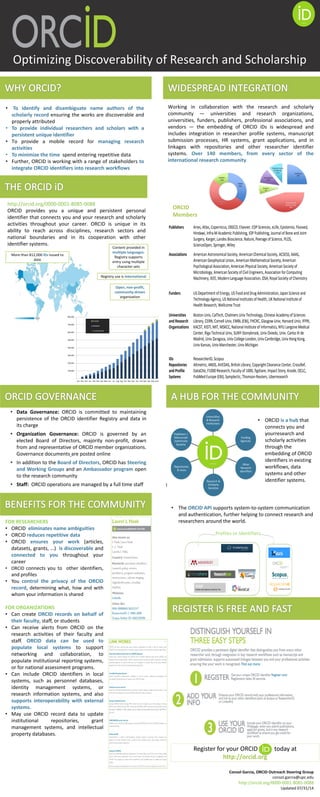
Working in collaboration with the research and scholarly 
community — universities and research organizations, 
universities, funders, publishers, professional associations, and 
vendors — the embedding of ORCID iDs is widespread and 
includes integration in researcher profile systems, manuscript 
submission processes, HR systems, grant applications, and in 
linkages with repositories and other researcher identifier 
systems. Over 140 members, from every sector of the 
international research community. 
ORCID 
Members 
Registry use is international 
More than 812,000 iDs issued to 
date 
Open, non-profit, 
community-driven 
organization 
Content provided in 
multiple languages. 
Registry supports 
entry using multiple 
character sets 
http://orcid.org/0000-0001-8085-0088 
ORCID provides you a unique and persistent personal 
identifier that connects you and your research and scholarly 
activities throughout your career. ORCID is unique in its 
ability to reach across disciplines, research sectors and 
national boundaries and in its cooperation with other 
identifier systems. 
Register for your ORCID today at 
http://orcid.org 
Publishers Aries, Atlas, Copernicus, EBSCO, Elsevier, EDP Sciences, eLife, Epistemio, Flooved, 
Hindawi, Infra-M Academic Publishing, IOP Publishing, Journal of Bone and Joint 
Surgery, Karger, Landes Bioscience, Nature, Peerage of Science, PLOS, 
ScienceOpen, Springer, Wiley 
Associations American Astronomical Society, American Chemical Society, ACSESS, AAAS, 
American Geophysical Union, American Mathematical Society, American 
Psychological Association, American Physical Society, American Society of 
Microbiology, American Society of Civil Engineers, Association for Computing 
Machinery, IEEE, Modern Language Association, OSA, Royal Society of Chemistry 
Funders US Department of Energy, US Food and Drug Administration, Japan Science and 
Technology Agency, US National Institutes of Health, UK National Institute of 
Health Research, Wellcome Trust 
Universities 
and Research 
Organizations 
Boston Univ, CalTech, Chalmers Univ Technology, Chinese Academy of Sciences 
Library, CERN, Cornell Univ, EMBL (EBI), FHCRC, Glasgow Univ, Harvard Univ, IFPRI, 
KACST, KISTI, MIT, MSKCC, National Institute of Informatics, NYU Langone Medical 
Center, Riga Technical Univ, SUNY-Stonybrook, Univ Oviedo, Univ. Carlos III de 
Madrid, Univ Zaragoza, Univ College London, Univ Cambridge, Univ Hong Kong, 
Univ Kansas, Univ Manchester, Univ Michigan 
IDs ResearcherID, Scopus 
Repositories 
and Profile 
Systems 
Altmetric, ANDS, AVEDAS, British Library, Copyright Clearance Center, CrossRef, 
DataCite, F1000 Research, Faculty of 1000, figshare, Impact Story, Knode, OCLC, 
PubMed Europe (EBI), Symplectic, Thomson Reuters, Uberresearch 
• Data Governance: ORCID is committed to maintaining 
persistence of the ORCID identifier Registry and data in 
its charge 
• Organization Governance: ORCID is governed by an 
elected Board of Directors, majority non-profit, drawn 
from and representative of ORCID member organizations. 
Governance documents are posted online 
• In addition to the Board of Directors, ORCID has Steering 
and Working Groups and an Ambassador program open 
to the research community 
• Staff: ORCID operations are managed by a full time staff 
Profiles or Identifiers 
Publishing 
25% 
Universities & 
Research Orgs 
45% 
Funders 
7% 
Associations 
12% 
Repositories & 
Profile Sys 
11% 
EMEA 
35% 
Americas 
50% 
AsiaPac 
15% 
- 
100.000 
200.000 
300.000 
400.000 
500.000 
600.000 
700.000 
800.000 
Oct Nov Dec Jan Feb Mar Apr May Jun Jul Aug Sep Oct Nov Dec Jan Feb Mar Apr May June 
Creator 
Website 
Trusted Party 
• ORCID is a hub that 
connects you and 
yourresearch and 
scholarly activities 
through the 
embedding of ORCID 
identifiers in existing 
workflows, data 
systems and other 
identifier systems. 
• The ORCID API supports system-to-system communication 
and authentication, further helping to connect research and 
researchers around the world.

ORCID IFLA 2014 Poster

  • 1.
    Optimizing Discoverability ofResearch and Scholarship • To identify and disambiguate name authors of the scholarly record ensuring the works are discoverable and properly attributed • To provide individual researchers and scholars with a persistent unique identifier • To provide a mobile record for managing research activities • To minimize the time spend entering repetitive data • Further, ORCID is working with a range of stakeholders to integrate ORCID identifiers into research workflows Consol Garcia, ORCID Outreach Steering Group consol.garcia@upc.edu http://orcid.org/0000-0001-8085-0088 Updated 07/31/14 FOR RESEARCHERS • ORCID eliminates name ambiguities • ORCID reduces repetitive data • ORCID ensures your work (articles, datasets, grants, …) is discoverable and connected to you throughout your career • ORCID connects you to other identifiers, and profiles • You control the privacy of the ORCID record, determining what, how and with whom your information is shared FOR ORGANIZATIONS • Can create ORCID records on behalf of their faculty, staff, or students • Can receive alerts from ORCID on the research activities of their faculty and staff. ORCID data can be used to populate local systems to support networking and collaboration, to populate institutional reporting systems, or for national assessment programs. • Can include ORCID identifiers in local systems, such as personnel databases, identity management systems, or research information systems, and also supports interoperability with external systems. • May use ORCID record data to update institutional repositories, grant management systems, and intellectual property databases. Working in collaboration with the research and scholarly community — universities and research organizations, universities, funders, publishers, professional associations, and vendors — the embedding of ORCID iDs is widespread and includes integration in researcher profile systems, manuscript submission processes, HR systems, grant applications, and in linkages with repositories and other researcher identifier systems. Over 140 members, from every sector of the international research community. ORCID Members Registry use is international More than 812,000 iDs issued to date Open, non-profit, community-driven organization Content provided in multiple languages. Registry supports entry using multiple character sets http://orcid.org/0000-0001-8085-0088 ORCID provides you a unique and persistent personal identifier that connects you and your research and scholarly activities throughout your career. ORCID is unique in its ability to reach across disciplines, research sectors and national boundaries and in its cooperation with other identifier systems. Register for your ORCID today at http://orcid.org Publishers Aries, Atlas, Copernicus, EBSCO, Elsevier, EDP Sciences, eLife, Epistemio, Flooved, Hindawi, Infra-M Academic Publishing, IOP Publishing, Journal of Bone and Joint Surgery, Karger, Landes Bioscience, Nature, Peerage of Science, PLOS, ScienceOpen, Springer, Wiley Associations American Astronomical Society, American Chemical Society, ACSESS, AAAS, American Geophysical Union, American Mathematical Society, American Psychological Association, American Physical Society, American Society of Microbiology, American Society of Civil Engineers, Association for Computing Machinery, IEEE, Modern Language Association, OSA, Royal Society of Chemistry Funders US Department of Energy, US Food and Drug Administration, Japan Science and Technology Agency, US National Institutes of Health, UK National Institute of Health Research, Wellcome Trust Universities and Research Organizations Boston Univ, CalTech, Chalmers Univ Technology, Chinese Academy of Sciences Library, CERN, Cornell Univ, EMBL (EBI), FHCRC, Glasgow Univ, Harvard Univ, IFPRI, KACST, KISTI, MIT, MSKCC, National Institute of Informatics, NYU Langone Medical Center, Riga Technical Univ, SUNY-Stonybrook, Univ Oviedo, Univ. Carlos III de Madrid, Univ Zaragoza, Univ College London, Univ Cambridge, Univ Hong Kong, Univ Kansas, Univ Manchester, Univ Michigan IDs ResearcherID, Scopus Repositories and Profile Systems Altmetric, ANDS, AVEDAS, British Library, Copyright Clearance Center, CrossRef, DataCite, F1000 Research, Faculty of 1000, figshare, Impact Story, Knode, OCLC, PubMed Europe (EBI), Symplectic, Thomson Reuters, Uberresearch • Data Governance: ORCID is committed to maintaining persistence of the ORCID identifier Registry and data in its charge • Organization Governance: ORCID is governed by an elected Board of Directors, majority non-profit, drawn from and representative of ORCID member organizations. Governance documents are posted online • In addition to the Board of Directors, ORCID has Steering and Working Groups and an Ambassador program open to the research community • Staff: ORCID operations are managed by a full time staff Profiles or Identifiers Publishing 25% Universities & Research Orgs 45% Funders 7% Associations 12% Repositories & Profile Sys 11% EMEA 35% Americas 50% AsiaPac 15% - 100.000 200.000 300.000 400.000 500.000 600.000 700.000 800.000 Oct Nov Dec Jan Feb Mar Apr May Jun Jul Aug Sep Oct Nov Dec Jan Feb Mar Apr May June Creator Website Trusted Party • ORCID is a hub that connects you and yourresearch and scholarly activities through the embedding of ORCID identifiers in existing workflows, data systems and other identifier systems. • The ORCID API supports system-to-system communication and authentication, further helping to connect research and researchers around the world.