Pruning Edge Research
with Latency Shears
ACM Workshop on Hot Topics in Networks (HotNets) 2020
Nitinder Mohan𝚫 Lorenzo CorneoΦ Aleksandr ZavodovskiΦ Suzan BayhanΘ
Walter Wong
⊺
Jussi Kangasharju
⊺
𝚫 Technical University of Munich ΦUppsala University ΘUniversity of Twente
⊺
University of Helsinki
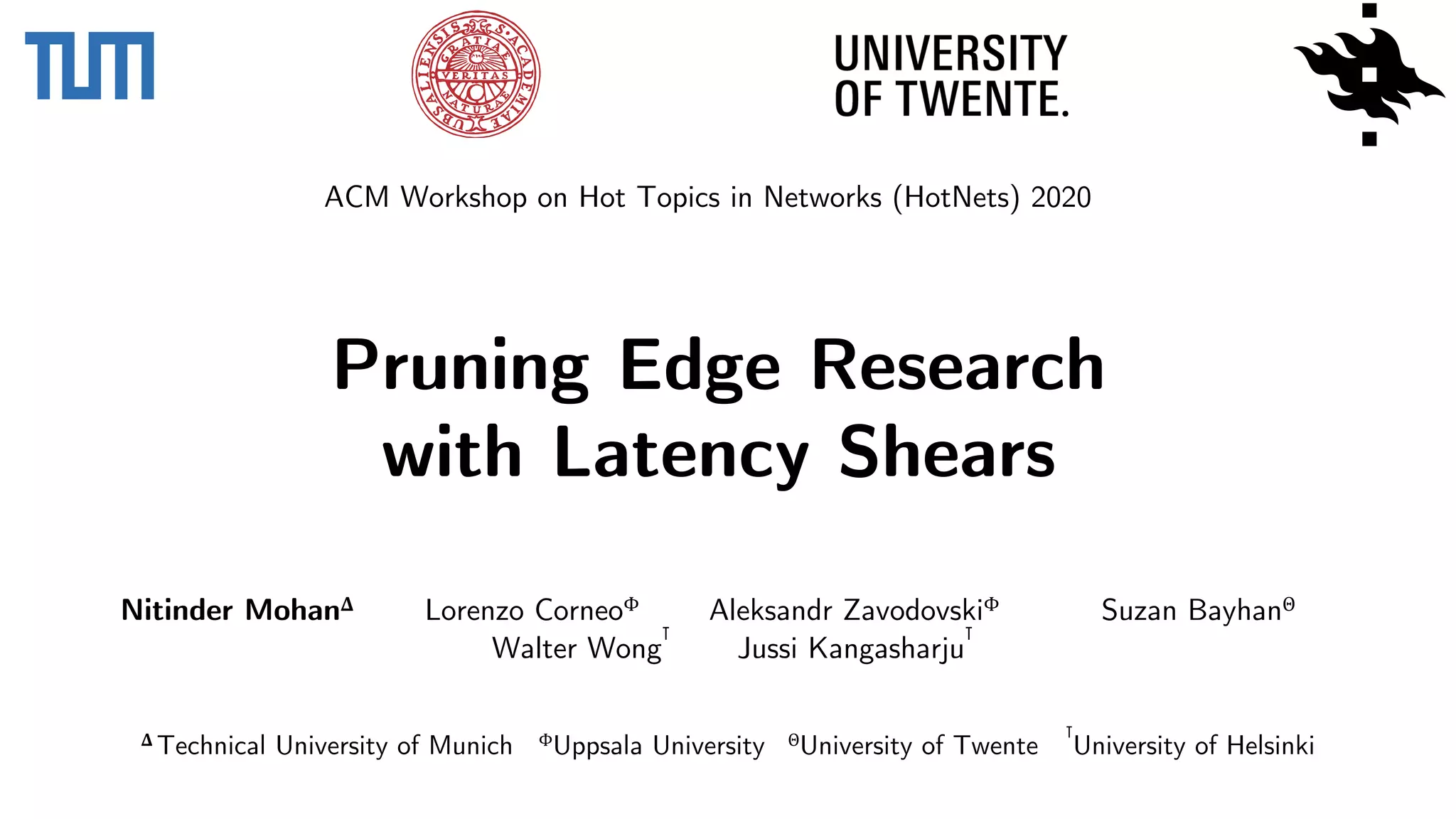
Cloud
Centralization to Clouds
Cloud
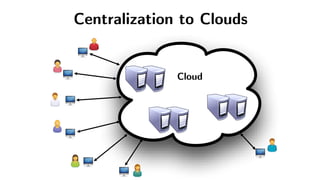
Decentralize to Edge
Edge
Edge
Edge
Cloud
Next Generation
Applications
Edge
Edge
Edge
“Next-generation applications impose strict
latency and bandwidth demands that
current cloud infrastructure cannot satisfy”*
*Introduction section of (almost) every edge computing research paper and
blog
10MB >1TB
100MB 10GB 100GB
5ms
1hr
50ms
100ms
10min
Required
Latency
Data generated/entity
Requirements
of Next-
Generation
Applications
Motion-to-Photon (10-20ms)
Perceivable
Latency (80-100ms)
Human
Reaction Time
Delay between input and
effect
Results in motion sickness
Latency becomes noticeable
to user
Results in lags
(230-250ms)
Delay between stimulus and response
Delays active human engagement
High latency, Small data
Low latency, Small data Low latency, Large data
High latency, Large data
Requirements
of Next-
Generation
Applications
Can the cloud really not support the
requirements of these applications?
101 cloud
regions from 7
major cloud
providers
Cloud Reachability
Measurements
Cloud Reachability
Measurements
RIPE Atlas probes
3200+ probes
globally
• Filtered out all the probes that are clearly installed in privileged locations,
e.g., in datacenters, ISP infrastructure, from our measurements using their
user-defined tags – 3200+ probes in 166 countries
• Measured end-to-end [probe-to-cloud] latencies via ICMP pings every two
hours
• Results based on nine months of data collected since September 2019
[~3.2M datapoints]
• Dataset is available for public use*
*check out paper for the link
Cloud Reachability
Measurements
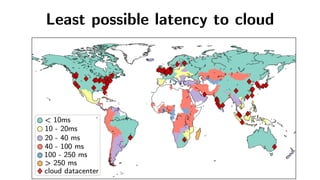
Least possible latency to cloud
• 32 countries can access cloud < 10ms
& 21 countries (totaling 70% world
population) can access cloud between
10 – 20 ms [MTP bound]
• 80% of the probes (and every probe
in EU, NA & SA) can reach cloud
within < 100ms [PL bound]
• Almost every probe (except few in
Africa) can access cloud < 250 ms
[HRT bound]
For detailed results, please refer to the paper
So where is the latency?
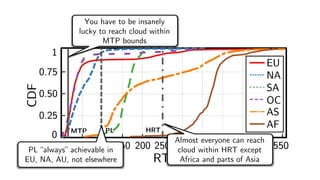
MTP PL HRT
PL “always” achievable in
EU, NA, AU, not elsewhere
You have to be insanely
lucky to reach cloud within
MTP bounds
Almost everyone can reach
cloud within HRT except
Africa and parts of Asia
Latency at last-mile
Wired
120
110
100
10
0
20
30
40
50
60
70
80
90
RTT
(ms)
Wireless
2.5x
• Many previous studies over LTE and WiFi have shown last-mile
to be the major bottleneck due to frequent packet drops,
buffebloating due to handovers, etc. [1][2]
• Filtered probes tagged “ethernet, broadband, ..” as wired and
“lte, wifi, wlan, ..” as wireless in similar regions connecting to
same cloud DC
• Results show users can experience 10-40 ms longer when
accessing over wireless (in line with previous studies [3])
• 5G promises shorter latencies (≈1 ms) but recent investigations
report otherwise [4]
Revisiting Edge-Enabling
Applications
10MB >1TB
100MB 10GB 100GB
1hr
50ms
100ms
10min
Smart home
Weather
Smart city
Wearables
Camera/
Traffic
Monitoring
Required
Latency
Data generated/entity
D2D
<$100Bn $100-300Bn $300-700Bn >$700Bn
Streaming
Remote
Surgery
Farm
360o
video
AR/VR
Gaming
AV
MTP
HRT
PL
10ms
Edge FZ
10MB >1TB
100MB 10GB 100GB
1hr
50ms
100ms
10min
Smart home
Weather
Smart city
Wearables
Camera/
Traffic
Monitoring
Required
Latency
Data generated/entity
D2D
<$100Bn $100-300Bn $300-700Bn >$700Bn
Streaming
Remote
Surgery
Farm
360o
video
AR/VR
Gaming
AV
MTP
HRT
PL
10ms
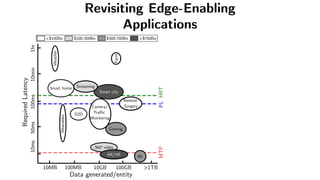
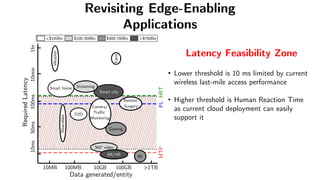
Latency Feasibility Zone
• Lower threshold is 10 ms limited by current
wireless last-mile access performance
• Higher threshold is Human Reaction Time
as current cloud deployment can easily
support it
Revisiting Edge-Enabling
Applications
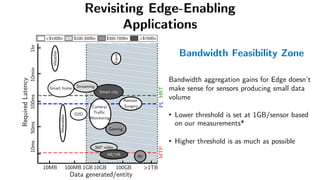
Bandwidth Feasibility Zone
Bandwidth aggregation gains for Edge doesn’t
make sense for sensors producing small data
volume
• Lower threshold is set at 1GB/sensor based
on our measurements*
• Higher threshold is as much as possible
10MB >1TB
100MB 10GB 100GB
1hr
50ms
100ms
10min
Smart home
Weather
Smart city
Wearables
Camera/
Traffic
Monitoring
Required
Latency
Data generated/entity
D2D
<$100Bn $100-300Bn $300-700Bn >$700Bn
Streaming
Remote
Surgery
Farm
360o
video
AR/VR
Gaming
AV
MTP
HRT
PL
10ms
1GB
Revisiting Edge-Enabling
Applications
10MB >1TB
100MB 10GB 100GB
1hr
50ms
100ms
10min
Smart home
Weather
Smart city
Wearables
Camera/
Traffic
Monitoring
Required
Latency
Data generated/entity
D2D
<$100Bn $100-300Bn $300-700Bn >$700Bn
Streaming
Remote
Surgery
Farm
360o
video
AR/VR
Gaming
AV
MTP
HRT
PL
10ms
1GB
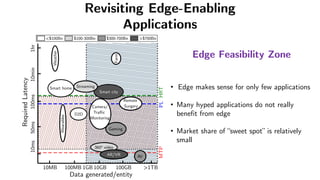
Edge Feasibility Zone
• Edge makes sense for only few applications
• Many hyped applications do not really
benefit from edge
• Market share of “sweet spot” is relatively
small
Revisiting Edge-Enabling
Applications
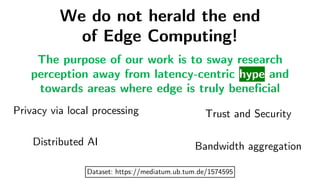
We do not herald the end
of Edge Computing!
Privacy via local processing Trust and Security
Distributed AI Bandwidth aggregation
The purpose of our work is to sway research
perception away from latency-centric hype and
towards areas where edge is truly beneficial
Dataset: https://mediatum.ub.tum.de/1574595

Pruning Edge Research with Latency Shears

  • 1.
    Pruning Edge Research withLatency Shears ACM Workshop on Hot Topics in Networks (HotNets) 2020 Nitinder Mohan𝚫 Lorenzo CorneoΦ Aleksandr ZavodovskiΦ Suzan BayhanΘ Walter Wong ⊺ Jussi Kangasharju ⊺ 𝚫 Technical University of Munich ΦUppsala University ΘUniversity of Twente ⊺ University of Helsinki
  • 2.
  • 3.
  • 4.
    Cloud Next Generation Applications Edge Edge Edge “Next-generation applicationsimpose strict latency and bandwidth demands that current cloud infrastructure cannot satisfy”* *Introduction section of (almost) every edge computing research paper and blog
  • 5.
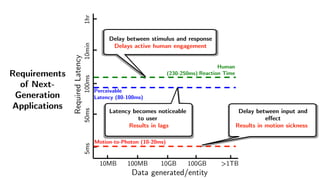
    10MB >1TB 100MB 10GB100GB 5ms 1hr 50ms 100ms 10min Required Latency Data generated/entity Requirements of Next- Generation Applications Motion-to-Photon (10-20ms) Perceivable Latency (80-100ms) Human Reaction Time Delay between input and effect Results in motion sickness Latency becomes noticeable to user Results in lags (230-250ms) Delay between stimulus and response Delays active human engagement
  • 6.
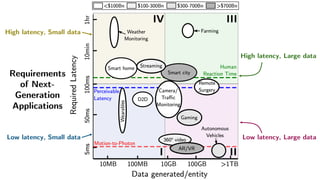
    High latency, Smalldata Low latency, Small data Low latency, Large data High latency, Large data Requirements of Next- Generation Applications
  • 7.
    Can the cloudreally not support the requirements of these applications?
  • 8.
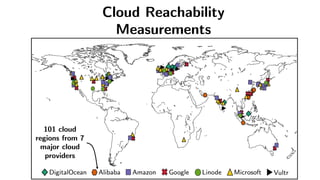
    101 cloud regions from7 major cloud providers Cloud Reachability Measurements
  • 9.
  • 10.
    3200+ probes globally • Filteredout all the probes that are clearly installed in privileged locations, e.g., in datacenters, ISP infrastructure, from our measurements using their user-defined tags – 3200+ probes in 166 countries • Measured end-to-end [probe-to-cloud] latencies via ICMP pings every two hours • Results based on nine months of data collected since September 2019 [~3.2M datapoints] • Dataset is available for public use* *check out paper for the link Cloud Reachability Measurements
  • 11.
  • 12.
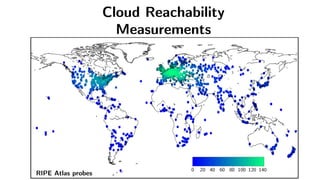
    Least possible latencyto cloud • 32 countries can access cloud < 10ms & 21 countries (totaling 70% world population) can access cloud between 10 – 20 ms [MTP bound] • 80% of the probes (and every probe in EU, NA & SA) can reach cloud within < 100ms [PL bound] • Almost every probe (except few in Africa) can access cloud < 250 ms [HRT bound] For detailed results, please refer to the paper
  • 13.
    So where isthe latency?
  • 14.
    MTP PL HRT PL“always” achievable in EU, NA, AU, not elsewhere You have to be insanely lucky to reach cloud within MTP bounds Almost everyone can reach cloud within HRT except Africa and parts of Asia
  • 15.
    Latency at last-mile Wired 120 110 100 10 0 20 30 40 50 60 70 80 90 RTT (ms) Wireless 2.5x •Many previous studies over LTE and WiFi have shown last-mile to be the major bottleneck due to frequent packet drops, buffebloating due to handovers, etc. [1][2] • Filtered probes tagged “ethernet, broadband, ..” as wired and “lte, wifi, wlan, ..” as wireless in similar regions connecting to same cloud DC • Results show users can experience 10-40 ms longer when accessing over wireless (in line with previous studies [3]) • 5G promises shorter latencies (≈1 ms) but recent investigations report otherwise [4]
  • 16.
    Revisiting Edge-Enabling Applications 10MB >1TB 100MB10GB 100GB 1hr 50ms 100ms 10min Smart home Weather Smart city Wearables Camera/ Traffic Monitoring Required Latency Data generated/entity D2D <$100Bn $100-300Bn $300-700Bn >$700Bn Streaming Remote Surgery Farm 360o video AR/VR Gaming AV MTP HRT PL 10ms Edge FZ
  • 17.
    10MB >1TB 100MB 10GB100GB 1hr 50ms 100ms 10min Smart home Weather Smart city Wearables Camera/ Traffic Monitoring Required Latency Data generated/entity D2D <$100Bn $100-300Bn $300-700Bn >$700Bn Streaming Remote Surgery Farm 360o video AR/VR Gaming AV MTP HRT PL 10ms Latency Feasibility Zone • Lower threshold is 10 ms limited by current wireless last-mile access performance • Higher threshold is Human Reaction Time as current cloud deployment can easily support it Revisiting Edge-Enabling Applications
  • 18.
    Bandwidth Feasibility Zone Bandwidthaggregation gains for Edge doesn’t make sense for sensors producing small data volume • Lower threshold is set at 1GB/sensor based on our measurements* • Higher threshold is as much as possible 10MB >1TB 100MB 10GB 100GB 1hr 50ms 100ms 10min Smart home Weather Smart city Wearables Camera/ Traffic Monitoring Required Latency Data generated/entity D2D <$100Bn $100-300Bn $300-700Bn >$700Bn Streaming Remote Surgery Farm 360o video AR/VR Gaming AV MTP HRT PL 10ms 1GB Revisiting Edge-Enabling Applications
  • 19.
    10MB >1TB 100MB 10GB100GB 1hr 50ms 100ms 10min Smart home Weather Smart city Wearables Camera/ Traffic Monitoring Required Latency Data generated/entity D2D <$100Bn $100-300Bn $300-700Bn >$700Bn Streaming Remote Surgery Farm 360o video AR/VR Gaming AV MTP HRT PL 10ms 1GB Edge Feasibility Zone • Edge makes sense for only few applications • Many hyped applications do not really benefit from edge • Market share of “sweet spot” is relatively small Revisiting Edge-Enabling Applications
  • 20.
    We do notherald the end of Edge Computing! Privacy via local processing Trust and Security Distributed AI Bandwidth aggregation The purpose of our work is to sway research perception away from latency-centric hype and towards areas where edge is truly beneficial Dataset: https://mediatum.ub.tum.de/1574595