WELCOME
Seminar Topic
on
RAIN TECHNOLOGY
Presented By
Nadha Azeez P M
MSc Second Sem
COPSCS1208
CONTENTS
 Introduction
 Goals of RAIN Technology
 Architecture
 Features of RAIN
 Advantages and Disadvantages
 Applications
 Future Scope
 Conclusion
 References
INTRODUCTION
 The name of the original research project is RAIN which stands for
Reliable Array of Independent Nodes. The RAIN technology originated in
a research project at the California Institute of Technology(Caltech), in
collaboration with NASA’s Jet Propulsion Laboratory and the Defense
Advanced Research Projects Agency(DARPA).
 A component that stores data across distributed processors and retrieves it
even if some of the processors fail
 A communications component that creates a redundant network between
multiple processors and supports a single, uniform way of connecting to any
of the processors
 A computing component that automatically recovers and restarts
applications if a processor fails
Goals of RAIN Technology
 RAIN Technology is able to offer the solution by minimizing number of
nodes in the chain connecting the client and server.
 RAIN Technology making the exiting nodes more robust andindependent
of each other.
 RAIN Technology provides the feature of replacing a faulty node by a
healthy one.
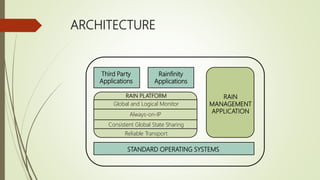
ARCHITECTURE
Third Party
Applications
Rainfinity
Applications
RAIN
MANAGEMENT
APPLICATION
STANDARD OPERATING SYSTEMS
RAIN PLATFORM
Global and Logical Monitor
Always-on-IP
Consistent Global State Sharing
Reliable Transport
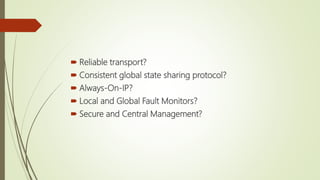
 Reliable transport?
 Consistent global state sharing protocol?
 Always-On-IP?
 Local and Global Fault Monitors?
 Secure and Central Management?
FEATURES OF RAIN
 It includes scalability and high availability.
 Many novel features in an attempt to deal with faults in nodes, network,
and data storage,Fault tolerant interconnect.
 Group members
 Data storage
Scalability
 Scalability is the ability of a system to provide throughput in proportion
to, and limited only by, available hardware resources. A scalable system is
one that can handle increasing numbers of requests without adversely
affecting response time and throughput.
High Availability
 The availability of a system or any component in that system is defined
by the percentage of time that it works normally. The formula for
determining the availability for a system is: Availability average time to
failure (ATTF) / [average time to failure (ATTF) + average time to recover
(ATTR)]
Data Storage
 Fault tolerance in data storage across many disks is obtained using
redundant storage schemes, Novel error-correcting codes have been
developed for this purpose. These are array codes that encode and
decode using simple XOR operations.
Fault Tolerance
 The ability of a system to respond gracefully to an unexpected hardware
or software failure. There are many levels of fault tolerance, the lowest
being the ability to continue operation in the event of a power failure
Advantages
 There is no limit on the size of a RAIN cluster
 There is no concept of master-slave relation.
 A RAIN cluster can tolerate multiple node failure.
 This is highly efficiency in traffic management.
 New node can be added into the cluster to participate in load sharing.
 It work with many different intermit application
Disadvantages
Rain technology suffers with some drawback as specified below:
 As the rain technology requires placement of switches in between
ofstructure, so it becomes little expensive.
 Secondly, Installation andconfiguration is time consuming andrequires
maintenance also.
 Although if the node of the topology fails, it will not disturb the topology
completely as mentioned above but if the switch fails, it affects the
network partially and switch has to be repaired as early as possible.
Applications
 High Availability Video Server
 High Availability Web Server
 Distributed Check pointing Mechanism
Future Scope
 Development of API's for using the various building blocks.
 The implementation of a real distributed file system using thepartitioning
scheme developed here.
 The group communication protocols are being extended toaddress more
challenging scenarios.
Conclusion
 The goal of the RAIN project has been to build a test-bed for various
building blocks that address fault management.
 Communication and storage in a distributed environment.
 The creation of such building blocks is important for the development of
a fully functional distributed computing system.
References
 www.Wikipedia.com
 www.google.com
 www.seminartime.com
 www.campusfever.com
THANK YOU

Rain technology seminar

  • 1.
  • 2.
    Seminar Topic on RAIN TECHNOLOGY PresentedBy Nadha Azeez P M MSc Second Sem COPSCS1208
  • 3.
    CONTENTS  Introduction  Goalsof RAIN Technology  Architecture  Features of RAIN  Advantages and Disadvantages  Applications  Future Scope  Conclusion  References
  • 4.
    INTRODUCTION  The nameof the original research project is RAIN which stands for Reliable Array of Independent Nodes. The RAIN technology originated in a research project at the California Institute of Technology(Caltech), in collaboration with NASA’s Jet Propulsion Laboratory and the Defense Advanced Research Projects Agency(DARPA).  A component that stores data across distributed processors and retrieves it even if some of the processors fail  A communications component that creates a redundant network between multiple processors and supports a single, uniform way of connecting to any of the processors  A computing component that automatically recovers and restarts applications if a processor fails
  • 5.
    Goals of RAINTechnology  RAIN Technology is able to offer the solution by minimizing number of nodes in the chain connecting the client and server.  RAIN Technology making the exiting nodes more robust andindependent of each other.  RAIN Technology provides the feature of replacing a faulty node by a healthy one.
  • 6.
    ARCHITECTURE Third Party Applications Rainfinity Applications RAIN MANAGEMENT APPLICATION STANDARD OPERATINGSYSTEMS RAIN PLATFORM Global and Logical Monitor Always-on-IP Consistent Global State Sharing Reliable Transport
  • 7.
     Reliable transport? Consistent global state sharing protocol?  Always-On-IP?  Local and Global Fault Monitors?  Secure and Central Management?
  • 8.
    FEATURES OF RAIN It includes scalability and high availability.  Many novel features in an attempt to deal with faults in nodes, network, and data storage,Fault tolerant interconnect.  Group members  Data storage
  • 9.
    Scalability  Scalability isthe ability of a system to provide throughput in proportion to, and limited only by, available hardware resources. A scalable system is one that can handle increasing numbers of requests without adversely affecting response time and throughput.
  • 10.
    High Availability  Theavailability of a system or any component in that system is defined by the percentage of time that it works normally. The formula for determining the availability for a system is: Availability average time to failure (ATTF) / [average time to failure (ATTF) + average time to recover (ATTR)]
  • 11.
    Data Storage  Faulttolerance in data storage across many disks is obtained using redundant storage schemes, Novel error-correcting codes have been developed for this purpose. These are array codes that encode and decode using simple XOR operations.
  • 12.
    Fault Tolerance  Theability of a system to respond gracefully to an unexpected hardware or software failure. There are many levels of fault tolerance, the lowest being the ability to continue operation in the event of a power failure
  • 13.
    Advantages  There isno limit on the size of a RAIN cluster  There is no concept of master-slave relation.  A RAIN cluster can tolerate multiple node failure.  This is highly efficiency in traffic management.  New node can be added into the cluster to participate in load sharing.  It work with many different intermit application
  • 14.
    Disadvantages Rain technology sufferswith some drawback as specified below:  As the rain technology requires placement of switches in between ofstructure, so it becomes little expensive.  Secondly, Installation andconfiguration is time consuming andrequires maintenance also.  Although if the node of the topology fails, it will not disturb the topology completely as mentioned above but if the switch fails, it affects the network partially and switch has to be repaired as early as possible.
  • 15.
    Applications  High AvailabilityVideo Server  High Availability Web Server  Distributed Check pointing Mechanism
  • 16.
    Future Scope  Developmentof API's for using the various building blocks.  The implementation of a real distributed file system using thepartitioning scheme developed here.  The group communication protocols are being extended toaddress more challenging scenarios.
  • 17.
    Conclusion  The goalof the RAIN project has been to build a test-bed for various building blocks that address fault management.  Communication and storage in a distributed environment.  The creation of such building blocks is important for the development of a fully functional distributed computing system.
  • 18.
    References  www.Wikipedia.com  www.google.com www.seminartime.com  www.campusfever.com
  • 19.