ICON:
Intelligent Container Overlays
A. Zavodovski, N. Mohan, S. Bayhan, W. Wong and J. Kangasharju

HotNets 2018,
November 15-16, 2018
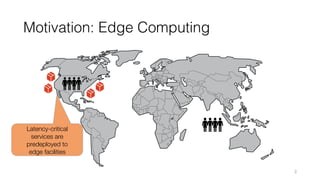
Motivation: Edge Computing
2
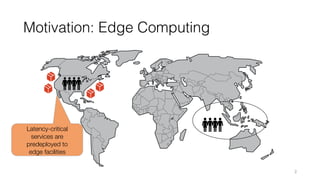
Motivation: Edge Computing
2
Latency-critical
services are
predeployed to
edge facilities
Motivation: Edge Computing
2
Latency-critical
services are
predeployed to
edge facilities
Motivation: Edge Computing
2
Latency-critical
services are
predeployed to
edge facilities
Motivation: Edge Computing
2
Latency-critical
services are
predeployed to
edge facilities
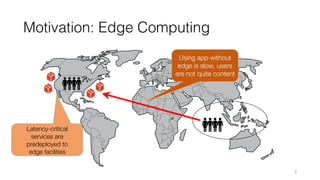
Motivation: Edge Computing
2
Latency-critical
services are
predeployed to
edge facilities
Using app without
edge is slow, users
are not quite content
Motivation: Edge Computing
2
Latency-critical
services are
predeployed to
edge facilities
How to discover local
edge servers? Are there
any?
Using app without
edge is slow, users
are not quite content
3
CDN for Services?
NO!
3
CDN for Services?
NO!
3
CDN for Services?
Open Standards
NO!
3
CDN for Services?
Decentralized Solution
Open Standards
NO!
3
CDN for Services?
Something like the Internet!
Decentralized Solution
Open Standards
Motivation
• Growing demand for edge computing, making edge pervasive
• Applications should unfold towards the edge autonomously
• Managing applications by setting only high level objectives
• Autonomous adaptation to the changing environment
4
Motivation
• Growing demand for edge computing, making edge pervasive
• Applications should unfold towards the edge autonomously
• Managing applications by setting only high level objectives
• Autonomous adaptation to the changing environment
• Towards common standards of self-organized service
provisioning on global scale
4
Motivation
• Growing demand for edge computing, making edge pervasive
• Applications should unfold towards the edge autonomously
• Managing applications by setting only high level objectives
• Autonomous adaptation to the changing environment
• Towards common standards of self-organized service
provisioning on global scale
• Not only about the edge!
4
ICON: Intelligent Container
• Virtualized entity containing a service
• Built on top of Docker container, VM, unikernel, etc.
• Oriented towards microservices architecture (application is a collection of
loosely coupled services)
5
ICON: Intelligent Container
• Virtualized entity containing a service
• Built on top of Docker container, VM, unikernel, etc.
• Oriented towards microservices architecture (application is a collection of
loosely coupled services)
• Capable of observing the environment
• Monitors where incoming flows come from
• Discovers potential deployment locations
6
ICON: Intelligent Container
• Virtualized entity containing a service
• Built on top of Docker container, VM, unikernel, etc.
• Oriented towards microservices architecture (application is a collection of
loosely coupled services)
• Capable of observing the environment
• Monitors where incoming flows come from
• Discovers potential deployment locations
• Capable of taking decisions and acting autonomously
• Migrates or replicates closer to end-users to satisfy, e.g., latency objectives
• Terminates if utility falls below predefined threshold
7
Operation of ICON
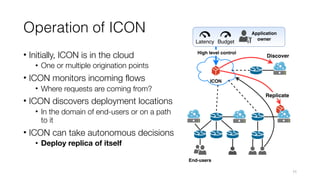
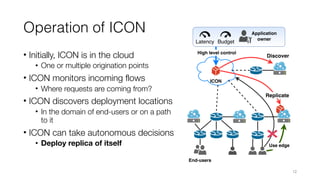
• Initially, ICON is in the cloud
• One or multiple origination points
8
Operation of ICON
• Initially, ICON is in the cloud
• One or multiple origination points
• ICON monitors incoming flows
• Where requests are coming from?
9
Operation of ICON
• Initially, ICON is in the cloud
• One or multiple origination points
• ICON monitors incoming flows
• Where requests are coming from?
• ICON discovers deployment
locations
• In the domain of end-users or on a
path to it
10
Operation of ICON
• Initially, ICON is in the cloud
• One or multiple origination points
• ICON monitors incoming flows
• Where requests are coming from?
• ICON discovers deployment locations
• In the domain of end-users or on a path
to it
• ICON can take autonomous decisions
• Deploy replica of itself
11
Operation of ICON
• Initially, ICON is in the cloud
• One or multiple origination points
• ICON monitors incoming flows
• Where requests are coming from?
• ICON discovers deployment locations
• In the domain of end-users or on a path
to it
• ICON can take autonomous decisions
• Deploy replica of itself
12
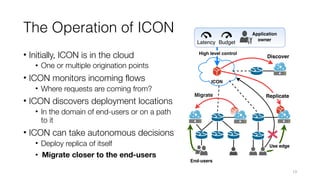
The Operation of ICON
• Initially, ICON is in the cloud
• One or multiple origination points
• ICON monitors incoming flows
• Where requests are coming from?
• ICON discovers deployment locations
• In the domain of end-users or on a path
to it
• ICON can take autonomous decisions
• Deploy replica of itself
• Migrate closer to the end-users
13
Overlay of ICONs
14
Tokyo
Origin
Overlay of ICONs
15
Tokyo
Wellington
LisbonNew
York
Origin
Overlay of ICONs
16
Tokyo
Wellington
LisbonNew
York
Los
Angeles
Rio
Origin
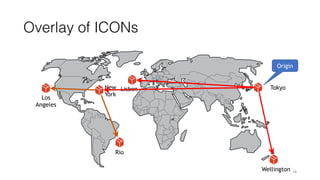
Overlay of ICONs
• Tree is formed organically as ICONs
deploy replicas of themselves
• Efficient for information propagation
• Coordination
• Control
• Other topologies are possible (e.g.,
swarm)
17
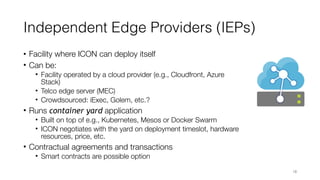
Independent Edge Providers (IEPs)
• Facility where ICON can deploy itself
• Can be:
• Facility operated by a cloud provider (e.g., Cloudfront, Azure
Stack)
• Telco edge server (MEC)
• Crowdsourced: iExec, Golem, etc.?
• Runs container yard application
• Built on top of e.g., Kubernetes, Mesos or Docker Swarm
• ICON negotiates with the yard on deployment timeslot, hardware
resources, price, etc.
• Contractual agreements and transactions
• Smart contracts are possible option
18
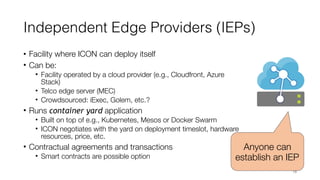
Independent Edge Providers (IEPs)
• Facility where ICON can deploy itself
• Can be:
• Facility operated by a cloud provider (e.g., Cloudfront, Azure
Stack)
• Telco edge server (MEC)
• Crowdsourced: iExec, Golem, etc.?
• Runs container yard application
• Built on top of e.g., Kubernetes, Mesos or Docker Swarm
• ICON negotiates with the yard on deployment timeslot, hardware
resources, price, etc.
• Contractual agreements and transactions
• Smart contracts are possible option
18
Anyone can
establish an IEP
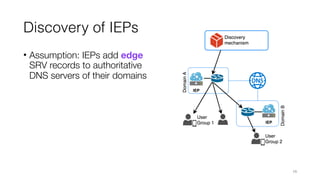
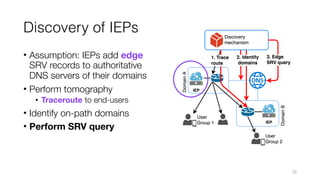
Discovery of IEPs
• Assumption: IEPs add edge
SRV records to authoritative
DNS servers of their domains
19
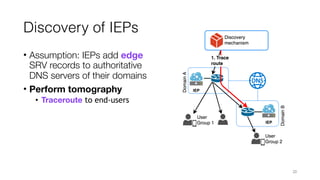
Discovery of IEPs
• Assumption: IEPs add edge
SRV records to authoritative
DNS servers of their domains
• Perform tomography
• Traceroute to end-users
20
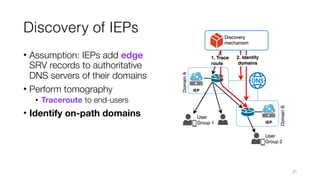
Discovery of IEPs
• Assumption: IEPs add edge
SRV records to authoritative
DNS servers of their domains
• Perform tomography
• Traceroute to end-users
• Identify on-path domains
21
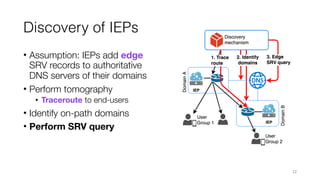
Discovery of IEPs
• Assumption: IEPs add edge
SRV records to authoritative
DNS servers of their domains
• Perform tomography
• Traceroute to end-users
• Identify on-path domains
• Perform SRV query
22
Discovery of IEPs
• Assumption: IEPs add edge
SRV records to authoritative
DNS servers of their domains
• Perform tomography
• Traceroute to end-users
• Identify on-path domains
• Perform SRV query
22
Discovery of IEPs
• Assumption: IEPs add edge
SRV records to authoritative
DNS servers of their domains
• Perform tomography
• Traceroute to end-users
• Identify on-path domains
• Perform SRV query
22
Intelligence of ICONs
• Easy version: Governed by utility function
• Weights are “control knobs”, e.g., budget vs. latency
• Application owner can also “hotswap” the entire utility function
• Thresholds: When expected utility of an action exceeds certain
boundary value:
• Replicate
• Migrate
• Terminate
• More complex version: Overlay forms a picture of the world and
adapts the network as a whole
23
Open Questions
24
Open Questions
• Intelligence
• What kind of intelligence do ICONs need?
24
Open Questions
• Intelligence
• What kind of intelligence do ICONs need?
• Discovery of the closest ICON
• How new clients will discover the ICON which is closest to them?
24
Open Questions
• Intelligence
• What kind of intelligence do ICONs need?
• Discovery of the closest ICON
• How new clients will discover the ICON which is closest to them?
• Security
• Trusted execution environments?
24
Open Questions
• Intelligence
• What kind of intelligence do ICONs need?
• Discovery of the closest ICON
• How new clients will discover the ICON which is closest to them?
• Security
• Trusted execution environments?
• Contractual agreement between ICON and independent edge
providers
• Are smart contracts the best option?
24
Future Work
25
Future Work
• Implementing container yard for hosting ICONs
25
Future Work
• Implementing container yard for hosting ICONs
• Negotiation protocol
• Like all routers support IP, facilities providing capacity to run services should
support some common protocol to negotiate on new service deployment
25
Future Work
• Implementing container yard for hosting ICONs
• Negotiation protocol
• Like all routers support IP, facilities providing capacity to run services should
support some common protocol to negotiate on new service deployment
• Sophisticated intelligence
• Proactively predicting where from most of the requests will come
25
Future Work
• Implementing container yard for hosting ICONs
• Negotiation protocol
• Like all routers support IP, facilities providing capacity to run services should
support some common protocol to negotiate on new service deployment
• Sophisticated intelligence
• Proactively predicting where from most of the requests will come
• Game theoretic analysis
• What if two (or more) competing applications are deployed using ICONs?
25
Future Work
• Implementing container yard for hosting ICONs
• Negotiation protocol
• Like all routers support IP, facilities providing capacity to run services should
support some common protocol to negotiate on new service deployment
• Sophisticated intelligence
• Proactively predicting where from most of the requests will come
• Game theoretic analysis
• What if two (or more) competing applications are deployed using ICONs?
• Specialized ICONs forming chains of services, and multitier apps
• Not limited to edge, e.g., a database may also be packed as ICON
• How to coordinate?
25
Summary: Why ICONs?
26
Summary: Why ICONs?
• IEPs to tackle growing demand for edge computing
• Less cloud monopoly
26
Summary: Why ICONs?
• IEPs to tackle growing demand for edge computing
• Less cloud monopoly
• Open infrastructure standards to enable ad hoc deployment of
services on global scale
26
Summary: Why ICONs?
• IEPs to tackle growing demand for edge computing
• Less cloud monopoly
• Open infrastructure standards to enable ad hoc deployment of
services on global scale
• Reducing administrative overhead: applications move across the
network themselves following high level objectives
26
Summary: Why ICONs?
• IEPs to tackle growing demand for edge computing
• Less cloud monopoly
• Open infrastructure standards to enable ad hoc deployment of
services on global scale
• Reducing administrative overhead: applications move across the
network themselves following high level objectives
• Taking advantage of autonomous local decision-making leads to
faster adaptation to changing environment
26
Summary: Why ICONs?
• IEPs to tackle growing demand for edge computing
• Less cloud monopoly
• Open infrastructure standards to enable ad hoc deployment of
services on global scale
• Reducing administrative overhead: applications move across the
network themselves following high level objectives
• Taking advantage of autonomous local decision-making leads to
faster adaptation to changing environment
26
Thank you!
Summary: Why ICONs?
• IEPs to tackle growing demand for edge computing
• Less cloud monopoly
• Open infrastructure standards to enable ad hoc deployment of
services on global scale
• Reducing administrative overhead: applications move across the
network themselves following high level objectives
• Taking advantage of autonomous local decision-making leads to
faster adaptation to changing environment
26
Thank you! aleksandr.zavodovski@helsinki.fi

ICON: Intelligent Container Overlays

  • 1.
    ICON: Intelligent Container Overlays A.Zavodovski, N. Mohan, S. Bayhan, W. Wong and J. Kangasharju
 HotNets 2018, November 15-16, 2018
  • 2.
  • 3.
  • 4.
  • 5.
  • 6.
  • 7.
    Motivation: Edge Computing 2 Latency-critical servicesare predeployed to edge facilities Using app without edge is slow, users are not quite content
  • 8.
    Motivation: Edge Computing 2 Latency-critical servicesare predeployed to edge facilities How to discover local edge servers? Are there any? Using app without edge is slow, users are not quite content
  • 9.
  • 10.
  • 11.
  • 12.
  • 13.
    NO! 3 CDN for Services? Somethinglike the Internet! Decentralized Solution Open Standards
  • 14.
    Motivation • Growing demandfor edge computing, making edge pervasive • Applications should unfold towards the edge autonomously • Managing applications by setting only high level objectives • Autonomous adaptation to the changing environment 4
  • 15.
    Motivation • Growing demandfor edge computing, making edge pervasive • Applications should unfold towards the edge autonomously • Managing applications by setting only high level objectives • Autonomous adaptation to the changing environment • Towards common standards of self-organized service provisioning on global scale 4
  • 16.
    Motivation • Growing demandfor edge computing, making edge pervasive • Applications should unfold towards the edge autonomously • Managing applications by setting only high level objectives • Autonomous adaptation to the changing environment • Towards common standards of self-organized service provisioning on global scale • Not only about the edge! 4
  • 17.
    ICON: Intelligent Container •Virtualized entity containing a service • Built on top of Docker container, VM, unikernel, etc. • Oriented towards microservices architecture (application is a collection of loosely coupled services) 5
  • 18.
    ICON: Intelligent Container •Virtualized entity containing a service • Built on top of Docker container, VM, unikernel, etc. • Oriented towards microservices architecture (application is a collection of loosely coupled services) • Capable of observing the environment • Monitors where incoming flows come from • Discovers potential deployment locations 6
  • 19.
    ICON: Intelligent Container •Virtualized entity containing a service • Built on top of Docker container, VM, unikernel, etc. • Oriented towards microservices architecture (application is a collection of loosely coupled services) • Capable of observing the environment • Monitors where incoming flows come from • Discovers potential deployment locations • Capable of taking decisions and acting autonomously • Migrates or replicates closer to end-users to satisfy, e.g., latency objectives • Terminates if utility falls below predefined threshold 7
  • 20.
    Operation of ICON •Initially, ICON is in the cloud • One or multiple origination points 8
  • 21.
    Operation of ICON •Initially, ICON is in the cloud • One or multiple origination points • ICON monitors incoming flows • Where requests are coming from? 9
  • 22.
    Operation of ICON •Initially, ICON is in the cloud • One or multiple origination points • ICON monitors incoming flows • Where requests are coming from? • ICON discovers deployment locations • In the domain of end-users or on a path to it 10
  • 23.
    Operation of ICON •Initially, ICON is in the cloud • One or multiple origination points • ICON monitors incoming flows • Where requests are coming from? • ICON discovers deployment locations • In the domain of end-users or on a path to it • ICON can take autonomous decisions • Deploy replica of itself 11
  • 24.
    Operation of ICON •Initially, ICON is in the cloud • One or multiple origination points • ICON monitors incoming flows • Where requests are coming from? • ICON discovers deployment locations • In the domain of end-users or on a path to it • ICON can take autonomous decisions • Deploy replica of itself 12
  • 25.
    The Operation ofICON • Initially, ICON is in the cloud • One or multiple origination points • ICON monitors incoming flows • Where requests are coming from? • ICON discovers deployment locations • In the domain of end-users or on a path to it • ICON can take autonomous decisions • Deploy replica of itself • Migrate closer to the end-users 13
  • 26.
  • 27.
  • 28.
  • 29.
    Overlay of ICONs •Tree is formed organically as ICONs deploy replicas of themselves • Efficient for information propagation • Coordination • Control • Other topologies are possible (e.g., swarm) 17
  • 30.
    Independent Edge Providers(IEPs) • Facility where ICON can deploy itself • Can be: • Facility operated by a cloud provider (e.g., Cloudfront, Azure Stack) • Telco edge server (MEC) • Crowdsourced: iExec, Golem, etc.? • Runs container yard application • Built on top of e.g., Kubernetes, Mesos or Docker Swarm • ICON negotiates with the yard on deployment timeslot, hardware resources, price, etc. • Contractual agreements and transactions • Smart contracts are possible option 18
  • 31.
    Independent Edge Providers(IEPs) • Facility where ICON can deploy itself • Can be: • Facility operated by a cloud provider (e.g., Cloudfront, Azure Stack) • Telco edge server (MEC) • Crowdsourced: iExec, Golem, etc.? • Runs container yard application • Built on top of e.g., Kubernetes, Mesos or Docker Swarm • ICON negotiates with the yard on deployment timeslot, hardware resources, price, etc. • Contractual agreements and transactions • Smart contracts are possible option 18 Anyone can establish an IEP
  • 32.
    Discovery of IEPs •Assumption: IEPs add edge SRV records to authoritative DNS servers of their domains 19
  • 33.
    Discovery of IEPs •Assumption: IEPs add edge SRV records to authoritative DNS servers of their domains • Perform tomography • Traceroute to end-users 20
  • 34.
    Discovery of IEPs •Assumption: IEPs add edge SRV records to authoritative DNS servers of their domains • Perform tomography • Traceroute to end-users • Identify on-path domains 21
  • 35.
    Discovery of IEPs •Assumption: IEPs add edge SRV records to authoritative DNS servers of their domains • Perform tomography • Traceroute to end-users • Identify on-path domains • Perform SRV query 22
  • 36.
    Discovery of IEPs •Assumption: IEPs add edge SRV records to authoritative DNS servers of their domains • Perform tomography • Traceroute to end-users • Identify on-path domains • Perform SRV query 22
  • 37.
    Discovery of IEPs •Assumption: IEPs add edge SRV records to authoritative DNS servers of their domains • Perform tomography • Traceroute to end-users • Identify on-path domains • Perform SRV query 22
  • 38.
    Intelligence of ICONs •Easy version: Governed by utility function • Weights are “control knobs”, e.g., budget vs. latency • Application owner can also “hotswap” the entire utility function • Thresholds: When expected utility of an action exceeds certain boundary value: • Replicate • Migrate • Terminate • More complex version: Overlay forms a picture of the world and adapts the network as a whole 23
  • 39.
  • 40.
    Open Questions • Intelligence •What kind of intelligence do ICONs need? 24
  • 41.
    Open Questions • Intelligence •What kind of intelligence do ICONs need? • Discovery of the closest ICON • How new clients will discover the ICON which is closest to them? 24
  • 42.
    Open Questions • Intelligence •What kind of intelligence do ICONs need? • Discovery of the closest ICON • How new clients will discover the ICON which is closest to them? • Security • Trusted execution environments? 24
  • 43.
    Open Questions • Intelligence •What kind of intelligence do ICONs need? • Discovery of the closest ICON • How new clients will discover the ICON which is closest to them? • Security • Trusted execution environments? • Contractual agreement between ICON and independent edge providers • Are smart contracts the best option? 24
  • 44.
  • 45.
    Future Work • Implementingcontainer yard for hosting ICONs 25
  • 46.
    Future Work • Implementingcontainer yard for hosting ICONs • Negotiation protocol • Like all routers support IP, facilities providing capacity to run services should support some common protocol to negotiate on new service deployment 25
  • 47.
    Future Work • Implementingcontainer yard for hosting ICONs • Negotiation protocol • Like all routers support IP, facilities providing capacity to run services should support some common protocol to negotiate on new service deployment • Sophisticated intelligence • Proactively predicting where from most of the requests will come 25
  • 48.
    Future Work • Implementingcontainer yard for hosting ICONs • Negotiation protocol • Like all routers support IP, facilities providing capacity to run services should support some common protocol to negotiate on new service deployment • Sophisticated intelligence • Proactively predicting where from most of the requests will come • Game theoretic analysis • What if two (or more) competing applications are deployed using ICONs? 25
  • 49.
    Future Work • Implementingcontainer yard for hosting ICONs • Negotiation protocol • Like all routers support IP, facilities providing capacity to run services should support some common protocol to negotiate on new service deployment • Sophisticated intelligence • Proactively predicting where from most of the requests will come • Game theoretic analysis • What if two (or more) competing applications are deployed using ICONs? • Specialized ICONs forming chains of services, and multitier apps • Not limited to edge, e.g., a database may also be packed as ICON • How to coordinate? 25
  • 50.
  • 51.
    Summary: Why ICONs? •IEPs to tackle growing demand for edge computing • Less cloud monopoly 26
  • 52.
    Summary: Why ICONs? •IEPs to tackle growing demand for edge computing • Less cloud monopoly • Open infrastructure standards to enable ad hoc deployment of services on global scale 26
  • 53.
    Summary: Why ICONs? •IEPs to tackle growing demand for edge computing • Less cloud monopoly • Open infrastructure standards to enable ad hoc deployment of services on global scale • Reducing administrative overhead: applications move across the network themselves following high level objectives 26
  • 54.
    Summary: Why ICONs? •IEPs to tackle growing demand for edge computing • Less cloud monopoly • Open infrastructure standards to enable ad hoc deployment of services on global scale • Reducing administrative overhead: applications move across the network themselves following high level objectives • Taking advantage of autonomous local decision-making leads to faster adaptation to changing environment 26
  • 55.
    Summary: Why ICONs? •IEPs to tackle growing demand for edge computing • Less cloud monopoly • Open infrastructure standards to enable ad hoc deployment of services on global scale • Reducing administrative overhead: applications move across the network themselves following high level objectives • Taking advantage of autonomous local decision-making leads to faster adaptation to changing environment 26 Thank you!
  • 56.
    Summary: Why ICONs? •IEPs to tackle growing demand for edge computing • Less cloud monopoly • Open infrastructure standards to enable ad hoc deployment of services on global scale • Reducing administrative overhead: applications move across the network themselves following high level objectives • Taking advantage of autonomous local decision-making leads to faster adaptation to changing environment 26 Thank you! aleksandr.zavodovski@helsinki.fi