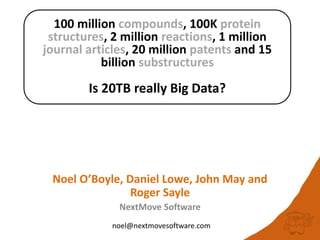
100 million compounds, 100K protein
structures, 2 million reactions, 1 million
journal articles, 20 million patents and 15
billion substructures
Is 20TB really Big Data?
Noel O’Boyle, Daniel Lowe, John May and
Roger Sayle
NextMove Software
From Big Data to Chemical Information (RSC CICAG) 22 April 2015 London
Big Data is…
“…a broad term for data sets so large or complex
that traditional data processing applications are
inadequate.” [Wikipedia]
Any dataset could be considered Big Data
without sufficiently efficient algorithms and
tools
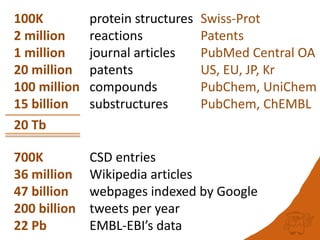
100K protein structures
2 million reactions
1 million journal articles
20 million patents
100 million compounds
15 billion substructures
Swiss-Prot
Patents
PubMed Central OA
US, EU, JP, Kr
PubChem, UniChem
PubChem, ChEMBL
700K CSD entries
36 million Wikipedia articles
47 billion webpages indexed by Google
200 billion tweets per year
22 Pb EMBL-EBI’s data
20 Tb
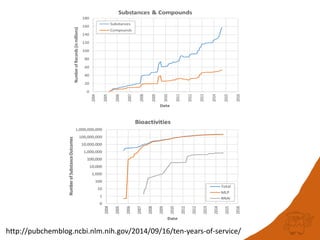
http://pubchemblog.ncbi.nlm.nih.gov/2014/09/16/ten-years-of-service/
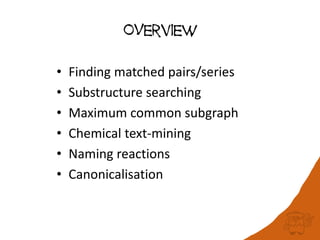
OVerview
• Finding matched pairs/series
• Substructure searching
• Maximum common subgraph
• Chemical text-mining
• Naming reactions
• Canonicalisation
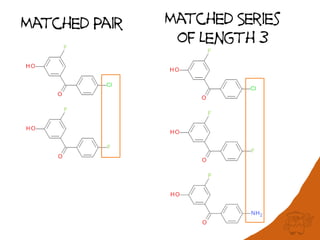
Matched Pair Matched Series
of Length 3
+
+
+
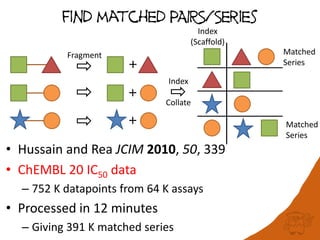
find matched PAIRS/Series
Fragment
Index
Collate
Index
(Scaffold)
Matched
Series
• Hussain and Rea JCIM 2010, 50, 339
• ChEMBL 20 IC50 data
– 752 K datapoints from 64 K assays
• Processed in 12 minutes
– Giving 391 K matched series
Matched
Series
“Google searches are screamingly fast, so fast
that the type-ahead feature is doing the search
as you key characters in. Why are all chemical
searches so sloooow? … Ideally, as you sketch
your mol in, the searches should be happening
at the same pace, like the typeahead feature.”
John Van Drie, Nov 2011
Via Rajarshi Guha’s blog
http://blog.rguha.net/?p=993
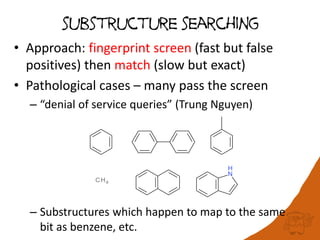
substructure searching
• Approach: fingerprint screen (fast but false
positives) then match (slow but exact)
• Pathological cases – many pass the screen
– “denial of service queries” (Trung Nguyen)
– Substructures which happen to map to the same
bit as benzene, etc.
Faster Substructure searching
• Worst-case behaviour dominated by slow
matching
– This implies focus should be on faster matching
• Typical substructures can be expressed as
SMARTS patterns
– Arthor: fast SMARTS matching against a database
• Test set: Structure Query Collection (Andrew
Dalke, BindingDB)
– Time to count hits for 3323 queries against
eMolecules (6.9 million)
Optimised smarts matching
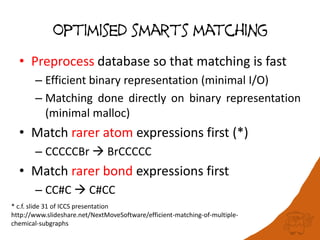
• Preprocess database so that matching is fast
– Efficient binary representation (minimal I/O)
– Matching done directly on binary representation
(minimal malloc)
• Match rarer atom expressions first (*)
– CCCCCBr  BrCCCCC
• Match rarer bond expressions first
– CC#C  C#CC
* c.f. slide 31 of ICCS presentation
http://www.slideshare.net/NextMoveSoftware/efficient-matching-of-multiple-
chemical-subgraphs
Time (ms)
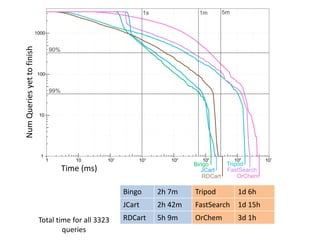
Bingo 2h 7m Tripod 1d 6h
JCart 2h 42m FastSearch 1d 15h
RDCart 5h 9m OrChem 3d 1h
NumQueriesyettofinish
Total time for all 3323
queries
Time (ms)
NumQueriesyettofinish
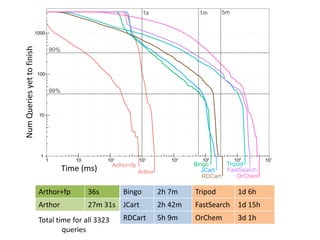
Arthor+fp 36s
Arthor 27m 31s
Bingo 2h 7m Tripod 1d 6h
JCart 2h 42m FastSearch 1d 15h
RDCart 5h 9m OrChem 3d 1hTotal time for all 3323
queries
What about even larger
databases?
• Imagine a chemical database 100 times larger
than PubChem
– Search time scales linearly, so even Arthor will
take 100 times longer to search it
• A completely different approach is needed
• SmallWorld: sublinear searching by
precalculating all possible substructures and
their relationships
– The catch: disk space, and takes months of CPU-
time to generate (here’s one we made earlier)
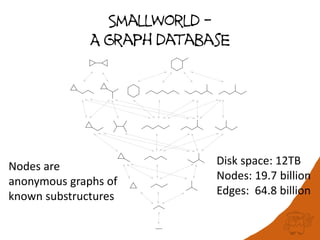
SmallWorld -
A Graph database
Nodes are
anonymous graphs of
known substructures
Disk space: 12TB
Nodes: 19.7 billion
Edges: 64.8 billion
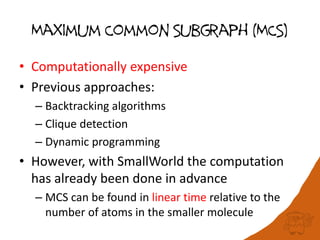
Maximum Common Subgraph (MCS)
• Computationally expensive
• Previous approaches:
– Backtracking algorithms
– Clique detection
– Dynamic programming
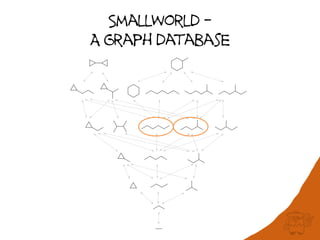
• However, with SmallWorld the computation
has already been done in advance
– MCS can be found in linear time relative to the
number of atoms in the smaller molecule
SmallWorld -
A Graph database
Chemical Text-Mining Big Data
• LeadMine for chemical entity extraction from text
– Performance: Finds ~90% of chemical structures
(compared to inter-annotator agreement of 91%*)
• Method:
– Dictionaries (e.g. list of common English words, trivial
chemical names) and grammars (e.g. all possible
IUPAC names)
– Speed just depends on the number of dictionaries
– Any dictionary can be used with spelling correction
* Krallinger et al, J. Cheminf. 2015, 7, S2
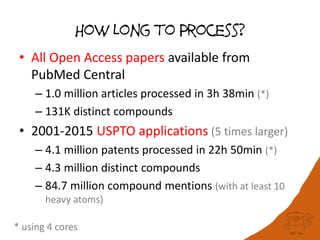
How Long to Process?
• All Open Access papers available from
PubMed Central
– 1.0 million articles processed in 3h 38min (*)
– 131K distinct compounds
• 2001-2015 USPTO applications (5 times larger)
– 4.1 million patents processed in 22h 50min (*)
– 4.3 million distinct compounds
– 84.7 million compound mentions (with at least 10
heavy atoms)
* using 4 cores
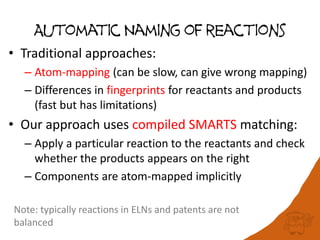
Automatic Naming of reactions
• Traditional approaches:
– Atom-mapping (can be slow, can give wrong mapping)
– Differences in fingerprints for reactants and products
(fast but has limitations)
• Our approach uses compiled SMARTS matching:
– Apply a particular reaction to the reactants and check
whether the products appears on the right
– Components are atom-mapped implicitly
Note: typically reactions in ELNs and patents are not
balanced
Performance
• Scales with the number of SMARTS patterns
used
– currently 802 patterns for 504 reactions
• Test set: 1.1 million reactions extracted from
the USPTO applications 2001-2012
– Processed in 11.2 h
– 437 K reactions named
US20010000038A1 : 3.10.2 Friedel-Crafts alkylation [Friedel-
Crafts reaction]
US20010000038A1 : 10.1.5 Wohl-Ziegler bromination
[Halogenation]
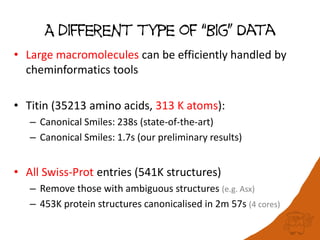
A different type of “Big” Data
• Large macromolecules can be efficiently handled by
cheminformatics tools
• Titin (35213 amino acids, 313 K atoms):
CC[C@H](C)[C@@H](C(=O)NCC(=O)N[C@@H](CCCCN)C(=O)N1CCC[C@H]1C(=O)N[C@@H](CO)C(=O)N[C@@H](Cc2c[nH]cn2)C(=
O)N3CCC[C@H]3C(=O)N[C@@H](CO)C(=O)N[C@@H](CCC(=O)O)C(=O)N4CCC[C@H]4C(=O)N[C@@H](C(C)C)C(=O)N[C@@H](CC(
C)C)C(=O)N[C@@H](C)C(=O)N[C@@H]([C@@H](C)CC)C(=O)N[C@@H](CC(=O)O)C(=O)N[C@@H](C)C(=O)N[C@@H](CS)C(=O)N[
C@@H](CCC(=O)O)C(=O)N5CCC[C@H]5C(=O)N6CCC[C@H]6C(=O)N[C@@H](CCCNC(=N)N)C(=O)N[C@@H](CC(=O)N)C(=O)N[C@
@H](C(C)C)C(=O)N[C@@H](CCCNC(=N)N)C(=O)N[C@@H]([C@@H](C)CC)C(=O)N[C@@H]([C@@H](C)O)C(=O)N[C@@H](CC(=O)
O)C(=O)N[C@@H]([C@@H](C)CC)C(=O)N[C@@H](CO)C(=O)N[C@@H](CCCCN)C(=O)N[C@@H](CC(=O)N)C(=O)N[C@@H](CO)C(=
O)N[C@@H](C(C)C)C(=O)N[C@@H](CC(=O)N)C(=O)N[C@@H](CC(C)C)C(=O)N[C@@H](CO)C(=O)N[C@@H](Cc7c[nH]c8c7cccc8)C(
=O)N[C@@H](CCC(=O)N)C(=O)N[C@@H](CCC(=O)N)C(=O)N9CCC[C@H]9C(=O)N[C@@H](C)C(=O)N[C@@H](Cc1ccccc1)C(=O)N[
C@@H](CC(=O)O)C(=O)NCC(=O)NCC(=O)N[C@@H](CO)C(=O)N[C@@H](CCCCN)C(=O)N[C@@H]([C@@H](C)CC)C(=O)N[C@@H](
[C@@H](C)O)C(=O)NCC(=O)N[C@@H](Cc1ccc(cc1)O)C(=O)N[C@@H]([C@@H](C)CC)C(=O)N[C@@H](C(C)C)C(=O)N[C@@H](CCC
(=O)O)C(=O)N[C@@H](CCCNC(=N)N)C(=O)N[C@@H](CCCNC(=N)N)C(=O)N[C@@H](CC(=O)O)C(=O)N[C@@H](CC(C)C)C(=O)N1C
CC[C@H]1C(=O)N[C@@H](CC(=O)O)C(=O)NCC(=O)N[C@@H](CCCNC(=N)N)C(=O)N[C@@H](Cc1c[nH]c2c1cccc2)C(=O)N[C@@H](
[C@@H](C)O)C(=O)N[C@@H](CCCCN)C(=O)N[C@@H](C)C(=O)N[C@@H](CO)C(=O)N[C@@H](Cc1ccccc1)C(=O)N[C@@H]([C@@H
](C)O)C(=O)N[C@@H](CC(=O)N)C(=O)N[C@@H](C(C)C)C(=O)N[C@@H]([C@@H](C)CC)C(=O)N[C@@H](CCC(=O)O)C(=O)N[C@@
H]([C@@H](C)O)C(=O)N[C@@H](CCC(=O)N)C(=O)N[C@@H](Cc1ccccc1)C(=O)N[C@@H]([C@@H](C)O)C(=O)N[C@@H](C(C)C)C(
=O)N[C@@H](CO)C(=O)NCC(=O)N[C@@H](CC(C)C)C(=O)N[C@@H]([C@@H](C)O)C(=O)N[C@@H](CCC(=O)N)C(=O)N[C@@H](CC
(=O)N)C(=O)N[C@@H](CO)C(=O)N[C@@H](CCC(=O)N)C(=O)N[C@@H](Cc1ccc(cc1)O)C(=O)N[C@@H](CCC(=O)O)C(=O)N[C@@H
](Cc1ccccc1)C(=O)N[C@@H](CCCNC(=N)N)C(=O)N[C@@H](C(C)C)C(=O)N[C@@H](Cc1ccccc1)C(=O)N[C@@H](C)C(=O)……
A different type of “Big” Data
• Large macromolecules can be efficiently handled by
cheminformatics tools
• Titin (35213 amino acids, 313 K atoms):
– Canonical Smiles: 238s (state-of-the-art)
– Canonical Smiles: 1.7s (our preliminary results)
• All Swiss-Prot entries (541K structures)
– Remove those with ambiguous structures (e.g. Asx)
– 453K protein structures canonicalised in 2m 57s (4 cores)
100 million compounds, 100K protein
structures, 2 million reactions, 1 million
journal articles, 20 million patents and 15
billion substructures
Is 20TB really Big Data?
noel@nextmovesoftware.com
Noel O’Boyle, Daniel Lowe, John May and
Roger Sayle
NextMove Software
100 million compounds, 100K protein
structures, 2 million reactions, 1 million
journal articles, 20 million patents and 15
billion substructures
Is 20TB really Big Data?
With modern hardware and efficient algorithms,
many classic cheminformatics problems can be
handled with today’s datasets.
noel@nextmovesoftware.com
Noel O’Boyle, Daniel Lowe, John May and
Roger Sayle
NextMove Software

Is 20TB really Big Data?

  • 1.
    100 million compounds,100K protein structures, 2 million reactions, 1 million journal articles, 20 million patents and 15 billion substructures Is 20TB really Big Data? Noel O’Boyle, Daniel Lowe, John May and Roger Sayle NextMove Software From Big Data to Chemical Information (RSC CICAG) 22 April 2015 London
  • 2.
    Big Data is… “…abroad term for data sets so large or complex that traditional data processing applications are inadequate.” [Wikipedia] Any dataset could be considered Big Data without sufficiently efficient algorithms and tools
  • 3.
    100K protein structures 2million reactions 1 million journal articles 20 million patents 100 million compounds 15 billion substructures Swiss-Prot Patents PubMed Central OA US, EU, JP, Kr PubChem, UniChem PubChem, ChEMBL 700K CSD entries 36 million Wikipedia articles 47 billion webpages indexed by Google 200 billion tweets per year 22 Pb EMBL-EBI’s data 20 Tb
  • 4.
  • 5.
    OVerview • Finding matchedpairs/series • Substructure searching • Maximum common subgraph • Chemical text-mining • Naming reactions • Canonicalisation
  • 6.
    Matched Pair MatchedSeries of Length 3
  • 7.
    + + + find matched PAIRS/Series Fragment Index Collate Index (Scaffold) Matched Series •Hussain and Rea JCIM 2010, 50, 339 • ChEMBL 20 IC50 data – 752 K datapoints from 64 K assays • Processed in 12 minutes – Giving 391 K matched series Matched Series
  • 8.
    “Google searches arescreamingly fast, so fast that the type-ahead feature is doing the search as you key characters in. Why are all chemical searches so sloooow? … Ideally, as you sketch your mol in, the searches should be happening at the same pace, like the typeahead feature.” John Van Drie, Nov 2011 Via Rajarshi Guha’s blog http://blog.rguha.net/?p=993
  • 9.
    substructure searching • Approach:fingerprint screen (fast but false positives) then match (slow but exact) • Pathological cases – many pass the screen – “denial of service queries” (Trung Nguyen) – Substructures which happen to map to the same bit as benzene, etc.
  • 10.
    Faster Substructure searching •Worst-case behaviour dominated by slow matching – This implies focus should be on faster matching • Typical substructures can be expressed as SMARTS patterns – Arthor: fast SMARTS matching against a database • Test set: Structure Query Collection (Andrew Dalke, BindingDB) – Time to count hits for 3323 queries against eMolecules (6.9 million)
  • 11.
    Optimised smarts matching •Preprocess database so that matching is fast – Efficient binary representation (minimal I/O) – Matching done directly on binary representation (minimal malloc) • Match rarer atom expressions first (*) – CCCCCBr  BrCCCCC • Match rarer bond expressions first – CC#C  C#CC * c.f. slide 31 of ICCS presentation http://www.slideshare.net/NextMoveSoftware/efficient-matching-of-multiple- chemical-subgraphs
  • 12.
    Time (ms) Bingo 2h7m Tripod 1d 6h JCart 2h 42m FastSearch 1d 15h RDCart 5h 9m OrChem 3d 1h NumQueriesyettofinish Total time for all 3323 queries
  • 13.
    Time (ms) NumQueriesyettofinish Arthor+fp 36s Arthor27m 31s Bingo 2h 7m Tripod 1d 6h JCart 2h 42m FastSearch 1d 15h RDCart 5h 9m OrChem 3d 1hTotal time for all 3323 queries
  • 14.
    What about evenlarger databases? • Imagine a chemical database 100 times larger than PubChem – Search time scales linearly, so even Arthor will take 100 times longer to search it • A completely different approach is needed • SmallWorld: sublinear searching by precalculating all possible substructures and their relationships – The catch: disk space, and takes months of CPU- time to generate (here’s one we made earlier)
  • 15.
    SmallWorld - A Graphdatabase Nodes are anonymous graphs of known substructures Disk space: 12TB Nodes: 19.7 billion Edges: 64.8 billion
  • 16.
    Maximum Common Subgraph(MCS) • Computationally expensive • Previous approaches: – Backtracking algorithms – Clique detection – Dynamic programming • However, with SmallWorld the computation has already been done in advance – MCS can be found in linear time relative to the number of atoms in the smaller molecule
  • 17.
  • 18.
    Chemical Text-Mining BigData • LeadMine for chemical entity extraction from text – Performance: Finds ~90% of chemical structures (compared to inter-annotator agreement of 91%*) • Method: – Dictionaries (e.g. list of common English words, trivial chemical names) and grammars (e.g. all possible IUPAC names) – Speed just depends on the number of dictionaries – Any dictionary can be used with spelling correction * Krallinger et al, J. Cheminf. 2015, 7, S2
  • 19.
    How Long toProcess? • All Open Access papers available from PubMed Central – 1.0 million articles processed in 3h 38min (*) – 131K distinct compounds • 2001-2015 USPTO applications (5 times larger) – 4.1 million patents processed in 22h 50min (*) – 4.3 million distinct compounds – 84.7 million compound mentions (with at least 10 heavy atoms) * using 4 cores
  • 20.
    Automatic Naming ofreactions • Traditional approaches: – Atom-mapping (can be slow, can give wrong mapping) – Differences in fingerprints for reactants and products (fast but has limitations) • Our approach uses compiled SMARTS matching: – Apply a particular reaction to the reactants and check whether the products appears on the right – Components are atom-mapped implicitly Note: typically reactions in ELNs and patents are not balanced
  • 21.
    Performance • Scales withthe number of SMARTS patterns used – currently 802 patterns for 504 reactions • Test set: 1.1 million reactions extracted from the USPTO applications 2001-2012 – Processed in 11.2 h – 437 K reactions named US20010000038A1 : 3.10.2 Friedel-Crafts alkylation [Friedel- Crafts reaction] US20010000038A1 : 10.1.5 Wohl-Ziegler bromination [Halogenation]
  • 22.
    A different typeof “Big” Data • Large macromolecules can be efficiently handled by cheminformatics tools • Titin (35213 amino acids, 313 K atoms): CC[C@H](C)[C@@H](C(=O)NCC(=O)N[C@@H](CCCCN)C(=O)N1CCC[C@H]1C(=O)N[C@@H](CO)C(=O)N[C@@H](Cc2c[nH]cn2)C(= O)N3CCC[C@H]3C(=O)N[C@@H](CO)C(=O)N[C@@H](CCC(=O)O)C(=O)N4CCC[C@H]4C(=O)N[C@@H](C(C)C)C(=O)N[C@@H](CC( C)C)C(=O)N[C@@H](C)C(=O)N[C@@H]([C@@H](C)CC)C(=O)N[C@@H](CC(=O)O)C(=O)N[C@@H](C)C(=O)N[C@@H](CS)C(=O)N[ C@@H](CCC(=O)O)C(=O)N5CCC[C@H]5C(=O)N6CCC[C@H]6C(=O)N[C@@H](CCCNC(=N)N)C(=O)N[C@@H](CC(=O)N)C(=O)N[C@ @H](C(C)C)C(=O)N[C@@H](CCCNC(=N)N)C(=O)N[C@@H]([C@@H](C)CC)C(=O)N[C@@H]([C@@H](C)O)C(=O)N[C@@H](CC(=O) O)C(=O)N[C@@H]([C@@H](C)CC)C(=O)N[C@@H](CO)C(=O)N[C@@H](CCCCN)C(=O)N[C@@H](CC(=O)N)C(=O)N[C@@H](CO)C(= O)N[C@@H](C(C)C)C(=O)N[C@@H](CC(=O)N)C(=O)N[C@@H](CC(C)C)C(=O)N[C@@H](CO)C(=O)N[C@@H](Cc7c[nH]c8c7cccc8)C( =O)N[C@@H](CCC(=O)N)C(=O)N[C@@H](CCC(=O)N)C(=O)N9CCC[C@H]9C(=O)N[C@@H](C)C(=O)N[C@@H](Cc1ccccc1)C(=O)N[ C@@H](CC(=O)O)C(=O)NCC(=O)NCC(=O)N[C@@H](CO)C(=O)N[C@@H](CCCCN)C(=O)N[C@@H]([C@@H](C)CC)C(=O)N[C@@H]( [C@@H](C)O)C(=O)NCC(=O)N[C@@H](Cc1ccc(cc1)O)C(=O)N[C@@H]([C@@H](C)CC)C(=O)N[C@@H](C(C)C)C(=O)N[C@@H](CCC (=O)O)C(=O)N[C@@H](CCCNC(=N)N)C(=O)N[C@@H](CCCNC(=N)N)C(=O)N[C@@H](CC(=O)O)C(=O)N[C@@H](CC(C)C)C(=O)N1C CC[C@H]1C(=O)N[C@@H](CC(=O)O)C(=O)NCC(=O)N[C@@H](CCCNC(=N)N)C(=O)N[C@@H](Cc1c[nH]c2c1cccc2)C(=O)N[C@@H]( [C@@H](C)O)C(=O)N[C@@H](CCCCN)C(=O)N[C@@H](C)C(=O)N[C@@H](CO)C(=O)N[C@@H](Cc1ccccc1)C(=O)N[C@@H]([C@@H ](C)O)C(=O)N[C@@H](CC(=O)N)C(=O)N[C@@H](C(C)C)C(=O)N[C@@H]([C@@H](C)CC)C(=O)N[C@@H](CCC(=O)O)C(=O)N[C@@ H]([C@@H](C)O)C(=O)N[C@@H](CCC(=O)N)C(=O)N[C@@H](Cc1ccccc1)C(=O)N[C@@H]([C@@H](C)O)C(=O)N[C@@H](C(C)C)C( =O)N[C@@H](CO)C(=O)NCC(=O)N[C@@H](CC(C)C)C(=O)N[C@@H]([C@@H](C)O)C(=O)N[C@@H](CCC(=O)N)C(=O)N[C@@H](CC (=O)N)C(=O)N[C@@H](CO)C(=O)N[C@@H](CCC(=O)N)C(=O)N[C@@H](Cc1ccc(cc1)O)C(=O)N[C@@H](CCC(=O)O)C(=O)N[C@@H ](Cc1ccccc1)C(=O)N[C@@H](CCCNC(=N)N)C(=O)N[C@@H](C(C)C)C(=O)N[C@@H](Cc1ccccc1)C(=O)N[C@@H](C)C(=O)……
  • 23.
    A different typeof “Big” Data • Large macromolecules can be efficiently handled by cheminformatics tools • Titin (35213 amino acids, 313 K atoms): – Canonical Smiles: 238s (state-of-the-art) – Canonical Smiles: 1.7s (our preliminary results) • All Swiss-Prot entries (541K structures) – Remove those with ambiguous structures (e.g. Asx) – 453K protein structures canonicalised in 2m 57s (4 cores)
  • 24.
    100 million compounds,100K protein structures, 2 million reactions, 1 million journal articles, 20 million patents and 15 billion substructures Is 20TB really Big Data? noel@nextmovesoftware.com Noel O’Boyle, Daniel Lowe, John May and Roger Sayle NextMove Software
  • 25.
    100 million compounds,100K protein structures, 2 million reactions, 1 million journal articles, 20 million patents and 15 billion substructures Is 20TB really Big Data? With modern hardware and efficient algorithms, many classic cheminformatics problems can be handled with today’s datasets. noel@nextmovesoftware.com Noel O’Boyle, Daniel Lowe, John May and Roger Sayle NextMove Software