Capturing and leveraging materials science
knowledge from millions of journal articles using
natural language processing techniques
Anubhav Jain
Energy Technologies Area
Lawrence Berkeley National Laboratory
Berkeley, CA
NSF-JST joint workshop on Thermal Transport, Materials
Informatics and Quantum Computing
March 22 2021
Slides (already) posted to hackingmaterials.lbl.gov
2
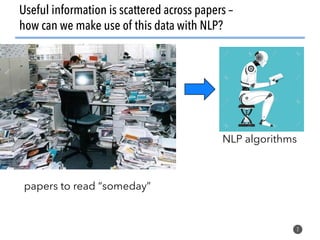
Useful information is scattered across papers –
how can we make use of this data with NLP?
papers to read “someday”
NLP algorithms
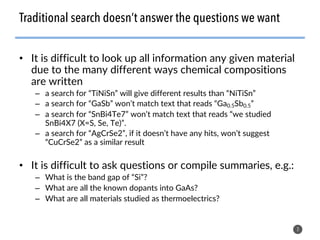
• It is difficult to look up all information any given material
due to the many different ways chemical compositions
are written
– a search for “TiNiSn” will give different results than “NiTiSn”
– a search for “GaSb” won’t match text that reads “Ga0.5Sb0.5”
– a search for “SnBi4Te7” won’t match text that reads “we studied
SnBi4X7 (X=S, Se, Te)”.
– a search for “AgCrSe2”, if it doesn’t have any hits, won’t suggest
“CuCrSe2” as a similar result
• It is difficult to ask questions or compile summaries, e.g.:
– What is the band gap of “Si”?
– What are all the known dopants into GaAs?
– What are all materials studied as thermoelectrics?
3
Traditional search doesn’t answer the questions we want
What is matscholar?
• Matscholar is an attempt to organize the world’s
information on materials science, connecting
together topics of study, synthesis and
characterization methods, and specific materials
compositions
• It is also an effort to use state-of-the-art natural
language processing to make collective use of
the information in millions of articles
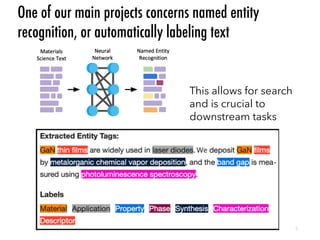
One of our main projects concerns named entity
recognition, or automatically labeling text
5
This allows for search
and is crucial to
downstream tasks
6
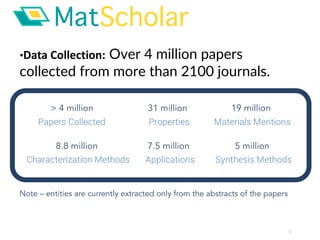
> 4 million
Papers Collected
31 million
Properties
19 million
Materials Mentions
8.8 million
Characterization Methods
7.5 million
Applications
5 million
Synthesis Methods
•Data Collection: Over 4 million papers
collected from more than 2100 journals.
Note – entities are currently extracted only from the abstracts of the papers
7
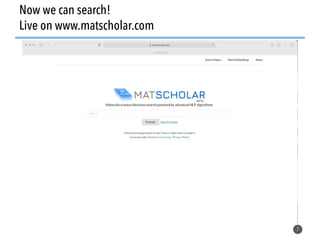
Now we can search!
Live on www.matscholar.com
8
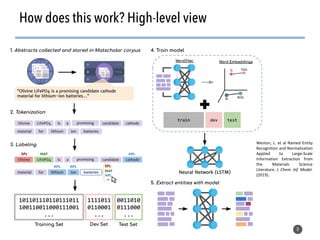
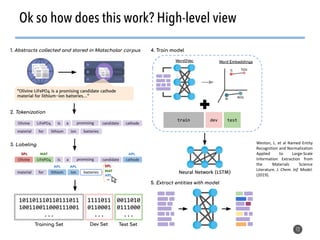
How does this work? High-level view
Weston, L. et al Named Entity
Recognition and Normalization
Applied to Large-Scale
Information Extraction from
the Materials Science
Literature. J. Chem. Inf. Model.
(2019).
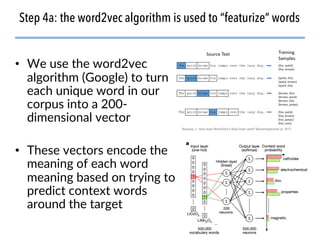
• We use the word2vec
algorithm (Google) to turn
each unique word in our
corpus into a 200-
dimensional vector
• These vectors encode the
meaning of each word
meaning based on trying to
predict context words
around the target
9
Step 4a: the word2vec algorithm is used to “featurize” words
Barazza, L. How does Word2Vec’s Skip-Gram work? Becominghuman.ai. 2017
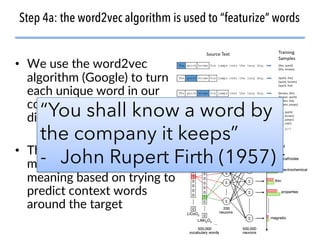
• We use the word2vec
algorithm (Google) to turn
each unique word in our
corpus into a 200-
dimensional vector
• These vectors encode the
meaning of each word
meaning based on trying to
predict context words
around the target
10
Step 4a: the word2vec algorithm is used to “featurize” words
Barazza, L. How does Word2Vec’s Skip-Gram work? Becominghuman.ai. 2017
“You shall know a word by
the company it keeps”
- John Rupert Firth (1957)
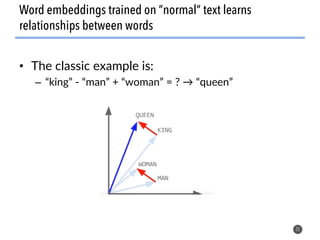
• The classic example is:
– “king” - “man” + “woman” = ? → “queen”
11
Word embeddings trained on ”normal” text learns
relationships between words
12
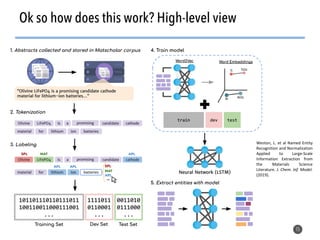
Ok so how does this work? High-level view
Weston, L. et al Named Entity
Recognition and Normalization
Applied to Large-Scale
Information Extraction from
the Materials Science
Literature. J. Chem. Inf. Model.
(2019).
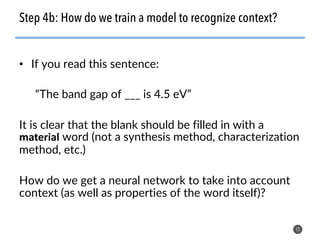
• If you read this sentence:
“The band gap of ___ is 4.5 eV”
It is clear that the blank should be filled in with a
material word (not a synthesis method, characterization
method, etc.)
How do we get a neural network to take into account
context (as well as properties of the word itself)?
13
Step 4b: How do we train a model to recognize context?
14
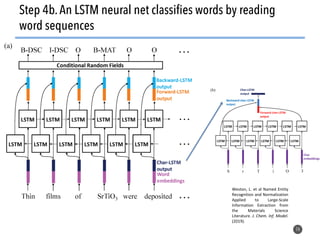
Step 4b.An LSTM neural net classifies words by reading
word sequences
Weston, L. et al Named Entity
Recognition and Normalization
Applied to Large-Scale
Information Extraction from
the Materials Science
Literature. J. Chem. Inf. Model.
(2019).
15
Ok so how does this work? High-level view
Weston, L. et al Named Entity
Recognition and Normalization
Applied to Large-Scale
Information Extraction from
the Materials Science
Literature. J. Chem. Inf. Model.
(2019).
16
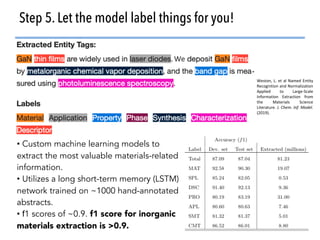
Step 5. Let the model label things for you!
Named Entity Recognition
X
• Custom machine learning models to
extract the most valuable materials-related
information.
• Utilizes a long short-term memory (LSTM)
network trained on ~1000 hand-annotated
abstracts.
• f1 scores of ~0.9. f1 score for inorganic
materials extraction is >0.9.
Weston, L. et al Named Entity
Recognition and Normalization
Applied to Large-Scale
Information Extraction from
the Materials Science
Literature. J. Chem. Inf. Model.
(2019).
17
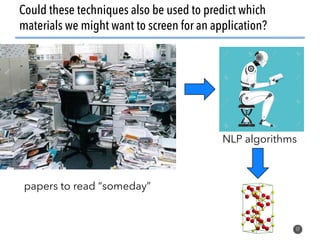
Could these techniques also be used to predict which
materials we might want to screen for an application?
papers to read “someday”
NLP algorithms
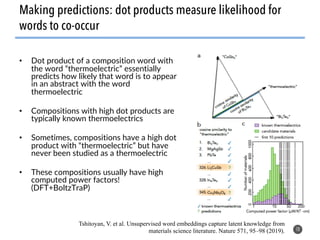
• Dot product of a composition word with
the word “thermoelectric” essentially
predicts how likely that word is to appear
in an abstract with the word
thermoelectric
• Compositions with high dot products are
typically known thermoelectrics
• Sometimes, compositions have a high dot
product with “thermoelectric” but have
never been studied as a thermoelectric
• These compositions usually have high
computed power factors!
(DFT+BoltzTraP)
18
Making predictions: dot products measure likelihood for
words to co-occur
Tshitoyan, V. et al. Unsupervised word embeddings capture latent knowledge from
materials science literature. Nature 571, 95–98 (2019).
19
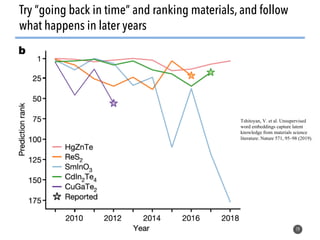
Try ”going back in time” and ranking materials, and follow
what happens in later years
Tshitoyan, V. et al. Unsupervised
word embeddings capture latent
knowledge from materials science
literature. Nature 571, 95–98 (2019).
20
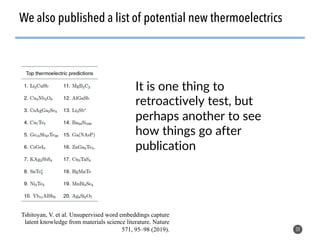
We also published a list of potential new thermoelectrics
Tshitoyan, V. et al. Unsupervised word embeddings capture
latent knowledge from materials science literature. Nature
571, 95–98 (2019).
It is one thing to
retroactively test, but
perhaps another to see
how things go after
publication
21
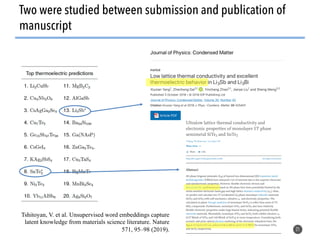
Two were studied between submission and publication of
manuscript
Tshitoyan, V. et al. Unsupervised word embeddings capture
latent knowledge from materials science literature. Nature
571, 95–98 (2019).
22
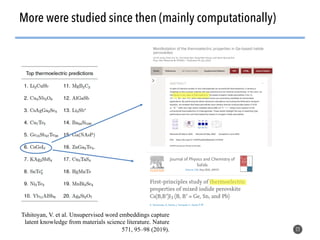
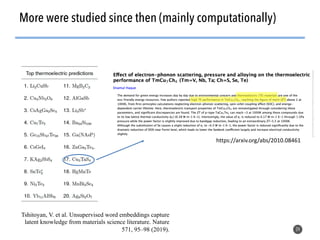
More were studied since then (mainly computationally)
Tshitoyan, V. et al. Unsupervised word embeddings capture
latent knowledge from materials science literature. Nature
571, 95–98 (2019).
23
More were studied since then (mainly computationally)
Tshitoyan, V. et al. Unsupervised word embeddings capture
latent knowledge from materials science literature. Nature
571, 95–98 (2019).
24
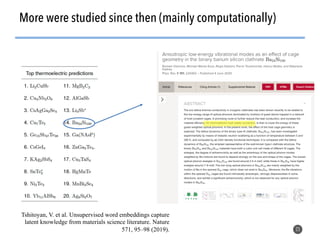
More were studied since then (mainly computationally)
Tshitoyan, V. et al. Unsupervised word embeddings capture
latent knowledge from materials science literature. Nature
571, 95–98 (2019).
https://arxiv.org/abs/2010.08461
25
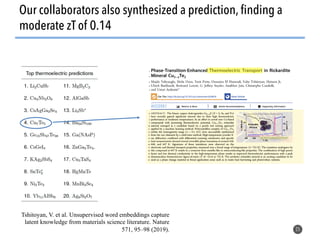
Our collaborators also synthesized a prediction, finding a
moderate zT of 0.14
Tshitoyan, V. et al. Unsupervised word embeddings capture
latent knowledge from materials science literature. Nature
571, 95–98 (2019).
26
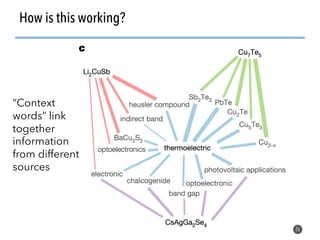
How is this working?
“Context
words” link
together
information
from different
sources
27
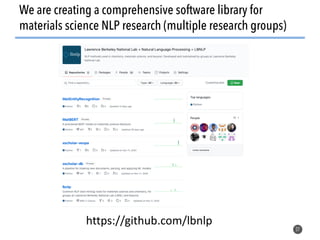
We are creating a comprehensive software library for
materials science NLP research (multiple research groups)
https://github.com/lbnlp
28
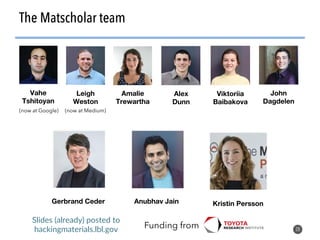
The Matscholar team
Kristin Persson
Anubhav Jain
Gerbrand Ceder
John
Dagdelen
Leigh
Weston
Vahe
Tshitoyan
Amalie
Trewartha
Alex
Dunn
Viktoriia
Baibakova
Funding from
(now at Google) (now at Medium)
Slides (already) posted to
hackingmaterials.lbl.gov

Capturing and leveraging materials science knowledge from millions of journal articles using natural language processing techniques

  • 1.
    Capturing and leveragingmaterials science knowledge from millions of journal articles using natural language processing techniques Anubhav Jain Energy Technologies Area Lawrence Berkeley National Laboratory Berkeley, CA NSF-JST joint workshop on Thermal Transport, Materials Informatics and Quantum Computing March 22 2021 Slides (already) posted to hackingmaterials.lbl.gov
  • 2.
    2 Useful information isscattered across papers – how can we make use of this data with NLP? papers to read “someday” NLP algorithms
  • 3.
    • It isdifficult to look up all information any given material due to the many different ways chemical compositions are written – a search for “TiNiSn” will give different results than “NiTiSn” – a search for “GaSb” won’t match text that reads “Ga0.5Sb0.5” – a search for “SnBi4Te7” won’t match text that reads “we studied SnBi4X7 (X=S, Se, Te)”. – a search for “AgCrSe2”, if it doesn’t have any hits, won’t suggest “CuCrSe2” as a similar result • It is difficult to ask questions or compile summaries, e.g.: – What is the band gap of “Si”? – What are all the known dopants into GaAs? – What are all materials studied as thermoelectrics? 3 Traditional search doesn’t answer the questions we want
  • 4.
    What is matscholar? •Matscholar is an attempt to organize the world’s information on materials science, connecting together topics of study, synthesis and characterization methods, and specific materials compositions • It is also an effort to use state-of-the-art natural language processing to make collective use of the information in millions of articles
  • 5.
    One of ourmain projects concerns named entity recognition, or automatically labeling text 5 This allows for search and is crucial to downstream tasks
  • 6.
    6 > 4 million PapersCollected 31 million Properties 19 million Materials Mentions 8.8 million Characterization Methods 7.5 million Applications 5 million Synthesis Methods •Data Collection: Over 4 million papers collected from more than 2100 journals. Note – entities are currently extracted only from the abstracts of the papers
  • 7.
    7 Now we cansearch! Live on www.matscholar.com
  • 8.
    8 How does thiswork? High-level view Weston, L. et al Named Entity Recognition and Normalization Applied to Large-Scale Information Extraction from the Materials Science Literature. J. Chem. Inf. Model. (2019).
  • 9.
    • We usethe word2vec algorithm (Google) to turn each unique word in our corpus into a 200- dimensional vector • These vectors encode the meaning of each word meaning based on trying to predict context words around the target 9 Step 4a: the word2vec algorithm is used to “featurize” words Barazza, L. How does Word2Vec’s Skip-Gram work? Becominghuman.ai. 2017
  • 10.
    • We usethe word2vec algorithm (Google) to turn each unique word in our corpus into a 200- dimensional vector • These vectors encode the meaning of each word meaning based on trying to predict context words around the target 10 Step 4a: the word2vec algorithm is used to “featurize” words Barazza, L. How does Word2Vec’s Skip-Gram work? Becominghuman.ai. 2017 “You shall know a word by the company it keeps” - John Rupert Firth (1957)
  • 11.
    • The classicexample is: – “king” - “man” + “woman” = ? → “queen” 11 Word embeddings trained on ”normal” text learns relationships between words
  • 12.
    12 Ok so howdoes this work? High-level view Weston, L. et al Named Entity Recognition and Normalization Applied to Large-Scale Information Extraction from the Materials Science Literature. J. Chem. Inf. Model. (2019).
  • 13.
    • If youread this sentence: “The band gap of ___ is 4.5 eV” It is clear that the blank should be filled in with a material word (not a synthesis method, characterization method, etc.) How do we get a neural network to take into account context (as well as properties of the word itself)? 13 Step 4b: How do we train a model to recognize context?
  • 14.
    14 Step 4b.An LSTMneural net classifies words by reading word sequences Weston, L. et al Named Entity Recognition and Normalization Applied to Large-Scale Information Extraction from the Materials Science Literature. J. Chem. Inf. Model. (2019).
  • 15.
    15 Ok so howdoes this work? High-level view Weston, L. et al Named Entity Recognition and Normalization Applied to Large-Scale Information Extraction from the Materials Science Literature. J. Chem. Inf. Model. (2019).
  • 16.
    16 Step 5. Letthe model label things for you! Named Entity Recognition X • Custom machine learning models to extract the most valuable materials-related information. • Utilizes a long short-term memory (LSTM) network trained on ~1000 hand-annotated abstracts. • f1 scores of ~0.9. f1 score for inorganic materials extraction is >0.9. Weston, L. et al Named Entity Recognition and Normalization Applied to Large-Scale Information Extraction from the Materials Science Literature. J. Chem. Inf. Model. (2019).
  • 17.
    17 Could these techniquesalso be used to predict which materials we might want to screen for an application? papers to read “someday” NLP algorithms
  • 18.
    • Dot productof a composition word with the word “thermoelectric” essentially predicts how likely that word is to appear in an abstract with the word thermoelectric • Compositions with high dot products are typically known thermoelectrics • Sometimes, compositions have a high dot product with “thermoelectric” but have never been studied as a thermoelectric • These compositions usually have high computed power factors! (DFT+BoltzTraP) 18 Making predictions: dot products measure likelihood for words to co-occur Tshitoyan, V. et al. Unsupervised word embeddings capture latent knowledge from materials science literature. Nature 571, 95–98 (2019).
  • 19.
    19 Try ”going backin time” and ranking materials, and follow what happens in later years Tshitoyan, V. et al. Unsupervised word embeddings capture latent knowledge from materials science literature. Nature 571, 95–98 (2019).
  • 20.
    20 We also publisheda list of potential new thermoelectrics Tshitoyan, V. et al. Unsupervised word embeddings capture latent knowledge from materials science literature. Nature 571, 95–98 (2019). It is one thing to retroactively test, but perhaps another to see how things go after publication
  • 21.
    21 Two were studiedbetween submission and publication of manuscript Tshitoyan, V. et al. Unsupervised word embeddings capture latent knowledge from materials science literature. Nature 571, 95–98 (2019).
  • 22.
    22 More were studiedsince then (mainly computationally) Tshitoyan, V. et al. Unsupervised word embeddings capture latent knowledge from materials science literature. Nature 571, 95–98 (2019).
  • 23.
    23 More were studiedsince then (mainly computationally) Tshitoyan, V. et al. Unsupervised word embeddings capture latent knowledge from materials science literature. Nature 571, 95–98 (2019).
  • 24.
    24 More were studiedsince then (mainly computationally) Tshitoyan, V. et al. Unsupervised word embeddings capture latent knowledge from materials science literature. Nature 571, 95–98 (2019). https://arxiv.org/abs/2010.08461
  • 25.
    25 Our collaborators alsosynthesized a prediction, finding a moderate zT of 0.14 Tshitoyan, V. et al. Unsupervised word embeddings capture latent knowledge from materials science literature. Nature 571, 95–98 (2019).
  • 26.
    26 How is thisworking? “Context words” link together information from different sources
  • 27.
    27 We are creatinga comprehensive software library for materials science NLP research (multiple research groups) https://github.com/lbnlp
  • 28.
    28 The Matscholar team KristinPersson Anubhav Jain Gerbrand Ceder John Dagdelen Leigh Weston Vahe Tshitoyan Amalie Trewartha Alex Dunn Viktoriia Baibakova Funding from (now at Google) (now at Medium) Slides (already) posted to hackingmaterials.lbl.gov