


Using WhatsApp to facilitate
language learning in preparation
for and during the year abroad
E- symposium 2015
22nd January, 2013 - 23rd January, 2015
University of Southampton
Isabel Cobo Palacios, Billy Brick and Tiziana Cervi-Wilson
Coventry University
 Growth of Internet messaging
 The project
 Tasks
 Participation
 Responses
 Positive and negative aspects
 Feedback
 Future Directions
Overview
03/02/20152
03/02/20153
 Students don’t feel confident with the language
before spending their 3rd Year abroad
Motivation for the project
‘Even sending us an email asking
how we were getting on would’ve
made a huge difference’
The Guardian, (2014)
Universities don't offer enough
support
03/02/20155
 Immediacy
 Grouping feature
 Accessibility
 Multiple formats: videos, images, sound
 Cross-network and device coverage
 “The greatest and most important part of
our daily learning is made through informal
learning” (Rogers, 2004)
Advantages of the use of
WhatsApp Brick and Cervi-Wilson
(2014)
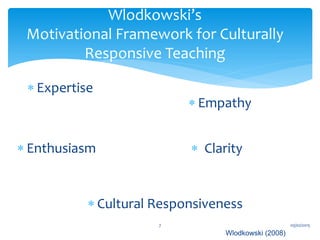
 Expertise
Wlodkowski’s
Motivational Framework for Culturally
Responsive Teaching
03/02/20157
 Empathy
 Enthusiasm  Clarity
 Cultural Responsiveness
Wlodkowski (2008)
WhatsApp Project
03/02/20158
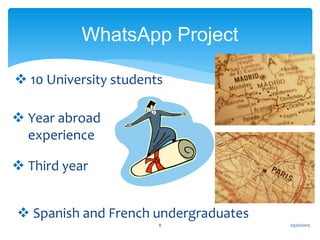
 10 University students
 Year abroad
experience
 Third year
 Spanish and French undergraduates
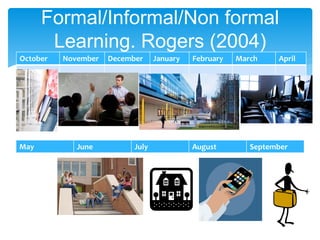
October November December January February March April
Formal/Informal/Non formal
Learning. Rogers (2004)
May June July August September
To enhance learners’ efficacy
To improve learners’ linguistic output
To develop learners’ cultural awareness
Byram (1997)
To support learners on their year abroad
and to build a community
Objectives
03/02/201510
Audio or video introducing themselves
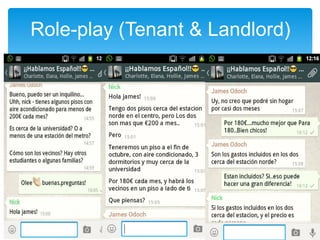
Role-play (Landlord and Tenant)
Short tasks
Open questions
Sending links or articles to ask them for their
opinion
WhatsApp Tasks
03/02/201511
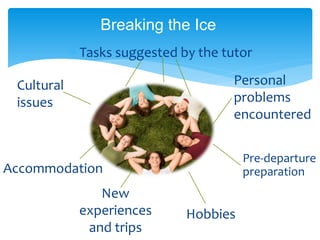
New
experiences
and trips
Pre-departure
preparation
Personal
problems
encountered
Hobbies
Accommodation
Cultural
issues
 Tasks suggested by the tutor
Breaking the Ice
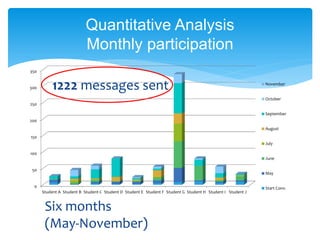
Quantitative Analysis
Monthly participation
0
50
100
150
200
250
300
350
Student A Student B Student C Student D Student E Student F Student G Student H Student I Student J
November
October
September
August
July
June
May
Start Conv.
Six months
(May-November)
1222 messages sent
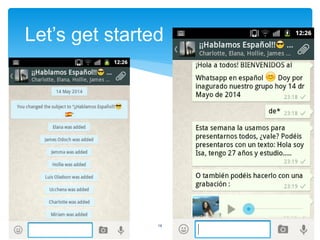
Let’s get started
03/02/201514
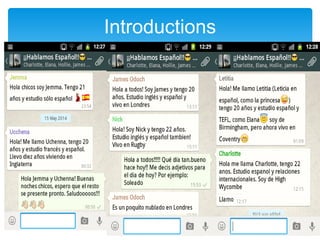
Introductions
03/02/201515
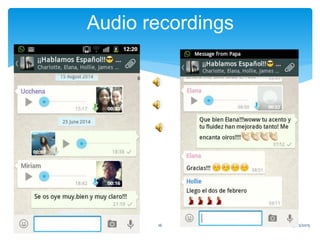
Audio recordings
03/02/201516
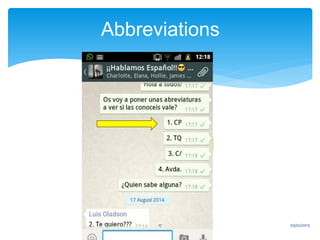
Abbreviations
03/02/201517
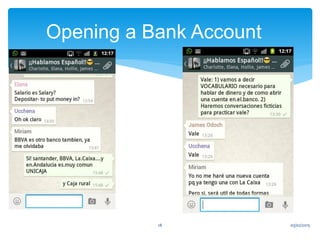
Opening a Bank Account
03/02/201518
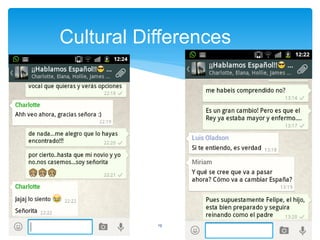
Cultural Differences
03/02/201519
Role-play (Tenant & Landlord)
03/02/201520
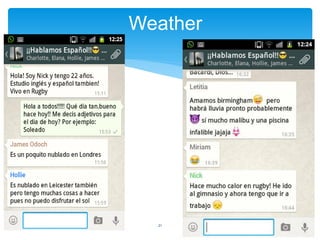
Weather
03/02/201521
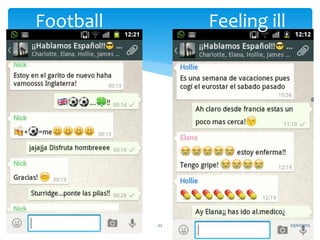
Football
03/02/201522
Feeling ill
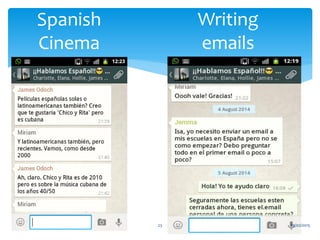
Spanish
Cinema
03/02/201523
Writing
emails
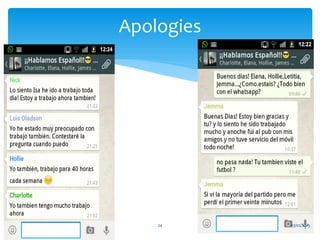
Apologies
03/02/201524
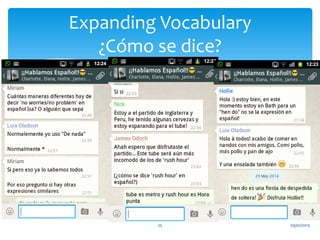
Expanding Vocabulary
¿Cómo se dice?
03/02/201525
Images
03/02/201526
03/02/201527
03/02/201528
 Common Errors
 Feedback by Email
Language Sample analysis
03/02/201529
Yes
Keep the Group Alive
Motivation
Time Consuming?
03/02/201530
03/02/201531
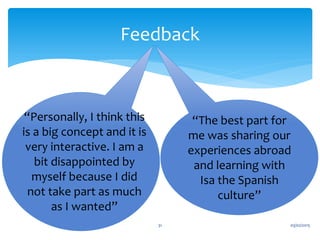
Feedback
“Personally, I think this
is a big concept and it is
very interactive. I am a
bit disappointed by
myself because I did
not take part as much
as I wanted”
“The best part for
me was sharing our
experiences abroad
and learning with
Isa the Spanish
culture”
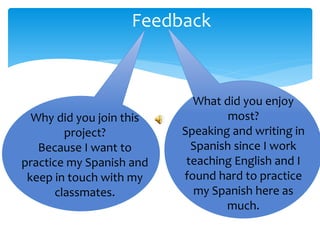
Feedback
What did you enjoy
most?
Speaking and writing in
Spanish since I work
teaching English and I
found hard to practice
my Spanish here as
much.
Why did you join this
project?
Because I want to
practice my Spanish and
keep in touch with my
classmates.
 Continue with this group until the end
of the academic year
 Show learners improvement through
language samples and a decrease in
their errors
 Lessons learnt
Future Directions
03/02/201533
Ashenden, A (2014). ’Year-abroad students say universities don't offer enough support’. The Guardian [online]
15 December available from <http://www.theguardian.com/education/2014/dec/15/universities-failing-
provide-welfare-support-year-abroad-students> [20 January 2015]
Brick, B. & Cervi-Wilson, T. (2014) WhatsApp: Language Learning on-the-go. LLAS Annual E-Learning
Symposium. Held 23-24 January 2014
Byram, M. (1997) Teaching and Assessing Intercultural Communicative Competence. Clevedon. Multilingual
Matters.
Gander, K (2015) ’ WhatsApp for PC: messaging web client now available on internet browsers’. The
Independent [online] 21 January available from < http://www.independent.co.uk/life-style/gadgets-and-
tech/news/whatsapp-now-available-on-web-browsers-9993675.html?cmpid=facebook-post > [21 January
2015]
Gasmi, A (2014) ’ Mobile assisted language learning: potential and limitations of using 'whatsapp' messenger to
enhance students writing skills ’ . INTED2014 Proceedings, p. 7243. [online] 12 March available from
<http://library.iated.org/view/GASMI2014MOB > [21 January 2015]
Rogers, A. (2004) Non-Formal Education: flexible schooling or participatory education? Hong Kong University
Press .
Wlodkowski, R. J (2008) Enhancing Adult Motivation to Learn: A Comprehensive Guide for Teaching All Adults.
California: John Wiley & Sons.
References
03/02/201534

WhatsApp Southampton LLAS 2015

  • 1.
    Using WhatsApp tofacilitate language learning in preparation for and during the year abroad E- symposium 2015 22nd January, 2013 - 23rd January, 2015 University of Southampton Isabel Cobo Palacios, Billy Brick and Tiziana Cervi-Wilson Coventry University
  • 2.
     Growth ofInternet messaging  The project  Tasks  Participation  Responses  Positive and negative aspects  Feedback  Future Directions Overview 03/02/20152
  • 3.
  • 4.
     Students don’tfeel confident with the language before spending their 3rd Year abroad Motivation for the project
  • 5.
    ‘Even sending usan email asking how we were getting on would’ve made a huge difference’ The Guardian, (2014) Universities don't offer enough support 03/02/20155
  • 6.
     Immediacy  Groupingfeature  Accessibility  Multiple formats: videos, images, sound  Cross-network and device coverage  “The greatest and most important part of our daily learning is made through informal learning” (Rogers, 2004) Advantages of the use of WhatsApp Brick and Cervi-Wilson (2014)
  • 7.
     Expertise Wlodkowski’s Motivational Frameworkfor Culturally Responsive Teaching 03/02/20157  Empathy  Enthusiasm  Clarity  Cultural Responsiveness Wlodkowski (2008)
  • 8.
    WhatsApp Project 03/02/20158  10University students  Year abroad experience  Third year  Spanish and French undergraduates
  • 9.
    October November DecemberJanuary February March April Formal/Informal/Non formal Learning. Rogers (2004) May June July August September
  • 10.
    To enhance learners’efficacy To improve learners’ linguistic output To develop learners’ cultural awareness Byram (1997) To support learners on their year abroad and to build a community Objectives 03/02/201510
  • 11.
    Audio or videointroducing themselves Role-play (Landlord and Tenant) Short tasks Open questions Sending links or articles to ask them for their opinion WhatsApp Tasks 03/02/201511
  • 12.
  • 13.
    Quantitative Analysis Monthly participation 0 50 100 150 200 250 300 350 StudentA Student B Student C Student D Student E Student F Student G Student H Student I Student J November October September August July June May Start Conv. Six months (May-November) 1222 messages sent
  • 14.
  • 15.
  • 16.
  • 17.
  • 18.
    Opening a BankAccount 03/02/201518
  • 19.
  • 20.
    Role-play (Tenant &Landlord) 03/02/201520
  • 21.
  • 22.
  • 23.
  • 24.
  • 25.
  • 26.
  • 27.
  • 28.
  • 29.
     Common Errors Feedback by Email Language Sample analysis 03/02/201529
  • 30.
    Yes Keep the GroupAlive Motivation Time Consuming? 03/02/201530
  • 31.
    03/02/201531 Feedback “Personally, I thinkthis is a big concept and it is very interactive. I am a bit disappointed by myself because I did not take part as much as I wanted” “The best part for me was sharing our experiences abroad and learning with Isa the Spanish culture”
  • 32.
    Feedback What did youenjoy most? Speaking and writing in Spanish since I work teaching English and I found hard to practice my Spanish here as much. Why did you join this project? Because I want to practice my Spanish and keep in touch with my classmates.
  • 33.
     Continue withthis group until the end of the academic year  Show learners improvement through language samples and a decrease in their errors  Lessons learnt Future Directions 03/02/201533
  • 34.
    Ashenden, A (2014).’Year-abroad students say universities don't offer enough support’. The Guardian [online] 15 December available from <http://www.theguardian.com/education/2014/dec/15/universities-failing- provide-welfare-support-year-abroad-students> [20 January 2015] Brick, B. & Cervi-Wilson, T. (2014) WhatsApp: Language Learning on-the-go. LLAS Annual E-Learning Symposium. Held 23-24 January 2014 Byram, M. (1997) Teaching and Assessing Intercultural Communicative Competence. Clevedon. Multilingual Matters. Gander, K (2015) ’ WhatsApp for PC: messaging web client now available on internet browsers’. The Independent [online] 21 January available from < http://www.independent.co.uk/life-style/gadgets-and- tech/news/whatsapp-now-available-on-web-browsers-9993675.html?cmpid=facebook-post > [21 January 2015] Gasmi, A (2014) ’ Mobile assisted language learning: potential and limitations of using 'whatsapp' messenger to enhance students writing skills ’ . INTED2014 Proceedings, p. 7243. [online] 12 March available from <http://library.iated.org/view/GASMI2014MOB > [21 January 2015] Rogers, A. (2004) Non-Formal Education: flexible schooling or participatory education? Hong Kong University Press . Wlodkowski, R. J (2008) Enhancing Adult Motivation to Learn: A Comprehensive Guide for Teaching All Adults. California: John Wiley & Sons. References 03/02/201534