 Introduction
 Definition & Steps of Clinical Teaching
 Philosophy / Principles of clinical teaching
 Methods of clinical teaching
 Nursing Clinic / Bedside clinic
 Nursing care conference
 Nursing Rounds
 Nursing Care Study
 Guidelines for best method
 Evaluation of Clinical teaching
 Conclusion
In recent years, nursing education focused on
theoretical education & deep gap between
theoretical & clinical education created.
Many nursing researchers reported that
nursing students, in spite of good knowledge
base, weren’t skillful in clinical settings. In
result, with entrance of these unskillful
students to the nursing care system, the
quality of this system falls day to day.
Clinical teaching of students and continuing
education is vital for professional
development.
Clinical teaching is a individualized or group
teaching to the nursing students in the
clinical area by the nurse educators, staff
nurse and clinical nurse manager.
 Formulating objectives
 Determining the student knowledge by
conducting a test
 Planning the content for ward teaching
depending on the student’s knowledge
 Organizing the programme
 Implementing & evaluating the sessions.
 Clinical education should reflect the nature
of professional practice
 Clinical teaching is more important than
class room teaching
 The nursing student in the clinical setting is
a learner, not a Nurse
 Sufficient learning time should be provided
before performance is evaluated
 Clinical teaching is supported by a climate of
mutual Trust & respect
 Clinical teaching & learning should focus on
essential knowledge, skill & attitude
 The espoused curriculum may not be the
curriculum in use
 Quality is more important than quantity
 Nursing Clinic / Bedside clinic
 Nursing care conference
 Nursing Rounds
 Nursing Care Study
 Bedside clinic always help to study the problems
typically associated with a particular disease or
disorder.
 Always ensure the presence of the patient.
 Either the group visits the patient or the patient is
brought to the conference room.
• Patients with Typical cases rather with unusual
conditions are selected. During the clinic the
patient may be asked to speak something about
the course of illness, symptoms and involves the
family members and plan for discharge.
• Brief history and therapy, nursing problems are
presented along with the nursing care including
physical, mental and social components.
• Nursing clinic can be conducted by the head
nurse or the clinical instructor.
• Before the client entry the head nurse points
out the group the observations which should
made while he/she is present. When the patient
no longer needed should send back.
• This is usually followed by a discussion and
question and answer round. The Material is
summarized and the most important points are
emphasized.
• The clinic lasts for about 30 min finally it is
evaluated by the head nurse and the group
members.
 The student nurse is getting an opportunity
to observe, analyze & make decision in
nursing care
 Remembers the nursing measures for longer
time since directly they involved
• It is same like a bedside clinic but the patient is
not usually present for the class. This may be a
method of choice when the entire group is
acquainted with the patient.
• Bedside clinic and nursing care conference can
be used to evaluate the students. Both should be
planned earlier if it is to be made more
effective. But the nurse instructor conduct it on
the spot if she wishes to evaluate the students.
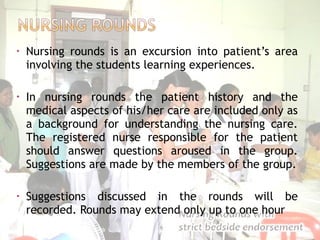
• Nursing rounds is an excursion into patient’s area
involving the students learning experiences.
• In nursing rounds the patient history and the
medical aspects of his/her care are included only as
a background for understanding the nursing care.
The registered nurse responsible for the patient
should answer questions aroused in the group.
Suggestions are made by the members of the group.
• Suggestions discussed in the rounds will be
recorded. Rounds may extend only up to one hour
Information giving rounds
Instructional rounds
Problem solving rounds
 Increases the learning ability
 Increases interest to share ideas &
Knowledge with others for the benefit of the
client
 Response of the client is more natural
 Students can select client with specific
problem & plan for proper nursing care
Types
 Case Study
 Case Analysis
 Case incident Technique
• The student with the help of the clinical
instructor selects one of her patients for
intensive study which she finds interesting. The
student tries to solve the problems through the
study, consultation and experimentation and
decides the nursing measures which will meet
the patient’s individual needs and solve nursing
problems. The student must be given opportunity
to take care of the patient over a long duration
of time, to understand his/her behavior, to gain
his/her confidence, to learn the real nature of
his/her problems, and to note the effect of
nursing measures and the results of the care.
 The concentrated effort on the part of the
student to define and solve the problems in
the patient care arouses interests in him and
results in better nursing care. The students
learn to recognize the effect of personal and
social factors on illness and recovery, to
organize the information and identify the
problems.
• The student also learns about the problem
solving approach to nursing. The report may
act as a reference material for the student.
• The student can present the report in front
of the group and it should be evaluated in
terms of content, organization, clarity of
thought and interest. The oral presentation
helps the student to speak in front of the
group.
 Identify the barriers
 Consider learning style
 Plan activities collaboratively
 Create learning environment
 Effective clinical teaching
 Extend evaluation possibilities
 Designate
 Encourage experts
 Documented
 Valid
 Reliable
 Objective
 Comprehensive
 Useful
 Evaluation should be based upon first-hand
(Observed) or Objective (written)
information
 It should match with the clinical skill or
knowledge being assessed
 Complex skill may require multiple sources
of evaluation before promotive / certification
 It should consider feasibility in terms of time,
money, space, trained observers / raters
 Learning by doing is the most effective
method of teaching. The laboratory of the
nursing students is the clinical field. The
nursing students get the practical experience
and skill doing procedures by taking care of
the patients. The nurse manager manages
and controls the practical field of nursing
students. The clinical teaching should well
organized to provide the needed experience
to the students. The nurse manager plays a
dual role, she is aware of the practical
problems, and she should use each and every
opportunity to teach the nursing students.
 “Clinical Teaching Strategies in NURSING”,
Kathleen B. Gaberson, Marilyn H.Oermann, 3rd
edition, Springer Publishing Company.
 “Fast factors for the clinical nursing instructors”,
Eden Zabat Kan, Susan Stabler-Hass, Springer
Publishing Company, New York.
 “Virtual Learning Environments”,
Pierre.Dillenbourg, University of Geneva, EUN
Conference 2000.
 Education for Health, Vol.17, No.2, July 2004,236-
39
Clinical teaching methods

Clinical teaching methods

  • 2.
     Introduction  Definition& Steps of Clinical Teaching  Philosophy / Principles of clinical teaching  Methods of clinical teaching  Nursing Clinic / Bedside clinic  Nursing care conference  Nursing Rounds  Nursing Care Study  Guidelines for best method  Evaluation of Clinical teaching  Conclusion
  • 3.
    In recent years,nursing education focused on theoretical education & deep gap between theoretical & clinical education created. Many nursing researchers reported that nursing students, in spite of good knowledge base, weren’t skillful in clinical settings. In result, with entrance of these unskillful students to the nursing care system, the quality of this system falls day to day. Clinical teaching of students and continuing education is vital for professional development.
  • 4.
    Clinical teaching isa individualized or group teaching to the nursing students in the clinical area by the nurse educators, staff nurse and clinical nurse manager.
  • 5.
     Formulating objectives Determining the student knowledge by conducting a test  Planning the content for ward teaching depending on the student’s knowledge  Organizing the programme  Implementing & evaluating the sessions.
  • 6.
     Clinical educationshould reflect the nature of professional practice  Clinical teaching is more important than class room teaching  The nursing student in the clinical setting is a learner, not a Nurse  Sufficient learning time should be provided before performance is evaluated
  • 7.
     Clinical teachingis supported by a climate of mutual Trust & respect  Clinical teaching & learning should focus on essential knowledge, skill & attitude  The espoused curriculum may not be the curriculum in use  Quality is more important than quantity
  • 8.
     Nursing Clinic/ Bedside clinic  Nursing care conference  Nursing Rounds  Nursing Care Study
  • 10.
     Bedside clinicalways help to study the problems typically associated with a particular disease or disorder.  Always ensure the presence of the patient.  Either the group visits the patient or the patient is brought to the conference room.
  • 11.
    • Patients withTypical cases rather with unusual conditions are selected. During the clinic the patient may be asked to speak something about the course of illness, symptoms and involves the family members and plan for discharge. • Brief history and therapy, nursing problems are presented along with the nursing care including physical, mental and social components.
  • 12.
    • Nursing cliniccan be conducted by the head nurse or the clinical instructor. • Before the client entry the head nurse points out the group the observations which should made while he/she is present. When the patient no longer needed should send back.
  • 13.
    • This isusually followed by a discussion and question and answer round. The Material is summarized and the most important points are emphasized. • The clinic lasts for about 30 min finally it is evaluated by the head nurse and the group members.
  • 14.
     The studentnurse is getting an opportunity to observe, analyze & make decision in nursing care  Remembers the nursing measures for longer time since directly they involved
  • 16.
    • It issame like a bedside clinic but the patient is not usually present for the class. This may be a method of choice when the entire group is acquainted with the patient. • Bedside clinic and nursing care conference can be used to evaluate the students. Both should be planned earlier if it is to be made more effective. But the nurse instructor conduct it on the spot if she wishes to evaluate the students.
  • 18.
    • Nursing roundsis an excursion into patient’s area involving the students learning experiences. • In nursing rounds the patient history and the medical aspects of his/her care are included only as a background for understanding the nursing care. The registered nurse responsible for the patient should answer questions aroused in the group. Suggestions are made by the members of the group. • Suggestions discussed in the rounds will be recorded. Rounds may extend only up to one hour
  • 19.
    Information giving rounds Instructionalrounds Problem solving rounds
  • 20.
     Increases thelearning ability  Increases interest to share ideas & Knowledge with others for the benefit of the client  Response of the client is more natural  Students can select client with specific problem & plan for proper nursing care
  • 22.
    Types  Case Study Case Analysis  Case incident Technique
  • 23.
    • The studentwith the help of the clinical instructor selects one of her patients for intensive study which she finds interesting. The student tries to solve the problems through the study, consultation and experimentation and decides the nursing measures which will meet the patient’s individual needs and solve nursing problems. The student must be given opportunity to take care of the patient over a long duration of time, to understand his/her behavior, to gain his/her confidence, to learn the real nature of his/her problems, and to note the effect of nursing measures and the results of the care.
  • 24.
     The concentratedeffort on the part of the student to define and solve the problems in the patient care arouses interests in him and results in better nursing care. The students learn to recognize the effect of personal and social factors on illness and recovery, to organize the information and identify the problems.
  • 25.
    • The studentalso learns about the problem solving approach to nursing. The report may act as a reference material for the student. • The student can present the report in front of the group and it should be evaluated in terms of content, organization, clarity of thought and interest. The oral presentation helps the student to speak in front of the group.
  • 26.
     Identify thebarriers  Consider learning style  Plan activities collaboratively  Create learning environment  Effective clinical teaching  Extend evaluation possibilities  Designate  Encourage experts
  • 27.
     Documented  Valid Reliable  Objective  Comprehensive  Useful
  • 28.
     Evaluation shouldbe based upon first-hand (Observed) or Objective (written) information  It should match with the clinical skill or knowledge being assessed  Complex skill may require multiple sources of evaluation before promotive / certification  It should consider feasibility in terms of time, money, space, trained observers / raters
  • 29.
     Learning bydoing is the most effective method of teaching. The laboratory of the nursing students is the clinical field. The nursing students get the practical experience and skill doing procedures by taking care of the patients. The nurse manager manages and controls the practical field of nursing students. The clinical teaching should well organized to provide the needed experience to the students. The nurse manager plays a dual role, she is aware of the practical problems, and she should use each and every opportunity to teach the nursing students.
  • 30.
     “Clinical TeachingStrategies in NURSING”, Kathleen B. Gaberson, Marilyn H.Oermann, 3rd edition, Springer Publishing Company.  “Fast factors for the clinical nursing instructors”, Eden Zabat Kan, Susan Stabler-Hass, Springer Publishing Company, New York.  “Virtual Learning Environments”, Pierre.Dillenbourg, University of Geneva, EUN Conference 2000.  Education for Health, Vol.17, No.2, July 2004,236- 39