NATIONAL
COUNCIL
ON
INTERPRETING
IN
HEALTH
CARE
NATIONAL
COUNCIL
ON
INTERPRETING
IN
HEALTH
CARE
Housekeeping
• This session is being recorded
• Certificate of Attendance
*must attend full 90 minutes
*certificates will be emailed by
September 22, 2021
• Use “Q&A” to send comments and questions
to the hosts
Home for Trainers Interpreter Trainers Webinars Workgroup
An initiative of the Standards and Training Committee
www.ncihc.org/home-for-trainers
NATIONAL
COUNCIL
ON
INTERPRETING
IN
HEALTH
CARE
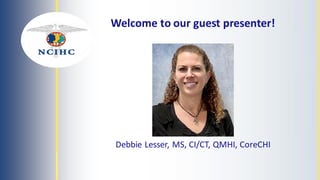
Welcome to our guest presenter!
Debbie Lesser, MS, CI/CT, QMHI, CoreCHI
Interpreting:
A Practice Profession
Improving Professional Performance with Demand Control Schema
Debbie Lesser, MS, CI/CT, QMHI, CoreCHI
debbie.lesser@wellstar.org
404-226-5607
Encounters with
Reality
1001 Interpreter
Scenarios
Barabara E. Cartwright
“Once one has mastered
(sign) language, the
mechanics of interpreting,
and internalized the Code
of Ethics, the really
difficult work begins.”
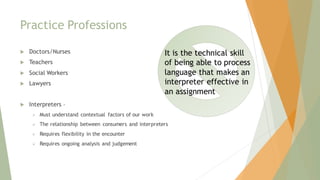
Practice Professions
 Doctors/Nurses
 Teachers
 Social Workers
 Lawyers
 Interpreters –
➢ Must understand contextual factors of our work
➢ The relationship between consumers and interpreters
➢ Requires flexibility in the encounter
➢ Requires ongoing analysis and judgement
It is the technical skill
of being able to process
language that makes an
interpreter effective in
an assignment
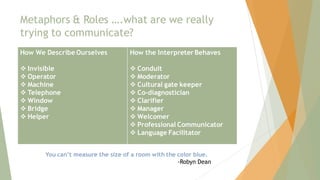
Metaphors & Roles ….what are we really
trying to communicate?
How We Describe Ourselves
❖ Invisible
❖ Operator
❖ Machine
❖ Telephone
❖ Window
❖ Bridge
❖ Helper
How the Interpreter Behaves
❖ Conduit
❖ Moderator
❖ Cultural gate keeper
❖ Co-diagnostician
❖ Clarifier
❖ Manager
❖ Welcomer
❖ Professional Communicator
❖ Language Facilitator
You can’t measure the size of a room with the color blue.
-Robyn Dean
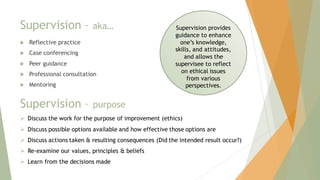
Supervision – aka…
 Reflective practice
 Case conferencing
 Peer guidance
 Professional consultation
 Mentoring
Supervision provides
guidance to enhance
one’s knowledge,
skills, and attitudes,
and allows the
supervisee to reflect
on ethical issues
from various
perspectives.
➢ Discuss the work for the purpose of improvement (ethics)
➢ Discuss possible options available and how effective those options are
➢ Discuss actions taken & resulting consequences (Did the intended result occur?)
➢ Re-examine our values, principles & beliefs
➢ Learn from the decisions made
Supervision – purpose
Patient Meeting with Genetic Counselor
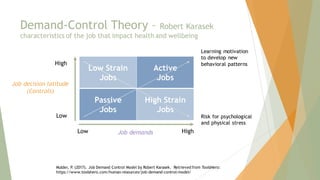
Demand-Control Theory – Robert Karasek
characteristics of the job that impact health and wellbeing
Low Strain
Jobs
Active
Jobs
Passive
Jobs
High Strain
Jobs
High
Low
Low High
Job decision latitude
(Controls)
Job demands
Learning motivation
to develop new
behavioral patterns
Risk for psychological
and physical stress
Mulder, P. (2017). Job Demand Control Model by Robert Karasek. Retrieved from ToolsHero:
https://www.toolshero.com/human-resources/job-demand-control-model/
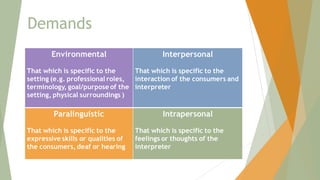
Demands
Environmental
That which is specific to the
setting (e.g. professional roles,
terminology, goal/purpose of the
setting, physical surroundings )
Interpersonal
That which is specific to the
interaction of the consumers and
interpreter
Paralinguistic
That which is specific to the
expressive skills or qualities of
the consumers, deaf or hearing
Intrapersonal
That which is specific to the
feelings or thoughts of the
interpreter
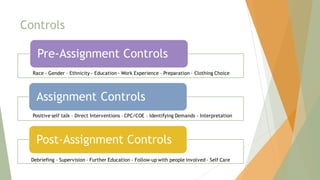
Controls
Pre-Assignment Controls
Assignment Controls
Post-Assignment Controls
Race - Gender – Ethnicity - Education - Work Experience – Preparation – Clothing Choice
Positive self talk – Direct Interventions – CPC/COE – Identifying Demands - Interpretation
Debriefing – Supervision – Further Education – Follow-up with people involved – Self Care
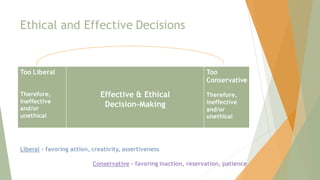
Ethical and Effective Decisions
Too Liberal
Therefore,
ineffective
and/or
unethical
Effective & Ethical
Decision-Making
Too
Conservative
Therefore,
ineffective
and/or
unethical
Liberal - favoring action, creativity, assertiveness
Conservative - favoring inaction, reservation, patience
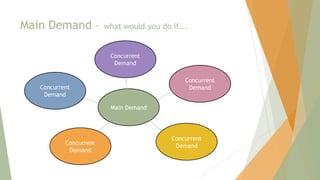
Main Demand – what would you do if….
Main Demand
Concurrent
Demand
Concurrent
Demand
Concurrent
Demand
Concurrent
Demand
Concurrent
Demand
The Science Lesson….
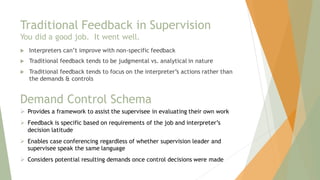
Traditional Feedback in Supervision
You did a good job. It went well.
 Interpreters can’t improve with non-specific feedback
 Traditional feedback tends to be judgmental vs. analytical in nature
 Traditional feedback tends to focus on the interpreter’s actions rather than
the demands & controls
➢ Provides a framework to assist the supervisee in evaluating their own work
➢ Feedback is specific based on requirements of the job and interpreter’s
decision latitude
➢ Enables case conferencing regardless of whether supervision leader and
supervisee speak the same language
➢ Considers potential resulting demands once control decisions were made
Demand Control Schema
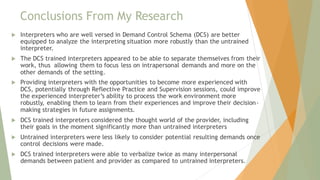
Conclusions From My Research
 Interpreters who are well versed in Demand Control Schema (DCS) are better
equipped to analyze the interpreting situation more robustly than the untrained
interpreter.
 The DCS trained interpreters appeared to be able to separate themselves from their
work, thus allowing them to focus less on intrapersonal demands and more on the
other demands of the setting.
 Providing interpreters with the opportunities to become more experienced with
DCS, potentially through Reflective Practice and Supervision sessions, could improve
the experienced interpreter’s ability to process the work environment more
robustly, enabling them to learn from their experiences and improve their decision-
making strategies in future assignments.
 DCS trained interpreters considered the thought world of the provider, including
their goals in the moment significantly more than untrained interpreters
 Untrained interpreters were less likely to consider potential resulting demands once
control decisions were made.
 DCS trained interpreters were able to verbalize twice as many interpersonal
demands between patient and provider as compared to untrained interpreters.
Q & A
The Demand Control Schema: Interpreting as a Practice Profession 1st Edition
by Robyn K. Dean (Author), Robert Q Pollard Jr (Author)
NATIONAL
COUNCIL
ON
INTERPRETING
IN
HEALTH
CARE
• Upcoming webinars
• Webinar evaluation form
• Follow up via email:
TrainersWebinars@ncihc.org
• ncihc.org/participate
Announcements
Home for Trainers Interpreter Trainers Webinars Workgroup
An initiative of the Standards and Training Committee
www.ncihc.org/home-for-trainers
NATIONAL
COUNCIL
ON
INTERPRETING
IN
HEALTH
CARE
Thank you for attending!

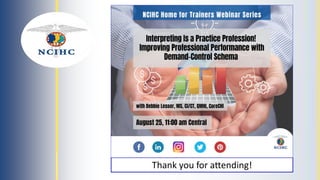
Interpreting is a Practice Profession Improving Professional Performance with Demand-Control Schema

  • 1.
  • 2.
    NATIONAL COUNCIL ON INTERPRETING IN HEALTH CARE Housekeeping • This sessionis being recorded • Certificate of Attendance *must attend full 90 minutes *certificates will be emailed by September 22, 2021 • Use “Q&A” to send comments and questions to the hosts Home for Trainers Interpreter Trainers Webinars Workgroup An initiative of the Standards and Training Committee www.ncihc.org/home-for-trainers
  • 3.
    NATIONAL COUNCIL ON INTERPRETING IN HEALTH CARE Welcome to ourguest presenter! Debbie Lesser, MS, CI/CT, QMHI, CoreCHI
  • 4.
    Interpreting: A Practice Profession ImprovingProfessional Performance with Demand Control Schema Debbie Lesser, MS, CI/CT, QMHI, CoreCHI debbie.lesser@wellstar.org 404-226-5607
  • 5.
    Encounters with Reality 1001 Interpreter Scenarios BarabaraE. Cartwright “Once one has mastered (sign) language, the mechanics of interpreting, and internalized the Code of Ethics, the really difficult work begins.”
  • 6.
    Practice Professions  Doctors/Nurses Teachers  Social Workers  Lawyers  Interpreters – ➢ Must understand contextual factors of our work ➢ The relationship between consumers and interpreters ➢ Requires flexibility in the encounter ➢ Requires ongoing analysis and judgement It is the technical skill of being able to process language that makes an interpreter effective in an assignment
  • 7.
    Metaphors & Roles….what are we really trying to communicate? How We Describe Ourselves ❖ Invisible ❖ Operator ❖ Machine ❖ Telephone ❖ Window ❖ Bridge ❖ Helper How the Interpreter Behaves ❖ Conduit ❖ Moderator ❖ Cultural gate keeper ❖ Co-diagnostician ❖ Clarifier ❖ Manager ❖ Welcomer ❖ Professional Communicator ❖ Language Facilitator You can’t measure the size of a room with the color blue. -Robyn Dean
  • 8.
    Supervision – aka… Reflective practice  Case conferencing  Peer guidance  Professional consultation  Mentoring Supervision provides guidance to enhance one’s knowledge, skills, and attitudes, and allows the supervisee to reflect on ethical issues from various perspectives. ➢ Discuss the work for the purpose of improvement (ethics) ➢ Discuss possible options available and how effective those options are ➢ Discuss actions taken & resulting consequences (Did the intended result occur?) ➢ Re-examine our values, principles & beliefs ➢ Learn from the decisions made Supervision – purpose
  • 9.
    Patient Meeting withGenetic Counselor
  • 10.
    Demand-Control Theory –Robert Karasek characteristics of the job that impact health and wellbeing Low Strain Jobs Active Jobs Passive Jobs High Strain Jobs High Low Low High Job decision latitude (Controls) Job demands Learning motivation to develop new behavioral patterns Risk for psychological and physical stress Mulder, P. (2017). Job Demand Control Model by Robert Karasek. Retrieved from ToolsHero: https://www.toolshero.com/human-resources/job-demand-control-model/
  • 11.
    Demands Environmental That which isspecific to the setting (e.g. professional roles, terminology, goal/purpose of the setting, physical surroundings ) Interpersonal That which is specific to the interaction of the consumers and interpreter Paralinguistic That which is specific to the expressive skills or qualities of the consumers, deaf or hearing Intrapersonal That which is specific to the feelings or thoughts of the interpreter
  • 12.
    Controls Pre-Assignment Controls Assignment Controls Post-AssignmentControls Race - Gender – Ethnicity - Education - Work Experience – Preparation – Clothing Choice Positive self talk – Direct Interventions – CPC/COE – Identifying Demands - Interpretation Debriefing – Supervision – Further Education – Follow-up with people involved – Self Care
  • 13.
    Ethical and EffectiveDecisions Too Liberal Therefore, ineffective and/or unethical Effective & Ethical Decision-Making Too Conservative Therefore, ineffective and/or unethical Liberal - favoring action, creativity, assertiveness Conservative - favoring inaction, reservation, patience
  • 14.
    Main Demand –what would you do if…. Main Demand Concurrent Demand Concurrent Demand Concurrent Demand Concurrent Demand Concurrent Demand
  • 15.
  • 16.
    Traditional Feedback inSupervision You did a good job. It went well.  Interpreters can’t improve with non-specific feedback  Traditional feedback tends to be judgmental vs. analytical in nature  Traditional feedback tends to focus on the interpreter’s actions rather than the demands & controls ➢ Provides a framework to assist the supervisee in evaluating their own work ➢ Feedback is specific based on requirements of the job and interpreter’s decision latitude ➢ Enables case conferencing regardless of whether supervision leader and supervisee speak the same language ➢ Considers potential resulting demands once control decisions were made Demand Control Schema
  • 17.
    Conclusions From MyResearch  Interpreters who are well versed in Demand Control Schema (DCS) are better equipped to analyze the interpreting situation more robustly than the untrained interpreter.  The DCS trained interpreters appeared to be able to separate themselves from their work, thus allowing them to focus less on intrapersonal demands and more on the other demands of the setting.  Providing interpreters with the opportunities to become more experienced with DCS, potentially through Reflective Practice and Supervision sessions, could improve the experienced interpreter’s ability to process the work environment more robustly, enabling them to learn from their experiences and improve their decision- making strategies in future assignments.  DCS trained interpreters considered the thought world of the provider, including their goals in the moment significantly more than untrained interpreters  Untrained interpreters were less likely to consider potential resulting demands once control decisions were made.  DCS trained interpreters were able to verbalize twice as many interpersonal demands between patient and provider as compared to untrained interpreters.
  • 18.
    Q & A TheDemand Control Schema: Interpreting as a Practice Profession 1st Edition by Robyn K. Dean (Author), Robert Q Pollard Jr (Author)
  • 19.
    NATIONAL COUNCIL ON INTERPRETING IN HEALTH CARE • Upcoming webinars •Webinar evaluation form • Follow up via email: TrainersWebinars@ncihc.org • ncihc.org/participate Announcements Home for Trainers Interpreter Trainers Webinars Workgroup An initiative of the Standards and Training Committee www.ncihc.org/home-for-trainers
  • 20.