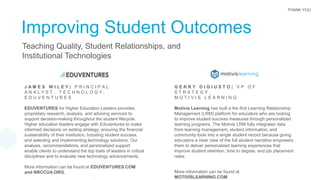
Improving Student Outcomes
Teaching Quality, Student Relationships, and
Institutional Technologies
J A M E S W I L E Y | P R I N C I P A L A N A L Y S T , T E C H N O L O G Y , E D U V E N T U R E S
G E R R Y D I G I U S T O | V P O F S T R A T E G Y , M O T I V I S L E A R N I N G
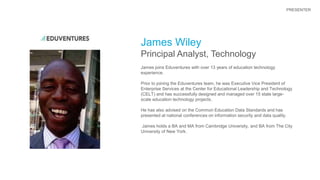
James Wiley
Principal Analyst, Technology
James joins Eduventures with over 13 years of education technology
experience.
Prior to joining the Eduventures team, he was Executive Vice President of
Enterprise Services at the Center for Educational Leadership and Technology
(CELT) and has successfully designed and managed over 15 state large-
scale education technology projects.
He has also advised on the Common Education Data Standards and has
presented at national conferences on information security and data quality.
James holds a BA and MA from Cambridge University, and BA from The City
University of New York.
PRESENTER
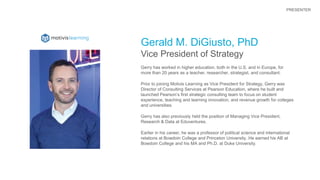
Gerald M. DiGiusto, PhD
Vice President of Strategy
Gerry has worked in higher education, both in the U.S. and in Europe, for
more than 20 years as a teacher, researcher, strategist, and consultant.
Prior to joining Motivis Learning as Vice President for Strategy, Gerry was
Director of Consulting Services at Pearson Education, where he built and
launched Pearson’s first strategic consulting team to focus on student
experience, teaching and learning innovation, and revenue growth for colleges
and universities.
Gerry has also previously held the position of Managing Vice President,
Research & Data at Eduventures.
Earlier in his career, he was a professor of political science and international
relations at Bowdoin College and Princeton University. He earned his AB at
Bowdoin College and his MA and Ph.D. at Duke University.
PRESENTER
Contents
TABLE OF
Introduction 1
What are the types of student outcomes? 3
What are some challenges for improving student outcomes? 7
What are some steps to improve student outcomes? 9
What is a Learning Relationship Management (LRM) solution? 11
Motivis Learning’s Approach to LRM 14
Q&A 23
Introduction
Why are we here today?
• For many academic leaders, improving student outcomes -- such as retention, persistence,
and employability -- is a top priority. Yet most institutions struggle to develop successful
strategies to achieve substantial gains in student outcomes.
• In this webinar, we will examine the challenges many institutions face to improving student
outcomes and explore enterprise technologies such as Learning Relationship Management
systems (LRM) that can facilitate successful strategies to enhance teaching quality and
deploy student support resources more effectively.
• There will be a question and answer period at the end of the webinar, where participant
questions (submitted via the chat box) will be addressed.
INTRODUCTION
What are the types of
student outcomes?
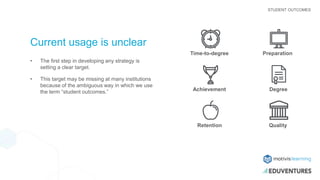
Current usage is unclear
• The first step in developing any strategy is
setting a clear target.
• This target may be missing at many institutions
because of the ambiguous way in which we use
the term “student outcomes.”
STUDENT OUTCOMES
Retention Quality
Time-to-degree Preparation
DegreeAchievement
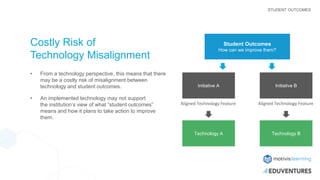
Costly Risk of
Technology Misalignment
• From a technology perspective, this means that there
may be a costly risk of misalignment between
technology and student outcomes.
• An implemented technology may not support
the institution’s view of what “student outcomes”
means and how it plans to take action to improve
them.
STUDENT OUTCOMES
Student Outcomes
How can we improve them?
Initiative A
Technology A
Aligned Technology Feature
Initiative B
Technology B
Aligned Technology Feature
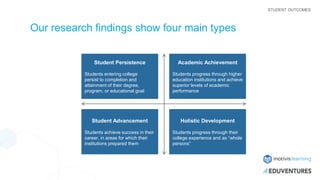
Our research findings show four main types
STUDENT OUTCOMES
Student Persistence
Students entering college
persist to completion and
attainment of their degree,
program, or educational goal
Academic Achievement
Students progress through higher
education institutions and achieve
superior levels of academic
performance
Student Advancement
Students achieve success in their
career, in areas for which their
institutions prepared them
Holistic Development
Students progress through their
college experience and as “whole
persons”
What are the challenges?
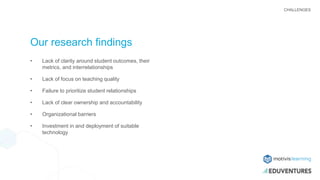
CHALLENGES
Our research findings
• Lack of clarity around student outcomes, their
metrics, and interrelationships
• Lack of focus on teaching quality
• Failure to prioritize student relationships
• Lack of clear ownership and accountability
• Organizational barriers
• Investment in and deployment of suitable
technology
What are some key steps?
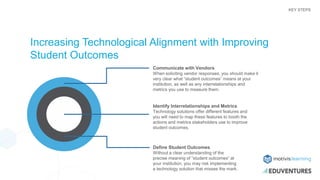
KEY STEPS
Increasing Technological Alignment with Improving
Student Outcomes
Communicate with Vendors
When soliciting vendor responses, you should make it
very clear what “student outcomes” means at your
institution, as well as any interrelationships and
metrics you use to measure them.
Identify Interrelationships and Metrics
Technology solutions offer different features and
you will need to map these features to booth the
actions and metrics stakeholders use to improve
student outcomes.
Define Student Outcomes
Without a clear understanding of the
precise meaning of “student outcomes” at
your institution, you may risk implementing
a technology solution that misses the mark.
What is a Learning Relationship
Management System?
LRM
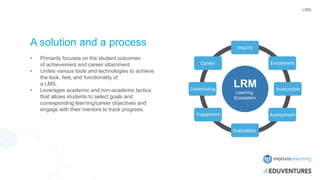
A solution and a process
• Primarily focuses on the student outcomes
of achievement and career attainment.
• Unites various tools and technologies to achieve
the look, feel, and functionality of
a LMS.
• Leverages academic and non-academic tactics
that allows students to select goals and
corresponding learning/career objectives and
engage with their mentors to track progress.
LRM
Learning
Ecosystem
Inquiry
Credentialing
Career Enrollment
Instruction
Evaluation
Engagement Assessment
Student Information System (SIS)
LRM
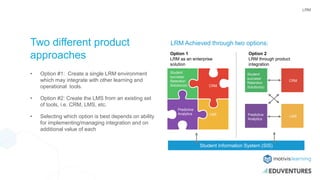
Two different product
approaches
• Option #1: Create a single LRM environment
which may integrate with other learning and
operational tools.
• Option #2: Create the LMS from an existing set
of tools, i.e. CRM, LMS, etc.
• Selecting which option is best depends on ability
for implementing/managing integration and on
additional value of each
Student
success/
Retention
Solution(s) CRM
LMS
Predictive
Analytics
Student
success/
Retention
Solution(s)
CRM
LMSPredictive
Analytics
LRM Achieved through two options:
Option 1
LRM as an enterprise
solution
Option 2
LRM through product
integration
Motivis Learning Approach to LRM
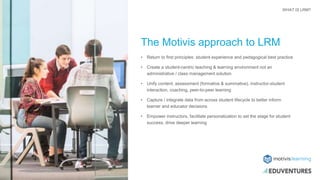
The Motivis approach to LRM
• Return to first principles: student experience and pedagogical best practice
• Create a student-centric teaching & learning environment not an
administrative / class management solution
• Unify content, assessment (formative & summative), instructor-student
interaction, coaching, peer-to-peer learning
• Capture / integrate data from across student lifecycle to better inform
learner and educator decisions
• Empower instructors, facilitate personalization to set the stage for student
success, drive deeper learning
WHAT IS LRM?
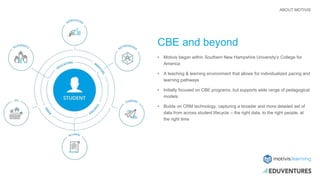
CBE and beyond
• Motivis began within Southern New Hampshire University’s College for
America
• A teaching & learning environment that allows for individualized pacing and
learning pathways
• Initially focused on CBE programs, but supports wide range of pedagogical
models
• Builds on CRM technology, capturing a broader and more detailed set of
data from across student lifecycle – the right data, to the right people, at
the right time
ABOUT MOTIVIS
MOTIVIS PARTNERS
MOTIVIS LRM
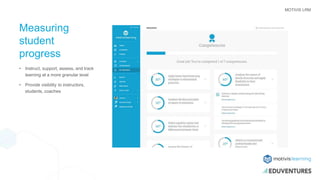
Measuring
student
progress
• Instruct, support, assess, and track
learning at a more granular level
• Provide visibility to instructors,
students, coaches
MOTIVIS LRM
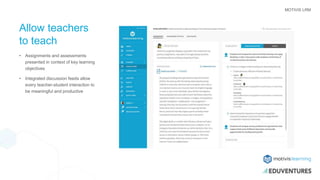
Allow teachers
to teach
• Assignments and assessments
presented in context of key learning
objectives
• Integrated discussion feeds allow
every teacher-student interaction to
be meaningful and productive
MOTIVIS LRM
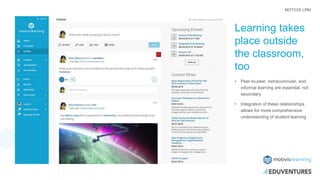
Learning takes
place outside
the classroom,
too
• Peer-to-peer, extracurricular, and
informal learning are essential, not
secondary
• Integration of these relationships
allows for more comprehensive
understanding of student learning
Thank You!
Q&A
Questions and Answers
THANK YOU
Improving Student Outcomes
Teaching Quality, Student Relationships, and
Institutional Technologies
J A M E S W I L E Y | P R I N C I P A L
A N A L Y S T , T E C H N O L O G Y ,
E D U V E N T U R E S
EDUVENTURES for Higher Education Leaders provides
proprietary research, analysis, and advising services to
support decision-making throughout the student lifecycle.
Higher education leaders engage with Eduventures to make
informed decisions on setting strategy, ensuring the financial
sustainability of their institution, boosting student success,
and selecting and implementing technology solutions. Our
analysis, recommendations, and personalized support
enable clients to understand the top traits of leaders in critical
disciplines and to evaluate new technology advancements.
More information can be found at EDUVENTURES.COM
and NRCCUA.ORG.
G E R R Y D I G I U S T O | V P O F
S T R A T E G Y ,
M O T I V I S L E A R N I N G
Motivis Learning has built a the first Learning Relationship
Management (LRM) platform for educators who are looking
to improve student success measures through personalized
learning programs. The Motivis LRM fully integrates data
from learning management, student information, and
community tools into a single student record because giving
educators a clear view of the full student narrative empowers
them to deliver personalized learning experiences that
improve student retention, time to degree, and job placement
rates.
More information can be found at
MOTIVISLEARNING.COM

Improving Student Outcomes | Teaching Quality, Student Relationships, and Institutional Technologies

  • 1.
    Improving Student Outcomes TeachingQuality, Student Relationships, and Institutional Technologies J A M E S W I L E Y | P R I N C I P A L A N A L Y S T , T E C H N O L O G Y , E D U V E N T U R E S G E R R Y D I G I U S T O | V P O F S T R A T E G Y , M O T I V I S L E A R N I N G
  • 2.
    James Wiley Principal Analyst,Technology James joins Eduventures with over 13 years of education technology experience. Prior to joining the Eduventures team, he was Executive Vice President of Enterprise Services at the Center for Educational Leadership and Technology (CELT) and has successfully designed and managed over 15 state large- scale education technology projects. He has also advised on the Common Education Data Standards and has presented at national conferences on information security and data quality. James holds a BA and MA from Cambridge University, and BA from The City University of New York. PRESENTER
  • 3.
    Gerald M. DiGiusto,PhD Vice President of Strategy Gerry has worked in higher education, both in the U.S. and in Europe, for more than 20 years as a teacher, researcher, strategist, and consultant. Prior to joining Motivis Learning as Vice President for Strategy, Gerry was Director of Consulting Services at Pearson Education, where he built and launched Pearson’s first strategic consulting team to focus on student experience, teaching and learning innovation, and revenue growth for colleges and universities. Gerry has also previously held the position of Managing Vice President, Research & Data at Eduventures. Earlier in his career, he was a professor of political science and international relations at Bowdoin College and Princeton University. He earned his AB at Bowdoin College and his MA and Ph.D. at Duke University. PRESENTER
  • 4.
    Contents TABLE OF Introduction 1 Whatare the types of student outcomes? 3 What are some challenges for improving student outcomes? 7 What are some steps to improve student outcomes? 9 What is a Learning Relationship Management (LRM) solution? 11 Motivis Learning’s Approach to LRM 14 Q&A 23
  • 5.
  • 6.
    Why are wehere today? • For many academic leaders, improving student outcomes -- such as retention, persistence, and employability -- is a top priority. Yet most institutions struggle to develop successful strategies to achieve substantial gains in student outcomes. • In this webinar, we will examine the challenges many institutions face to improving student outcomes and explore enterprise technologies such as Learning Relationship Management systems (LRM) that can facilitate successful strategies to enhance teaching quality and deploy student support resources more effectively. • There will be a question and answer period at the end of the webinar, where participant questions (submitted via the chat box) will be addressed. INTRODUCTION
  • 7.
    What are thetypes of student outcomes?
  • 8.
    Current usage isunclear • The first step in developing any strategy is setting a clear target. • This target may be missing at many institutions because of the ambiguous way in which we use the term “student outcomes.” STUDENT OUTCOMES Retention Quality Time-to-degree Preparation DegreeAchievement
  • 9.
    Costly Risk of TechnologyMisalignment • From a technology perspective, this means that there may be a costly risk of misalignment between technology and student outcomes. • An implemented technology may not support the institution’s view of what “student outcomes” means and how it plans to take action to improve them. STUDENT OUTCOMES Student Outcomes How can we improve them? Initiative A Technology A Aligned Technology Feature Initiative B Technology B Aligned Technology Feature
  • 10.
    Our research findingsshow four main types STUDENT OUTCOMES Student Persistence Students entering college persist to completion and attainment of their degree, program, or educational goal Academic Achievement Students progress through higher education institutions and achieve superior levels of academic performance Student Advancement Students achieve success in their career, in areas for which their institutions prepared them Holistic Development Students progress through their college experience and as “whole persons”
  • 11.
    What are thechallenges?
  • 12.
    CHALLENGES Our research findings •Lack of clarity around student outcomes, their metrics, and interrelationships • Lack of focus on teaching quality • Failure to prioritize student relationships • Lack of clear ownership and accountability • Organizational barriers • Investment in and deployment of suitable technology
  • 13.
    What are somekey steps?
  • 14.
    KEY STEPS Increasing TechnologicalAlignment with Improving Student Outcomes Communicate with Vendors When soliciting vendor responses, you should make it very clear what “student outcomes” means at your institution, as well as any interrelationships and metrics you use to measure them. Identify Interrelationships and Metrics Technology solutions offer different features and you will need to map these features to booth the actions and metrics stakeholders use to improve student outcomes. Define Student Outcomes Without a clear understanding of the precise meaning of “student outcomes” at your institution, you may risk implementing a technology solution that misses the mark.
  • 15.
    What is aLearning Relationship Management System?
  • 16.
    LRM A solution anda process • Primarily focuses on the student outcomes of achievement and career attainment. • Unites various tools and technologies to achieve the look, feel, and functionality of a LMS. • Leverages academic and non-academic tactics that allows students to select goals and corresponding learning/career objectives and engage with their mentors to track progress. LRM Learning Ecosystem Inquiry Credentialing Career Enrollment Instruction Evaluation Engagement Assessment
  • 17.
    Student Information System(SIS) LRM Two different product approaches • Option #1: Create a single LRM environment which may integrate with other learning and operational tools. • Option #2: Create the LMS from an existing set of tools, i.e. CRM, LMS, etc. • Selecting which option is best depends on ability for implementing/managing integration and on additional value of each Student success/ Retention Solution(s) CRM LMS Predictive Analytics Student success/ Retention Solution(s) CRM LMSPredictive Analytics LRM Achieved through two options: Option 1 LRM as an enterprise solution Option 2 LRM through product integration
  • 18.
  • 19.
    The Motivis approachto LRM • Return to first principles: student experience and pedagogical best practice • Create a student-centric teaching & learning environment not an administrative / class management solution • Unify content, assessment (formative & summative), instructor-student interaction, coaching, peer-to-peer learning • Capture / integrate data from across student lifecycle to better inform learner and educator decisions • Empower instructors, facilitate personalization to set the stage for student success, drive deeper learning WHAT IS LRM?
  • 20.
    CBE and beyond •Motivis began within Southern New Hampshire University’s College for America • A teaching & learning environment that allows for individualized pacing and learning pathways • Initially focused on CBE programs, but supports wide range of pedagogical models • Builds on CRM technology, capturing a broader and more detailed set of data from across student lifecycle – the right data, to the right people, at the right time ABOUT MOTIVIS
  • 21.
  • 22.
    MOTIVIS LRM Measuring student progress • Instruct,support, assess, and track learning at a more granular level • Provide visibility to instructors, students, coaches
  • 23.
    MOTIVIS LRM Allow teachers toteach • Assignments and assessments presented in context of key learning objectives • Integrated discussion feeds allow every teacher-student interaction to be meaningful and productive
  • 24.
    MOTIVIS LRM Learning takes placeoutside the classroom, too • Peer-to-peer, extracurricular, and informal learning are essential, not secondary • Integration of these relationships allows for more comprehensive understanding of student learning
  • 25.
  • 26.
  • 27.
    THANK YOU Improving StudentOutcomes Teaching Quality, Student Relationships, and Institutional Technologies J A M E S W I L E Y | P R I N C I P A L A N A L Y S T , T E C H N O L O G Y , E D U V E N T U R E S EDUVENTURES for Higher Education Leaders provides proprietary research, analysis, and advising services to support decision-making throughout the student lifecycle. Higher education leaders engage with Eduventures to make informed decisions on setting strategy, ensuring the financial sustainability of their institution, boosting student success, and selecting and implementing technology solutions. Our analysis, recommendations, and personalized support enable clients to understand the top traits of leaders in critical disciplines and to evaluate new technology advancements. More information can be found at EDUVENTURES.COM and NRCCUA.ORG. G E R R Y D I G I U S T O | V P O F S T R A T E G Y , M O T I V I S L E A R N I N G Motivis Learning has built a the first Learning Relationship Management (LRM) platform for educators who are looking to improve student success measures through personalized learning programs. The Motivis LRM fully integrates data from learning management, student information, and community tools into a single student record because giving educators a clear view of the full student narrative empowers them to deliver personalized learning experiences that improve student retention, time to degree, and job placement rates. More information can be found at MOTIVISLEARNING.COM