DEFECATION REFLEXES
DEFECATION REFLEXES
1. Intrinsic defecation reflex
 Enteric nervous system – Myenteric
plexus
 Weak reflex – fortified with
Parasympathetic defecation reflex
2. Parasympathetic defecation reflex
 Autonomic nervous system –
Parasympathetic fibers of pelvic nerves
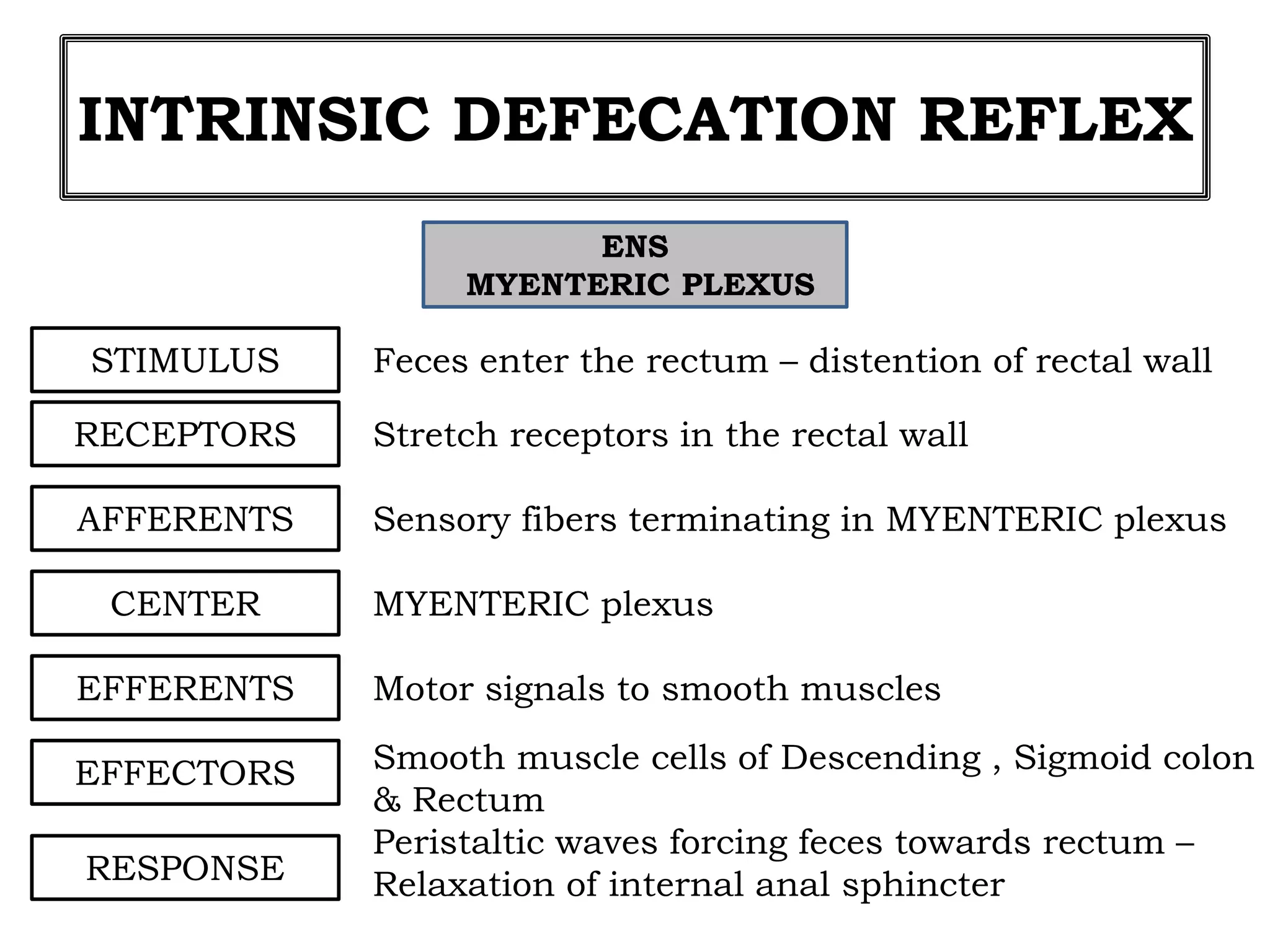
INTRINSIC DEFECATION REFLEX
ENS
MYENTERIC PLEXUS
STIMULUS Feces enter the rectum – distention of rectal wall
RECEPTORS Stretch receptors in the rectal wall
AFFERENTS Sensory fibers terminating in MYENTERIC plexus
CENTER
EFFERENTS
EFFECTORS
RESPONSE
MYENTERIC plexus
Smooth muscle cells of Descending , Sigmoid colon
& Rectum
Motor signals to smooth muscles
Peristaltic waves forcing feces towards rectum –
Relaxation of internal anal sphincter
PARASYMPATHETIC DEFECATION
REFLEX
Afferents
Efferents
Skeletal motor nerve
PARASYMPATHETIC DEFECATION
REFLEX
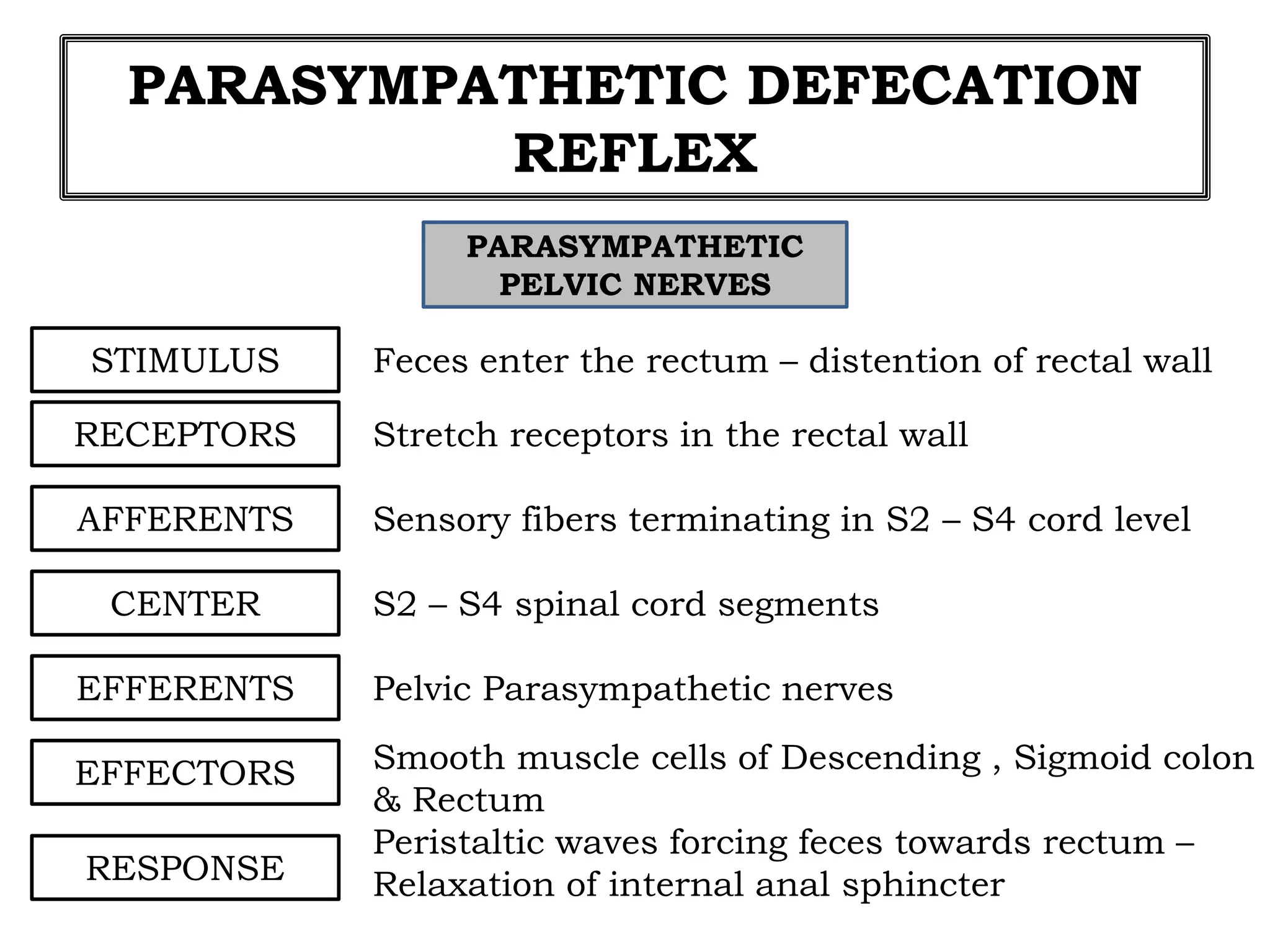
PARASYMPATHETIC
PELVIC NERVES
STIMULUS Feces enter the rectum – distention of rectal wall
RECEPTORS Stretch receptors in the rectal wall
AFFERENTS Sensory fibers terminating in S2 – S4 cord level
CENTER
EFFERENTS
EFFECTORS
RESPONSE
S2 – S4 spinal cord segments
Smooth muscle cells of Descending , Sigmoid colon
& Rectum
Pelvic Parasympathetic nerves
Peristaltic waves forcing feces towards rectum –
Relaxation of internal anal sphincter
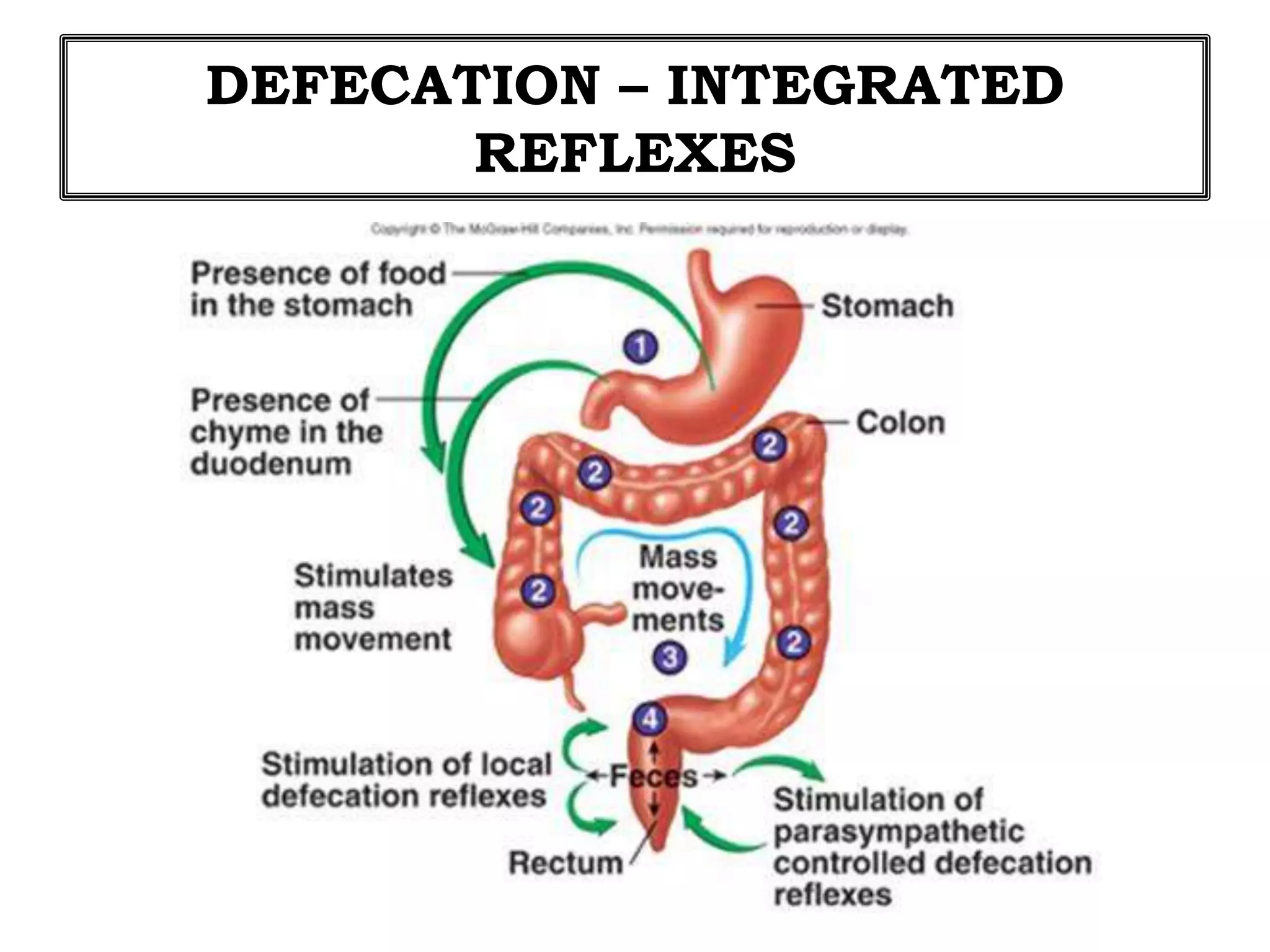
DEFECATION – INTEGRATED
REFLEXES
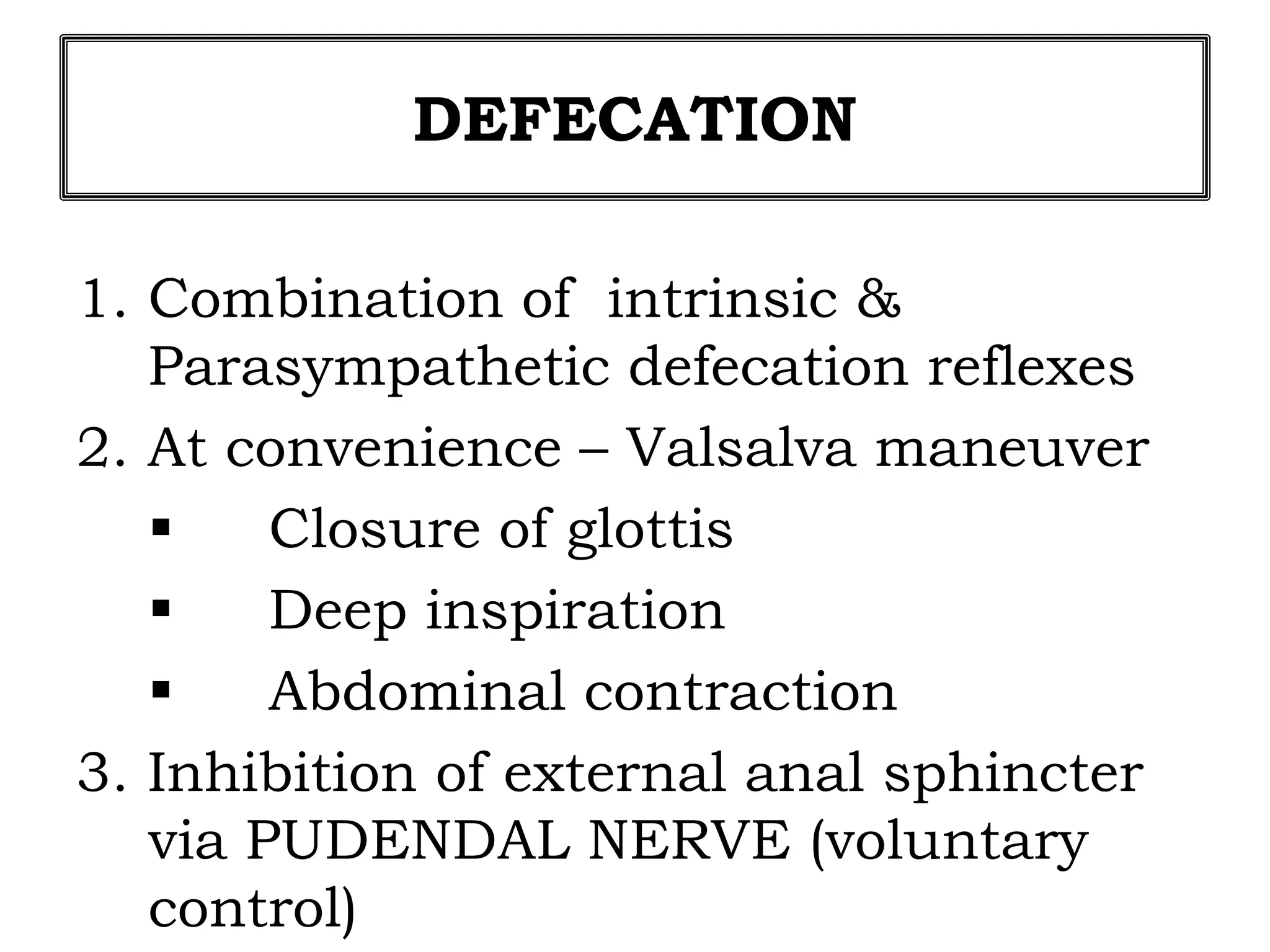
DEFECATION
1. Combination of intrinsic &
Parasympathetic defecation reflexes
2. At convenience – Valsalva maneuver
 Closure of glottis
 Deep inspiration
 Abdominal contraction
3. Inhibition of external anal sphincter
via PUDENDAL NERVE (voluntary
control)
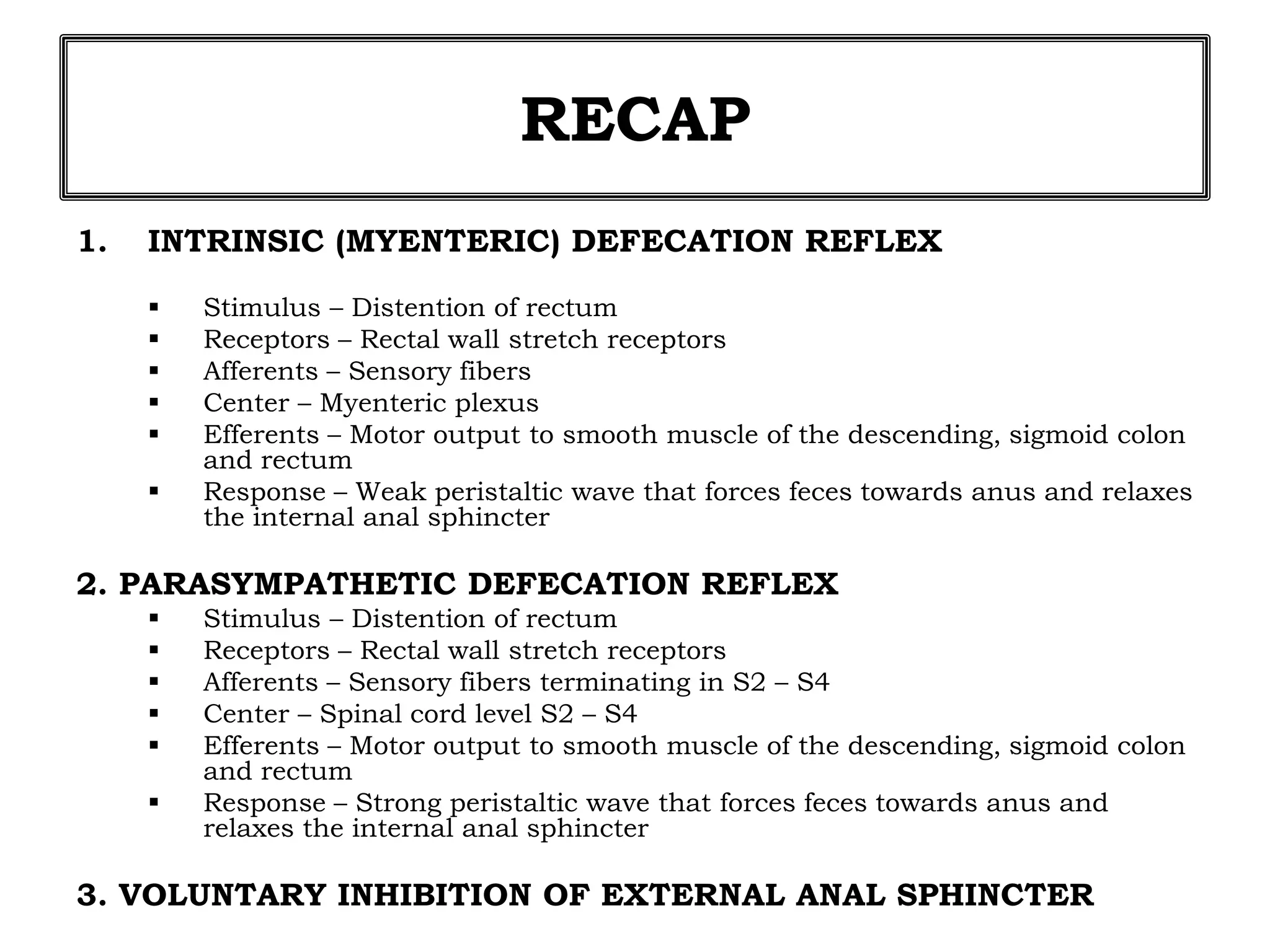
RECAP
1. INTRINSIC (MYENTERIC) DEFECATION REFLEX
 Stimulus – Distention of rectum
 Receptors – Rectal wall stretch receptors
 Afferents – Sensory fibers
 Center – Myenteric plexus
 Efferents – Motor output to smooth muscle of the descending, sigmoid colon
and rectum
 Response – Weak peristaltic wave that forces feces towards anus and relaxes
the internal anal sphincter
2. PARASYMPATHETIC DEFECATION REFLEX
 Stimulus – Distention of rectum
 Receptors – Rectal wall stretch receptors
 Afferents – Sensory fibers terminating in S2 – S4
 Center – Spinal cord level S2 – S4
 Efferents – Motor output to smooth muscle of the descending, sigmoid colon
and rectum
 Response – Strong peristaltic wave that forces feces towards anus and
relaxes the internal anal sphincter
3. VOLUNTARY INHIBITION OF EXTERNAL ANAL SPHINCTER
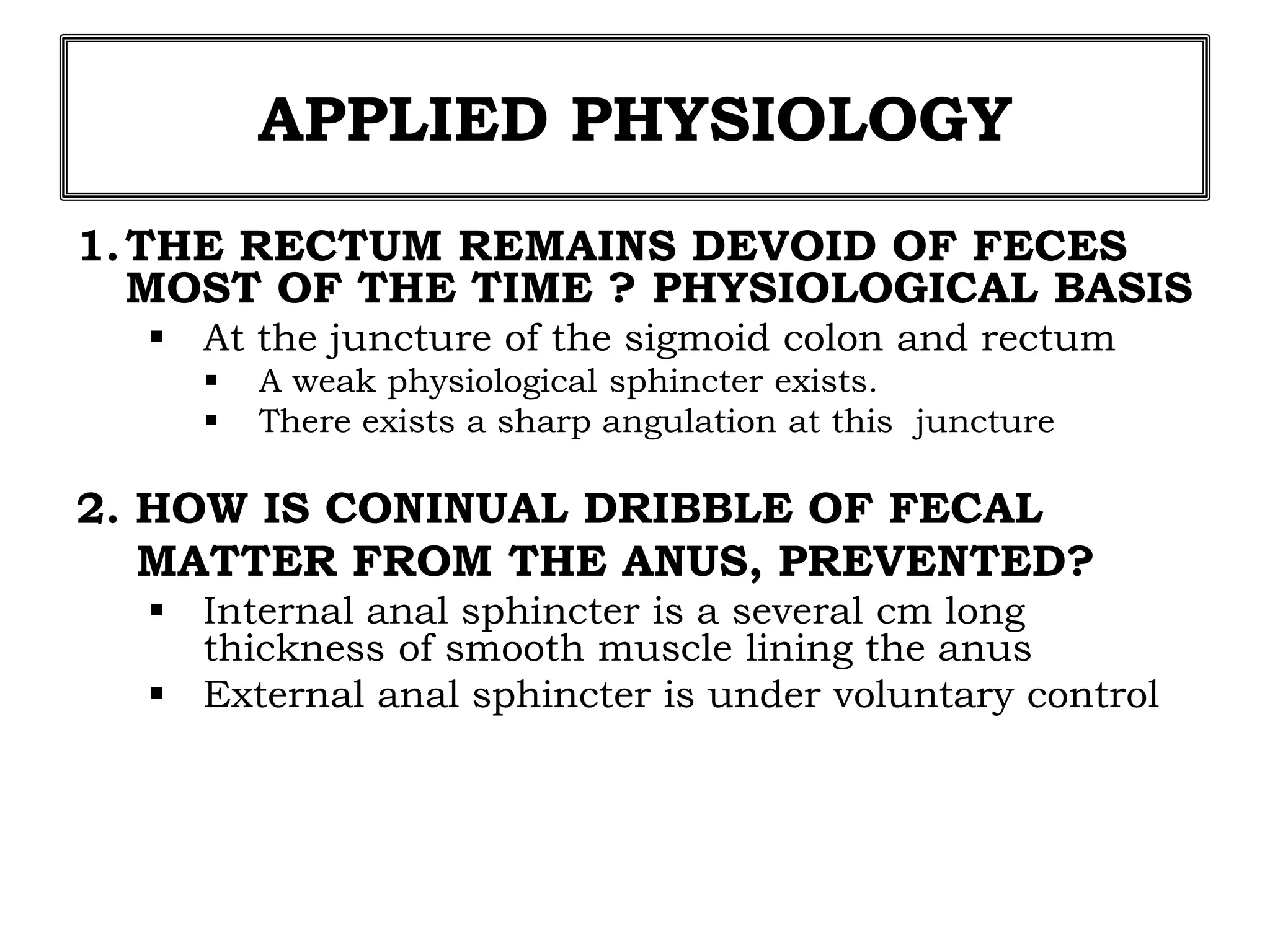
APPLIED PHYSIOLOGY
1.THE RECTUM REMAINS DEVOID OF FECES
MOST OF THE TIME ? PHYSIOLOGICAL BASIS
 At the juncture of the sigmoid colon and rectum
 A weak physiological sphincter exists.
 There exists a sharp angulation at this juncture
2. HOW IS CONINUAL DRIBBLE OF FECAL
MATTER FROM THE ANUS, PREVENTED?
 Internal anal sphincter is a several cm long
thickness of smooth muscle lining the anus
 External anal sphincter is under voluntary control
APPLIED PHYSIOLOGY
3. THE RECTUM OF SMALL CHILDREN AND PATIENTS
WITH SPINAL CORD TRANSECTION EMPTIES
AUTOMATICALLY ?
PHYSIOLOGICAL / PATHOPHYSIOLOGICAL BASIS?
 Inhibitory inputs from higher control centers to the spinal cord
segments S2 – S4 are not fully developed in small children,
whereas they are interrupted in case of spinal cord transection
above this level, as result of which, the rectum in these cases
empties automatically purely on initiation of intrinsic and
parasympathetic defecation reflexes.

Defecation reflex

  • 1.
  • 2.
    DEFECATION REFLEXES 1. Intrinsicdefecation reflex  Enteric nervous system – Myenteric plexus  Weak reflex – fortified with Parasympathetic defecation reflex 2. Parasympathetic defecation reflex  Autonomic nervous system – Parasympathetic fibers of pelvic nerves
  • 3.
    INTRINSIC DEFECATION REFLEX ENS MYENTERICPLEXUS STIMULUS Feces enter the rectum – distention of rectal wall RECEPTORS Stretch receptors in the rectal wall AFFERENTS Sensory fibers terminating in MYENTERIC plexus CENTER EFFERENTS EFFECTORS RESPONSE MYENTERIC plexus Smooth muscle cells of Descending , Sigmoid colon & Rectum Motor signals to smooth muscles Peristaltic waves forcing feces towards rectum – Relaxation of internal anal sphincter
  • 4.
  • 5.
    PARASYMPATHETIC DEFECATION REFLEX PARASYMPATHETIC PELVIC NERVES STIMULUSFeces enter the rectum – distention of rectal wall RECEPTORS Stretch receptors in the rectal wall AFFERENTS Sensory fibers terminating in S2 – S4 cord level CENTER EFFERENTS EFFECTORS RESPONSE S2 – S4 spinal cord segments Smooth muscle cells of Descending , Sigmoid colon & Rectum Pelvic Parasympathetic nerves Peristaltic waves forcing feces towards rectum – Relaxation of internal anal sphincter
  • 6.
  • 7.
    DEFECATION 1. Combination ofintrinsic & Parasympathetic defecation reflexes 2. At convenience – Valsalva maneuver  Closure of glottis  Deep inspiration  Abdominal contraction 3. Inhibition of external anal sphincter via PUDENDAL NERVE (voluntary control)
  • 8.
    RECAP 1. INTRINSIC (MYENTERIC)DEFECATION REFLEX  Stimulus – Distention of rectum  Receptors – Rectal wall stretch receptors  Afferents – Sensory fibers  Center – Myenteric plexus  Efferents – Motor output to smooth muscle of the descending, sigmoid colon and rectum  Response – Weak peristaltic wave that forces feces towards anus and relaxes the internal anal sphincter 2. PARASYMPATHETIC DEFECATION REFLEX  Stimulus – Distention of rectum  Receptors – Rectal wall stretch receptors  Afferents – Sensory fibers terminating in S2 – S4  Center – Spinal cord level S2 – S4  Efferents – Motor output to smooth muscle of the descending, sigmoid colon and rectum  Response – Strong peristaltic wave that forces feces towards anus and relaxes the internal anal sphincter 3. VOLUNTARY INHIBITION OF EXTERNAL ANAL SPHINCTER
  • 9.
    APPLIED PHYSIOLOGY 1.THE RECTUMREMAINS DEVOID OF FECES MOST OF THE TIME ? PHYSIOLOGICAL BASIS  At the juncture of the sigmoid colon and rectum  A weak physiological sphincter exists.  There exists a sharp angulation at this juncture 2. HOW IS CONINUAL DRIBBLE OF FECAL MATTER FROM THE ANUS, PREVENTED?  Internal anal sphincter is a several cm long thickness of smooth muscle lining the anus  External anal sphincter is under voluntary control
  • 10.
    APPLIED PHYSIOLOGY 3. THERECTUM OF SMALL CHILDREN AND PATIENTS WITH SPINAL CORD TRANSECTION EMPTIES AUTOMATICALLY ? PHYSIOLOGICAL / PATHOPHYSIOLOGICAL BASIS?  Inhibitory inputs from higher control centers to the spinal cord segments S2 – S4 are not fully developed in small children, whereas they are interrupted in case of spinal cord transection above this level, as result of which, the rectum in these cases empties automatically purely on initiation of intrinsic and parasympathetic defecation reflexes.