K. Allen, SRNA, L. Allison, SRNA, L. Camp, SRNA, J.
Carlisle, SRNA, M. Cochiaosue, SRNA, A. Hughes,
SRNA, J. Jimenez, SRNA
Middle Tennessee School of Anesthesia
Introduction
 How our subject came to fruition
 Purpose
 A brief history
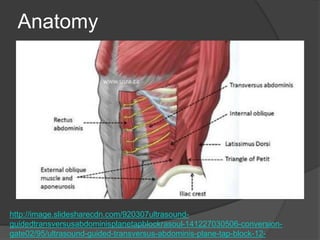
 Anatomy
 How does it work?
 Background
 Results from research
 Possible clinical implications
We hope you enjoy the
presentation
TAP Blocks: A Brief History
• 1855-Friedrich Gaedcke: First to chemically isolate
cocaine, naming it erythroxyline
• 1884-Karl Koller: Tested anesthetic effectiveness of
2% cocaine solution
• 1885-William Halsted: First brachial plexus blocked
performed
• 1885 - James Leonard Corning: Injected cocaine
between the lumbar spinous processes, first to
publish descriptions of spinal anesthesia
• 1898 - August Bier: Considered the "Father of Spinal
Anesthesia", performed the first surgery under spinal
anesthesia
TAP Blocks: A Brief History
 2001-A.N. Rafi: Published "Abdominal field block: a
new approach via the lumbar triangle"
• The article described a single shot abdominal block, using
the lumbar triangle of Petit as an anatomical landmark
• At the time of publication, Rafi had been using this blind
technique for 2 years, on over 200 patients
• Referred to as the RAFI technique, Regional Abdominal
Field Infiltration
 2004-2007-J.G. McDonnell et al., used computerized
tomography and MRI to study the spread and
effectiveness of the single shot abdominal block
• Coined the term transversus abdominal plane (TAP) block
Background
 The transversus abdominis plane block is a
regional anesthetic technique first
described in 2001
 It is useful in procedures requiring nerve
block in the anterior abdominal wall region,
from T6 to L1
 It was first used as a blind landmark
technique but more recently it has been
used under ultrasound guidance
 TAP blocks are important because they can
be used as an alternative analgesic
solution in surgery
Background
 The ultimate goal of TAP blocks is to
increase analgesia with the use of local
anesthetic
 Absolute contraindications include infection
at the site, allergy to local anesthetic and
patient refusal
 Although complications are rare, TAP
blocks are underutilized
 Beneficial for hysterectomies,
prostatectomies, Caesarean sections,
laparoscopic cholecystectomies and other
abdominal surgeries
Background
 The purpose of this research analysis
was to investigate the potential benefits
of the TAP block.
 Seven journal articles were reviewed.
 Some research studies focused on how
effective TAP blocks were in reducing
postoperative opioid use in various
populations.
Anatomy
http://www.hindawi.com/journals/arp/2012/731645/fig2/
Transverse section of the abdominal wall demonstrating the relevant
muscular structures and course of nerves (T7 – T12) within the TAP.
Anatomy
http://image.slidesharecdn.com/920307ultrasound-
guidedtransversusabdominisplanetapblockrasoul-141227030506-conversion-
gate02/95/ultrasound-guided-transversus-abdominis-plane-tap-block-12-
TAP Block Technique
 Ultrasound Anatomy
 https://www.youtube.com/watch?v=9TIHDn7
uBZI&feature=youtu.be&t=92 (at 1:31)
 TAP Block Technique
 https://www.youtube.com/watch?v=ab8Dvja
uk_U&feature=youtu.be&t=14
Randomized, double-blind, placebo-controlled study:
Literature Review
STUDY SIZE VARIABLES OF
INTEREST
FINDINGS RECOMMENDATIONS WEAKNESS
Belavy,
D., et al.
50 Pt’s receiving an active TAP
block & morphine PCA
compared to pt’s receiving a
placebo block & morphine.
24hr following cesarean-
median morphine dose 43%
lower in active block group
compared to placebo group
Use of TAP blocks
provide higher pain
relief and reduces
morphine
requirements.
Study had small
sample size, & only
compared pt’s
undergoing
cesareans.
Fields,
A.C., et
al.
100 TAP block vs Placebo
Injection for laparscopic
ventral hernia repair (LVHR)
Pt’s who received TAP blocks
had decreased opioid use &
pain scores compared w/ pt’s
who received placebo.
Support use of TAP
blocks for LVHR.
Significantly decreases
post-op opioid use &
pain.
Surgeons had
knowledge of group
assignments, some
pt’s excluded from
study, & data not
collected on clinical
differences.
Mrunalin
i, P., et
al.
60 TAP blocks vs placebo on
post op pain score and
tramadol PCA pump use.
Mean total pain score were
significantly lower in TAP
block group compared to
control group.
TAP block is effective
for reducing post op
pain and opioid usage
after laparotomy.
Findings limited to
24hr post op.
Ultrasound guided
not used.
Peterso
n, P.L. et
al.
80 Pt’s assessed at
0,2,4,6,8,&24 hrs for post op
pain levels when coughing &
at rest, opioid consumption,
and side effects.
While coughing, pain levels
reduced in TAP group. Median
morphine consumption was
7.5mg in placebo group
compared to 5mg TAP group.
TAP block after Lap
Choley may have
some beneficial effect
in reducing pain while
coughing & opioid req.
No assessment
data b/ 8-24hrs, no
sensory
assessment done
after blocks were
performed to
compare their
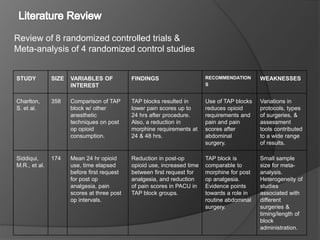
Review of 8 randomized controlled trials &
Meta-analysis of 4 randomized control studies
STUDY SIZE VARIABLES OF
INTEREST
FINDINGS RECOMMENDATION
S
WEAKNESSES
Charlton,
S. et al.
358 Comparison of TAP
block w/ other
anesthetic
techniques on post
op opioid
consumption.
TAP blocks resulted in
lower pain scores up to
24 hrs after procedure.
Also, a reduction in
morphine requirements at
24 & 48 hrs.
Use of TAP blocks
reduces opioid
requirements and
pain and pain
scores after
abdominal
surgery.
Variations in
protocols, types
of surgeries, &
assessment
tools contributed
to a wide range
of results.
Siddiqui,
M.R., et al.
174 Mean 24 hr opioid
use, time elapsed
before first request
for post op
analgesia, pain
scores at three post
op intervals.
Reduction in post-op
opioid use, increased time
between first request for
analgesia, and reduction
of pain scores in PACU in
TAP block groups.
TAP block is
comparable to
morphine for post
op analgesia.
Evidence points
towards a role in
routine abdominal
surgery.
Small sample
size for meta-
analysis.
Heterogeneity of
studies
associated with
different
surgeries &
timing/length of
block
administration.
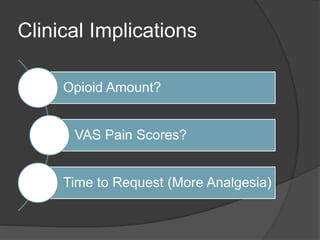
• Average opioid amount given was lower in TAP block groups
• Average lower postoperative pain scores in TAP block groups
• Increase time to first request for further analgesia in TAP block groups
Clinical Implications
 By utilizing the TAP block patients may
be able to consume less opioids and
experience less pain postoperatively
than if the case was strictly a general
anesthesia case with opioids as the sole
pain relief adjunct
Clinical Implications
Opioid Amount?
VAS Pain Scores?
Time to Request (More Analgesia)
• In our studies the use of TAP
blocks provided higher pain relief
and reduced opioid consumption
when compared to placebo
groups
• TAP blocks were found especially
beneficial during times of activity
or coughing postoperative lay
While all the studies suggest a decrease in pain scores and
opioid administration there is a wide variation on the degree of
benefit across the literature review.
Additionally, none of the studies in the review show a significant
decrease in opioid related side effects such as nausea,
vomiting, or decrease GI motility.

Tap block presentation

  • 1.
    K. Allen, SRNA,L. Allison, SRNA, L. Camp, SRNA, J. Carlisle, SRNA, M. Cochiaosue, SRNA, A. Hughes, SRNA, J. Jimenez, SRNA Middle Tennessee School of Anesthesia
  • 2.
    Introduction  How oursubject came to fruition  Purpose  A brief history  Anatomy  How does it work?  Background  Results from research  Possible clinical implications
  • 3.
    We hope youenjoy the presentation
  • 4.
    TAP Blocks: ABrief History • 1855-Friedrich Gaedcke: First to chemically isolate cocaine, naming it erythroxyline • 1884-Karl Koller: Tested anesthetic effectiveness of 2% cocaine solution • 1885-William Halsted: First brachial plexus blocked performed • 1885 - James Leonard Corning: Injected cocaine between the lumbar spinous processes, first to publish descriptions of spinal anesthesia • 1898 - August Bier: Considered the "Father of Spinal Anesthesia", performed the first surgery under spinal anesthesia
  • 5.
    TAP Blocks: ABrief History  2001-A.N. Rafi: Published "Abdominal field block: a new approach via the lumbar triangle" • The article described a single shot abdominal block, using the lumbar triangle of Petit as an anatomical landmark • At the time of publication, Rafi had been using this blind technique for 2 years, on over 200 patients • Referred to as the RAFI technique, Regional Abdominal Field Infiltration  2004-2007-J.G. McDonnell et al., used computerized tomography and MRI to study the spread and effectiveness of the single shot abdominal block • Coined the term transversus abdominal plane (TAP) block
  • 6.
    Background  The transversusabdominis plane block is a regional anesthetic technique first described in 2001  It is useful in procedures requiring nerve block in the anterior abdominal wall region, from T6 to L1  It was first used as a blind landmark technique but more recently it has been used under ultrasound guidance  TAP blocks are important because they can be used as an alternative analgesic solution in surgery
  • 7.
    Background  The ultimategoal of TAP blocks is to increase analgesia with the use of local anesthetic  Absolute contraindications include infection at the site, allergy to local anesthetic and patient refusal  Although complications are rare, TAP blocks are underutilized  Beneficial for hysterectomies, prostatectomies, Caesarean sections, laparoscopic cholecystectomies and other abdominal surgeries
  • 8.
    Background  The purposeof this research analysis was to investigate the potential benefits of the TAP block.  Seven journal articles were reviewed.  Some research studies focused on how effective TAP blocks were in reducing postoperative opioid use in various populations.
  • 9.
    Anatomy http://www.hindawi.com/journals/arp/2012/731645/fig2/ Transverse section ofthe abdominal wall demonstrating the relevant muscular structures and course of nerves (T7 – T12) within the TAP.
  • 10.
  • 11.
    TAP Block Technique Ultrasound Anatomy  https://www.youtube.com/watch?v=9TIHDn7 uBZI&feature=youtu.be&t=92 (at 1:31)  TAP Block Technique  https://www.youtube.com/watch?v=ab8Dvja uk_U&feature=youtu.be&t=14
  • 12.
    Randomized, double-blind, placebo-controlledstudy: Literature Review STUDY SIZE VARIABLES OF INTEREST FINDINGS RECOMMENDATIONS WEAKNESS Belavy, D., et al. 50 Pt’s receiving an active TAP block & morphine PCA compared to pt’s receiving a placebo block & morphine. 24hr following cesarean- median morphine dose 43% lower in active block group compared to placebo group Use of TAP blocks provide higher pain relief and reduces morphine requirements. Study had small sample size, & only compared pt’s undergoing cesareans. Fields, A.C., et al. 100 TAP block vs Placebo Injection for laparscopic ventral hernia repair (LVHR) Pt’s who received TAP blocks had decreased opioid use & pain scores compared w/ pt’s who received placebo. Support use of TAP blocks for LVHR. Significantly decreases post-op opioid use & pain. Surgeons had knowledge of group assignments, some pt’s excluded from study, & data not collected on clinical differences. Mrunalin i, P., et al. 60 TAP blocks vs placebo on post op pain score and tramadol PCA pump use. Mean total pain score were significantly lower in TAP block group compared to control group. TAP block is effective for reducing post op pain and opioid usage after laparotomy. Findings limited to 24hr post op. Ultrasound guided not used. Peterso n, P.L. et al. 80 Pt’s assessed at 0,2,4,6,8,&24 hrs for post op pain levels when coughing & at rest, opioid consumption, and side effects. While coughing, pain levels reduced in TAP group. Median morphine consumption was 7.5mg in placebo group compared to 5mg TAP group. TAP block after Lap Choley may have some beneficial effect in reducing pain while coughing & opioid req. No assessment data b/ 8-24hrs, no sensory assessment done after blocks were performed to compare their
  • 13.
    Review of 8randomized controlled trials & Meta-analysis of 4 randomized control studies STUDY SIZE VARIABLES OF INTEREST FINDINGS RECOMMENDATION S WEAKNESSES Charlton, S. et al. 358 Comparison of TAP block w/ other anesthetic techniques on post op opioid consumption. TAP blocks resulted in lower pain scores up to 24 hrs after procedure. Also, a reduction in morphine requirements at 24 & 48 hrs. Use of TAP blocks reduces opioid requirements and pain and pain scores after abdominal surgery. Variations in protocols, types of surgeries, & assessment tools contributed to a wide range of results. Siddiqui, M.R., et al. 174 Mean 24 hr opioid use, time elapsed before first request for post op analgesia, pain scores at three post op intervals. Reduction in post-op opioid use, increased time between first request for analgesia, and reduction of pain scores in PACU in TAP block groups. TAP block is comparable to morphine for post op analgesia. Evidence points towards a role in routine abdominal surgery. Small sample size for meta- analysis. Heterogeneity of studies associated with different surgeries & timing/length of block administration.
  • 14.
    • Average opioidamount given was lower in TAP block groups • Average lower postoperative pain scores in TAP block groups • Increase time to first request for further analgesia in TAP block groups
  • 15.
    Clinical Implications  Byutilizing the TAP block patients may be able to consume less opioids and experience less pain postoperatively than if the case was strictly a general anesthesia case with opioids as the sole pain relief adjunct
  • 16.
    Clinical Implications Opioid Amount? VASPain Scores? Time to Request (More Analgesia)
  • 17.
    • In ourstudies the use of TAP blocks provided higher pain relief and reduced opioid consumption when compared to placebo groups • TAP blocks were found especially beneficial during times of activity or coughing postoperative lay
  • 18.
    While all thestudies suggest a decrease in pain scores and opioid administration there is a wide variation on the degree of benefit across the literature review. Additionally, none of the studies in the review show a significant decrease in opioid related side effects such as nausea, vomiting, or decrease GI motility.