TAP blockade –what’s new?
• Basically there is nothing new – a brief view of the history
• What began as a so-called posterior TAP block initially evolved into new blocks – more anterior blocks
• We are now again searching for various approaches that are more posterior
• We now look more for visceral pain amelioration
• Epidural block is on the decline in the Western world
• Obstetric surgery is the exception
• The holy grail is the thoracic paravertebral block – without actually being this!!!
• We search for new approaches!
4 kind ofTAP block techniques currently in general use
1. Prof. O´Donnell & Prof. McDonnell (landmark based, triangle of Petit)
• First movers, extensive dermatomal anaesthesia, long lasting effect
• Primarily blind double pop technique, but also USG technique
2. Prof. Hebbard (oblique subcostal TAP block)
• Aim: to anaesthetize all dermatomes Th6-Th12
• Insertion of catheters for continous pain management
• Requires some time and extensive anatomical knowledge
3. Classical USG TAP block (anterior/middle axillary line)
• Below the thoracic cage, above the iliac crest
• Two injections, fast and easy
• Primarily the lower abdomen Th10-Th12
• Perhaps the USG technique most frequently in clinical use today
4. Bilateral Dual TAP (BD-TAP) block (Børglum J & Jensen K)
• 4 point ultrasound-guided strategy
• Single-shot, fast and easy
• Anaesthetizing all dermatomes from Th6-Th12 bilaterally
8.
• Reg AnesthPain Med. 2006 Jan-Feb;31(1):91. The transversus abdominis plane (TAP) block in open retropubic
prostatectomy. O'Donnell BD, McDonnell JG, McShane AJ.
• Reg Anesth Pain Med. 2007 Sep-Oct;32(5):399-404. Transversus abdominis plane block: a cadaveric and radiological evaluationMcDonnell
JG, O'Donnell BD, Farrell T, Gough N, Tuite D, Power C, Laffey JG.
• Anesth Analg. 2007 Jan;104(1):193-7. The analgesic efficacy of transversus abdominis plane block after abdominal surgery: a prospective
randomized controlled trial. McDonnell JG, O'Donnell B, Curley G, Heffernan A, Power C, Laffey JG.
• Anesth Analg. 2008 Jan;106(1):186-91, table of contents. The analgesic efficacy of transversus abdominis plane block after cesarean
delivery: a randomized controlled trial. McDonnell JG, Curley G, Carney J, Benton A, Costello J, Maharaj CH, Laffey JG.
Prof. O’Donnell BD & Prof. McDonnell JG – Triangle of Petit
• Two injections
• Both blind, landmarked-based & USG blocks in the Triangle of Petit
• Extensive scientific evidence for positive effects
• Double pop technique
• Extensive dermatomal anaesthesia
• Long lasting effect
9.
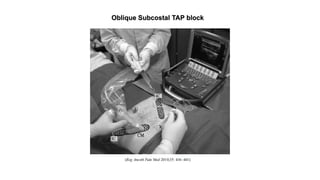
Prof. Hebbard PD– The Oblique Subcostal TAP block
• Reg Anesth Pain Med. 2010 Sep-Oct;35(5):436-41. Ultrasound-guided continuous oblique
subcostal transversus abdominis plane blockade: description of anatomy and clinical
technique. Hebbard PD, Barrington MJ, Vasey C.
• Disection technique
• Ultrasound-guided technique
• Aims to anaesthetize the entire abdominal wall (Th6-Th12(L1))
• Continuous anaesthesia
• A catheter can be placed along the oblique subcostal line in the
transversus abdominis plane for continuous infusion of local anesthetic.
Multimodal analgesia and intravenous opioid are used in addition because
visceral pain is not blocked. Continuous oblique subcostal transversus
abdominis plane block is a new technique and requires both a detailed
knowledge of sonographic anatomy and technical skill for it to be
successful.
The Classical TAPblock
• Br J Anaesth. 2009 Jun;102(6):763-7. Epub 2009 Apr 17. Ultrasound-guided
transversus abdominis plane block: description of a new technique and
comparison with conventional systemic analgesia during laparoscopic
cholecystectomy. El-Dawlatly AA, Turkistani A, Kettner SC, Machata AM,
Delvi MB, Thallaj A, Kapral S, Marhofer P.
• Anesth Analg. 2007 Sep;105(3):883; author reply 883. Transversus
abdominis plane block. Shibata Y, Sato Y, Fujiwara Y, Komatsu T.
• Ultrasound-guided technique
• Above the pelvic crest and below the costal margin
• Anterior/medial axillary line
• Aim to anaesthetize as much of the abdominal wall as possible
• Simple to understand, simple to execute
• Probably the technique preferred by most physicians
• Anatomical structures are clearly visible
• Two injections
The Bilateral DualTAP (BD-TAP) block
• Large branch communications anterolaterally (intercostal plexus) – Th6-Th9
• Large branch communications in plexuses that run with the deep circumflex
iliac artery (DCIA) (TAP plexus) – lower lateral abdomen – Th10-Th12 (L1)
• Large brance communications that run with the deep inferior epigastric artery
(DIEA) (rectus sheath plexus). Th6-Th12 (L1)
16.
The Bilateral DualTAP (BD-TAP) block
(Børglum J et al. Reg Anesth Pain Med. 2012 May-Jun;37(3):294-301)
• WHEN: Indicatedfor abdominal and
retroperitoneal surgery
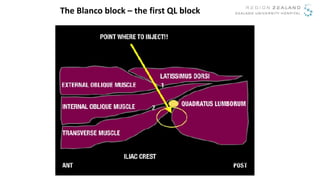
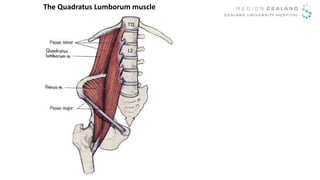
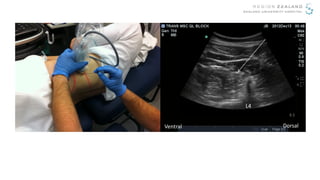
• WHERE: Administered between QL and PMM
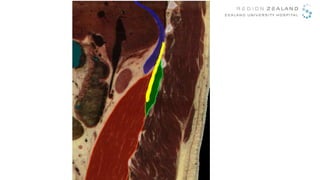
• WHY: Spreads to the Thoracic Paravertebral Space
• WHY: Alleviates visceral pain
• WHY: Long lasting effect > 24 hours
• HOW: It’s obvious – the TEQUILA way!