.SLOB TECHNIQUE
.ITS INDICATIONS
.ADVANTAGES AND DISADVANTAGES.
Department of Operative Dentistry
Presenter: MANSOOR AHMED
Supervised by Dr: M.ALI
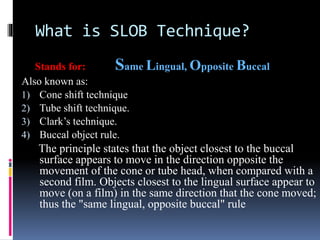
What is SLOB Technique?
Stands for: Same Lingual, Opposite Buccal
Also known as:
1) Cone shift technique
2) Tube shift technique.
3) Clark’s technique.
4) Buccal object rule.
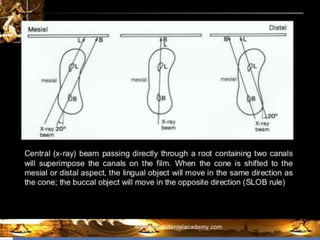
The principle states that the object closest to the buccal
surface appears to move in the direction opposite the
movement of the cone or tube head, when compared with a
second film. Objects closest to the lingual surface appear to
move (on a film) in the same direction that the cone moved;
thus the "same lingual, opposite buccal" rule
.
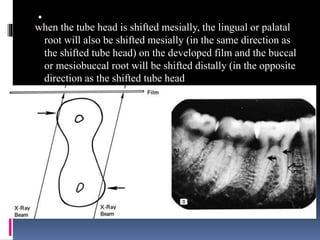
when the tube head is shifted mesially, the lingual or palatal
root will also be shifted mesially (in the same direction as
the shifted tube head) on the developed film and the buccal
or mesiobuccal root will be shifted distally (in the opposite
direction as the shifted tube head
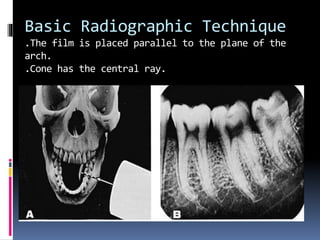
Basic Radiographic Technique
.The film is placed parallel to the plane of the
arch.
.Cone has the central ray.
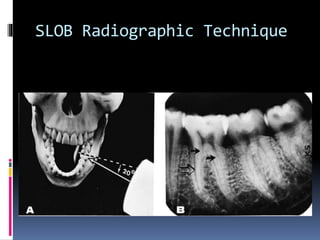
SLOB Radiographic Technique
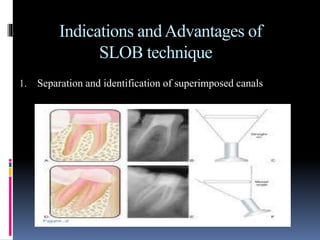
Indications andAdvantages of
SLOB technique
1. Separation and identification of superimposed canals
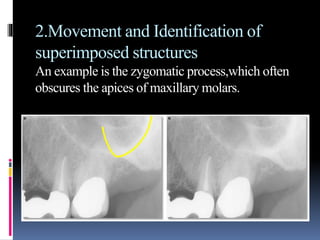
2.Movement and Identification of
superimposed structures
An example is the zygomatic process,which often
obscures the apices of maxillary molars.
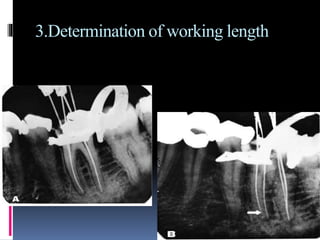
3.Determination of working length
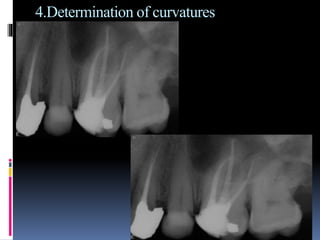
4.Determination of curvatures
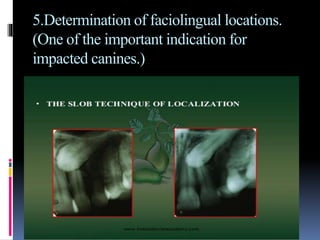
5.Determination of faciolingual locations.
(One of the important indication for
impacted canines.)
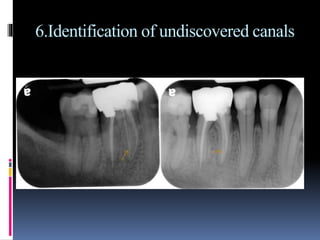
6.Identification of undiscovered canals
INDICATIONS / ADVANTAGES (Continued)
7. Location of Calcified Canals.
8. Application of the technique allows to distinguish
between various types of resorption.
9. It also helps the to determine the buccolingual
position of fractures and perforative defects.
10. To locate foreign bodies and to locate
anatomical landmarks in relation to the root apex,
such as mandibular canal.
Disadvantages
1. Decreased Clarity
Rays passing through the object and striking
the film at an angle the object becomes
blurred.(More angle = More blurred)
2.Superimposition of structures
Objects that ordinarily have a separation on
parallel radiographs may, with cone shift,move
relative to each other and become
superimposed.
Example: Roots of Maxillary molar.
A mesial or distal angled radiograph moves the
palatal root over the distobuccal or
mesiobuccal,reducing the ability to
distinguish the apices clearly.
.
.

SLOB Technique

  • 1.
    .SLOB TECHNIQUE .ITS INDICATIONS .ADVANTAGESAND DISADVANTAGES. Department of Operative Dentistry Presenter: MANSOOR AHMED Supervised by Dr: M.ALI
  • 2.
    What is SLOBTechnique? Stands for: Same Lingual, Opposite Buccal Also known as: 1) Cone shift technique 2) Tube shift technique. 3) Clark’s technique. 4) Buccal object rule. The principle states that the object closest to the buccal surface appears to move in the direction opposite the movement of the cone or tube head, when compared with a second film. Objects closest to the lingual surface appear to move (on a film) in the same direction that the cone moved; thus the "same lingual, opposite buccal" rule
  • 3.
    . when the tubehead is shifted mesially, the lingual or palatal root will also be shifted mesially (in the same direction as the shifted tube head) on the developed film and the buccal or mesiobuccal root will be shifted distally (in the opposite direction as the shifted tube head
  • 5.
    Basic Radiographic Technique .Thefilm is placed parallel to the plane of the arch. .Cone has the central ray.
  • 6.
  • 7.
    Indications andAdvantages of SLOBtechnique 1. Separation and identification of superimposed canals
  • 8.
    2.Movement and Identificationof superimposed structures An example is the zygomatic process,which often obscures the apices of maxillary molars.
  • 9.
  • 10.
  • 11.
    5.Determination of faciolinguallocations. (One of the important indication for impacted canines.)
  • 12.
  • 13.
    INDICATIONS / ADVANTAGES(Continued) 7. Location of Calcified Canals. 8. Application of the technique allows to distinguish between various types of resorption. 9. It also helps the to determine the buccolingual position of fractures and perforative defects. 10. To locate foreign bodies and to locate anatomical landmarks in relation to the root apex, such as mandibular canal.
  • 14.
    Disadvantages 1. Decreased Clarity Rayspassing through the object and striking the film at an angle the object becomes blurred.(More angle = More blurred) 2.Superimposition of structures Objects that ordinarily have a separation on parallel radiographs may, with cone shift,move relative to each other and become superimposed. Example: Roots of Maxillary molar. A mesial or distal angled radiograph moves the palatal root over the distobuccal or mesiobuccal,reducing the ability to distinguish the apices clearly.
  • 15.