

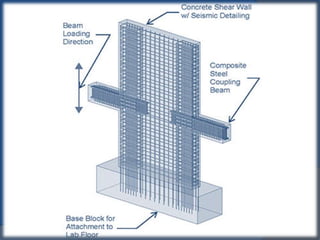

Shear Walls are structural elements in
addition to slabs, beams and columns.
These walls generally start at foundation
level and are continuous throughout the
building height. Their thickness can be as
low as 150mm, or as high as 400mm in
high rise buildings.
Shear walls are especially important in
high-rise buildings subject to lateral wind
and seismic forces. Generally, shear walls
are either plane or flanged in section.
They also provide adequate strength and
stiffness to control lateral displacements.
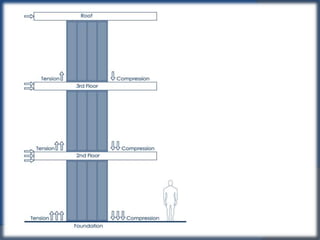
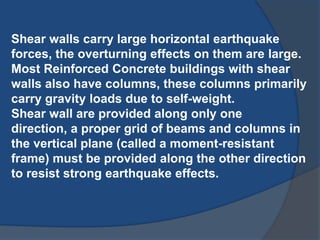
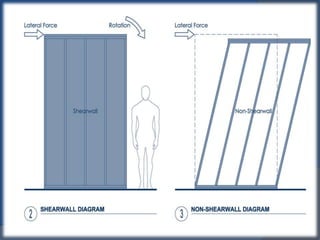
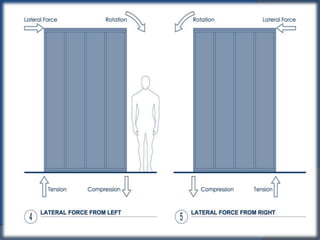
Shear walls carry large horizontal earthquake
forces, the overturning effects on them are large.
Most Reinforced Concrete buildings with shear
walls also have columns, these columns primarily
carry gravity loads due to self-weight.
Shear wall are provided along only one
direction, a proper grid of beams and columns in
the vertical plane (called a moment-resistant
frame) must be provided along the other direction
to resist strong earthquake effects.
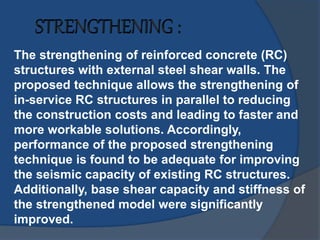
The strengthening of reinforced concrete (RC)
structures with external steel shear walls. The
proposed technique allows the strengthening of
in-service RC structures in parallel to reducing
the construction costs and leading to faster and
more workable solutions. Accordingly,
performance of the proposed strengthening
technique is found to be adequate for improving
the seismic capacity of existing RC structures.
Additionally, base shear capacity and stiffness of
the strengthened model were significantly
improved.
Easy house keeping
Speed in erecting and dismantling forms
Good appearance
Greater control of accuracy and workmanship
Bigger spacious
Sound reducing
Cost saving
The straightness of RC shear wall
Superb concrete finish, quality improvement
Hardly has skim finish crack at ceiling level
Lesser water seepage problem
Strong, solid, rigid, durable and low
maintenance
Fire resistance
Earthquake resistance
shear wall

shear wall

  • 3.
    Shear Walls arestructural elements in addition to slabs, beams and columns. These walls generally start at foundation level and are continuous throughout the building height. Their thickness can be as low as 150mm, or as high as 400mm in high rise buildings.
  • 5.
    Shear walls areespecially important in high-rise buildings subject to lateral wind and seismic forces. Generally, shear walls are either plane or flanged in section. They also provide adequate strength and stiffness to control lateral displacements.
  • 7.
    Shear walls carrylarge horizontal earthquake forces, the overturning effects on them are large. Most Reinforced Concrete buildings with shear walls also have columns, these columns primarily carry gravity loads due to self-weight. Shear wall are provided along only one direction, a proper grid of beams and columns in the vertical plane (called a moment-resistant frame) must be provided along the other direction to resist strong earthquake effects.
  • 8.
    The strengthening ofreinforced concrete (RC) structures with external steel shear walls. The proposed technique allows the strengthening of in-service RC structures in parallel to reducing the construction costs and leading to faster and more workable solutions. Accordingly, performance of the proposed strengthening technique is found to be adequate for improving the seismic capacity of existing RC structures. Additionally, base shear capacity and stiffness of the strengthened model were significantly improved.
  • 11.
    Easy house keeping Speedin erecting and dismantling forms Good appearance Greater control of accuracy and workmanship Bigger spacious Sound reducing Cost saving
  • 12.
    The straightness ofRC shear wall Superb concrete finish, quality improvement Hardly has skim finish crack at ceiling level Lesser water seepage problem Strong, solid, rigid, durable and low maintenance Fire resistance Earthquake resistance