PRESTRESSED CONCRETE
&
FIBER-REINFORCED CONCRETE
MAHREENZAMIRABRO
14CE-16
SABEENMANZOORCHANNA
14CE-50
CONCRETE …
We all know that concrete is strong in compression and weak in tension.This is
reason for providing reinforcement (in the form of steel bars) to resist
tension/tensile force acting on beams/columns/slabs etcetera.
RC structures under service load undergoes deflection causing the bottom of
the beam (tensile zone) to elongate, .causing cracks. Generally, steel bars are
provided to limit the crack widths and resist the tensile force which the concrete
lacks.
PRESTRESSED CONCRETE …
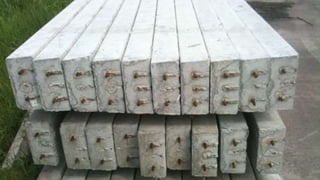
Pretressed concrete is a method of overcoming concrete’s natural
Weakness in tension .
It can be used to produce beams, floors bridges with a longer span than is
practical with ordinary reinforced concrete .
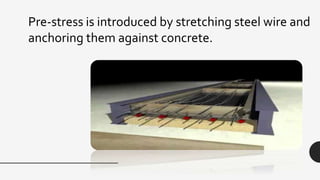
Pre-stress is introduced by stretching steel wire and
anchoring them against concrete.
Cont…
Prestressed concrete was started to be used in building
frames, parking structures, stadiums, railway sleepers,
transmission line poles and other types of structures and
elements. Materials for pre-stress concrete member.
1. Cement
2. Concrete
3. Steel
Types of Pre-stressing
1. External or internal pre-stressing : It is based on the location of the
pre-stressing tendons with respect to concrete section.
2. Pre-tensioning or post-tensioning : It based on the sequence of
casting the concrete and applying tension to the tendons.
3. Linear or circular pre-stressing: It based on the shape of the member
pre-stressed.
4. Full, limited or partial pre-stressing : It based on the pre-stressing
force.
5. Uniaxial, biaxial or multi-axial pre-stressing : It based on the
direction of the pre-stressing member.
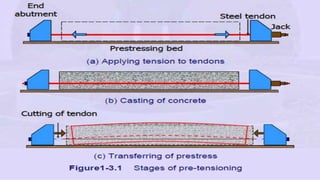
Pre-tensioning:
In this method the tendons (group of wires) are
pulled between two end bulkhead prior to casting
. This pre-stress is later transferred to concrete
due to bonding between the concrete and
tendons .
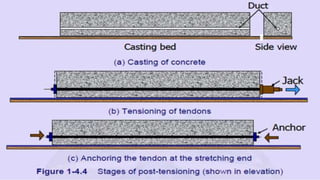
Post-tensioning:
In this process first the casting of structure is done and later
the tensioning is done . Stressing in Post-Tensioning is done
in two-stages in which the order of selection of tendon is
done based on the drawing provided.
Fiber Reinforced Concrete :
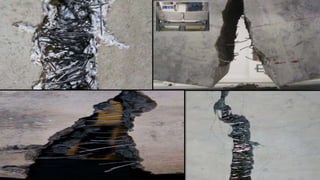
Fibers are usually used in concrete to control cracking
due to plastic shrinkage and to drying shrinkage. ...
Generally fibers do not increase the flexural strength
of concrete, and so cannot replace moment–resisting or
structural steel reinforcement. Indeed,
some fibers actually reduce the strength of concrete.
Factors affecting the Properties of FRC …
1. Volume of fibers
2. Aspect ratio of fiber
3. Orientation of fiber
4. Relative fiber matrix stiffness
Types of fiber used in FRC …
1. Steel Fiber Reinforced Concrete
2. Polypropylene Fiber Reinforced (PFR) concrete
3. Glass-Fiber Reinforced Concrete
4. Asbestos fibers
5. Carbon fibers and Other Natural fibers
Problems with Steel Fibers …
1. Reduces the workability
2. loss of workability is proportional to volume
concentration of fibers in concrete
3. Higher Aspect Ratio also reduced workability
THANK
YOU

PRESTRESSED AND FRC

  • 2.
  • 3.
    CONCRETE … We allknow that concrete is strong in compression and weak in tension.This is reason for providing reinforcement (in the form of steel bars) to resist tension/tensile force acting on beams/columns/slabs etcetera. RC structures under service load undergoes deflection causing the bottom of the beam (tensile zone) to elongate, .causing cracks. Generally, steel bars are provided to limit the crack widths and resist the tensile force which the concrete lacks.
  • 4.
    PRESTRESSED CONCRETE … Pretressedconcrete is a method of overcoming concrete’s natural Weakness in tension . It can be used to produce beams, floors bridges with a longer span than is practical with ordinary reinforced concrete .
  • 6.
    Pre-stress is introducedby stretching steel wire and anchoring them against concrete.
  • 7.
    Cont… Prestressed concrete wasstarted to be used in building frames, parking structures, stadiums, railway sleepers, transmission line poles and other types of structures and elements. Materials for pre-stress concrete member. 1. Cement 2. Concrete 3. Steel
  • 8.
    Types of Pre-stressing 1.External or internal pre-stressing : It is based on the location of the pre-stressing tendons with respect to concrete section. 2. Pre-tensioning or post-tensioning : It based on the sequence of casting the concrete and applying tension to the tendons. 3. Linear or circular pre-stressing: It based on the shape of the member pre-stressed. 4. Full, limited or partial pre-stressing : It based on the pre-stressing force. 5. Uniaxial, biaxial or multi-axial pre-stressing : It based on the direction of the pre-stressing member.
  • 9.
    Pre-tensioning: In this methodthe tendons (group of wires) are pulled between two end bulkhead prior to casting . This pre-stress is later transferred to concrete due to bonding between the concrete and tendons .
  • 11.
    Post-tensioning: In this processfirst the casting of structure is done and later the tensioning is done . Stressing in Post-Tensioning is done in two-stages in which the order of selection of tendon is done based on the drawing provided.
  • 14.
    Fiber Reinforced Concrete: Fibers are usually used in concrete to control cracking due to plastic shrinkage and to drying shrinkage. ... Generally fibers do not increase the flexural strength of concrete, and so cannot replace moment–resisting or structural steel reinforcement. Indeed, some fibers actually reduce the strength of concrete.
  • 16.
    Factors affecting theProperties of FRC … 1. Volume of fibers 2. Aspect ratio of fiber 3. Orientation of fiber 4. Relative fiber matrix stiffness
  • 17.
    Types of fiberused in FRC … 1. Steel Fiber Reinforced Concrete 2. Polypropylene Fiber Reinforced (PFR) concrete 3. Glass-Fiber Reinforced Concrete 4. Asbestos fibers 5. Carbon fibers and Other Natural fibers
  • 18.
    Problems with SteelFibers … 1. Reduces the workability 2. loss of workability is proportional to volume concentration of fibers in concrete 3. Higher Aspect Ratio also reduced workability
  • 19.