Content
• Introduction
• Types of Activities
• Seven types of wastes
• Waste of 3 Angle of Project delivery
• Integrated project
• Advantages
• Limitation
• References
What do we Want on our project?
• Lower Costs
• Better Schedules
• Better Quality
• Improved Project Team Environment
Why do we need a different Approach?
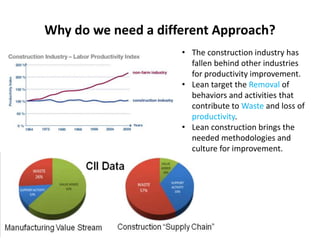
• The construction industry has
fallen behind other industries
for productivity improvement.
• Lean target the Removal of
behaviors and activities that
contribute to Waste and loss of
productivity.
• Lean construction brings the
needed methodologies and
culture for improvement.
What is lean Construction?
• Definition of lean:
• A production approach that preserve value and less waste
• “ To produce right product at the right time in the right quality for
the costumer and to produce exactly what you need and nothing
more”
• Taiichi Ohno, creator of Toyota Production System.
• Lean Construction:
• A design and execution methodology to minimize Waste of
material and effort in order to generate the maximum value.
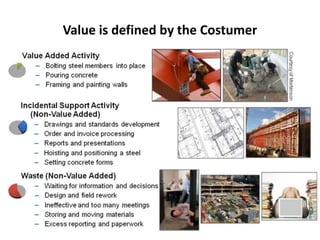
Value is defined by the Costumer
Seven types of waste
-Defects/Rework; scrap and fixing errors
-Overproduction; making more than just in case
-Over-Processing; Beyond what costumer need
-Inventory/Queue; Excessive work in process inventory
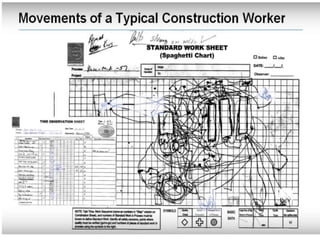
-Motion; unnecessary and awkward movement
-Waiting; Delay for upstream activity to complete
-Transport; unnecessary material movement
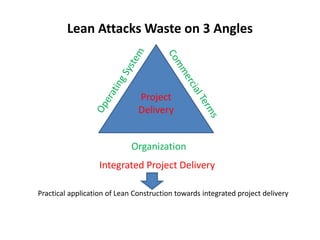
Lean Attacks Waste on 3 Angles
Project
Delivery
Organization
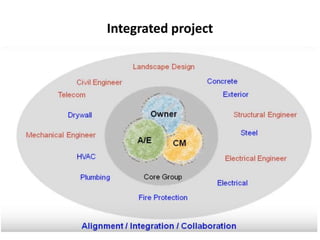
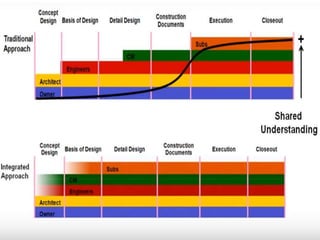
Integrated Project Delivery
Practical application of Lean Construction towards integrated project delivery
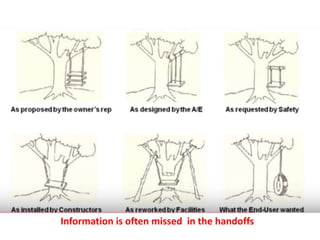
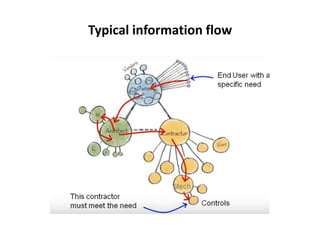
Information is often missed in the handoffs
Typical information flow
Integrated project
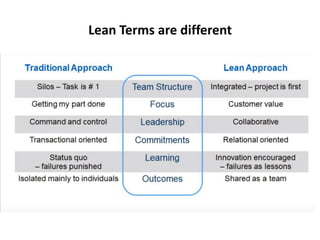
Lean Terms are different
Benefits
• less waste can greatly reduce all around costs
• Construction time can greatly be reduced by increased planning and
strategic vision.
• Fewer accidents and a higher rate of safety through increased worker
focus and understanding.
• Increased schedule reliability and predictability.
• Improved overall results due to increased communication and fewer
workers.
• Decreased stress for workers and management due to fewer workers.
• Increased productivity all around due to a higher rate of planning.
• Increased profits and turnovers, with increased customer satisfaction.
• Increased worker accountability.
• Increased job satisfaction resulting in more performance commitment
Drawbacks
• All areas of management, along with the workers, have to be in
accordance with the plan. If there is a break in the chain, the lean
methodology cannot work.
• Getting everyone onboard with a new production method isn’t easy, and
some people may be ambivalent about change.
• In order for successful implementation, management officials must be
able to guide employees directly and efficiently. In essence, the lean
method of operation is derived by how well a management official can
work with his employees more so than with the standard procedure, and
personality clashes, as well as other issues may arise.
• Training and educating employees in the lean method takes time and
dedication, and as expressed earlier, some workers may not like or deal
well with change.
Drawback Continue
• Staying on course with a new system of operation can be difficult for some
managers, and some may grow frustrated.
• Cohesive teamwork is essential for lean production. Each worker has to be
well versed in his position or a breakdown will occur as all workers rely on
one another.
• Training employees with a new system can take some time, and this could
decrease the overall time on a project or design.
• Management has to be astute to all production issues as a breakdown in
the system can easily occur. Staying alert to the change in operations can
be hard for all employees.
• Suppliers and distributors have to be notified of the change in production,
and this could cause problems.
• A temporary decrease in employee morale might be noticed due to the
change in policy.
References
• http://www.buildingsguide.com/blog/introduction-lean-construction
• https://www.academia.edu/8852339/Advantages_and_disadvantages_of_
traditional_and_lean_method
• https://www.youtube.com/watch?v=x0-9nlg-FDY
• https://en.wikipedia.org/wiki/Lean_construction
• www.leanconstruction.org
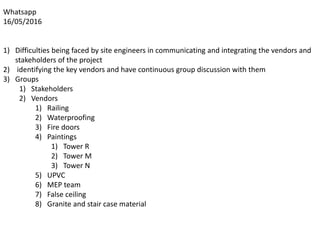
Whatsapp
16/05/2016
1) Difficulties being faced by site engineers in communicating and integrating the vendors and
stakeholders of the project
2) identifying the key vendors and have continuous group discussion with them
3) Groups
1) Stakeholders
2) Vendors
1) Railing
2) Waterproofing
3) Fire doors
4) Paintings
1) Tower R
2) Tower M
3) Tower N
5) UPVC
6) MEP team
7) False ceiling
8) Granite and stair case material
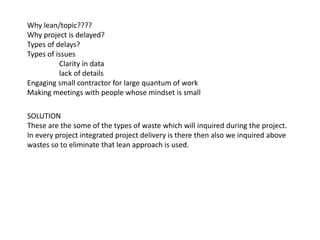
Why lean/topic????
Why project is delayed?
Types of delays?
Types of issues
Clarity in data
lack of details
Engaging small contractor for large quantum of work
Making meetings with people whose mindset is small
SOLUTION
These are the some of the types of waste which will inquired during the project.
In every project integrated project delivery is there then also we inquired above
wastes so to eliminate that lean approach is used.
What to do…..
hhshh

lean construction and integrated project delivery

  • 2.
    Content • Introduction • Typesof Activities • Seven types of wastes • Waste of 3 Angle of Project delivery • Integrated project • Advantages • Limitation • References
  • 3.
    What do weWant on our project? • Lower Costs • Better Schedules • Better Quality • Improved Project Team Environment
  • 4.
    Why do weneed a different Approach? • The construction industry has fallen behind other industries for productivity improvement. • Lean target the Removal of behaviors and activities that contribute to Waste and loss of productivity. • Lean construction brings the needed methodologies and culture for improvement.
  • 5.
    What is leanConstruction? • Definition of lean: • A production approach that preserve value and less waste • “ To produce right product at the right time in the right quality for the costumer and to produce exactly what you need and nothing more” • Taiichi Ohno, creator of Toyota Production System. • Lean Construction: • A design and execution methodology to minimize Waste of material and effort in order to generate the maximum value.
  • 6.
    Value is definedby the Costumer
  • 7.
    Seven types ofwaste -Defects/Rework; scrap and fixing errors -Overproduction; making more than just in case -Over-Processing; Beyond what costumer need -Inventory/Queue; Excessive work in process inventory -Motion; unnecessary and awkward movement -Waiting; Delay for upstream activity to complete -Transport; unnecessary material movement
  • 9.
    Lean Attacks Wasteon 3 Angles Project Delivery Organization Integrated Project Delivery Practical application of Lean Construction towards integrated project delivery
  • 10.
    Information is oftenmissed in the handoffs
  • 11.
  • 12.
  • 14.
    Lean Terms aredifferent
  • 15.
    Benefits • less wastecan greatly reduce all around costs • Construction time can greatly be reduced by increased planning and strategic vision. • Fewer accidents and a higher rate of safety through increased worker focus and understanding. • Increased schedule reliability and predictability. • Improved overall results due to increased communication and fewer workers. • Decreased stress for workers and management due to fewer workers. • Increased productivity all around due to a higher rate of planning. • Increased profits and turnovers, with increased customer satisfaction. • Increased worker accountability. • Increased job satisfaction resulting in more performance commitment
  • 16.
    Drawbacks • All areasof management, along with the workers, have to be in accordance with the plan. If there is a break in the chain, the lean methodology cannot work. • Getting everyone onboard with a new production method isn’t easy, and some people may be ambivalent about change. • In order for successful implementation, management officials must be able to guide employees directly and efficiently. In essence, the lean method of operation is derived by how well a management official can work with his employees more so than with the standard procedure, and personality clashes, as well as other issues may arise. • Training and educating employees in the lean method takes time and dedication, and as expressed earlier, some workers may not like or deal well with change.
  • 17.
    Drawback Continue • Stayingon course with a new system of operation can be difficult for some managers, and some may grow frustrated. • Cohesive teamwork is essential for lean production. Each worker has to be well versed in his position or a breakdown will occur as all workers rely on one another. • Training employees with a new system can take some time, and this could decrease the overall time on a project or design. • Management has to be astute to all production issues as a breakdown in the system can easily occur. Staying alert to the change in operations can be hard for all employees. • Suppliers and distributors have to be notified of the change in production, and this could cause problems. • A temporary decrease in employee morale might be noticed due to the change in policy.
  • 19.
    References • http://www.buildingsguide.com/blog/introduction-lean-construction • https://www.academia.edu/8852339/Advantages_and_disadvantages_of_ traditional_and_lean_method •https://www.youtube.com/watch?v=x0-9nlg-FDY • https://en.wikipedia.org/wiki/Lean_construction • www.leanconstruction.org
  • 21.
    Whatsapp 16/05/2016 1) Difficulties beingfaced by site engineers in communicating and integrating the vendors and stakeholders of the project 2) identifying the key vendors and have continuous group discussion with them 3) Groups 1) Stakeholders 2) Vendors 1) Railing 2) Waterproofing 3) Fire doors 4) Paintings 1) Tower R 2) Tower M 3) Tower N 5) UPVC 6) MEP team 7) False ceiling 8) Granite and stair case material
  • 22.
    Why lean/topic???? Why projectis delayed? Types of delays? Types of issues Clarity in data lack of details Engaging small contractor for large quantum of work Making meetings with people whose mindset is small SOLUTION These are the some of the types of waste which will inquired during the project. In every project integrated project delivery is there then also we inquired above wastes so to eliminate that lean approach is used.
  • 23.