Lean Thinking
in Construction
From 10,200BC to 2015AD
By Jonathan Baker
History and Principles of Lean
• Lean is a common sense structured approach that is aimed at understanding what it is
that your customers need and then redesigning the way you operate to ensure that you
deliver this in the most cost effective, timely and safe way possible (Eaton, 2013).
• Lean is often associated with Toyota by many, and whilst it is fair to suggest that Toyota
have done a lot to shape what we consider to be Lean, via the Toyota Production System,
the concepts of flow, standardisation and what the end customer considers ‘value’ were
established long before 1940 when Toyota adopted them (Eaton, 2013).
• In tracing the history of lean, we could perhaps go back as far as 1.6million years to the
period when archaeologists first started to find stone hand axes in the fossil records.
These tools were produced consistently over hundreds of different places over many
thousands of years. This implies that the process of creating them was standardised in
some way and the manufacturers of these tools improved the design slowly over many
generations through a process of continuous improvement from the simple broken rock
to the classic tear shaped design driven by experimentation and sharing of experience.
Perhaps the only thing new about Lean, is the term used (Eaton, 2013).
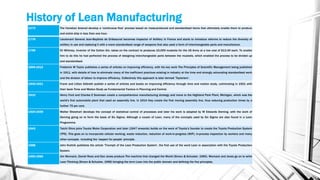
• Table 1 below highlights the history of Lean in manufacturing terms:
History of Lean Manufacturing
1473 The Venetian Arsenal develop a ‘continuous flow’ process based on mass-produced and standardised items that ultimately enable them to produce
and entire ship in less than one hour.
1776 Lieutenant General Jean-Baptiste de Gribeauval becomes Inspector of Artillery in France and starts to introduce reforms to reduce the diversity of
artillery in use and replacing it with a more standardised range of weapons that also used a form of interchangeable parts and manufacture.
1799 Eli Whitney, inventor of the Cotton Gin, takes on the contract to produces 10,000 muskets for the US Army at a low cost of $13.40 each. To enable
him to do this he had perfected the process of designing interchangeable parts between the muskets, which enabled the process to be divided up
and standardised.
1894-1912 Frederick W Taylor publishes a series of articles on improving efficiency, with his key work The Principles of Scientific Management being published
in 1911, with details of how to eliminate many of the inefficient practices existing in industry at the time and strongly advocating standardised work
and the division of labour to improve efficiency. Collectively this approach is later termed ‘Taylorism’.
1905-1921 Frank and Lillian Gilbreth publish a series of articles and books on improving efficiency through time and motion study, culminating in 1921 with
their book Time and Motion Study as Fundamental Factors in Planning and Control.
1910 Henry Ford and Charles E Sorensen create a comprehensive manufacturing strategy and move to the Highland Park Plant, Michigan, which was the
world’s first automobile plant that used an assembly line. In 1914 they create the first moving assembly line, thus reducing production times by a
further 75 per cent.
1924-1939 Walter Shewhart develops the concept of statistical control of processes and later his work is adapted by W Edwards Deming, with the work of
Deming going on to form the basis of Six Sigma. Although a cousin of Lean, many of the concepts used by Six Sigma are also found in a Lean
Programme.
1943 Taichi Ohno joins Toyota Motor Corporation and later (1947 onwards) builds on the work of Toyota’s founder to create the Toyota Production System
(TPS). This goes on to incorporate cellular working, waste reduction, reduction of work-in-progress (WIP), in-process inspection by workers and many
other concepts including the ‘respect for people’ principle.
1988 John Krafcik publishes the article ‘Triumph of the Lean Production System’, the first use of the word Lean in association with the Toyota Production
System.
1990-1996 Jim Womack, Daniel Roos and Dan Jones produce The machine that changed the World (Simon & Schuster, 1990). Womack and Jones go on to write
Lean Thinking (Simon & Schuster, 1996) bringing the term Lean into the public domain and defining the five principles.
How was Lean adopted into the
Construction Industry?
• Lean as a term was likely introduced shortly after 1988 when the term
‘Lean’ was coined and used by John Krafcik when describing the TPS
system in his article ‘Triumph of the Lean Production System’
• Lean thinking and principles however, as a common sense improvement
approach will have been in place since the first construction of Neolithic
cave structures. Whilst most caves were naturally formed, areas such as
Bridgnorth, Shropshire show evidence of man made caves in the soft red
bunter sandstone geology in that area.
• Before any formal systems were created, written down or taught, history
shows that construction methods and skills were passed down across
generations. As with most human activity on the earths timeline, we seek a
better, easier and more efficient method in anything that we do.
How was Lean adopted into the
Construction Industry?
• It is only since construction projects have seemingly become more complex
and technical in nature relating to materials, structural engineering and
size that modern trains of thought have required the advanced study of
management skills, particularly in managing the flow of information. It is
widely known that project failures are largely a result of poor
communication management (working from old drawings, etc.)
• Lean manufacturing studies 7 flows within a project, whereas construction
project management mostly focusses on one flow, the previous work/trade.
How was Lean adopted into the
Construction Industry?
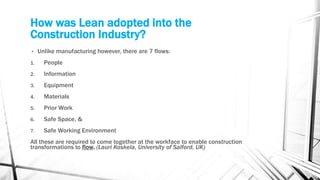
• Unlike manufacturing however, there are 7 flows:
1. People
2. Information
3. Equipment
4. Materials
5. Prior Work
6. Safe Space, &
7. Safe Working Environment
All these are required to come together at the workface to enable construction
transformations to flow. (Lauri Koskela, University of Salford, UK)
BRE & the Construction Lean Improvement
Programme (CLIP)
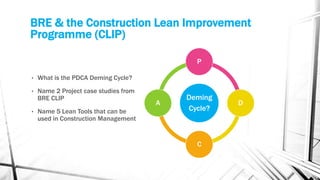
• What is the PDCA Deming Cycle?
• Name 2 Project case studies from
BRE CLIP
• Name 5 Lean Tools that can be
used in Construction Management
Deming
Cycle?
P
D
C
A
Answers
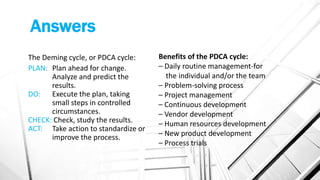
The Deming cycle, or PDCA cycle:
PLAN: Plan ahead for change.
Analyze and predict the
results.
DO: Execute the plan, taking
small steps in controlled
circumstances.
CHECK: Check, study the results.
ACT: Take action to standardize or
improve the process.
Benefits of the PDCA cycle:
– Daily routine management-for
the individual and/or the team
– Problem-solving process
– Project management
– Continuous development
– Vendor development
– Human resources development
– New product development
– Process trials
Answers
Oakwood Builders & Joinery Ltd
Tools:
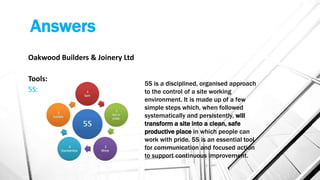
5S:
5S is a disciplined, organised approach
to the control of a site working
environment. It is made up of a few
simple steps which, when followed
systematically and persistently, will
transform a site into a clean, safe
productive place in which people can
work with pride. 5S is an essential tool
for communication and focused action
to support continuous improvement.
Answers
Oakwood Builders & Joinery Ltd
Benefits:
‘Looking at site lay-out, storage,
and the use and re-use of
materials was very helpful as it
saved on time spent looking for
things, collecting new or
replacement materials, double
ordering, waste removal costs,
etc.’
Answers
Oakwood Builders & Joinery Ltd
Simple 5S:
5S
Step 1: Set in order
As Christopher Robin said: ‘Organising is what you do before you
do something, so when you do it, it’s not all mixed up.’ Among
things that obstruct smooth construction operations are difficulty
finding things on site, not knowing what is expected at critical
handovers, insufficient light and power to enable staff to do a
quality job, mess and debris littering the site. 5S can help us set
the site up to eliminate these obstructions.
5S
Step 2: Sort
To help ensure that materials and equipment are easy to find
and not in the way and stocks are easy to monitor
5S
Step 3: Shine
This step is designed to ensure that there are fewer hazards;
access and emergency evacuation is easier; the site is a more
attractive place in which to work. There are improvements to the
way the work gets done – increasing both effectiveness and
efficiency.
5S
Step 4: Standardise
Without standard operating procedures, the same operation
could be performed in different ways depending on who does the
work, what order it is done in, and the tools and methods used.
Such variations can lead to variable safety standards, and
variations in quality and cost.
This step is designed to develop standard operating procedures
to cover future work together.
5S
Step 5: Sustain
This step is concerned with project-to-project learning.
Answers
University of Wolverhampton M&E
Package
Tools:
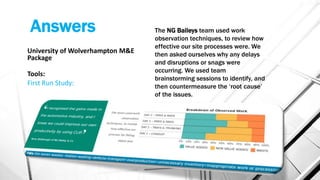
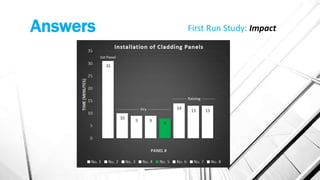
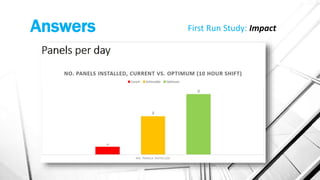
First Run Study:
The NG Baileys team used work
observation techniques, to review how
effective our site processes were. We
then asked ourselves why any delays
and disruptions or snags were
occurring. We used team
brainstorming sessions to identify, and
then countermeasure the ‘root cause’
of the issues.
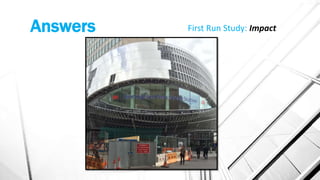
Answers First Run Study: Impact
5 Lean Tools for Construction
• Whilst there are many Lean tools in use (30+) here are 5 commonly used tools:
1. 5S (aka 5C)
2. First Run Study / Work & Motion Study
3. Visual Management
4. Value Stream Mapping
5. Standardisation
The use of these 5 tools alone will have a dramatic impact on any construction
programme; but for sustainable long-term lean transformation of an organisation
the entire culture needs to be transformed with the Lean Philosophy
Cultural Change
• Jeffrey Liker, PhD, cautions that over 90% of those who attempt Lean fail
(personal communication, 2009). But why? Because success in Lean derives
from the culture of Toyota, which is founded in the management principles of
W. Edwards Deming and the personal philosophy of the company’s founders,
the Toyoda family. One comes up short without mirroring that cultural base,
consisting of a philosophy, a supportive management system, and intelligent
approaches to engaging employees to continuously define and eliminate
wastes inherent in non–value processes. One is then left with making sporadic
process improvements usually at management’s direction. This contrasts with
Toyota’s culture, which is dedicated to developing human talent throughout the
organization to participate in continuously improving the enterprise. Ergo,
success is defined not just by performance or financial metrics but by an
engaged workforce producing thousands of process improvements and
continually striving for higher targets of quality.
Cultural Change
• So what is culture? How do you change the culture? But moreover, how do you sustain it?
Culture in its most simplified definition is how people are incentivized to behave and the way
people think, talk, work, and act every day. Corporate culture is based on a philosophy and
supported by a management system and structures that allow the desired behaviours to take
place consistently.
• Deming’s 14 management principles form the basis for leaders to create a continuous
improvement culture as exemplified by Toyota in its Lean production system. Toyota’s tenets,
as defined by Deming, provide the philosophical and management basis for pursuing,
supporting, and nurturing quality by designing systems that foster doing things right the first
time. According to Deming’s quality chain reaction, when quality is the driving force of the
culture, it will increase efficiency and productivity, decrease costs, and in turn, allow the
company to lower prices, attract a higher market share, increase profits, and improve
customer satisfaction. At the core of that philosophy is recognizing the customer as a priority
and developing people as the most important resource to achieve that quality by enabling
continuous improvement (kaizen) throughout the enterprise. This philosophy must be
supported by an appropriate management system that empowers the workforce to pursue
higher targets of quality while identifying defects (errors) blamelessly and then effectively
using technical tools of process improvement to redesign more efficient, waste-free work.
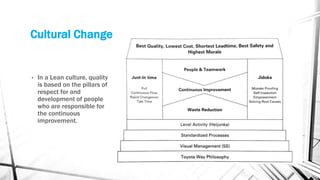
• In a Lean culture, quality
is based on the pillars of
respect for and
development of people
who are responsible for
the continuous
improvement.
Cultural Change
Thank-you

Lean construction

  • 1.
    Lean Thinking in Construction From10,200BC to 2015AD By Jonathan Baker
  • 2.
    History and Principlesof Lean • Lean is a common sense structured approach that is aimed at understanding what it is that your customers need and then redesigning the way you operate to ensure that you deliver this in the most cost effective, timely and safe way possible (Eaton, 2013). • Lean is often associated with Toyota by many, and whilst it is fair to suggest that Toyota have done a lot to shape what we consider to be Lean, via the Toyota Production System, the concepts of flow, standardisation and what the end customer considers ‘value’ were established long before 1940 when Toyota adopted them (Eaton, 2013). • In tracing the history of lean, we could perhaps go back as far as 1.6million years to the period when archaeologists first started to find stone hand axes in the fossil records. These tools were produced consistently over hundreds of different places over many thousands of years. This implies that the process of creating them was standardised in some way and the manufacturers of these tools improved the design slowly over many generations through a process of continuous improvement from the simple broken rock to the classic tear shaped design driven by experimentation and sharing of experience. Perhaps the only thing new about Lean, is the term used (Eaton, 2013). • Table 1 below highlights the history of Lean in manufacturing terms:
  • 3.
    History of LeanManufacturing 1473 The Venetian Arsenal develop a ‘continuous flow’ process based on mass-produced and standardised items that ultimately enable them to produce and entire ship in less than one hour. 1776 Lieutenant General Jean-Baptiste de Gribeauval becomes Inspector of Artillery in France and starts to introduce reforms to reduce the diversity of artillery in use and replacing it with a more standardised range of weapons that also used a form of interchangeable parts and manufacture. 1799 Eli Whitney, inventor of the Cotton Gin, takes on the contract to produces 10,000 muskets for the US Army at a low cost of $13.40 each. To enable him to do this he had perfected the process of designing interchangeable parts between the muskets, which enabled the process to be divided up and standardised. 1894-1912 Frederick W Taylor publishes a series of articles on improving efficiency, with his key work The Principles of Scientific Management being published in 1911, with details of how to eliminate many of the inefficient practices existing in industry at the time and strongly advocating standardised work and the division of labour to improve efficiency. Collectively this approach is later termed ‘Taylorism’. 1905-1921 Frank and Lillian Gilbreth publish a series of articles and books on improving efficiency through time and motion study, culminating in 1921 with their book Time and Motion Study as Fundamental Factors in Planning and Control. 1910 Henry Ford and Charles E Sorensen create a comprehensive manufacturing strategy and move to the Highland Park Plant, Michigan, which was the world’s first automobile plant that used an assembly line. In 1914 they create the first moving assembly line, thus reducing production times by a further 75 per cent. 1924-1939 Walter Shewhart develops the concept of statistical control of processes and later his work is adapted by W Edwards Deming, with the work of Deming going on to form the basis of Six Sigma. Although a cousin of Lean, many of the concepts used by Six Sigma are also found in a Lean Programme. 1943 Taichi Ohno joins Toyota Motor Corporation and later (1947 onwards) builds on the work of Toyota’s founder to create the Toyota Production System (TPS). This goes on to incorporate cellular working, waste reduction, reduction of work-in-progress (WIP), in-process inspection by workers and many other concepts including the ‘respect for people’ principle. 1988 John Krafcik publishes the article ‘Triumph of the Lean Production System’, the first use of the word Lean in association with the Toyota Production System. 1990-1996 Jim Womack, Daniel Roos and Dan Jones produce The machine that changed the World (Simon & Schuster, 1990). Womack and Jones go on to write Lean Thinking (Simon & Schuster, 1996) bringing the term Lean into the public domain and defining the five principles.
  • 4.
    How was Leanadopted into the Construction Industry? • Lean as a term was likely introduced shortly after 1988 when the term ‘Lean’ was coined and used by John Krafcik when describing the TPS system in his article ‘Triumph of the Lean Production System’ • Lean thinking and principles however, as a common sense improvement approach will have been in place since the first construction of Neolithic cave structures. Whilst most caves were naturally formed, areas such as Bridgnorth, Shropshire show evidence of man made caves in the soft red bunter sandstone geology in that area. • Before any formal systems were created, written down or taught, history shows that construction methods and skills were passed down across generations. As with most human activity on the earths timeline, we seek a better, easier and more efficient method in anything that we do.
  • 5.
    How was Leanadopted into the Construction Industry? • It is only since construction projects have seemingly become more complex and technical in nature relating to materials, structural engineering and size that modern trains of thought have required the advanced study of management skills, particularly in managing the flow of information. It is widely known that project failures are largely a result of poor communication management (working from old drawings, etc.) • Lean manufacturing studies 7 flows within a project, whereas construction project management mostly focusses on one flow, the previous work/trade.
  • 6.
    How was Leanadopted into the Construction Industry? • Unlike manufacturing however, there are 7 flows: 1. People 2. Information 3. Equipment 4. Materials 5. Prior Work 6. Safe Space, & 7. Safe Working Environment All these are required to come together at the workface to enable construction transformations to flow. (Lauri Koskela, University of Salford, UK)
  • 7.
    BRE & theConstruction Lean Improvement Programme (CLIP) • What is the PDCA Deming Cycle? • Name 2 Project case studies from BRE CLIP • Name 5 Lean Tools that can be used in Construction Management Deming Cycle? P D C A
  • 8.
    Answers The Deming cycle,or PDCA cycle: PLAN: Plan ahead for change. Analyze and predict the results. DO: Execute the plan, taking small steps in controlled circumstances. CHECK: Check, study the results. ACT: Take action to standardize or improve the process. Benefits of the PDCA cycle: – Daily routine management-for the individual and/or the team – Problem-solving process – Project management – Continuous development – Vendor development – Human resources development – New product development – Process trials
  • 9.
    Answers Oakwood Builders &Joinery Ltd Tools: 5S: 5S is a disciplined, organised approach to the control of a site working environment. It is made up of a few simple steps which, when followed systematically and persistently, will transform a site into a clean, safe productive place in which people can work with pride. 5S is an essential tool for communication and focused action to support continuous improvement.
  • 10.
    Answers Oakwood Builders &Joinery Ltd Benefits: ‘Looking at site lay-out, storage, and the use and re-use of materials was very helpful as it saved on time spent looking for things, collecting new or replacement materials, double ordering, waste removal costs, etc.’
  • 11.
    Answers Oakwood Builders &Joinery Ltd Simple 5S:
  • 12.
    5S Step 1: Setin order As Christopher Robin said: ‘Organising is what you do before you do something, so when you do it, it’s not all mixed up.’ Among things that obstruct smooth construction operations are difficulty finding things on site, not knowing what is expected at critical handovers, insufficient light and power to enable staff to do a quality job, mess and debris littering the site. 5S can help us set the site up to eliminate these obstructions.
  • 13.
    5S Step 2: Sort Tohelp ensure that materials and equipment are easy to find and not in the way and stocks are easy to monitor
  • 14.
    5S Step 3: Shine Thisstep is designed to ensure that there are fewer hazards; access and emergency evacuation is easier; the site is a more attractive place in which to work. There are improvements to the way the work gets done – increasing both effectiveness and efficiency.
  • 15.
    5S Step 4: Standardise Withoutstandard operating procedures, the same operation could be performed in different ways depending on who does the work, what order it is done in, and the tools and methods used. Such variations can lead to variable safety standards, and variations in quality and cost. This step is designed to develop standard operating procedures to cover future work together.
  • 16.
    5S Step 5: Sustain Thisstep is concerned with project-to-project learning.
  • 17.
    Answers University of WolverhamptonM&E Package Tools: First Run Study: The NG Baileys team used work observation techniques, to review how effective our site processes were. We then asked ourselves why any delays and disruptions or snags were occurring. We used team brainstorming sessions to identify, and then countermeasure the ‘root cause’ of the issues.
  • 18.
    Answers First RunStudy: Impact
  • 19.
    Answers First RunStudy: Impact
  • 20.
    Answers First RunStudy: Impact
  • 21.
    5 Lean Toolsfor Construction • Whilst there are many Lean tools in use (30+) here are 5 commonly used tools: 1. 5S (aka 5C) 2. First Run Study / Work & Motion Study 3. Visual Management 4. Value Stream Mapping 5. Standardisation The use of these 5 tools alone will have a dramatic impact on any construction programme; but for sustainable long-term lean transformation of an organisation the entire culture needs to be transformed with the Lean Philosophy
  • 22.
    Cultural Change • JeffreyLiker, PhD, cautions that over 90% of those who attempt Lean fail (personal communication, 2009). But why? Because success in Lean derives from the culture of Toyota, which is founded in the management principles of W. Edwards Deming and the personal philosophy of the company’s founders, the Toyoda family. One comes up short without mirroring that cultural base, consisting of a philosophy, a supportive management system, and intelligent approaches to engaging employees to continuously define and eliminate wastes inherent in non–value processes. One is then left with making sporadic process improvements usually at management’s direction. This contrasts with Toyota’s culture, which is dedicated to developing human talent throughout the organization to participate in continuously improving the enterprise. Ergo, success is defined not just by performance or financial metrics but by an engaged workforce producing thousands of process improvements and continually striving for higher targets of quality.
  • 23.
    Cultural Change • Sowhat is culture? How do you change the culture? But moreover, how do you sustain it? Culture in its most simplified definition is how people are incentivized to behave and the way people think, talk, work, and act every day. Corporate culture is based on a philosophy and supported by a management system and structures that allow the desired behaviours to take place consistently. • Deming’s 14 management principles form the basis for leaders to create a continuous improvement culture as exemplified by Toyota in its Lean production system. Toyota’s tenets, as defined by Deming, provide the philosophical and management basis for pursuing, supporting, and nurturing quality by designing systems that foster doing things right the first time. According to Deming’s quality chain reaction, when quality is the driving force of the culture, it will increase efficiency and productivity, decrease costs, and in turn, allow the company to lower prices, attract a higher market share, increase profits, and improve customer satisfaction. At the core of that philosophy is recognizing the customer as a priority and developing people as the most important resource to achieve that quality by enabling continuous improvement (kaizen) throughout the enterprise. This philosophy must be supported by an appropriate management system that empowers the workforce to pursue higher targets of quality while identifying defects (errors) blamelessly and then effectively using technical tools of process improvement to redesign more efficient, waste-free work.
  • 24.
    • In aLean culture, quality is based on the pillars of respect for and development of people who are responsible for the continuous improvement. Cultural Change
  • 25.