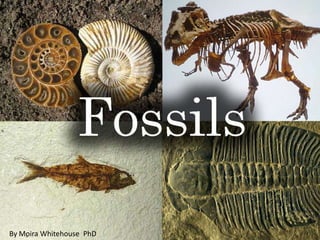
By Moira Whitehouse PhD
What is a fossil?
• A fossil is the preserved remains of
 a once-living organism.
How are fossils formed?
• Fossils are formed when animals or
  plants are buried in sedimentary rock.

• You should remember how
  sedimentary rock is formed and how to
  identify which layers are the oldest and
  which are youngest.
Plants and animals buried
here might become fossils.
If sediment covers a
                               dead organism
                               before the it has
                               time to rot, the
                               organism’s body
                               may become
                       fossils fossilized.
As many, many years pass, new types of
sediment are deposited on top of the original
sediment containing the fossil and the layers of
sediment change to rock. As a result, the
fossils are finally buried under layers of rock.
Based on what you already know about how
sedimentary is formed, you should be able to tell
which fossils in this picture are older or younger.
                                 The youngest fossils
                                 would be found in
                                 the
                                 a. top layers of
                                     rock
                                 b. the middle rock
                                     layers
                                 c. the bottom
      Natural Resources Canada
                                     layers of rock
There are four types of fossils:

Molds

Casts

Trace fossils

Whole or part of an organism that has
been preserved
Molds and Casts
1. A mold forms when: a. an organism dies
and is buried in sediment such as sand, silt or
clay b. the sediment changes to rock and the
organism’s body decomposes leaving an
imprint or mold in the rock. Molds can be seen
if the rock is broken open.


Present day scallop Mold of a scallop in clay   Mold of scallop in rock
2. A cast forms when an organism dies and is
buried in sediment. Its body rots leaving a
“hole” in the shape of its body. Water with
minerals fills up the hole. When the water
evaporates, a copy of the original structure of
organism is formed as a rock.
Picture of present day snail          Picture of fossilized snail


      Bob Hermann//Cochise College.
                                               R.Weller/Cochise College.
Ammonite
        mold             Ammonitec
                         ast


Molds and casts are often found together.
gastropod mold   gastropod casts
Which is
the cast of
the clam
and which
is the
mold?
Clam mold


Clam cast
Dinosaur bones are not
really bones. They are
the fossilized cast of a
dinosaur bone that has
changed to a rock.
www.oum.ox.ac.uk/thezone/fossils/intro/for
m.htmhttp://www.oum.ox.ac.uk/thezone/fos
sils/intro/form.htm
3. Trace Fossils
Trace fossils include leaf prints, burrows,
coprolites (feces or poop), trails,
footprints.
Trace fossils of an animal tell
something about its movement and
behavior.


Trace fossils are not an imprint of the
hard part of an animal’s body.
Leaf
    imprints


R.Weller/Cochise College
Dinosaur tracks


Wikipedia Creative Commons
Coprolite (dinosaur poop)
        dmr.nd.gov
Worm
tubes
made by
ancient
worms as
they
moved
through
soil.
4. Whole or a part of a body is preserved

In rare instances an entire organism or
its skeleton is preserved because the
organism gets trapped in a substance
that protects its body from decaying.
Examples are:
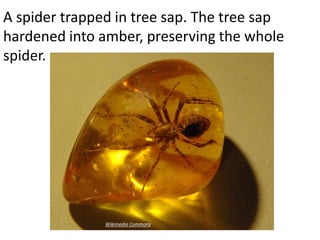
A spider trapped in tree sap. The tree sap
hardened into amber, preserving the whole
spider.


               Wikimedia Commons
A sabretooth cat skeleton found in La
Brea Tar Pits in California. The tiger fell
into the tar and got “stuck”. His skeleton
was preserved by the tar.


              Wikimedia Commons
Sometimes, a whole organism can be
  preserved if it is frozen very quickly.


                               Photo: Francis Latreille/National Geographic

40,000 year old frozen baby mammoth found in Siberia
What do fossils tell us?
• Fossils give clues about organisms
 that lived long ago.

• They also provide evidence about
  how Earth’s surface has changed over
  time.
• Fossils help scientists understand what
  past environments may have been like.
In the next few slides you will see fossils
found either in or near Fort Worth. They
tell us:
   •what organisms lived here millions of
   years ago.
   •about the environment of this area at
   that time.

   •and help us see how things have
   changed over time.
Gastropod casts
Oyster casts
Clam cast
Scallop cast
Sea urchin cast
Ammonite cast
One arm of an ammonite cast
Looking at these organisms, you can
conclude they once lived:
a. in a forest      c. in a grassland
b. In an ocean      d. in a desert
Yes, you could conclude that they once
lived in an ocean.
So what must have been here in Fort Worth
at that time (100 million years ago)?
Yes, at one time, very long ago, this area
was covered by a shallow sea.
The North American continent
  during late Cretaceous time.


The Western Interior Sea covered most of
the Midwest from the present Gulf of
Mexico to the Arctic.
Wikipedia Commons


Western Interior Seaway during the mid-
Cretaceous, about 100 million years ago.
100 million years ago Central Texas was a shallow sea


As the sea receded, Central Texas rose above sea level.
The next page
shows
dinosaur
footprints
found in the
Paluxy River
bed in
Dinosaur State
Park, Glen
Rose, TX very
close to Fort
Worth.
Dinosaur tracks made
113 million years ago in the
Paluxy River bed near Glen
Rose, TX.
Paleontologists who examined the three-toed prints
identified Acrocanthosaurus as the likely trackmaker.
Other dinosaurs had also left their footprints here.
Sauropod tracks likely made by Paluxysaurus, a
herbivore, appear as huge potholes—sometimes
three feet long—pit the rocky bottom of the riverbed.


    Acrocanthosaurus             Paluxysaurus,
Based on what scientists know about dinosaurs,
what can we conclude about the climate at Glen
Rose 113 million years ago and the kinds of plants
that grew during this time?
A
Protohadrosdin
osaur skull was
found in Flower
Mound, Texas
in 1994.
The Protohadros
lived 98 million
years ago.
A Protohadro dinosaur belongs to the
Hadrosaurs family, the formal name of
duck-billed dinosaurs.
Flower Mound is very close to Fort Worth.
Above is a artist’s painting of what a Protohadros
might have looked like and the habitat that
scientists believe it lived in.
A cast of its
 Dinosaur remains of a Tenontosaurusdossiwere
                            foot
 found in 1998 by a nine year old boy on a ranch
 just west of Fort Worth near Weatherford. This
 dinosaur lived 110 million years ago.

A cast of skull and teeth in rock.   A cast of a foot.


                                      An artist’s picture
                                      of what a
                                      Tenontosaurus
                                      dossi might
                                      have looked like..
From these finding what can we
conclude about the environment
and climate of the region around
Fort Worth 98--110 million years
ago?
To conclude, let’s review a few things
we have learned.
Fossils are
a. always made of rock
b. an artist’s painting of animals that
lived long ago
c. the remains of plants and animals
that lived long ago
d. dishes that people used who
lived long ago
Fossils give us information about

a. organisms that lived long ago
b. the climate and environments of
   the past
c. how the earth has changed over
   time
d. all of the above
Fossils are usually
found in
a. soil
b. sedimentary
    rock
c. igneous rock
    from volcanoes
d. the interior of
    the Earth
The fossils in layer C
    are the
A
B   a. the youngest
C   b. the oldest
    c. the same age as
       the fossils in
       layer A

Fossils (teach)

  • 1.
  • 2.
    What is afossil? • A fossil is the preserved remains of a once-living organism. How are fossils formed? • Fossils are formed when animals or plants are buried in sedimentary rock. • You should remember how sedimentary rock is formed and how to identify which layers are the oldest and which are youngest.
  • 3.
    Plants and animalsburied here might become fossils.
  • 4.
    If sediment coversa dead organism before the it has time to rot, the organism’s body may become fossils fossilized. As many, many years pass, new types of sediment are deposited on top of the original sediment containing the fossil and the layers of sediment change to rock. As a result, the fossils are finally buried under layers of rock.
  • 5.
    Based on whatyou already know about how sedimentary is formed, you should be able to tell which fossils in this picture are older or younger. The youngest fossils would be found in the a. top layers of rock b. the middle rock layers c. the bottom Natural Resources Canada layers of rock
  • 6.
    There are fourtypes of fossils: Molds Casts Trace fossils Whole or part of an organism that has been preserved
  • 7.
  • 8.
    1. A moldforms when: a. an organism dies and is buried in sediment such as sand, silt or clay b. the sediment changes to rock and the organism’s body decomposes leaving an imprint or mold in the rock. Molds can be seen if the rock is broken open. Present day scallop Mold of a scallop in clay Mold of scallop in rock
  • 9.
    2. A castforms when an organism dies and is buried in sediment. Its body rots leaving a “hole” in the shape of its body. Water with minerals fills up the hole. When the water evaporates, a copy of the original structure of organism is formed as a rock. Picture of present day snail Picture of fossilized snail Bob Hermann//Cochise College. R.Weller/Cochise College.
  • 10.
    Ammonite mold Ammonitec ast Molds and casts are often found together.
  • 11.
    gastropod mold gastropod casts
  • 12.
    Which is the castof the clam and which is the mold?
  • 13.
  • 14.
    Dinosaur bones arenot really bones. They are the fossilized cast of a dinosaur bone that has changed to a rock.
  • 15.
  • 16.
  • 17.
    Trace fossils includeleaf prints, burrows, coprolites (feces or poop), trails, footprints. Trace fossils of an animal tell something about its movement and behavior. Trace fossils are not an imprint of the hard part of an animal’s body.
  • 18.
    Leaf imprints R.Weller/Cochise College
  • 19.
  • 20.
  • 21.
  • 22.
    4. Whole ora part of a body is preserved In rare instances an entire organism or its skeleton is preserved because the organism gets trapped in a substance that protects its body from decaying. Examples are:
  • 23.
    A spider trappedin tree sap. The tree sap hardened into amber, preserving the whole spider. Wikimedia Commons
  • 24.
    A sabretooth catskeleton found in La Brea Tar Pits in California. The tiger fell into the tar and got “stuck”. His skeleton was preserved by the tar. Wikimedia Commons
  • 25.
    Sometimes, a wholeorganism can be preserved if it is frozen very quickly. Photo: Francis Latreille/National Geographic 40,000 year old frozen baby mammoth found in Siberia
  • 26.
    What do fossilstell us? • Fossils give clues about organisms that lived long ago. • They also provide evidence about how Earth’s surface has changed over time. • Fossils help scientists understand what past environments may have been like.
  • 27.
    In the nextfew slides you will see fossils found either in or near Fort Worth. They tell us: •what organisms lived here millions of years ago. •about the environment of this area at that time. •and help us see how things have changed over time.
  • 28.
  • 29.
  • 30.
  • 31.
  • 32.
  • 33.
  • 34.
    One arm ofan ammonite cast
  • 35.
    Looking at theseorganisms, you can conclude they once lived: a. in a forest c. in a grassland b. In an ocean d. in a desert Yes, you could conclude that they once lived in an ocean. So what must have been here in Fort Worth at that time (100 million years ago)? Yes, at one time, very long ago, this area was covered by a shallow sea.
  • 36.
    The North Americancontinent during late Cretaceous time. The Western Interior Sea covered most of the Midwest from the present Gulf of Mexico to the Arctic.
  • 37.
    Wikipedia Commons Western InteriorSeaway during the mid- Cretaceous, about 100 million years ago.
  • 38.
    100 million yearsago Central Texas was a shallow sea As the sea receded, Central Texas rose above sea level.
  • 39.
    The next page shows dinosaur footprints foundin the Paluxy River bed in Dinosaur State Park, Glen Rose, TX very close to Fort Worth.
  • 40.
    Dinosaur tracks made 113million years ago in the Paluxy River bed near Glen Rose, TX.
  • 41.
    Paleontologists who examinedthe three-toed prints identified Acrocanthosaurus as the likely trackmaker. Other dinosaurs had also left their footprints here. Sauropod tracks likely made by Paluxysaurus, a herbivore, appear as huge potholes—sometimes three feet long—pit the rocky bottom of the riverbed. Acrocanthosaurus Paluxysaurus,
  • 42.
    Based on whatscientists know about dinosaurs, what can we conclude about the climate at Glen Rose 113 million years ago and the kinds of plants that grew during this time?
  • 43.
    A Protohadrosdin osaur skull was foundin Flower Mound, Texas in 1994. The Protohadros lived 98 million years ago. A Protohadro dinosaur belongs to the Hadrosaurs family, the formal name of duck-billed dinosaurs.
  • 44.
    Flower Mound isvery close to Fort Worth.
  • 45.
    Above is aartist’s painting of what a Protohadros might have looked like and the habitat that scientists believe it lived in.
  • 46.
    A cast ofits Dinosaur remains of a Tenontosaurusdossiwere foot found in 1998 by a nine year old boy on a ranch just west of Fort Worth near Weatherford. This dinosaur lived 110 million years ago. A cast of skull and teeth in rock. A cast of a foot. An artist’s picture of what a Tenontosaurus dossi might have looked like..
  • 47.
    From these findingwhat can we conclude about the environment and climate of the region around Fort Worth 98--110 million years ago?
  • 48.
    To conclude, let’sreview a few things we have learned. Fossils are a. always made of rock b. an artist’s painting of animals that lived long ago c. the remains of plants and animals that lived long ago d. dishes that people used who lived long ago
  • 49.
    Fossils give usinformation about a. organisms that lived long ago b. the climate and environments of the past c. how the earth has changed over time d. all of the above
  • 50.
    Fossils are usually foundin a. soil b. sedimentary rock c. igneous rock from volcanoes d. the interior of the Earth
  • 51.
    The fossils inlayer C are the A B a. the youngest C b. the oldest c. the same age as the fossils in layer A