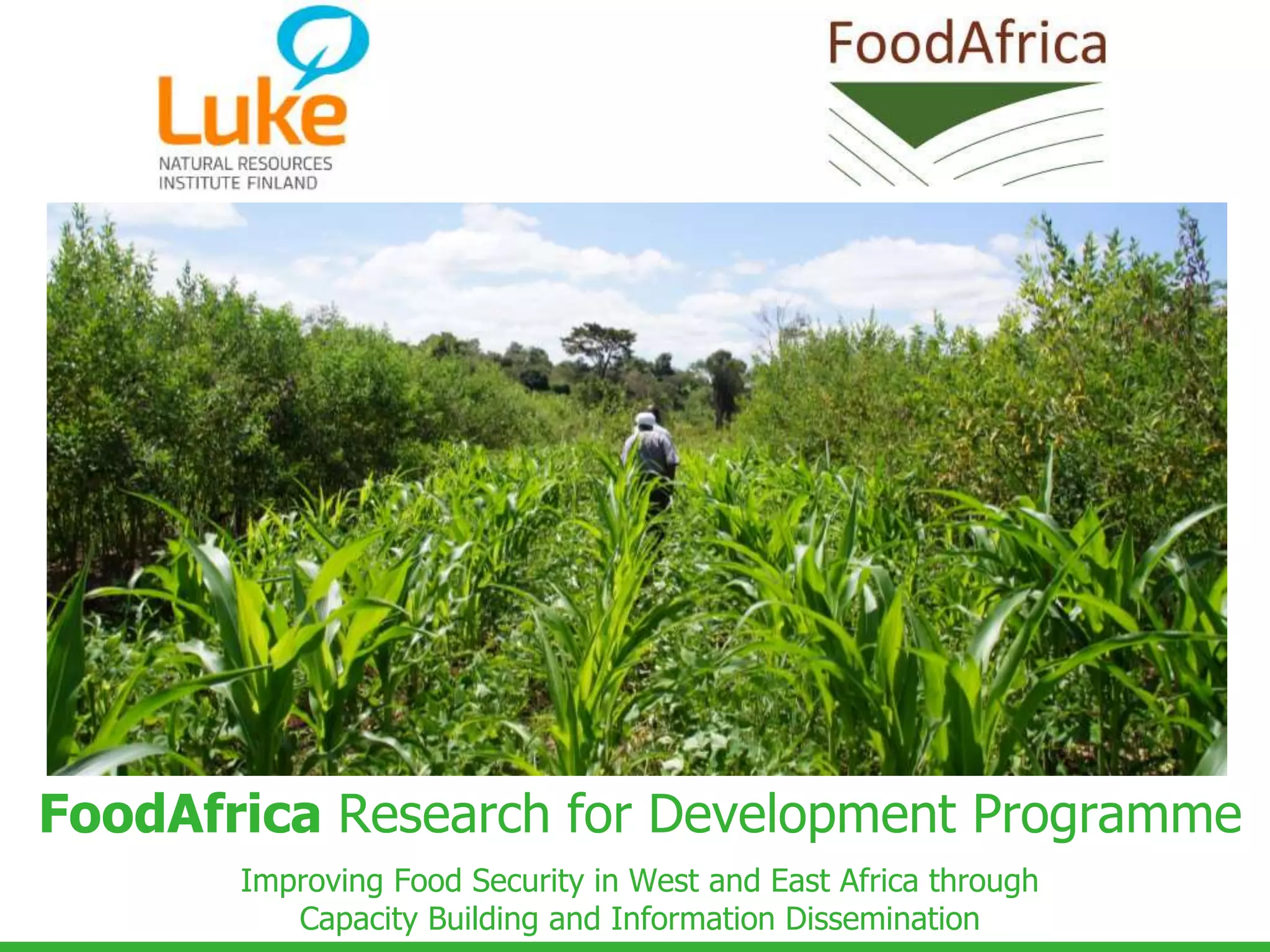
FoodAfrica Research for Development Programme
Improving Food Security in West and East Africa through
Capacity Building and Information Dissemination
FoodAfrica Programme
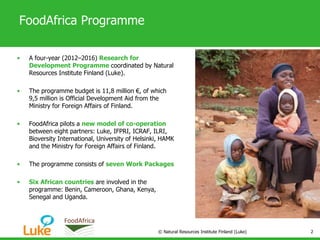
• A four-year (2012–2016) Research for
Development Programme coordinated by Natural
Resources Institute Finland (Luke).
• The programme budget is 11,8 million €, of which
9,5 million is Official Development Aid from the
Ministry for Foreign Affairs of Finland.
• FoodAfrica pilots a new model of co-operation
between eight partners: Luke, IFPRI, ICRAF, ILRI,
Bioversity International, University of Helsinki, HAMK
and the Ministry for Foreign Affairs of Finland.
• The programme consists of seven Work Packages
• Six African countries are involved in the
programme: Benin, Cameroon, Ghana, Kenya,
Senegal and Uganda.
© Natural Resources Institute Finland (Luke) 2
Programme Objectives
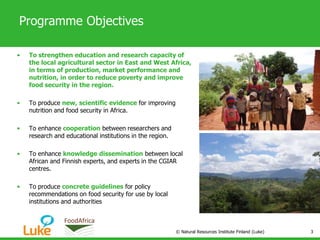
• To strengthen education and research capacity of
the local agricultural sector in East and West Africa,
in terms of production, market performance and
nutrition, in order to reduce poverty and improve
food security in the region.
• To produce new, scientific evidence for improving
nutrition and food security in Africa.
• To enhance cooperation between researchers and
research and educational institutions in the region.
• To enhance knowledge dissemination between local
African and Finnish experts, and experts in the CGIAR
centres.
• To produce concrete guidelines for policy
recommendations on food security for use by local
institutions and authorities
© Natural Resources Institute Finland (Luke) 3
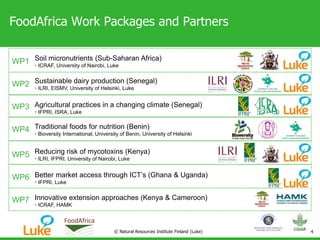
FoodAfrica Work Packages and Partners
© Natural Resources Institute Finland (Luke) 4
Soil micronutrients (Sub-Saharan Africa)
• ICRAF, University of Nairobi, Luke
Sustainable dairy production (Senegal)
• ILRI, EISMV, University of Helsinki, Luke
Agricultural practices in a changing climate (Senegal)
• IFPRI, ISRA, Luke
Traditional foods for nutrition (Benin)
• Bioversity International, University of Benin, University of Helsinki
Reducing risk of mycotoxins (Kenya)
• ILRI, IFPRI, University of Nairobi, Luke
Better market access through ICT’s (Ghana & Uganda)
• IFPRI, Luke
Innovative extension approaches (Kenya & Cameroon)
• ICRAF, HAMK
WP1
WP2
WP3
WP4
WP5
WP6
WP7
Cross-Cutting Objectives and Joint Activities
• The seven Work Packages have a common Dissemination
Strategy
• Human Rights based approach in all Work Packages
• Integration of cross-cutting objectives of Finnish Development
policy in all Work Packages
• Climate Sustainability
• Gender Equality
• Reduction of Inequality
© Natural Resources Institute Finland (Luke) 5
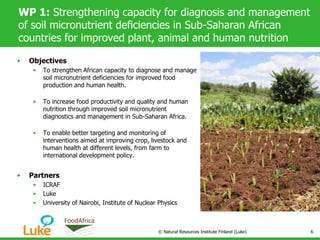
WP 1: Strengthening capacity for diagnosis and management
of soil micronutrient deficiencies in Sub-Saharan African
countries for improved plant, animal and human nutrition
• Objectives
• To strengthen African capacity to diagnose and manage
soil micronutrient deficiencies for improved food
production and human health.
• To increase food productivity and quality and human
nutrition through improved soil micronutrient
diagnostics and management in Sub-Saharan Africa.
• To enable better targeting and monitoring of
interventions aimed at improving crop, livestock and
human health at different levels, from farm to
international development policy.
• Partners
• ICRAF
• Luke
• University of Nairobi, Institute of Nuclear Physics
© Natural Resources Institute Finland (Luke) 6
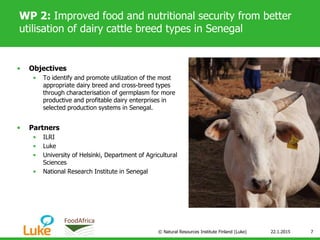
WP 2: Improved food and nutritional security from better
utilisation of dairy cattle breed types in Senegal
• Objectives
• To identify and promote utilization of the most
appropriate dairy breed and cross-breed types
through characterisation of germplasm for more
productive and profitable dairy enterprises in
selected production systems in Senegal.
• Partners
• ILRI
• Luke
• University of Helsinki, Department of Agricultural
Sciences
• National Research Institute in Senegal
22.1.2015© Natural Resources Institute Finland (Luke) 7
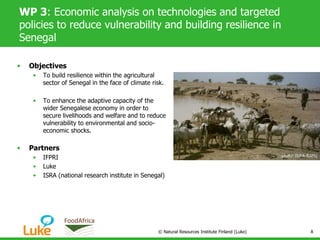
WP 3: Economic analysis on technologies and targeted
policies to reduce vulnerability and building resilience in
Senegal
• Objectives
• To build resilience within the agricultural
sector of Senegal in the face of climate risk.
• To enhance the adaptive capacity of the
wider Senegalese economy in order to
secure livelihoods and welfare and to reduce
vulnerability to environmental and socio-
economic shocks.
• Partners
• IFPRI
• Luke
• ISRA (national research institute in Senegal)
© Natural Resources Institute Finland (Luke) 8
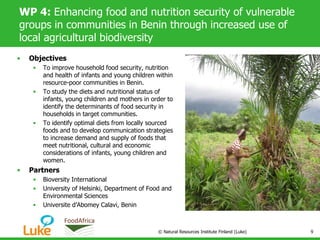
WP 4: Enhancing food and nutrition security of vulnerable
groups in communities in Benin through increased use of
local agricultural biodiversity
• Objectives
• To improve household food security, nutrition
and health of infants and young children within
resource-poor communities in Benin.
• To study the diets and nutritional status of
infants, young children and mothers in order to
identify the determinants of food security in
households in target communities.
• To identify optimal diets from locally sourced
foods and to develop communication strategies
to increase demand and supply of foods that
meet nutritional, cultural and economic
considerations of infants, young children and
women.
• Partners
• Bioversity International
• University of Helsinki, Department of Food and
Environmental Sciences
• Universite d’Abomey Calavi, Benin
© Natural Resources Institute Finland (Luke) 9
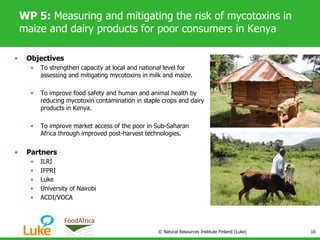
WP 5: Measuring and mitigating the risk of mycotoxins in
maize and dairy products for poor consumers in Kenya
• Objectives
• To strengthen capacity at local and national level for
assessing and mitigating mycotoxins in milk and maize.
• To improve food safety and human and animal health by
reducing mycotoxin contamination in staple crops and dairy
products in Kenya.
• To improve market access of the poor in Sub-Saharan
Africa through improved post-harvest technologies.
• Partners
• ILRI
• IFPRI
• Luke
• University of Nairobi
• ACDI/VOCA
© Natural Resources Institute Finland (Luke) 10
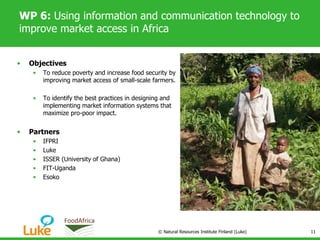
WP 6: Using information and communication technology to
improve market access in Africa
• Objectives
• To reduce poverty and increase food security by
improving market access of small-scale farmers.
• To identify the best practices in designing and
implementing market information systems that
maximize pro-poor impact.
• Partners
• IFPRI
• Luke
• ISSER (University of Ghana)
• FIT-Uganda
• Esoko
© Natural Resources Institute Finland (Luke) 11
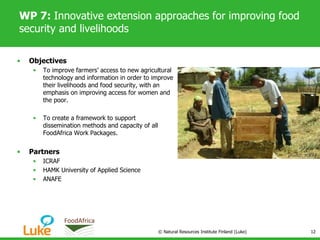
WP 7: Innovative extension approaches for improving food
security and livelihoods
• Objectives
• To improve farmers’ access to new agricultural
technology and information in order to improve
their livelihoods and food security, with an
emphasis on improving access for women and
the poor.
• To create a framework to support
dissemination methods and capacity of all
FoodAfrica Work Packages.
• Partners
• ICRAF
• HAMK University of Applied Science
• ANAFE
© Natural Resources Institute Finland (Luke) 12
Expected Outcomes
• Concrete tools and guidelines for policy makers, small-scale
farmers and for their educators
• New market and risk management approaches
• Agricultural innovations and technologies accessible to the
small-scale farmers
• Strengthened scientific capacity and networks of African
researchers
• Strengthened human and institutional capacity
© Natural Resources Institute Finland (Luke) 13
Contact Information
© Natural Resources Institute Finland (Luke) 14
• Keith Shepherd, ICRAF, k.shepherd@cgiar.org
• Martti Esala, Luke, martti.esala@luke.fi
• Karen Marshall, ILRI, k.marshall@cgiar.org
• Jarmo Juga, University of Helsinki, jarmo.juga@helsinki.fi
• Siwa Msangi, IFPRI, s.msangi@cgiar.org
• Jarkko Niemi, Luke, jarkko.niemi@luke.fi
• Bruce Cogill, Bioversity International, b.cogill@cgiar.org
• Marja Mutanen, University of Helsinki, marja.mutanen@helsinki.fi
• Delia Grace, ILRI, d.grace@cgiar.org
• Hannu Korhonen, Luke, hannu.j.korhonen@luke.fi
• Nick Minot, IFPRI, n.minot@cgiar.org
• Jarkko Niemi, Luke, jarkko.niemi@luke.fi
• Steve Franzel, ICRAF, s.franzel@cgiar.org
• Eija Laitinen, HAMK, eija.laitinen@hamk.fi
WP1
WP2
WP3
WP4
WP5
WP6
WP7
Programme Director
Hannu Korhonen, Luke, hannu.j.korhonen@luke.fi
Programme Coordinator
Mila Sell, Luke, mila.sell@luke.fi
22.1.2015© MTT Agrifood Research Finland 15
Thank you!
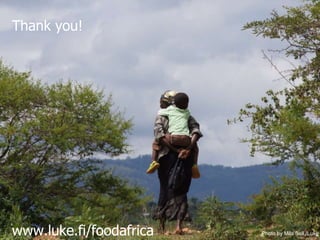
www.luke.fi/foodafrica Photo by Mila Sell /Luke

FoodAfrica Research for Development Programme

  • 1.
    FoodAfrica Research forDevelopment Programme Improving Food Security in West and East Africa through Capacity Building and Information Dissemination
  • 2.
    FoodAfrica Programme • Afour-year (2012–2016) Research for Development Programme coordinated by Natural Resources Institute Finland (Luke). • The programme budget is 11,8 million €, of which 9,5 million is Official Development Aid from the Ministry for Foreign Affairs of Finland. • FoodAfrica pilots a new model of co-operation between eight partners: Luke, IFPRI, ICRAF, ILRI, Bioversity International, University of Helsinki, HAMK and the Ministry for Foreign Affairs of Finland. • The programme consists of seven Work Packages • Six African countries are involved in the programme: Benin, Cameroon, Ghana, Kenya, Senegal and Uganda. © Natural Resources Institute Finland (Luke) 2
  • 3.
    Programme Objectives • Tostrengthen education and research capacity of the local agricultural sector in East and West Africa, in terms of production, market performance and nutrition, in order to reduce poverty and improve food security in the region. • To produce new, scientific evidence for improving nutrition and food security in Africa. • To enhance cooperation between researchers and research and educational institutions in the region. • To enhance knowledge dissemination between local African and Finnish experts, and experts in the CGIAR centres. • To produce concrete guidelines for policy recommendations on food security for use by local institutions and authorities © Natural Resources Institute Finland (Luke) 3
  • 4.
    FoodAfrica Work Packagesand Partners © Natural Resources Institute Finland (Luke) 4 Soil micronutrients (Sub-Saharan Africa) • ICRAF, University of Nairobi, Luke Sustainable dairy production (Senegal) • ILRI, EISMV, University of Helsinki, Luke Agricultural practices in a changing climate (Senegal) • IFPRI, ISRA, Luke Traditional foods for nutrition (Benin) • Bioversity International, University of Benin, University of Helsinki Reducing risk of mycotoxins (Kenya) • ILRI, IFPRI, University of Nairobi, Luke Better market access through ICT’s (Ghana & Uganda) • IFPRI, Luke Innovative extension approaches (Kenya & Cameroon) • ICRAF, HAMK WP1 WP2 WP3 WP4 WP5 WP6 WP7
  • 5.
    Cross-Cutting Objectives andJoint Activities • The seven Work Packages have a common Dissemination Strategy • Human Rights based approach in all Work Packages • Integration of cross-cutting objectives of Finnish Development policy in all Work Packages • Climate Sustainability • Gender Equality • Reduction of Inequality © Natural Resources Institute Finland (Luke) 5
  • 6.
    WP 1: Strengtheningcapacity for diagnosis and management of soil micronutrient deficiencies in Sub-Saharan African countries for improved plant, animal and human nutrition • Objectives • To strengthen African capacity to diagnose and manage soil micronutrient deficiencies for improved food production and human health. • To increase food productivity and quality and human nutrition through improved soil micronutrient diagnostics and management in Sub-Saharan Africa. • To enable better targeting and monitoring of interventions aimed at improving crop, livestock and human health at different levels, from farm to international development policy. • Partners • ICRAF • Luke • University of Nairobi, Institute of Nuclear Physics © Natural Resources Institute Finland (Luke) 6
  • 7.
    WP 2: Improvedfood and nutritional security from better utilisation of dairy cattle breed types in Senegal • Objectives • To identify and promote utilization of the most appropriate dairy breed and cross-breed types through characterisation of germplasm for more productive and profitable dairy enterprises in selected production systems in Senegal. • Partners • ILRI • Luke • University of Helsinki, Department of Agricultural Sciences • National Research Institute in Senegal 22.1.2015© Natural Resources Institute Finland (Luke) 7
  • 8.
    WP 3: Economicanalysis on technologies and targeted policies to reduce vulnerability and building resilience in Senegal • Objectives • To build resilience within the agricultural sector of Senegal in the face of climate risk. • To enhance the adaptive capacity of the wider Senegalese economy in order to secure livelihoods and welfare and to reduce vulnerability to environmental and socio- economic shocks. • Partners • IFPRI • Luke • ISRA (national research institute in Senegal) © Natural Resources Institute Finland (Luke) 8
  • 9.
    WP 4: Enhancingfood and nutrition security of vulnerable groups in communities in Benin through increased use of local agricultural biodiversity • Objectives • To improve household food security, nutrition and health of infants and young children within resource-poor communities in Benin. • To study the diets and nutritional status of infants, young children and mothers in order to identify the determinants of food security in households in target communities. • To identify optimal diets from locally sourced foods and to develop communication strategies to increase demand and supply of foods that meet nutritional, cultural and economic considerations of infants, young children and women. • Partners • Bioversity International • University of Helsinki, Department of Food and Environmental Sciences • Universite d’Abomey Calavi, Benin © Natural Resources Institute Finland (Luke) 9
  • 10.
    WP 5: Measuringand mitigating the risk of mycotoxins in maize and dairy products for poor consumers in Kenya • Objectives • To strengthen capacity at local and national level for assessing and mitigating mycotoxins in milk and maize. • To improve food safety and human and animal health by reducing mycotoxin contamination in staple crops and dairy products in Kenya. • To improve market access of the poor in Sub-Saharan Africa through improved post-harvest technologies. • Partners • ILRI • IFPRI • Luke • University of Nairobi • ACDI/VOCA © Natural Resources Institute Finland (Luke) 10
  • 11.
    WP 6: Usinginformation and communication technology to improve market access in Africa • Objectives • To reduce poverty and increase food security by improving market access of small-scale farmers. • To identify the best practices in designing and implementing market information systems that maximize pro-poor impact. • Partners • IFPRI • Luke • ISSER (University of Ghana) • FIT-Uganda • Esoko © Natural Resources Institute Finland (Luke) 11
  • 12.
    WP 7: Innovativeextension approaches for improving food security and livelihoods • Objectives • To improve farmers’ access to new agricultural technology and information in order to improve their livelihoods and food security, with an emphasis on improving access for women and the poor. • To create a framework to support dissemination methods and capacity of all FoodAfrica Work Packages. • Partners • ICRAF • HAMK University of Applied Science • ANAFE © Natural Resources Institute Finland (Luke) 12
  • 13.
    Expected Outcomes • Concretetools and guidelines for policy makers, small-scale farmers and for their educators • New market and risk management approaches • Agricultural innovations and technologies accessible to the small-scale farmers • Strengthened scientific capacity and networks of African researchers • Strengthened human and institutional capacity © Natural Resources Institute Finland (Luke) 13
  • 14.
    Contact Information © NaturalResources Institute Finland (Luke) 14 • Keith Shepherd, ICRAF, k.shepherd@cgiar.org • Martti Esala, Luke, martti.esala@luke.fi • Karen Marshall, ILRI, k.marshall@cgiar.org • Jarmo Juga, University of Helsinki, jarmo.juga@helsinki.fi • Siwa Msangi, IFPRI, s.msangi@cgiar.org • Jarkko Niemi, Luke, jarkko.niemi@luke.fi • Bruce Cogill, Bioversity International, b.cogill@cgiar.org • Marja Mutanen, University of Helsinki, marja.mutanen@helsinki.fi • Delia Grace, ILRI, d.grace@cgiar.org • Hannu Korhonen, Luke, hannu.j.korhonen@luke.fi • Nick Minot, IFPRI, n.minot@cgiar.org • Jarkko Niemi, Luke, jarkko.niemi@luke.fi • Steve Franzel, ICRAF, s.franzel@cgiar.org • Eija Laitinen, HAMK, eija.laitinen@hamk.fi WP1 WP2 WP3 WP4 WP5 WP6 WP7 Programme Director Hannu Korhonen, Luke, hannu.j.korhonen@luke.fi Programme Coordinator Mila Sell, Luke, mila.sell@luke.fi
  • 15.
    22.1.2015© MTT AgrifoodResearch Finland 15 Thank you! www.luke.fi/foodafrica Photo by Mila Sell /Luke

Editor's Notes