DJIM workshop
 on Peer Review
Lara Killian (MA, MLIS 2010)
Journal of Library Innovation
(JOLI) Peer Reviewer, 2010-2012
DJIM Past Editorial Co-Chair
2008-2010 (Volumes 5 & 6)

19 Jan 2012
lara.killian@dal.ca
Why peer review?
   Looks excellent on a résumé

   Can help you evaluate your own work, keep
    a better eye on overall coherence of
    arguments, flow of writing

   Gives you the opportunity to network within
    the Faculty and get to know the review
    process before you graduate and enter the
    professional world where you may need or
    want to publish in the future
Peer review @ DJIM:
 Peer   review is not copy editing

 Professionally
               evaluate a colleague's work
 using clear guidelines, and contribute
 constructive feedback

 Reviewers should be familiar with
 standard of previous content (read past
 issues of DJIM!)
Peer review aka “blind review”
   The peer review process, for DJIM’s
    purposes, is anonymous (“blind review”)
   One faculty member and two current
    students review each submission
   Reviewer should not know whose work they
    are reviewing
   Author should not know who is reviewing their
    work
   Everything goes through the editorial board
Peer reviewers can always…
   Ask editorial board for guidance or
    clarification

   Express concern that they may have
    inadvertently discovered author identity

   Request help with completing the peer review
    feedback form clearly and completely so the
    author will benefit from the process
Editorial board support
 Editorial
         staff have already screened for
  adherence to submission guidelines

 Eachsubmission should already have the
  necessary components

 Peer reviewers can focus on central
  question: Is this submission suitable for
  publication?
Peer review is not copy editing
   Try to leave typos and grammar alone –
    unless they interfere with comprehension

   Focus on the big picture: Is the article suitable
    for publication or not?

   Consult guidelines provided by editorial
    board throughout the process, provide
    meaningful feedback for author and to let
    editorial board why you made the
    recommendation to publish (or not)
Consider:
   Does the title describe the submission’s
    scope?

   Does the abstract summarize the content?

   Is the content clearly organized?

   Is the writing understandable to students at
    the graduate level of your field?
Consider questions such as:
   Are arguments made in the submission sound and
    reasonable, based on your knowledge of the
    field?

   Are arguments well supported by the evidence
    presented?

   If the submission contains statistical evaluation, are
    all statistical techniques identified and, when
    appropriate, referenced?

   Is the conclusion relevant to the arguments of the
    submission, and interesting to readers?
Red flags
   Unsupported statements
   Abstract subject, vagueness (reader can’t
    grasp the meaning)
   Passive voice, weak or repetitive verbs
   Lack of clarity
   Wordiness, lack of conciseness
   Official style (high diction, ponderous
    nouns, strings of prepositions)
   Inanity, superficiality, superfluousness
               www.brandeis.edu/.../uwsexercises/peer-review-exercises.doc
Exercise

Read the short writing samples provided

In small groups, discuss (5-10 minutes)
Time commitment (step 1)
   Set aside adequate time to read the
    submission through completely, rather than
    piece by piece

       If you must leave the submission partway
        through and return to it, re-read at least the
        introductory section to be sure you remember
        what the author’s intentions were

   Do the author a favor and really pay
    attention, offer constructive feedback
Time commitment (step 2)
   Come back to the submission a day or a week
    later and review all of the text as well as your
    comments on the peer review feedback form

       Are your comments or questions still clear and
        easy to understand?
       Do you clearly indicate where in the submission
        you are referring to? If you can’t find where you
        meant, the author will also have trouble
       If you can’t follow your own comments a few days
        later, the author won’t understand them either
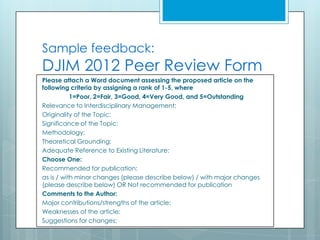
Sample feedback:
DJIM 2012 Peer Review Form
Please attach a Word document assessing the proposed article on the
following criteria by assigning a rank of 1-5, where
           1=Poor, 2=Fair, 3=Good, 4=Very Good, and 5=Outstanding
Relevance to Interdisciplinary Management:
Originality of the Topic:
Significance of the Topic:
Methodology:
Theoretical Grounding:
Adequate Reference to Existing Literature:
Choose One:
Recommended for publication:
as is / with minor changes (please describe below) / with major changes
(please describe below) OR Not recommended for publication
Comments to the Author:
Major contributions/strengths of the article:
Weaknesses of the article:
Suggestions for changes:
Giving feedback (1)
 Be very specific when pointing out issues
 to the author

 Simply
       noting “unclear” or “?” as a note
 about a particular section is unhelpful

 Imagine
        yourself as the author – do you
 have enough guidance to revise your
 work?
Giving feedback (2)
   Ask questions (give page & para # for location)
    like:
       “Do you mean X? Or do you mean Y?”
       “I don’t understand what you mean by X; could
        you clarify?”

   Make comments such as
       “Here it sounds like you’re saying X, when on page
        # you wrote [something contradictory]; please
        clarify.”
       “This idea would be better included on page #
        where you talk about [something related].”
       “This section is extraneous to your main argument;
        consider omitting.”
Problems?
 Anystumbling blocks or areas of
  concern, contact the DJIM editorial
  board right away!

 Ifyou’re not sure what to do, and wait
  until the last minute, the board is delayed
  in returning content to the author

 Be   professional, observe timeline
Thanks!

Questions?
Lara Killian (MA, MLIS 2010)
lara.killian@dal.ca

Djim workshop on peer review 2012

  • 1.
    DJIM workshop onPeer Review Lara Killian (MA, MLIS 2010) Journal of Library Innovation (JOLI) Peer Reviewer, 2010-2012 DJIM Past Editorial Co-Chair 2008-2010 (Volumes 5 & 6) 19 Jan 2012 lara.killian@dal.ca
  • 2.
    Why peer review?  Looks excellent on a résumé  Can help you evaluate your own work, keep a better eye on overall coherence of arguments, flow of writing  Gives you the opportunity to network within the Faculty and get to know the review process before you graduate and enter the professional world where you may need or want to publish in the future
  • 3.
    Peer review @DJIM:  Peer review is not copy editing  Professionally evaluate a colleague's work using clear guidelines, and contribute constructive feedback  Reviewers should be familiar with standard of previous content (read past issues of DJIM!)
  • 4.
    Peer review aka“blind review”  The peer review process, for DJIM’s purposes, is anonymous (“blind review”)  One faculty member and two current students review each submission  Reviewer should not know whose work they are reviewing  Author should not know who is reviewing their work  Everything goes through the editorial board
  • 5.
    Peer reviewers canalways…  Ask editorial board for guidance or clarification  Express concern that they may have inadvertently discovered author identity  Request help with completing the peer review feedback form clearly and completely so the author will benefit from the process
  • 6.
    Editorial board support Editorial staff have already screened for adherence to submission guidelines  Eachsubmission should already have the necessary components  Peer reviewers can focus on central question: Is this submission suitable for publication?
  • 7.
    Peer review isnot copy editing  Try to leave typos and grammar alone – unless they interfere with comprehension  Focus on the big picture: Is the article suitable for publication or not?  Consult guidelines provided by editorial board throughout the process, provide meaningful feedback for author and to let editorial board why you made the recommendation to publish (or not)
  • 8.
    Consider:  Does the title describe the submission’s scope?  Does the abstract summarize the content?  Is the content clearly organized?  Is the writing understandable to students at the graduate level of your field?
  • 9.
    Consider questions suchas:  Are arguments made in the submission sound and reasonable, based on your knowledge of the field?  Are arguments well supported by the evidence presented?  If the submission contains statistical evaluation, are all statistical techniques identified and, when appropriate, referenced?  Is the conclusion relevant to the arguments of the submission, and interesting to readers?
  • 10.
    Red flags  Unsupported statements  Abstract subject, vagueness (reader can’t grasp the meaning)  Passive voice, weak or repetitive verbs  Lack of clarity  Wordiness, lack of conciseness  Official style (high diction, ponderous nouns, strings of prepositions)  Inanity, superficiality, superfluousness www.brandeis.edu/.../uwsexercises/peer-review-exercises.doc
  • 11.
    Exercise Read the shortwriting samples provided In small groups, discuss (5-10 minutes)
  • 12.
    Time commitment (step1)  Set aside adequate time to read the submission through completely, rather than piece by piece  If you must leave the submission partway through and return to it, re-read at least the introductory section to be sure you remember what the author’s intentions were  Do the author a favor and really pay attention, offer constructive feedback
  • 13.
    Time commitment (step2)  Come back to the submission a day or a week later and review all of the text as well as your comments on the peer review feedback form  Are your comments or questions still clear and easy to understand?  Do you clearly indicate where in the submission you are referring to? If you can’t find where you meant, the author will also have trouble  If you can’t follow your own comments a few days later, the author won’t understand them either
  • 14.
    Sample feedback: DJIM 2012Peer Review Form Please attach a Word document assessing the proposed article on the following criteria by assigning a rank of 1-5, where 1=Poor, 2=Fair, 3=Good, 4=Very Good, and 5=Outstanding Relevance to Interdisciplinary Management: Originality of the Topic: Significance of the Topic: Methodology: Theoretical Grounding: Adequate Reference to Existing Literature: Choose One: Recommended for publication: as is / with minor changes (please describe below) / with major changes (please describe below) OR Not recommended for publication Comments to the Author: Major contributions/strengths of the article: Weaknesses of the article: Suggestions for changes:
  • 15.
    Giving feedback (1) Be very specific when pointing out issues to the author  Simply noting “unclear” or “?” as a note about a particular section is unhelpful  Imagine yourself as the author – do you have enough guidance to revise your work?
  • 16.
    Giving feedback (2)  Ask questions (give page & para # for location) like:  “Do you mean X? Or do you mean Y?”  “I don’t understand what you mean by X; could you clarify?”  Make comments such as  “Here it sounds like you’re saying X, when on page # you wrote [something contradictory]; please clarify.”  “This idea would be better included on page # where you talk about [something related].”  “This section is extraneous to your main argument; consider omitting.”
  • 17.
    Problems?  Anystumbling blocksor areas of concern, contact the DJIM editorial board right away!  Ifyou’re not sure what to do, and wait until the last minute, the board is delayed in returning content to the author  Be professional, observe timeline
  • 18.
    Thanks! Questions? Lara Killian (MA,MLIS 2010) lara.killian@dal.ca