Class 21 Online
EWRT 1A
https://www.youtube.com/watch?v=n2iT-7h_Rmg
AGENDA
 Sentence Strategies
 Self Assessment
 Prepare the final draft
 Work through slides 12-19 to
prepare your essay for the in-class
writing workshop. The essay you
bring to class should be ready to
submit for a grade.
 Review Material Included: MLA
 Integrating and Citing Sources
 Works Cited Page
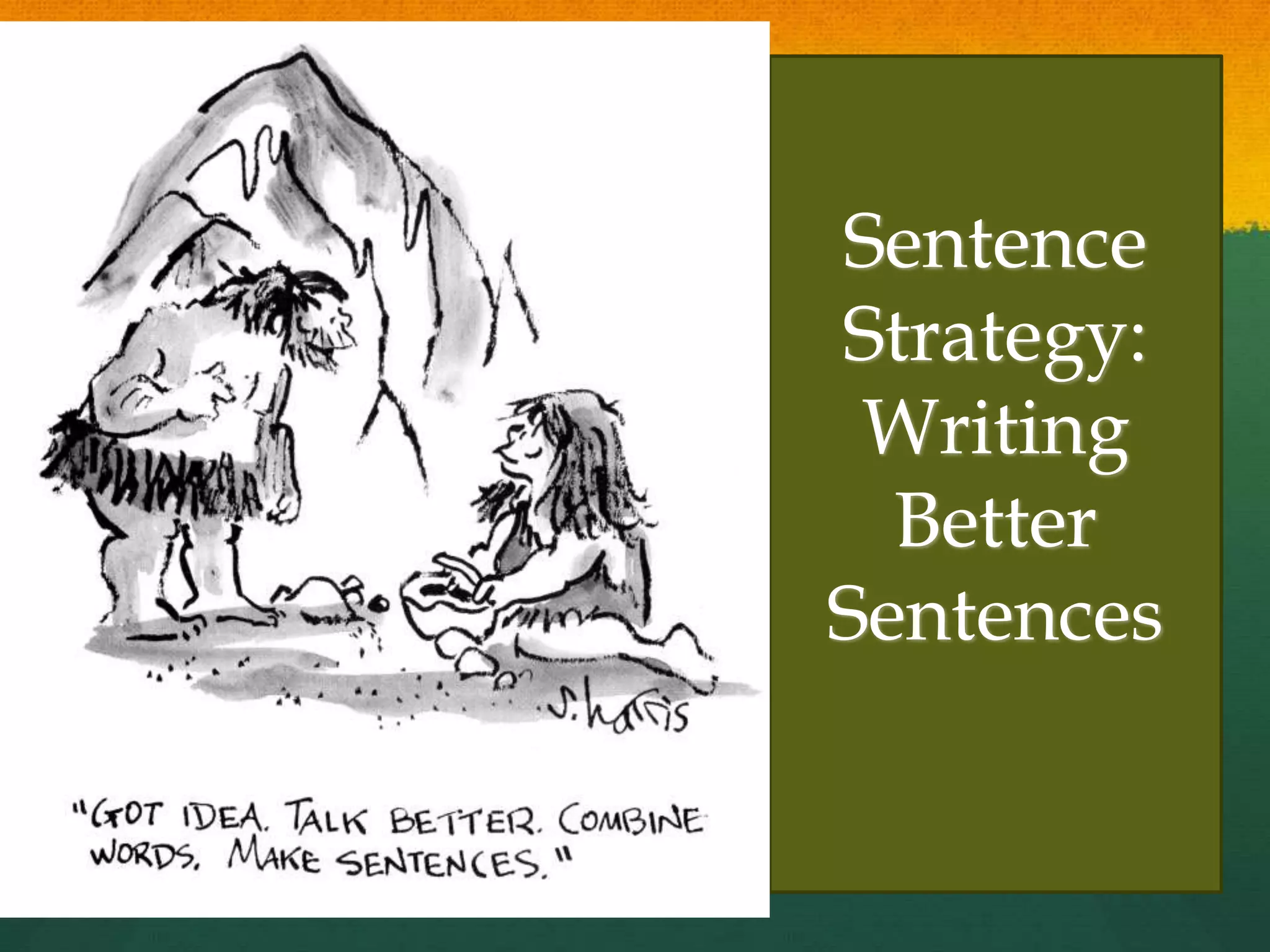
Sentence
Strategy:
Writing
Better
Sentences
Avoiding Ambiguous Use of
“This” and “That”
 The Problem: Because you must frequently
refer to the problem and the solution in a
proposal, you will often use pronouns to
avoid the monotony or wordiness of
repeatedly referring to them by name. Using
this and that vaguely to refer to other words
or ideas, however, can confuse readers.
How to Correct It.
 Add a specific noun after this or that. For example, in his
essay in this chapter, Patrick O’Malley writes:
 Another possible solution would be to help students prepare
for midterm and final exams by providing sets of questions
from which the exam questions will be selected. . . . This
solution would have the advantage of reducing students’
anxiety about learning every fact in the textbook. . . . (par.
12)
 O’Malley avoids an ambiguous this in the second
sentence by repeating the noun “solution.”
 (He might just as well have used preparation or action or
approach.)
Look for ambiguous uses of
“this” and “that” in your essay
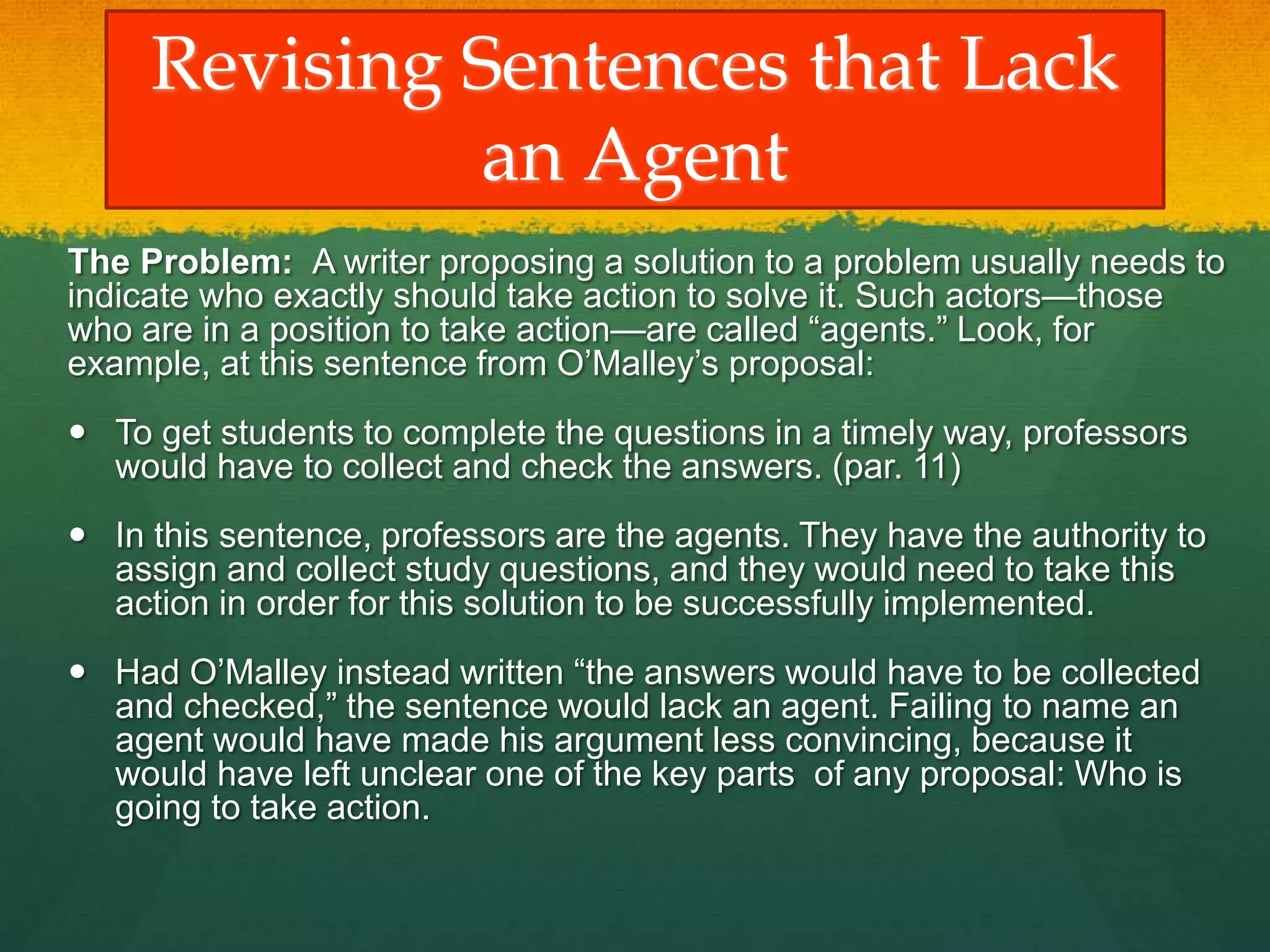
Revising Sentences that Lack
an Agent
The Problem: A writer proposing a solution to a problem usually needs to
indicate who exactly should take action to solve it. Such actors—those
who are in a position to take action—are called “agents.” Look, for
example, at this sentence from O’Malley’s proposal:
 To get students to complete the questions in a timely way, professors
would have to collect and check the answers. (par. 11)
 In this sentence, professors are the agents. They have the authority to
assign and collect study questions, and they would need to take this
action in order for this solution to be successfully implemented.
 Had O’Malley instead written “the answers would have to be collected
and checked,” the sentence would lack an agent. Failing to name an
agent would have made his argument less convincing, because it
would have left unclear one of the key parts of any proposal: Who is
going to take action.
How to Correct It
 When you revise your work, ask yourself who or
what performed the action in any given sentence. If
there is no clear answer, rewrite the sentence to
give it an agent. Watch in particular for forms of the
verb to be (the balls were dropped, exams should
be given, etc.), which often signal agentless
sentences.
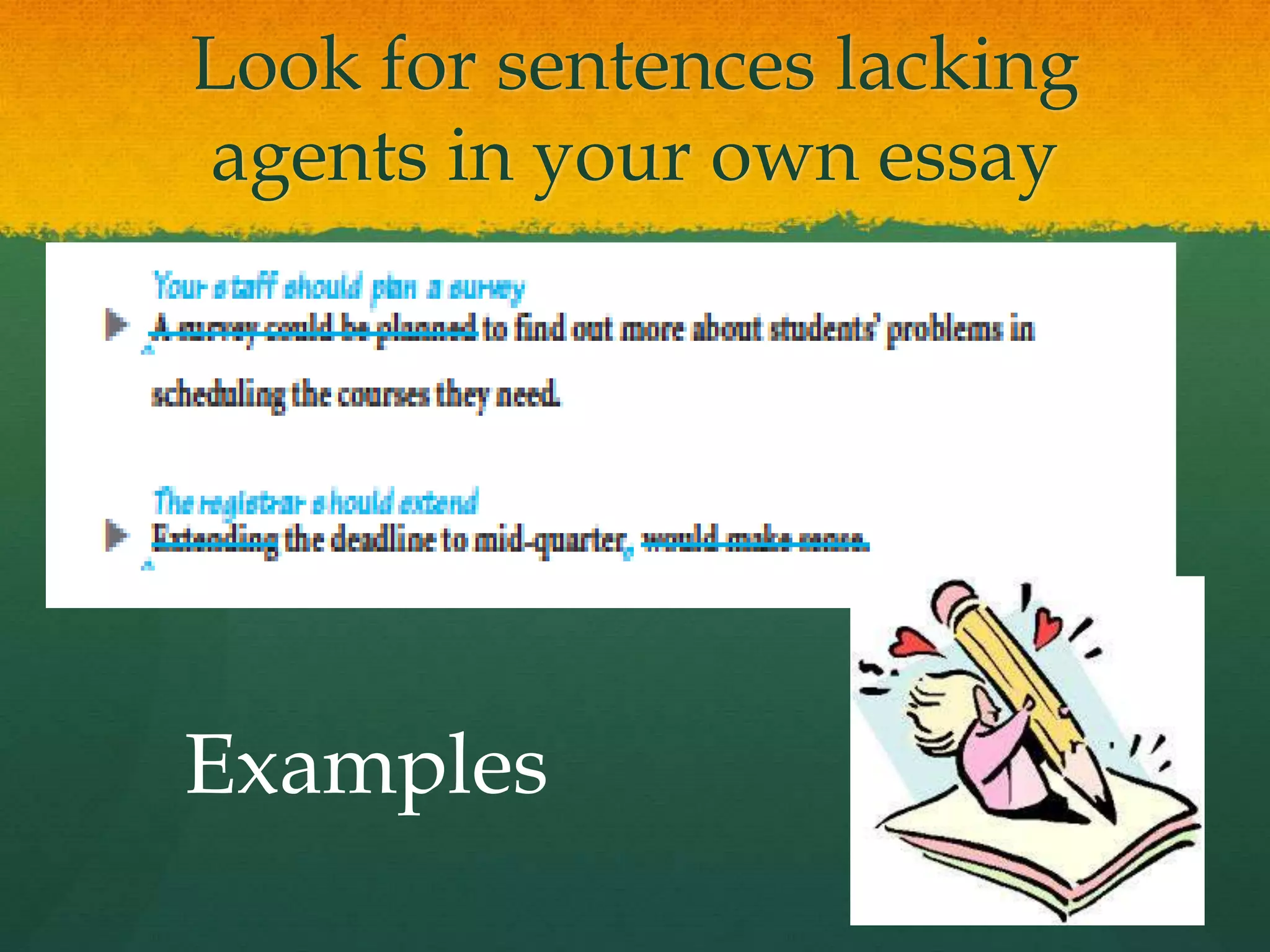
Look for sentences lacking
agents in your own essay
Examples
Preparing the final draft
Work through the slides to prepare your essay for the in-class
writing workshop. The essay you bring to class should be ready to
submit for a grade.
http://www.youtube.com/watch?v=n2iT-7h_Rmg
The Beginning
 Have I begun my essay with hook or another
interesting beginning?
 Did I begin with a scenario, statistics, a research
study, or an analogy?
 Did I use a comparison to other places where the
solution has been tried successfully, give a preview
of the negative consequences if the problem goes
unsolved, or lead with a criticism of an alternative
solution?
 Or, did I use another appropriate beginning?
Clarifying Your Purpose
and Audience
 Have I determined what my readers already know about
this problem? If my readers are unfamiliar with it, have I
clearly explained the problem? If my readers know about
the problem but do not realize how serious it is, have I
convinced them that it is serious?
 Have I gained readers’ enthusiastic support? Have I
convince them that solving the problem is in everyone’s
interest, as O’Malley and Kornbluh try to do?
 Have I presented myself so that I seem both reasonable
and authoritative?
Defining the Problem
 Have I demonstrated that the problem really exists?
Have I presented statistics, as Kornbluh does?
 Have I shown the seriousness and urgency of the
problem? Have I stressed the negative consequences?
Have I used quotations or cited research to stress the
problem’s importance?
 Have I speculated about the problem’s causes or history
to help readers understand why it needs attention? Can I
use comparison and contrast, as Kornbluh does?
 Have I devoted enough space to defining the problem? Is
my entire description of the problem before the thesis, as
it should be?
Describing the Proposed
Solution
 Have I described my solution so that it looks like
the best way to proceed?
 Have I given examples to show how solutions like
mine have worked? Or have I focused on my
reasons to support my solution, as O’Malley does?
 Have I made the solution seem easy to implement,
as O’Malley does, or have I acknowledged that the
solution will require effort and compromise, as
Kornbluh does?
Counterarguing Readers’
Objections
 Have I included the best objections?
 Do I need to accommodate or concede certain
objections by modifying my proposal, as O’Malley
does?
 Have I supported any refutations I have made?
Have I cited statistics or research studies to do so?
Should I get more evidence?
Alternative Solutions
 Have I mentioned the best alternative solutions?
 Have I supported my refutation of alternative
solutions? Have I argued that they are too expensive
and time-consuming, or that they will not really
solve the problem?
 Have I rejected these other solutions without
seeming to criticize their proponents?
 Have I provided reasons, as O’Malley does, or
marshaled statistics, as Kornbluh does?
The Ending
 Have I included an appropriate ending?
 Have I ended by summarizing my solution and its
advantages,
 Have I ended with a scenario suggesting the
consequences of a failure to solve the problem?
 Have I ended with an inspiring call to action? Might a
shift to humor or satire provide an effective ending?
 Have I reminded readers of something special about the
problem, as Kornbluh does when she urges that an
award be given to the companies that lead the way?
For your convenience
MLA Formatting
MLA End-of-Paper Checklist
In-Text Citations
1. Have you given credit to other
sources when you’ve quoted
and/or paraphrased throughout
your paper?
2. Are the in-text citations properly
constructed according to MLA
style?
3. Does every in-text citation have a
complete, matching citation in
your Works Cited List?
Works Cited List
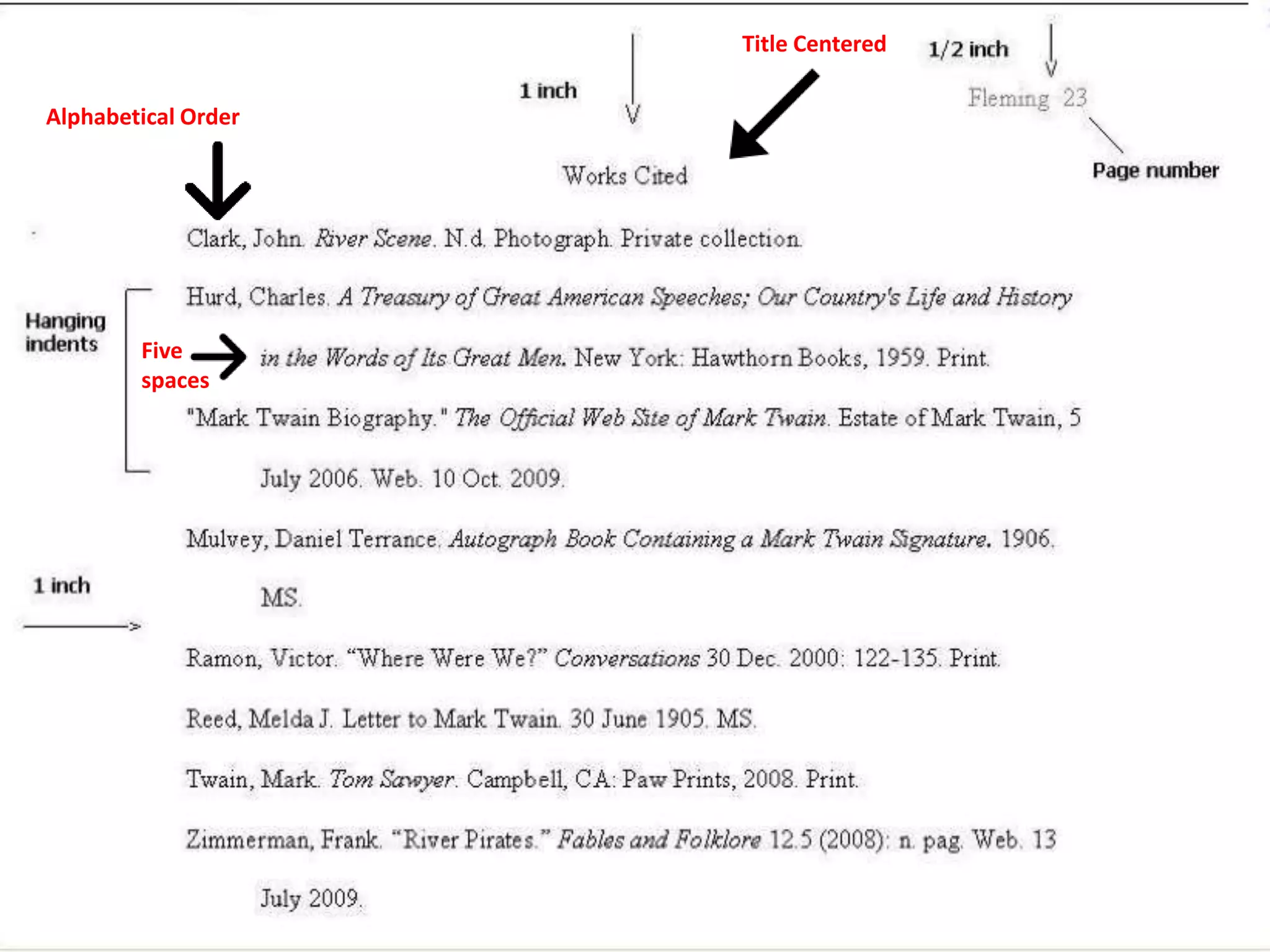
1. Does it say Works Cited at the top of your page,
centered, and without bolding or underlining?
2. Is the Works Cited page double spaced?
3. Are the citations in alphabetical order by the first
word/name of each citation?
4. Are the citations properly constructed according to MLA
style?
5. Is the second line of any citation longer than one line
indented half an inch? This is called a “hanging indent”
in your paragraph settings.
6. Does each citation in the Works Cited list have a
matching in-text citation in your assignment?
MLA End-of-Paper Checklist
Overall Paper Presentation
1. Did you cite the appropriate
number of sources according to
your assignment instructions?
2. Is your paper double spaced?
3. Unless specified otherwise by
your instructor, is your paper in
Times New Roman size 12 font?
4. Did you create a header at the top
right of each page with your last
name and page number?
MLA End-of-Paper Checklist
Alphabetical Order
Title Centered
Five
spaces
The blogging post points (75) require self-
assessment. Consider three aspects of your
responses: First, how many of the posts did you
make? Second, what was the quality of your
response? Third, how timely were your
submissions? Write a paragraph justifying your
grade. Submit your self-assessment via Kaizena
as soon as you finish today’s post; you must
send it before our final meeting. The formula is
on the next slide.
Reminder: Self-Assessment
Here is the Math!
See the Assignment Sheet for More Details
Your final grade will be figured this way: 75/25 = 3 points per post
minus 1.5 points for each late post (48 hours after the due time. There are
no points awarded for posts more than 48 hours late). Then, multiply the
total times the average grade percentage for the quality of your work.
Example
Posts completed: 25 x 3 points = 75 points
Late posts: 4 x 1.5 = 6
Subtract the smaller from the larger: 75 – 6= 69
Quality of posts: B+ or 88%
Multiply the total times the quality: 69 x .88= 61/75 points or 81%
Homework
 Check your essay for ambiguity. Add
words to clarify “this” and “that.”
 Check your sentences for “agents.”
Make sure you have an actor in each
sentence.
 Bring one clean, hard copy of your
final essay to class. An Electronic Copy
will not do for this exercise!
• Your essay should be in MLA
format
• It should include a works cited
page
 Self Assessment Due via Kaizena
before Midnight Wednesday.

Class 21 online

  • 1.
    Class 21 Online EWRT1A https://www.youtube.com/watch?v=n2iT-7h_Rmg
  • 2.
    AGENDA  Sentence Strategies Self Assessment  Prepare the final draft  Work through slides 12-19 to prepare your essay for the in-class writing workshop. The essay you bring to class should be ready to submit for a grade.  Review Material Included: MLA  Integrating and Citing Sources  Works Cited Page
  • 3.
  • 4.
    Avoiding Ambiguous Useof “This” and “That”  The Problem: Because you must frequently refer to the problem and the solution in a proposal, you will often use pronouns to avoid the monotony or wordiness of repeatedly referring to them by name. Using this and that vaguely to refer to other words or ideas, however, can confuse readers.
  • 5.
    How to CorrectIt.  Add a specific noun after this or that. For example, in his essay in this chapter, Patrick O’Malley writes:  Another possible solution would be to help students prepare for midterm and final exams by providing sets of questions from which the exam questions will be selected. . . . This solution would have the advantage of reducing students’ anxiety about learning every fact in the textbook. . . . (par. 12)  O’Malley avoids an ambiguous this in the second sentence by repeating the noun “solution.”  (He might just as well have used preparation or action or approach.)
  • 6.
    Look for ambiguoususes of “this” and “that” in your essay
  • 7.
    Revising Sentences thatLack an Agent The Problem: A writer proposing a solution to a problem usually needs to indicate who exactly should take action to solve it. Such actors—those who are in a position to take action—are called “agents.” Look, for example, at this sentence from O’Malley’s proposal:  To get students to complete the questions in a timely way, professors would have to collect and check the answers. (par. 11)  In this sentence, professors are the agents. They have the authority to assign and collect study questions, and they would need to take this action in order for this solution to be successfully implemented.  Had O’Malley instead written “the answers would have to be collected and checked,” the sentence would lack an agent. Failing to name an agent would have made his argument less convincing, because it would have left unclear one of the key parts of any proposal: Who is going to take action.
  • 8.
    How to CorrectIt  When you revise your work, ask yourself who or what performed the action in any given sentence. If there is no clear answer, rewrite the sentence to give it an agent. Watch in particular for forms of the verb to be (the balls were dropped, exams should be given, etc.), which often signal agentless sentences.
  • 9.
    Look for sentenceslacking agents in your own essay Examples
  • 10.
    Preparing the finaldraft Work through the slides to prepare your essay for the in-class writing workshop. The essay you bring to class should be ready to submit for a grade. http://www.youtube.com/watch?v=n2iT-7h_Rmg
  • 11.
    The Beginning  HaveI begun my essay with hook or another interesting beginning?  Did I begin with a scenario, statistics, a research study, or an analogy?  Did I use a comparison to other places where the solution has been tried successfully, give a preview of the negative consequences if the problem goes unsolved, or lead with a criticism of an alternative solution?  Or, did I use another appropriate beginning?
  • 12.
    Clarifying Your Purpose andAudience  Have I determined what my readers already know about this problem? If my readers are unfamiliar with it, have I clearly explained the problem? If my readers know about the problem but do not realize how serious it is, have I convinced them that it is serious?  Have I gained readers’ enthusiastic support? Have I convince them that solving the problem is in everyone’s interest, as O’Malley and Kornbluh try to do?  Have I presented myself so that I seem both reasonable and authoritative?
  • 13.
    Defining the Problem Have I demonstrated that the problem really exists? Have I presented statistics, as Kornbluh does?  Have I shown the seriousness and urgency of the problem? Have I stressed the negative consequences? Have I used quotations or cited research to stress the problem’s importance?  Have I speculated about the problem’s causes or history to help readers understand why it needs attention? Can I use comparison and contrast, as Kornbluh does?  Have I devoted enough space to defining the problem? Is my entire description of the problem before the thesis, as it should be?
  • 14.
    Describing the Proposed Solution Have I described my solution so that it looks like the best way to proceed?  Have I given examples to show how solutions like mine have worked? Or have I focused on my reasons to support my solution, as O’Malley does?  Have I made the solution seem easy to implement, as O’Malley does, or have I acknowledged that the solution will require effort and compromise, as Kornbluh does?
  • 15.
    Counterarguing Readers’ Objections  HaveI included the best objections?  Do I need to accommodate or concede certain objections by modifying my proposal, as O’Malley does?  Have I supported any refutations I have made? Have I cited statistics or research studies to do so? Should I get more evidence?
  • 16.
    Alternative Solutions  HaveI mentioned the best alternative solutions?  Have I supported my refutation of alternative solutions? Have I argued that they are too expensive and time-consuming, or that they will not really solve the problem?  Have I rejected these other solutions without seeming to criticize their proponents?  Have I provided reasons, as O’Malley does, or marshaled statistics, as Kornbluh does?
  • 17.
    The Ending  HaveI included an appropriate ending?  Have I ended by summarizing my solution and its advantages,  Have I ended with a scenario suggesting the consequences of a failure to solve the problem?  Have I ended with an inspiring call to action? Might a shift to humor or satire provide an effective ending?  Have I reminded readers of something special about the problem, as Kornbluh does when she urges that an award be given to the companies that lead the way?
  • 18.
  • 19.
    MLA End-of-Paper Checklist In-TextCitations 1. Have you given credit to other sources when you’ve quoted and/or paraphrased throughout your paper? 2. Are the in-text citations properly constructed according to MLA style? 3. Does every in-text citation have a complete, matching citation in your Works Cited List?
  • 20.
    Works Cited List 1.Does it say Works Cited at the top of your page, centered, and without bolding or underlining? 2. Is the Works Cited page double spaced? 3. Are the citations in alphabetical order by the first word/name of each citation? 4. Are the citations properly constructed according to MLA style? 5. Is the second line of any citation longer than one line indented half an inch? This is called a “hanging indent” in your paragraph settings. 6. Does each citation in the Works Cited list have a matching in-text citation in your assignment? MLA End-of-Paper Checklist
  • 21.
    Overall Paper Presentation 1.Did you cite the appropriate number of sources according to your assignment instructions? 2. Is your paper double spaced? 3. Unless specified otherwise by your instructor, is your paper in Times New Roman size 12 font? 4. Did you create a header at the top right of each page with your last name and page number? MLA End-of-Paper Checklist
  • 22.
  • 28.
    The blogging postpoints (75) require self- assessment. Consider three aspects of your responses: First, how many of the posts did you make? Second, what was the quality of your response? Third, how timely were your submissions? Write a paragraph justifying your grade. Submit your self-assessment via Kaizena as soon as you finish today’s post; you must send it before our final meeting. The formula is on the next slide. Reminder: Self-Assessment
  • 29.
    Here is theMath! See the Assignment Sheet for More Details Your final grade will be figured this way: 75/25 = 3 points per post minus 1.5 points for each late post (48 hours after the due time. There are no points awarded for posts more than 48 hours late). Then, multiply the total times the average grade percentage for the quality of your work. Example Posts completed: 25 x 3 points = 75 points Late posts: 4 x 1.5 = 6 Subtract the smaller from the larger: 75 – 6= 69 Quality of posts: B+ or 88% Multiply the total times the quality: 69 x .88= 61/75 points or 81%
  • 30.
    Homework  Check youressay for ambiguity. Add words to clarify “this” and “that.”  Check your sentences for “agents.” Make sure you have an actor in each sentence.  Bring one clean, hard copy of your final essay to class. An Electronic Copy will not do for this exercise! • Your essay should be in MLA format • It should include a works cited page  Self Assessment Due via Kaizena before Midnight Wednesday.