Greenhouse Gas Emissions of Beef
Cattle Under Grazing Conditions in
Florida
Marta Moura Kohmann- ABE/UF
Dr. Clyde W. Fraisse- ABE/UF
Dr. Hilary Swain, Archbold Biological Station
Dr. Martin Ruiz-Moreno, ANS/UF
Dr. Lynn E. Sollenberger, PhD., AGR/UF
Dr. Nicolas DiLorenzo, ANS/UF
Francine Messias Ciríaco, ANS/UF
Darren D. Henry, ANS/UF
April 2013
Background
2
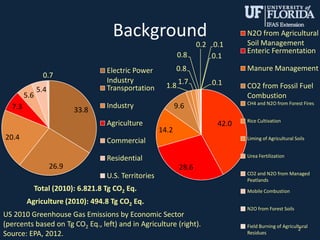
US 2010 Greenhouse Gas Emissions by Economic Sector
(percents based on Tg CO2 Eq., left) and in Agriculture (right).
Source: EPA, 2012.
33.8
26.9
20.4
7.3
5.6
5.4
0.7
Electric Power
Industry
Transportation
Industry
Agriculture
Commercial
Residential
U.S. Territories
Total (2010): 6.821.8 Tg CO2 Eq.
Agriculture (2010): 494.8 Tg CO2 Eq.
42.0
28.6
14.2
9.6
1.8
1.7
0.8
0.8
0.2 0.1
0.1
0.1
N2O from Agricultural
Soil Management
Enteric Fermentation
Manure Management
CO2 from Fossil Fuel
Combustion
CH4 and N2O from Forest Fires
Rice Cultivation
Liming of Agricultural Soils
Urea Fertilization
CO2 and N2O from Managed
Peatlands
Mobile Combustion
N2O from Forest Soils
Field Burning of Agricultural
Residues
Importance
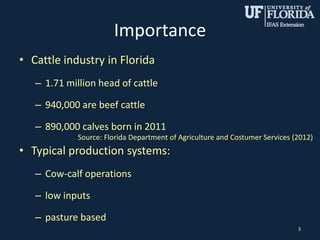
• Cattle industry in Florida
– 1.71 million head of cattle
– 940,000 are beef cattle
– 890,000 calves born in 2011
• Typical production systems:
– Cow-calf operations
– low inputs
– pasture based
3
Source: Florida Department of Agriculture and Costumer Services (2012)
Objective
The objective is to calculate the carbon footprint of
a typical cow-calf operation in Florida..
Specific objectives are
– Identify main Greenhouse Gas (GHG) sources
– Understand the model used
– Further investigation of ruminal fermentation with
field trials
4
Methodology
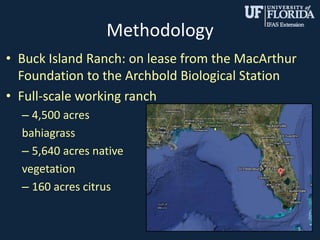
• Buck Island Ranch: on lease from the MacArthur
Foundation to the Archbold Biological Station
• Full-scale working ranch
– 4,500 acres
bahiagrass
– 5,640 acres native
vegetation
– 160 acres citrus
5
Methodology
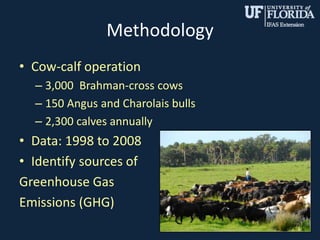
• Cow-calf operation
– 3,000 Brahman-cross cows
– 150 Angus and Charolais bulls
– 2,300 calves annually
• Data: 1998 to 2008
• Identify sources of
Greenhouse Gas
Emissions (GHG)
6
Methodology
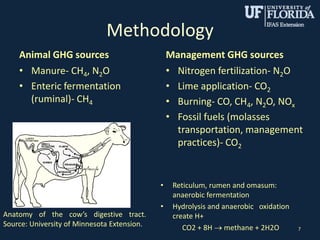
Animal GHG sources
• Manure- CH4, N2O
• Enteric fermentation
(ruminal)- CH4
Management GHG sources
• Nitrogen fertilization- N2O
• Lime application- CO2
• Burning- CO, CH4, N2O, NOx
• Fossil fuels (molasses
transportation, management
practices)- CO2
7
Anatomy of the cow’s digestive tract.
Source: University of Minnesota Extension.
• Reticulum, rumen and omasum:
anaerobic fermentation
• Hydrolysis and anaerobic oxidation
create H+
CO2 + 8H methane + 2H2O
Methodology
• Intergovernmental Panel on Climate Change
(2008)
• EPA (2005)
• Results transformed into CO2eq
– CH4 = 21 CO2
– N2O = 310 CO2
8
Results
9
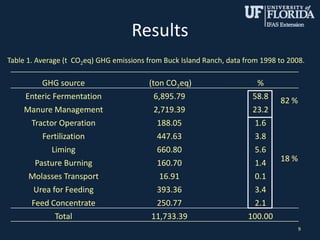
GHG source (ton CO2eq) %
Enteric Fermentation 6,895.79 58.8
Manure Management 2,719.39 23.2
Tractor Operation 188.05 1.6
Fertilization 447.63 3.8
Liming 660.80 5.6
Pasture Burning 160.70 1.4
Molasses Transport 16.91 0.1
Urea for Feeding 393.36 3.4
Feed Concentrate 250.77 2.1
Total 11,733.39 100.00
Table 1. Average (t CO2eq) GHG emissions from Buck Island Ranch, data from 1998 to 2008.
82 %
18 %
0
500
1000
1500
2000
2500
3000
3500
4000
4500
5000
0
2000
4000
6000
8000
10000
12000
1998 1999 2000 2001 2002 2003 2004 2005 2006 2007 2008
numberofanimals
Totalemissions(tonCO2eq/year)
Agrochemicals Total emissions Adult animals
Results
10
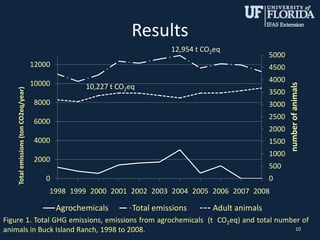
10,227 t CO2eq
12,954 t CO2eq
Figure 1. Total GHG emissions, emissions from agrochemicals (t CO2eq) and total number of
animals in Buck Island Ranch, 1998 to 2008.
Results
11
71
42
29
58
0
10
20
30
40
50
60
70
80
90
100
%
Lime Fertilizer (N)
Production, transportation, storage and transfer
After application
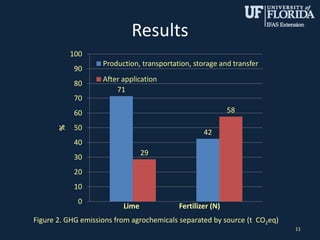
Figure 2. GHG emissions from agrochemicals separated by source (t CO2eq)
Results
12
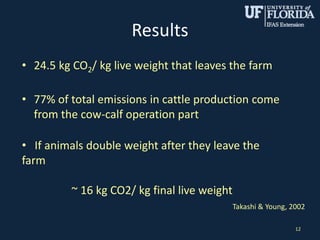
• 24.5 kg CO2/ kg live weight that leaves the farm
• 77% of total emissions in cattle production come
from the cow-calf operation part
• If animals double weight after they leave the
farm
~ 16 kg CO2/ kg final live weight
Takashi & Young, 2002
Ongoing Research
• Field trials in the North Florida Research and
Educational Center in Marianna, Florida
– Methane measurements using the SF6 technique
– Three stocking rates
– Animal performance (weight gain)
– Pasture measurements (production, nutritive
value)
13
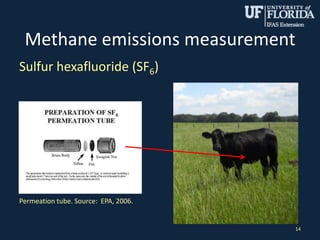
Methane emissions measurement
Sulfur hexafluoride (SF6)
14
Permeation tube. Source: EPA, 2006.
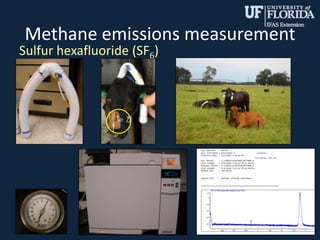
Methane emissions measurement
Sulfur hexafluoride (SF6)
15
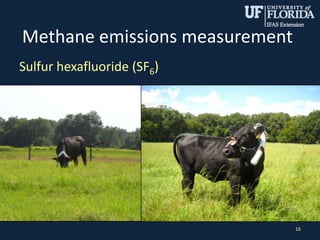
Methane emissions measurement
Sulfur hexafluoride (SF6)
16
Final considerations
• Methane emissions from ruminal fermentation
accounts for 59% of total emissions
• 24.5 kg CO2/ kg live weight that leaves the ranch
• Average 11,733 tons CO2eq/ year
• Model still needs further investigation
• Field experiments
Future research
• In vitro methane measurements
• Parametrization
17
Acknowledgements
• This study has been funded by the Agriculture
and Food Research Initiative Competitive
Grant no. 2011-67003-30347 from the USDA-
National Institute of Food and Agriculture
18
Thank you
mkohmann@ufl.edu.com
Greenhouse Gas Emissions of Beef
Cattle Under Grazing Conditions in
Florida
Marta Moura Kohmann
Department Agricultural and
Biological Engineering
April 2013

Mourakohman w2w 2013

  • 1.
    Greenhouse Gas Emissionsof Beef Cattle Under Grazing Conditions in Florida Marta Moura Kohmann- ABE/UF Dr. Clyde W. Fraisse- ABE/UF Dr. Hilary Swain, Archbold Biological Station Dr. Martin Ruiz-Moreno, ANS/UF Dr. Lynn E. Sollenberger, PhD., AGR/UF Dr. Nicolas DiLorenzo, ANS/UF Francine Messias Ciríaco, ANS/UF Darren D. Henry, ANS/UF April 2013
  • 2.
    Background 2 US 2010 GreenhouseGas Emissions by Economic Sector (percents based on Tg CO2 Eq., left) and in Agriculture (right). Source: EPA, 2012. 33.8 26.9 20.4 7.3 5.6 5.4 0.7 Electric Power Industry Transportation Industry Agriculture Commercial Residential U.S. Territories Total (2010): 6.821.8 Tg CO2 Eq. Agriculture (2010): 494.8 Tg CO2 Eq. 42.0 28.6 14.2 9.6 1.8 1.7 0.8 0.8 0.2 0.1 0.1 0.1 N2O from Agricultural Soil Management Enteric Fermentation Manure Management CO2 from Fossil Fuel Combustion CH4 and N2O from Forest Fires Rice Cultivation Liming of Agricultural Soils Urea Fertilization CO2 and N2O from Managed Peatlands Mobile Combustion N2O from Forest Soils Field Burning of Agricultural Residues
  • 3.
    Importance • Cattle industryin Florida – 1.71 million head of cattle – 940,000 are beef cattle – 890,000 calves born in 2011 • Typical production systems: – Cow-calf operations – low inputs – pasture based 3 Source: Florida Department of Agriculture and Costumer Services (2012)
  • 4.
    Objective The objective isto calculate the carbon footprint of a typical cow-calf operation in Florida.. Specific objectives are – Identify main Greenhouse Gas (GHG) sources – Understand the model used – Further investigation of ruminal fermentation with field trials 4
  • 5.
    Methodology • Buck IslandRanch: on lease from the MacArthur Foundation to the Archbold Biological Station • Full-scale working ranch – 4,500 acres bahiagrass – 5,640 acres native vegetation – 160 acres citrus 5
  • 6.
    Methodology • Cow-calf operation –3,000 Brahman-cross cows – 150 Angus and Charolais bulls – 2,300 calves annually • Data: 1998 to 2008 • Identify sources of Greenhouse Gas Emissions (GHG) 6
  • 7.
    Methodology Animal GHG sources •Manure- CH4, N2O • Enteric fermentation (ruminal)- CH4 Management GHG sources • Nitrogen fertilization- N2O • Lime application- CO2 • Burning- CO, CH4, N2O, NOx • Fossil fuels (molasses transportation, management practices)- CO2 7 Anatomy of the cow’s digestive tract. Source: University of Minnesota Extension. • Reticulum, rumen and omasum: anaerobic fermentation • Hydrolysis and anaerobic oxidation create H+ CO2 + 8H methane + 2H2O
  • 8.
    Methodology • Intergovernmental Panelon Climate Change (2008) • EPA (2005) • Results transformed into CO2eq – CH4 = 21 CO2 – N2O = 310 CO2 8
  • 9.
    Results 9 GHG source (tonCO2eq) % Enteric Fermentation 6,895.79 58.8 Manure Management 2,719.39 23.2 Tractor Operation 188.05 1.6 Fertilization 447.63 3.8 Liming 660.80 5.6 Pasture Burning 160.70 1.4 Molasses Transport 16.91 0.1 Urea for Feeding 393.36 3.4 Feed Concentrate 250.77 2.1 Total 11,733.39 100.00 Table 1. Average (t CO2eq) GHG emissions from Buck Island Ranch, data from 1998 to 2008. 82 % 18 %
  • 10.
    0 500 1000 1500 2000 2500 3000 3500 4000 4500 5000 0 2000 4000 6000 8000 10000 12000 1998 1999 20002001 2002 2003 2004 2005 2006 2007 2008 numberofanimals Totalemissions(tonCO2eq/year) Agrochemicals Total emissions Adult animals Results 10 10,227 t CO2eq 12,954 t CO2eq Figure 1. Total GHG emissions, emissions from agrochemicals (t CO2eq) and total number of animals in Buck Island Ranch, 1998 to 2008.
  • 11.
    Results 11 71 42 29 58 0 10 20 30 40 50 60 70 80 90 100 % Lime Fertilizer (N) Production,transportation, storage and transfer After application Figure 2. GHG emissions from agrochemicals separated by source (t CO2eq)
  • 12.
    Results 12 • 24.5 kgCO2/ kg live weight that leaves the farm • 77% of total emissions in cattle production come from the cow-calf operation part • If animals double weight after they leave the farm ~ 16 kg CO2/ kg final live weight Takashi & Young, 2002
  • 13.
    Ongoing Research • Fieldtrials in the North Florida Research and Educational Center in Marianna, Florida – Methane measurements using the SF6 technique – Three stocking rates – Animal performance (weight gain) – Pasture measurements (production, nutritive value) 13
  • 14.
    Methane emissions measurement Sulfurhexafluoride (SF6) 14 Permeation tube. Source: EPA, 2006.
  • 15.
  • 16.
  • 17.
    Final considerations • Methaneemissions from ruminal fermentation accounts for 59% of total emissions • 24.5 kg CO2/ kg live weight that leaves the ranch • Average 11,733 tons CO2eq/ year • Model still needs further investigation • Field experiments Future research • In vitro methane measurements • Parametrization 17
  • 18.
    Acknowledgements • This studyhas been funded by the Agriculture and Food Research Initiative Competitive Grant no. 2011-67003-30347 from the USDA- National Institute of Food and Agriculture 18 Thank you mkohmann@ufl.edu.com
  • 19.
    Greenhouse Gas Emissionsof Beef Cattle Under Grazing Conditions in Florida Marta Moura Kohmann Department Agricultural and Biological Engineering April 2013