
CCAFS
Carbon Footprint Assessment and Mitigation Options of Dairy
under Chinese Conditions
Implementation plan
DONG Hongmin
Institute of Environment and Sustainable Development in Agriculture, CAAS
一.Background
二.Objectives, Activities
三.Implementation Plan
四.Task Assignments
Outline
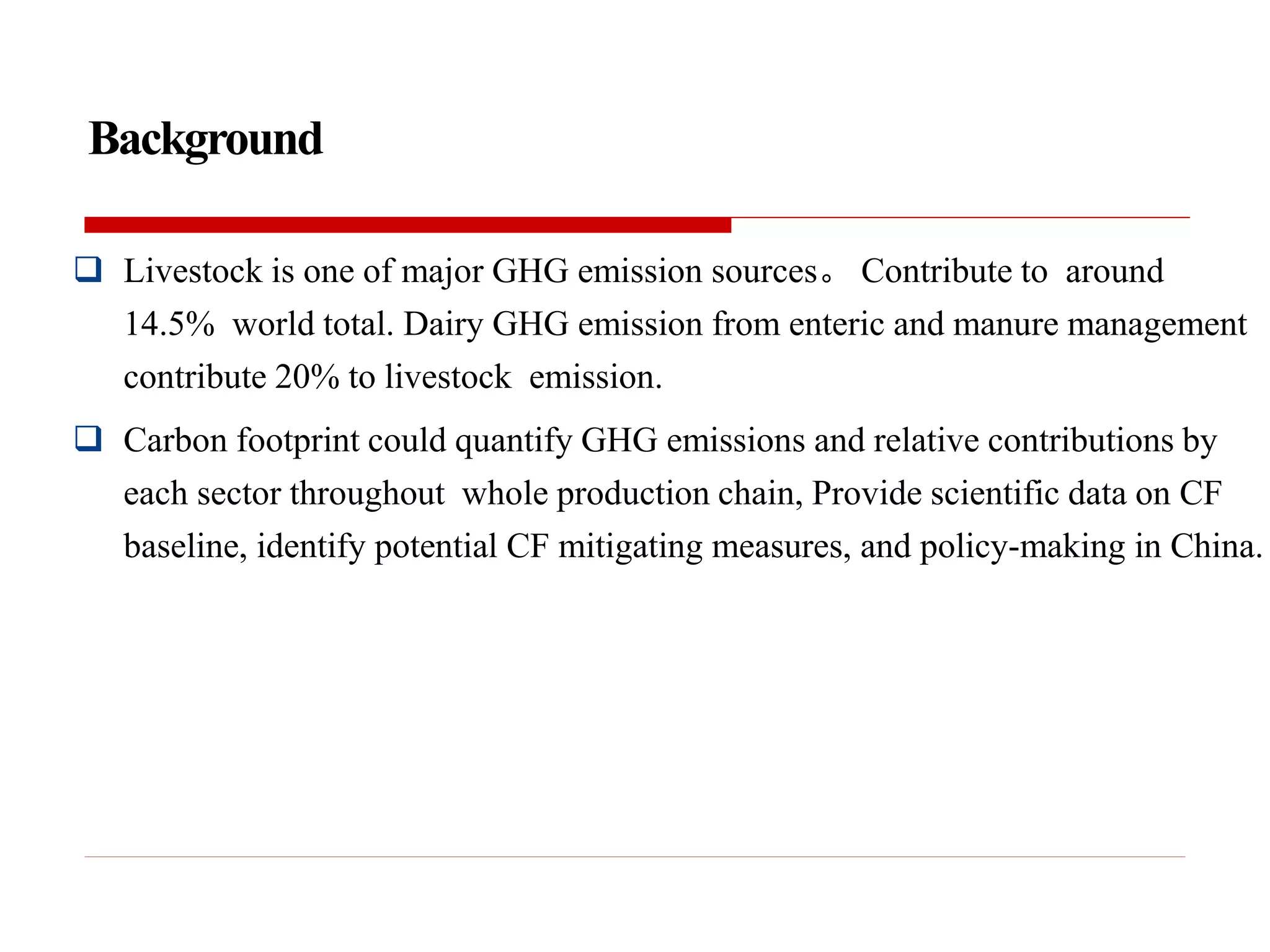
Background
 Livestock is one of major GHG emission sources。 Contribute to around
14.5% world total. Dairy GHG emission from enteric and manure management
contribute 20% to livestock emission.
 Carbon footprint could quantify GHG emissions and relative contributions by
each sector throughout whole production chain, Provide scientific data on CF
baseline, identify potential CF mitigating measures, and policy-making in China.
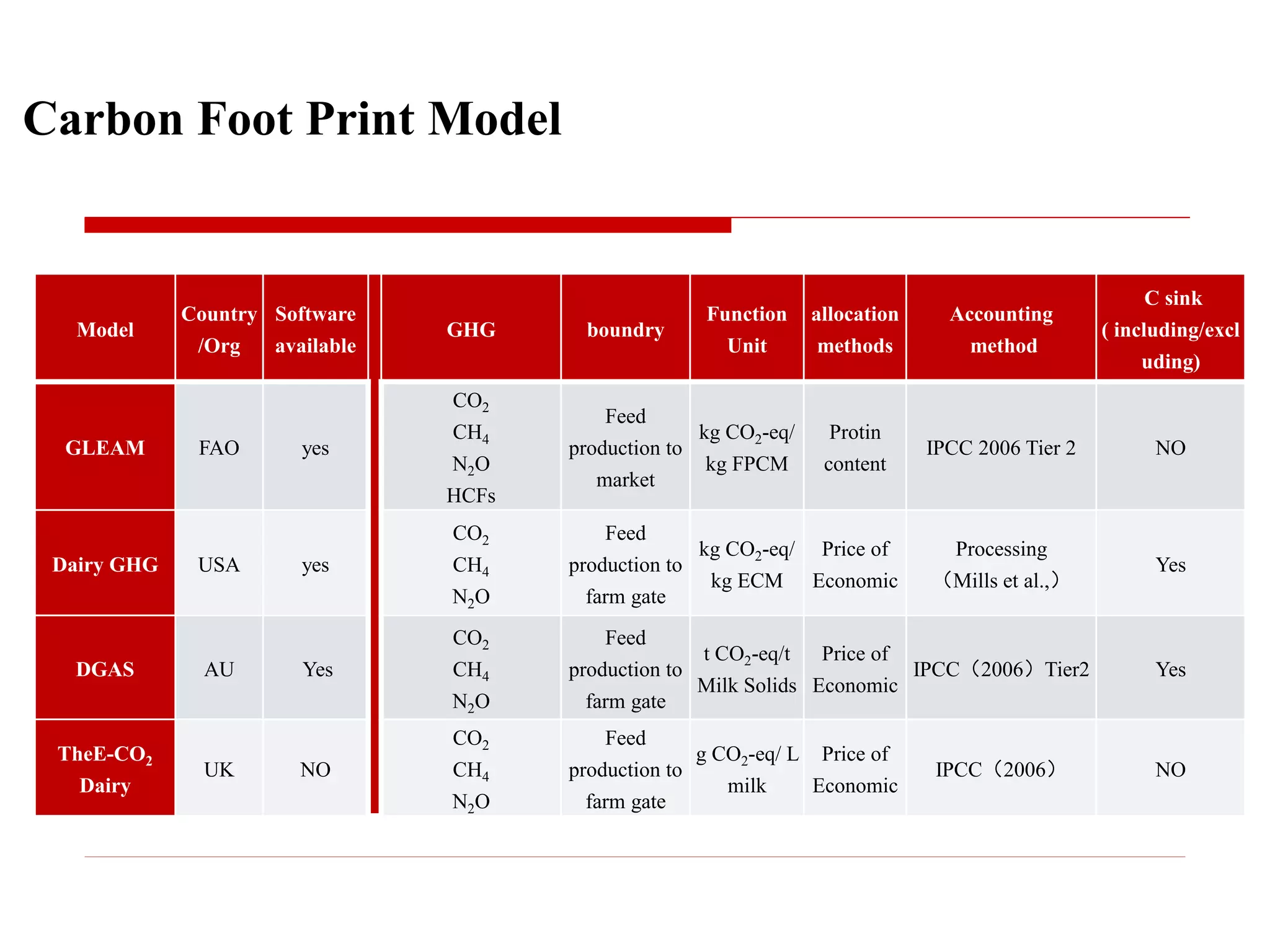
Carbon Foot Print Model
Model
Country
/Org
Software
available
GHG boundry
Function
Unit
allocation
methods
Accounting
method
C sink
( including/excl
uding)
GLEAM FAO yes
CO2
CH4
N2O
HCFs
Feed
production to
market
kg CO2-eq/
kg FPCM
Protin
content
IPCC 2006 Tier 2 NO
Dairy GHG USA yes
CO2
CH4
N2O
Feed
production to
farm gate
kg CO2-eq/
kg ECM
Price of
Economic
Processing
(Mills et al.,)
Yes
DGAS AU Yes
CO2
CH4
N2O
Feed
production to
farm gate
t CO2-eq/t
Milk Solids
Price of
Economic
IPCC(2006)Tier2 Yes
TheE-CO2
Dairy
UK NO
CO2
CH4
N2O
Feed
production to
farm gate
g CO2-eq/ L
milk
Price of
Economic
IPCC(2006) NO
Objectives, Activities
Objectives
 Develop a model and tool that could be used to assess the
greenhouse gas footprint of dairy cattle in China.
 Provide an inventory of mitigation measures for reducing dairy
production’s GHG footprint and simultaneously reduce the cost of
milk in China.
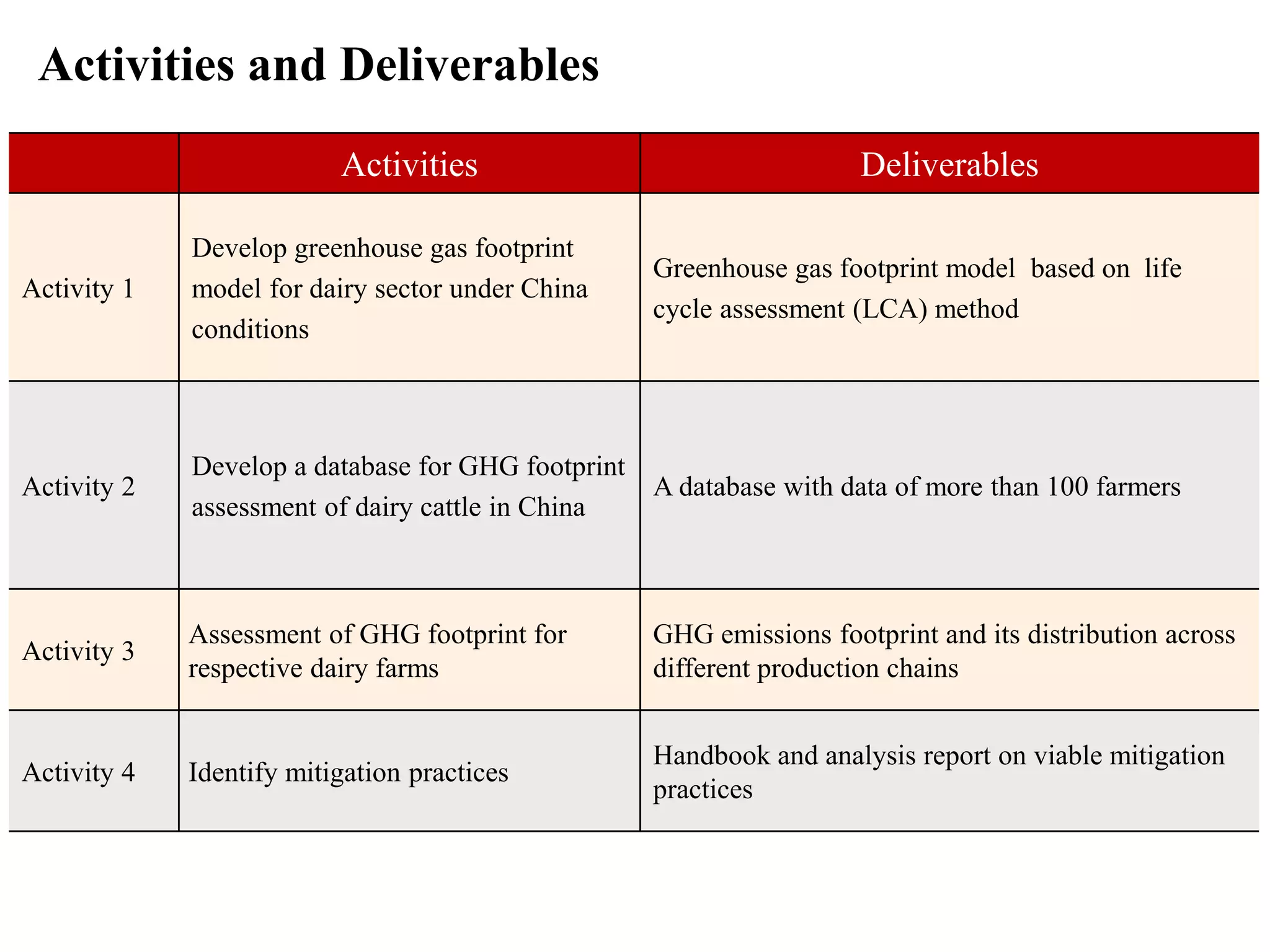
Activities and Deliverables
Activities Deliverables
Activity 1
Develop greenhouse gas footprint
model for dairy sector under China
conditions
Greenhouse gas footprint model based on life
cycle assessment (LCA) method
Activity 2
Develop a database for GHG footprint
assessment of dairy cattle in China
A database with data of more than 100 farmers
Activity 3
Assessment of GHG footprint for
respective dairy farms
GHG emissions footprint and its distribution across
different production chains
Activity 4 Identify mitigation practices
Handbook and analysis report on viable mitigation
practices
Implementation plan
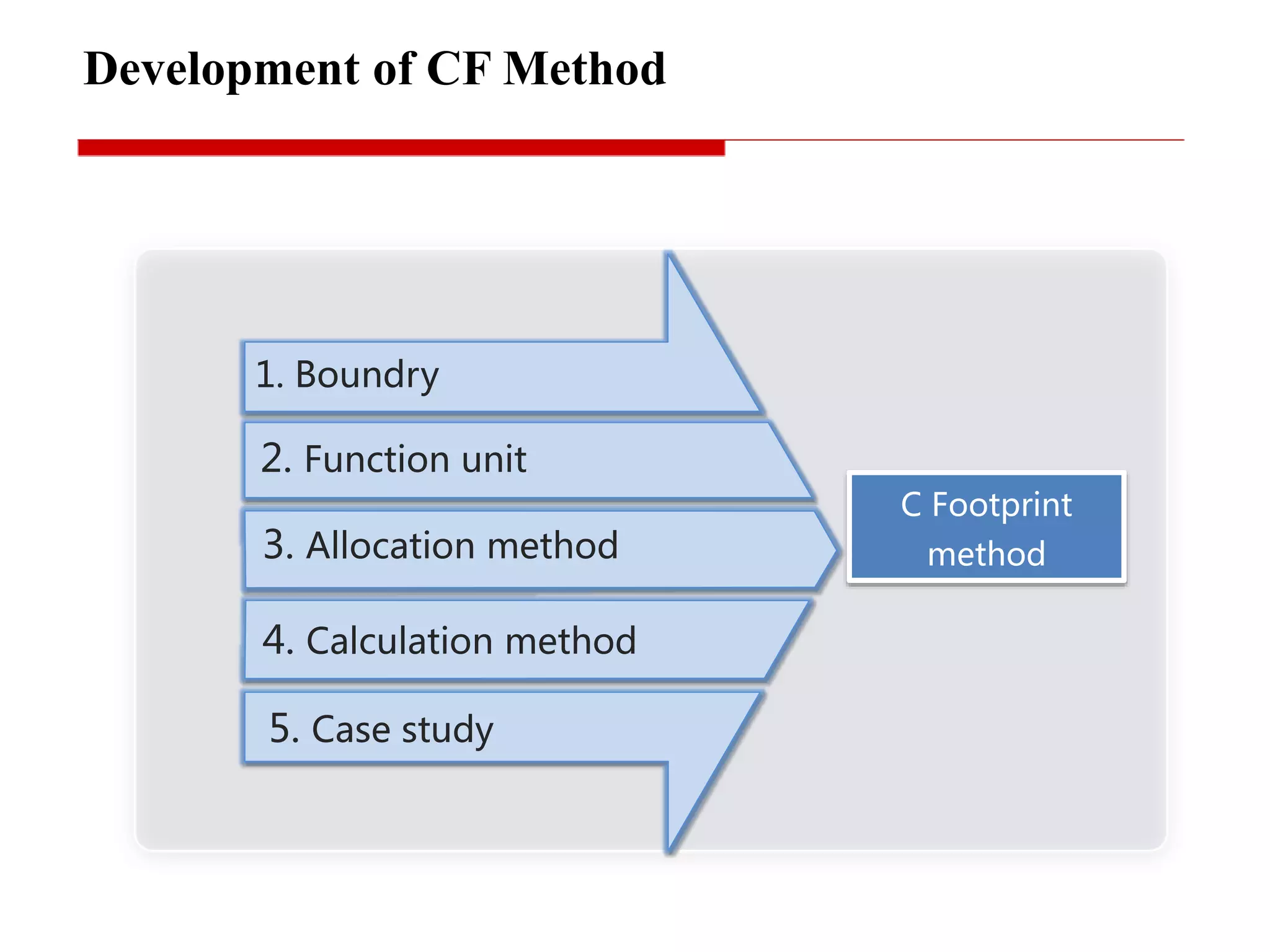
Development of CF Method
1. Boundry
2. Function unit
3. Allocation method
4. Calculation method
5. Case study
C Footprint
method
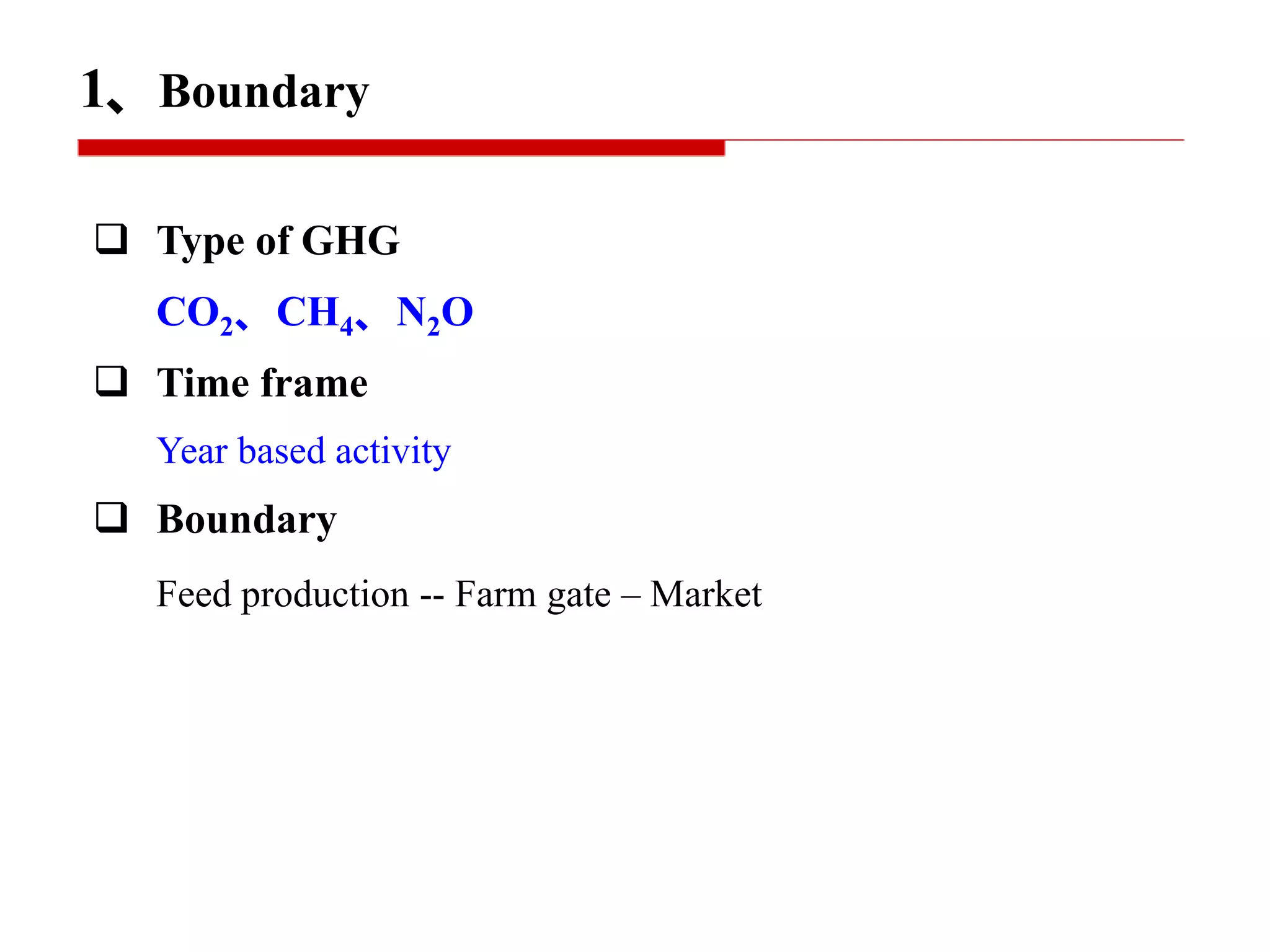
1、Boundary
 Type of GHG
CO2、CH4、N2O
 Time frame
Year based activity
 Boundary
Feed production -- Farm gate – Market
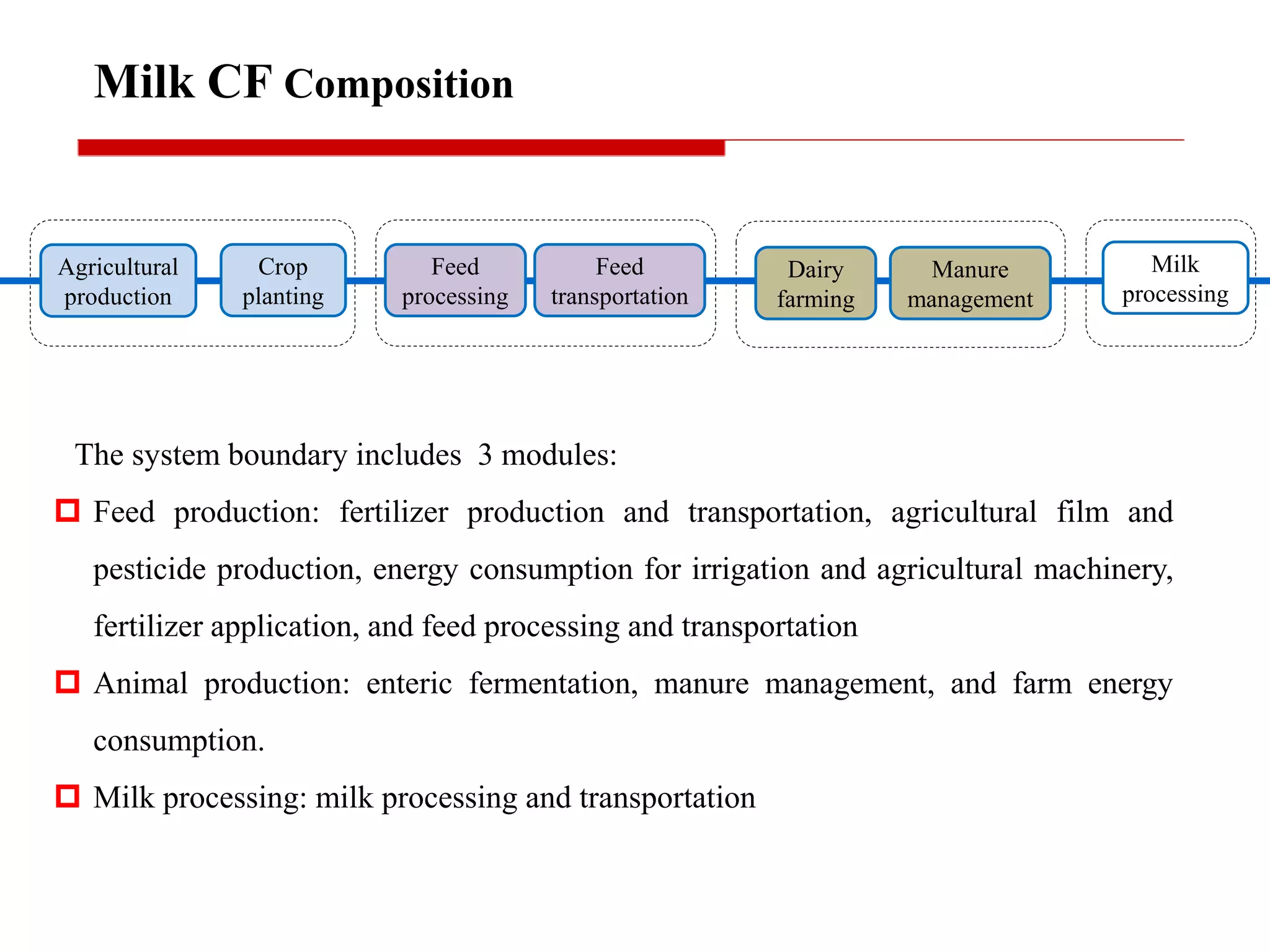
The system boundary includes 3 modules:
 Feed production: fertilizer production and transportation, agricultural film and
pesticide production, energy consumption for irrigation and agricultural machinery,
fertilizer application, and feed processing and transportation
 Animal production: enteric fermentation, manure management, and farm energy
consumption.
 Milk processing: milk processing and transportation
Agricultural
production
Crop
planting
Feed
processing
Feed
transportation
Dairy
farming
Manure
management
Milk
processing
Milk CF Composition
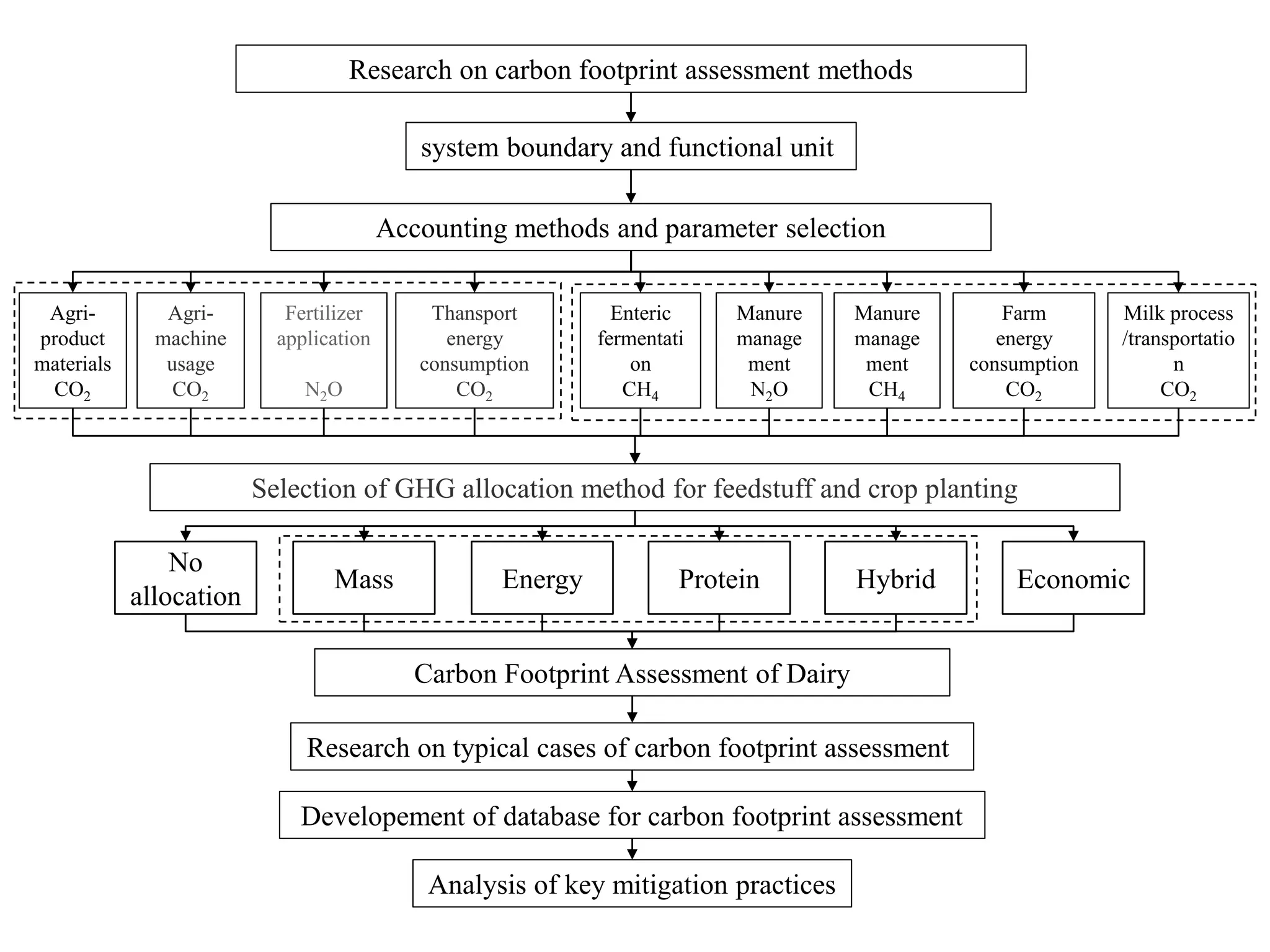
Research on carbon footprint assessment methods
system boundary and functional unit
Accounting methods and parameter selection
Agri-
product
materials
CO2
Carbon Footprint Assessment of Dairy
Research on typical cases of carbon footprint assessment
Developement of database for carbon footprint assessment
Analysis of key mitigation practices
Agri-
machine
usage
CO2
Fertilizer
application
N2O
Thansport
energy
consumption
CO2
Enteric
fermentati
on
CH4
Manure
manage
ment
N2O
Manure
manage
ment
CH4
Farm
energy
consumption
CO2
Selection of GHG allocation method for feedstuff and crop planting
No
allocation
Mass Energy Protein Hybrid Economic
Milk process
/transportatio
n
CO2
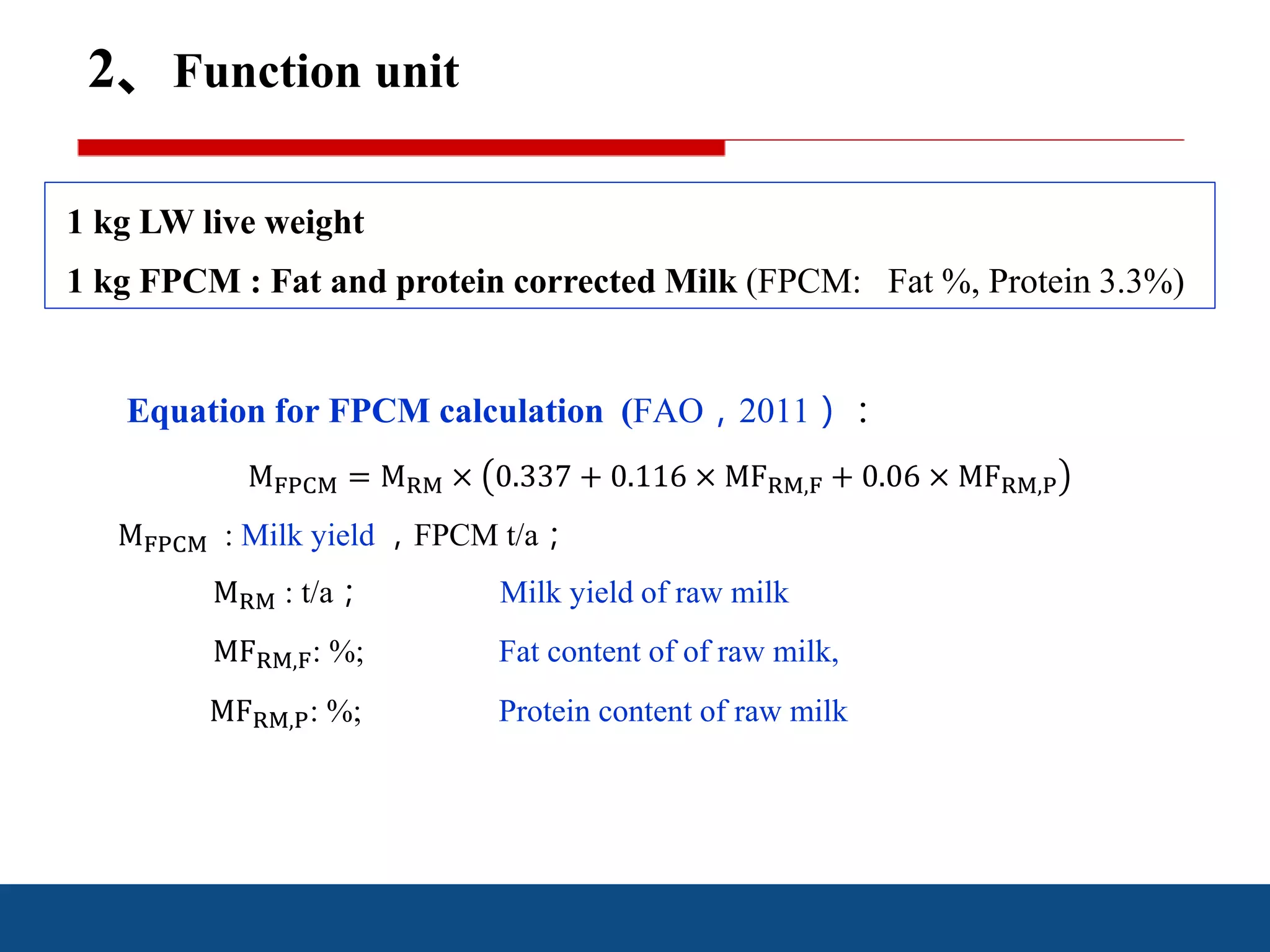
2、Function unit
1 kg LW live weight
1 kg FPCM : Fat and protein corrected Milk (FPCM: Fat %, Protein 3.3%)
Equation for FPCM calculation (FAO,2011):
MFPCM = MRM × 0.337 + 0.116 × MFRM,F + 0.06 × MFRM,P
MFPCM : Milk yield ,FPCM t/a;
MRM : t/a; Milk yield of raw milk
MFRM,F: %; Fat content of of raw milk,
MFRM,P: %; Protein content of raw milk
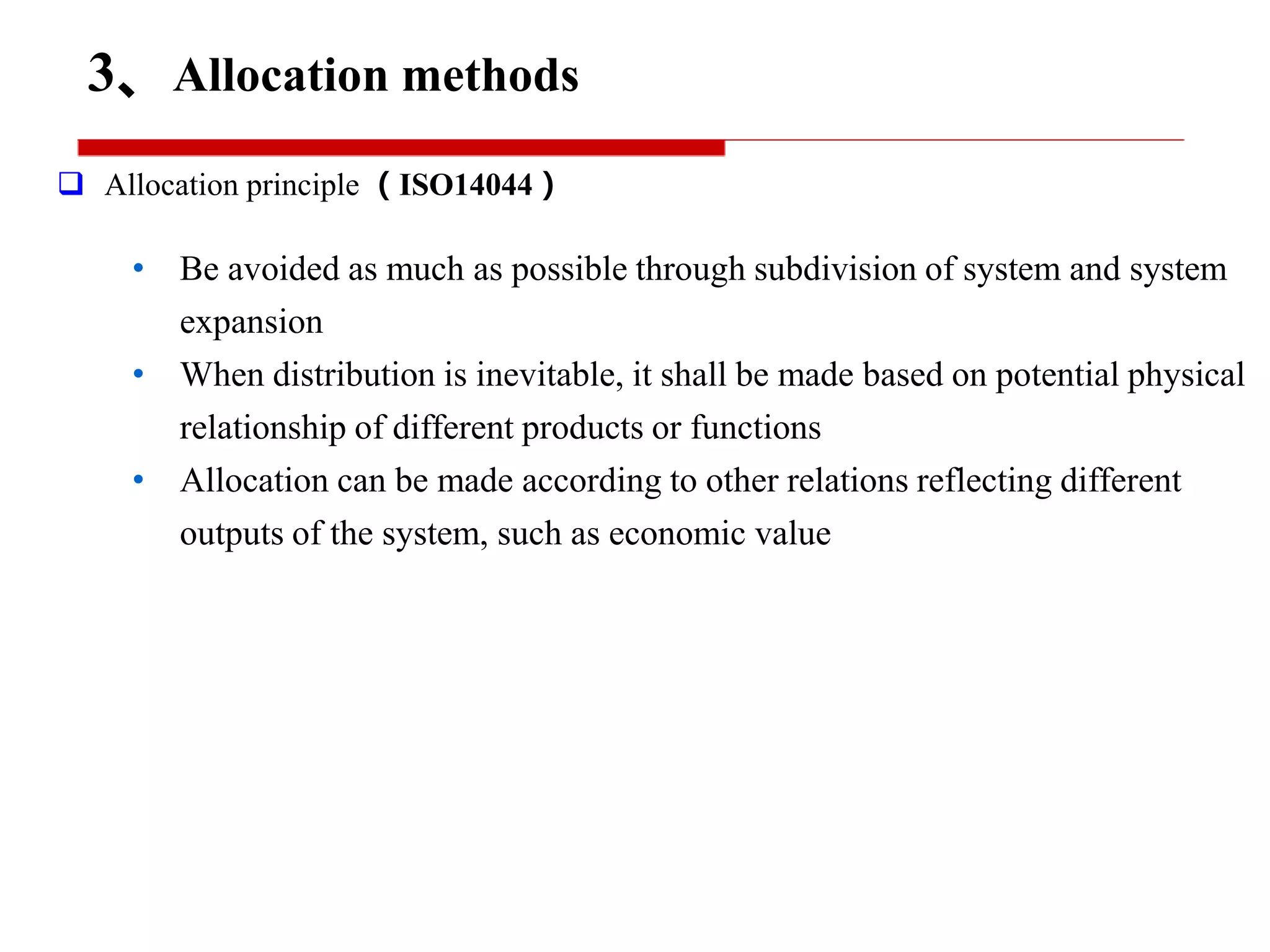
3、Allocation methods
 Allocation principle (ISO14044)
• Be avoided as much as possible through subdivision of system and system
expansion
• When distribution is inevitable, it shall be made based on potential physical
relationship of different products or functions
• Allocation can be made according to other relations reflecting different
outputs of the system, such as economic value
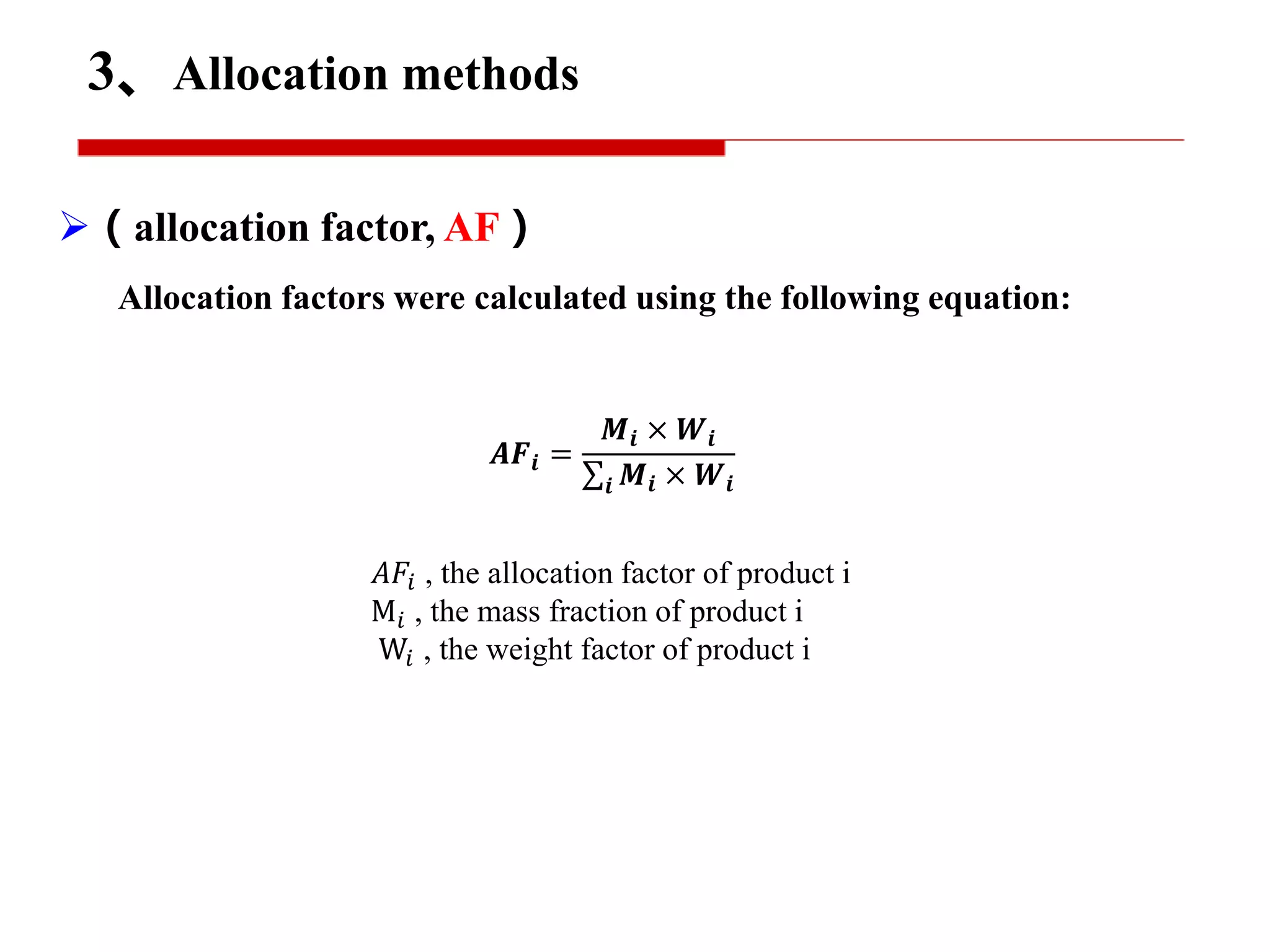
(allocation factor, AF)
Allocation factors were calculated using the following equation:
𝑨𝑭𝒊 =
𝑴𝒊 × 𝑾𝒊
𝒊 𝑴𝒊 × 𝑾𝒊
𝐴𝐹𝑖 , the allocation factor of product i
M𝑖 , the mass fraction of product i
W𝑖 , the weight factor of product i
3、Allocation methods
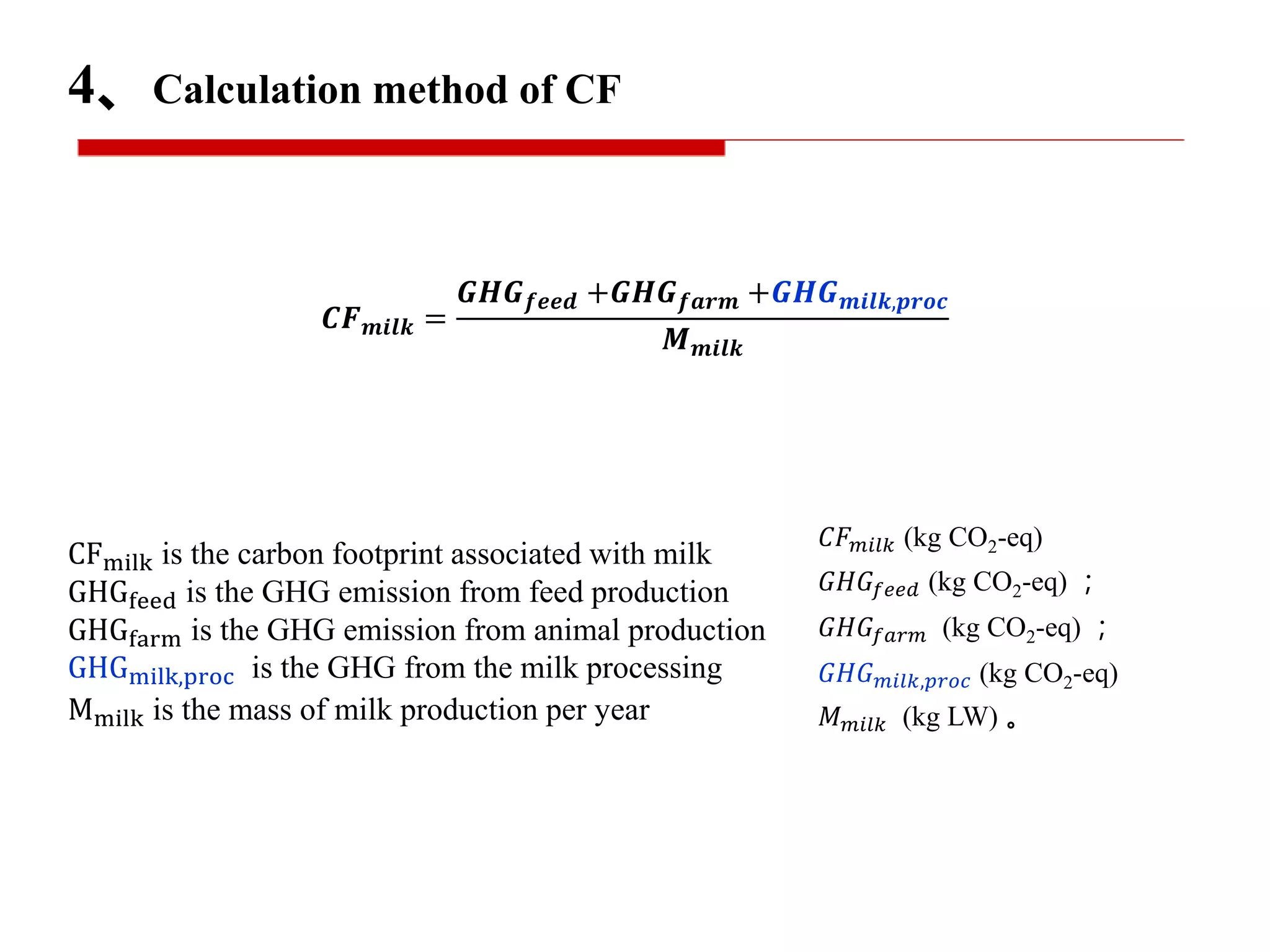
𝑪𝑭 𝒎𝒊𝒍𝒌 =
𝑮𝑯𝑮 𝒇𝒆𝒆𝒅 +𝑮𝑯𝑮 𝒇𝒂𝒓𝒎 +𝑮𝑯𝑮 𝒎𝒊𝒍𝒌,𝒑𝒓𝒐𝒄
𝑴 𝒎𝒊𝒍𝒌
𝐶𝐹 𝑚𝑖𝑙𝑘 (kg CO2-eq)
𝐺𝐻𝐺𝑓𝑒𝑒𝑑 (kg CO2-eq) ;
𝐺𝐻𝐺𝑓𝑎𝑟𝑚 (kg CO2-eq) ;
𝐺𝐻𝐺 𝑚𝑖𝑙𝑘,𝑝𝑟𝑜𝑐 (kg CO2-eq)
𝑀 𝑚𝑖𝑙𝑘 (kg LW) 。
4、Calculation method of CF
CFmilk is the carbon footprint associated with milk
GHGfeed is the GHG emission from feed production
GHGfarm is the GHG emission from animal production
GHGmilk,proc is the GHG from the milk processing
Mmilk is the mass of milk production per year
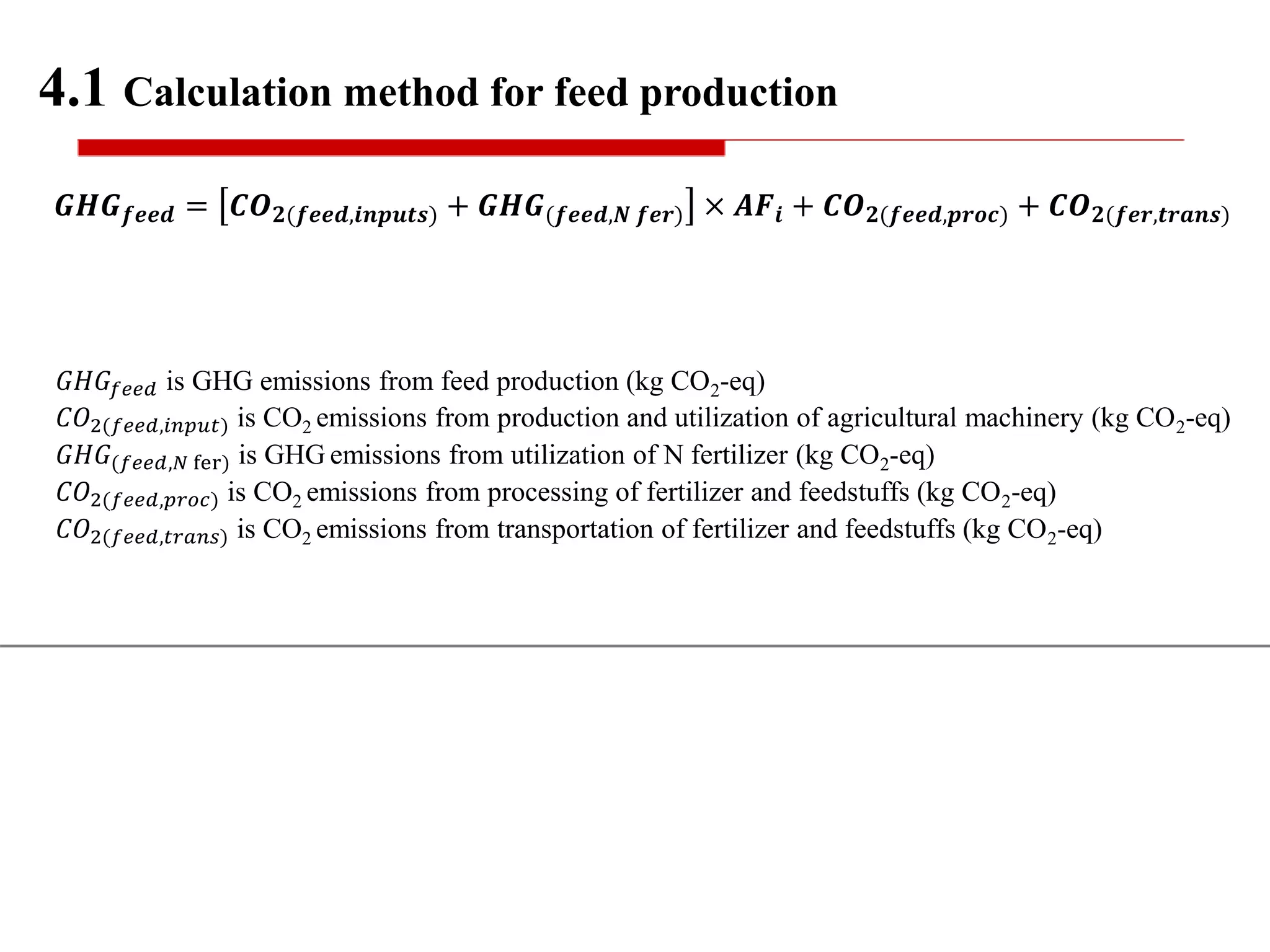
𝑮𝑯𝑮 𝒇𝒆𝒆𝒅 = 𝑪𝑶 𝟐(𝒇𝒆𝒆𝒅,𝒊𝒏𝒑𝒖𝒕𝒔) + 𝑮𝑯𝑮(𝒇𝒆𝒆𝒅,𝑵 𝒇𝒆𝒓) × 𝑨𝑭𝒊 + 𝑪𝑶 𝟐(𝒇𝒆𝒆𝒅,𝒑𝒓𝒐𝒄) + 𝑪𝑶 𝟐(𝒇𝒆𝒓,𝒕𝒓𝒂𝒏𝒔)
4.1 Calculation method for feed production
𝐺𝐻𝐺𝑓𝑒𝑒𝑑 is GHG emissions from feed production (kg CO2-eq)
𝐶𝑂2(𝑓𝑒𝑒𝑑,𝑖𝑛𝑝𝑢𝑡) is CO2 emissions from production and utilization of agricultural machinery (kg CO2-eq)
𝐺𝐻𝐺(𝑓𝑒𝑒𝑑,𝑁 fer) is GHG emissions from utilization of N fertilizer (kg CO2-eq)
𝐶𝑂2(𝑓𝑒𝑒𝑑,𝑝𝑟𝑜𝑐) is CO2 emissions from processing of fertilizer and feedstuffs (kg CO2-eq)
𝐶𝑂2(𝑓𝑒𝑒𝑑,𝑡𝑟𝑎𝑛𝑠) is CO2 emissions from transportation of fertilizer and feedstuffs (kg CO2-eq)
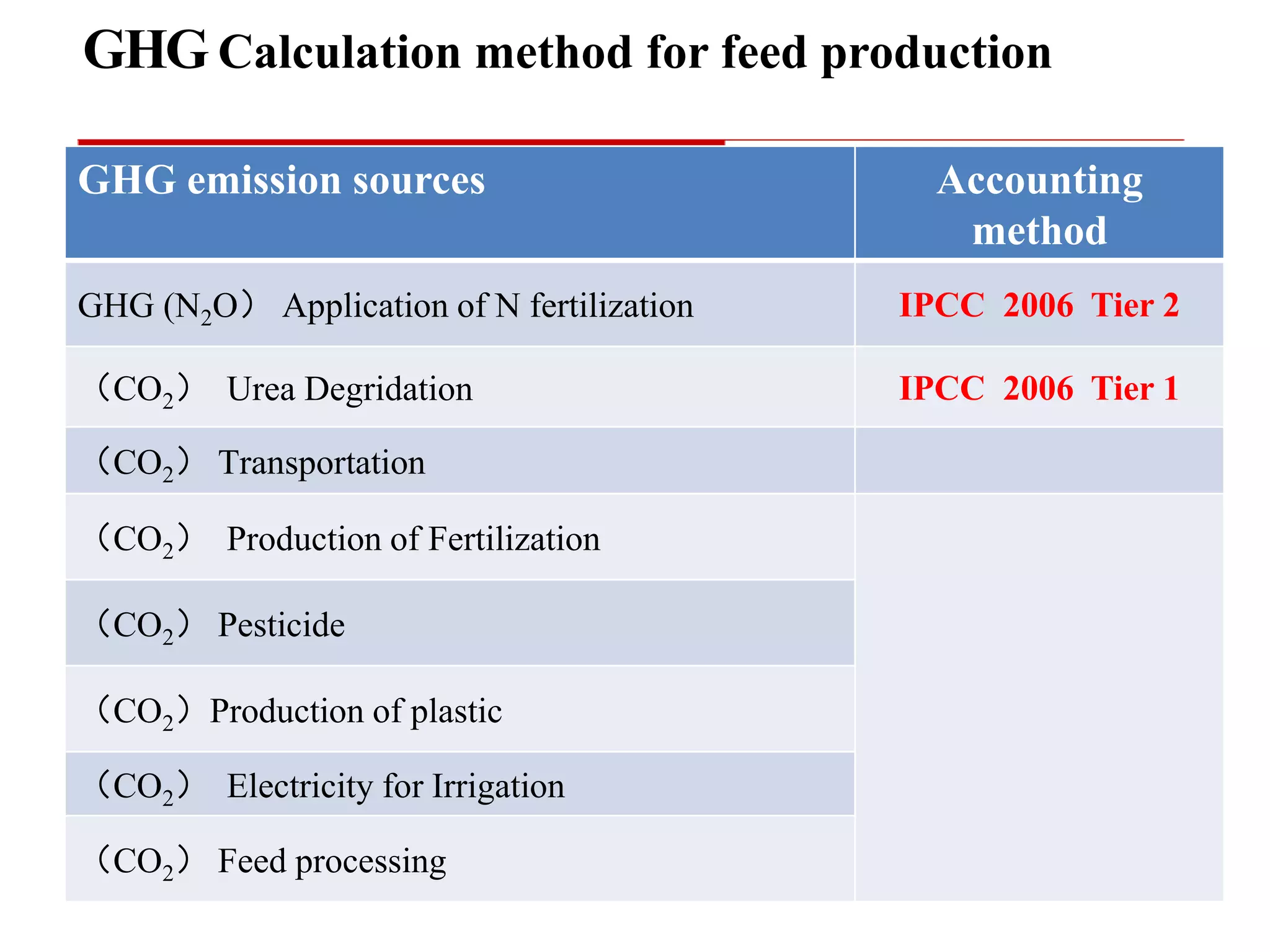
GHG Calculation method for feed production
GHG emission sources Accounting
method
GHG (N2O) Application of N fertilization IPCC 2006 Tier 2
(CO2) Urea Degridation IPCC 2006 Tier 1
(CO2) Transportation
(CO2) Production of Fertilization
(CO2) Pesticide
(CO2)Production of plastic
(CO2) Electricity for Irrigation
(CO2) Feed processing
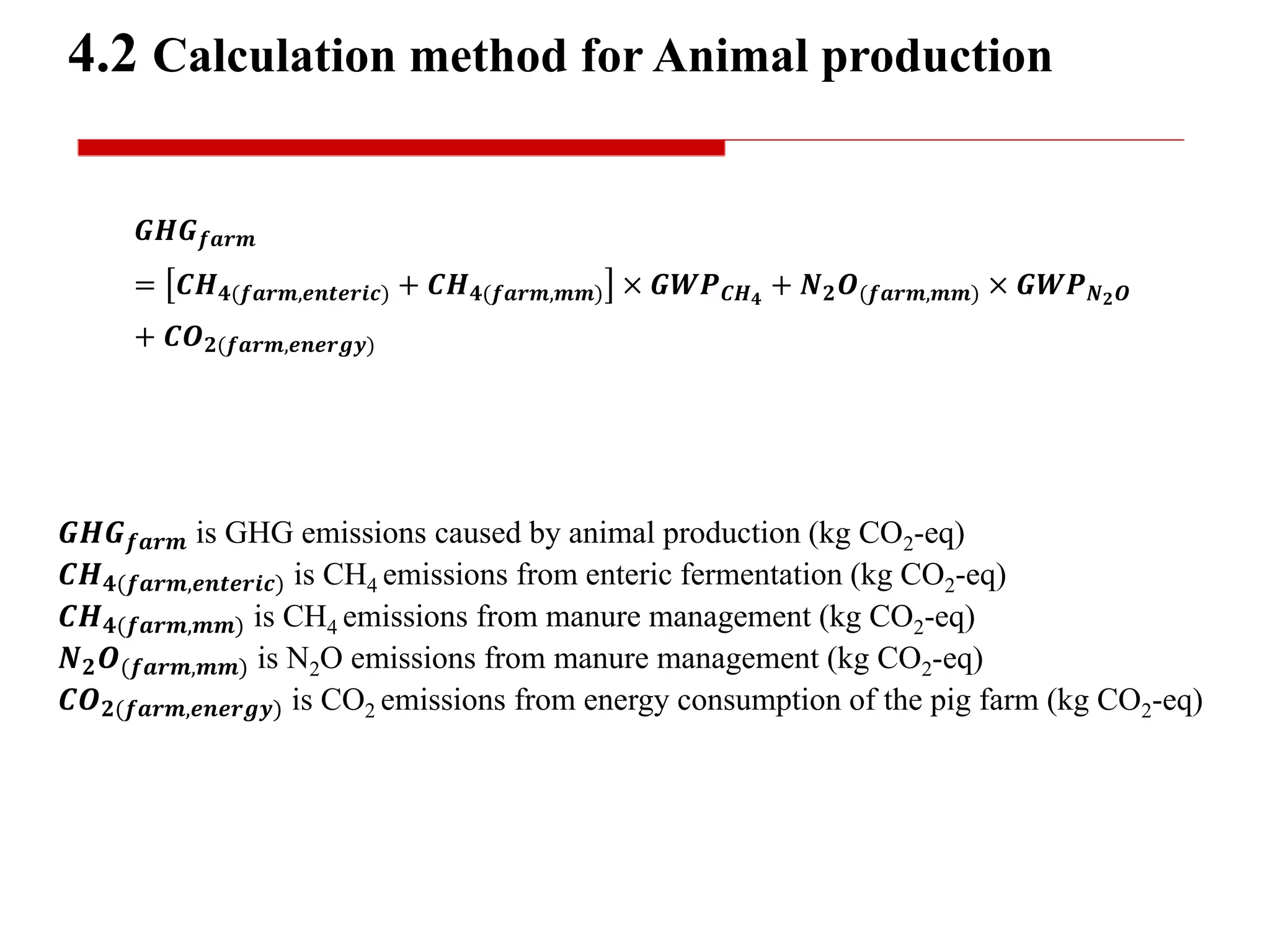
𝑮𝑯𝑮 𝒇𝒂𝒓𝒎
= 𝑪𝑯 𝟒(𝒇𝒂𝒓𝒎,𝒆𝒏𝒕𝒆𝒓𝒊𝒄) + 𝑪𝑯 𝟒(𝒇𝒂𝒓𝒎,𝒎𝒎) × 𝑮𝑾𝑷 𝑪𝑯 𝟒
+ 𝑵 𝟐 𝑶(𝒇𝒂𝒓𝒎,𝒎𝒎) × 𝑮𝑾𝑷 𝑵 𝟐 𝑶
+ 𝑪𝑶 𝟐(𝒇𝒂𝒓𝒎,𝒆𝒏𝒆𝒓𝒈𝒚)
4.2 Calculation method for Animal production
𝑮𝑯𝑮 𝒇𝒂𝒓𝒎 is GHG emissions caused by animal production (kg CO2-eq)
𝑪𝑯 𝟒(𝒇𝒂𝒓𝒎,𝒆𝒏𝒕𝒆𝒓𝒊𝒄) is CH4 emissions from enteric fermentation (kg CO2-eq)
𝑪𝑯 𝟒(𝒇𝒂𝒓𝒎,𝒎𝒎) is CH4 emissions from manure management (kg CO2-eq)
𝑵 𝟐 𝑶(𝒇𝒂𝒓𝒎,𝒎𝒎) is N2O emissions from manure management (kg CO2-eq)
𝑪𝑶 𝟐(𝒇𝒂𝒓𝒎,𝒆𝒏𝒆𝒓𝒈𝒚) is CO2 emissions from energy consumption of the pig farm (kg CO2-eq)
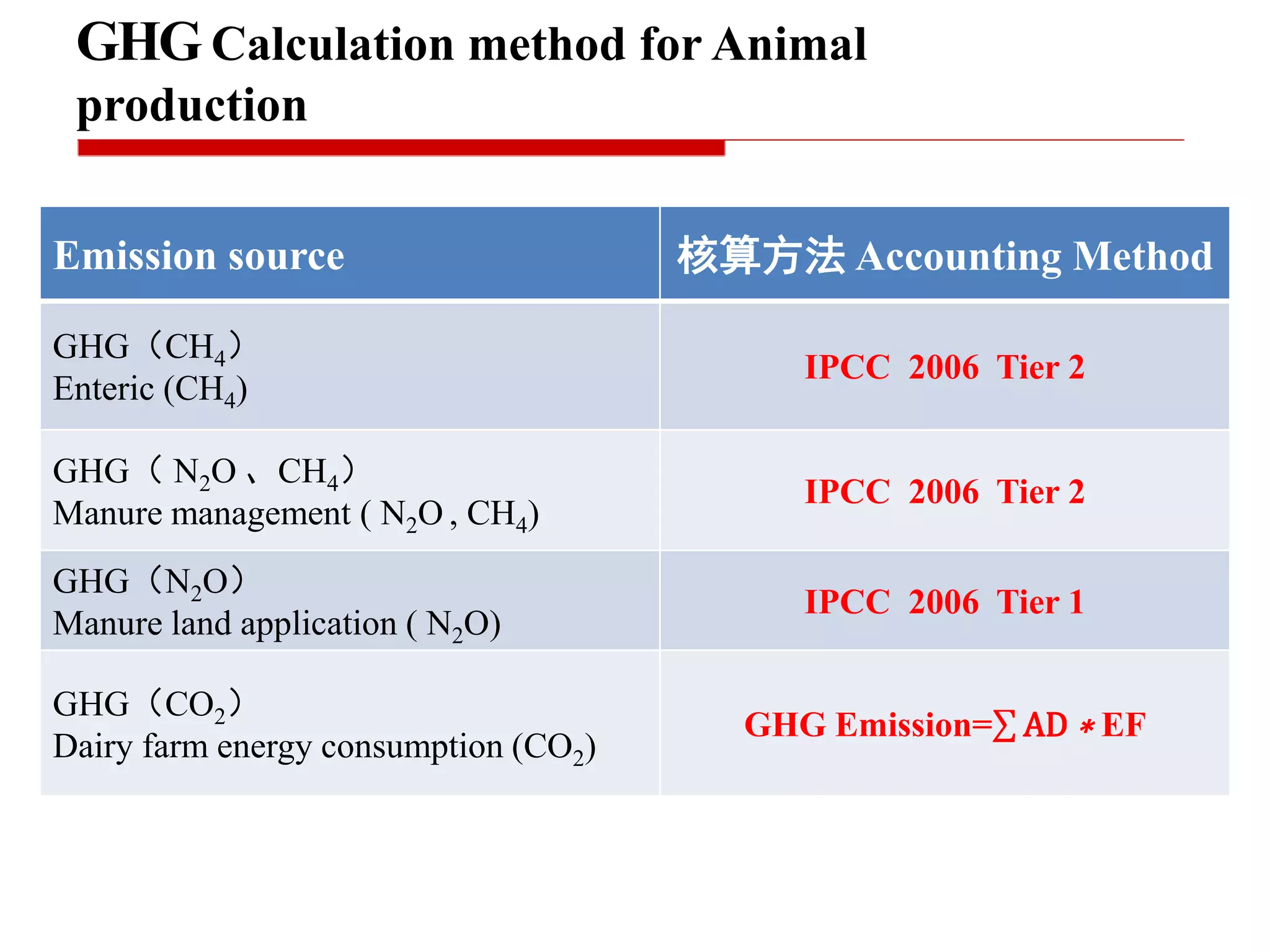
GHG Calculation method for Animal
production
Emission source 核算方法 Accounting Method
GHG(CH4)
Enteric (CH4)
IPCC 2006 Tier 2
GHG( N2O 、CH4)
Manure management ( N2O , CH4)
IPCC 2006 Tier 2
GHG(N2O)
Manure land application ( N2O)
IPCC 2006 Tier 1
GHG(CO2)
Dairy farm energy consumption (CO2)
GHG Emission= AD ∗ EF
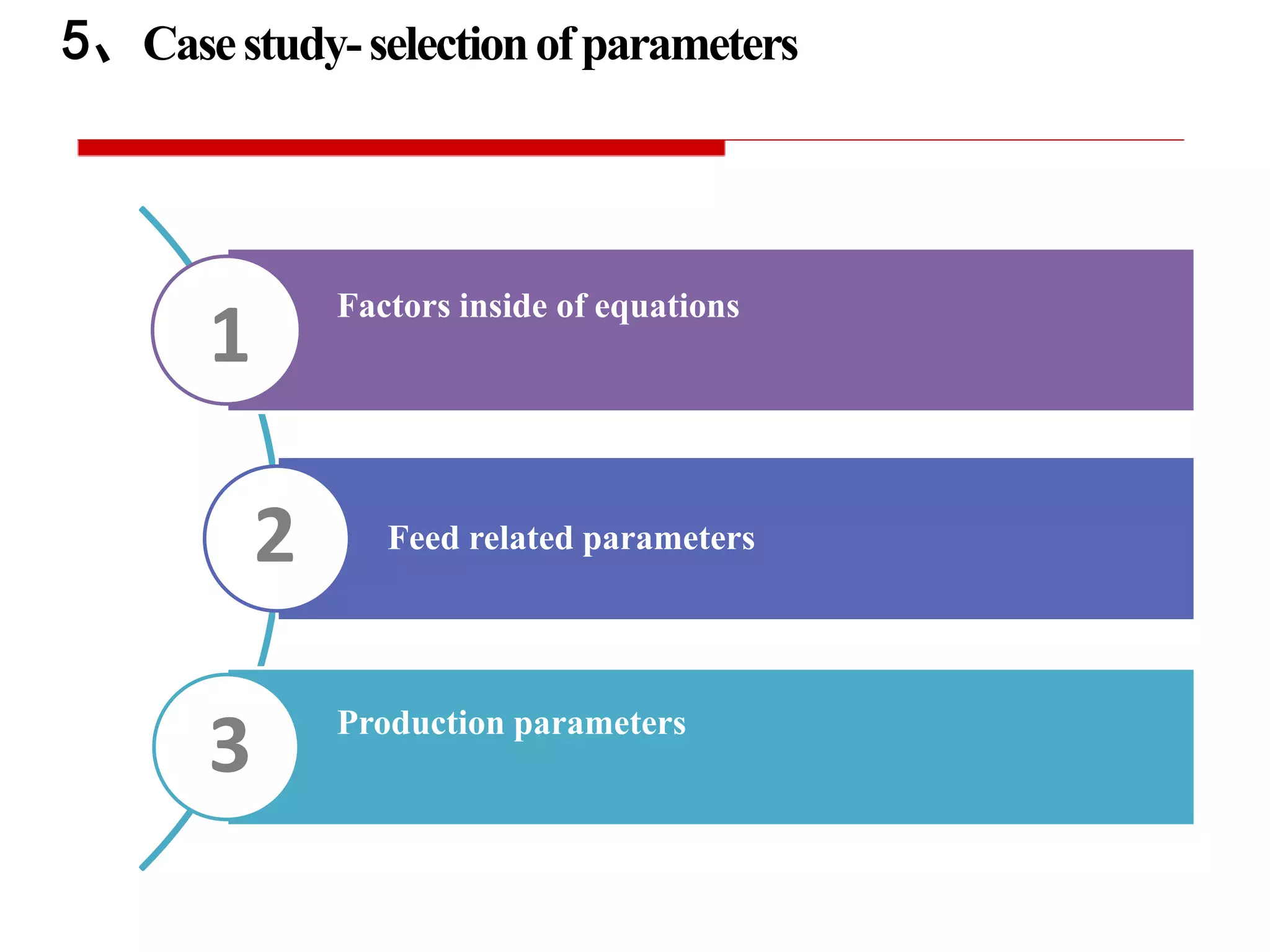
5、Casestudy-selectionofparameters
Factors inside of equations
Feed related parameters
Production parameters
1
2
3
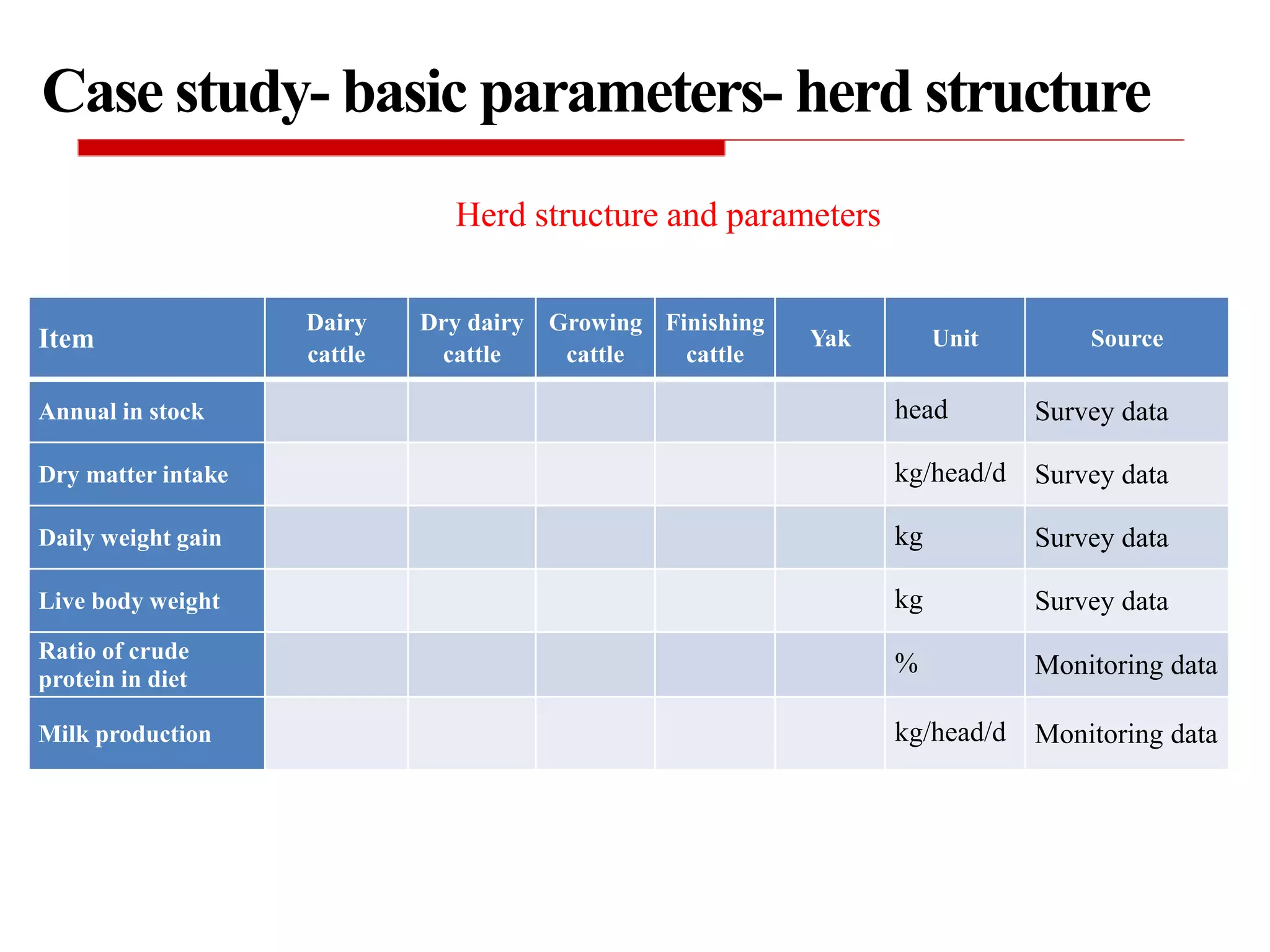
Case study- basic parameters- herd structure
Item
Dairy
cattle
Dry dairy
cattle
Growing
cattle
Finishing
cattle
Yak Unit Source
Annual in stock head Survey data
Dry matter intake kg/head/d Survey data
Daily weight gain kg Survey data
Live body weight kg Survey data
Ratio of crude
protein in diet
% Monitoring data
Milk production kg/head/d Monitoring data
Herd structure and parameters
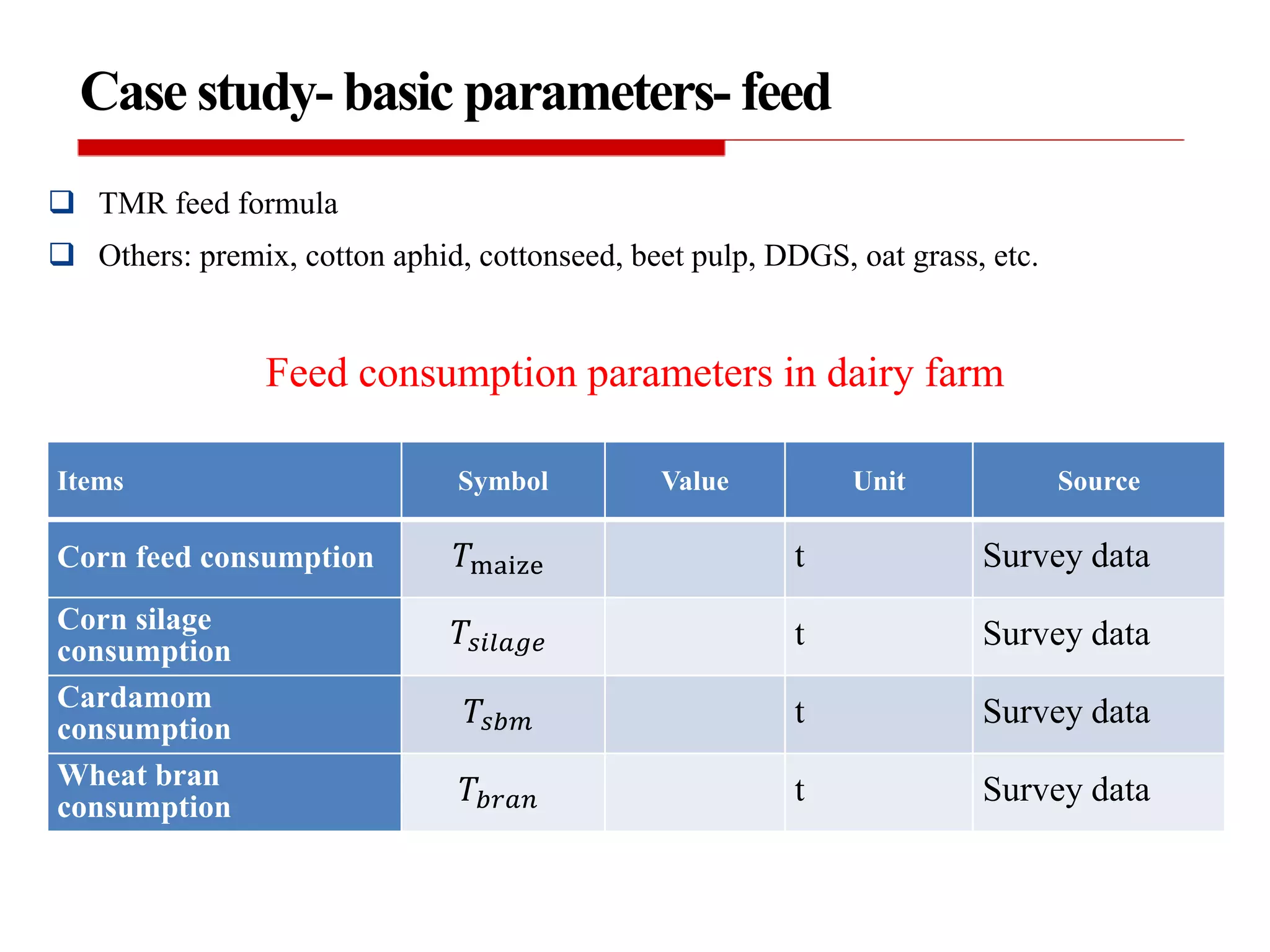
Feed consumption parameters in dairy farm
 TMR feed formula
 Others: premix, cotton aphid, cottonseed, beet pulp, DDGS, oat grass, etc.
Items Symbol Value Unit Source
Corn feed consumption 𝑇maize t Survey data
Corn silage
consumption
𝑇𝑠𝑖𝑙𝑎𝑔𝑒 t Survey data
Cardamom
consumption
𝑇𝑠𝑏𝑚 t Survey data
Wheat bran
consumption
𝑇𝑏𝑟𝑎𝑛 t Survey data
Case study- basic parameters- feed
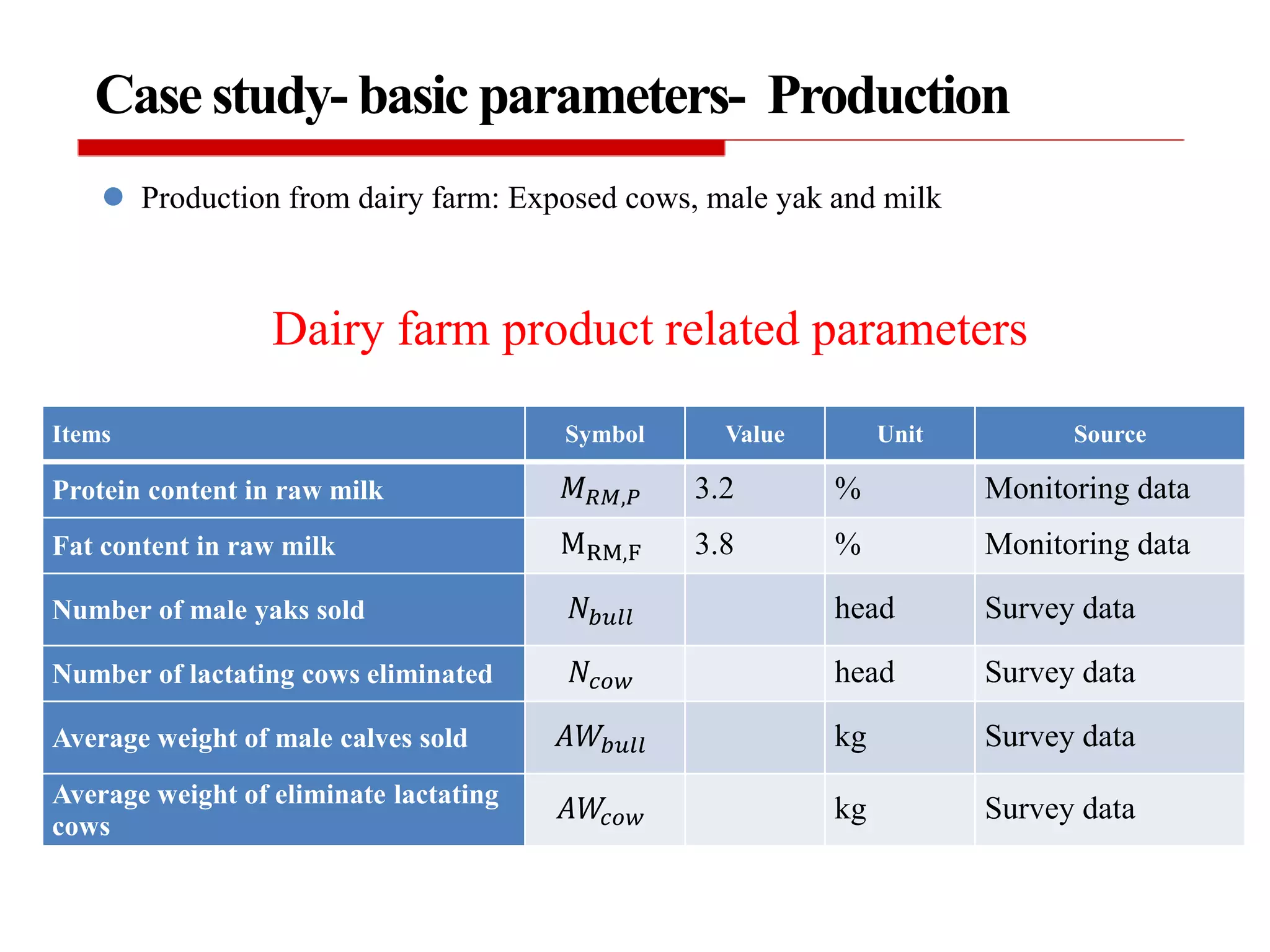
Dairy farm product related parameters
 Production from dairy farm: Exposed cows, male yak and milk
Items Symbol Value Unit Source
Protein content in raw milk 𝑀 𝑅𝑀,𝑃 3.2 % Monitoring data
Fat content in raw milk MRM,F 3.8 % Monitoring data
Number of male yaks sold 𝑁𝑏𝑢𝑙𝑙 head Survey data
Number of lactating cows eliminated 𝑁𝑐𝑜𝑤 head Survey data
Average weight of male calves sold 𝐴𝑊𝑏𝑢𝑙𝑙 kg Survey data
Average weight of eliminate lactating
cows
𝐴𝑊𝑐𝑜𝑤 kg Survey data
Case study- basic parameters- Production
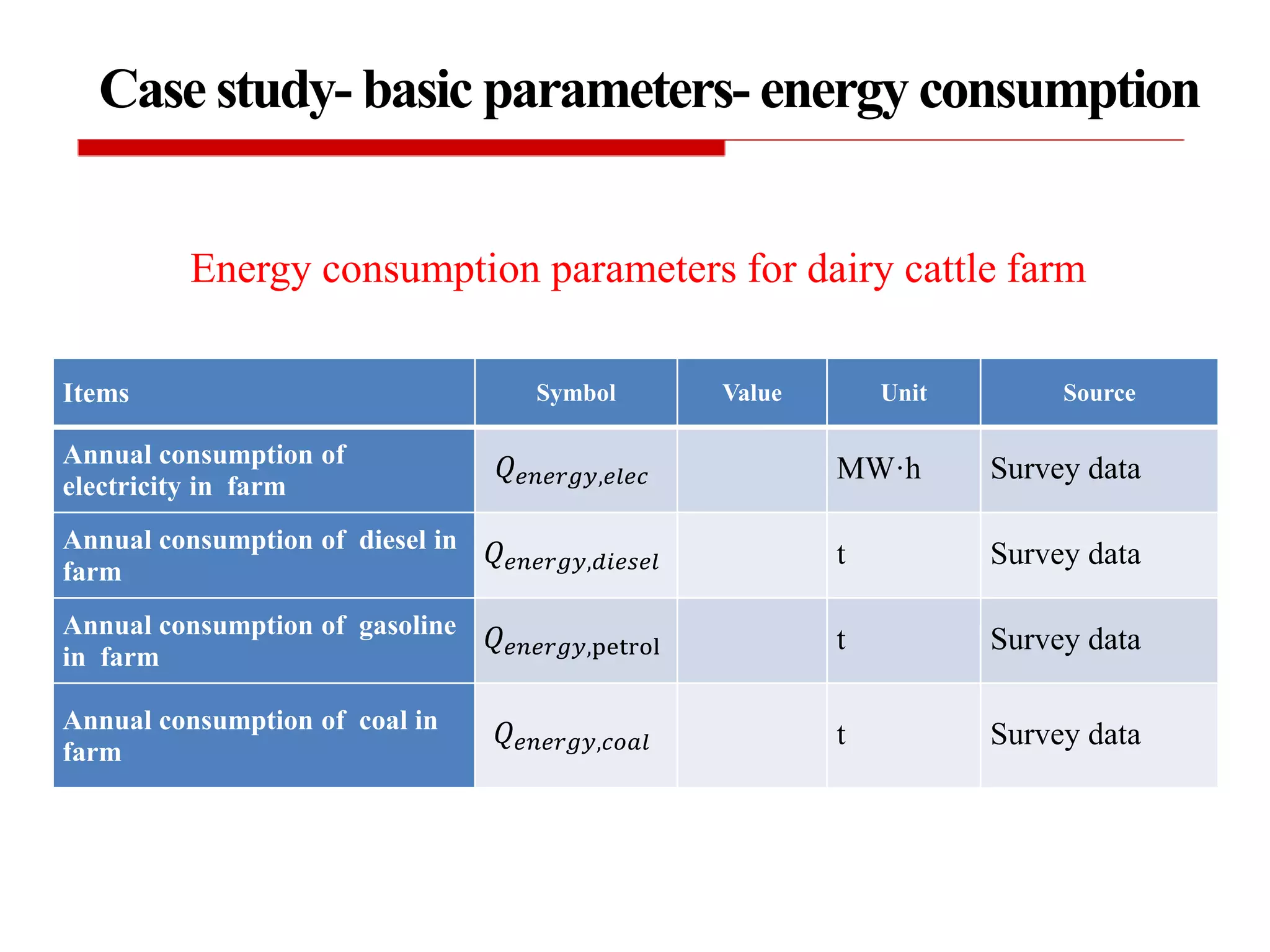
Energy consumption parameters for dairy cattle farm
Items Symbol Value Unit Source
Annual consumption of
electricity in farm
𝑄 𝑒𝑛𝑒𝑟𝑔𝑦,𝑒𝑙𝑒𝑐 MW·h Survey data
Annual consumption of diesel in
farm
𝑄 𝑒𝑛𝑒𝑟𝑔𝑦,𝑑𝑖𝑒𝑠𝑒𝑙 t Survey data
Annual consumption of gasoline
in farm
𝑄 𝑒𝑛𝑒𝑟𝑔𝑦,petrol t Survey data
Annual consumption of coal in
farm
𝑄 𝑒𝑛𝑒𝑟𝑔𝑦,𝑐𝑜𝑎𝑙 t Survey data
Case study- basic parameters- energy consumption
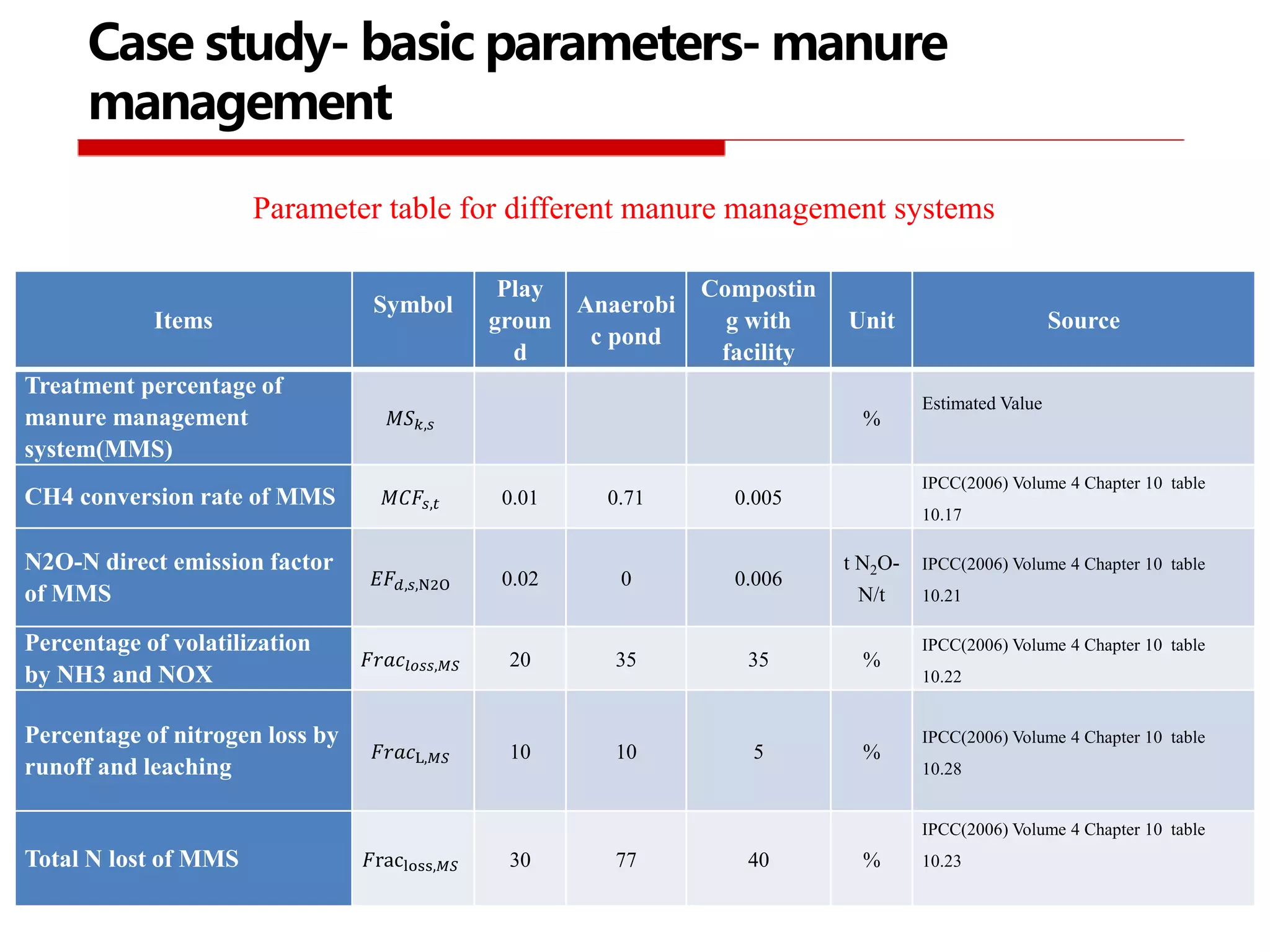
Parameter table for different manure management systems
Items
Symbol
Play
groun
d
Anaerobi
c pond
Compostin
g with
facility
Unit Source
Treatment percentage of
manure management
system(MMS)
𝑀𝑆 𝑘,𝑠 %
Estimated Value
CH4 conversion rate of MMS 𝑀𝐶𝐹𝑠,𝑡 0.01 0.71 0.005
IPCC(2006) Volume 4 Chapter 10 table
10.17
N2O-N direct emission factor
of MMS
𝐸𝐹𝑑,𝑠,N2O 0.02 0 0.006
t N2O-
N/t
IPCC(2006) Volume 4 Chapter 10 table
10.21
Percentage of volatilization
by NH3 and NOX
𝐹𝑟𝑎𝑐𝑙𝑜𝑠𝑠,𝑀𝑆 20 35 35 %
IPCC(2006) Volume 4 Chapter 10 table
10.22
Percentage of nitrogen loss by
runoff and leaching
𝐹𝑟𝑎𝑐L,𝑀𝑆 10 10 5 %
IPCC(2006) Volume 4 Chapter 10 table
10.28
Total N lost of MMS 𝐹racloss,𝑀𝑆 30 77 40 %
IPCC(2006) Volume 4 Chapter 10 table
10.23
Case study- basic parameters- manure
management
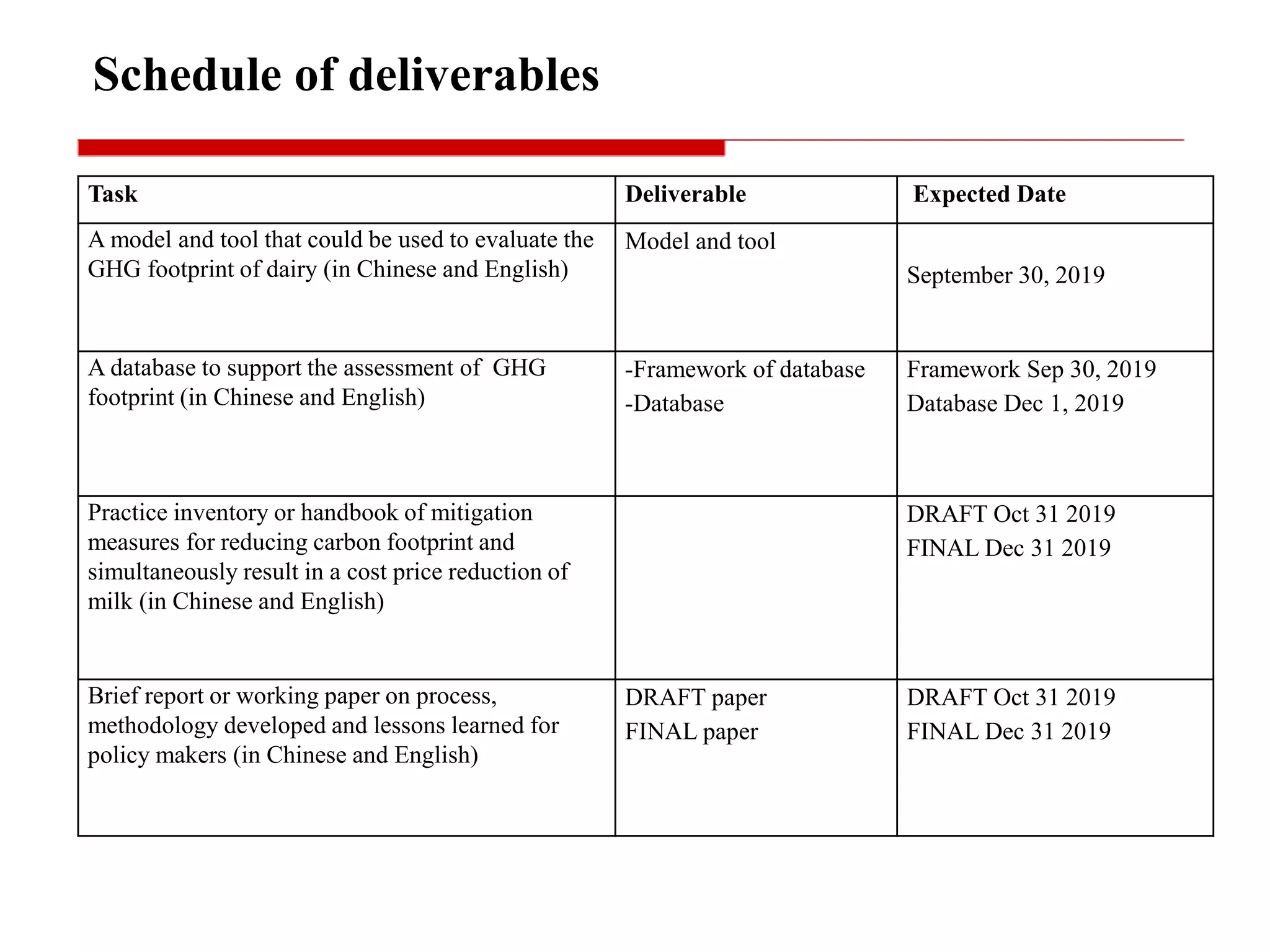
Schedule of deliverables
Task Deliverable Expected Date
A model and tool that could be used to evaluate the
GHG footprint of dairy (in Chinese and English)
Model and tool
September 30, 2019
A database to support the assessment of GHG
footprint (in Chinese and English)
-Framework of database
-Database
Framework Sep 30, 2019
Database Dec 1, 2019
Practice inventory or handbook of mitigation
measures for reducing carbon footprint and
simultaneously result in a cost price reduction of
milk (in Chinese and English)
DRAFT Oct 31 2019
FINAL Dec 31 2019
Brief report or working paper on process,
methodology developed and lessons learned for
policy makers (in Chinese and English)
DRAFT paper
FINAL paper
DRAFT Oct 31 2019
FINAL Dec 31 2019
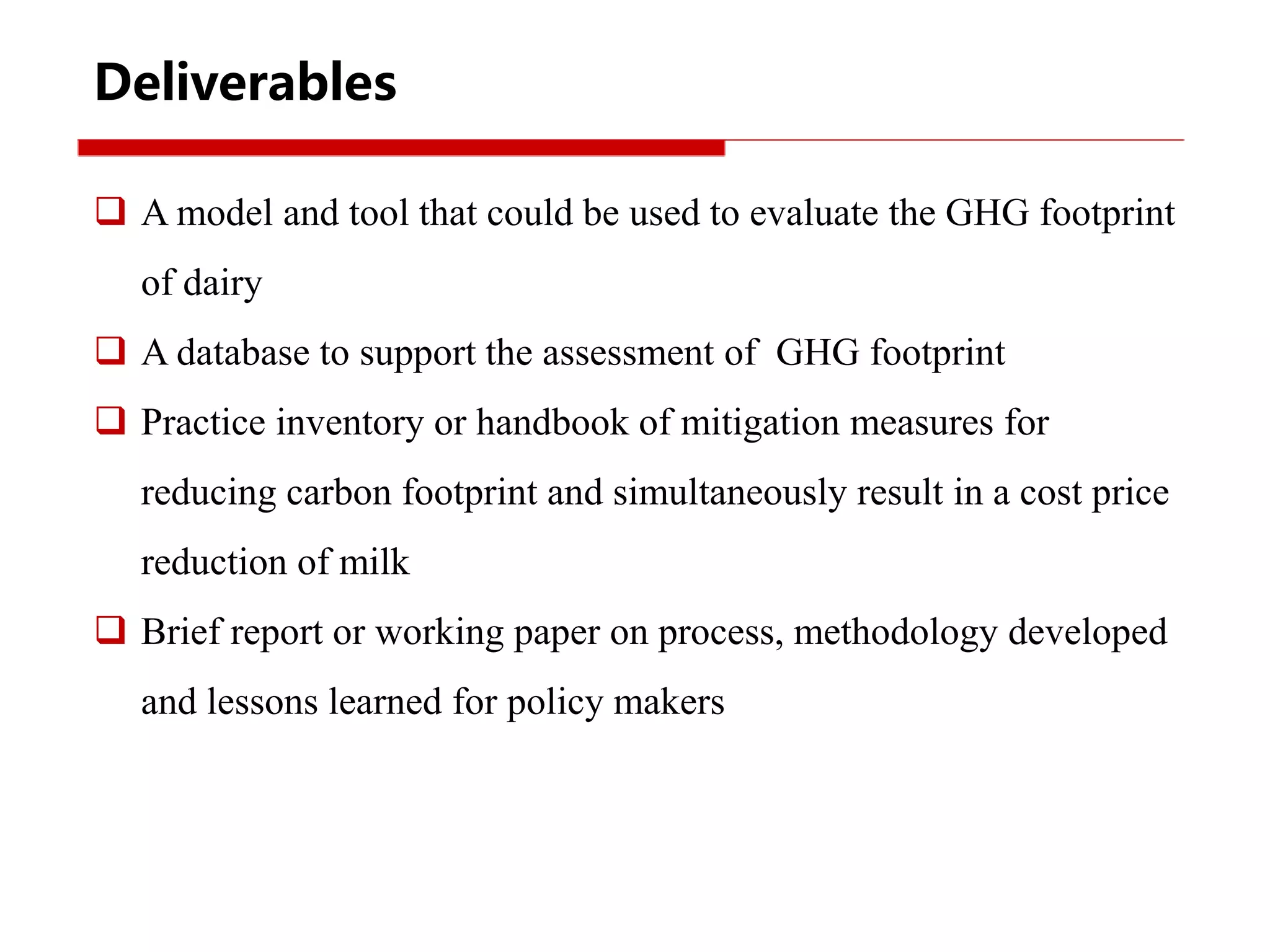
Deliverables
 A model and tool that could be used to evaluate the GHG footprint
of dairy
 A database to support the assessment of GHG footprint
 Practice inventory or handbook of mitigation measures for
reducing carbon footprint and simultaneously result in a cost price
reduction of milk
 Brief report or working paper on process, methodology developed
and lessons learned for policy makers
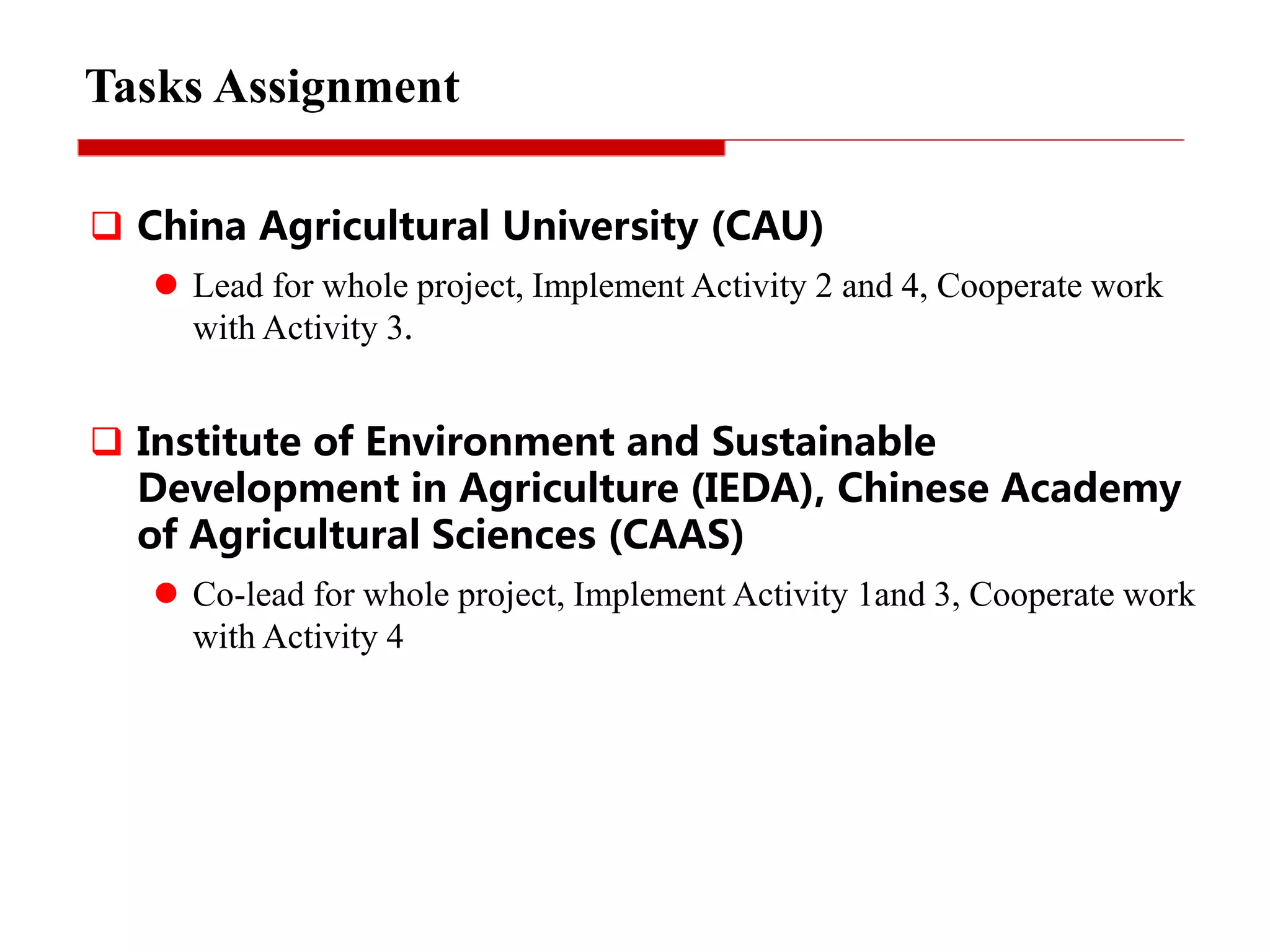
Tasks Assignment
 China Agricultural University (CAU)
 Lead for whole project, Implement Activity 2 and 4, Cooperate work
with Activity 3.
 Institute of Environment and Sustainable
Development in Agriculture (IEDA), Chinese Academy
of Agricultural Sciences (CAAS)
 Co-lead for whole project, Implement Activity 1and 3, Cooperate work
with Activity 4
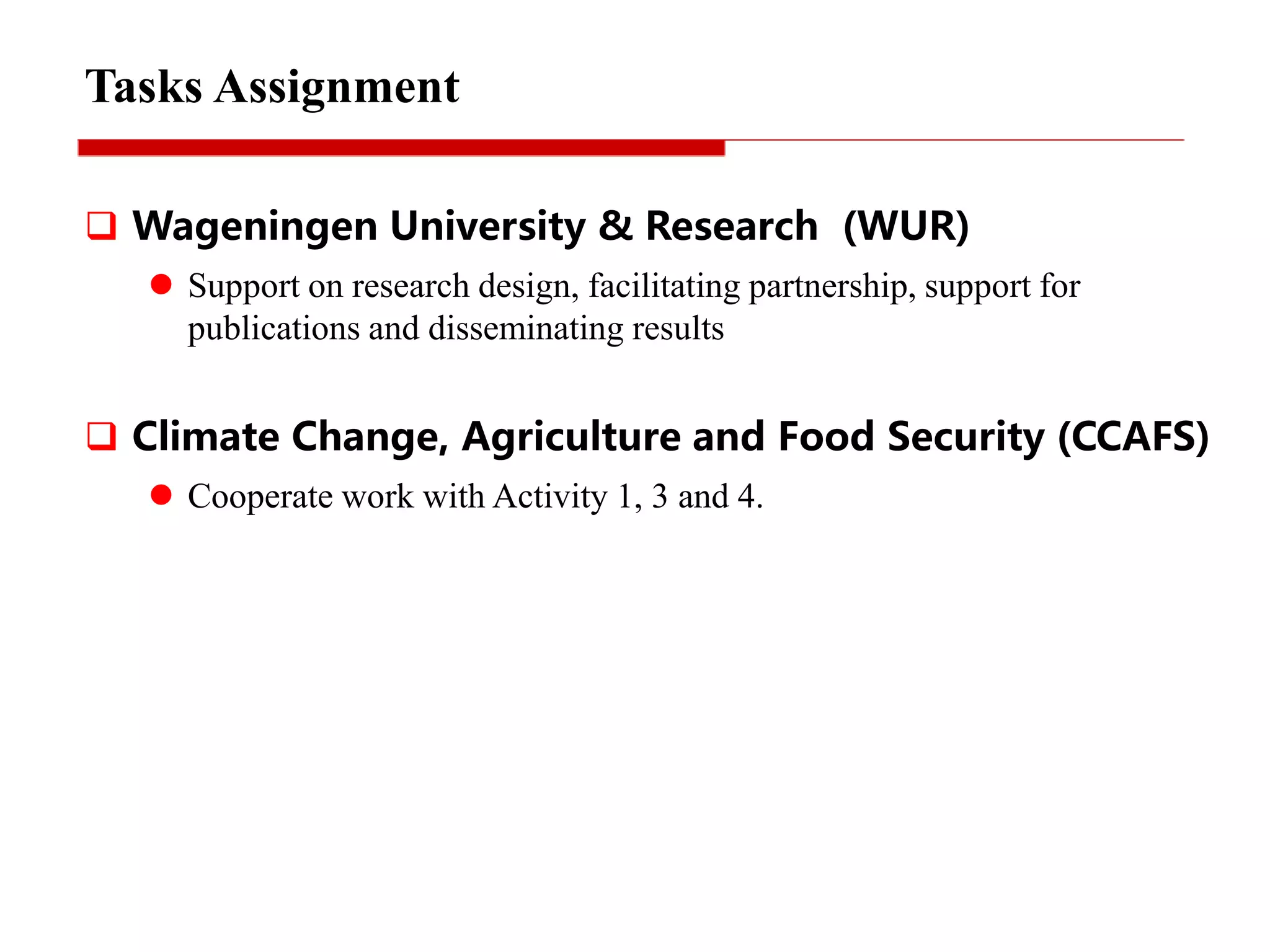
 Wageningen University & Research (WUR)
 Support on research design, facilitating partnership, support for
publications and disseminating results
 Climate Change, Agriculture and Food Security (CCAFS)
 Cooperate work with Activity 1, 3 and 4.
Tasks Assignment
Carbon footprint assessment and mitigation options of dairy under Chinese conditions - Implementation plan

Carbon footprint assessment and mitigation options of dairy under Chinese conditions - Implementation plan

  • 1.
    CCAFS Carbon Footprint Assessmentand Mitigation Options of Dairy under Chinese Conditions Implementation plan DONG Hongmin Institute of Environment and Sustainable Development in Agriculture, CAAS
  • 2.
  • 3.
    Background  Livestock isone of major GHG emission sources。 Contribute to around 14.5% world total. Dairy GHG emission from enteric and manure management contribute 20% to livestock emission.  Carbon footprint could quantify GHG emissions and relative contributions by each sector throughout whole production chain, Provide scientific data on CF baseline, identify potential CF mitigating measures, and policy-making in China.
  • 4.
    Carbon Foot PrintModel Model Country /Org Software available GHG boundry Function Unit allocation methods Accounting method C sink ( including/excl uding) GLEAM FAO yes CO2 CH4 N2O HCFs Feed production to market kg CO2-eq/ kg FPCM Protin content IPCC 2006 Tier 2 NO Dairy GHG USA yes CO2 CH4 N2O Feed production to farm gate kg CO2-eq/ kg ECM Price of Economic Processing (Mills et al.,) Yes DGAS AU Yes CO2 CH4 N2O Feed production to farm gate t CO2-eq/t Milk Solids Price of Economic IPCC(2006)Tier2 Yes TheE-CO2 Dairy UK NO CO2 CH4 N2O Feed production to farm gate g CO2-eq/ L milk Price of Economic IPCC(2006) NO
  • 5.
  • 6.
    Objectives  Develop amodel and tool that could be used to assess the greenhouse gas footprint of dairy cattle in China.  Provide an inventory of mitigation measures for reducing dairy production’s GHG footprint and simultaneously reduce the cost of milk in China.
  • 7.
    Activities and Deliverables ActivitiesDeliverables Activity 1 Develop greenhouse gas footprint model for dairy sector under China conditions Greenhouse gas footprint model based on life cycle assessment (LCA) method Activity 2 Develop a database for GHG footprint assessment of dairy cattle in China A database with data of more than 100 farmers Activity 3 Assessment of GHG footprint for respective dairy farms GHG emissions footprint and its distribution across different production chains Activity 4 Identify mitigation practices Handbook and analysis report on viable mitigation practices
  • 8.
  • 9.
    Development of CFMethod 1. Boundry 2. Function unit 3. Allocation method 4. Calculation method 5. Case study C Footprint method
  • 10.
    1、Boundary  Type ofGHG CO2、CH4、N2O  Time frame Year based activity  Boundary Feed production -- Farm gate – Market
  • 11.
    The system boundaryincludes 3 modules:  Feed production: fertilizer production and transportation, agricultural film and pesticide production, energy consumption for irrigation and agricultural machinery, fertilizer application, and feed processing and transportation  Animal production: enteric fermentation, manure management, and farm energy consumption.  Milk processing: milk processing and transportation Agricultural production Crop planting Feed processing Feed transportation Dairy farming Manure management Milk processing Milk CF Composition
  • 12.
    Research on carbonfootprint assessment methods system boundary and functional unit Accounting methods and parameter selection Agri- product materials CO2 Carbon Footprint Assessment of Dairy Research on typical cases of carbon footprint assessment Developement of database for carbon footprint assessment Analysis of key mitigation practices Agri- machine usage CO2 Fertilizer application N2O Thansport energy consumption CO2 Enteric fermentati on CH4 Manure manage ment N2O Manure manage ment CH4 Farm energy consumption CO2 Selection of GHG allocation method for feedstuff and crop planting No allocation Mass Energy Protein Hybrid Economic Milk process /transportatio n CO2
  • 13.
    2、Function unit 1 kgLW live weight 1 kg FPCM : Fat and protein corrected Milk (FPCM: Fat %, Protein 3.3%) Equation for FPCM calculation (FAO,2011): MFPCM = MRM × 0.337 + 0.116 × MFRM,F + 0.06 × MFRM,P MFPCM : Milk yield ,FPCM t/a; MRM : t/a; Milk yield of raw milk MFRM,F: %; Fat content of of raw milk, MFRM,P: %; Protein content of raw milk
  • 14.
    3、Allocation methods  Allocationprinciple (ISO14044) • Be avoided as much as possible through subdivision of system and system expansion • When distribution is inevitable, it shall be made based on potential physical relationship of different products or functions • Allocation can be made according to other relations reflecting different outputs of the system, such as economic value
  • 15.
    (allocation factor, AF) Allocationfactors were calculated using the following equation: 𝑨𝑭𝒊 = 𝑴𝒊 × 𝑾𝒊 𝒊 𝑴𝒊 × 𝑾𝒊 𝐴𝐹𝑖 , the allocation factor of product i M𝑖 , the mass fraction of product i W𝑖 , the weight factor of product i 3、Allocation methods
  • 16.
    𝑪𝑭 𝒎𝒊𝒍𝒌 = 𝑮𝑯𝑮𝒇𝒆𝒆𝒅 +𝑮𝑯𝑮 𝒇𝒂𝒓𝒎 +𝑮𝑯𝑮 𝒎𝒊𝒍𝒌,𝒑𝒓𝒐𝒄 𝑴 𝒎𝒊𝒍𝒌 𝐶𝐹 𝑚𝑖𝑙𝑘 (kg CO2-eq) 𝐺𝐻𝐺𝑓𝑒𝑒𝑑 (kg CO2-eq) ; 𝐺𝐻𝐺𝑓𝑎𝑟𝑚 (kg CO2-eq) ; 𝐺𝐻𝐺 𝑚𝑖𝑙𝑘,𝑝𝑟𝑜𝑐 (kg CO2-eq) 𝑀 𝑚𝑖𝑙𝑘 (kg LW) 。 4、Calculation method of CF CFmilk is the carbon footprint associated with milk GHGfeed is the GHG emission from feed production GHGfarm is the GHG emission from animal production GHGmilk,proc is the GHG from the milk processing Mmilk is the mass of milk production per year
  • 17.
    𝑮𝑯𝑮 𝒇𝒆𝒆𝒅 =𝑪𝑶 𝟐(𝒇𝒆𝒆𝒅,𝒊𝒏𝒑𝒖𝒕𝒔) + 𝑮𝑯𝑮(𝒇𝒆𝒆𝒅,𝑵 𝒇𝒆𝒓) × 𝑨𝑭𝒊 + 𝑪𝑶 𝟐(𝒇𝒆𝒆𝒅,𝒑𝒓𝒐𝒄) + 𝑪𝑶 𝟐(𝒇𝒆𝒓,𝒕𝒓𝒂𝒏𝒔) 4.1 Calculation method for feed production 𝐺𝐻𝐺𝑓𝑒𝑒𝑑 is GHG emissions from feed production (kg CO2-eq) 𝐶𝑂2(𝑓𝑒𝑒𝑑,𝑖𝑛𝑝𝑢𝑡) is CO2 emissions from production and utilization of agricultural machinery (kg CO2-eq) 𝐺𝐻𝐺(𝑓𝑒𝑒𝑑,𝑁 fer) is GHG emissions from utilization of N fertilizer (kg CO2-eq) 𝐶𝑂2(𝑓𝑒𝑒𝑑,𝑝𝑟𝑜𝑐) is CO2 emissions from processing of fertilizer and feedstuffs (kg CO2-eq) 𝐶𝑂2(𝑓𝑒𝑒𝑑,𝑡𝑟𝑎𝑛𝑠) is CO2 emissions from transportation of fertilizer and feedstuffs (kg CO2-eq)
  • 18.
    GHG Calculation methodfor feed production GHG emission sources Accounting method GHG (N2O) Application of N fertilization IPCC 2006 Tier 2 (CO2) Urea Degridation IPCC 2006 Tier 1 (CO2) Transportation (CO2) Production of Fertilization (CO2) Pesticide (CO2)Production of plastic (CO2) Electricity for Irrigation (CO2) Feed processing
  • 19.
    𝑮𝑯𝑮 𝒇𝒂𝒓𝒎 = 𝑪𝑯𝟒(𝒇𝒂𝒓𝒎,𝒆𝒏𝒕𝒆𝒓𝒊𝒄) + 𝑪𝑯 𝟒(𝒇𝒂𝒓𝒎,𝒎𝒎) × 𝑮𝑾𝑷 𝑪𝑯 𝟒 + 𝑵 𝟐 𝑶(𝒇𝒂𝒓𝒎,𝒎𝒎) × 𝑮𝑾𝑷 𝑵 𝟐 𝑶 + 𝑪𝑶 𝟐(𝒇𝒂𝒓𝒎,𝒆𝒏𝒆𝒓𝒈𝒚) 4.2 Calculation method for Animal production 𝑮𝑯𝑮 𝒇𝒂𝒓𝒎 is GHG emissions caused by animal production (kg CO2-eq) 𝑪𝑯 𝟒(𝒇𝒂𝒓𝒎,𝒆𝒏𝒕𝒆𝒓𝒊𝒄) is CH4 emissions from enteric fermentation (kg CO2-eq) 𝑪𝑯 𝟒(𝒇𝒂𝒓𝒎,𝒎𝒎) is CH4 emissions from manure management (kg CO2-eq) 𝑵 𝟐 𝑶(𝒇𝒂𝒓𝒎,𝒎𝒎) is N2O emissions from manure management (kg CO2-eq) 𝑪𝑶 𝟐(𝒇𝒂𝒓𝒎,𝒆𝒏𝒆𝒓𝒈𝒚) is CO2 emissions from energy consumption of the pig farm (kg CO2-eq)
  • 20.
    GHG Calculation methodfor Animal production Emission source 核算方法 Accounting Method GHG(CH4) Enteric (CH4) IPCC 2006 Tier 2 GHG( N2O 、CH4) Manure management ( N2O , CH4) IPCC 2006 Tier 2 GHG(N2O) Manure land application ( N2O) IPCC 2006 Tier 1 GHG(CO2) Dairy farm energy consumption (CO2) GHG Emission= AD ∗ EF
  • 21.
    5、Casestudy-selectionofparameters Factors inside ofequations Feed related parameters Production parameters 1 2 3
  • 22.
    Case study- basicparameters- herd structure Item Dairy cattle Dry dairy cattle Growing cattle Finishing cattle Yak Unit Source Annual in stock head Survey data Dry matter intake kg/head/d Survey data Daily weight gain kg Survey data Live body weight kg Survey data Ratio of crude protein in diet % Monitoring data Milk production kg/head/d Monitoring data Herd structure and parameters
  • 23.
    Feed consumption parametersin dairy farm  TMR feed formula  Others: premix, cotton aphid, cottonseed, beet pulp, DDGS, oat grass, etc. Items Symbol Value Unit Source Corn feed consumption 𝑇maize t Survey data Corn silage consumption 𝑇𝑠𝑖𝑙𝑎𝑔𝑒 t Survey data Cardamom consumption 𝑇𝑠𝑏𝑚 t Survey data Wheat bran consumption 𝑇𝑏𝑟𝑎𝑛 t Survey data Case study- basic parameters- feed
  • 24.
    Dairy farm productrelated parameters  Production from dairy farm: Exposed cows, male yak and milk Items Symbol Value Unit Source Protein content in raw milk 𝑀 𝑅𝑀,𝑃 3.2 % Monitoring data Fat content in raw milk MRM,F 3.8 % Monitoring data Number of male yaks sold 𝑁𝑏𝑢𝑙𝑙 head Survey data Number of lactating cows eliminated 𝑁𝑐𝑜𝑤 head Survey data Average weight of male calves sold 𝐴𝑊𝑏𝑢𝑙𝑙 kg Survey data Average weight of eliminate lactating cows 𝐴𝑊𝑐𝑜𝑤 kg Survey data Case study- basic parameters- Production
  • 25.
    Energy consumption parametersfor dairy cattle farm Items Symbol Value Unit Source Annual consumption of electricity in farm 𝑄 𝑒𝑛𝑒𝑟𝑔𝑦,𝑒𝑙𝑒𝑐 MW·h Survey data Annual consumption of diesel in farm 𝑄 𝑒𝑛𝑒𝑟𝑔𝑦,𝑑𝑖𝑒𝑠𝑒𝑙 t Survey data Annual consumption of gasoline in farm 𝑄 𝑒𝑛𝑒𝑟𝑔𝑦,petrol t Survey data Annual consumption of coal in farm 𝑄 𝑒𝑛𝑒𝑟𝑔𝑦,𝑐𝑜𝑎𝑙 t Survey data Case study- basic parameters- energy consumption
  • 26.
    Parameter table fordifferent manure management systems Items Symbol Play groun d Anaerobi c pond Compostin g with facility Unit Source Treatment percentage of manure management system(MMS) 𝑀𝑆 𝑘,𝑠 % Estimated Value CH4 conversion rate of MMS 𝑀𝐶𝐹𝑠,𝑡 0.01 0.71 0.005 IPCC(2006) Volume 4 Chapter 10 table 10.17 N2O-N direct emission factor of MMS 𝐸𝐹𝑑,𝑠,N2O 0.02 0 0.006 t N2O- N/t IPCC(2006) Volume 4 Chapter 10 table 10.21 Percentage of volatilization by NH3 and NOX 𝐹𝑟𝑎𝑐𝑙𝑜𝑠𝑠,𝑀𝑆 20 35 35 % IPCC(2006) Volume 4 Chapter 10 table 10.22 Percentage of nitrogen loss by runoff and leaching 𝐹𝑟𝑎𝑐L,𝑀𝑆 10 10 5 % IPCC(2006) Volume 4 Chapter 10 table 10.28 Total N lost of MMS 𝐹racloss,𝑀𝑆 30 77 40 % IPCC(2006) Volume 4 Chapter 10 table 10.23 Case study- basic parameters- manure management
  • 27.
    Schedule of deliverables TaskDeliverable Expected Date A model and tool that could be used to evaluate the GHG footprint of dairy (in Chinese and English) Model and tool September 30, 2019 A database to support the assessment of GHG footprint (in Chinese and English) -Framework of database -Database Framework Sep 30, 2019 Database Dec 1, 2019 Practice inventory or handbook of mitigation measures for reducing carbon footprint and simultaneously result in a cost price reduction of milk (in Chinese and English) DRAFT Oct 31 2019 FINAL Dec 31 2019 Brief report or working paper on process, methodology developed and lessons learned for policy makers (in Chinese and English) DRAFT paper FINAL paper DRAFT Oct 31 2019 FINAL Dec 31 2019
  • 28.
    Deliverables  A modeland tool that could be used to evaluate the GHG footprint of dairy  A database to support the assessment of GHG footprint  Practice inventory or handbook of mitigation measures for reducing carbon footprint and simultaneously result in a cost price reduction of milk  Brief report or working paper on process, methodology developed and lessons learned for policy makers
  • 29.
    Tasks Assignment  ChinaAgricultural University (CAU)  Lead for whole project, Implement Activity 2 and 4, Cooperate work with Activity 3.  Institute of Environment and Sustainable Development in Agriculture (IEDA), Chinese Academy of Agricultural Sciences (CAAS)  Co-lead for whole project, Implement Activity 1and 3, Cooperate work with Activity 4
  • 30.
     Wageningen University& Research (WUR)  Support on research design, facilitating partnership, support for publications and disseminating results  Climate Change, Agriculture and Food Security (CCAFS)  Cooperate work with Activity 1, 3 and 4. Tasks Assignment