Canberra Islamic Centre
DESIGN REPORT
KATE O’HARA
u3073727
LANDSCAPE RESEARCH STUDIO S2 2015
TABLE OF CONTENTS
ABSTRACT 3
PROJECT OVERVIEW 4
SITE CHARACTERISTICS 5
BRIEF 6
RESEARCH & PRECEDENTS 7
SITE APPRAISAL 12
SITE ANALYSIS 13
SWOT ANALYSIS 14
MASTERPLAN OVERVIEW 15
DESIGN CONCEPTS & VISION 16
EVALUATION OF PROJECT 18
DESIGN PROCESS 19
DESIGN OUTCOME 24
CONCEPT DESIGN – CANBERRA ISLAMIC CENTRE 25
MASTERPLAN – CANBERRA CENTENARY TRAIL PARK 26
DOCUMENTATION 27
DESIGN MODEL 30
REVIEW ANALYSIS 32
CONCLUSION 33
FINAL PRESENTATION BOARDS 34
APPENDICES 37
BIBLIOGRAPHY 38
2
ABSTRACT
This project presented an opportunity to be involved in a realistic client engagement whereby traditional design sequences of research, inventory, analysis, public
participation, design and critique were essential to its success.
At the start of the year, emphasis was given to research whereby collaborative actions through selected partnerships enabled a cross section of results and findings
which enhanced and further questioned design principles and key outcomes.
Schematic and conceptual designs were produced and built upon through mentorships and university principles who provided feedback and encouragement whilst also
addressing key individual design skills and knowledge.
Over the course of the year, design vision was altered to include unique and functional options which would lead to further development and opportunities of the
original site.
3
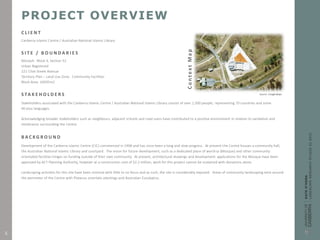
PROJECT OVERVIEW
C L I E N T
Canberra Islamic Centre / Australian National Islamic Library
S I T E / B O U N D A R I E S
Monash: Block 4, Section 52
Urban Registered
221 Clive Steele Avenue
Territory Plan – Land Use Zone: Community Facilities
Block Area: 16045m2
S TA K E H O L D E R S
Stakeholders associated with the Canberra Islamic Centre / Australian National Islamic Library consist of over 1,500 people; representing 70 countries and some
40 plus languages.
Acknowledging broader stakeholders such as neighbours, adjacent schools and road users have contributed to a positive environment in relation to vandalism and
intolerance surrounding the Centre.
B A C K G R O U N D
Development of the Canberra Islamic Centre (CIC) commenced in 1998 and has since been a long and slow progress. At present the Centre houses a community hall,
the Australian National Islamic Library and courtyard. The vision for future development, such as a dedicated place of worship (Mosque) and other community
orientated facilities hinges on funding outside of their own community. At present, architectural drawings and development applications for the Mosque have been
approved by ACT Planning Authority, however at a construction cost of $2.2 million, work for this project cannot be sustained with donations alone.
Landscaping activities for this site have been minimal with little to no focus and as such, the site is considerably exposed. Areas of community landscaping exist around
the perimeter of the Centre with Platanus orientalis plantings and Australian Eucalyptus.
ContextMap
Source: Google Maps
4
SITE CHARACTERISTICS
L O C A L I T Y
The site is located along an arterial road, approximately 2 kilometres from a significant retail shopping precinct with an external car parking entrance off Clive Steele
Avenue, Monash. The site is neighboured by residential dwellings, school, independent college, retirement village and open space areas designated for community
development.
T R A N S P O R TAT I O N
The site is accessed primarily through motor-vehicle users and this pattern is likely to continue due to the nature of Canberra transport facilities. A pedestrian
walking/bicycle path exists which skirts the boundary of the site providing opportunities for accessibility.
T O P O G R A P H Y
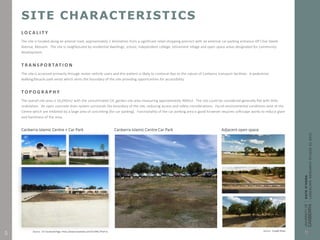
The overall site area is 16,045m2 with the concentrated CIC garden site area measuring approximately 400m2. The site could be considered generally flat with little
undulation. An open concrete drain system surrounds the boundary of the site, reducing access and safety considerations. Harsh environmental conditions exist at the
Centre which are inhibited by a large area of concreting (for car parking). Functionality of the car parking area is good however requires softscape works to reduce glare
and harshness of the area.
Canberra Islamic Centre + Car Park Canberra Islamic Centre Car Park Adjacent open space
Source: CIC Facebook Page. https://www.facebook.com/CICANIL/?fref=ts Source: Google Maps
5
BRIEF
The Canberra Islamic Centre garden design project presented an opportunity to bring to life explorations of design through Islamic and Australian influences. The
Centre itself is culturally rich and diverse, providing opportunities to contribute to the urban fabric of Canberra’s south through design facets that complimented the
character and landscape features of the area. The client’s expectations for this project included:
 Development of a landscape which was functional yet aesthetically pleasing for the members of the Canberra Islamic Centre.
 Create a contemporary design which incorporated traditional Islamic design with Australian impressions.
 Develop a landscape design which complimented the existing building.
 Landscape design which was inviting to both the public and the CIC community.
Further information was obtained through a community Forum held at the beginning of the year:
Beautiful garden Children’s play space BBQ area
Colourful plants and materials Low maintenance Encourage wildlife
Durable/longevity Shade Aesthetics
Contemporary design Compliment building structure Circulation
Interpretation of water Blend of Australian & Islamic design Funding constraints
Staged elements Social gatherings Perennial plantings
Children aspect Oak tree Reading places
Small groves Fruit trees Natives and exotics
6
RESEARCH & PRECEDENTS
Landscape design integrates habitat, cultural and geographical elements of an environment. Research and application of such findings supports, informs and transforms
design decisions. This design project brought forth exciting options of combining both Islamic and non-Islamic design principles.
Initial enquiries addressed the Canberra Islamic Centre itself, however as conceptual designs evolved, further questions were raised as to the landscape vision for the
entirety of the site. Was it possible to capitalise on a prominent location and natural setting in order to create a high quality parkland in conjunction with the CIC
garden destination?
Early research questions relating to the CIC garden included:
 Role and use of the Mosque
- Who visits and when? - What are the activities?
- What facilities exist? - Relationship between all services within CIC/ANIL?
 Historical and Contemporary Islamic Landscape Design
- Cultural or aesthetic design guidelines. - Islamic traditional and contemporary design opportunities.
- Respecting religious and cultural factors. - Relevant issues / restrictions / possibilities.
 Relationship with surrounding Islamic Centres and Community
- Visual and cultural aspects of the CIC. - What is this relationship?
- How does this affect the local community? - Measures in place to manage current and ongoing concerns?
 Other relevant questions
- Built and surrounding environment. - Interrelationships between the users of the Centre.
- Aesthetic value of Islamic design. - Infrastructure.
- Funding and construction times. - Social and behavioural aspects through identifying users.
7
RESEARCH & PRECEDENTS
Best practice landscape design examples researched prior to the concept stage were:
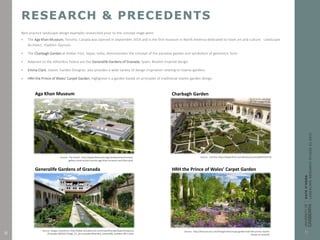
 The Aga Khan Museum, Toronto, Canada was opened in September 2014 and is the first museum in North America dedicated to Islam art and culture. Landscape
Architect, Vladimir Djurovic.
 The Charbagh Garden at Amber Fort, Jaipur, India, demonstrates the concept of the paradise garden and symbolism of geometric form.
 Adjacent to the Alhambra Palace are the Generalife Gardens of Granada, Spain; Muslim inspired design.
 Emma Clark, Islamic Garden Designer, also provides a wide variety of design inspiration relating to Islamic gardens.
 HRH the Prince of Wales’ Carpet Garden, Highgrove is a garden based on principles of traditional Islamic garden design.
Source: The Ismaili. http://www.theismaili.org/ismailicentres/toronto/
gallery-construction-toronto-aga-khan-museum-and-their-park
Source: Czerina. https://www.flickr.com/photos/czerina/6870762576
Source: Sergey, Kuznetsov. http://www.virtualtourist.com/travel/Europe/Spain/Andalucia
/Granada-266541/Things_To_Do-Granada-Alhambra_Generalife_Gardens-BR-1.html
Source: http://thecarousel.com/living/homes/royal-garden-look-like-prince-charles
-shows-us-around/
Aga Khan Museum Charbagh Garden
Generalife Gardens of Granada HRH the Prince of Wales’ Carpet Garden
8
RESEARCH & PRECEDENTS
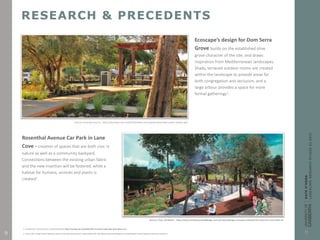
Ecoscape’s design for Dom Serra
Grove builds on the established olive
grove character of the site, and draws
inspiration from Mediterranean landscapes.
Shady, terraced outdoor rooms are created
within the landscape to provide areas for
both congregation and seclusion, and a
large arbour provides a space for more
formal gatherings1.
Source: Ecoscape.com.au. https://ecoscape.com.au/portfolio/dom-serra-grove-parks-open-space-subiaco-wa/
1. EcoScape 2015, ‘Dom Serra Grove’, viewed 28 April 2015, https://ecoscape.com.au/portfolio/dom-serra-grove-parks-open-space-subiaco-wa/
Rosenthal Avenue Car Park in Lane
Cove - creation of spaces that are both civic in
nature as well as a community backyard.
Connections between the existing urban fabric
and the new insertion will be fostered, while a
habitat for humans, animals and plants is
created2.
Source: Chua, Geraldine . http://www.architectureanddesign.com.au/news/design-concepts-released-for-new-lane-cove-park-an
2. Chua, G 2014, ‘Design concepts released for new Lane Cove park and public space’, viewed 28 April 2015, http://www.architectureanddesign.com.au/news/design-concepts-released-for-new-lane-cove-park-an.9
RESEARCH & PRECEDENTS
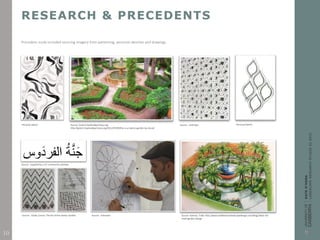
Precedent study included sourcing imagery from patterning, personal sketches and drawings.
Personal sketch Source: Green3.banksideprimary.org.
http://green3.banksideprimary.org/2012/07/09/this-is-a-islamic-garden-by-imran/
Source: Unknown Personal sketch
Source: Supplied by a CIC community member
Source: Unknown Source: Haiman, Todd. http://www.toddhaimanlandscapedesign.com/blog//ideas-for-
small-garden-design
Source: Clarke, Emma. The Art of the Islamic Garden
10
RESEARCH & PRECEDENTS
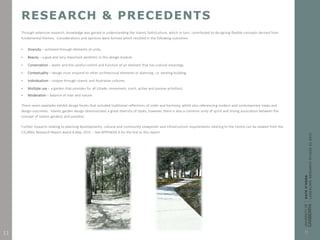
Through extensive research, knowledge was gained in understanding the Islamic faith/culture, which in turn, contributed to designing flexible concepts derived from
fundamental themes. Considerations and opinions were formed which resulted in the following outcomes:
 Diversity – achieved through elements of unity.
 Beauty – a goal and very important aesthetic in this design module.
 Conservation – water and the careful control and function of an element that has cultural meanings.
 Contextuality – design must respond to other architectural elements or planning, i.e. existing building.
 Individualism – unique through Islamic and Australian cultures.
 Multiple use – a garden that provides for all (shade, movement, scent, active and passive activities).
 Moderation – balance of man and nature.
These seven examples exhibit design facets that included traditional reflections of order and harmony, whilst also referencing modern and contemporary views and
design outcomes. Islamic garden design demonstrates a great diversity of styles, however, there is also a common unity of spirit and strong association between the
concept of Islamic gardens and paradise.
Further research relating to planning developments, cultural and community viewpoints and infrastructure requirements relating to the Centre can be viewed from the
CIC/ANIL Research Report dated 8 May 2015 – See APPENDIX A for the link to this report.
11
SITE APPRAISAL
P H Y S I C A L S I T E C O N T E X T
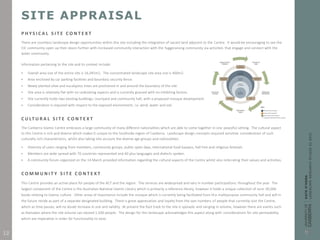
There are countless landscape design opportunities within this site including the integration of vacant land adjacent to the Centre. It would be encouraging to see the
CIC community open up their doors further with increased community interaction with the Tuggeranong community via activities that engage and connect with the
wider community.
Information pertaining to the site and its context include:
 Overall area size of the entire site is 16,045m2. The concentrated landscape site area size is 400m2.
 Area enclosed by car parking facilities and boundary security fence.
 Newly planted olive and eucalyptus trees are positioned in and around the boundary of the site.
 Site area is relatively flat with no undulating aspects and is currently grassed with no inhibiting factors.
 Site currently holds two existing buildings; courtyard and community hall, with a proposed mosque development.
 Consideration is required with respect to the exposed environment, i.e. wind, water and soil.
C U LT U R A L S I T E C O N T E X T
The Canberra Islamic Centre embraces a large community of many different nationalities which are able to come together in one peaceful setting. The cultural aspect
to this Centre is rich and diverse which makes it unique to the Southside region of Canberra. Landscape design concepts required sensitive consideration of such
culturally rich characteristics, whilst also taking into account the diverse age groups and nationalities.
 Diversity of users ranging from members, community groups, public open days, international food bazaars, hall hire and religious festivals.
 Members are wide spread with 70 countries represented and 40 plus languages and dialects spoken.
 A community forum organized on the 14 March provided information regarding the cultural aspects of the Centre whilst also reiterating their values and activities.
C O M M U N I T Y S I T E C O N T E X T
This Centre provides an active place for people of the ACT and the region. The services are widespread and vary in number participations throughout the year. The
largest component of the Centre is the Australian National Islamic Library which is primarily a reference library, however it holds a unique collection of over 30,000
books relating to Islamic culture. Other areas of importance include the mosque which is currently being facilitated from the multipurpose community hall and will in
the future reside as part of a separate designated building. There is great appreciation and loyalty from the vast numbers of people that currently visit the Centre,
which as time passes, will no doubt increase in size and validity. At present the foot track to the site is sporadic and ranging in volume, however there are events such
as Ramadan where the site volume can exceed 1,500 people. The design for this landscape acknowledges this aspect along with considerations for site permeability
which are imperative in order for functionality to exist.
12
SITE ANALYSIS
B U I LT A N A LY S I S
Utilities
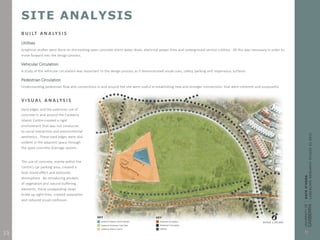
Graphical studies were done on the existing open concrete storm water drain, electrical power lines and underground service utilities. All this was necessary in order to
move forward into the design process.
Vehicular Circulation
A study of the vehicular circulation was important to the design process as it demonstrated visual cues, safety, parking and impervious surfaces.
Pedestrian Circulation
Understanding pedestrian flow and connections in and around the site were useful in establishing new and stronger connections that were coherent and purposeful.
V I S U A L A N A LY S I S
Hard edges and the extensive use of
concrete in and around the Canberra
Islamic Centre created a rigid
environment that was not conducive
to social interaction and environmental
aesthetics. These hard edges were also
evident in the adjacent space through
the open concrete drainage system.
The use of concrete, mainly within the
Centre’s car parking area, created a
heat island effect and lackluster
atmosphere. By introducing pockets
of vegetation and natural buffering
elements, these unappealing views
broke up sight lines, created separation
and reduced visual confusion.
13
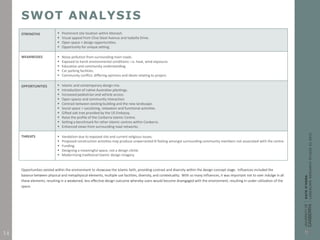
SWOT ANALYSIS
STRENGTHS  Prominent site location within Monash.
 Visual appeal from Clive Steel Avenue and Isabella Drive.
 Open space = design opportunities.
 Opportunity for unique setting.
WEAKNESSES  Noise pollution from surrounding main roads.
 Exposed to harsh environmental conditions: i.e. heat, wind exposure.
 Education and community understanding.
 Car parking facilities.
 Community conflict; differing opinions and ideals relating to project.
OPPORTUNITIES  Islamic and contemporary design mix.
 Introduction of native Australian plantings.
 Increased pedestrian and vehicle access.
 Open spaces and community interaction.
 Contrast between existing building and the new landscape.
 Social space = socializing, relaxation and functional activities.
 Gifted oak tree provided by the US Embassy.
 Raise the profile of the Canberra Islamic Centre.
 Setting a benchmark for other Islamic centres within Canberra.
 Enhanced views from surrounding road networks.
THREATS  Vandalism due to exposed site and current religious issues.
 Proposed construction activities may produce unwarranted ill feeling amongst surrounding community members not associated with the centre.
 Funding.
 Designing a meaningful space, not a design cliché.
 Modernising traditional Islamic design imagery.
Opportunities existed within the environment to showcase the Islamic faith, providing contrast and diversity within the design concept stage. Influences included the
balance between physical and metaphysical elements, multiple use facilities, diversity, and contextuality. With so many influences, it was important not to over indulge in all
these elements; resulting in a weakened, less effective design outcome whereby users would become disengaged with the environment, resulting in under-utilization of the
space.
14
MASTERPLAN OVERVIEW
As the project progressed, it became apparent that there was an opportunity to
increase visual and consistent connections that would contribute to the urban
framework of the Tuggeranong community through improved access and
increased viewpoint opportunities. The Canberra Islamic Centre became a catalyst
for this expansion and it is through design integrity and uniqueness of the CIC
garden design that recreational and landscape value links were adopted and
encouraged.
Initially, design principles for this project were allocated specifically to the CIC garden design, however as the project gained momentum, it was evident that these
design principles provided value to the entirety of the masterplan also.
Access + Circulation
Create a circulation network to increase accessibility, functionality and movement through clear hierarchy of spaces and way-finding systems.
Engage + Connection
Opportunities to encourage engagement within the space upon entry and existing
whilst also providing a connection within the surrounding landscape; improving the existing urban fabric and contributing and enhancing Canberra’s urban character.
Celebrate + Unique Culture
Incorporate references to Islamic culture and traditions with a complimentary mix of
Australian influences; enriching the experience and value of the landscape.
Inclusive + Interaction
Accommodate large demographic of members both within the CIC community and
Tuggeranong region, through increased visual and consistent connections.
Place + Identity
Create a strong landscape identity which enhances the location as being a place
for meeting and gathering, local events, sharing of community values and civic pride.
D E S I G N P R I N C I P L E S
15
DESIGN CONCEPTS & VISION
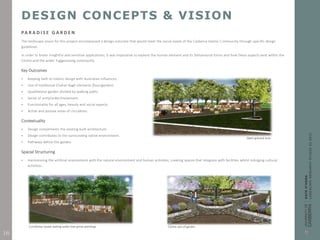
PA R A D I S E G A R D E N
The landscape vision for this project encompassed a design outcome that would meet the social needs of the Canberra Islamic Community through specific design
guidelines.
In order to foster insightful and sensitive applications, it was imperative to explore the human element and its behavioural forms and how these aspects exist within the
Centre and the wider Tuggeranong community.
Key Outcomes
 Keeping faith to Islamic design with Australian influences.
 Use of traditional Chahar-Bagh elements (four/garden).
 Quadilateral garden divided by walking paths.
 Sense of unity/order/movement.
 Functionality for all ages, beauty and social aspects.
 Active and passive areas of circulation.
Contextuality
 Design compliments the existing built architecture.
 Design contributes to the surrounding native environment.
 Pathways define the garden.
Spacial Structuring
 Harmonising the artificial environment with the natural environment and human activities; creating spaces that integrate with facilities whilst indulging cultural
activities.
Curvilinear raised seating under tree grove plantings Centre axis of garden
Open grassed area
16
DESIGN CONCEPTS & VISION
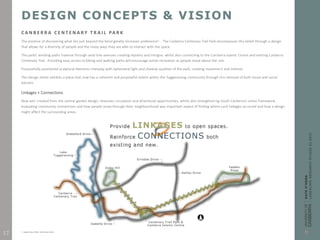
C A N B E R R A C E N T E N A R Y T R A I L PA R K
The promise of discovering what lies just beyond the bend greatly increases preference3 . The Canberra Centenary Trail Park encompasses this belief through a design
that allows for a diversity of people and the many ways they are able to interact with the space.
The parks’ winding paths traverse through axial tree avenues creating mystery and intrigue, whilst also connecting to the Canberra Islamic Centre and existing Canberra
Centenary Trail. Providing easy access to biking and walking paths will encourage active recreation as people move about the site.
Purposefully positioned sculptural elements interplay with ephemeral light and shadow qualities of the park, creating movement and interest.
This design intent exhibits a place that now has a coherent and purposeful extent within the Tuggeranong community through the removal of both visual and social
barriers.
Linkages + Connections
New axis’ created from the central garden design, improves circulation and directional opportunities, whilst also strengthening South Canberra’s urban framework.
Evaluating community connections and how people move through their neighbourhood was important aspect of finding where such linkages occurred and how a design
might affect the surrounding areas.
3. Kaplan & Ryan (1998). With People in Mind.
17
EVALUATION OF PROJECT
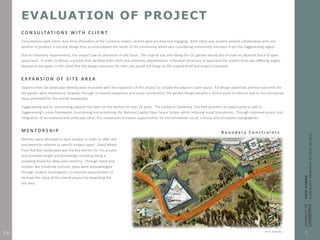
C O N S U LTAT I O N S W I T H C L I E N T
Consultations with client; Azra Khan (President of the Canberra Islamic Centre) were positive and engaging. Both client and student worked collaborative with one
another to produce a concept design that accommodated the needs of the community whilst also considering community members from the Tuggeranong region.
Due to University requirements, this project saw an alteration of site focus. The original site area being the CIC garden would also include an adjacent block of open
space land. In order to deliver a project that satisfied both client and university requirements, it became necessary to approach the project from two differing angles.
Assurance was given to the client that the design outcomes for their site would not hinge on the original brief and project outcomes.
E X PA N S I O N O F S I T E A R E A
Opportunities for landscape identity were increased with the expansion of this project to include the adjacent open space. All design objectives and key outcomes for
the garden were maintained, however through increased viewpoints and visual connections, the garden design became a centre point of interest due to the conceptual
ideas presented for the overall masterplan.
Tuggeranong and its surrounding suburbs has been on the decline for over 10 years. The Canberra Centenary Trail Park provides an opportunity to add to
Tuggeranong’s urban framework, maintaining and promoting the National Capital Open Space System whilst reducing visual boundaries. Through improved access and
integration of recreational and landscape value, this masterplan increases opportunities for environmental, social, cultural and circulation topographies.
M E N T O R S H I P
Mentors were allocated to each student in order to offer skill
and expertise relevant to specific project types. David Moyle
from Red Box Landscapes was the key mentor for this project
and provided insight and knowledge including being a
sounding board for ideas and concerns. Through David and
another key University Lecturer, ideas were acknowledged
through student investigation, to improve opportunities to
increase the value of the overall project by expanding the
site area.
Source: Google Maps
B o u n d a r y C o n s t r a i n t s
18
DESIGN PROCESS
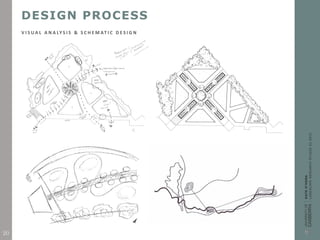
V I S U A L A N A LY S I S & S C H E M AT I C D E S I G N
Visual analysis for both the CIC garden and Canberra Centenary Trail Park included conceptual diagramming and sketches, photo cataloguing and computer imagery.
Preliminary schematic diagrams assisted in exploring alternatives, solutions and assisted visual thinking without the rigidity of programmatic constraints. These
drawings and conceptual diagrams also performed an integral addition to the overall process as these early sketches confirmed concept ideas, design intent, circulation
links and spatial structuring.
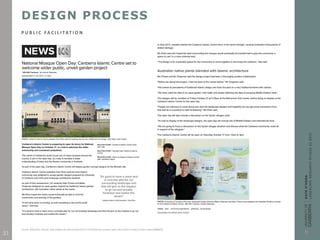
P U B L I C FA C I L I TAT I O N
The use of participatory community forums increased the success of this project. Through the analysis of users needs and wants, creative solutions were formed which
met project objectives. Documentation from such forums was a useful guide and reference tool going forward in this project. Public Relation activities also increased
awareness of the project and provided community feedback.
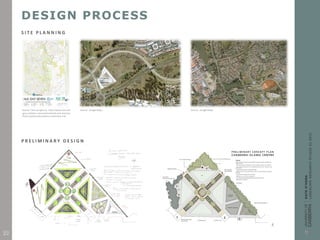
S I T E P L A N N I N G
Site planning for this project incorporated pedestrian circulation, entry and exist points, recreational facilities, cultural inclusions, environmental influences, visual cues,
spatial structuring and social interaction. Site planning for both the CIC garden and Canberra Centenary Trail Park looked at vicinity and geographical mapping. These
maps provided information on adjacent land use, opportunities and constraints that existed in and around the site areas. Through site inventories and background
research, concept formulation and development became available for preliminary design formulation. Additional research into the National Capital Open Space System
provided insight into Canberra’s need for an integrated open space system and the importance of recreational patterning and attitudes towards territory planning.
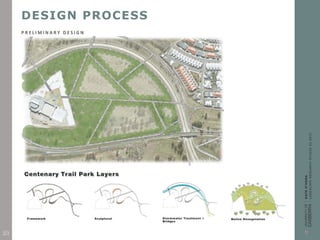
P R E L I M I N A R Y D E S I G N
Preliminary design concepts were generated and tested according to the opportunities and constraints of the landscape characteristics and client consultation.
Landscape characteristics were assessed according to their importance within the hierarchy of the project and value was added to balance out any discrepancies.
D E S I G N D E V E L O P M E N T
The design development stage confirmed earlier decisions and explorative investigations, allowing for a detailed design to evolve that was coherent and included a
sense of place (identity of place).
C O N S T R U C T I O N D O C U M E N T S
Construction documents became graphic conclusions to the design process, including plant and material choices, methods of detail construction and finishes. Plans
and sections drawn to scale were used to communicate information to the viewer. Accuracy and clarity of these documents were essential to explain the design intent.
19
V I S U A L A N A LY S I S & S C H E M AT I C D E S I G N
DESIGN PROCESS
20
DESIGN PROCESS
P U B L I C FA C I L I TAT I O N
Source: Walmsley, Hannah. http://www.abc.net.au/news/2015-10-20/national-mosque-open-day-canberra-islamic-centre-opens/6868456
21
DESIGN PROCESS
S I T E P L A N N I N G
P R E L I M I N A R Y D E S I G N
Source: Tams.act.gov.au. http://www.tams.act
.gov.au/parks-conservation/parks-and-reserves
/find-a-park/rural/canberra-centenary-trail
Source: Google Maps Source: Google Maps
22
DESIGN PROCESS
P R E L I M I N A R Y D E S I G N
23
DESIGN OUTCOME
C A N B E R R A I S L A M I C C E N T R E – PA R A D I S E G A R D E N
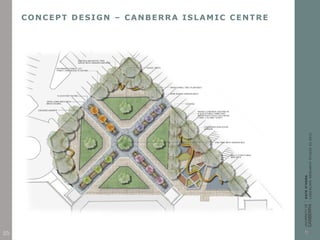
The backbone of this design and the reason it’s functionality works so well is due to the influence of the Charhar-Bagh design element. The existing building (courtyard
pillars) enabled a structured pathway to form the axial paths which encourage movement and circulation around the space.
Native grove plantings provided passive areas and enclose the space; softening harsh surfaces created from the car park. These groves also encourage a micro-climatic
change to the space, decreases exposure and harsh environmental conditions.
Grassed open areas encourage social gatherings and also contribute to the micro climate setting of the space. An Oak tree, gifted from the US Embassy, is positioned
centrally in the garden, forming a statement piece within an onion dome garden bed. This unusually shaped garden bed represents a cultural entity of eternity in Islamic
imagery. All tree plantings along pathway axis’ and within the boundary of the space are purposefully chosen to represent Mediterranean/traditional plantings;
encouraging the complimentary mix of exotics and natives. This is also seen in shrub plantings where colourful exotic plantings compliment native tonal plantings.
Semi-raised axial garden beds are maintenance friendly and provide visual references and cues. Raised concrete seating in a sculptural form represent pages in a book;
bringing a direct link from within the Australian National Islamic Library. The children’s discovery garden forms an area of the garden that is separated from the
quadrilateral setting of the main space; allowing for flexibility and more active participation. This space also allows for a multi-functional BBQ area.
Flagstone paving is functional but also represents the parched dried land of Australia; providing an interesting contrast to the lush green materiality of the open grassed
areas. All surface changes and divides are managed through Bluestone brick paving; increasing durability and ease of maintenance for the space.
C A N B E R R A C E N T E N A R Y T R A I L PA R K
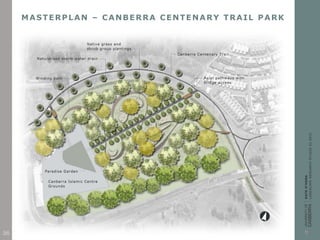
The simplicity of this park is why is works so well. The main feature is the axial pathways which link to the CIC garden pathways; encouraging a strong link due to the
visual imagery of planted tree avenues. Winding paths traverse through this main pathway creating mystery and curiosity. Sculptural elements are purposefully
positioned in order to create movement and interest through casting shadows.
Small coherent spaces open up through the thinning of tree canopies, providing opportunities for picnicking and recreational usage. Traversing pathway surfaces are
crushed granite which are contrasted with a more formal and functional setting of pavers. These two textures balance well with one another, one increasing the
textural quality of exploration and the other acknowledging a formal visual cue of direction.
The experience should be one of exploration and participation whereby people are encouraged to venture out and explore their environment; offer possibilities of
discovery and adventure. It is people’s exploration of a space and from considering options, wondering and imagining that places become cherished memories.
24
CONCEPT DESIGN – CANBERRA ISLAMIC CENTRE
25
MASTERPLAN – CANBERRA CENTENARY TRAIL PARK
26
DOCUMENTATION
PA R A D I S E G A R D E N D O C U M E N TAT I O N
PLANTING PLAN
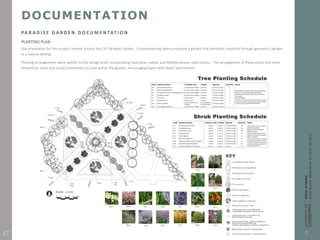
Documentation for this project centred around the CIC Paradise Garden. Complementing layers produced a garden that exhibited simplicity through geometric designs
in a natural setting.
Planting arrangements were specific to the design brief, incorporating Australian natives and Mediterranean style exotics. The arrangement of these plants and trees
allowed for vistas and visual connections to exist within the garden, encouraging layers with depth and interest.
27
DOCUMENTATION
PA R A D I S E G A R D E N D O C U M E N TAT I O N
MATERIALS AND FINISHES PLAN
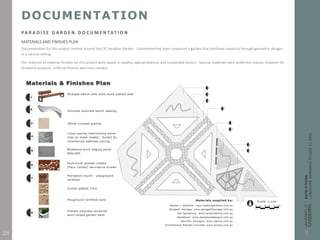
Documentation for this project centred around the CIC Paradise Garden. Complementing layers produced a garden that exhibited simplicity through geometric designs
in a natural setting.
The selection of material finishes for this project were based on quality, appropriateness and sustainable factors. Natural materials were preferred choices, however for
durability purposes, artificial finishes were also needed.
28
DOCUMENTATION
C A N B E R R A C E N T E N A R Y T R A I L PA R K D E TA I L S
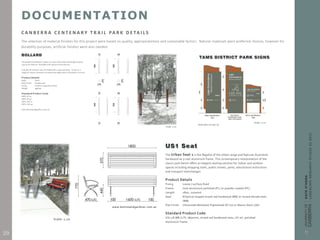
The selection of material finishes for this project were based on quality, appropriateness and sustainable factors. Natural materials were preferred choices, however for
durability purposes, artificial finishes were also needed.
29
DESIGN MODEL
T H R E S H O L D S
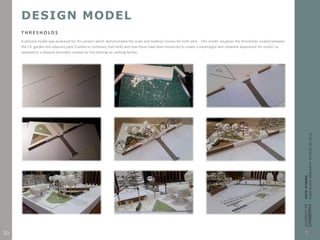
A physical model was produced for this project which demonstrated the scale and material choices for both sites. This model visualizes the thresholds created between
the CIC garden and adjacent park (Canberra Centenary Trail Park) and how these have been enhanced to create a meaningful and coherent experience for visitors as
opposed to a physical boundary created by the existing car parking facility.
30
DESIGN MODEL
T H R E S H O L D S
31
REVIEW ANALYSIS
The Canberra Islamic Centre project was a collaboration between client, mentors, academic staff and personal sounding boards.
The process throughout the year was concise although there were times where it was difficult to gain momentum due to the variety of input from varied sources. All
feedback and proposals were taken on board with enthusiasm, prompting further questioning and investigation. Reactions and discussions from client and academic
staff regarding concept designs started early allowing for diversity of ideas and surprising insights. Mentorship through David Moyle (Red Box Landscapes) was
invaluable and very appreciated.
From a Design and Management perspective, there are seven (7) areas which contribute to my overall design process which requires the engagement of a varied
number of people.
T H E P R O C E S S
DESIGN
 Start early and include many
 Understand the information
 Provide alternatives
 Acknowledge feedback
MANAGEMENT
 Be aware of opportunities for participation
 Ask questions
 Experiment
As a critical assessment, I felt that I was supported by all academic staff, albeit patience may have worn thin when dealing with students as a group resulting in negative
feedback which may have unnecessarily questioned individual abilities. There is no question that this group of students have a tight bond and I feel privileged to have
been part of this group for the last four years. Support and guidance from all students have contributed to our individual skill sets and professional development.
32
CONCLUSION
The Canberra Islamic Centre garden project presented a great opportunity to bring to life all explorations of design, both traditional and contemporary simply because
of the tremendous scope of creativity it presented.
The present urban framework for the South of Canberra suggests a need to improve accesses and increase viewpoints and opportunities for pedestrian experiences and
landscape value. Changes in recreational behaviour over the last ten years suggests the need for renewed regional parklands and urban peripheries in order to increase
visual and consistent connections in the area.
This project has great potential in providing such opportunities through environmental, social, cultural and circulatory elements; promoting the ideals and viewpoints of
the National Capital Open Space System. It was through the Canberra Islamic Centre garden project that such opportunities were able to present themselves and
although at present the community has had to deal with unsavory perceptions, this should not be a deterrent in producing a beautiful landscape for the Centre’s
community to enjoy and embrace.
Place is an important aspect of human existence and an important source of security and identity. Places shape our memories, feelings, thoughts and in turn shape the
landscape around them through their experience and actions – Maria Gabriella Trovato.
33
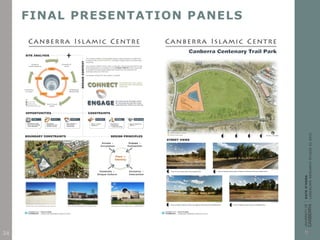
FINAL PRESENTATION PANELS
34
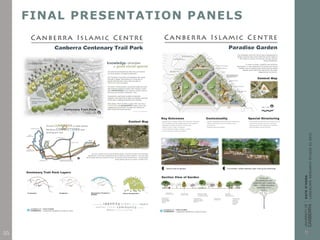
FINAL PRESENTATION PANELS
35
FINAL PRESENTATION PANELS
36
APPENDICES
Appendix A – Canberra Islamic Centre Research Report
https://www.slideshare.net/secret/3rtqATfcpyLZy1
Appendix B – Canberra Islamic Centre Advisory Board Presentation
https://www.slideshare.net/secret/1Lok3skjVkA5V5
Appendix C – Canberra Islamic Centre Interim Research Report
https://www.slideshare.net/secret/f5wCshbLdNVeBH
37
BIBLIOGRAPHY
1. Chua, Geraldine. 'Design Concepts Released For New Lane Cove Park And Public Space | Architecture And Design'. Architecture And Design. N.p., 2014. Web. 11 Nov.
2015.
2. Clark, Emma. The Art Of The Islamic Garden. Marlborough: Crowood, 2004. Print.
3. Czerina,. Char-Bagh (Four Gardens) At Amber Fort In Jaipur (Pink City). 2012. Web. 10 Nov. 2015.
4. Ecoscape.com.au,. 'Dom Serra Grove, An Award Winning Park - Subiaco, WA'. N.p., 2015. Web. 11 Nov. 2015.
5. EcoScape 2015, ‘Dom Serra Grove’, viewed 28 April 2015, https://ecoscape.com.au/portfolio/dom-serra-grove-parks-open-space-subiaco-wa/
6. Facebook.com,. 'Canberra Islamic Centre - Australian National Islamic Library'. N.p., 2015. Web. 11 Nov. 2015.
7. Green3.banksideprimary.org,. '» This Is A Islamic Garden By Imran Green 3 Blog'. N.p., 2012. Web. 11 Nov. 2015.
8. Haiman, Todd. 'IDEAS FOR SMALL GARDEN DESIGN'. Todd Haiman Landscape Design. N.p., 2014. Web. 11 Nov. 2015.
9. Kaplan, Rachel, Stephen Kaplan, and Robert L Ryan. With People In Mind. Washington, D.C.: Island Press, 1998. Print.
10. The Ismaili,. 'Ismaili Centres'. N.p., 2015. Web. 11 Nov. 2015.
11. Sergey, Kuznetsov. Jardines De Generalife. 2014. Web. 11 Nov. 2015.
12. Tams.act.gov.au,. 'Canberra Centenary Trail - Territory And Municipal Services'. N.p., 2015. Web. 11 Nov. 2015.
13. Walmsley, Hannah. 'National Mosque Open Day: Canberra Islamic Centre To Welcome Wider Public'. ABC News. N.p., 2015. Web. 11 Nov. 2015.
38

Landscape Design Research Report

  • 1.
    Canberra Islamic Centre DESIGNREPORT KATE O’HARA u3073727 LANDSCAPE RESEARCH STUDIO S2 2015
  • 2.
    TABLE OF CONTENTS ABSTRACT3 PROJECT OVERVIEW 4 SITE CHARACTERISTICS 5 BRIEF 6 RESEARCH & PRECEDENTS 7 SITE APPRAISAL 12 SITE ANALYSIS 13 SWOT ANALYSIS 14 MASTERPLAN OVERVIEW 15 DESIGN CONCEPTS & VISION 16 EVALUATION OF PROJECT 18 DESIGN PROCESS 19 DESIGN OUTCOME 24 CONCEPT DESIGN – CANBERRA ISLAMIC CENTRE 25 MASTERPLAN – CANBERRA CENTENARY TRAIL PARK 26 DOCUMENTATION 27 DESIGN MODEL 30 REVIEW ANALYSIS 32 CONCLUSION 33 FINAL PRESENTATION BOARDS 34 APPENDICES 37 BIBLIOGRAPHY 38 2
  • 3.
    ABSTRACT This project presentedan opportunity to be involved in a realistic client engagement whereby traditional design sequences of research, inventory, analysis, public participation, design and critique were essential to its success. At the start of the year, emphasis was given to research whereby collaborative actions through selected partnerships enabled a cross section of results and findings which enhanced and further questioned design principles and key outcomes. Schematic and conceptual designs were produced and built upon through mentorships and university principles who provided feedback and encouragement whilst also addressing key individual design skills and knowledge. Over the course of the year, design vision was altered to include unique and functional options which would lead to further development and opportunities of the original site. 3
  • 4.
    PROJECT OVERVIEW C LI E N T Canberra Islamic Centre / Australian National Islamic Library S I T E / B O U N D A R I E S Monash: Block 4, Section 52 Urban Registered 221 Clive Steele Avenue Territory Plan – Land Use Zone: Community Facilities Block Area: 16045m2 S TA K E H O L D E R S Stakeholders associated with the Canberra Islamic Centre / Australian National Islamic Library consist of over 1,500 people; representing 70 countries and some 40 plus languages. Acknowledging broader stakeholders such as neighbours, adjacent schools and road users have contributed to a positive environment in relation to vandalism and intolerance surrounding the Centre. B A C K G R O U N D Development of the Canberra Islamic Centre (CIC) commenced in 1998 and has since been a long and slow progress. At present the Centre houses a community hall, the Australian National Islamic Library and courtyard. The vision for future development, such as a dedicated place of worship (Mosque) and other community orientated facilities hinges on funding outside of their own community. At present, architectural drawings and development applications for the Mosque have been approved by ACT Planning Authority, however at a construction cost of $2.2 million, work for this project cannot be sustained with donations alone. Landscaping activities for this site have been minimal with little to no focus and as such, the site is considerably exposed. Areas of community landscaping exist around the perimeter of the Centre with Platanus orientalis plantings and Australian Eucalyptus. ContextMap Source: Google Maps 4
  • 5.
    SITE CHARACTERISTICS L OC A L I T Y The site is located along an arterial road, approximately 2 kilometres from a significant retail shopping precinct with an external car parking entrance off Clive Steele Avenue, Monash. The site is neighboured by residential dwellings, school, independent college, retirement village and open space areas designated for community development. T R A N S P O R TAT I O N The site is accessed primarily through motor-vehicle users and this pattern is likely to continue due to the nature of Canberra transport facilities. A pedestrian walking/bicycle path exists which skirts the boundary of the site providing opportunities for accessibility. T O P O G R A P H Y The overall site area is 16,045m2 with the concentrated CIC garden site area measuring approximately 400m2. The site could be considered generally flat with little undulation. An open concrete drain system surrounds the boundary of the site, reducing access and safety considerations. Harsh environmental conditions exist at the Centre which are inhibited by a large area of concreting (for car parking). Functionality of the car parking area is good however requires softscape works to reduce glare and harshness of the area. Canberra Islamic Centre + Car Park Canberra Islamic Centre Car Park Adjacent open space Source: CIC Facebook Page. https://www.facebook.com/CICANIL/?fref=ts Source: Google Maps 5
  • 6.
    BRIEF The Canberra IslamicCentre garden design project presented an opportunity to bring to life explorations of design through Islamic and Australian influences. The Centre itself is culturally rich and diverse, providing opportunities to contribute to the urban fabric of Canberra’s south through design facets that complimented the character and landscape features of the area. The client’s expectations for this project included:  Development of a landscape which was functional yet aesthetically pleasing for the members of the Canberra Islamic Centre.  Create a contemporary design which incorporated traditional Islamic design with Australian impressions.  Develop a landscape design which complimented the existing building.  Landscape design which was inviting to both the public and the CIC community. Further information was obtained through a community Forum held at the beginning of the year: Beautiful garden Children’s play space BBQ area Colourful plants and materials Low maintenance Encourage wildlife Durable/longevity Shade Aesthetics Contemporary design Compliment building structure Circulation Interpretation of water Blend of Australian & Islamic design Funding constraints Staged elements Social gatherings Perennial plantings Children aspect Oak tree Reading places Small groves Fruit trees Natives and exotics 6
  • 7.
    RESEARCH & PRECEDENTS Landscapedesign integrates habitat, cultural and geographical elements of an environment. Research and application of such findings supports, informs and transforms design decisions. This design project brought forth exciting options of combining both Islamic and non-Islamic design principles. Initial enquiries addressed the Canberra Islamic Centre itself, however as conceptual designs evolved, further questions were raised as to the landscape vision for the entirety of the site. Was it possible to capitalise on a prominent location and natural setting in order to create a high quality parkland in conjunction with the CIC garden destination? Early research questions relating to the CIC garden included:  Role and use of the Mosque - Who visits and when? - What are the activities? - What facilities exist? - Relationship between all services within CIC/ANIL?  Historical and Contemporary Islamic Landscape Design - Cultural or aesthetic design guidelines. - Islamic traditional and contemporary design opportunities. - Respecting religious and cultural factors. - Relevant issues / restrictions / possibilities.  Relationship with surrounding Islamic Centres and Community - Visual and cultural aspects of the CIC. - What is this relationship? - How does this affect the local community? - Measures in place to manage current and ongoing concerns?  Other relevant questions - Built and surrounding environment. - Interrelationships between the users of the Centre. - Aesthetic value of Islamic design. - Infrastructure. - Funding and construction times. - Social and behavioural aspects through identifying users. 7
  • 8.
    RESEARCH & PRECEDENTS Bestpractice landscape design examples researched prior to the concept stage were:  The Aga Khan Museum, Toronto, Canada was opened in September 2014 and is the first museum in North America dedicated to Islam art and culture. Landscape Architect, Vladimir Djurovic.  The Charbagh Garden at Amber Fort, Jaipur, India, demonstrates the concept of the paradise garden and symbolism of geometric form.  Adjacent to the Alhambra Palace are the Generalife Gardens of Granada, Spain; Muslim inspired design.  Emma Clark, Islamic Garden Designer, also provides a wide variety of design inspiration relating to Islamic gardens.  HRH the Prince of Wales’ Carpet Garden, Highgrove is a garden based on principles of traditional Islamic garden design. Source: The Ismaili. http://www.theismaili.org/ismailicentres/toronto/ gallery-construction-toronto-aga-khan-museum-and-their-park Source: Czerina. https://www.flickr.com/photos/czerina/6870762576 Source: Sergey, Kuznetsov. http://www.virtualtourist.com/travel/Europe/Spain/Andalucia /Granada-266541/Things_To_Do-Granada-Alhambra_Generalife_Gardens-BR-1.html Source: http://thecarousel.com/living/homes/royal-garden-look-like-prince-charles -shows-us-around/ Aga Khan Museum Charbagh Garden Generalife Gardens of Granada HRH the Prince of Wales’ Carpet Garden 8
  • 9.
    RESEARCH & PRECEDENTS Ecoscape’sdesign for Dom Serra Grove builds on the established olive grove character of the site, and draws inspiration from Mediterranean landscapes. Shady, terraced outdoor rooms are created within the landscape to provide areas for both congregation and seclusion, and a large arbour provides a space for more formal gatherings1. Source: Ecoscape.com.au. https://ecoscape.com.au/portfolio/dom-serra-grove-parks-open-space-subiaco-wa/ 1. EcoScape 2015, ‘Dom Serra Grove’, viewed 28 April 2015, https://ecoscape.com.au/portfolio/dom-serra-grove-parks-open-space-subiaco-wa/ Rosenthal Avenue Car Park in Lane Cove - creation of spaces that are both civic in nature as well as a community backyard. Connections between the existing urban fabric and the new insertion will be fostered, while a habitat for humans, animals and plants is created2. Source: Chua, Geraldine . http://www.architectureanddesign.com.au/news/design-concepts-released-for-new-lane-cove-park-an 2. Chua, G 2014, ‘Design concepts released for new Lane Cove park and public space’, viewed 28 April 2015, http://www.architectureanddesign.com.au/news/design-concepts-released-for-new-lane-cove-park-an.9
  • 10.
    RESEARCH & PRECEDENTS Precedentstudy included sourcing imagery from patterning, personal sketches and drawings. Personal sketch Source: Green3.banksideprimary.org. http://green3.banksideprimary.org/2012/07/09/this-is-a-islamic-garden-by-imran/ Source: Unknown Personal sketch Source: Supplied by a CIC community member Source: Unknown Source: Haiman, Todd. http://www.toddhaimanlandscapedesign.com/blog//ideas-for- small-garden-design Source: Clarke, Emma. The Art of the Islamic Garden 10
  • 11.
    RESEARCH & PRECEDENTS Throughextensive research, knowledge was gained in understanding the Islamic faith/culture, which in turn, contributed to designing flexible concepts derived from fundamental themes. Considerations and opinions were formed which resulted in the following outcomes:  Diversity – achieved through elements of unity.  Beauty – a goal and very important aesthetic in this design module.  Conservation – water and the careful control and function of an element that has cultural meanings.  Contextuality – design must respond to other architectural elements or planning, i.e. existing building.  Individualism – unique through Islamic and Australian cultures.  Multiple use – a garden that provides for all (shade, movement, scent, active and passive activities).  Moderation – balance of man and nature. These seven examples exhibit design facets that included traditional reflections of order and harmony, whilst also referencing modern and contemporary views and design outcomes. Islamic garden design demonstrates a great diversity of styles, however, there is also a common unity of spirit and strong association between the concept of Islamic gardens and paradise. Further research relating to planning developments, cultural and community viewpoints and infrastructure requirements relating to the Centre can be viewed from the CIC/ANIL Research Report dated 8 May 2015 – See APPENDIX A for the link to this report. 11
  • 12.
    SITE APPRAISAL P HY S I C A L S I T E C O N T E X T There are countless landscape design opportunities within this site including the integration of vacant land adjacent to the Centre. It would be encouraging to see the CIC community open up their doors further with increased community interaction with the Tuggeranong community via activities that engage and connect with the wider community. Information pertaining to the site and its context include:  Overall area size of the entire site is 16,045m2. The concentrated landscape site area size is 400m2.  Area enclosed by car parking facilities and boundary security fence.  Newly planted olive and eucalyptus trees are positioned in and around the boundary of the site.  Site area is relatively flat with no undulating aspects and is currently grassed with no inhibiting factors.  Site currently holds two existing buildings; courtyard and community hall, with a proposed mosque development.  Consideration is required with respect to the exposed environment, i.e. wind, water and soil. C U LT U R A L S I T E C O N T E X T The Canberra Islamic Centre embraces a large community of many different nationalities which are able to come together in one peaceful setting. The cultural aspect to this Centre is rich and diverse which makes it unique to the Southside region of Canberra. Landscape design concepts required sensitive consideration of such culturally rich characteristics, whilst also taking into account the diverse age groups and nationalities.  Diversity of users ranging from members, community groups, public open days, international food bazaars, hall hire and religious festivals.  Members are wide spread with 70 countries represented and 40 plus languages and dialects spoken.  A community forum organized on the 14 March provided information regarding the cultural aspects of the Centre whilst also reiterating their values and activities. C O M M U N I T Y S I T E C O N T E X T This Centre provides an active place for people of the ACT and the region. The services are widespread and vary in number participations throughout the year. The largest component of the Centre is the Australian National Islamic Library which is primarily a reference library, however it holds a unique collection of over 30,000 books relating to Islamic culture. Other areas of importance include the mosque which is currently being facilitated from the multipurpose community hall and will in the future reside as part of a separate designated building. There is great appreciation and loyalty from the vast numbers of people that currently visit the Centre, which as time passes, will no doubt increase in size and validity. At present the foot track to the site is sporadic and ranging in volume, however there are events such as Ramadan where the site volume can exceed 1,500 people. The design for this landscape acknowledges this aspect along with considerations for site permeability which are imperative in order for functionality to exist. 12
  • 13.
    SITE ANALYSIS B UI LT A N A LY S I S Utilities Graphical studies were done on the existing open concrete storm water drain, electrical power lines and underground service utilities. All this was necessary in order to move forward into the design process. Vehicular Circulation A study of the vehicular circulation was important to the design process as it demonstrated visual cues, safety, parking and impervious surfaces. Pedestrian Circulation Understanding pedestrian flow and connections in and around the site were useful in establishing new and stronger connections that were coherent and purposeful. V I S U A L A N A LY S I S Hard edges and the extensive use of concrete in and around the Canberra Islamic Centre created a rigid environment that was not conducive to social interaction and environmental aesthetics. These hard edges were also evident in the adjacent space through the open concrete drainage system. The use of concrete, mainly within the Centre’s car parking area, created a heat island effect and lackluster atmosphere. By introducing pockets of vegetation and natural buffering elements, these unappealing views broke up sight lines, created separation and reduced visual confusion. 13
  • 14.
    SWOT ANALYSIS STRENGTHS Prominent site location within Monash.  Visual appeal from Clive Steel Avenue and Isabella Drive.  Open space = design opportunities.  Opportunity for unique setting. WEAKNESSES  Noise pollution from surrounding main roads.  Exposed to harsh environmental conditions: i.e. heat, wind exposure.  Education and community understanding.  Car parking facilities.  Community conflict; differing opinions and ideals relating to project. OPPORTUNITIES  Islamic and contemporary design mix.  Introduction of native Australian plantings.  Increased pedestrian and vehicle access.  Open spaces and community interaction.  Contrast between existing building and the new landscape.  Social space = socializing, relaxation and functional activities.  Gifted oak tree provided by the US Embassy.  Raise the profile of the Canberra Islamic Centre.  Setting a benchmark for other Islamic centres within Canberra.  Enhanced views from surrounding road networks. THREATS  Vandalism due to exposed site and current religious issues.  Proposed construction activities may produce unwarranted ill feeling amongst surrounding community members not associated with the centre.  Funding.  Designing a meaningful space, not a design cliché.  Modernising traditional Islamic design imagery. Opportunities existed within the environment to showcase the Islamic faith, providing contrast and diversity within the design concept stage. Influences included the balance between physical and metaphysical elements, multiple use facilities, diversity, and contextuality. With so many influences, it was important not to over indulge in all these elements; resulting in a weakened, less effective design outcome whereby users would become disengaged with the environment, resulting in under-utilization of the space. 14
  • 15.
    MASTERPLAN OVERVIEW As theproject progressed, it became apparent that there was an opportunity to increase visual and consistent connections that would contribute to the urban framework of the Tuggeranong community through improved access and increased viewpoint opportunities. The Canberra Islamic Centre became a catalyst for this expansion and it is through design integrity and uniqueness of the CIC garden design that recreational and landscape value links were adopted and encouraged. Initially, design principles for this project were allocated specifically to the CIC garden design, however as the project gained momentum, it was evident that these design principles provided value to the entirety of the masterplan also. Access + Circulation Create a circulation network to increase accessibility, functionality and movement through clear hierarchy of spaces and way-finding systems. Engage + Connection Opportunities to encourage engagement within the space upon entry and existing whilst also providing a connection within the surrounding landscape; improving the existing urban fabric and contributing and enhancing Canberra’s urban character. Celebrate + Unique Culture Incorporate references to Islamic culture and traditions with a complimentary mix of Australian influences; enriching the experience and value of the landscape. Inclusive + Interaction Accommodate large demographic of members both within the CIC community and Tuggeranong region, through increased visual and consistent connections. Place + Identity Create a strong landscape identity which enhances the location as being a place for meeting and gathering, local events, sharing of community values and civic pride. D E S I G N P R I N C I P L E S 15
  • 16.
    DESIGN CONCEPTS &VISION PA R A D I S E G A R D E N The landscape vision for this project encompassed a design outcome that would meet the social needs of the Canberra Islamic Community through specific design guidelines. In order to foster insightful and sensitive applications, it was imperative to explore the human element and its behavioural forms and how these aspects exist within the Centre and the wider Tuggeranong community. Key Outcomes  Keeping faith to Islamic design with Australian influences.  Use of traditional Chahar-Bagh elements (four/garden).  Quadilateral garden divided by walking paths.  Sense of unity/order/movement.  Functionality for all ages, beauty and social aspects.  Active and passive areas of circulation. Contextuality  Design compliments the existing built architecture.  Design contributes to the surrounding native environment.  Pathways define the garden. Spacial Structuring  Harmonising the artificial environment with the natural environment and human activities; creating spaces that integrate with facilities whilst indulging cultural activities. Curvilinear raised seating under tree grove plantings Centre axis of garden Open grassed area 16
  • 17.
    DESIGN CONCEPTS &VISION C A N B E R R A C E N T E N A R Y T R A I L PA R K The promise of discovering what lies just beyond the bend greatly increases preference3 . The Canberra Centenary Trail Park encompasses this belief through a design that allows for a diversity of people and the many ways they are able to interact with the space. The parks’ winding paths traverse through axial tree avenues creating mystery and intrigue, whilst also connecting to the Canberra Islamic Centre and existing Canberra Centenary Trail. Providing easy access to biking and walking paths will encourage active recreation as people move about the site. Purposefully positioned sculptural elements interplay with ephemeral light and shadow qualities of the park, creating movement and interest. This design intent exhibits a place that now has a coherent and purposeful extent within the Tuggeranong community through the removal of both visual and social barriers. Linkages + Connections New axis’ created from the central garden design, improves circulation and directional opportunities, whilst also strengthening South Canberra’s urban framework. Evaluating community connections and how people move through their neighbourhood was important aspect of finding where such linkages occurred and how a design might affect the surrounding areas. 3. Kaplan & Ryan (1998). With People in Mind. 17
  • 18.
    EVALUATION OF PROJECT CO N S U LTAT I O N S W I T H C L I E N T Consultations with client; Azra Khan (President of the Canberra Islamic Centre) were positive and engaging. Both client and student worked collaborative with one another to produce a concept design that accommodated the needs of the community whilst also considering community members from the Tuggeranong region. Due to University requirements, this project saw an alteration of site focus. The original site area being the CIC garden would also include an adjacent block of open space land. In order to deliver a project that satisfied both client and university requirements, it became necessary to approach the project from two differing angles. Assurance was given to the client that the design outcomes for their site would not hinge on the original brief and project outcomes. E X PA N S I O N O F S I T E A R E A Opportunities for landscape identity were increased with the expansion of this project to include the adjacent open space. All design objectives and key outcomes for the garden were maintained, however through increased viewpoints and visual connections, the garden design became a centre point of interest due to the conceptual ideas presented for the overall masterplan. Tuggeranong and its surrounding suburbs has been on the decline for over 10 years. The Canberra Centenary Trail Park provides an opportunity to add to Tuggeranong’s urban framework, maintaining and promoting the National Capital Open Space System whilst reducing visual boundaries. Through improved access and integration of recreational and landscape value, this masterplan increases opportunities for environmental, social, cultural and circulation topographies. M E N T O R S H I P Mentors were allocated to each student in order to offer skill and expertise relevant to specific project types. David Moyle from Red Box Landscapes was the key mentor for this project and provided insight and knowledge including being a sounding board for ideas and concerns. Through David and another key University Lecturer, ideas were acknowledged through student investigation, to improve opportunities to increase the value of the overall project by expanding the site area. Source: Google Maps B o u n d a r y C o n s t r a i n t s 18
  • 19.
    DESIGN PROCESS V IS U A L A N A LY S I S & S C H E M AT I C D E S I G N Visual analysis for both the CIC garden and Canberra Centenary Trail Park included conceptual diagramming and sketches, photo cataloguing and computer imagery. Preliminary schematic diagrams assisted in exploring alternatives, solutions and assisted visual thinking without the rigidity of programmatic constraints. These drawings and conceptual diagrams also performed an integral addition to the overall process as these early sketches confirmed concept ideas, design intent, circulation links and spatial structuring. P U B L I C FA C I L I TAT I O N The use of participatory community forums increased the success of this project. Through the analysis of users needs and wants, creative solutions were formed which met project objectives. Documentation from such forums was a useful guide and reference tool going forward in this project. Public Relation activities also increased awareness of the project and provided community feedback. S I T E P L A N N I N G Site planning for this project incorporated pedestrian circulation, entry and exist points, recreational facilities, cultural inclusions, environmental influences, visual cues, spatial structuring and social interaction. Site planning for both the CIC garden and Canberra Centenary Trail Park looked at vicinity and geographical mapping. These maps provided information on adjacent land use, opportunities and constraints that existed in and around the site areas. Through site inventories and background research, concept formulation and development became available for preliminary design formulation. Additional research into the National Capital Open Space System provided insight into Canberra’s need for an integrated open space system and the importance of recreational patterning and attitudes towards territory planning. P R E L I M I N A R Y D E S I G N Preliminary design concepts were generated and tested according to the opportunities and constraints of the landscape characteristics and client consultation. Landscape characteristics were assessed according to their importance within the hierarchy of the project and value was added to balance out any discrepancies. D E S I G N D E V E L O P M E N T The design development stage confirmed earlier decisions and explorative investigations, allowing for a detailed design to evolve that was coherent and included a sense of place (identity of place). C O N S T R U C T I O N D O C U M E N T S Construction documents became graphic conclusions to the design process, including plant and material choices, methods of detail construction and finishes. Plans and sections drawn to scale were used to communicate information to the viewer. Accuracy and clarity of these documents were essential to explain the design intent. 19
  • 20.
    V I SU A L A N A LY S I S & S C H E M AT I C D E S I G N DESIGN PROCESS 20
  • 21.
    DESIGN PROCESS P UB L I C FA C I L I TAT I O N Source: Walmsley, Hannah. http://www.abc.net.au/news/2015-10-20/national-mosque-open-day-canberra-islamic-centre-opens/6868456 21
  • 22.
    DESIGN PROCESS S IT E P L A N N I N G P R E L I M I N A R Y D E S I G N Source: Tams.act.gov.au. http://www.tams.act .gov.au/parks-conservation/parks-and-reserves /find-a-park/rural/canberra-centenary-trail Source: Google Maps Source: Google Maps 22
  • 23.
    DESIGN PROCESS P RE L I M I N A R Y D E S I G N 23
  • 24.
    DESIGN OUTCOME C AN B E R R A I S L A M I C C E N T R E – PA R A D I S E G A R D E N The backbone of this design and the reason it’s functionality works so well is due to the influence of the Charhar-Bagh design element. The existing building (courtyard pillars) enabled a structured pathway to form the axial paths which encourage movement and circulation around the space. Native grove plantings provided passive areas and enclose the space; softening harsh surfaces created from the car park. These groves also encourage a micro-climatic change to the space, decreases exposure and harsh environmental conditions. Grassed open areas encourage social gatherings and also contribute to the micro climate setting of the space. An Oak tree, gifted from the US Embassy, is positioned centrally in the garden, forming a statement piece within an onion dome garden bed. This unusually shaped garden bed represents a cultural entity of eternity in Islamic imagery. All tree plantings along pathway axis’ and within the boundary of the space are purposefully chosen to represent Mediterranean/traditional plantings; encouraging the complimentary mix of exotics and natives. This is also seen in shrub plantings where colourful exotic plantings compliment native tonal plantings. Semi-raised axial garden beds are maintenance friendly and provide visual references and cues. Raised concrete seating in a sculptural form represent pages in a book; bringing a direct link from within the Australian National Islamic Library. The children’s discovery garden forms an area of the garden that is separated from the quadrilateral setting of the main space; allowing for flexibility and more active participation. This space also allows for a multi-functional BBQ area. Flagstone paving is functional but also represents the parched dried land of Australia; providing an interesting contrast to the lush green materiality of the open grassed areas. All surface changes and divides are managed through Bluestone brick paving; increasing durability and ease of maintenance for the space. C A N B E R R A C E N T E N A R Y T R A I L PA R K The simplicity of this park is why is works so well. The main feature is the axial pathways which link to the CIC garden pathways; encouraging a strong link due to the visual imagery of planted tree avenues. Winding paths traverse through this main pathway creating mystery and curiosity. Sculptural elements are purposefully positioned in order to create movement and interest through casting shadows. Small coherent spaces open up through the thinning of tree canopies, providing opportunities for picnicking and recreational usage. Traversing pathway surfaces are crushed granite which are contrasted with a more formal and functional setting of pavers. These two textures balance well with one another, one increasing the textural quality of exploration and the other acknowledging a formal visual cue of direction. The experience should be one of exploration and participation whereby people are encouraged to venture out and explore their environment; offer possibilities of discovery and adventure. It is people’s exploration of a space and from considering options, wondering and imagining that places become cherished memories. 24
  • 25.
    CONCEPT DESIGN –CANBERRA ISLAMIC CENTRE 25
  • 26.
    MASTERPLAN – CANBERRACENTENARY TRAIL PARK 26
  • 27.
    DOCUMENTATION PA R AD I S E G A R D E N D O C U M E N TAT I O N PLANTING PLAN Documentation for this project centred around the CIC Paradise Garden. Complementing layers produced a garden that exhibited simplicity through geometric designs in a natural setting. Planting arrangements were specific to the design brief, incorporating Australian natives and Mediterranean style exotics. The arrangement of these plants and trees allowed for vistas and visual connections to exist within the garden, encouraging layers with depth and interest. 27
  • 28.
    DOCUMENTATION PA R AD I S E G A R D E N D O C U M E N TAT I O N MATERIALS AND FINISHES PLAN Documentation for this project centred around the CIC Paradise Garden. Complementing layers produced a garden that exhibited simplicity through geometric designs in a natural setting. The selection of material finishes for this project were based on quality, appropriateness and sustainable factors. Natural materials were preferred choices, however for durability purposes, artificial finishes were also needed. 28
  • 29.
    DOCUMENTATION C A NB E R R A C E N T E N A R Y T R A I L PA R K D E TA I L S The selection of material finishes for this project were based on quality, appropriateness and sustainable factors. Natural materials were preferred choices, however for durability purposes, artificial finishes were also needed. 29
  • 30.
    DESIGN MODEL T HR E S H O L D S A physical model was produced for this project which demonstrated the scale and material choices for both sites. This model visualizes the thresholds created between the CIC garden and adjacent park (Canberra Centenary Trail Park) and how these have been enhanced to create a meaningful and coherent experience for visitors as opposed to a physical boundary created by the existing car parking facility. 30
  • 31.
    DESIGN MODEL T HR E S H O L D S 31
  • 32.
    REVIEW ANALYSIS The CanberraIslamic Centre project was a collaboration between client, mentors, academic staff and personal sounding boards. The process throughout the year was concise although there were times where it was difficult to gain momentum due to the variety of input from varied sources. All feedback and proposals were taken on board with enthusiasm, prompting further questioning and investigation. Reactions and discussions from client and academic staff regarding concept designs started early allowing for diversity of ideas and surprising insights. Mentorship through David Moyle (Red Box Landscapes) was invaluable and very appreciated. From a Design and Management perspective, there are seven (7) areas which contribute to my overall design process which requires the engagement of a varied number of people. T H E P R O C E S S DESIGN  Start early and include many  Understand the information  Provide alternatives  Acknowledge feedback MANAGEMENT  Be aware of opportunities for participation  Ask questions  Experiment As a critical assessment, I felt that I was supported by all academic staff, albeit patience may have worn thin when dealing with students as a group resulting in negative feedback which may have unnecessarily questioned individual abilities. There is no question that this group of students have a tight bond and I feel privileged to have been part of this group for the last four years. Support and guidance from all students have contributed to our individual skill sets and professional development. 32
  • 33.
    CONCLUSION The Canberra IslamicCentre garden project presented a great opportunity to bring to life all explorations of design, both traditional and contemporary simply because of the tremendous scope of creativity it presented. The present urban framework for the South of Canberra suggests a need to improve accesses and increase viewpoints and opportunities for pedestrian experiences and landscape value. Changes in recreational behaviour over the last ten years suggests the need for renewed regional parklands and urban peripheries in order to increase visual and consistent connections in the area. This project has great potential in providing such opportunities through environmental, social, cultural and circulatory elements; promoting the ideals and viewpoints of the National Capital Open Space System. It was through the Canberra Islamic Centre garden project that such opportunities were able to present themselves and although at present the community has had to deal with unsavory perceptions, this should not be a deterrent in producing a beautiful landscape for the Centre’s community to enjoy and embrace. Place is an important aspect of human existence and an important source of security and identity. Places shape our memories, feelings, thoughts and in turn shape the landscape around them through their experience and actions – Maria Gabriella Trovato. 33
  • 34.
  • 35.
  • 36.
  • 37.
    APPENDICES Appendix A –Canberra Islamic Centre Research Report https://www.slideshare.net/secret/3rtqATfcpyLZy1 Appendix B – Canberra Islamic Centre Advisory Board Presentation https://www.slideshare.net/secret/1Lok3skjVkA5V5 Appendix C – Canberra Islamic Centre Interim Research Report https://www.slideshare.net/secret/f5wCshbLdNVeBH 37
  • 38.
    BIBLIOGRAPHY 1. Chua, Geraldine.'Design Concepts Released For New Lane Cove Park And Public Space | Architecture And Design'. Architecture And Design. N.p., 2014. Web. 11 Nov. 2015. 2. Clark, Emma. The Art Of The Islamic Garden. Marlborough: Crowood, 2004. Print. 3. Czerina,. Char-Bagh (Four Gardens) At Amber Fort In Jaipur (Pink City). 2012. Web. 10 Nov. 2015. 4. Ecoscape.com.au,. 'Dom Serra Grove, An Award Winning Park - Subiaco, WA'. N.p., 2015. Web. 11 Nov. 2015. 5. EcoScape 2015, ‘Dom Serra Grove’, viewed 28 April 2015, https://ecoscape.com.au/portfolio/dom-serra-grove-parks-open-space-subiaco-wa/ 6. Facebook.com,. 'Canberra Islamic Centre - Australian National Islamic Library'. N.p., 2015. Web. 11 Nov. 2015. 7. Green3.banksideprimary.org,. '» This Is A Islamic Garden By Imran Green 3 Blog'. N.p., 2012. Web. 11 Nov. 2015. 8. Haiman, Todd. 'IDEAS FOR SMALL GARDEN DESIGN'. Todd Haiman Landscape Design. N.p., 2014. Web. 11 Nov. 2015. 9. Kaplan, Rachel, Stephen Kaplan, and Robert L Ryan. With People In Mind. Washington, D.C.: Island Press, 1998. Print. 10. The Ismaili,. 'Ismaili Centres'. N.p., 2015. Web. 11 Nov. 2015. 11. Sergey, Kuznetsov. Jardines De Generalife. 2014. Web. 11 Nov. 2015. 12. Tams.act.gov.au,. 'Canberra Centenary Trail - Territory And Municipal Services'. N.p., 2015. Web. 11 Nov. 2015. 13. Walmsley, Hannah. 'National Mosque Open Day: Canberra Islamic Centre To Welcome Wider Public'. ABC News. N.p., 2015. Web. 11 Nov. 2015. 38