The master that he is……
Geoffrey Bawa
Bentota Beach Hotel: Critical analysis of Contemporary
Vernacular Architecture in Geoffrey Bawa’s works
A presentation by Sukanya Chatterjee
Bentota Beach Hotel
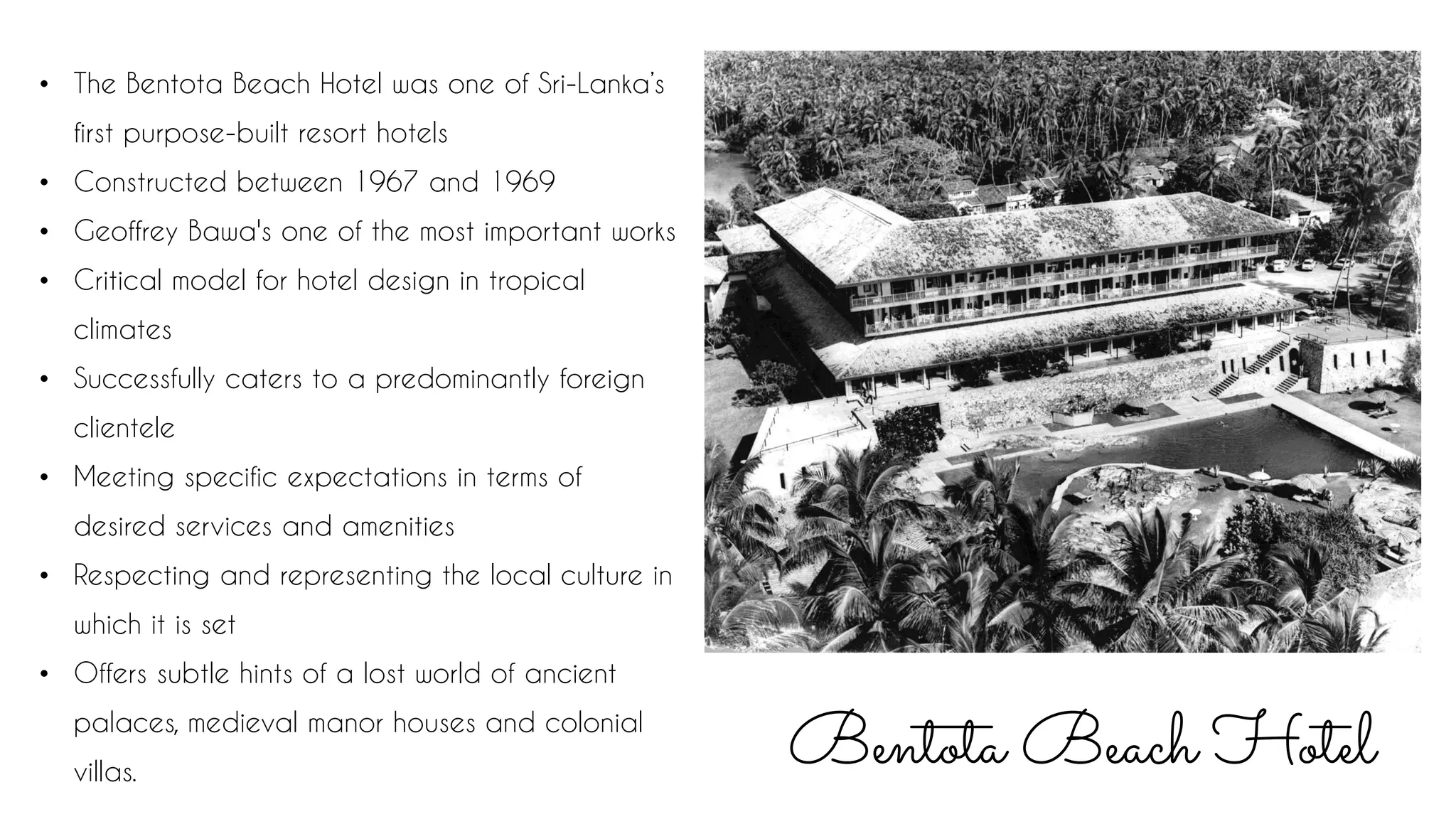
• The Bentota Beach Hotel was one of Sri-Lanka’s
first purpose-built resort hotels
• Constructed between 1967 and 1969
• Geoffrey Bawa's one of the most important works
• Critical model for hotel design in tropical
climates
• Successfully caters to a predominantly foreign
clientele
• Meeting specific expectations in terms of
desired services and amenities
• Respecting and representing the local culture in
which it is set
• Offers subtle hints of a lost world of ancient
palaces, medieval manor houses and colonial
villas.
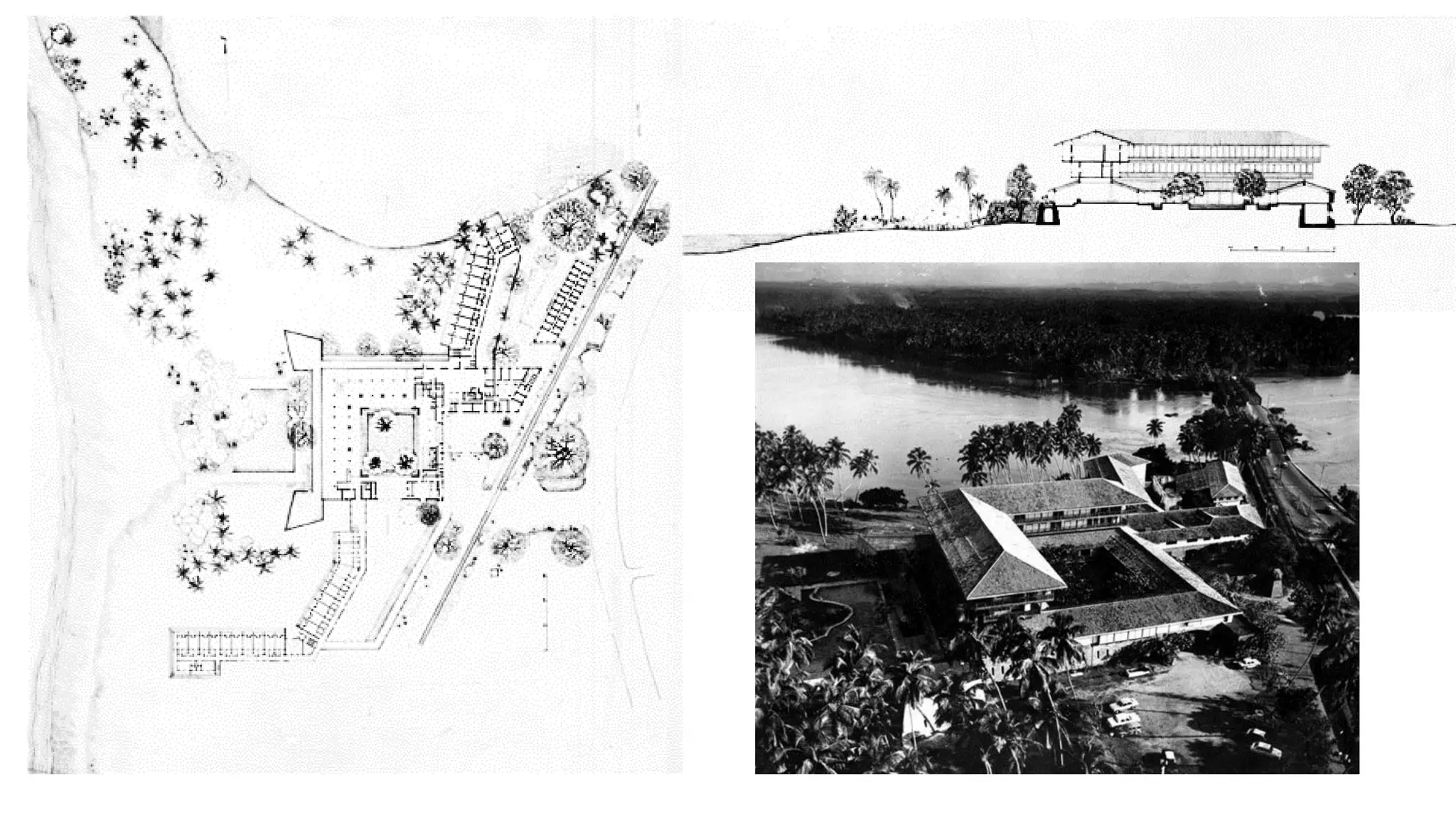
The hotel is located on a unique and picturesque site between two beaches in Bentota, a sixty-kilometer drive south
of Colombo, Sri Lanka. The site is to the immediate southwest of a major bridge that crosses the Bentota River as it
passes within 200 meters of the Indian Ocean, creating a long and narrow spit of land to the northwest of the site.
The Colombo-Galle highway, the road that crosses the Bentota River via the steel-frame bridge, bounds the hotel
property along its eastern edge. The western edge of the site is defined by the coastline of the Indian Ocean, and
the north by that of the Bentota River.
TheLocation……
The building’s apparent simplicity belies its spatial
complexity and the subtleties of its section. In plan it
recalls Le Corbusier's design for the Monastery of
LaTourette: the main reception spaces at the summit
form an enfilade of rooms around a square courtyard,
above which two floors of bedrooms seem to float, with
their balconies facing out towards the sea. From these
balconies guests experience the tropical landscape
beyond the confines of the hotel - the thunder of the
ocean, flashes of sunlight on the swaying palm fronds,
the shriek of a peacock, the orange glow of the setting
sun as it slips below the horizon. But when they quit
their rooms they are confronted by the civilized
landscape of the courtyard below, where they smell the
spices of the evening meal and hear the chink of
glasses and the babble of foreign tongues.
“..pandered to the needs of the
modern tourist, playing on the
senses to create a unique and
unforgettable experience.”
Influence of Local Buddhist Architecture
The building is square in plan at the first level, excepting a trapezoidal extension of the northern gallery beyond the eastern
edge of the square. This projection contains service spaces for the adjacent public areas of the resort, out of the way of
the principal guest circulation and major ocean views. A simple ring of galleries surround a large open central courtyard,
the entirety of which is occupied by a large rectangular reflecting pool. The second and third levels are each L-shaped,
located atop the north and west galleries of the first level. The second and third levels are narrower in plan than the
galleries of the first level, yet Bawa elevates the floor plane of the second level above the pitched roof of the first level such
that the second level to appears to cantilever over the roof of the first. In turn, the balconies of the third level cantilever
beyond those of the second level. This building profile, reminiscent of an inverted pyramid, recalls a distinctively local
architectural tradition, seen in the palace at Padmanabhapuram and the Saman Devale temple at Ratnapura.
Sinhalese traditions of water bodies…
Building on Dutch Foundations…
The central building of the hotel is located atop an existing sand mound that
was previously the site of a colonial Dutch fortification. Bawa encased the
mound in a rubble podium. The massive stone walls are an architectural nod to
the history of Dutch fortification structures on the island, and spaces are
carved into the ground behind the walls for shopping arcades as well as
pedestrian circulation between the first level and the surrounding grounds.
The large open central courtyard is entirely occupied by a large
rectangular reflecting pool. The pool occupies approx. one quarter of
the floor area of the first level, and it is located just southeast of the
center of the plan in order to increase the relative size of the ocean-
facing northern and western galleries. Planters scattered as islands
within the central pool provide space for large trees to grow within
the courtyard. The leafy canopy of trees shades the central open
space and defines the ceiling of this calm interior room.
“His buildings in fact are themselves in the nature of landscapes, not only because they incorporate planting
and water and subtly contrived changes of form and level, but because incident follows incident after the
manner of a well composed landscape which is never without an element of surprise. Indeed they reflect the
continually varying texture of the Sri Lanka landscape itself.” – J.M. Richards*
The landscape ….
The site slopes down from the hill anchoring the
main hotel building toward the Indian Ocean at
the west. The elevational change allows the west
side of the first level of the building to form a
terrace that overlooks the large pool and outdoor
cafe on the ground level. The hotel restaurant is
located on the western side of the first level,
affording dramatic ocean views to diners.*J.M. Richards is a British architect and historian who was editor of
Architectural Review magazine from 1937 to 1971. He has written
many books, including the classic Introduction to Modern Architecture.
He now lives in London.
The Roofscape……
Bawa’s emphasis on roofs is one of his characteristics, which
because of the climate have always been the essence of Sri-
Lankan architecture. His frequent use of the traditional roof-tile
have always been noted and in Bentota Beach hotel, its
application is perhaps the best. He manipulates areas of tiled
roofscape with notable success. He uses with evident
naturalness the half-round clay roofing-tile that became part
of the local vernacular after being introduced into Sri Lanka
by the Portuguese in the sixteenth century.
A variety of natural materials were used
in the structure and decoration of the
hotel. All of the building materials were
locally sourced, as imports were heavily
restricted during the years in which the
hotel was constructed and was build
entirely by local contractors. The
materials selected were intended to age
well with time and exposure to the humid
tropical climate. Though Bawa hoped
that the building would be completely
exposed to the elements in the common
spaces, the client insisted that the first floor
restaurant and lounges be enclosed with
glass walls and air-conditioned.
The Material Palette……
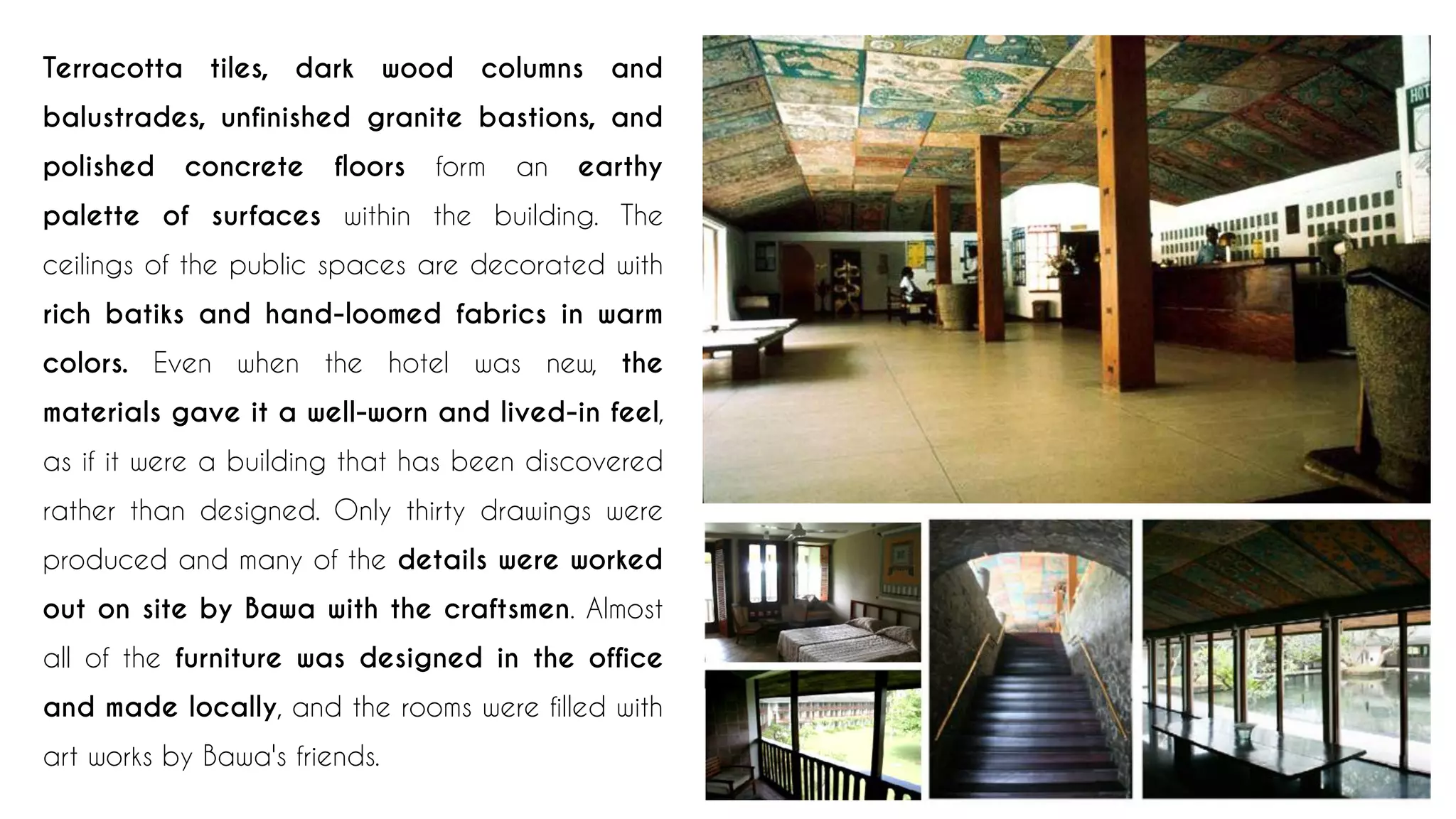
Terracotta tiles, dark wood columns and
balustrades, unfinished granite bastions, and
polished concrete floors form an earthy
palette of surfaces within the building. The
ceilings of the public spaces are decorated with
rich batiks and hand-loomed fabrics in warm
colors. Even when the hotel was new, the
materials gave it a well-worn and lived-in feel,
as if it were a building that has been discovered
rather than designed. Only thirty drawings were
produced and many of the details were worked
out on site by Bawa with the craftsmen. Almost
all of the furniture was designed in the office
and made locally, and the rooms were filled with
art works by Bawa's friends.
The Monologue
Some pictures of Bawa’s other works……
Ruhunu University
Typical roof under construction.Detail of roof tiling
RuhunuUniversity
Triton Hotel
Triton Hotel
Dining room with painted ceiling.Lobby area around the pool.
Interior courtyard with upstairs passage way
Garden patio outside the ground floor
TritonHotel

Geoffrey Bawa - Bentota Beach Hotel Analysis

  • 1.
    The master thathe is…… Geoffrey Bawa Bentota Beach Hotel: Critical analysis of Contemporary Vernacular Architecture in Geoffrey Bawa’s works A presentation by Sukanya Chatterjee
  • 2.
    Bentota Beach Hotel •The Bentota Beach Hotel was one of Sri-Lanka’s first purpose-built resort hotels • Constructed between 1967 and 1969 • Geoffrey Bawa's one of the most important works • Critical model for hotel design in tropical climates • Successfully caters to a predominantly foreign clientele • Meeting specific expectations in terms of desired services and amenities • Respecting and representing the local culture in which it is set • Offers subtle hints of a lost world of ancient palaces, medieval manor houses and colonial villas.
  • 3.
    The hotel islocated on a unique and picturesque site between two beaches in Bentota, a sixty-kilometer drive south of Colombo, Sri Lanka. The site is to the immediate southwest of a major bridge that crosses the Bentota River as it passes within 200 meters of the Indian Ocean, creating a long and narrow spit of land to the northwest of the site. The Colombo-Galle highway, the road that crosses the Bentota River via the steel-frame bridge, bounds the hotel property along its eastern edge. The western edge of the site is defined by the coastline of the Indian Ocean, and the north by that of the Bentota River. TheLocation……
  • 4.
    The building’s apparentsimplicity belies its spatial complexity and the subtleties of its section. In plan it recalls Le Corbusier's design for the Monastery of LaTourette: the main reception spaces at the summit form an enfilade of rooms around a square courtyard, above which two floors of bedrooms seem to float, with their balconies facing out towards the sea. From these balconies guests experience the tropical landscape beyond the confines of the hotel - the thunder of the ocean, flashes of sunlight on the swaying palm fronds, the shriek of a peacock, the orange glow of the setting sun as it slips below the horizon. But when they quit their rooms they are confronted by the civilized landscape of the courtyard below, where they smell the spices of the evening meal and hear the chink of glasses and the babble of foreign tongues. “..pandered to the needs of the modern tourist, playing on the senses to create a unique and unforgettable experience.”
  • 6.
    Influence of LocalBuddhist Architecture The building is square in plan at the first level, excepting a trapezoidal extension of the northern gallery beyond the eastern edge of the square. This projection contains service spaces for the adjacent public areas of the resort, out of the way of the principal guest circulation and major ocean views. A simple ring of galleries surround a large open central courtyard, the entirety of which is occupied by a large rectangular reflecting pool. The second and third levels are each L-shaped, located atop the north and west galleries of the first level. The second and third levels are narrower in plan than the galleries of the first level, yet Bawa elevates the floor plane of the second level above the pitched roof of the first level such that the second level to appears to cantilever over the roof of the first. In turn, the balconies of the third level cantilever beyond those of the second level. This building profile, reminiscent of an inverted pyramid, recalls a distinctively local architectural tradition, seen in the palace at Padmanabhapuram and the Saman Devale temple at Ratnapura.
  • 7.
    Sinhalese traditions ofwater bodies… Building on Dutch Foundations… The central building of the hotel is located atop an existing sand mound that was previously the site of a colonial Dutch fortification. Bawa encased the mound in a rubble podium. The massive stone walls are an architectural nod to the history of Dutch fortification structures on the island, and spaces are carved into the ground behind the walls for shopping arcades as well as pedestrian circulation between the first level and the surrounding grounds. The large open central courtyard is entirely occupied by a large rectangular reflecting pool. The pool occupies approx. one quarter of the floor area of the first level, and it is located just southeast of the center of the plan in order to increase the relative size of the ocean- facing northern and western galleries. Planters scattered as islands within the central pool provide space for large trees to grow within the courtyard. The leafy canopy of trees shades the central open space and defines the ceiling of this calm interior room.
  • 8.
    “His buildings infact are themselves in the nature of landscapes, not only because they incorporate planting and water and subtly contrived changes of form and level, but because incident follows incident after the manner of a well composed landscape which is never without an element of surprise. Indeed they reflect the continually varying texture of the Sri Lanka landscape itself.” – J.M. Richards* The landscape …. The site slopes down from the hill anchoring the main hotel building toward the Indian Ocean at the west. The elevational change allows the west side of the first level of the building to form a terrace that overlooks the large pool and outdoor cafe on the ground level. The hotel restaurant is located on the western side of the first level, affording dramatic ocean views to diners.*J.M. Richards is a British architect and historian who was editor of Architectural Review magazine from 1937 to 1971. He has written many books, including the classic Introduction to Modern Architecture. He now lives in London.
  • 9.
    The Roofscape…… Bawa’s emphasison roofs is one of his characteristics, which because of the climate have always been the essence of Sri- Lankan architecture. His frequent use of the traditional roof-tile have always been noted and in Bentota Beach hotel, its application is perhaps the best. He manipulates areas of tiled roofscape with notable success. He uses with evident naturalness the half-round clay roofing-tile that became part of the local vernacular after being introduced into Sri Lanka by the Portuguese in the sixteenth century.
  • 10.
    A variety ofnatural materials were used in the structure and decoration of the hotel. All of the building materials were locally sourced, as imports were heavily restricted during the years in which the hotel was constructed and was build entirely by local contractors. The materials selected were intended to age well with time and exposure to the humid tropical climate. Though Bawa hoped that the building would be completely exposed to the elements in the common spaces, the client insisted that the first floor restaurant and lounges be enclosed with glass walls and air-conditioned. The Material Palette……
  • 11.
    Terracotta tiles, darkwood columns and balustrades, unfinished granite bastions, and polished concrete floors form an earthy palette of surfaces within the building. The ceilings of the public spaces are decorated with rich batiks and hand-loomed fabrics in warm colors. Even when the hotel was new, the materials gave it a well-worn and lived-in feel, as if it were a building that has been discovered rather than designed. Only thirty drawings were produced and many of the details were worked out on site by Bawa with the craftsmen. Almost all of the furniture was designed in the office and made locally, and the rooms were filled with art works by Bawa's friends.
  • 12.
    The Monologue Some picturesof Bawa’s other works……
  • 22.
  • 23.
    Typical roof underconstruction.Detail of roof tiling RuhunuUniversity
  • 24.
  • 25.
    Triton Hotel Dining roomwith painted ceiling.Lobby area around the pool.
  • 26.
    Interior courtyard withupstairs passage way Garden patio outside the ground floor TritonHotel