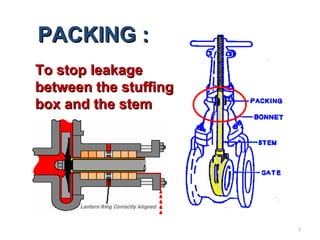
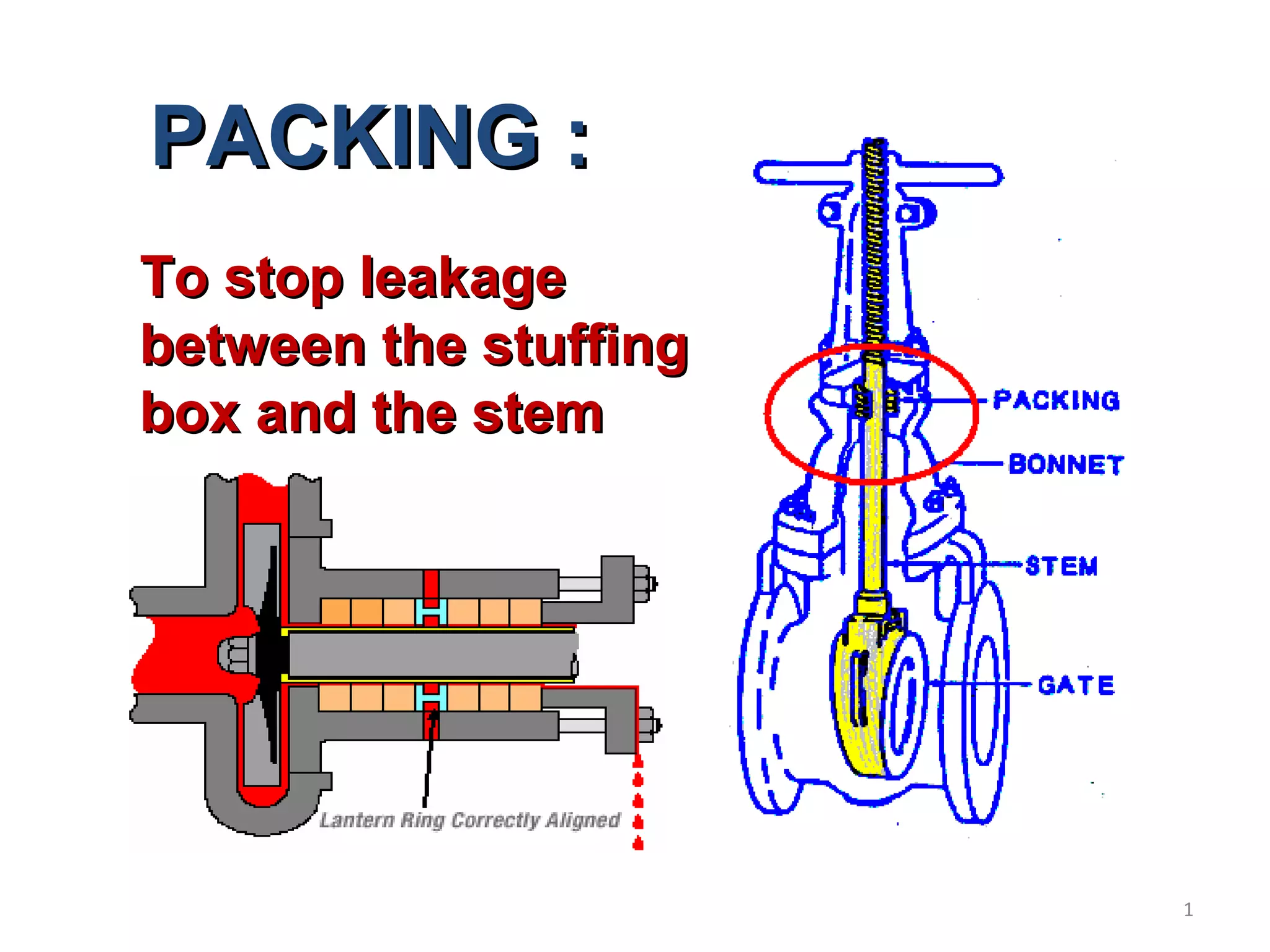
PACKING :PACKING :
To stop leakageTo stop leakage
between the stuffingbetween the stuffing
box and the stembox and the stem
1
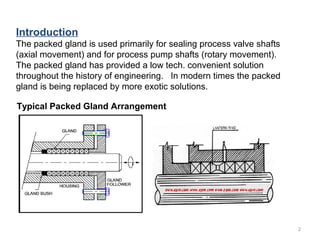
Introduction
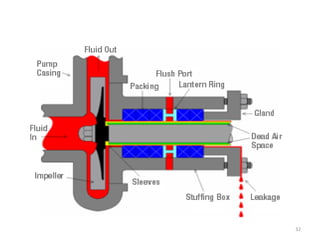
The packed gland is used primarily for sealing process valve shafts
(axial movement) and for process pump shafts (rotary movement).
The packed gland has provided a low tech. convenient solution
throughout the history of engineering. In modern times the packed
gland is being replaced by more exotic solutions.
Typical Packed Gland Arrangement
2
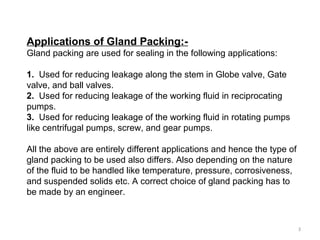
Applications of Gland Packing:-
Gland packing are used for sealing in the following applications:
1. Used for reducing leakage along the stem in Globe valve, Gate
valve, and ball valves.
2. Used for reducing leakage of the working fluid in reciprocating
pumps.
3. Used for reducing leakage of the working fluid in rotating pumps
like centrifugal pumps, screw, and gear pumps.
All the above are entirely different applications and hence the type of
gland packing to be used also differs. Also depending on the nature
of the fluid to be handled like temperature, pressure, corrosiveness,
and suspended solids etc. A correct choice of gland packing has to
be made by an engineer.
3
Pumps:-
 The packed gland seal for pump applications is now rarely fitted
to new pumps. This is due to it's high maintenance requirements.
 When fitted it is mostly used in conjunction with long coupled
bed plate mounted pumps. Specific operating conditions require
distinctly different types of packed gland seals.
 They require regular checks and maintenance adjustments.
Proper lubrication of the gland packing requires a certain
leakage rate.
 Special manufacturers recommendation's are to be observed
individually. Service life expectancy is between 1 and 2 years,
this can sometimes extend to several years on favorable
conditions. Extremely bad fluid conditions (sediments, additives,
overheating) can however drastically cut short their service life.
 Packed glands should preferably be used in conjunction with
shaft sleeves in order to avoid damage to the shaft by aggressive
fluids or due to improper treatment of the packed gland.
4
Valves:-
 The packed gland is still widely used for stem sealing of
various types of valves including gate valves, globe valves,
and ball valves.
 The packed gland provides a low cost option with the
capabilities of sealing under a wide range of operating
conditions with a wide range of fluids by selecting appropriate
packing materials.
 A packed gland is often used in conjunction with another
type of seal or fluid containment e.g. an o-ring seals, bellows
containment etc.
The gland packing generally creeps over time and therefore
needs to be regularly tightened to maintain the seal.
 The packing can be continuously spring loaded using disc
springs or similar to extend the maintenance period.
5
General :-
The properties of a packing system required for good sealing
and trouble free operation include :-

Compatibility with the working fluid at the operating
temperatures

Plasticity to conform to the shaft under the influence of the
gland force

Lubricant insoluble and immiscible with the sealed fluid

Non-abrasive to minimize shaft erosion

Non-corrosive to avoid damage to the shaft of housing

Wear resistant

Retain properties over time
6
Packing Materials:-
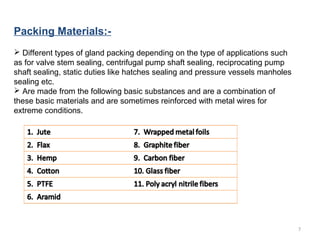
 Different types of gland packing depending on the type of applications such
as for valve stem sealing, centrifugal pump shaft sealing, reciprocating pump
shaft sealing, static duties like hatches sealing and pressure vessels manholes
sealing etc.
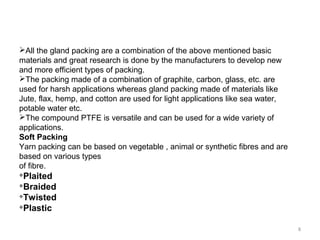
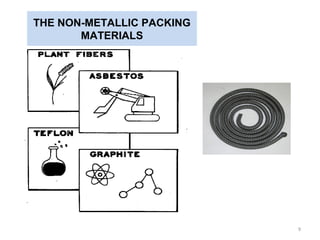
 Are made from the following basic substances and are a combination of
these basic materials and are sometimes reinforced with metal wires for
extreme conditions.
7
All the gland packing are a combination of the above mentioned basic
materials and great research is done by the manufacturers to develop new
and more efficient types of packing.
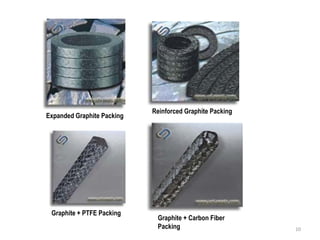
The packing made of a combination of graphite, carbon, glass, etc. are
used for harsh applications whereas gland packing made of materials like
Jute, flax, hemp, and cotton are used for light applications like sea water,
potable water etc.
The compound PTFE is versatile and can be used for a wide variety of
applications.
Soft Packing
Yarn packing can be based on vegetable , animal or synthetic fibres and are
based on various types
of fibre.

Plaited

Braided

Twisted

Plastic
8
THE NON-METALLIC PACKING
MATERIALS
9
Expanded Graphite Packing
Reinforced Graphite Packing
Graphite + PTFE Packing
Graphite + Carbon Fiber
Packing 10
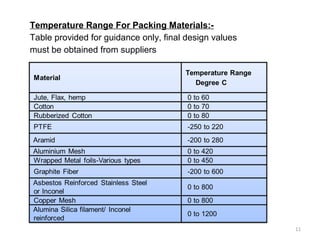
Temperature Range For Packing Materials:-
Table provided for guidance only, final design values
must be obtained from suppliers
11
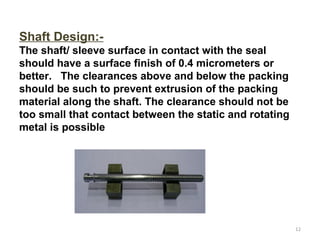
Shaft Design:-
The shaft/ sleeve surface in contact with the seal
should have a surface finish of 0.4 micrometers or
better. The clearances above and below the packing
should be such to prevent extrusion of the packing
material along the shaft. The clearance should not be
too small that contact between the static and rotating
metal is possible
12
MAINTENANCE OF VALVE COMPONENT & PARTS:-
Replacement of Gland Packing:
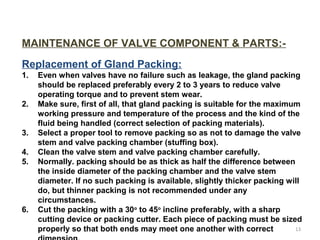
1. Even when valves have no failure such as leakage, the gland packing
should be replaced preferably every 2 to 3 years to reduce valve
operating torque and to prevent stem wear.
2. Make sure, first of all, that gland packing is suitable for the maximum
working pressure and temperature of the process and the kind of the
fluid being handled (correct selection of packing materials).
3. Select a proper tool to remove packing so as not to damage the valve
stem and valve packing chamber (stuffing box).
4. Clean the valve stem and valve packing chamber carefully.
5. Normally. packing should be as thick as half the difference between
the inside diameter of the packing chamber and the valve stem
diameter. If no such packing is available, slightly thicker packing will
do, but thinner packing is not recommended under any
circumstances.
6. Cut the packing with a 30o
to 45o
incline preferably, with a sharp
cutting device or packing cutter. Each piece of packing must be sized
properly so that both ends may meet one another with correct 13
Replacement of Gland Packing: cont:-
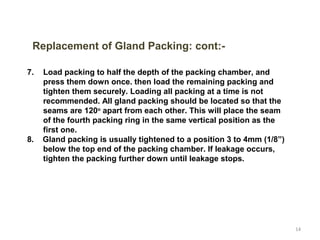
7. Load packing to half the depth of the packing chamber, and
press them down once. then load the remaining packing and
tighten them securely. Loading all packing at a time is not
recommended. All gland packing should be located so that the
seams are 120o
apart from each other. This will place the seam
of the fourth packing ring in the same vertical position as the
first one.
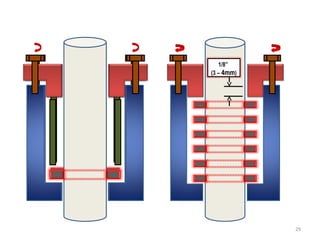
8. Gland packing is usually tightened to a position 3 to 4mm (1/8”)
below the top end of the packing chamber. If leakage occurs,
tighten the packing further down until leakage stops.
14
How to Remove Gland Packing:-
 Removing a gland packing can be very tough sometimes,
especially if it is old and well set, you need to have specially
contoured tools.
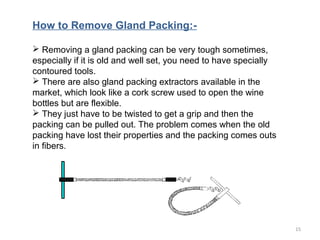
 There are also gland packing extractors available in the
market, which look like a cork screw used to open the wine
bottles but are flexible.
 They just have to be twisted to get a grip and then the
packing can be pulled out. The problem comes when the old
packing have lost their properties and the packing comes outs
in fibers.
15
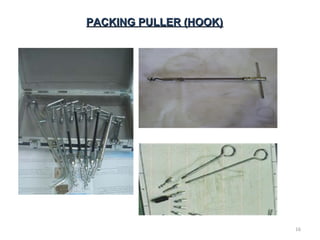
PACKING PULLER (HOOK)PACKING PULLER (HOOK)
16
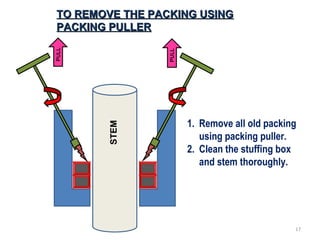
STEM
TO REMOVE THE PACKING USINGTO REMOVE THE PACKING USING
PACKING PULLERPACKING PULLER
1. Remove all old packing
using packing puller.
2. Clean the stuffing box
and stem thoroughly.
17
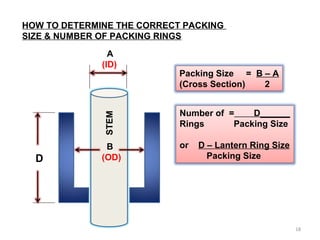
STEM
A
(ID)
B
(OD)D
HOW TO DETERMINE THE CORRECT PACKING
SIZE & NUMBER OF PACKING RINGS
Packing Size = B – A
(Cross Section) 2
Number of = D______
Rings Packing Size
or D – Lantern Ring Size
Packing Size
18
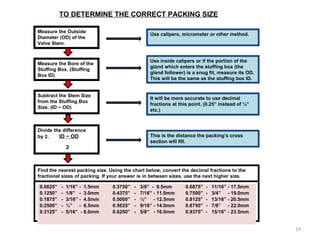
Use inside calipers or if the portion of the
gland which enters the stuffing box (the
gland follower) is a snug fit, measure its OD.
This will be the same as the stuffing box ID.
Use calipers, micrometer or other method.
Subtract the Stem Size
from the Stuffing Box
Size. (ID − OD)
Divide the difference
by 2. ID − OD
2
It will be more accurate to use decimal
fractions at this point. (0.25” instead of ¼”
etc.)
This is the distance the packing’s cross
section will fill.
Measure the Outside
Diameter (OD) of the
Valve Stem.
Measure the Bore of the
Stuffing Box. (Stuffing
Box ID)
Find the nearest packing size. Using the chart below, convert the decimal fractions to the
fractional sizes of packing. If your answer is in between sizes, use the next higher size.
0.0625” - 1/16” - 1.5mm
0.1250” - 1/8” - 3.0mm
0.1875” - 3/16” - 4.5mm
0.2500” - ¼” - 6.5mm
0.3125” - 5/16” - 8.0mm
0.3750” - 3/8” - 9.5mm
0.4375” - 7/16” - 11.0mm
0.5000” - ½” - 12.5mm
0.5625” - 9/16” - 14.0mm
0.6250” - 5/8” - 16.0mm
0.6875” - 11/16” - 17.5mm
0.7500” - 3/4” - 19.0mm
0.8125” - 13/16” - 20.5mm
0.8750” - 7/8” - 22.0mm
0.9375” - 15/16” - 23.5mm
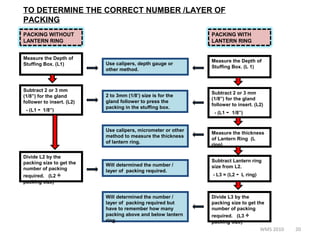
TO DETERMINE THE CORRECT PACKING SIZE
19
2 to 3mm (1/8’) size is for the
gland follower to press the
packing in the stuffing box.
Use calipers, depth gauge or
other method.
Subtract Lantern ring
size from L2.
- L3 = (L2 - L ring)
Use calipers, micrometer or other
method to measure the thickness
of lantern ring.
Will determined the number /
layer of packing required.
Measure the Depth of
Stuffing Box. (L1)
Subtract 2 or 3 mm
(1/8”) for the gland
follower to insert. (L2)
- (L1 - 1/8”)
TO DETERMINE THE CORRECT NUMBER /LAYER OF
PACKING
Divide L2 by the
packing size to get the
number of packing
required. (L2 ÷
packing size)
Measure the Depth of
Stuffing Box. (L 1)
Subtract 2 or 3 mm
(1/8”) for the gland
follower to insert. (L2)
- (L1 - 1/8”)
Measure the thickness
of Lantern Ring (L
ring)
PACKING WITHOUT
LANTERN RING
PACKING WITH
LANTERN RING
Divide L3 by the
packing size to get the
number of packing
required. (L3 ÷
packing size)
Will determined the number /
layer of packing required but
have to remember how many
packing above and below lantern
ring.
20WMS 2010
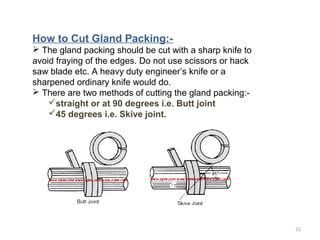
How to Cut Gland Packing:-
 The gland packing should be cut with a sharp knife to
avoid fraying of the edges. Do not use scissors or hack
saw blade etc. A heavy duty engineer’s knife or a
sharpened ordinary knife would do.
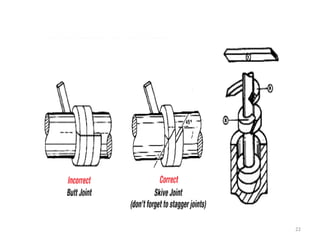
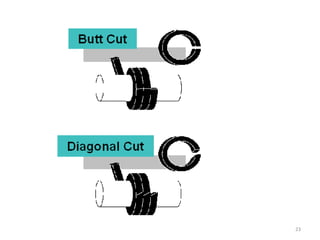
 There are two methods of cutting the gland packing:-
straight or at 90 degrees i.e. Butt joint
45 degrees i.e. Skive joint.
21
22
23
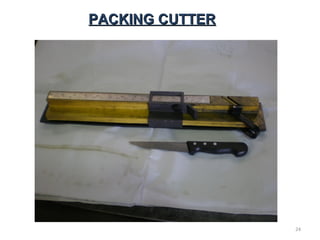
PACKING CUTTERPACKING CUTTER
24
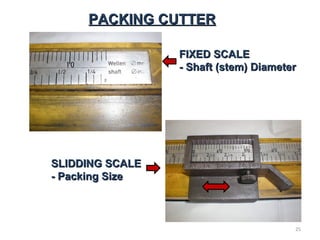
PACKING CUTTERPACKING CUTTER
FIXED SCALEFIXED SCALE
- Shaft (stem) Diameter- Shaft (stem) Diameter
SLIDDING SCALESLIDDING SCALE
- Packing Size- Packing Size
25
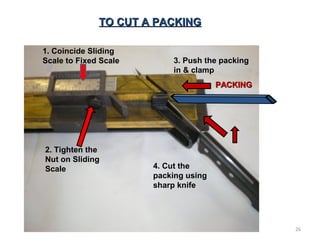
TO CUT A PACKINGTO CUT A PACKING
PACKINGPACKING
1. Coincide Sliding
Scale to Fixed Scale
2. Tighten the
Nut on Sliding
Scale
3. Push the packing
in & clamp
4. Cut the
packing using
sharp knife
26
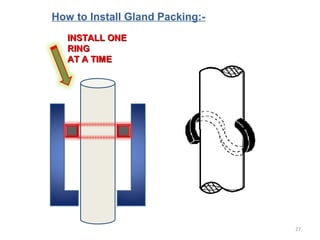
INSTALL ONEINSTALL ONE
RINGRING
AT A TIMEAT A TIME
How to Install Gland Packing:-
27
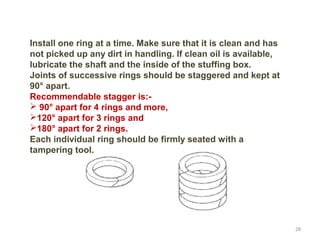
Install one ring at a time. Make sure that it is clean and has
not picked up any dirt in handling. If clean oil is available,
lubricate the shaft and the inside of the stuffing box.
Joints of successive rings should be staggered and kept at
90° apart.
Recommendable stagger is:-
 90° apart for 4 rings and more,
120° apart for 3 rings and
180° apart for 2 rings.
Each individual ring should be firmly seated with a
tampering tool.
28
1/8”
(3 – 4mm)
29
The Lantern Ring and its Purpose:-
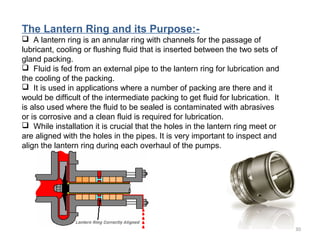
 A lantern ring is an annular ring with channels for the passage of
lubricant, cooling or flushing fluid that is inserted between the two sets of
gland packing.
 Fluid is fed from an external pipe to the lantern ring for lubrication and
the cooling of the packing.
 It is used in applications where a number of packing are there and it
would be difficult of the intermediate packing to get fluid for lubrication. It
is also used where the fluid to be sealed is contaminated with abrasives
or is corrosive and a clean fluid is required for lubrication.
 While installation it is crucial that the holes in the lantern ring meet or
are aligned with the holes in the pipes. It is very important to inspect and
align the lantern ring during each overhaul of the pumps.
30
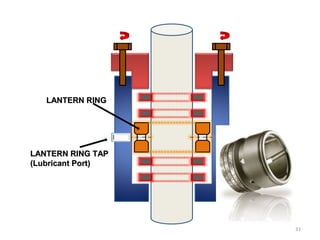
LANTERN RINGLANTERN RING
LANTERN RING TAPLANTERN RING TAP
(Lubricant Port)(Lubricant Port)
31
32
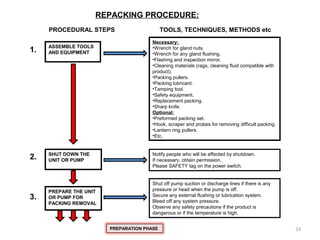
ASSEMBLE TOOLS
AND EQUIPMENT
Necessary:
•Wrench for gland nuts.
•Wrench for any gland flushing.
•Flashing and inspection mirror.
•Cleaning materials (rags, cleaning fluid compatible with
product).
•Packing pullers.
•Packing lubricant.
•Tamping tool.
•Safety equipment.
•Replacement packing.
•Sharp knife.
Optional:
•Preformed packing set.
•Hook, scraper and probes for removing difficult packing.
•Lantern ring pullers.
•Etc.
SHUT DOWN THE
UNIT OR PUMP
PREPARE THE UNIT
OR PUMP FOR
PACKING REMOVAL
Notify people who will be affected by shutdown.
If necessary, obtain permission.
Please SAFETY tag on the power switch.
PROCEDURAL STEPS TOOLS, TECHNIQUES, METHODS etc
Shut off pump suction or discharge lines if there is any
pressure or head when the pump is off.
Secure any external flushing or lubrication system.
Bleed off any system pressure.
Observe any safety precautions if the product is
dangerous or if the temperature is high.
REPACKING PROCEDURE:
1.
2.
3.
PREPARATION PHASE 33
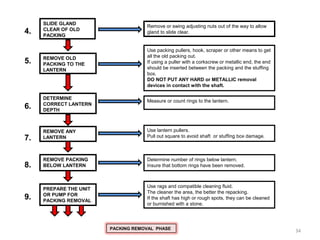
SLIDE GLAND
CLEAR OF OLD
PACKING
Remove or swing adjusting nuts out of the way to allow
gland to slide clear.
REMOVE OLD
PACKING TO THE
LANTERN
PREPARE THE UNIT
OR PUMP FOR
PACKING REMOVAL
Use packing pullers, hook, scraper or other means to get
all the old packing out.
If using a puller with a corkscrew or metallic end, the end
should be inserted between the packing and the stuffing
box.
DO NOT PUT ANY HARD or METALLIC removal
devices in contact with the shaft.
Determine number of rings below lantern.
Insure that bottom rings have been removed.
4.
8.
9.
DETERMINE
CORRECT LANTERN
DEPTH
Measure or count rings to the lantern.
REMOVE ANY
LANTERN
Use lantern pullers.
Pull out square to avoid shaft or stuffing box damage.
Use rags and compatible cleaning fluid.
The cleaner the area, the better the repacking.
If the shaft has high or rough spots, they can be cleaned
or burnished with a stone.
REMOVE PACKING
BELOW LANTERN
5.
6.
7.
PACKING REMOVAL PHASE
34
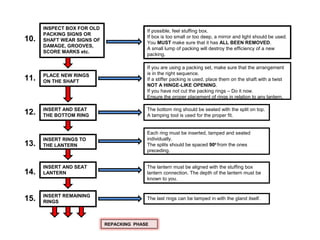
INSPECT BOX FOR OLD
PACKING SIGNS OR
SHAFT WEAR SIGNS OF
DAMAGE, GROOVES,
SCORE MARKS etc.
If possible, feel stuffing box.
If box is too small or too deep, a mirror and light should be used.
You MUST make sure that it has ALL BEEN REMOVED.
A small lump of packing will destroy the efficiency of a new
packing.
PLACE NEW RINGS
ON THE SHAFT
INSERT REMAINING
RINGS
If you are using a packing set, make sure that the arrangement
is in the right sequence.
If a stiffer packing is used, place them on the shaft with a twist
NOT A HINGE-LIKE OPENING.
If you have not cut the packing rings – Do it now.
Ensure the proper placement of rings in relation to any lantern.
The lantern must be aligned with the stuffing box
lantern connection. The depth of the lantern must be
known to you.
10.
14.
15.
INSERT AND SEAT
THE BOTTOM RING
The bottom ring should be seated with the split on top.
A tamping tool is used for the proper fit.
INSERT RINGS TO
THE LANTERN
Each ring must be inserted, tamped and seated
individually.
The splits should be spaced 900
from the ones
preceding.
The last rings can be tamped in with the gland itself.
INSERT AND SEAT
LANTERN
11.
12.
13.
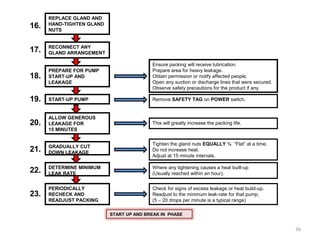
REPACKING PHASE
REPLACE GLAND AND
HAND-TIGHTEN GLAND
NUTS
Ensure packing will receive lubrication.
Prepare area for heavy leakage.
Obtain permission or notify affected people.
Open any suction or discharge lines that were secured.
Observe safety precautions for the product if any.
RECONNECT ANY
GLAND ARRANGEMENT
PERIODICALLY
RECHECK AND
READJUST PACKING
Remove SAFETY TAG on POWER switch.
Where any tightening causes a heat built-up
(Usually reached within an hour).
16.
22.
23.
PREPARE FOR PUMP
START-UP AND
LEAKAGE
This will greatly increase the packing life.
START-UP PUMP
Tighten the gland nuts EQUALLY ½ “Flat” at a time.
Do not increase heat.
Adjust at 15 minute intervals.
Check for signs of excess leakage or heat build-up.
Readjust to the minimum leak-rate for that pump.
(5 – 20 drops per minute is a typical range)
ALLOW GENEROUS
LEAKAGE FOR
15 MINUTES
18.
19.
20.
START UP AND BREAK IN PHASE
GRADUALLY CUT
DOWN LEAKAGE
DETERMINE MINIMUM
LEAK RATE
17.
21.
36

valve maintenance-packing-replacement

  • 1.
    PACKING :PACKING : Tostop leakageTo stop leakage between the stuffingbetween the stuffing box and the stembox and the stem 1
  • 2.
    Introduction The packed glandis used primarily for sealing process valve shafts (axial movement) and for process pump shafts (rotary movement). The packed gland has provided a low tech. convenient solution throughout the history of engineering. In modern times the packed gland is being replaced by more exotic solutions. Typical Packed Gland Arrangement 2
  • 3.
    Applications of GlandPacking:- Gland packing are used for sealing in the following applications: 1. Used for reducing leakage along the stem in Globe valve, Gate valve, and ball valves. 2. Used for reducing leakage of the working fluid in reciprocating pumps. 3. Used for reducing leakage of the working fluid in rotating pumps like centrifugal pumps, screw, and gear pumps. All the above are entirely different applications and hence the type of gland packing to be used also differs. Also depending on the nature of the fluid to be handled like temperature, pressure, corrosiveness, and suspended solids etc. A correct choice of gland packing has to be made by an engineer. 3
  • 4.
    Pumps:-  The packedgland seal for pump applications is now rarely fitted to new pumps. This is due to it's high maintenance requirements.  When fitted it is mostly used in conjunction with long coupled bed plate mounted pumps. Specific operating conditions require distinctly different types of packed gland seals.  They require regular checks and maintenance adjustments. Proper lubrication of the gland packing requires a certain leakage rate.  Special manufacturers recommendation's are to be observed individually. Service life expectancy is between 1 and 2 years, this can sometimes extend to several years on favorable conditions. Extremely bad fluid conditions (sediments, additives, overheating) can however drastically cut short their service life.  Packed glands should preferably be used in conjunction with shaft sleeves in order to avoid damage to the shaft by aggressive fluids or due to improper treatment of the packed gland. 4
  • 5.
    Valves:-  The packedgland is still widely used for stem sealing of various types of valves including gate valves, globe valves, and ball valves.  The packed gland provides a low cost option with the capabilities of sealing under a wide range of operating conditions with a wide range of fluids by selecting appropriate packing materials.  A packed gland is often used in conjunction with another type of seal or fluid containment e.g. an o-ring seals, bellows containment etc. The gland packing generally creeps over time and therefore needs to be regularly tightened to maintain the seal.  The packing can be continuously spring loaded using disc springs or similar to extend the maintenance period. 5
  • 6.
    General :- The propertiesof a packing system required for good sealing and trouble free operation include :-  Compatibility with the working fluid at the operating temperatures  Plasticity to conform to the shaft under the influence of the gland force  Lubricant insoluble and immiscible with the sealed fluid  Non-abrasive to minimize shaft erosion  Non-corrosive to avoid damage to the shaft of housing  Wear resistant  Retain properties over time 6
  • 7.
    Packing Materials:-  Differenttypes of gland packing depending on the type of applications such as for valve stem sealing, centrifugal pump shaft sealing, reciprocating pump shaft sealing, static duties like hatches sealing and pressure vessels manholes sealing etc.  Are made from the following basic substances and are a combination of these basic materials and are sometimes reinforced with metal wires for extreme conditions. 7
  • 8.
    All the glandpacking are a combination of the above mentioned basic materials and great research is done by the manufacturers to develop new and more efficient types of packing. The packing made of a combination of graphite, carbon, glass, etc. are used for harsh applications whereas gland packing made of materials like Jute, flax, hemp, and cotton are used for light applications like sea water, potable water etc. The compound PTFE is versatile and can be used for a wide variety of applications. Soft Packing Yarn packing can be based on vegetable , animal or synthetic fibres and are based on various types of fibre.  Plaited  Braided  Twisted  Plastic 8
  • 9.
  • 10.
    Expanded Graphite Packing ReinforcedGraphite Packing Graphite + PTFE Packing Graphite + Carbon Fiber Packing 10
  • 11.
    Temperature Range ForPacking Materials:- Table provided for guidance only, final design values must be obtained from suppliers 11
  • 12.
    Shaft Design:- The shaft/sleeve surface in contact with the seal should have a surface finish of 0.4 micrometers or better. The clearances above and below the packing should be such to prevent extrusion of the packing material along the shaft. The clearance should not be too small that contact between the static and rotating metal is possible 12
  • 13.
    MAINTENANCE OF VALVECOMPONENT & PARTS:- Replacement of Gland Packing: 1. Even when valves have no failure such as leakage, the gland packing should be replaced preferably every 2 to 3 years to reduce valve operating torque and to prevent stem wear. 2. Make sure, first of all, that gland packing is suitable for the maximum working pressure and temperature of the process and the kind of the fluid being handled (correct selection of packing materials). 3. Select a proper tool to remove packing so as not to damage the valve stem and valve packing chamber (stuffing box). 4. Clean the valve stem and valve packing chamber carefully. 5. Normally. packing should be as thick as half the difference between the inside diameter of the packing chamber and the valve stem diameter. If no such packing is available, slightly thicker packing will do, but thinner packing is not recommended under any circumstances. 6. Cut the packing with a 30o to 45o incline preferably, with a sharp cutting device or packing cutter. Each piece of packing must be sized properly so that both ends may meet one another with correct 13
  • 14.
    Replacement of GlandPacking: cont:- 7. Load packing to half the depth of the packing chamber, and press them down once. then load the remaining packing and tighten them securely. Loading all packing at a time is not recommended. All gland packing should be located so that the seams are 120o apart from each other. This will place the seam of the fourth packing ring in the same vertical position as the first one. 8. Gland packing is usually tightened to a position 3 to 4mm (1/8”) below the top end of the packing chamber. If leakage occurs, tighten the packing further down until leakage stops. 14
  • 15.
    How to RemoveGland Packing:-  Removing a gland packing can be very tough sometimes, especially if it is old and well set, you need to have specially contoured tools.  There are also gland packing extractors available in the market, which look like a cork screw used to open the wine bottles but are flexible.  They just have to be twisted to get a grip and then the packing can be pulled out. The problem comes when the old packing have lost their properties and the packing comes outs in fibers. 15
  • 16.
  • 17.
    STEM TO REMOVE THEPACKING USINGTO REMOVE THE PACKING USING PACKING PULLERPACKING PULLER 1. Remove all old packing using packing puller. 2. Clean the stuffing box and stem thoroughly. 17
  • 18.
    STEM A (ID) B (OD)D HOW TO DETERMINETHE CORRECT PACKING SIZE & NUMBER OF PACKING RINGS Packing Size = B – A (Cross Section) 2 Number of = D______ Rings Packing Size or D – Lantern Ring Size Packing Size 18
  • 19.
    Use inside calipersor if the portion of the gland which enters the stuffing box (the gland follower) is a snug fit, measure its OD. This will be the same as the stuffing box ID. Use calipers, micrometer or other method. Subtract the Stem Size from the Stuffing Box Size. (ID − OD) Divide the difference by 2. ID − OD 2 It will be more accurate to use decimal fractions at this point. (0.25” instead of ¼” etc.) This is the distance the packing’s cross section will fill. Measure the Outside Diameter (OD) of the Valve Stem. Measure the Bore of the Stuffing Box. (Stuffing Box ID) Find the nearest packing size. Using the chart below, convert the decimal fractions to the fractional sizes of packing. If your answer is in between sizes, use the next higher size. 0.0625” - 1/16” - 1.5mm 0.1250” - 1/8” - 3.0mm 0.1875” - 3/16” - 4.5mm 0.2500” - ¼” - 6.5mm 0.3125” - 5/16” - 8.0mm 0.3750” - 3/8” - 9.5mm 0.4375” - 7/16” - 11.0mm 0.5000” - ½” - 12.5mm 0.5625” - 9/16” - 14.0mm 0.6250” - 5/8” - 16.0mm 0.6875” - 11/16” - 17.5mm 0.7500” - 3/4” - 19.0mm 0.8125” - 13/16” - 20.5mm 0.8750” - 7/8” - 22.0mm 0.9375” - 15/16” - 23.5mm TO DETERMINE THE CORRECT PACKING SIZE 19
  • 20.
    2 to 3mm(1/8’) size is for the gland follower to press the packing in the stuffing box. Use calipers, depth gauge or other method. Subtract Lantern ring size from L2. - L3 = (L2 - L ring) Use calipers, micrometer or other method to measure the thickness of lantern ring. Will determined the number / layer of packing required. Measure the Depth of Stuffing Box. (L1) Subtract 2 or 3 mm (1/8”) for the gland follower to insert. (L2) - (L1 - 1/8”) TO DETERMINE THE CORRECT NUMBER /LAYER OF PACKING Divide L2 by the packing size to get the number of packing required. (L2 ÷ packing size) Measure the Depth of Stuffing Box. (L 1) Subtract 2 or 3 mm (1/8”) for the gland follower to insert. (L2) - (L1 - 1/8”) Measure the thickness of Lantern Ring (L ring) PACKING WITHOUT LANTERN RING PACKING WITH LANTERN RING Divide L3 by the packing size to get the number of packing required. (L3 ÷ packing size) Will determined the number / layer of packing required but have to remember how many packing above and below lantern ring. 20WMS 2010
  • 21.
    How to CutGland Packing:-  The gland packing should be cut with a sharp knife to avoid fraying of the edges. Do not use scissors or hack saw blade etc. A heavy duty engineer’s knife or a sharpened ordinary knife would do.  There are two methods of cutting the gland packing:- straight or at 90 degrees i.e. Butt joint 45 degrees i.e. Skive joint. 21
  • 22.
  • 23.
  • 24.
  • 25.
    PACKING CUTTERPACKING CUTTER FIXEDSCALEFIXED SCALE - Shaft (stem) Diameter- Shaft (stem) Diameter SLIDDING SCALESLIDDING SCALE - Packing Size- Packing Size 25
  • 26.
    TO CUT APACKINGTO CUT A PACKING PACKINGPACKING 1. Coincide Sliding Scale to Fixed Scale 2. Tighten the Nut on Sliding Scale 3. Push the packing in & clamp 4. Cut the packing using sharp knife 26
  • 27.
    INSTALL ONEINSTALL ONE RINGRING ATA TIMEAT A TIME How to Install Gland Packing:- 27
  • 28.
    Install one ringat a time. Make sure that it is clean and has not picked up any dirt in handling. If clean oil is available, lubricate the shaft and the inside of the stuffing box. Joints of successive rings should be staggered and kept at 90° apart. Recommendable stagger is:-  90° apart for 4 rings and more, 120° apart for 3 rings and 180° apart for 2 rings. Each individual ring should be firmly seated with a tampering tool. 28
  • 29.
  • 30.
    The Lantern Ringand its Purpose:-  A lantern ring is an annular ring with channels for the passage of lubricant, cooling or flushing fluid that is inserted between the two sets of gland packing.  Fluid is fed from an external pipe to the lantern ring for lubrication and the cooling of the packing.  It is used in applications where a number of packing are there and it would be difficult of the intermediate packing to get fluid for lubrication. It is also used where the fluid to be sealed is contaminated with abrasives or is corrosive and a clean fluid is required for lubrication.  While installation it is crucial that the holes in the lantern ring meet or are aligned with the holes in the pipes. It is very important to inspect and align the lantern ring during each overhaul of the pumps. 30
  • 31.
    LANTERN RINGLANTERN RING LANTERNRING TAPLANTERN RING TAP (Lubricant Port)(Lubricant Port) 31
  • 32.
  • 33.
    ASSEMBLE TOOLS AND EQUIPMENT Necessary: •Wrenchfor gland nuts. •Wrench for any gland flushing. •Flashing and inspection mirror. •Cleaning materials (rags, cleaning fluid compatible with product). •Packing pullers. •Packing lubricant. •Tamping tool. •Safety equipment. •Replacement packing. •Sharp knife. Optional: •Preformed packing set. •Hook, scraper and probes for removing difficult packing. •Lantern ring pullers. •Etc. SHUT DOWN THE UNIT OR PUMP PREPARE THE UNIT OR PUMP FOR PACKING REMOVAL Notify people who will be affected by shutdown. If necessary, obtain permission. Please SAFETY tag on the power switch. PROCEDURAL STEPS TOOLS, TECHNIQUES, METHODS etc Shut off pump suction or discharge lines if there is any pressure or head when the pump is off. Secure any external flushing or lubrication system. Bleed off any system pressure. Observe any safety precautions if the product is dangerous or if the temperature is high. REPACKING PROCEDURE: 1. 2. 3. PREPARATION PHASE 33
  • 34.
    SLIDE GLAND CLEAR OFOLD PACKING Remove or swing adjusting nuts out of the way to allow gland to slide clear. REMOVE OLD PACKING TO THE LANTERN PREPARE THE UNIT OR PUMP FOR PACKING REMOVAL Use packing pullers, hook, scraper or other means to get all the old packing out. If using a puller with a corkscrew or metallic end, the end should be inserted between the packing and the stuffing box. DO NOT PUT ANY HARD or METALLIC removal devices in contact with the shaft. Determine number of rings below lantern. Insure that bottom rings have been removed. 4. 8. 9. DETERMINE CORRECT LANTERN DEPTH Measure or count rings to the lantern. REMOVE ANY LANTERN Use lantern pullers. Pull out square to avoid shaft or stuffing box damage. Use rags and compatible cleaning fluid. The cleaner the area, the better the repacking. If the shaft has high or rough spots, they can be cleaned or burnished with a stone. REMOVE PACKING BELOW LANTERN 5. 6. 7. PACKING REMOVAL PHASE 34
  • 35.
    INSPECT BOX FOROLD PACKING SIGNS OR SHAFT WEAR SIGNS OF DAMAGE, GROOVES, SCORE MARKS etc. If possible, feel stuffing box. If box is too small or too deep, a mirror and light should be used. You MUST make sure that it has ALL BEEN REMOVED. A small lump of packing will destroy the efficiency of a new packing. PLACE NEW RINGS ON THE SHAFT INSERT REMAINING RINGS If you are using a packing set, make sure that the arrangement is in the right sequence. If a stiffer packing is used, place them on the shaft with a twist NOT A HINGE-LIKE OPENING. If you have not cut the packing rings – Do it now. Ensure the proper placement of rings in relation to any lantern. The lantern must be aligned with the stuffing box lantern connection. The depth of the lantern must be known to you. 10. 14. 15. INSERT AND SEAT THE BOTTOM RING The bottom ring should be seated with the split on top. A tamping tool is used for the proper fit. INSERT RINGS TO THE LANTERN Each ring must be inserted, tamped and seated individually. The splits should be spaced 900 from the ones preceding. The last rings can be tamped in with the gland itself. INSERT AND SEAT LANTERN 11. 12. 13. REPACKING PHASE
  • 36.
    REPLACE GLAND AND HAND-TIGHTENGLAND NUTS Ensure packing will receive lubrication. Prepare area for heavy leakage. Obtain permission or notify affected people. Open any suction or discharge lines that were secured. Observe safety precautions for the product if any. RECONNECT ANY GLAND ARRANGEMENT PERIODICALLY RECHECK AND READJUST PACKING Remove SAFETY TAG on POWER switch. Where any tightening causes a heat built-up (Usually reached within an hour). 16. 22. 23. PREPARE FOR PUMP START-UP AND LEAKAGE This will greatly increase the packing life. START-UP PUMP Tighten the gland nuts EQUALLY ½ “Flat” at a time. Do not increase heat. Adjust at 15 minute intervals. Check for signs of excess leakage or heat build-up. Readjust to the minimum leak-rate for that pump. (5 – 20 drops per minute is a typical range) ALLOW GENEROUS LEAKAGE FOR 15 MINUTES 18. 19. 20. START UP AND BREAK IN PHASE GRADUALLY CUT DOWN LEAKAGE DETERMINE MINIMUM LEAK RATE 17. 21. 36