Approach to
Hypoglycemia in
Children
Jwan Ali Ahmed AlSofi
Contents:-
• Introduction
• DEFINITION
• Symptoms and Signs of Hypoglycemia
• Sequelae of Hypoglycemia
• Hormonal Signal
• Regulation of serum glucose
• Disorders of Hypoglycemia
• Classification of Hypoglycemia in Infants and Children
• DIAGNOSIS
• EMERGENCY MANAGEMENT
Introduction:-
• Hypoglycemia in infancy and childhood can result from a large
variety of hormonal and metabolic defects.
• Hypoglycemia occurs most frequently in the early neonatal
period – often as a result of:-
1. transient neonatal hyperinsulinemia in infants of diabetic mothers
2. inadequate energy stores to meet the disproportionately large metabolic
needs of premature or small for gestational age newborns.
• Hypoglycemia during the first few days of life in an
otherwise normal newborn is less frequent and warrants
concern.
• After the initial 2–3 days of life, hypoglycemia is far less
common and is more frequently the result of
1. Endocrine disorders
2. Metabolic disorders
3. Sepsis must always be considered
3
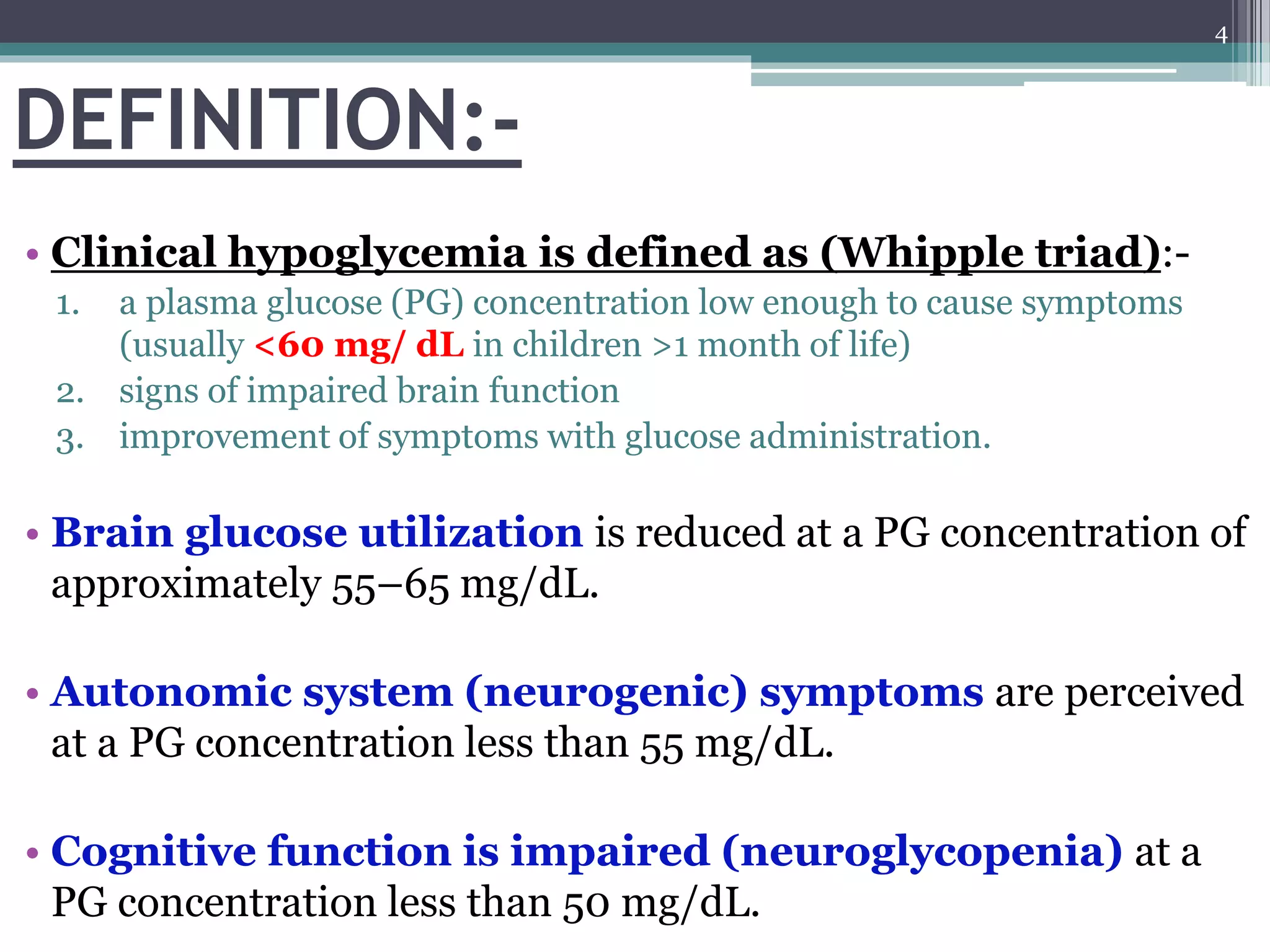
DEFINITION:-
• Clinical hypoglycemia is defined as (Whipple triad):-
1. a plasma glucose (PG) concentration low enough to cause symptoms
(usually <60 mg/ dL in children >1 month of life)
2. signs of impaired brain function
3. improvement of symptoms with glucose administration.
• Brain glucose utilization is reduced at a PG concentration of
approximately 55–65 mg/dL.
• Autonomic system (neurogenic) symptoms are perceived
at a PG concentration less than 55 mg/dL.
• Cognitive function is impaired (neuroglycopenia) at a
PG concentration less than 50 mg/dL.
4
Symptoms and Signs of Hypoglycemia
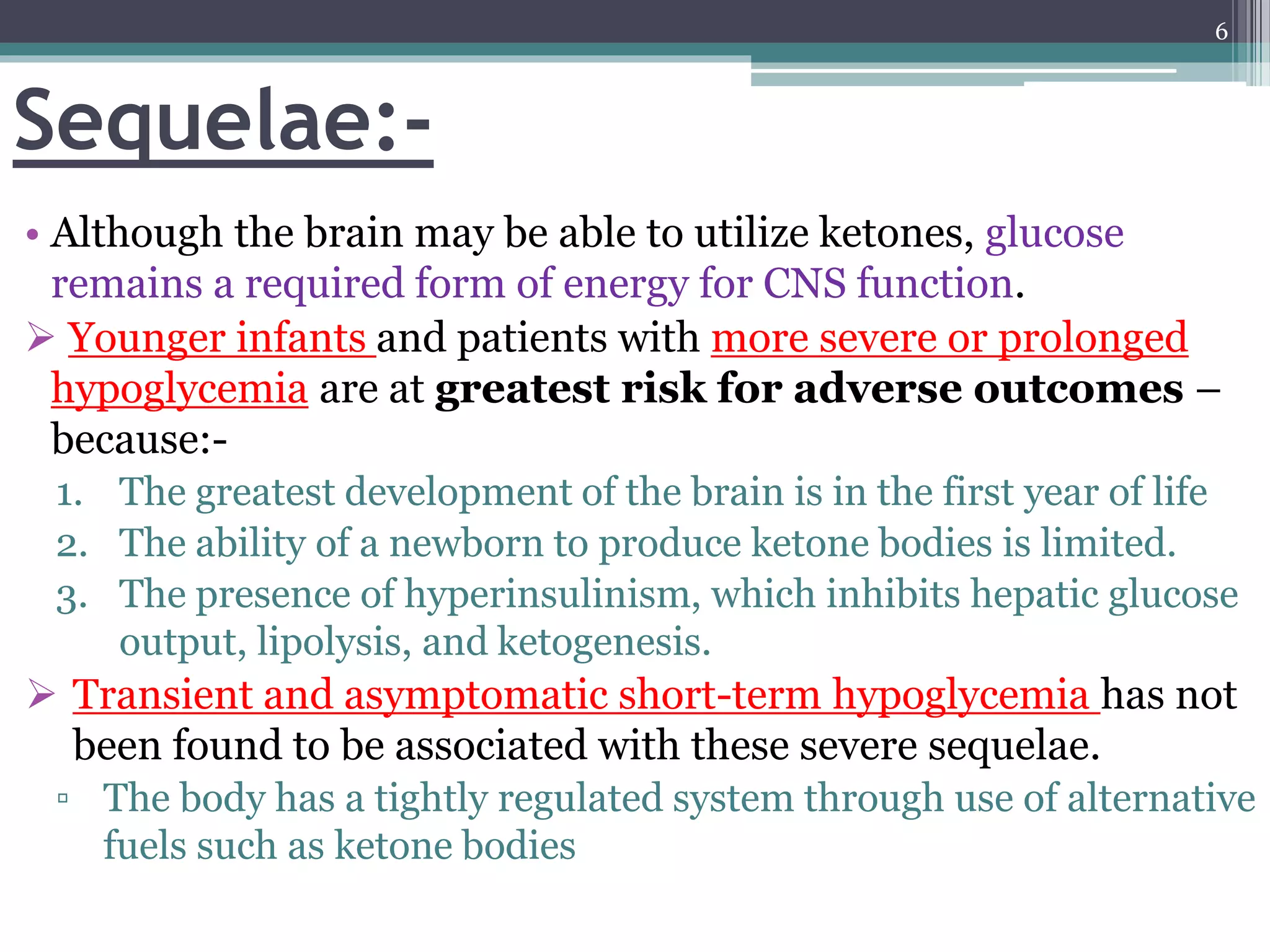
Sequelae:-
• Although the brain may be able to utilize ketones, glucose
remains a required form of energy for CNS function.
 Younger infants and patients with more severe or prolonged
hypoglycemia are at greatest risk for adverse outcomes –
because:-
1. The greatest development of the brain is in the first year of life
2. The ability of a newborn to produce ketone bodies is limited.
3. The presence of hyperinsulinism, which inhibits hepatic glucose
output, lipolysis, and ketogenesis.
 Transient and asymptomatic short-term hypoglycemia has not
been found to be associated with these severe sequelae.
▫ The body has a tightly regulated system through use of alternative
fuels such as ketone bodies
6
Failure to recognize and treat severe, prolonged
hypoglycemia can result in serious long-term
morbidity, including:-
1. Retard brain development and function
2. Intellectual disability
3. Non-hypoglycemic seizures
7
Hormonal Signal:-
•In a normal individual, a decrease in serum glucose
concentrations leads to:-
▫ Suppression of insulin secretion (to <5 μU/dL)
▫ Increased secretion of the counter-regulatory hormones:-
1. growth hormone [GH],
2. cortisol,
3. Glucagon
4. epinephrine.
8
These counter-regulatory hormones act together
to increase blood glucose concentrations by:-
1. Activating glycogenolytic enzymes (glucagon,
epinephrine)
2. Inducing gluconeogenic enzymes (glucagon, cortisol)
3. Preventing glucose uptake by muscle (epinephrine,
growth hormone, cortisol)
4. Aiding in release of amino acids from muscle for
gluconeogenesis (cortisol).
5. They all activate lipolysis, providing glycerol for
gluconeogenesis and fatty acids for ketogenesis
(epinephrine, cortisol, GH, glucagon).
9
Regulation of serum glucose:-
10
Disorders of Hypoglycemia:-
Etiology differentiated based on ketones
• Hypoketotic hypoglycemia
• Low insulin: fatty acid oxidation defect, ketogenic
defect (low insulin, increased free fatty acids)
• High insulin: hyperinsulinism (increased insulin,
decreased free fatty acids)
• Ketotic hypoglycemia
• Hepatomegaly absent: organic aciduria, ketolytic
defect, ketotic hypoglycemia
• Hepatomegaly present: glycogen storage disease,
gluconeogenesis defect
11
Classification of Hypoglycemia in Infants and
Children:-
13
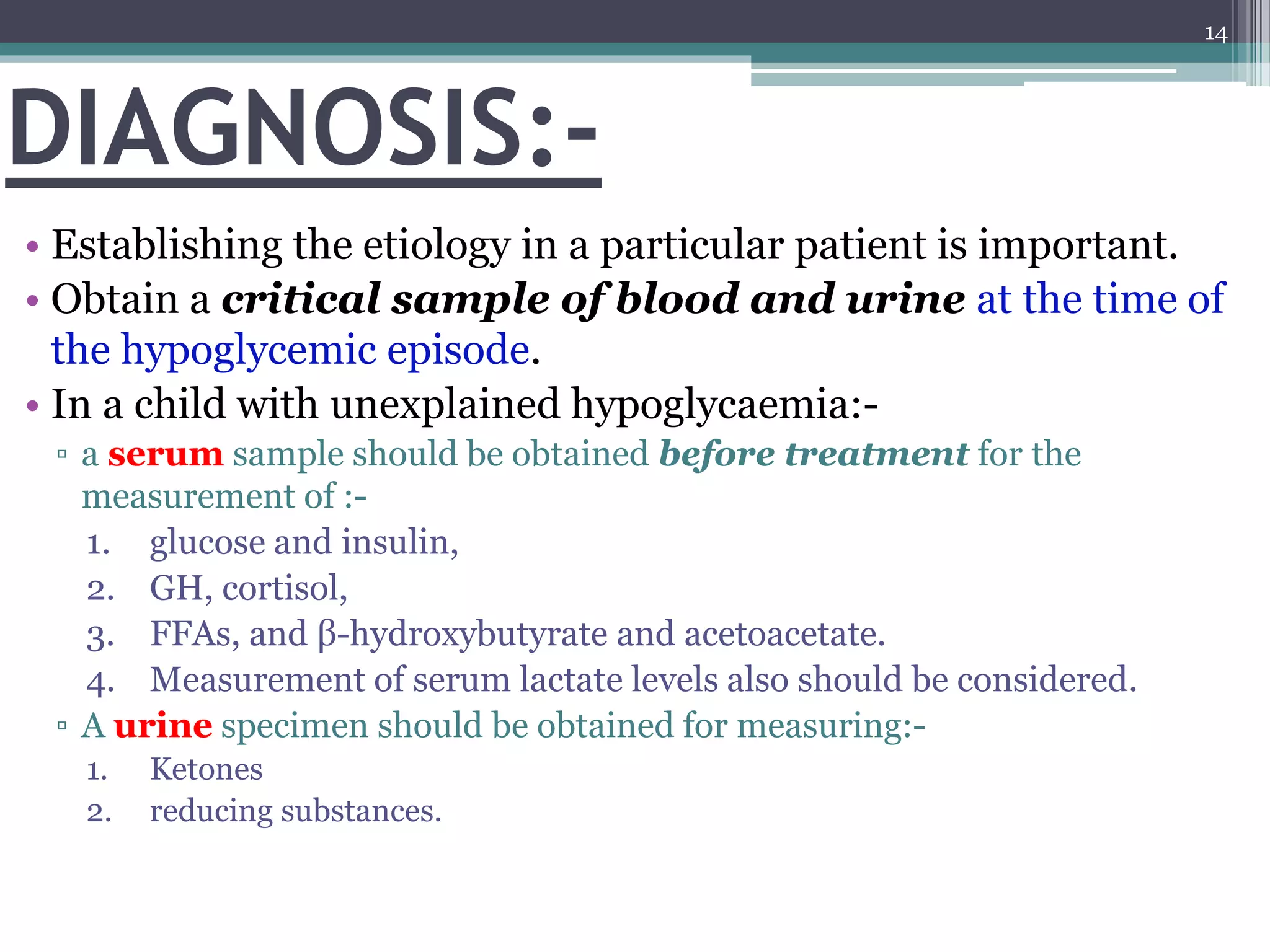
DIAGNOSIS:-
• Establishing the etiology in a particular patient is important.
• Obtain a critical sample of blood and urine at the time of
the hypoglycemic episode.
• In a child with unexplained hypoglycaemia:-
▫ a serum sample should be obtained before treatment for the
measurement of :-
1. glucose and insulin,
2. GH, cortisol,
3. FFAs, and β-hydroxybutyrate and acetoacetate.
4. Measurement of serum lactate levels also should be considered.
▫ A urine specimen should be obtained for measuring:-
1. Ketones
2. reducing substances.
14
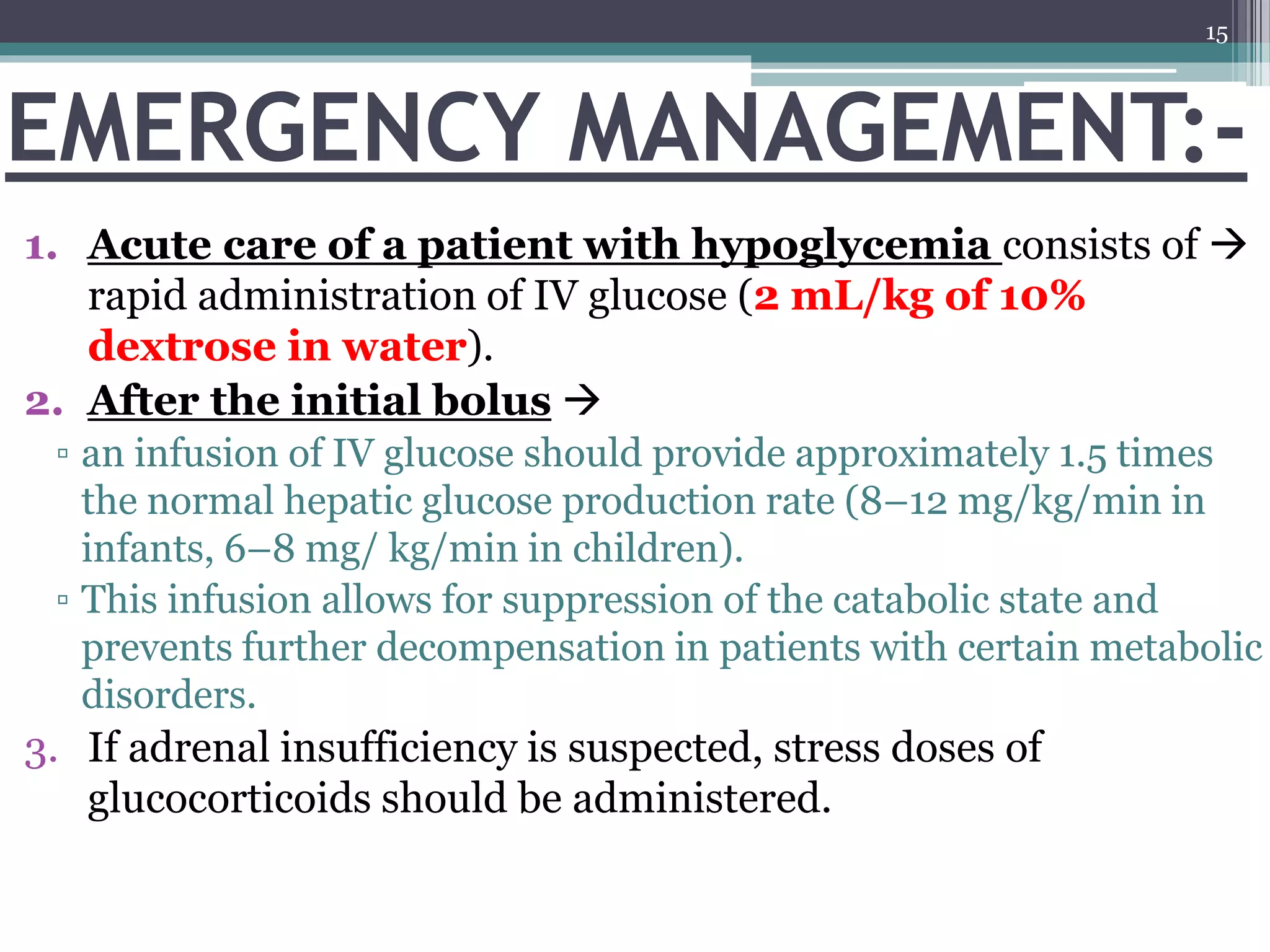
EMERGENCY MANAGEMENT:-
1. Acute care of a patient with hypoglycemia consists of 
rapid administration of IV glucose (2 mL/kg of 10%
dextrose in water).
2. After the initial bolus 
▫ an infusion of IV glucose should provide approximately 1.5 times
the normal hepatic glucose production rate (8–12 mg/kg/min in
infants, 6–8 mg/ kg/min in children).
▫ This infusion allows for suppression of the catabolic state and
prevents further decompensation in patients with certain metabolic
disorders.
3. If adrenal insufficiency is suspected, stress doses of
glucocorticoids should be administered.
15
Cases
Case -1-
• A 14-month-old female presents to the ED with decreased activity and poor feeding
in the context of 1 day of vomiting and diarrhea. In the ED the child is lethargic and
minimally responsive.There is no hepatomegaly appreciated on examination. Her
bicarbonate level is 8, her blood sugar is 34, and her lactate is 15 mmol/L.What
family of disease is highest on the differential:-
a. Mitochondrial disorder
b. Glycogen storage disorder
c. Urea cycle disorder
d. Congenital disorder of glycosylation
e. Lysosomal storage disorder
• a. Decompensation in the context of a viral illness should raise suspicion for an
inborn error of energy metabolism. In disorders of energy metabolism, chil- dren are
already driving energy metabolism at maxi- mum to compensate for impaired
energy production, and they have no reserve for increased metabolic demands, as
are required in illness.The child in this vignette is lethargic and has laboratories
remarkable for hypoglycemia and a severe acidosis with lactate accumulation.This
is consistent with both a glycogen storage disorder and a mitochondrial disorder.
Glyco- gen storage disorders that present with hypoglycemia and lactic acidosis are
associated with hepatomegaly due to increased glycogen storage and impaired
catab- olism, making a mitochondrial disorder more likely. For urea cycle disorders,
children do decompensate with illness because they cannot handle the increased
protein load: however, they are not hypoglycemic or acidotic. Congenital disorders
of glycosylation do not present with metabolic decompensation, nor do lyso- somal
storage disorders
Thanks

Approach to Hypoglycemia in Children.pptx

  • 1.
  • 2.
    Contents:- • Introduction • DEFINITION •Symptoms and Signs of Hypoglycemia • Sequelae of Hypoglycemia • Hormonal Signal • Regulation of serum glucose • Disorders of Hypoglycemia • Classification of Hypoglycemia in Infants and Children • DIAGNOSIS • EMERGENCY MANAGEMENT
  • 3.
    Introduction:- • Hypoglycemia ininfancy and childhood can result from a large variety of hormonal and metabolic defects. • Hypoglycemia occurs most frequently in the early neonatal period – often as a result of:- 1. transient neonatal hyperinsulinemia in infants of diabetic mothers 2. inadequate energy stores to meet the disproportionately large metabolic needs of premature or small for gestational age newborns. • Hypoglycemia during the first few days of life in an otherwise normal newborn is less frequent and warrants concern. • After the initial 2–3 days of life, hypoglycemia is far less common and is more frequently the result of 1. Endocrine disorders 2. Metabolic disorders 3. Sepsis must always be considered 3
  • 4.
    DEFINITION:- • Clinical hypoglycemiais defined as (Whipple triad):- 1. a plasma glucose (PG) concentration low enough to cause symptoms (usually <60 mg/ dL in children >1 month of life) 2. signs of impaired brain function 3. improvement of symptoms with glucose administration. • Brain glucose utilization is reduced at a PG concentration of approximately 55–65 mg/dL. • Autonomic system (neurogenic) symptoms are perceived at a PG concentration less than 55 mg/dL. • Cognitive function is impaired (neuroglycopenia) at a PG concentration less than 50 mg/dL. 4
  • 5.
    Symptoms and Signsof Hypoglycemia
  • 6.
    Sequelae:- • Although thebrain may be able to utilize ketones, glucose remains a required form of energy for CNS function.  Younger infants and patients with more severe or prolonged hypoglycemia are at greatest risk for adverse outcomes – because:- 1. The greatest development of the brain is in the first year of life 2. The ability of a newborn to produce ketone bodies is limited. 3. The presence of hyperinsulinism, which inhibits hepatic glucose output, lipolysis, and ketogenesis.  Transient and asymptomatic short-term hypoglycemia has not been found to be associated with these severe sequelae. ▫ The body has a tightly regulated system through use of alternative fuels such as ketone bodies 6
  • 7.
    Failure to recognizeand treat severe, prolonged hypoglycemia can result in serious long-term morbidity, including:- 1. Retard brain development and function 2. Intellectual disability 3. Non-hypoglycemic seizures 7
  • 8.
    Hormonal Signal:- •In anormal individual, a decrease in serum glucose concentrations leads to:- ▫ Suppression of insulin secretion (to <5 μU/dL) ▫ Increased secretion of the counter-regulatory hormones:- 1. growth hormone [GH], 2. cortisol, 3. Glucagon 4. epinephrine. 8
  • 9.
    These counter-regulatory hormonesact together to increase blood glucose concentrations by:- 1. Activating glycogenolytic enzymes (glucagon, epinephrine) 2. Inducing gluconeogenic enzymes (glucagon, cortisol) 3. Preventing glucose uptake by muscle (epinephrine, growth hormone, cortisol) 4. Aiding in release of amino acids from muscle for gluconeogenesis (cortisol). 5. They all activate lipolysis, providing glycerol for gluconeogenesis and fatty acids for ketogenesis (epinephrine, cortisol, GH, glucagon). 9
  • 10.
    Regulation of serumglucose:- 10
  • 11.
    Disorders of Hypoglycemia:- Etiologydifferentiated based on ketones • Hypoketotic hypoglycemia • Low insulin: fatty acid oxidation defect, ketogenic defect (low insulin, increased free fatty acids) • High insulin: hyperinsulinism (increased insulin, decreased free fatty acids) • Ketotic hypoglycemia • Hepatomegaly absent: organic aciduria, ketolytic defect, ketotic hypoglycemia • Hepatomegaly present: glycogen storage disease, gluconeogenesis defect 11
  • 13.
    Classification of Hypoglycemiain Infants and Children:- 13
  • 14.
    DIAGNOSIS:- • Establishing theetiology in a particular patient is important. • Obtain a critical sample of blood and urine at the time of the hypoglycemic episode. • In a child with unexplained hypoglycaemia:- ▫ a serum sample should be obtained before treatment for the measurement of :- 1. glucose and insulin, 2. GH, cortisol, 3. FFAs, and β-hydroxybutyrate and acetoacetate. 4. Measurement of serum lactate levels also should be considered. ▫ A urine specimen should be obtained for measuring:- 1. Ketones 2. reducing substances. 14
  • 15.
    EMERGENCY MANAGEMENT:- 1. Acutecare of a patient with hypoglycemia consists of  rapid administration of IV glucose (2 mL/kg of 10% dextrose in water). 2. After the initial bolus  ▫ an infusion of IV glucose should provide approximately 1.5 times the normal hepatic glucose production rate (8–12 mg/kg/min in infants, 6–8 mg/ kg/min in children). ▫ This infusion allows for suppression of the catabolic state and prevents further decompensation in patients with certain metabolic disorders. 3. If adrenal insufficiency is suspected, stress doses of glucocorticoids should be administered. 15
  • 16.
  • 17.
    Case -1- • A14-month-old female presents to the ED with decreased activity and poor feeding in the context of 1 day of vomiting and diarrhea. In the ED the child is lethargic and minimally responsive.There is no hepatomegaly appreciated on examination. Her bicarbonate level is 8, her blood sugar is 34, and her lactate is 15 mmol/L.What family of disease is highest on the differential:- a. Mitochondrial disorder b. Glycogen storage disorder c. Urea cycle disorder d. Congenital disorder of glycosylation e. Lysosomal storage disorder • a. Decompensation in the context of a viral illness should raise suspicion for an inborn error of energy metabolism. In disorders of energy metabolism, chil- dren are already driving energy metabolism at maxi- mum to compensate for impaired energy production, and they have no reserve for increased metabolic demands, as are required in illness.The child in this vignette is lethargic and has laboratories remarkable for hypoglycemia and a severe acidosis with lactate accumulation.This is consistent with both a glycogen storage disorder and a mitochondrial disorder. Glyco- gen storage disorders that present with hypoglycemia and lactic acidosis are associated with hepatomegaly due to increased glycogen storage and impaired catab- olism, making a mitochondrial disorder more likely. For urea cycle disorders, children do decompensate with illness because they cannot handle the increased protein load: however, they are not hypoglycemic or acidotic. Congenital disorders of glycosylation do not present with metabolic decompensation, nor do lyso- somal storage disorders
  • 20.

Editor's Notes

  • #11  – represents inhibitions. EPI, Epinephrine; FFA, free fatty acid; GH, growth hormone; TG, triglyceride.