Scientists deal with extremely large and extremely
small numbers like:
• The distance from the sun to the nearest star,
Proxima Centauri, is about 24 700 000 000 000
miles
• A single bacteria is about 0.00000075 meters
in diameter.
That’s why scientific notation was created for
the large number of zeros in these numbers
makes them difficult to read and makes them
tedious to write.
gives a convenient way to
write very large numbers or very small
numbers.
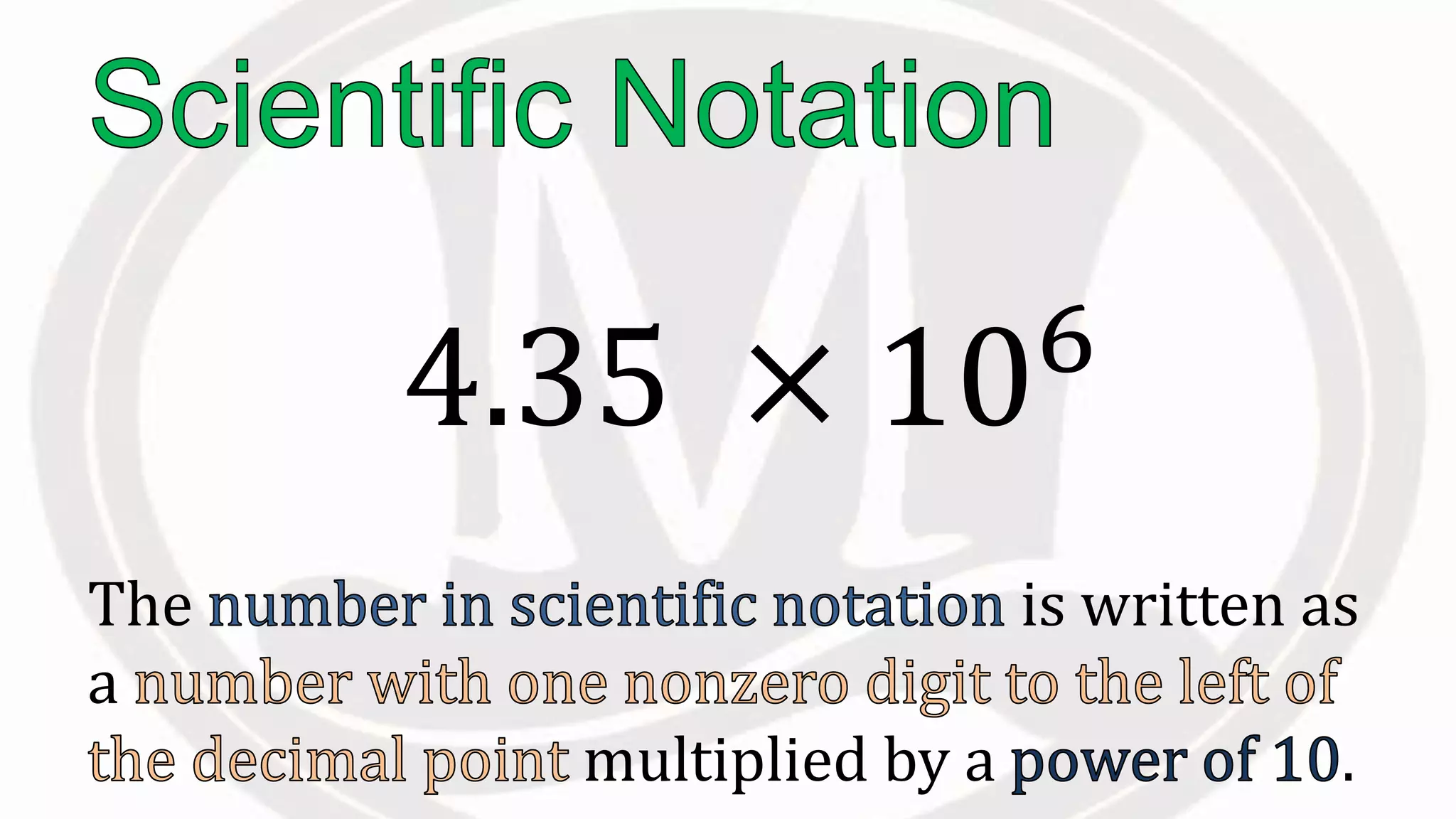
The is written as
a
multiplied by a .
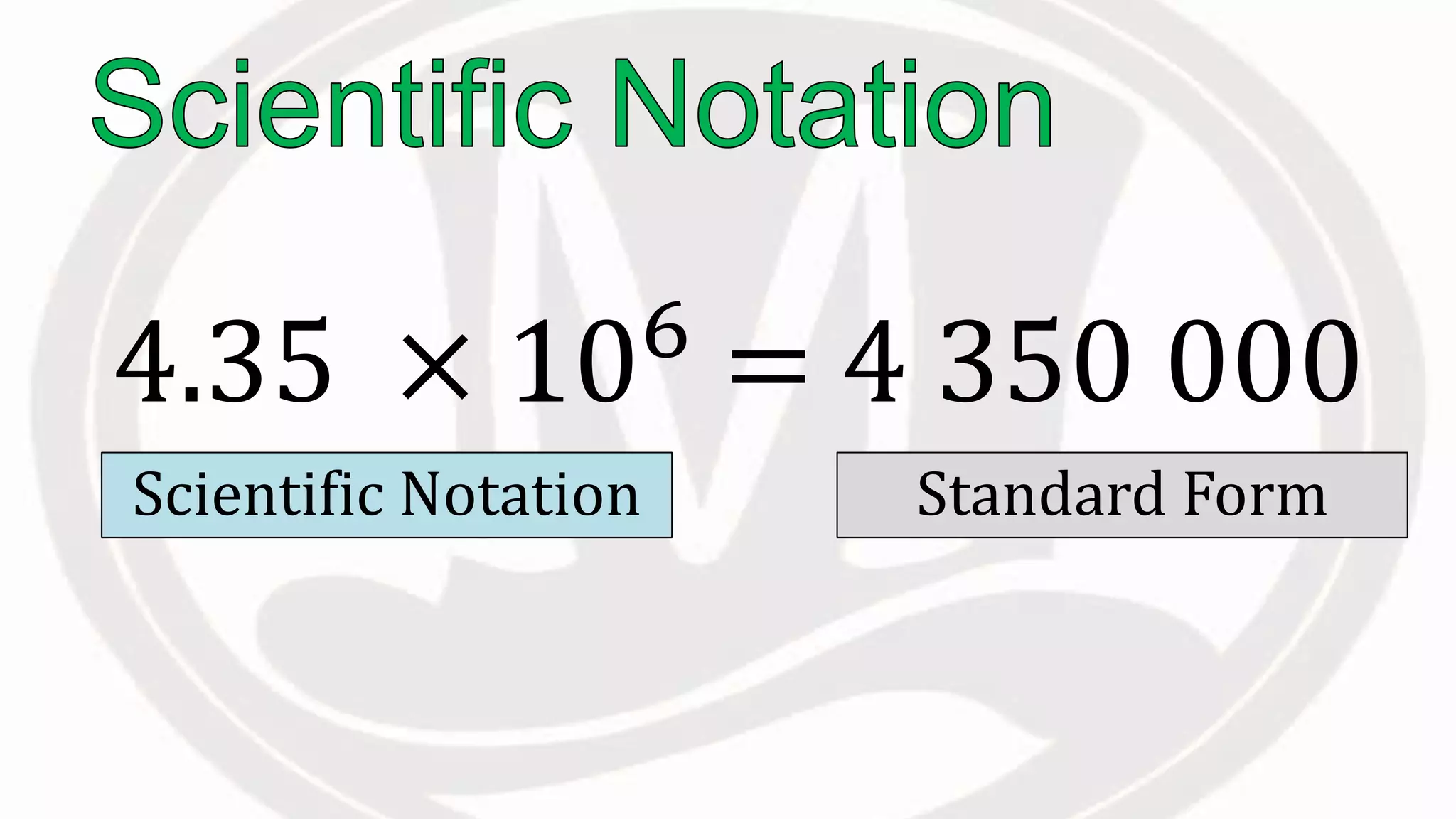
4.35 × 10⁶
4.35 × 106
= 4 350 000
Scientific Notation Standard Form
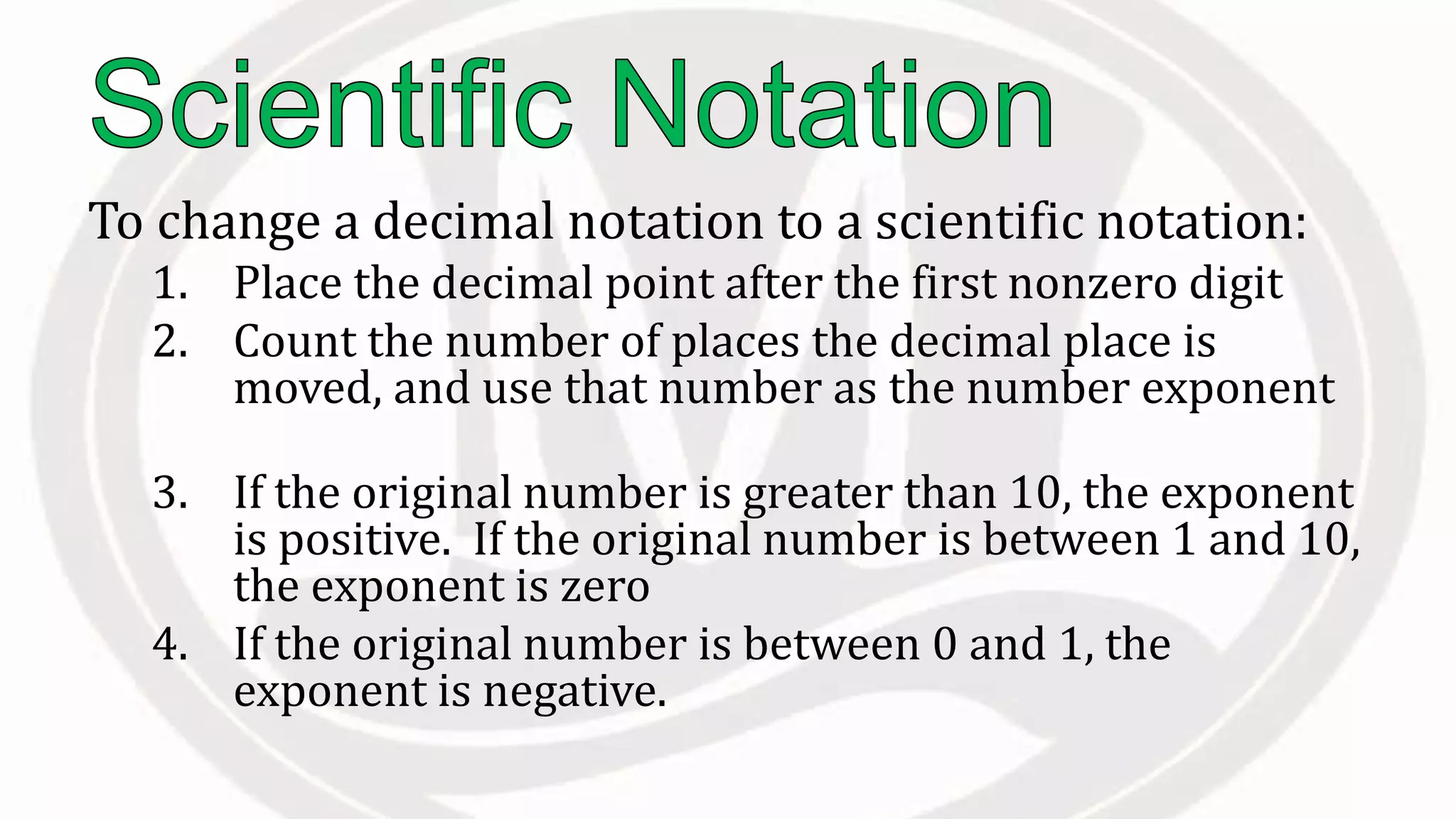
To change a decimal notation to a scientific notation:
1. Place the decimal point after the first nonzero digit
2. Count the number of places the decimal place is
moved, and use that number as the number exponent
3. If the original number is greater than 10, the exponent
is positive. If the original number is between 1 and 10,
the exponent is zero
4. If the original number is between 0 and 1, the
exponent is negative.
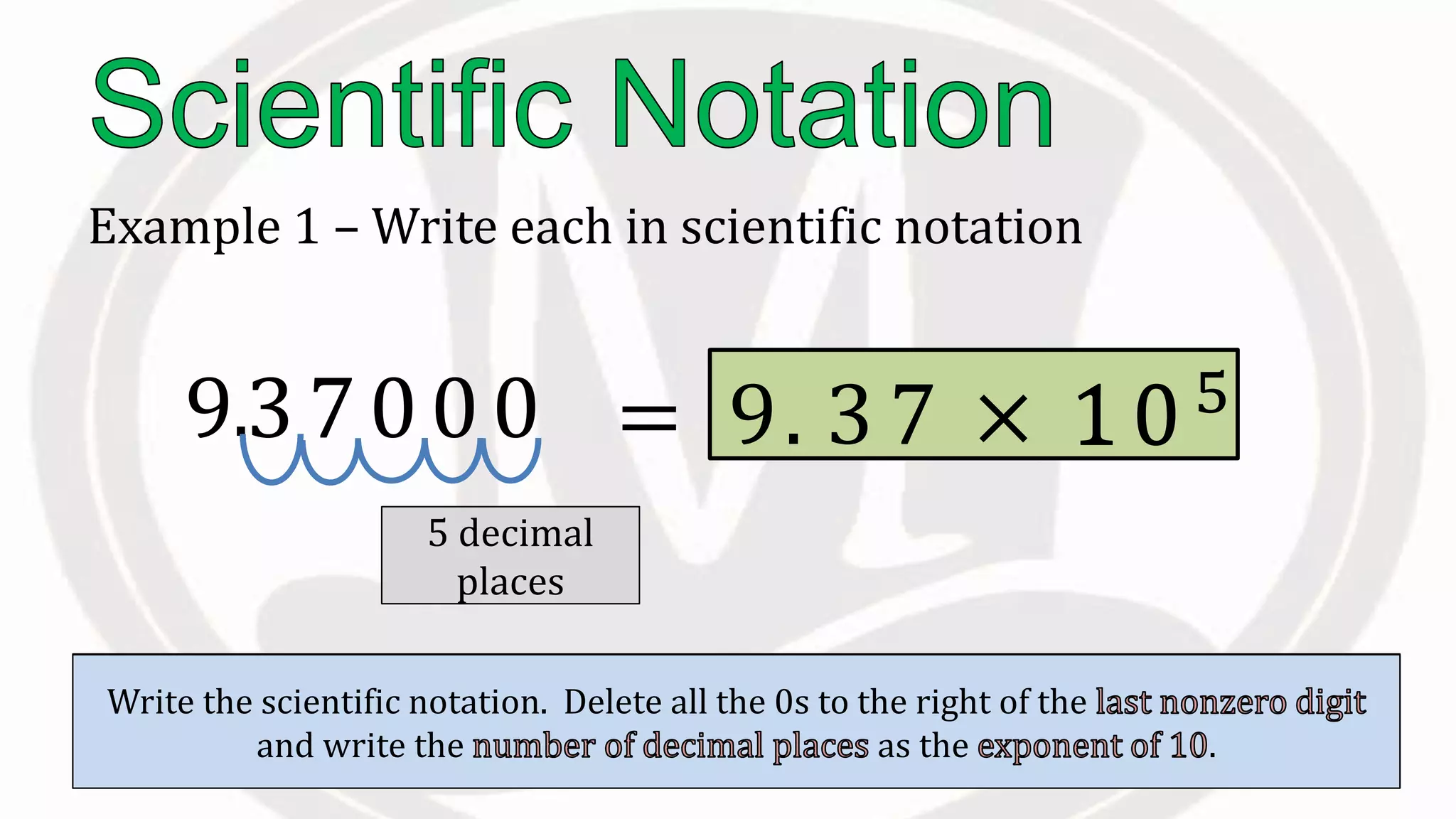
Example 1 – Write each in scientific notation
937000
Place the to the right of the .
.
Count the to the right of this
decimal.
5 decimal
places
Write the scientific notation. Delete all the 0s to the right of the
and write the as the .
= 9. 3 7 × 10510
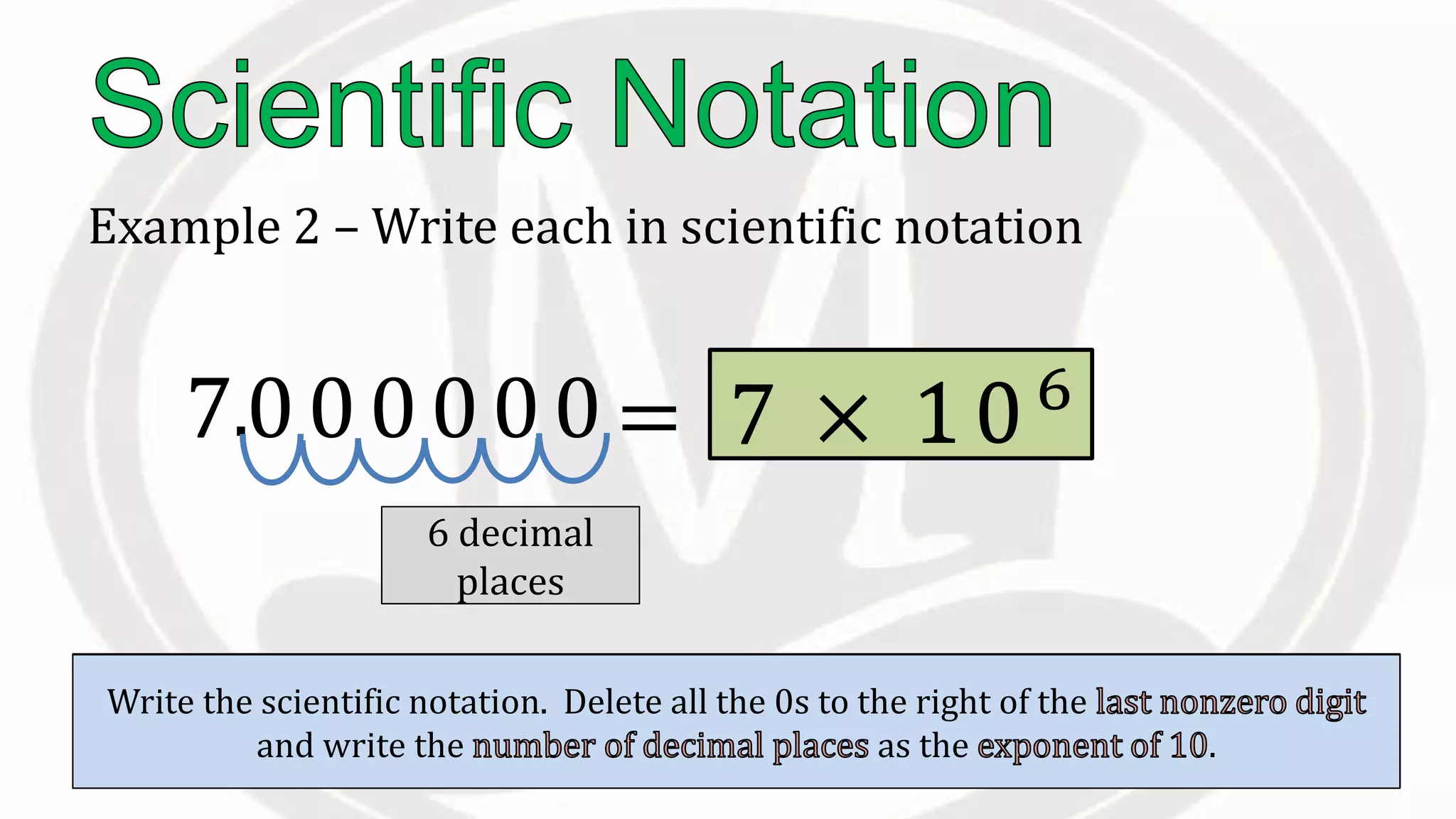
Example 2 – Write each in scientific notation
7000000
Place the to the right of the .
.
Count the to the right of this
decimal.
6 decimal
places
Count the to the right of this
decimal.
Write the scientific notation. Delete all the 0s to the right of the

and write the as the .
= 7 × 10⁶
10
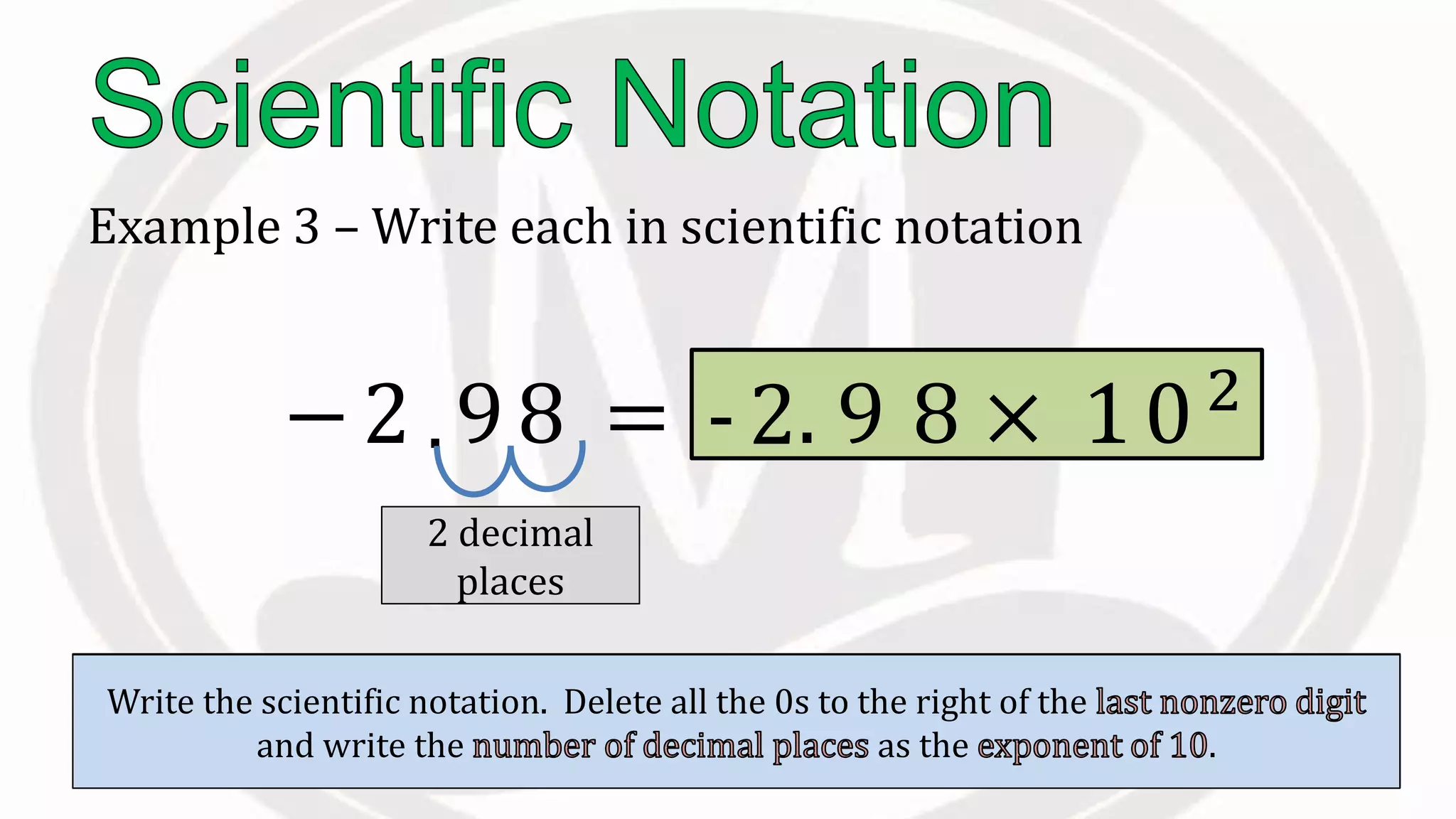
Example 3 – Write each in scientific notation
−2 98
Place the to the right of the .
.
Count the to the right of this
decimal.
2 decimal
places
Count the to the right of this
decimal.
Write the scientific notation. Delete all the 0s to the right of the

and write the as the .
= -2 × 10102
. 9 8
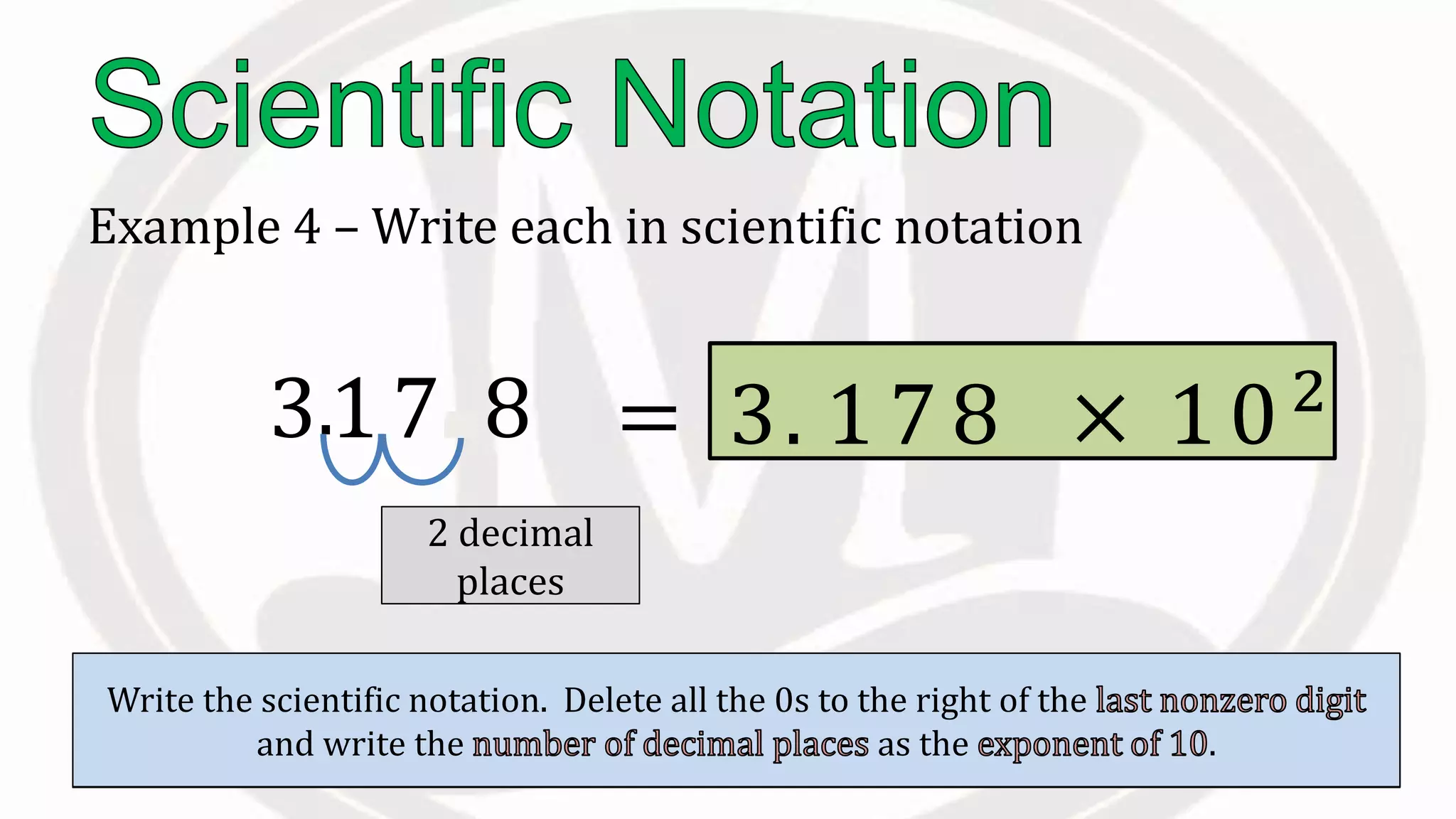
Example 4 – Write each in scientific notation
317.8
Place the to the right of the .
.
Count the moved.
2 decimal
places
Write the scientific notation. Delete all the 0s to the right of the

and write the as the .
= 3. 1 7 × 10102
8
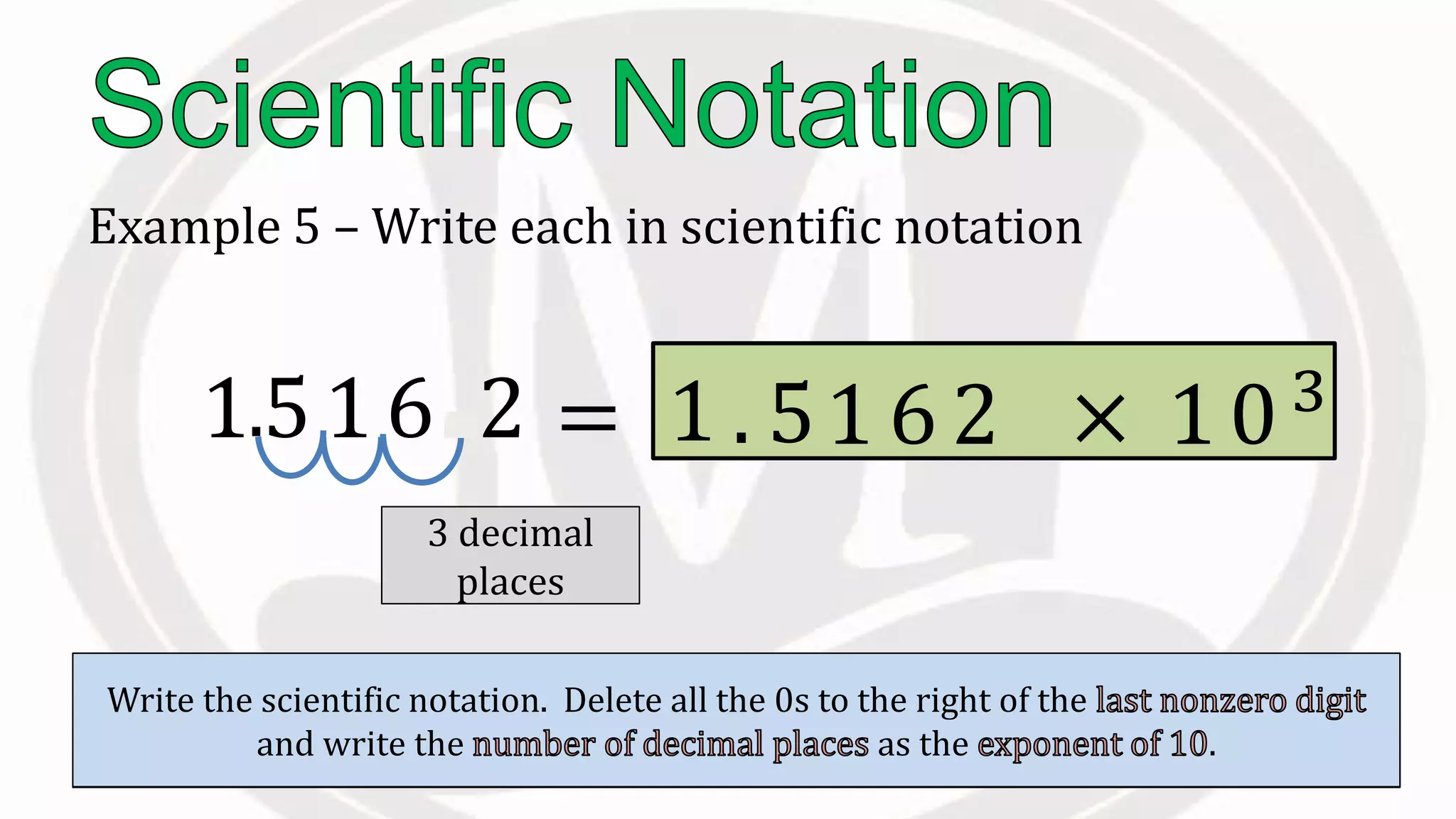
Example 5 – Write each in scientific notation
1516.2
Place the to the right of the .
.
Count the moved.
3 decimal
places
Write the scientific notation. Delete all the 0s to the right of the
and write the as the .
= 5. 1 6 × 10103
21
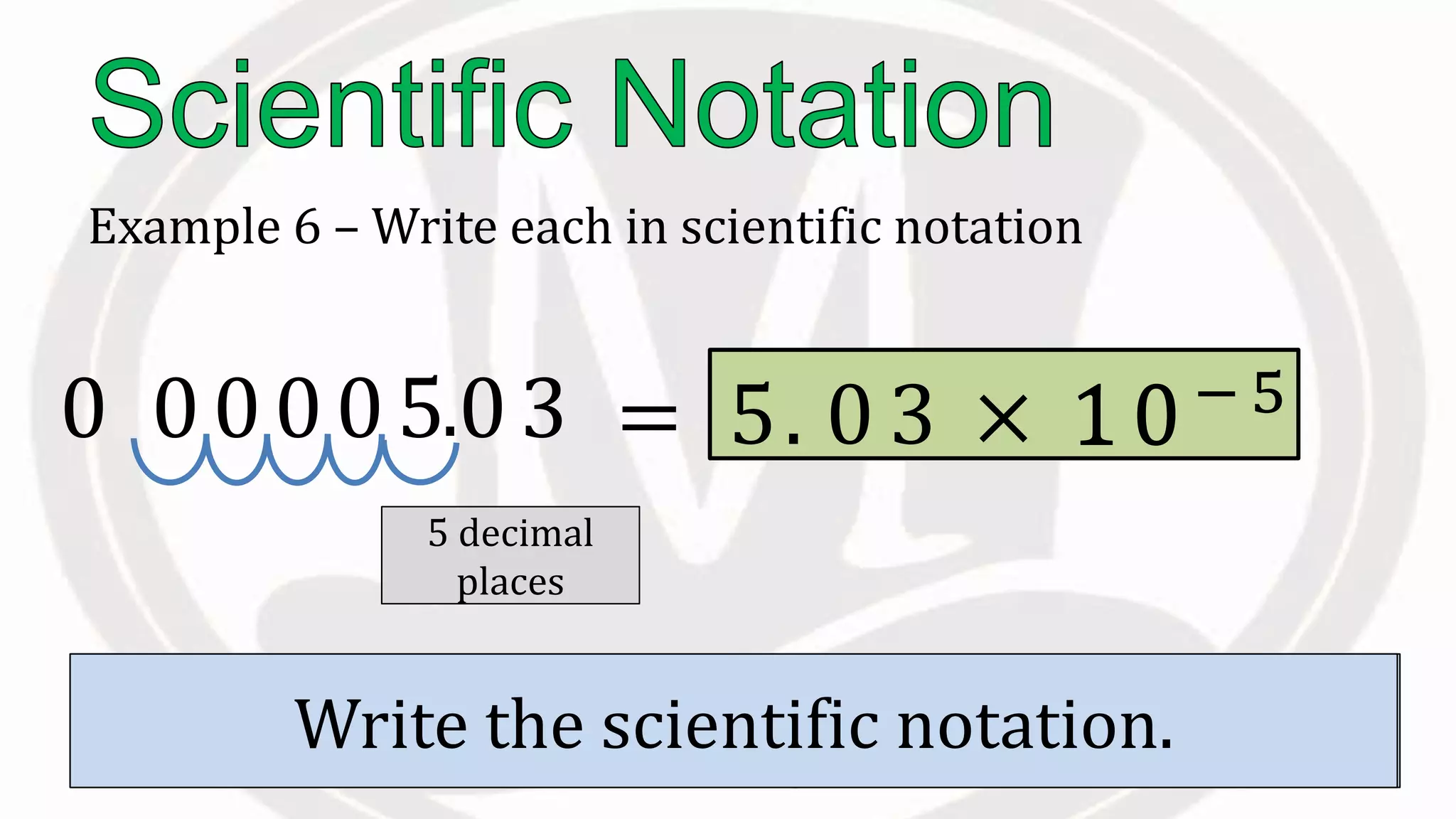
Example 6 – Write each in scientific notation
0.0000503
Move the to the right of the first non
zero digit.
.
Count the to the right of this
decimal.
5 decimal
places
Write the scientific notation.
= 5. 0 3 × 10−510
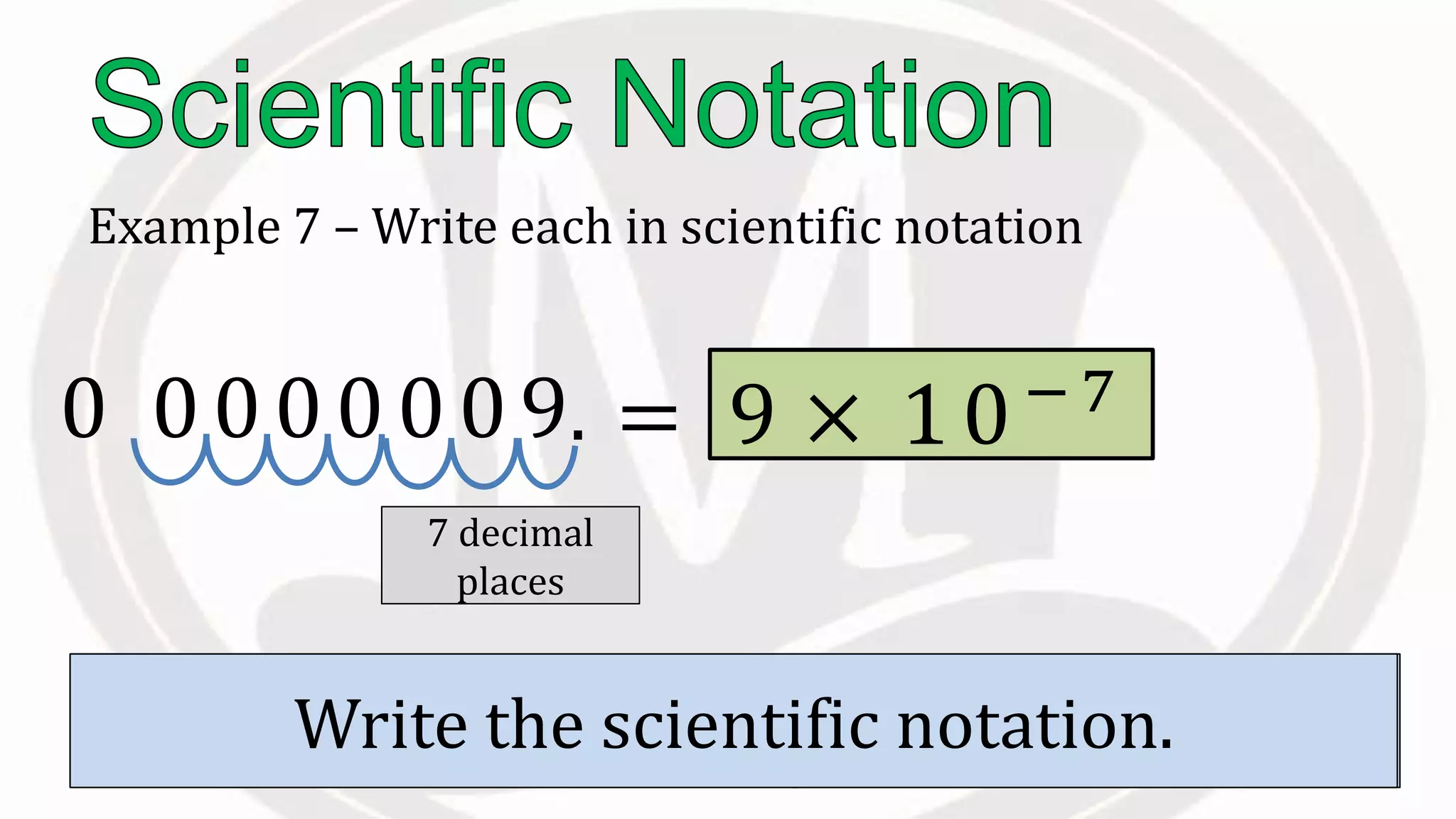
Example 7 – Write each in scientific notation
0.0000009
Move the to the right of the first non
zero digit.
.
Count the to the right of this
decimal.
7 decimal
places
Write the scientific notation.
= 9 × 10⁻⁷
10
question
s?
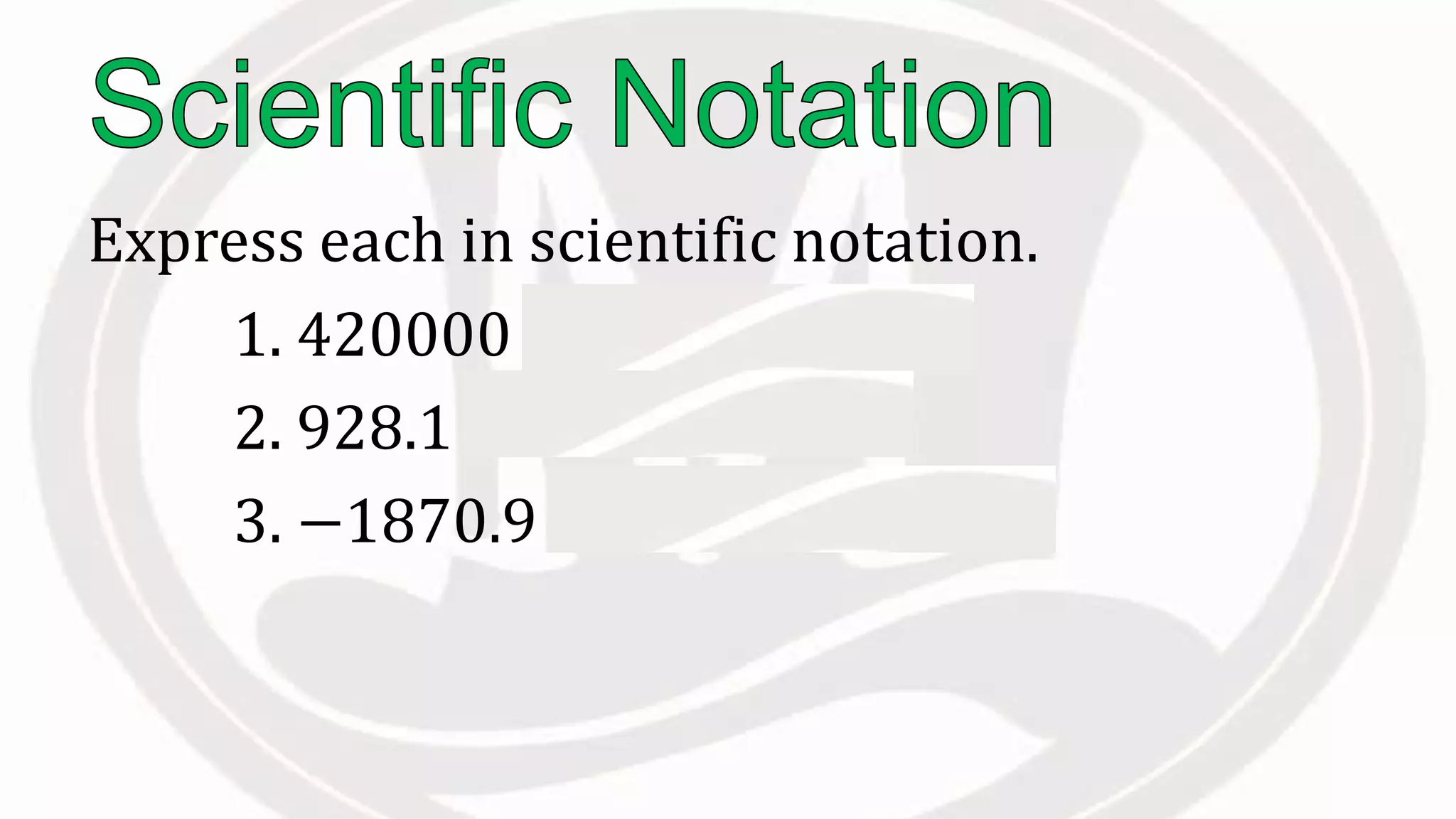
Express each in scientific notation.
1. 420000 = 4.2 × 10⁵
2. 928.1 = 9.281 × 10²
3. −1870.9 = −1.8709 × 10³
question
s?
E-Math 7
Practice and Application
Test I and II
Page 71
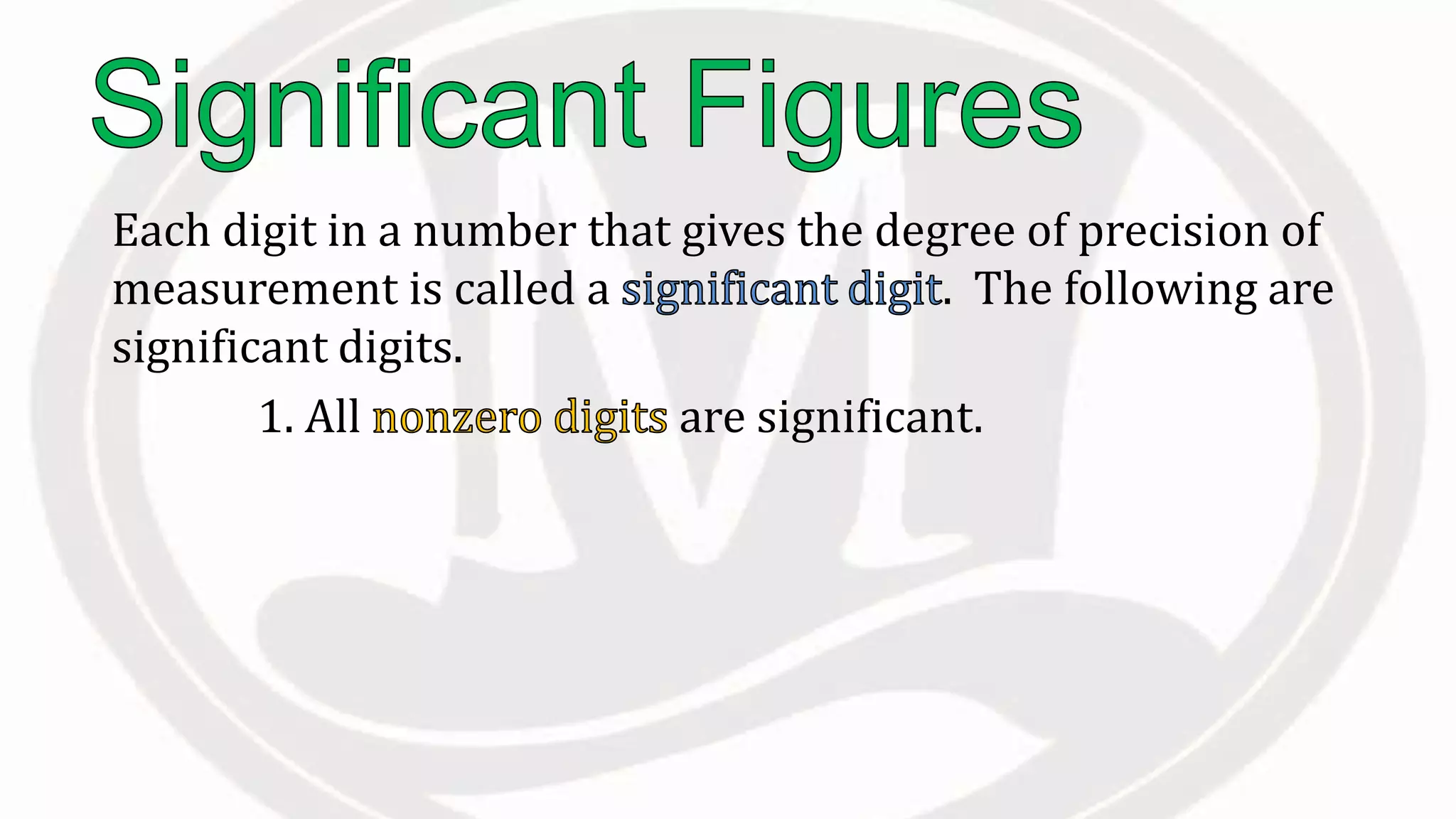
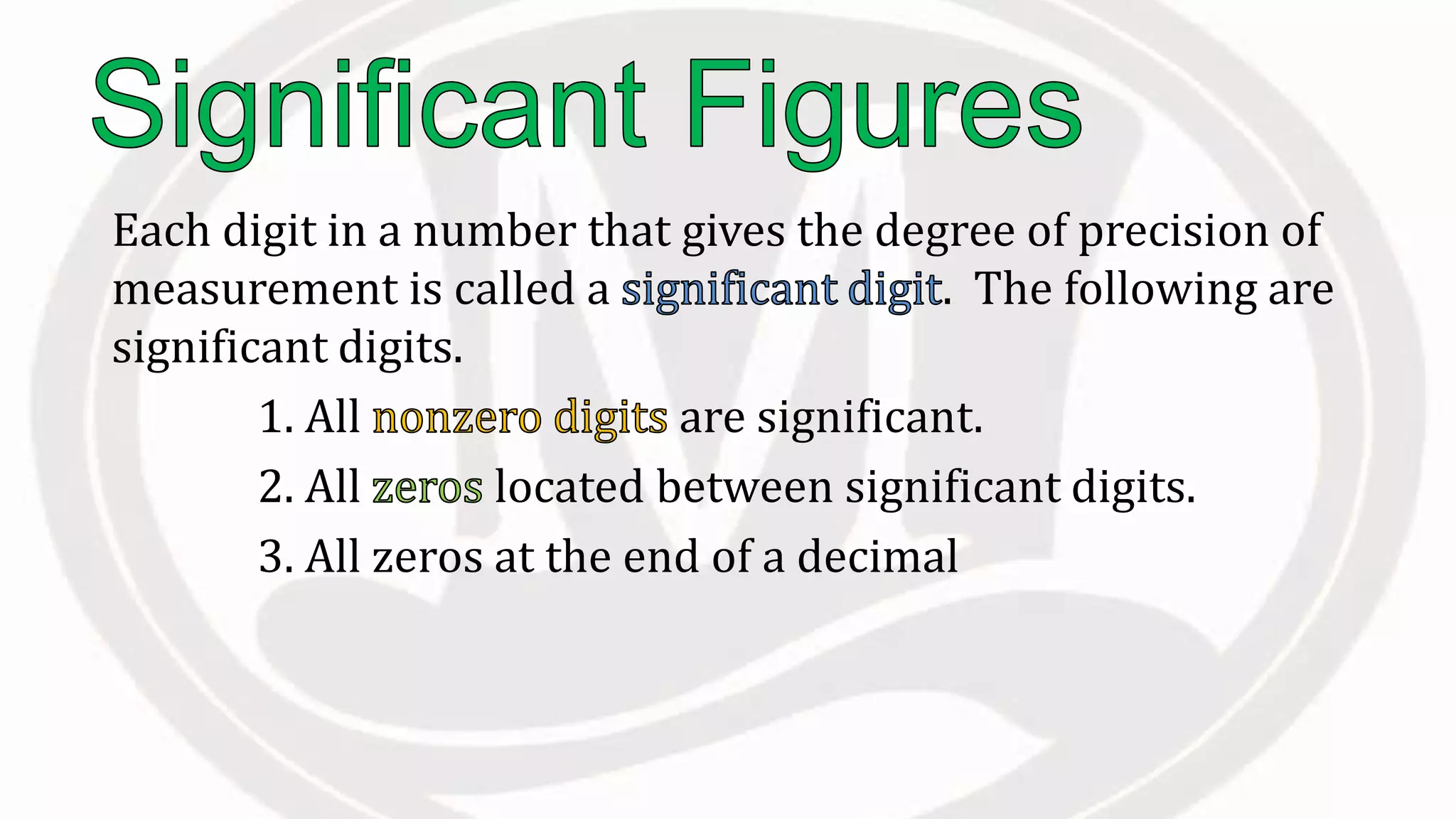
Each digit in a number that gives the degree of precision of
measurement is called a . The following are
significant digits.
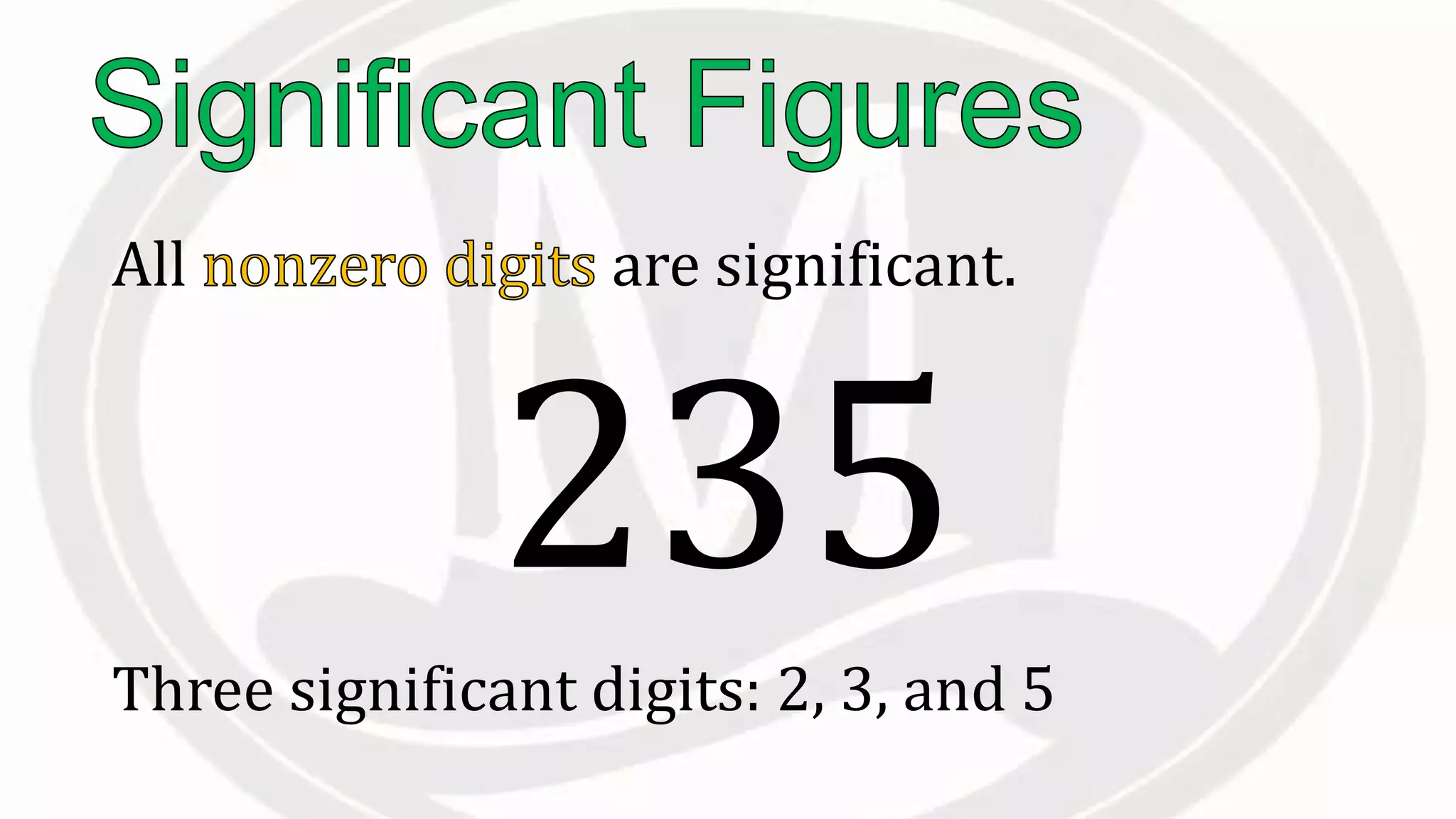
1. All are significant.
All are significant.
Three significant digits: 2, 3, and 5
235
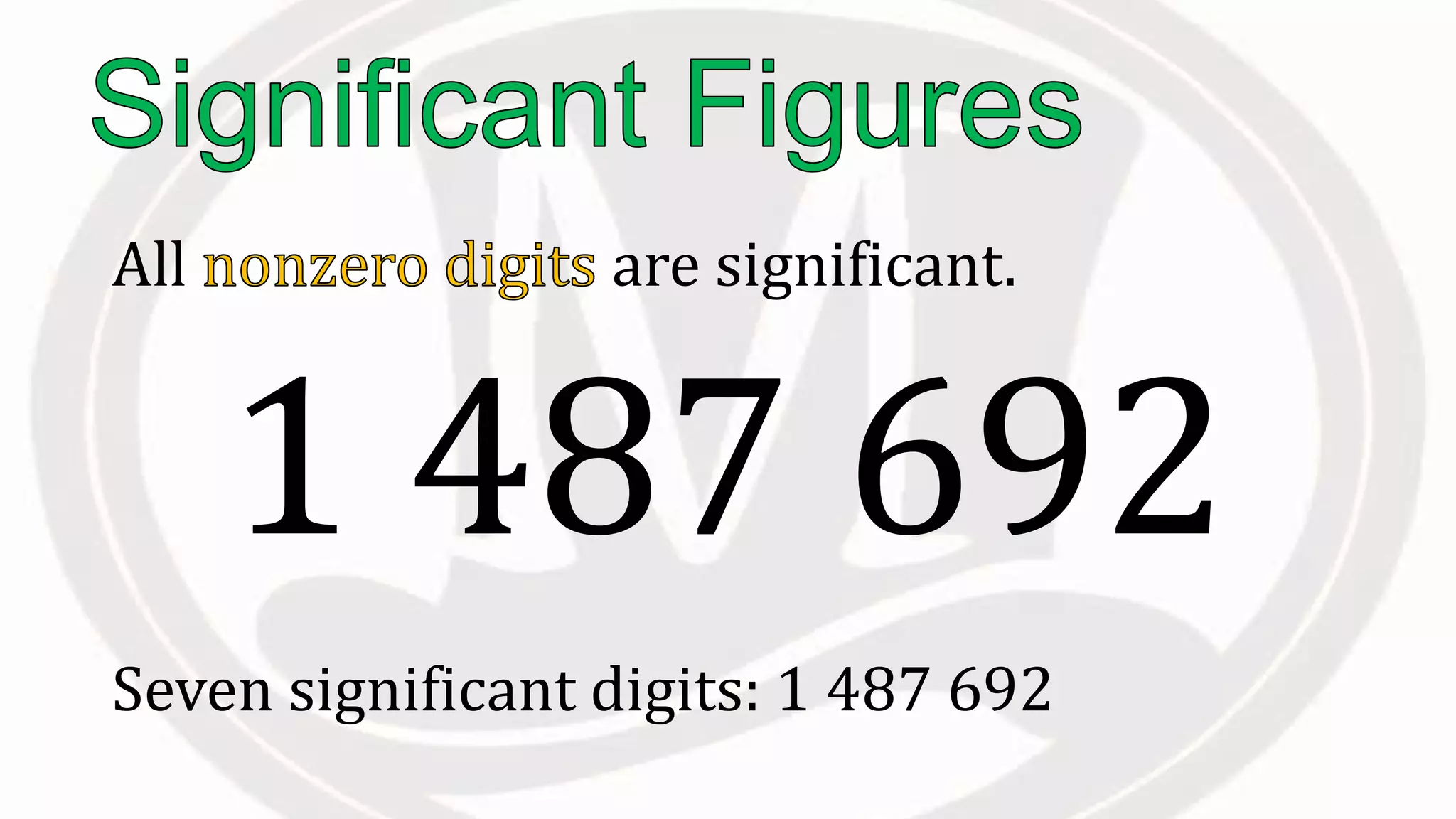
All are significant.
Seven significant digits: 1 487 692
1 487 692
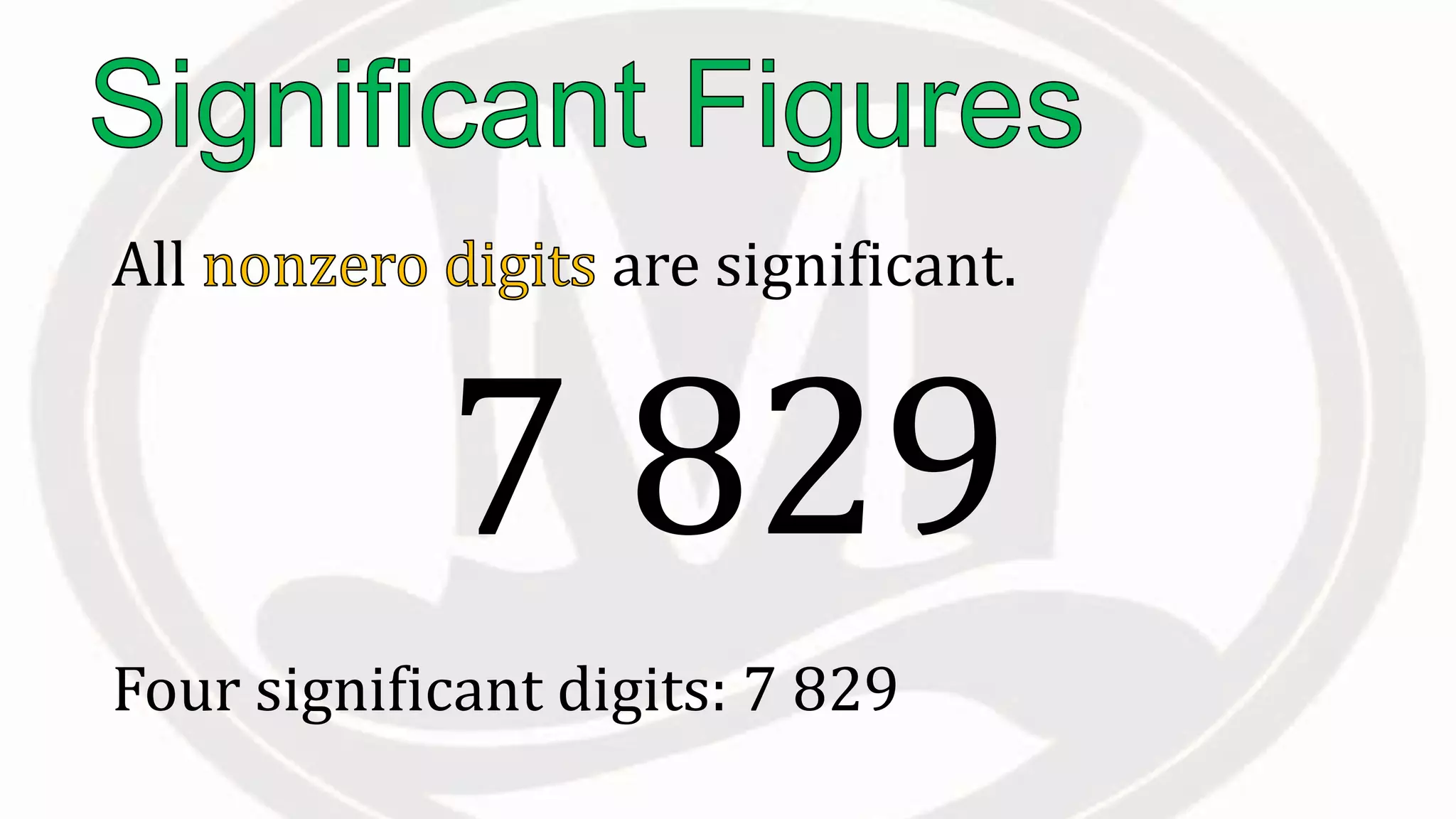
All are significant.
Four significant digits: 7 829
7 829
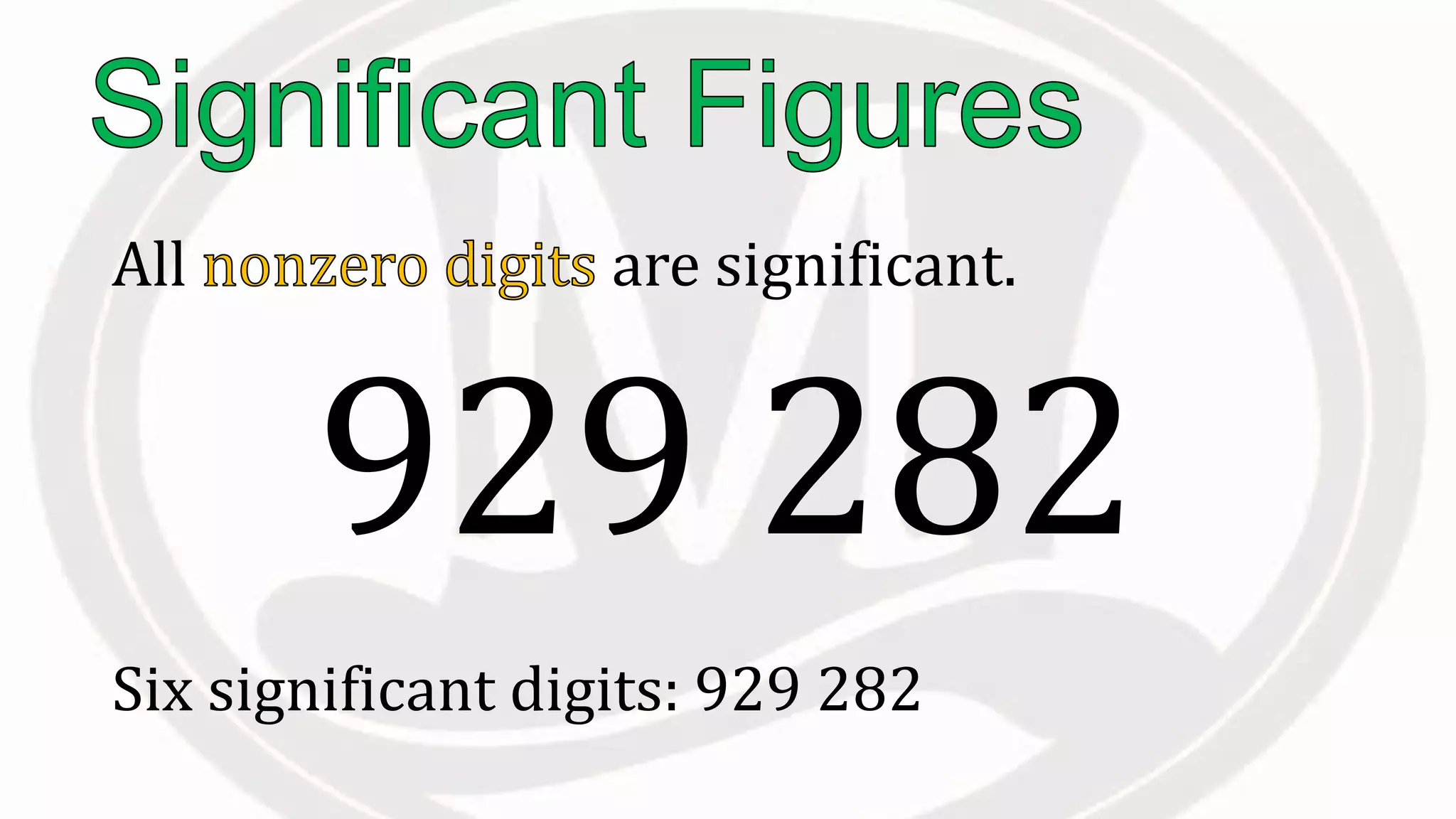
All are significant.
Six significant digits: 929 282
929 282
Each digit in a number that gives the degree of precision of
measurement is called a . The following are
significant digits.
1. All are significant.
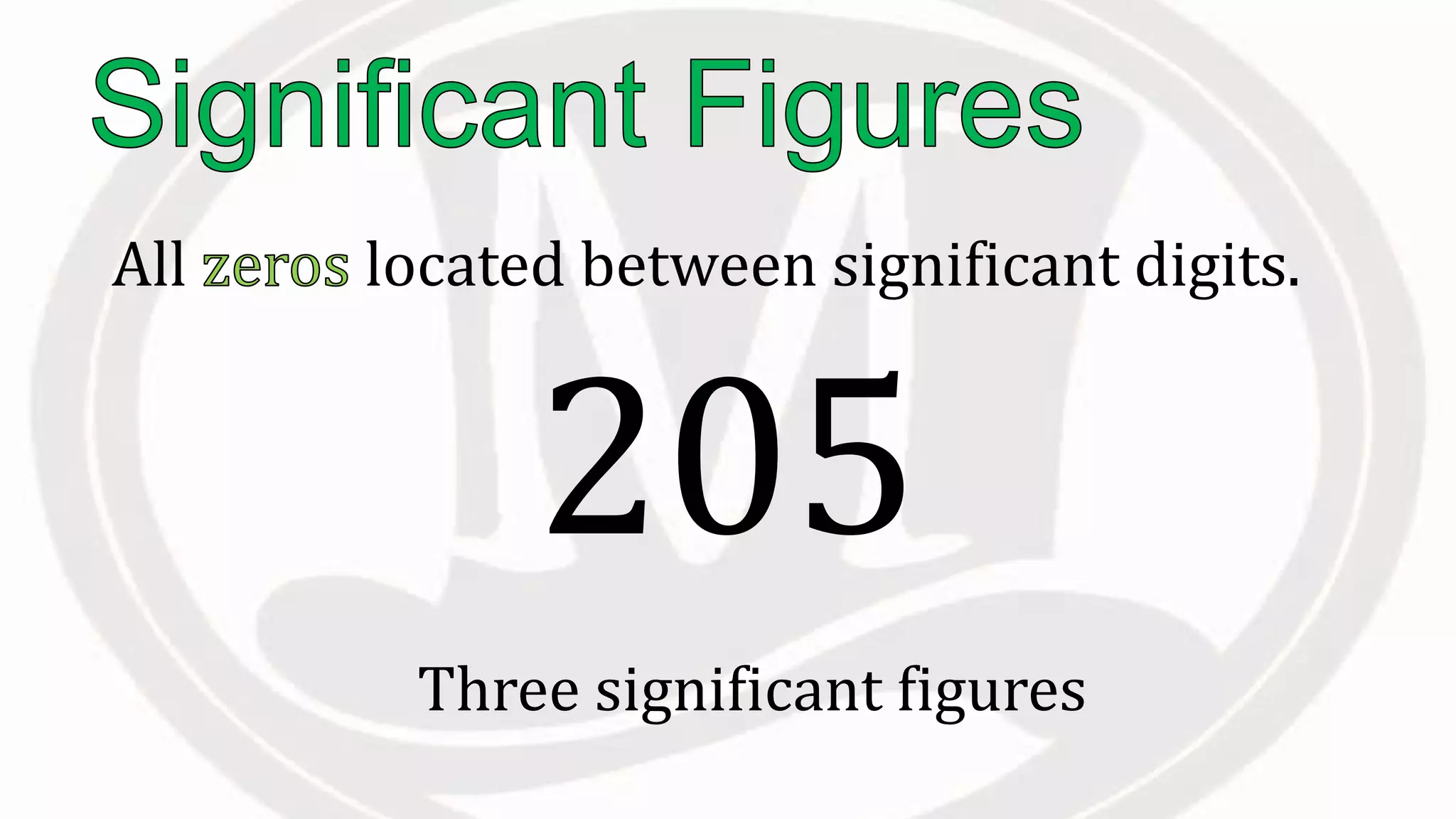
2. All located between significant digits.
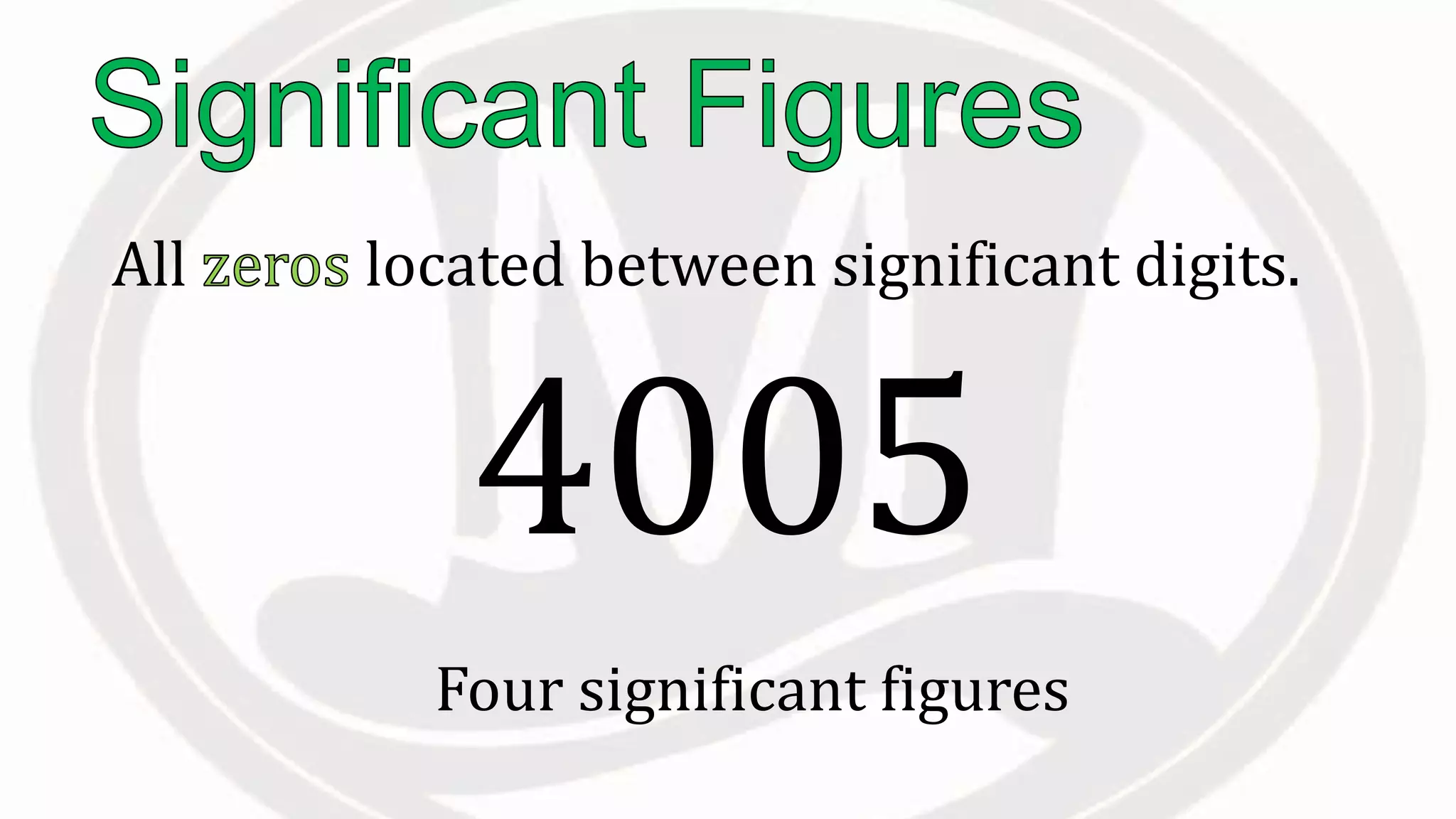
All located between significant digits.
Three significant figures
205
All located between significant digits.
Four significant figures
4005
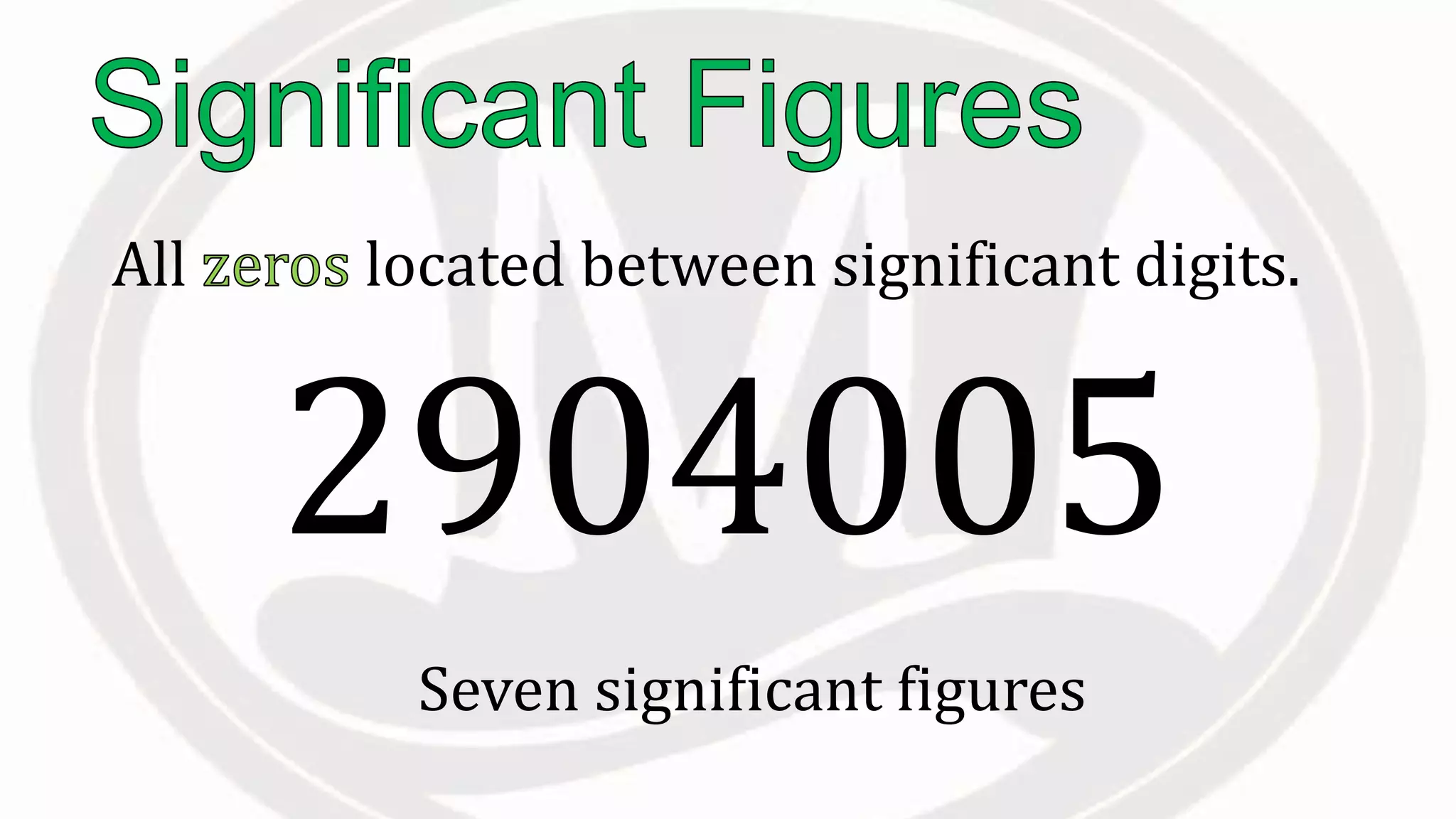
All located between significant digits.
Seven significant figures
2904005
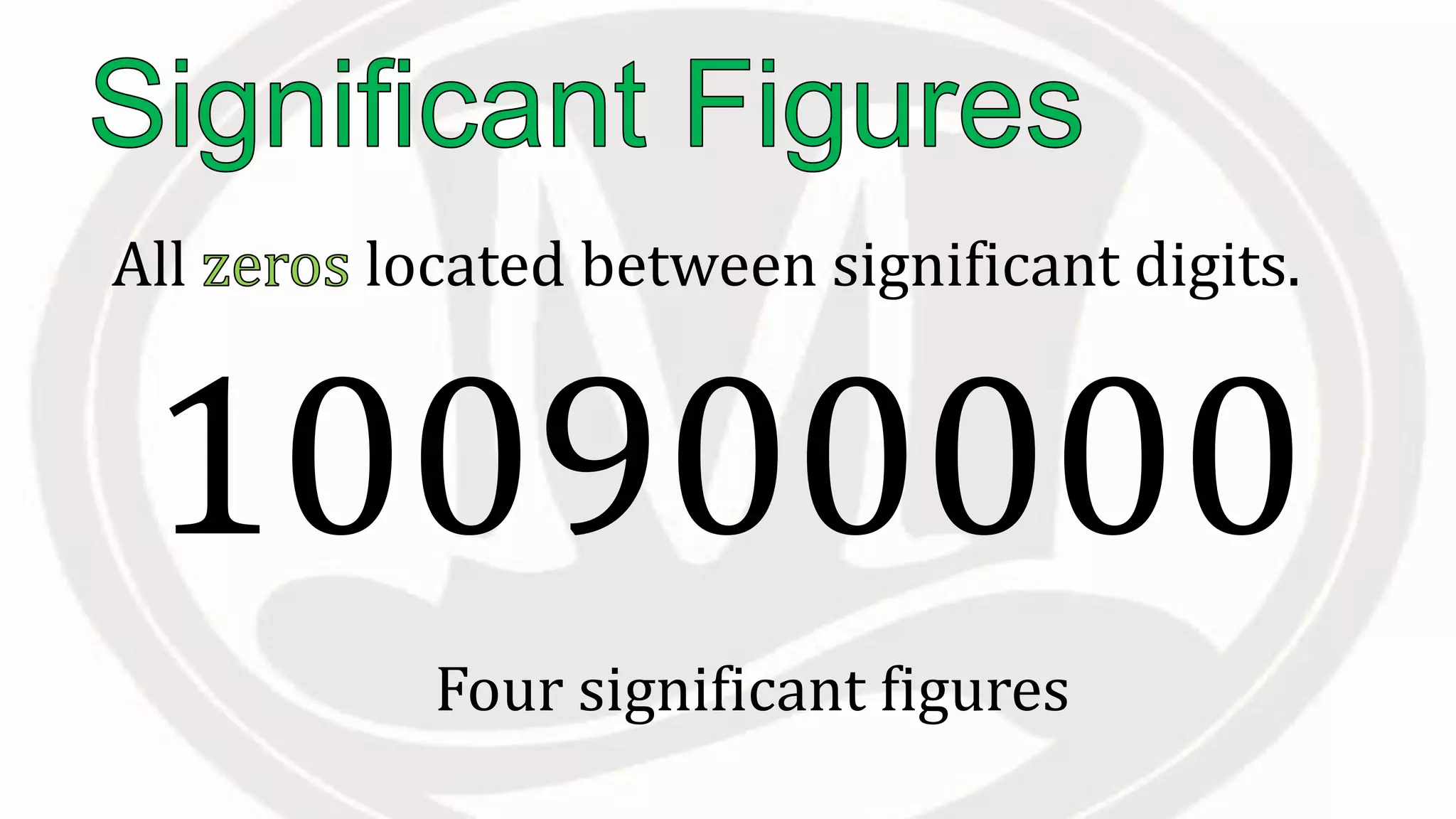
All located between significant digits.
Four significant figures
100900000
Each digit in a number that gives the degree of precision of
measurement is called a . The following are
significant digits.
1. All are significant.
2. All located between significant digits.
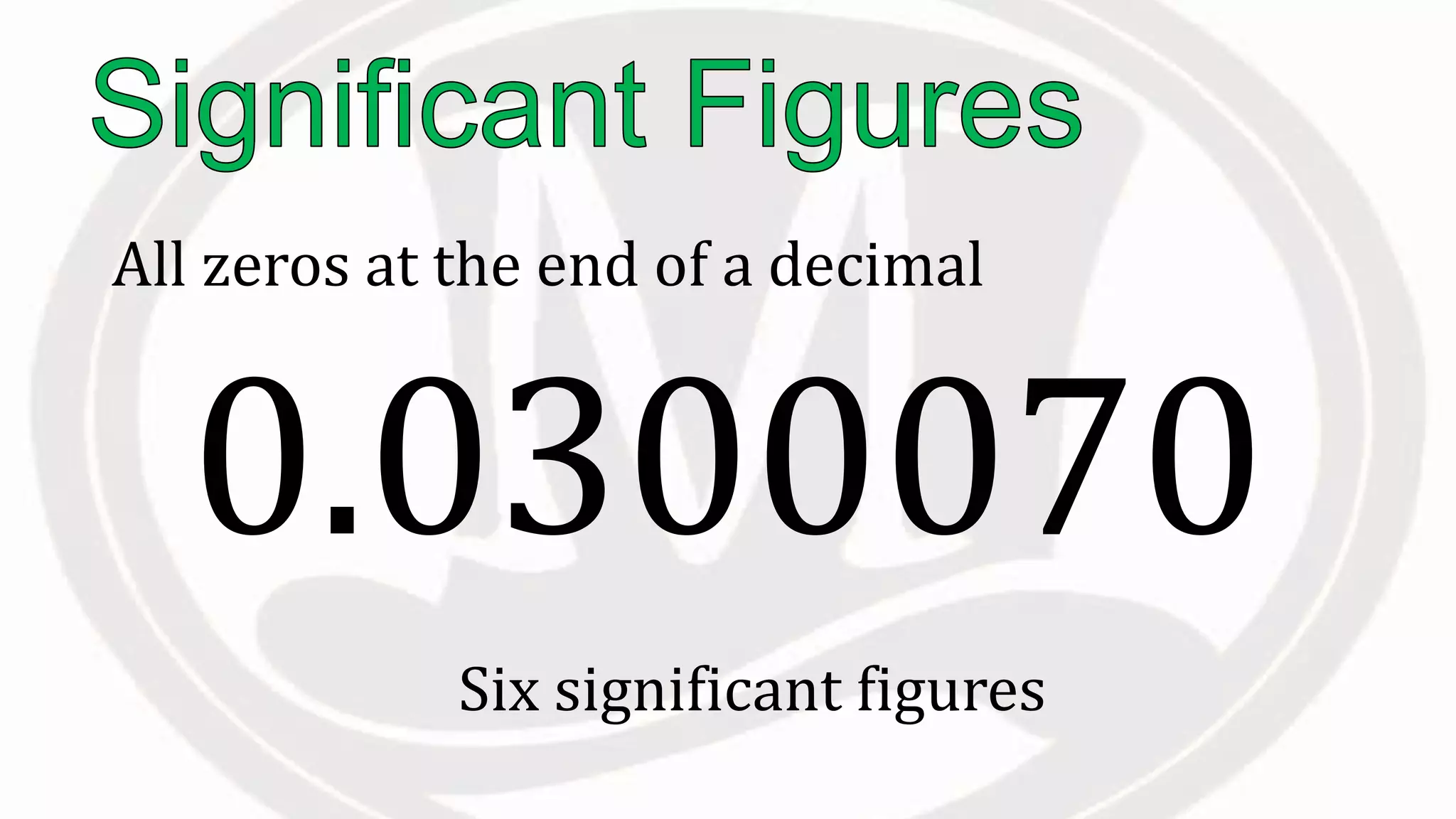
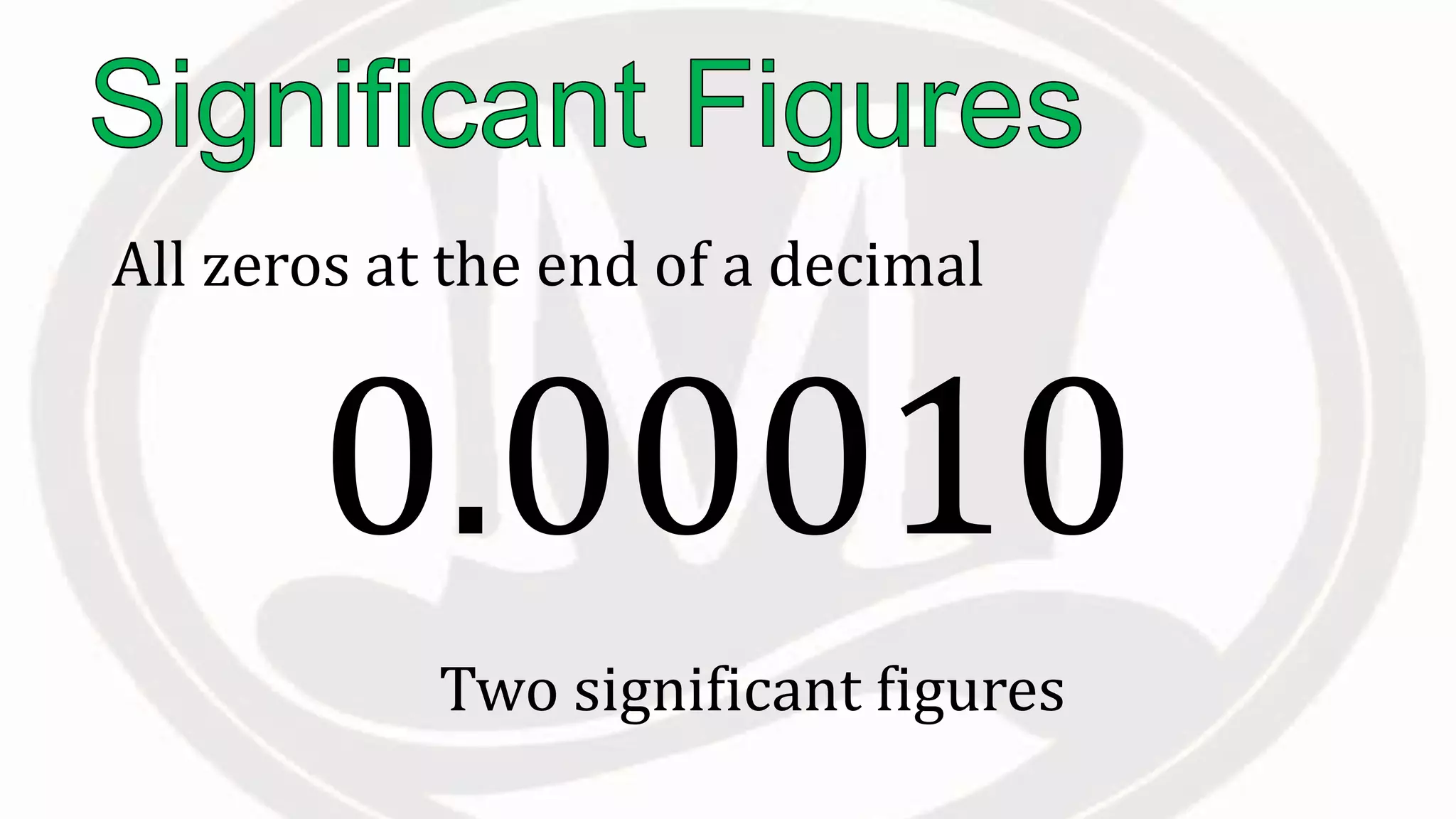
3. All zeros at the end of a decimal
All zeros at the end of a decimal
Four significant figures
21.30
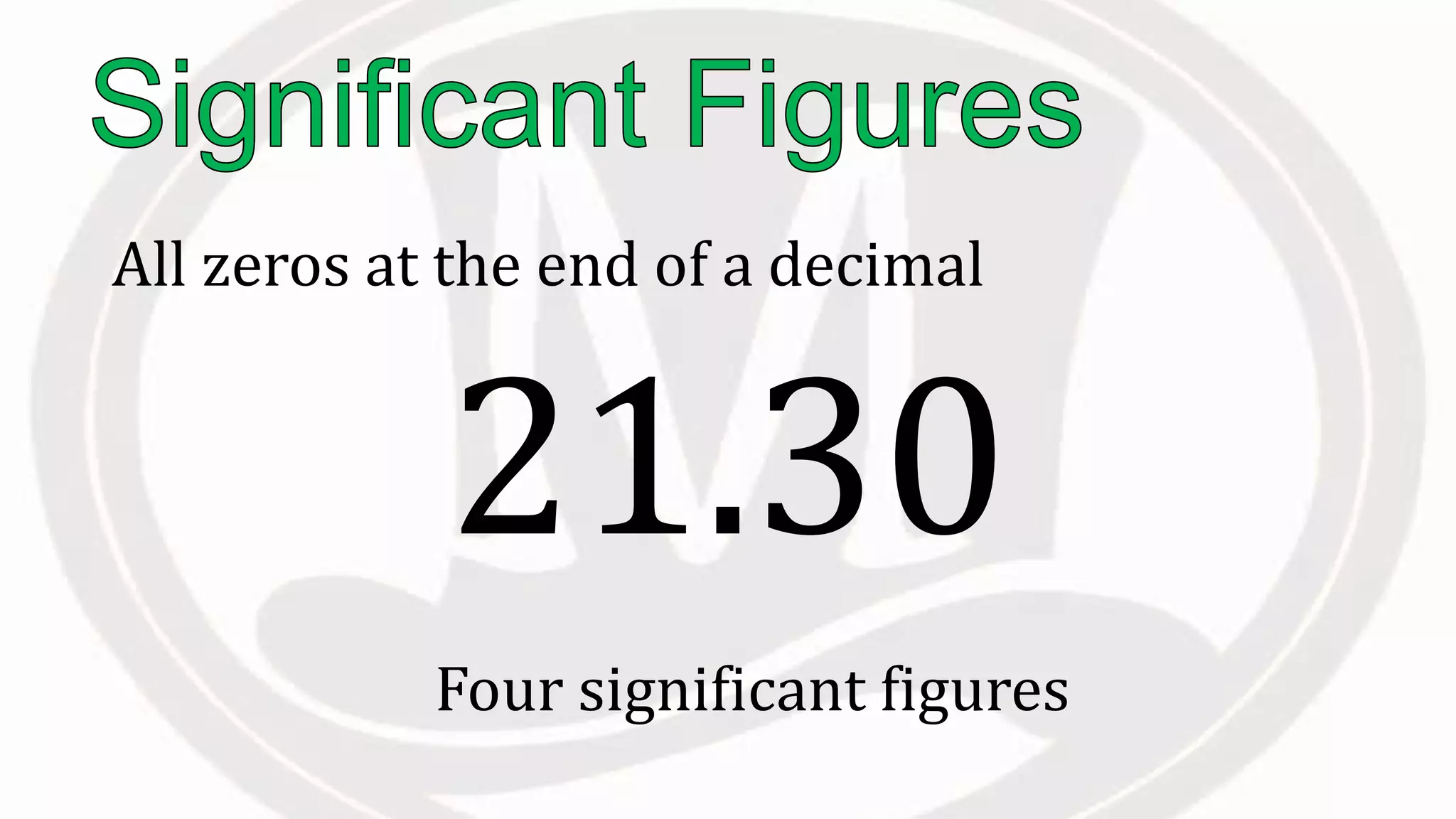
All zeros at the end of a decimal
Four significant figures
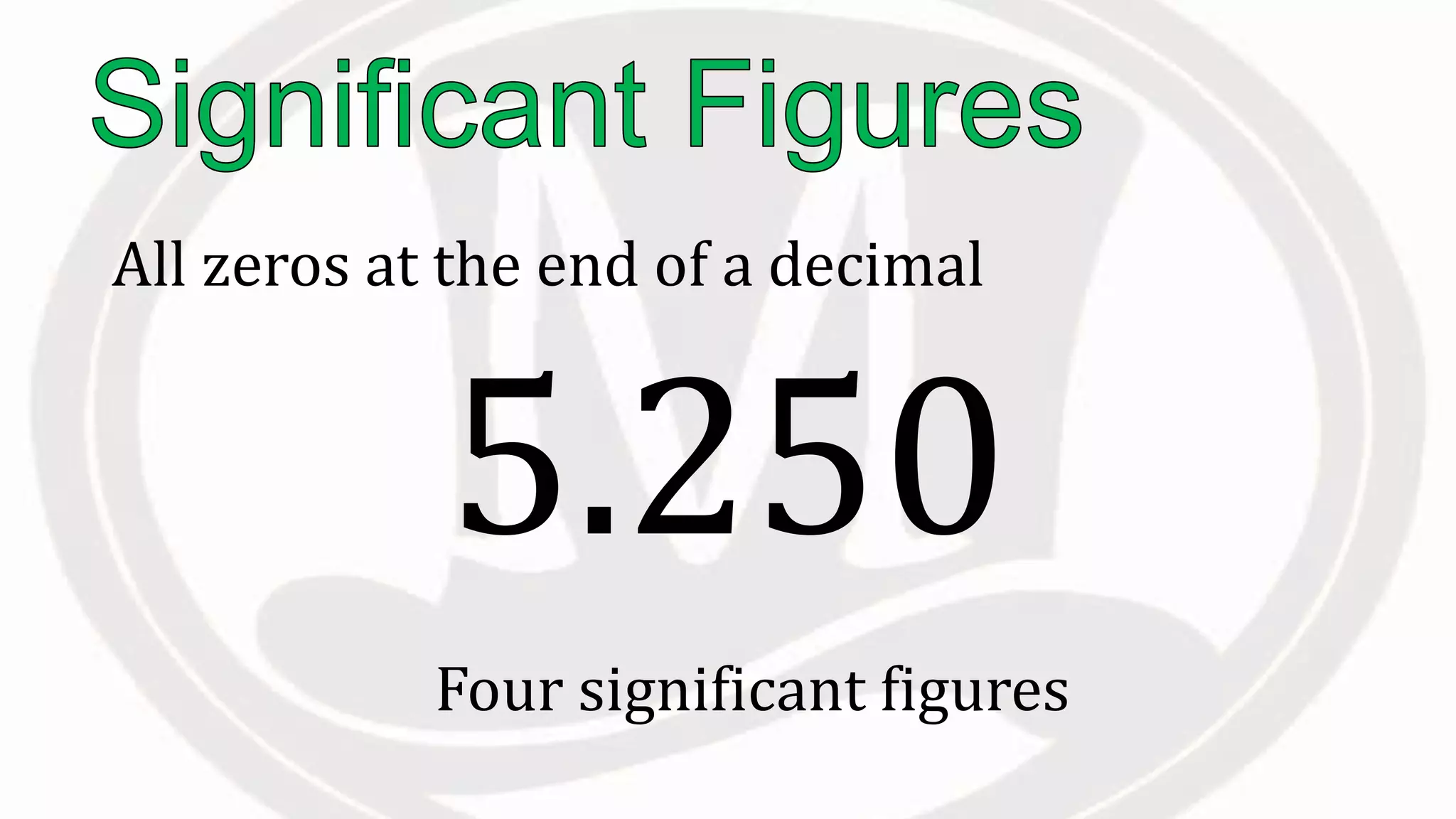
5.250
All zeros at the end of a decimal
Six significant figures
0.0300070
All zeros at the end of a decimal
Two significant figures
0.00010
Each digit in a number that gives the degree of precision of
measurement is called a . The following are
significant digits.
1. All are significant.
2. All located between significant digits.
3. All zeros at the end of a decimal
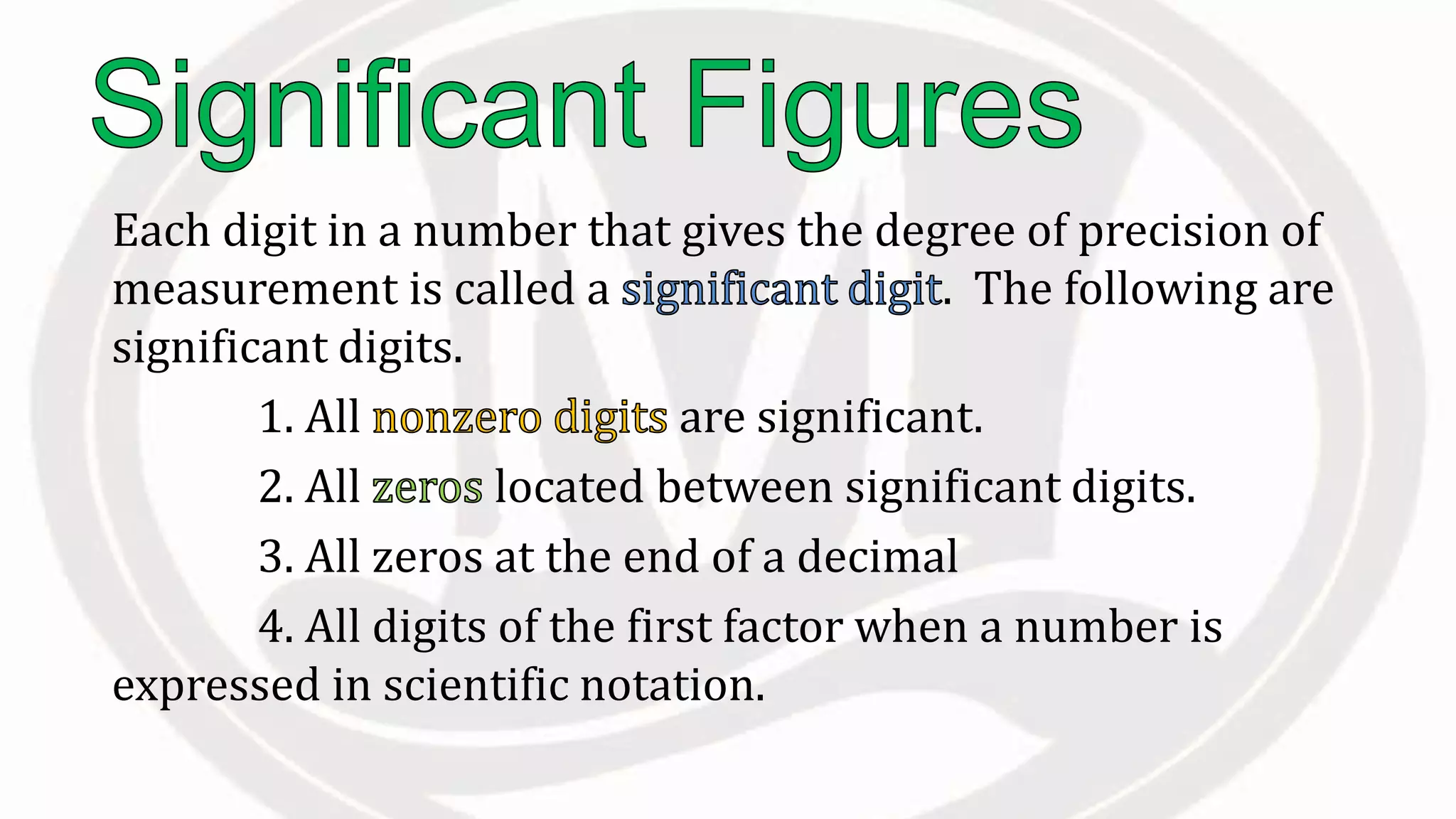
4. All digits of the first factor when a number is
expressed in scientific notation.
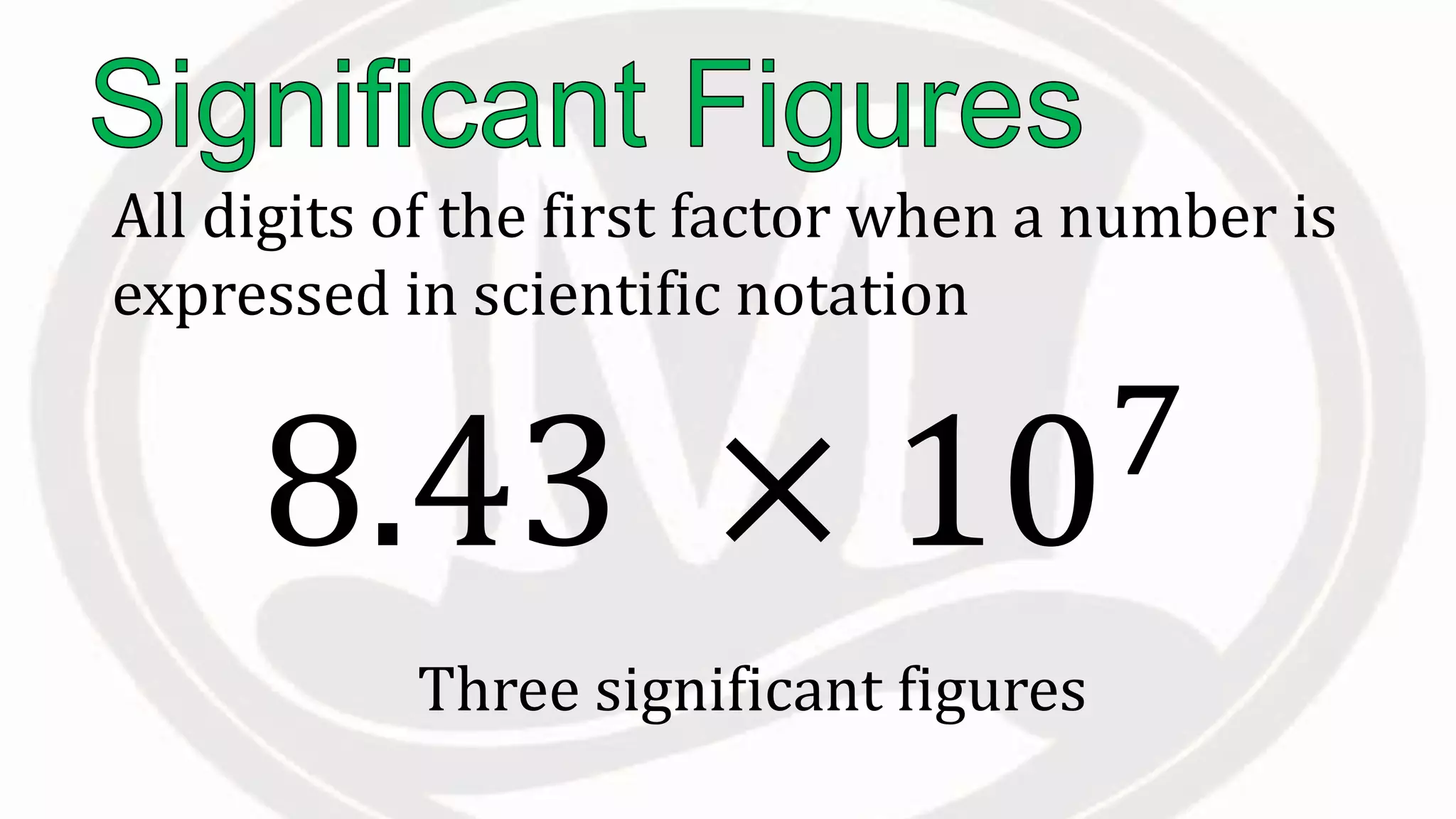
All digits of the first factor when a number is
expressed in scientific notation
Three significant figures
8.43 × 10⁷
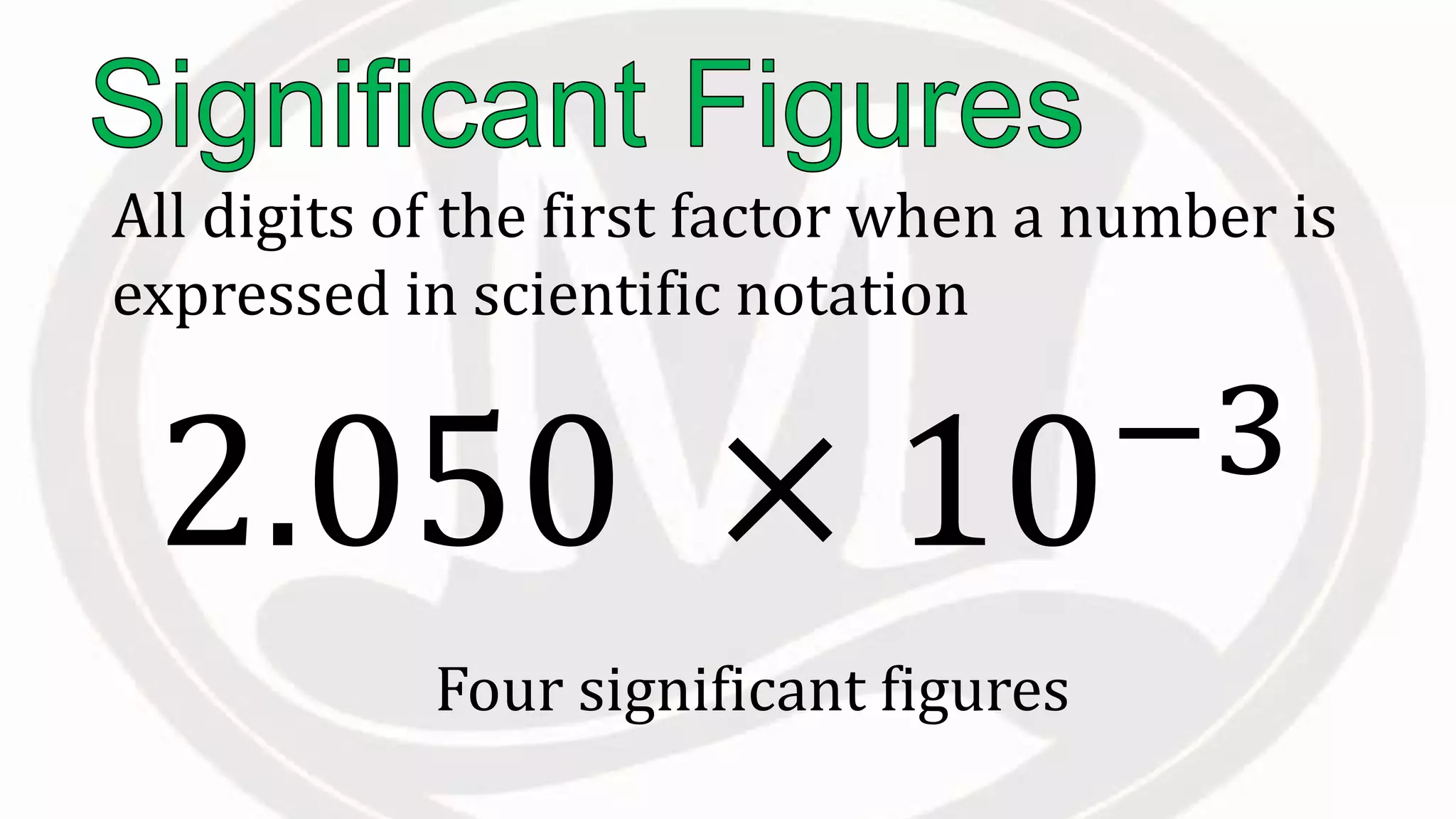
All digits of the first factor when a number is
expressed in scientific notation
Four significant figures
2.050 × 10⁻³
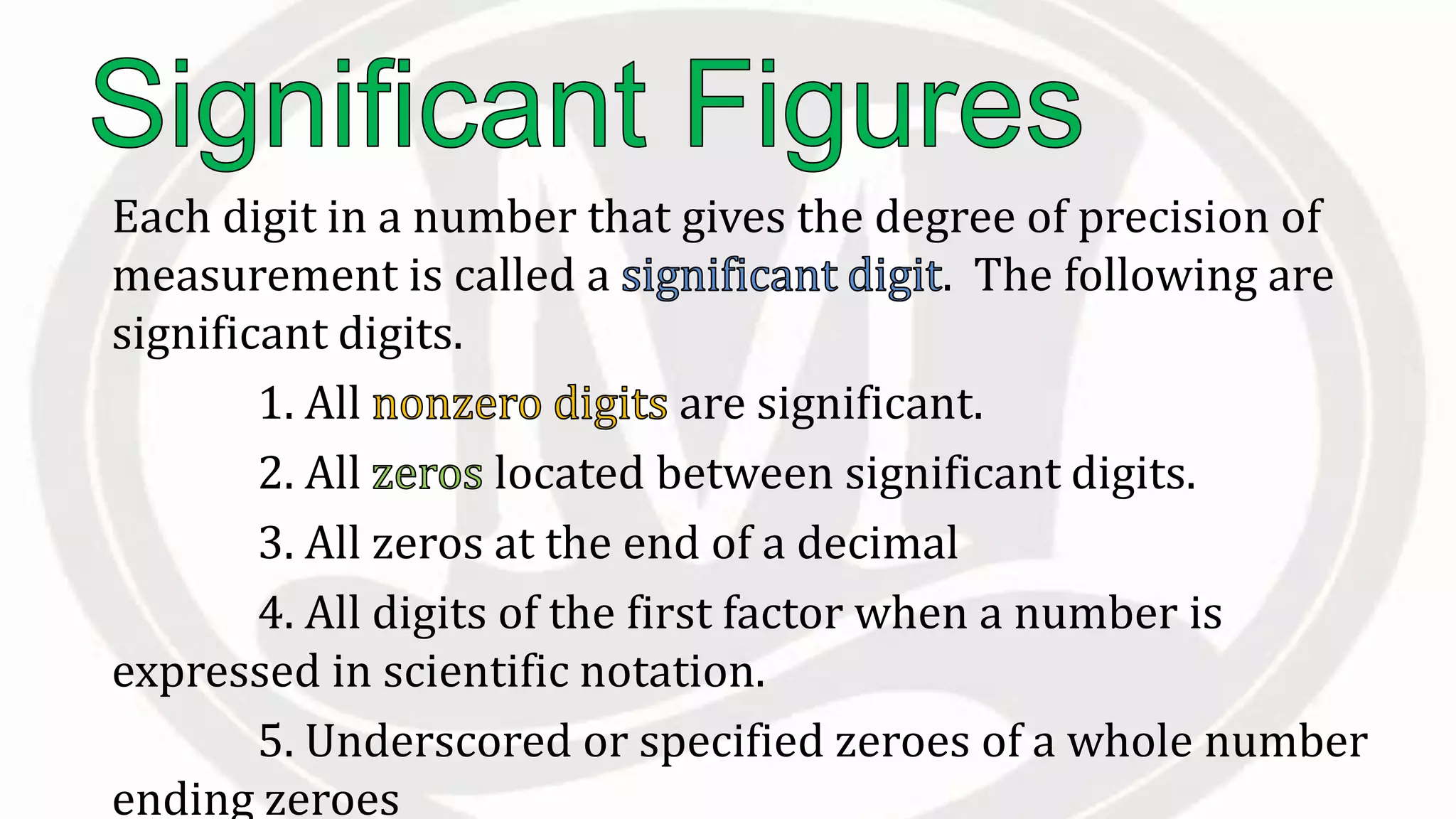
Each digit in a number that gives the degree of precision of
measurement is called a . The following are
significant digits.
1. All are significant.
2. All located between significant digits.
3. All zeros at the end of a decimal
4. All digits of the first factor when a number is
expressed in scientific notation.
5. Underscored or specified zeroes of a whole number
ending zeroes
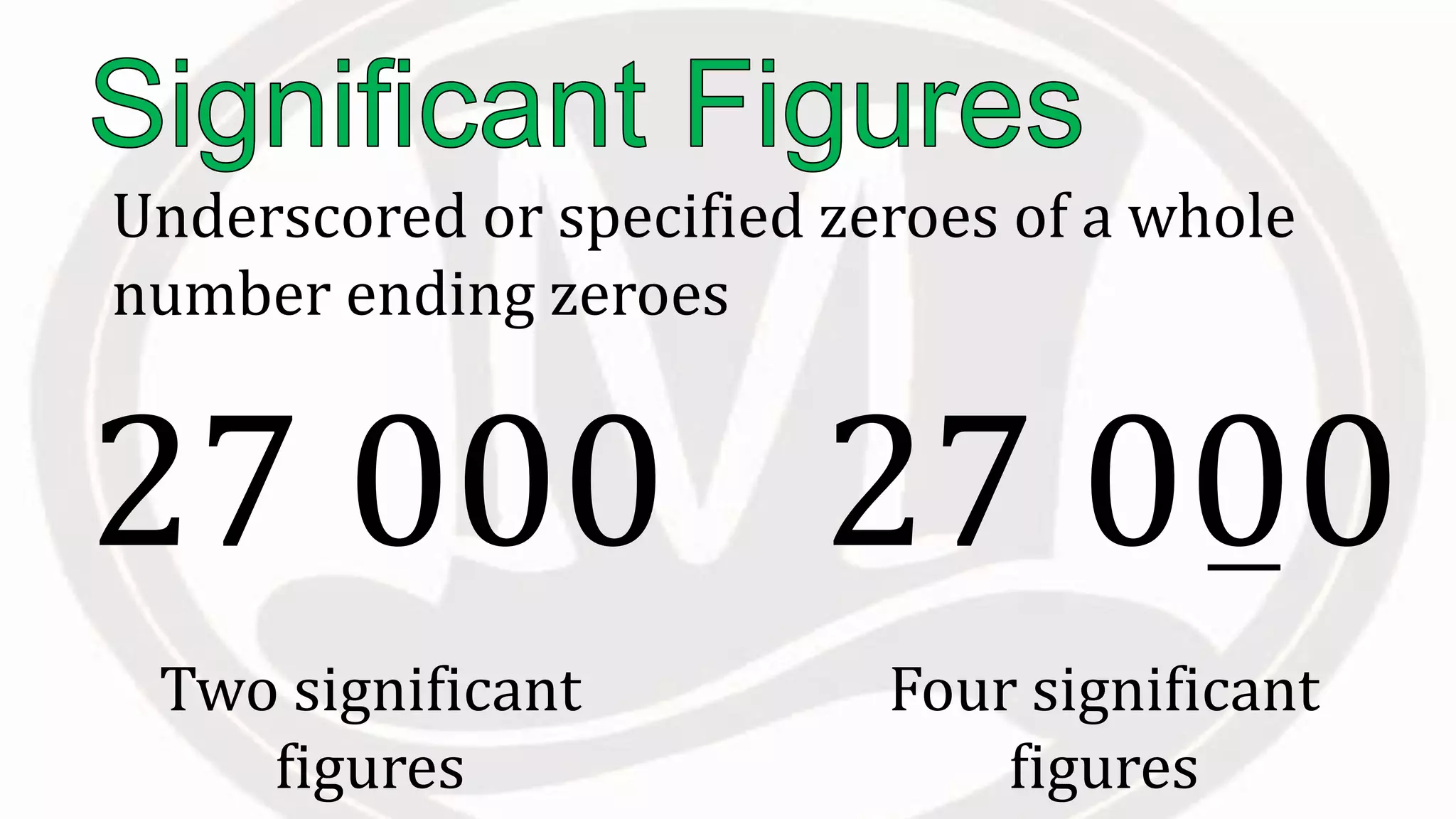
Underscored or specified zeroes of a whole
number ending zeroes
Two significant
figures
27 000
Four significant
figures
27 000
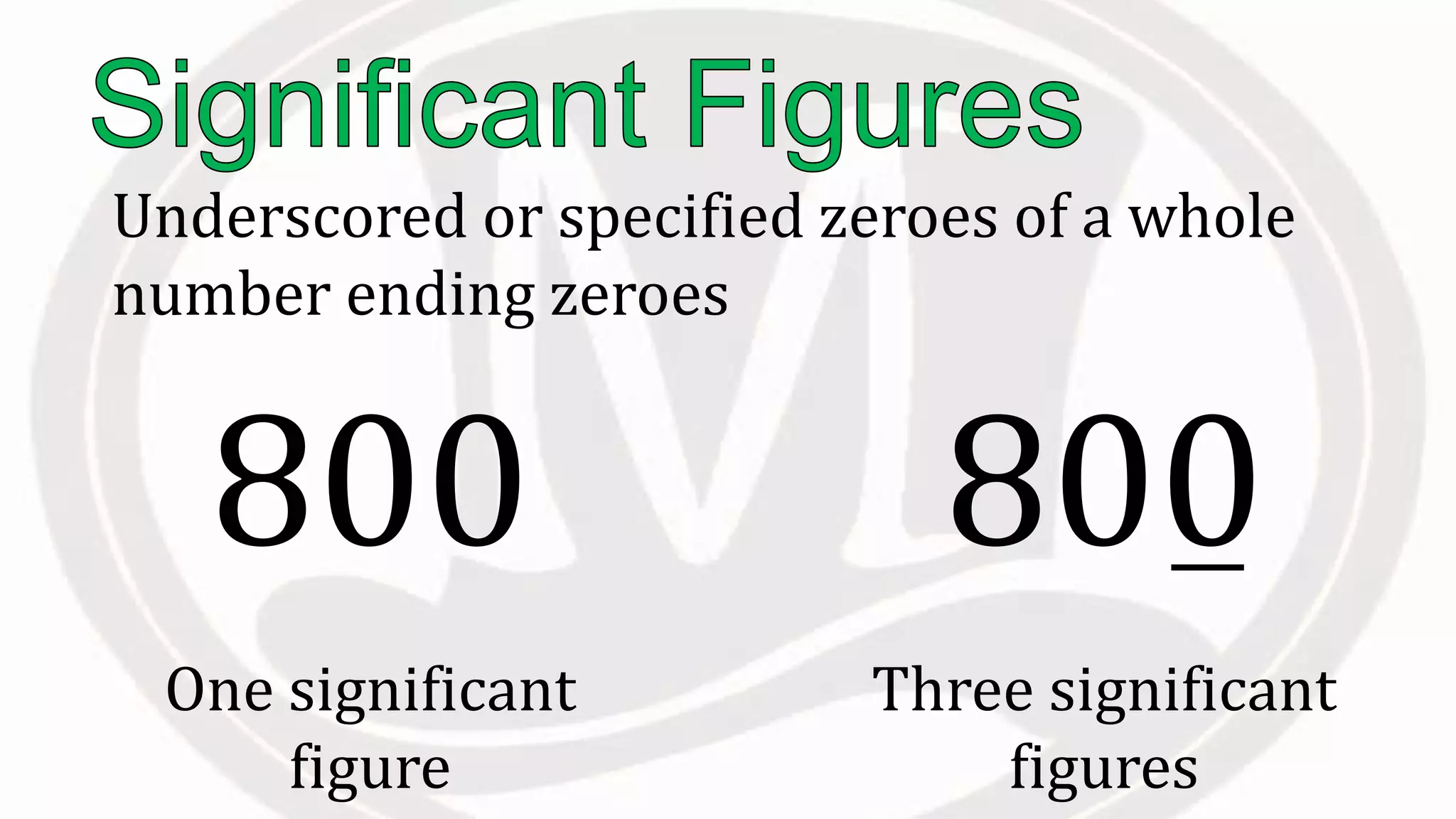
Underscored or specified zeroes of a whole
number ending zeroes
One significant
figure
800
Three significant
figures
800
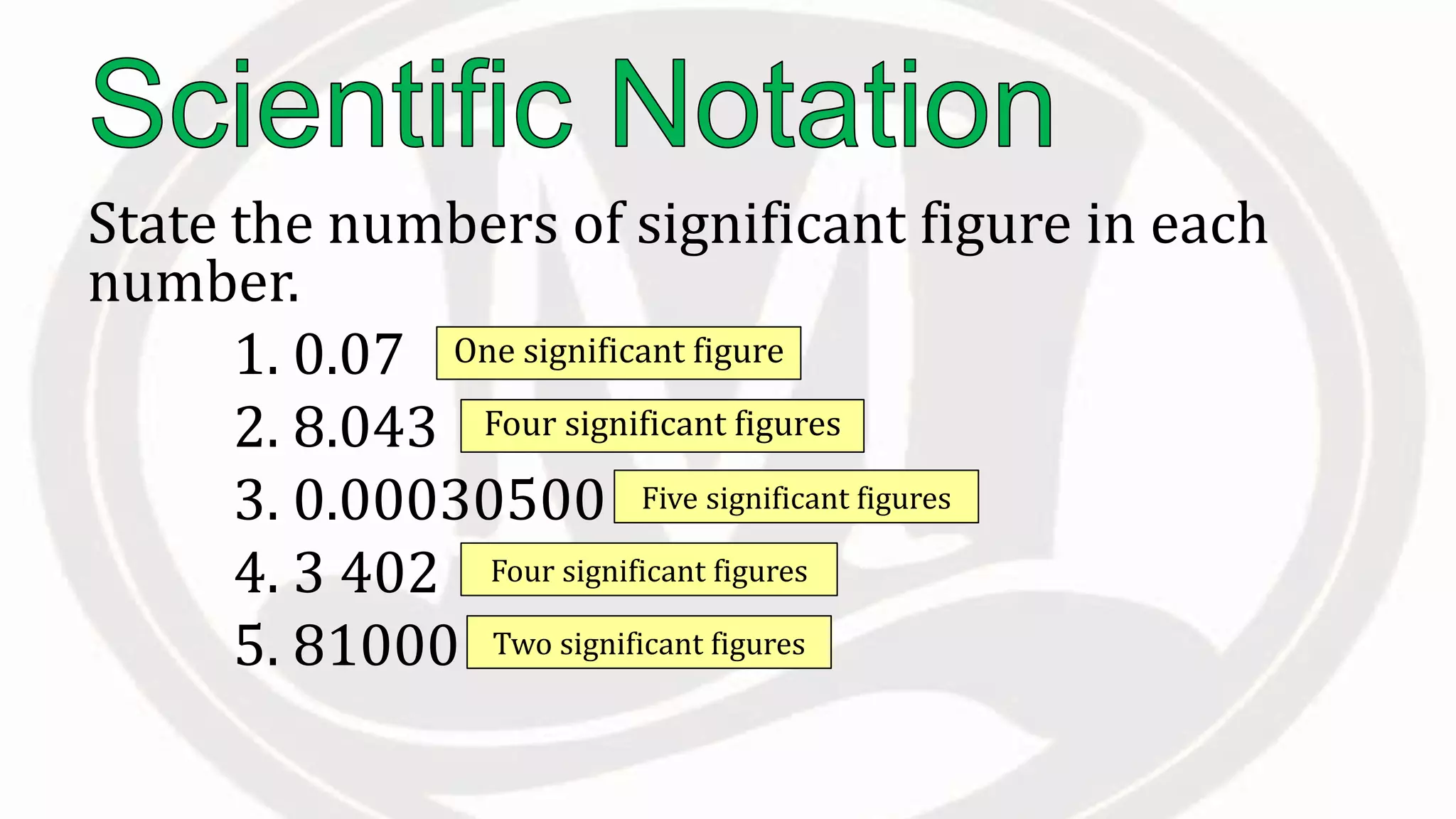
State the numbers of significant figure in each
number.
1. 0.07
2. 8.043
3. 0.00030500
4. 3 402
5. 81000
One significant figure
Four significant figures
Five significant figures
Four significant figures
Two significant figures
question
s?
E-Math 7
Practice and Application
Test VI
Page 72

Lesson 1.11 scientific notation

  • 4.
    Scientists deal withextremely large and extremely small numbers like: • The distance from the sun to the nearest star, Proxima Centauri, is about 24 700 000 000 000 miles • A single bacteria is about 0.00000075 meters in diameter.
  • 5.
    That’s why scientificnotation was created for the large number of zeros in these numbers makes them difficult to read and makes them tedious to write.
  • 6.
    gives a convenientway to write very large numbers or very small numbers.
  • 7.
    The is writtenas a multiplied by a . 4.35 × 10⁶
  • 8.
    4.35 × 106 =4 350 000 Scientific Notation Standard Form
  • 9.
    To change adecimal notation to a scientific notation: 1. Place the decimal point after the first nonzero digit 2. Count the number of places the decimal place is moved, and use that number as the number exponent 3. If the original number is greater than 10, the exponent is positive. If the original number is between 1 and 10, the exponent is zero 4. If the original number is between 0 and 1, the exponent is negative.
  • 10.
    Example 1 –Write each in scientific notation 937000 Place the to the right of the . . Count the to the right of this decimal. 5 decimal places Write the scientific notation. Delete all the 0s to the right of the and write the as the . = 9. 3 7 × 10510
  • 11.
    Example 2 –Write each in scientific notation 7000000 Place the to the right of the . . Count the to the right of this decimal. 6 decimal places Count the to the right of this decimal. Write the scientific notation. Delete all the 0s to the right of the and write the as the . = 7 × 10⁶ 10
  • 12.
    Example 3 –Write each in scientific notation −2 98 Place the to the right of the . . Count the to the right of this decimal. 2 decimal places Count the to the right of this decimal. Write the scientific notation. Delete all the 0s to the right of the and write the as the . = -2 × 10102 . 9 8
  • 13.
    Example 4 –Write each in scientific notation 317.8 Place the to the right of the . . Count the moved. 2 decimal places Write the scientific notation. Delete all the 0s to the right of the and write the as the . = 3. 1 7 × 10102 8
  • 14.
    Example 5 –Write each in scientific notation 1516.2 Place the to the right of the . . Count the moved. 3 decimal places Write the scientific notation. Delete all the 0s to the right of the and write the as the . = 5. 1 6 × 10103 21
  • 15.
    Example 6 –Write each in scientific notation 0.0000503 Move the to the right of the first non zero digit. . Count the to the right of this decimal. 5 decimal places Write the scientific notation. = 5. 0 3 × 10−510
  • 16.
    Example 7 –Write each in scientific notation 0.0000009 Move the to the right of the first non zero digit. . Count the to the right of this decimal. 7 decimal places Write the scientific notation. = 9 × 10⁻⁷ 10
  • 17.
  • 19.
    Express each inscientific notation. 1. 420000 = 4.2 × 10⁵ 2. 928.1 = 9.281 × 10² 3. −1870.9 = −1.8709 × 10³
  • 20.
  • 21.
    E-Math 7 Practice andApplication Test I and II Page 71
  • 23.
    Each digit ina number that gives the degree of precision of measurement is called a . The following are significant digits. 1. All are significant.
  • 24.
    All are significant. Threesignificant digits: 2, 3, and 5 235
  • 25.
    All are significant. Sevensignificant digits: 1 487 692 1 487 692
  • 26.
    All are significant. Foursignificant digits: 7 829 7 829
  • 27.
    All are significant. Sixsignificant digits: 929 282 929 282
  • 28.
    Each digit ina number that gives the degree of precision of measurement is called a . The following are significant digits. 1. All are significant. 2. All located between significant digits.
  • 29.
    All located betweensignificant digits. Three significant figures 205
  • 30.
    All located betweensignificant digits. Four significant figures 4005
  • 31.
    All located betweensignificant digits. Seven significant figures 2904005
  • 32.
    All located betweensignificant digits. Four significant figures 100900000
  • 33.
    Each digit ina number that gives the degree of precision of measurement is called a . The following are significant digits. 1. All are significant. 2. All located between significant digits. 3. All zeros at the end of a decimal
  • 34.
    All zeros atthe end of a decimal Four significant figures 21.30
  • 35.
    All zeros atthe end of a decimal Four significant figures 5.250
  • 36.
    All zeros atthe end of a decimal Six significant figures 0.0300070
  • 37.
    All zeros atthe end of a decimal Two significant figures 0.00010
  • 38.
    Each digit ina number that gives the degree of precision of measurement is called a . The following are significant digits. 1. All are significant. 2. All located between significant digits. 3. All zeros at the end of a decimal 4. All digits of the first factor when a number is expressed in scientific notation.
  • 39.
    All digits ofthe first factor when a number is expressed in scientific notation Three significant figures 8.43 × 10⁷
  • 40.
    All digits ofthe first factor when a number is expressed in scientific notation Four significant figures 2.050 × 10⁻³
  • 41.
    Each digit ina number that gives the degree of precision of measurement is called a . The following are significant digits. 1. All are significant. 2. All located between significant digits. 3. All zeros at the end of a decimal 4. All digits of the first factor when a number is expressed in scientific notation. 5. Underscored or specified zeroes of a whole number ending zeroes
  • 42.
    Underscored or specifiedzeroes of a whole number ending zeroes Two significant figures 27 000 Four significant figures 27 000
  • 43.
    Underscored or specifiedzeroes of a whole number ending zeroes One significant figure 800 Three significant figures 800
  • 45.
    State the numbersof significant figure in each number. 1. 0.07 2. 8.043 3. 0.00030500 4. 3 402 5. 81000 One significant figure Four significant figures Five significant figures Four significant figures Two significant figures
  • 46.
  • 47.
    E-Math 7 Practice andApplication Test VI Page 72