COMPUTERS AND
INFORMATION SYSTEMS MANAGEMENT
University of Antique
COLLEGE OF BUSINESS AND ACCOUNTANCY
Doctor of Public Administration
INFORMATION PROCESSING
INFORMATION SYSTEMS MANAGEMENT
Computerand InformationProcessing
Information processing is the manipulation of digitized
information by computers and other digital electronic
equipment, known collectively as information technology.
INFORMATION PROCESSING
INFORMATION SYSTEMS MANAGEMENT
Computerand InformationProcessing
5
• DATA is a collection of independent and unorganized facts.
• INFORMATION is the processed and organized data
presented in a meaningful form.
• DATA PROCESSING is the course of doing things in a
sequence of steps.
• SYSTEM is a set of components that work together to
achieve a common function.
INFORMATION PROCESSING
SYSTEM (IPS)
INFORMATION SYSTEMS MANAGEMENT
Computerand InformationProcessing
1. It accepts and gather data. (INPUT)
2. It processes data to become information. (PROCESSING)
3. It stores data and information. (STORAGE)
4. It presents information. (OUTPUT)
FUNCTIONS OF AN IPS
DATA INFORMATION
INPUT
OUTPUT
STORAGE
PROCESSOR
INFORMATION SYSTEMS MANAGEMENT
Computerand InformationProcessing
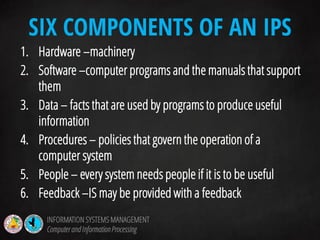
1. Hardware –machinery
2. Software –computer programs and the manuals that support
them
3. Data – facts that are used by programs to produce useful
information
4. Procedures – policies that govern the operation of a
computer system
5. People – every system needs people if it is to be useful
6. Feedback –IS may be provided with a feedback
SIX COMPONENTS OF AN IPS
INFORMATION SYSTEMS MANAGEMENT
Computerand InformationProcessing
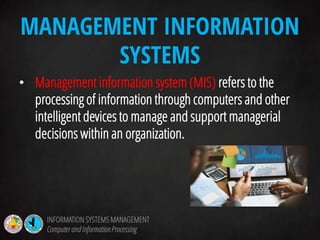
• Management information system (MIS) refers to the
processing of information through computers and other
intelligent devices to manage and support managerial
decisions within an organization.
MANAGEMENT INFORMATION
SYSTEMS
INFORMATION SYSTEMS MANAGEMENT
Computerand InformationProcessing
MAINFRAME AND MINICOMPUTER COMPUTING
FIVE ERAS OF MIS EVOLUTION
INFORMATION SYSTEMS MANAGEMENT
Computerand InformationProcessing
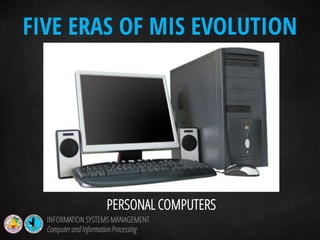
PERSONAL COMPUTERS
FIVE ERAS OF MIS EVOLUTION
INFORMATION SYSTEMS MANAGEMENT
Computerand InformationProcessing
CLIENT/SERVER NETWORKS
FIVE ERAS OF MIS EVOLUTION
INFORMATION SYSTEMS MANAGEMENT
Computerand InformationProcessing
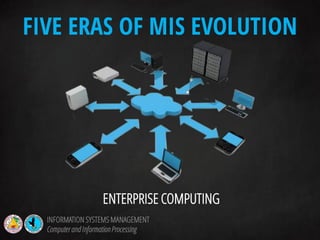
ENTERPRISE COMPUTING
FIVE ERAS OF MIS EVOLUTION
INFORMATION SYSTEMS MANAGEMENT
Computerand InformationProcessing
CLOUD COMPUTING
FIVE ERAS OF MIS EVOLUTION
INFORMATION SYSTEMS MANAGEMENT
Computerand InformationProcessing
MANAGEMENT INFORMATION SYSTEMS
TYPES OF MIS
INFORMATION SYSTEMS MANAGEMENT
Computerand InformationProcessing
DECISION SUPPORT SYSTEMS
TYPES OF MIS
INFORMATION SYSTEMS MANAGEMENT
Computerand InformationProcessing
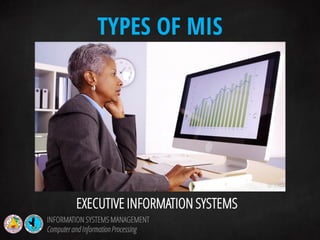
EXECUTIVE INFORMATION SYSTEMS
TYPES OF MIS
INFORMATION SYSTEMS MANAGEMENT
Computerand InformationProcessing
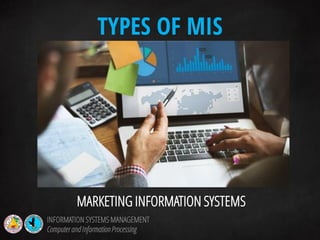
MARKETING INFORMATION SYSTEMS
TYPES OF MIS
INFORMATION SYSTEMS MANAGEMENT
Computerand InformationProcessing
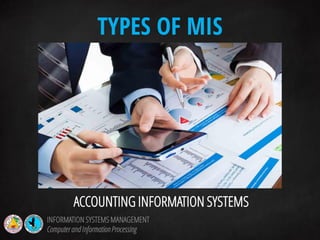
ACCOUNTING INFORMATION SYSTEMS
TYPES OF MIS
INFORMATION SYSTEMS MANAGEMENT
Computerand InformationProcessing
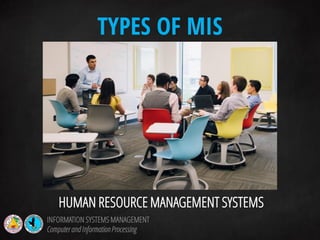
HUMAN RESOURCE MANAGEMENT SYSTEMS
TYPES OF MIS
INFORMATION SYSTEMS MANAGEMENT
Computerand InformationProcessing
OFFICE AUTOMATION SYSTEMS
TYPES OF MIS
INFORMATION SYSTEMS MANAGEMENT
Computerand InformationProcessing
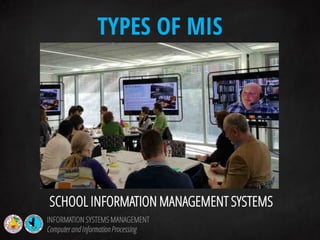
SCHOOL INFORMATION MANAGEMENT SYSTEMS
TYPES OF MIS
INFORMATION SYSTEMS MANAGEMENT
Computerand InformationProcessing
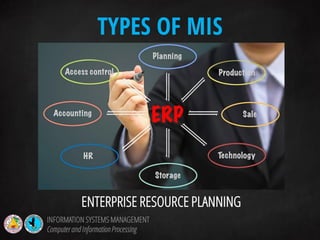
ENTERPRISE RESOURCE PLANNING
TYPES OF MIS
INFORMATION SYSTEMS MANAGEMENT
Computerand InformationProcessing
✓ Companies are able to identify their strengths and
weaknesses and help a company improve its business
processes and operations.
✓ Giving an overall picture of the company.
✓ Acting as a communication and planning tool.
✓ The availability of customer data and feedback can help
the company to align its business processes according to
the needs of its customers.
ADVANTAGES OF MIS
INFORMATION SYSTEMS MANAGEMENT
Computerand InformationProcessing
✓ MIS can help a company gain a competitive advantage.
✓ MIS report help to take decision and action on certain
object with quick time.
ADVANTAGES OF MIS
INFORMATION SYSTEMS MANAGEMENT
Computerand InformationProcessing
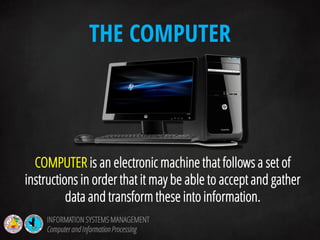
COMPUTER is an electronic machine that follows a set of
instructions in order that it may be able to accept and gather
data and transform these into information.
THE COMPUTER
INFORMATION SYSTEMS MANAGEMENT
Computerand InformationProcessing
Central Processing Unit (CPU)
• Brain of the computer
• It directs and controls the
entire computer system
and performs all arithmetic
and logical operations.
BASIC COMPUTER HARDWARE
INFORMATION SYSTEMS MANAGEMENT
Computerand InformationProcessing
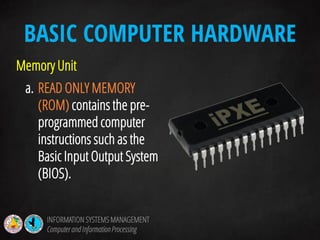
Memory Unit
a. READ ONLY MEMORY
(ROM) contains the pre-
programmed computer
instructions such as the
Basic Input Output System
(BIOS).
BASIC COMPUTER HARDWARE
INFORMATION SYSTEMS MANAGEMENT
Computerand InformationProcessing
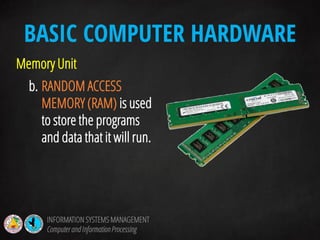
Memory Unit
b. RANDOM ACCESS
MEMORY (RAM) is used
to store the programs
and data that it will run.
BASIC COMPUTER HARDWARE
INFORMATION SYSTEMS MANAGEMENT
Computerand InformationProcessing
Input Devices
Keyboard
• typewriter-style device
which uses an
arrangement of buttons
or keys to act as a
mechanical lever or
electronic switch.
BASIC COMPUTER HARDWARE
INFORMATION SYSTEMS MANAGEMENT
Computerand InformationProcessing
Input Devices
Mouse
• pointing device (hand
control) that detects two-
dimensional motion
relative to a surface
BASIC COMPUTER HARDWARE
INFORMATION SYSTEMS MANAGEMENT
Computerand InformationProcessing
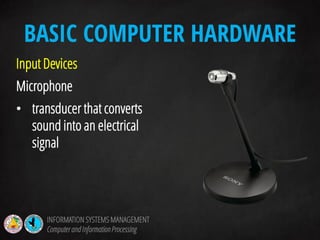
Input Devices
Microphone
• transducer that converts
sound into an electrical
signal
BASIC COMPUTER HARDWARE
INFORMATION SYSTEMS MANAGEMENT
Computerand InformationProcessing
Input Devices
Webcam
• video camera that feeds or
streams its image in real
time to or through a
computer to a computer
network
BASIC COMPUTER HARDWARE
INFORMATION SYSTEMS MANAGEMENT
Computerand InformationProcessing
Input Devices
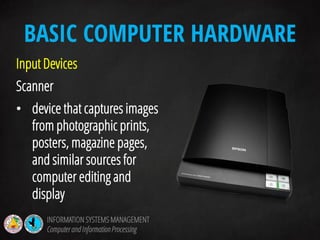
Scanner
• device that captures images
from photographic prints,
posters, magazine pages,
and similar sources for
computer editing and
display
BASIC COMPUTER HARDWARE
INFORMATION SYSTEMS MANAGEMENT
Computerand InformationProcessing
Output Devices
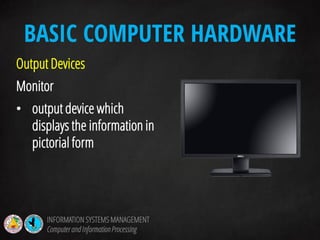
Monitor
• output device which
displays the information in
pictorial form
BASIC COMPUTER HARDWARE
INFORMATION SYSTEMS MANAGEMENT
Computerand InformationProcessing
Output Devices
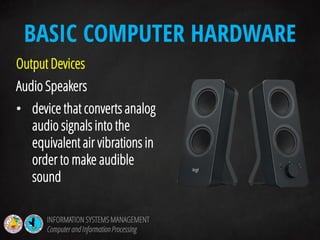
Audio Speakers
• device that converts analog
audio signals into the
equivalent air vibrations in
order to make audible
sound
BASIC COMPUTER HARDWARE
INFORMATION SYSTEMS MANAGEMENT
Computerand InformationProcessing
Output Devices
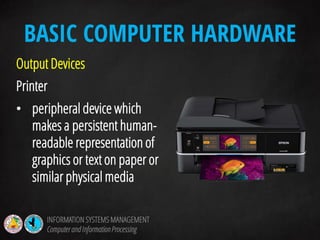
Printer
• peripheral device which
makes a persistent human-
readable representation of
graphics or text on paper or
similar physical media
BASIC COMPUTER HARDWARE
INFORMATION SYSTEMS MANAGEMENT
Computerand InformationProcessing
Secondary Storage Devices
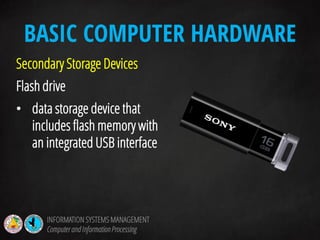
Flash drive
• data storage device that
includes flash memory with
an integrated USB interface
BASIC COMPUTER HARDWARE
INFORMATION SYSTEMS MANAGEMENT
Computerand InformationProcessing
Secondary Storage Devices
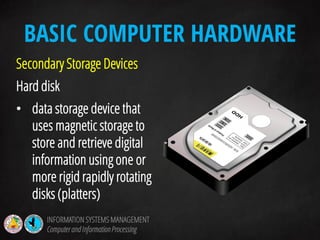
Hard disk
• data storage device that
uses magnetic storage to
store and retrieve digital
information using one or
more rigid rapidly rotating
disks (platters)
BASIC COMPUTER HARDWARE
INFORMATION SYSTEMS MANAGEMENT
Computerand InformationProcessing
Secondary Storage Devices
CD ROM
• pre-pressed optical
compact disc which
contains data
BASIC COMPUTER HARDWARE
INFORMATION SYSTEMS MANAGEMENT
Computerand InformationProcessing
Secondary Storage Devices
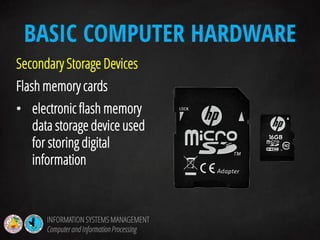
Flash memory cards
• electronic flash memory
data storage device used
for storing digital
information
BASIC COMPUTER HARDWARE
INFORMATION SYSTEMS MANAGEMENT
Computerand InformationProcessing
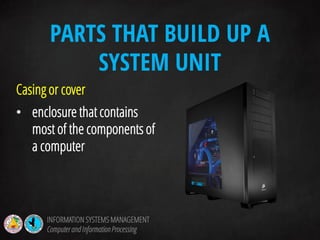
Casing or cover
• enclosure that contains
most of the components of
a computer
PARTS THAT BUILD UP A
SYSTEM UNIT
INFORMATION SYSTEMS MANAGEMENT
Computerand InformationProcessing
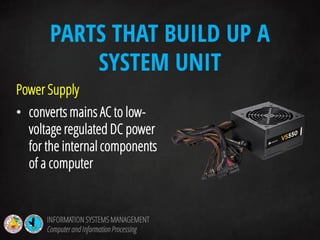
Power Supply
• converts mains AC to low-
voltage regulated DC power
for the internal components
of a computer
PARTS THAT BUILD UP A
SYSTEM UNIT
INFORMATION SYSTEMS MANAGEMENT
Computerand InformationProcessing
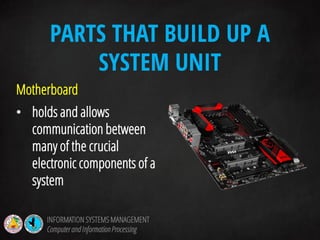
Motherboard
• holds and allows
communication between
many of the crucial
electronic components of a
system
PARTS THAT BUILD UP A
SYSTEM UNIT
INFORMATION SYSTEMS MANAGEMENT
Computerand InformationProcessing
Microprocessor
• perform arithmetic and logic
operations
• operations include adding,
subtracting, comparing two
numbers, and fetching numbers
from one area to another
PARTS THAT BUILD UP A
SYSTEM UNIT
INFORMATION SYSTEMS MANAGEMENT
Computerand InformationProcessing
Memory
• physical device capable of
storing information
temporarily or permanently
PARTS THAT BUILD UP A
SYSTEM UNIT
INFORMATION SYSTEMS MANAGEMENT
Computerand InformationProcessing
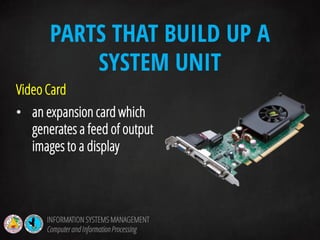
Video Card
• an expansion card which
generates a feed of output
images to a display
PARTS THAT BUILD UP A
SYSTEM UNIT
INFORMATION SYSTEMS MANAGEMENT
Computerand InformationProcessing
Sound card
• internal expansion card
that provides input and
output of audio signals to
and from a computer
PARTS THAT BUILD UP A
SYSTEM UNIT
INFORMATION SYSTEMS MANAGEMENT
Computerand InformationProcessing
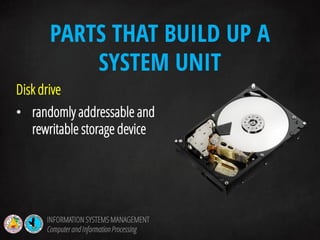
Disk drive
• randomly addressable and
rewritable storage device
PARTS THAT BUILD UP A
SYSTEM UNIT
INFORMATION SYSTEMS MANAGEMENT
Computerand InformationProcessing
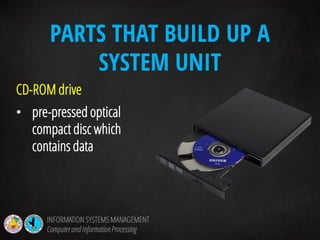
CD-ROM drive
• pre-pressed optical
compact disc which
contains data
PARTS THAT BUILD UP A
SYSTEM UNIT
INFORMATION SYSTEMS MANAGEMENT
Computerand InformationProcessing
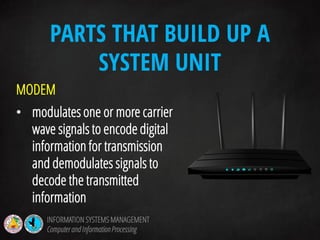
MODEM
• modulates one or more carrier
wave signals to encode digital
information for transmission
and demodulates signals to
decode the transmitted
information
PARTS THAT BUILD UP A
SYSTEM UNIT
INFORMATION SYSTEMS MANAGEMENT
Computerand InformationProcessing
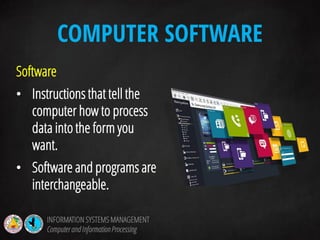
Software
• Instructions that tell the
computer how to process
data into the form you
want.
• Software and programs are
interchangeable.
COMPUTER SOFTWARE
INFORMATION SYSTEMS MANAGEMENT
Computerand InformationProcessing
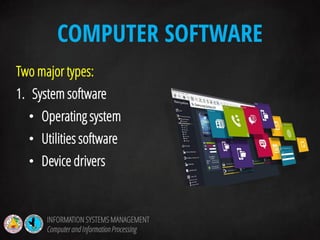
Two major types:
1. System software
• Operating system
• Utilities software
• Device drivers
COMPUTER SOFTWARE
INFORMATION SYSTEMS MANAGEMENT
Computerand InformationProcessing
Two major types:
2. Application software
• Basic Applications
• Specialized Applications
COMPUTER SOFTWARE
INFORMATION SYSTEMS MANAGEMENT
Computerand InformationProcessing
Two major types:
3. Malicious software
• developed to harm and
disrupt computers
COMPUTER SOFTWARE
INFORMATION SYSTEMS MANAGEMENT
Computerand InformationProcessing
COMPUTERS AND
INFORMATION SYSTEMS MANAGEMENT
University of Antique
COLLEGE OF BUSINESS AND ACCOUNTANCY
Doctor of Public Administration
INFORMATION PROCESSING
INFORMATION SYSTEMS MANAGEMENT
Computerand InformationProcessing

Computers and Information Processing

  • 1.
    COMPUTERS AND INFORMATION SYSTEMSMANAGEMENT University of Antique COLLEGE OF BUSINESS AND ACCOUNTANCY Doctor of Public Administration INFORMATION PROCESSING INFORMATION SYSTEMS MANAGEMENT Computerand InformationProcessing
  • 2.
    Information processing isthe manipulation of digitized information by computers and other digital electronic equipment, known collectively as information technology. INFORMATION PROCESSING INFORMATION SYSTEMS MANAGEMENT Computerand InformationProcessing
  • 3.
    5 • DATA isa collection of independent and unorganized facts. • INFORMATION is the processed and organized data presented in a meaningful form. • DATA PROCESSING is the course of doing things in a sequence of steps. • SYSTEM is a set of components that work together to achieve a common function. INFORMATION PROCESSING SYSTEM (IPS) INFORMATION SYSTEMS MANAGEMENT Computerand InformationProcessing
  • 4.
    1. It acceptsand gather data. (INPUT) 2. It processes data to become information. (PROCESSING) 3. It stores data and information. (STORAGE) 4. It presents information. (OUTPUT) FUNCTIONS OF AN IPS DATA INFORMATION INPUT OUTPUT STORAGE PROCESSOR INFORMATION SYSTEMS MANAGEMENT Computerand InformationProcessing
  • 5.
    1. Hardware –machinery 2.Software –computer programs and the manuals that support them 3. Data – facts that are used by programs to produce useful information 4. Procedures – policies that govern the operation of a computer system 5. People – every system needs people if it is to be useful 6. Feedback –IS may be provided with a feedback SIX COMPONENTS OF AN IPS INFORMATION SYSTEMS MANAGEMENT Computerand InformationProcessing
  • 6.
    • Management informationsystem (MIS) refers to the processing of information through computers and other intelligent devices to manage and support managerial decisions within an organization. MANAGEMENT INFORMATION SYSTEMS INFORMATION SYSTEMS MANAGEMENT Computerand InformationProcessing
  • 7.
    MAINFRAME AND MINICOMPUTERCOMPUTING FIVE ERAS OF MIS EVOLUTION INFORMATION SYSTEMS MANAGEMENT Computerand InformationProcessing
  • 8.
    PERSONAL COMPUTERS FIVE ERASOF MIS EVOLUTION INFORMATION SYSTEMS MANAGEMENT Computerand InformationProcessing
  • 9.
    CLIENT/SERVER NETWORKS FIVE ERASOF MIS EVOLUTION INFORMATION SYSTEMS MANAGEMENT Computerand InformationProcessing
  • 10.
    ENTERPRISE COMPUTING FIVE ERASOF MIS EVOLUTION INFORMATION SYSTEMS MANAGEMENT Computerand InformationProcessing
  • 11.
    CLOUD COMPUTING FIVE ERASOF MIS EVOLUTION INFORMATION SYSTEMS MANAGEMENT Computerand InformationProcessing
  • 12.
    MANAGEMENT INFORMATION SYSTEMS TYPESOF MIS INFORMATION SYSTEMS MANAGEMENT Computerand InformationProcessing
  • 13.
    DECISION SUPPORT SYSTEMS TYPESOF MIS INFORMATION SYSTEMS MANAGEMENT Computerand InformationProcessing
  • 14.
    EXECUTIVE INFORMATION SYSTEMS TYPESOF MIS INFORMATION SYSTEMS MANAGEMENT Computerand InformationProcessing
  • 15.
    MARKETING INFORMATION SYSTEMS TYPESOF MIS INFORMATION SYSTEMS MANAGEMENT Computerand InformationProcessing
  • 16.
    ACCOUNTING INFORMATION SYSTEMS TYPESOF MIS INFORMATION SYSTEMS MANAGEMENT Computerand InformationProcessing
  • 17.
    HUMAN RESOURCE MANAGEMENTSYSTEMS TYPES OF MIS INFORMATION SYSTEMS MANAGEMENT Computerand InformationProcessing
  • 18.
    OFFICE AUTOMATION SYSTEMS TYPESOF MIS INFORMATION SYSTEMS MANAGEMENT Computerand InformationProcessing
  • 19.
    SCHOOL INFORMATION MANAGEMENTSYSTEMS TYPES OF MIS INFORMATION SYSTEMS MANAGEMENT Computerand InformationProcessing
  • 20.
    ENTERPRISE RESOURCE PLANNING TYPESOF MIS INFORMATION SYSTEMS MANAGEMENT Computerand InformationProcessing
  • 21.
    ✓ Companies areable to identify their strengths and weaknesses and help a company improve its business processes and operations. ✓ Giving an overall picture of the company. ✓ Acting as a communication and planning tool. ✓ The availability of customer data and feedback can help the company to align its business processes according to the needs of its customers. ADVANTAGES OF MIS INFORMATION SYSTEMS MANAGEMENT Computerand InformationProcessing
  • 22.
    ✓ MIS canhelp a company gain a competitive advantage. ✓ MIS report help to take decision and action on certain object with quick time. ADVANTAGES OF MIS INFORMATION SYSTEMS MANAGEMENT Computerand InformationProcessing
  • 23.
    COMPUTER is anelectronic machine that follows a set of instructions in order that it may be able to accept and gather data and transform these into information. THE COMPUTER INFORMATION SYSTEMS MANAGEMENT Computerand InformationProcessing
  • 24.
    Central Processing Unit(CPU) • Brain of the computer • It directs and controls the entire computer system and performs all arithmetic and logical operations. BASIC COMPUTER HARDWARE INFORMATION SYSTEMS MANAGEMENT Computerand InformationProcessing
  • 25.
    Memory Unit a. READONLY MEMORY (ROM) contains the pre- programmed computer instructions such as the Basic Input Output System (BIOS). BASIC COMPUTER HARDWARE INFORMATION SYSTEMS MANAGEMENT Computerand InformationProcessing
  • 26.
    Memory Unit b. RANDOMACCESS MEMORY (RAM) is used to store the programs and data that it will run. BASIC COMPUTER HARDWARE INFORMATION SYSTEMS MANAGEMENT Computerand InformationProcessing
  • 27.
    Input Devices Keyboard • typewriter-styledevice which uses an arrangement of buttons or keys to act as a mechanical lever or electronic switch. BASIC COMPUTER HARDWARE INFORMATION SYSTEMS MANAGEMENT Computerand InformationProcessing
  • 28.
    Input Devices Mouse • pointingdevice (hand control) that detects two- dimensional motion relative to a surface BASIC COMPUTER HARDWARE INFORMATION SYSTEMS MANAGEMENT Computerand InformationProcessing
  • 29.
    Input Devices Microphone • transducerthat converts sound into an electrical signal BASIC COMPUTER HARDWARE INFORMATION SYSTEMS MANAGEMENT Computerand InformationProcessing
  • 30.
    Input Devices Webcam • videocamera that feeds or streams its image in real time to or through a computer to a computer network BASIC COMPUTER HARDWARE INFORMATION SYSTEMS MANAGEMENT Computerand InformationProcessing
  • 31.
    Input Devices Scanner • devicethat captures images from photographic prints, posters, magazine pages, and similar sources for computer editing and display BASIC COMPUTER HARDWARE INFORMATION SYSTEMS MANAGEMENT Computerand InformationProcessing
  • 32.
    Output Devices Monitor • outputdevice which displays the information in pictorial form BASIC COMPUTER HARDWARE INFORMATION SYSTEMS MANAGEMENT Computerand InformationProcessing
  • 33.
    Output Devices Audio Speakers •device that converts analog audio signals into the equivalent air vibrations in order to make audible sound BASIC COMPUTER HARDWARE INFORMATION SYSTEMS MANAGEMENT Computerand InformationProcessing
  • 34.
    Output Devices Printer • peripheraldevice which makes a persistent human- readable representation of graphics or text on paper or similar physical media BASIC COMPUTER HARDWARE INFORMATION SYSTEMS MANAGEMENT Computerand InformationProcessing
  • 35.
    Secondary Storage Devices Flashdrive • data storage device that includes flash memory with an integrated USB interface BASIC COMPUTER HARDWARE INFORMATION SYSTEMS MANAGEMENT Computerand InformationProcessing
  • 36.
    Secondary Storage Devices Harddisk • data storage device that uses magnetic storage to store and retrieve digital information using one or more rigid rapidly rotating disks (platters) BASIC COMPUTER HARDWARE INFORMATION SYSTEMS MANAGEMENT Computerand InformationProcessing
  • 37.
    Secondary Storage Devices CDROM • pre-pressed optical compact disc which contains data BASIC COMPUTER HARDWARE INFORMATION SYSTEMS MANAGEMENT Computerand InformationProcessing
  • 38.
    Secondary Storage Devices Flashmemory cards • electronic flash memory data storage device used for storing digital information BASIC COMPUTER HARDWARE INFORMATION SYSTEMS MANAGEMENT Computerand InformationProcessing
  • 39.
    Casing or cover •enclosure that contains most of the components of a computer PARTS THAT BUILD UP A SYSTEM UNIT INFORMATION SYSTEMS MANAGEMENT Computerand InformationProcessing
  • 40.
    Power Supply • convertsmains AC to low- voltage regulated DC power for the internal components of a computer PARTS THAT BUILD UP A SYSTEM UNIT INFORMATION SYSTEMS MANAGEMENT Computerand InformationProcessing
  • 41.
    Motherboard • holds andallows communication between many of the crucial electronic components of a system PARTS THAT BUILD UP A SYSTEM UNIT INFORMATION SYSTEMS MANAGEMENT Computerand InformationProcessing
  • 42.
    Microprocessor • perform arithmeticand logic operations • operations include adding, subtracting, comparing two numbers, and fetching numbers from one area to another PARTS THAT BUILD UP A SYSTEM UNIT INFORMATION SYSTEMS MANAGEMENT Computerand InformationProcessing
  • 43.
    Memory • physical devicecapable of storing information temporarily or permanently PARTS THAT BUILD UP A SYSTEM UNIT INFORMATION SYSTEMS MANAGEMENT Computerand InformationProcessing
  • 44.
    Video Card • anexpansion card which generates a feed of output images to a display PARTS THAT BUILD UP A SYSTEM UNIT INFORMATION SYSTEMS MANAGEMENT Computerand InformationProcessing
  • 45.
    Sound card • internalexpansion card that provides input and output of audio signals to and from a computer PARTS THAT BUILD UP A SYSTEM UNIT INFORMATION SYSTEMS MANAGEMENT Computerand InformationProcessing
  • 46.
    Disk drive • randomlyaddressable and rewritable storage device PARTS THAT BUILD UP A SYSTEM UNIT INFORMATION SYSTEMS MANAGEMENT Computerand InformationProcessing
  • 47.
    CD-ROM drive • pre-pressedoptical compact disc which contains data PARTS THAT BUILD UP A SYSTEM UNIT INFORMATION SYSTEMS MANAGEMENT Computerand InformationProcessing
  • 48.
    MODEM • modulates oneor more carrier wave signals to encode digital information for transmission and demodulates signals to decode the transmitted information PARTS THAT BUILD UP A SYSTEM UNIT INFORMATION SYSTEMS MANAGEMENT Computerand InformationProcessing
  • 49.
    Software • Instructions thattell the computer how to process data into the form you want. • Software and programs are interchangeable. COMPUTER SOFTWARE INFORMATION SYSTEMS MANAGEMENT Computerand InformationProcessing
  • 50.
    Two major types: 1.System software • Operating system • Utilities software • Device drivers COMPUTER SOFTWARE INFORMATION SYSTEMS MANAGEMENT Computerand InformationProcessing
  • 51.
    Two major types: 2.Application software • Basic Applications • Specialized Applications COMPUTER SOFTWARE INFORMATION SYSTEMS MANAGEMENT Computerand InformationProcessing
  • 52.
    Two major types: 3.Malicious software • developed to harm and disrupt computers COMPUTER SOFTWARE INFORMATION SYSTEMS MANAGEMENT Computerand InformationProcessing
  • 53.
    COMPUTERS AND INFORMATION SYSTEMSMANAGEMENT University of Antique COLLEGE OF BUSINESS AND ACCOUNTANCY Doctor of Public Administration INFORMATION PROCESSING INFORMATION SYSTEMS MANAGEMENT Computerand InformationProcessing