PORIFERA
DR.V.JEYANTHI KUMARI
ASSISTANT PROFESSOR OF ZOOLOGY
A.P.C.MAHALAXMI COLLEGE FOR WOMEN
THOOTHUKUDI-628002
Phylum porifera is divided into 3 classes based on types of
spicules. They are
1.CALCAREA
2.HEXA’ACTI’NELLIDA &
3.Demospongia.
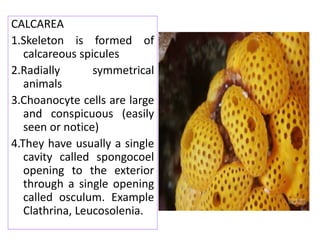
CALCAREA
1.Skeleton is formed of
calcareous spicules
2.Radially symmetrical
animals
3.Choanocyte cells are large
and conspicuous (easily
seen or notice)
4.They have usually a single
cavity called spongocoel
opening to the exterior
through a single opening
called osculum. Example
Clathrina, Leucosolenia.
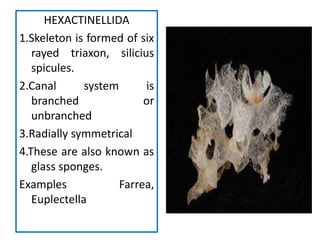
HEXACTINELLIDA
1.Skeleton is formed of six
rayed triaxon, silicius
spicules.
2.Canal system is
branched or
unbranched
3.Radially symmetrical
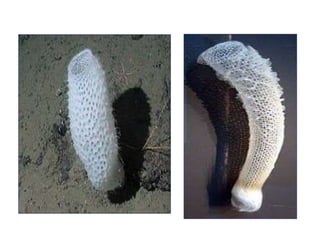
4.These are also known as
glass sponges.
Examples Farrea,
Euplectella
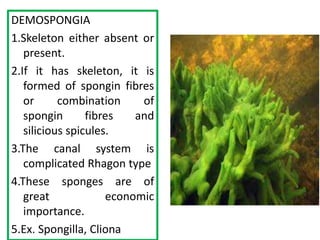
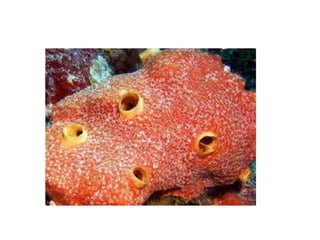
DEMOSPONGIA
1.Skeleton either absent or
present.
2.If it has skeleton, it is
formed of spongin fibres
or combination of
spongin fibres and
silicious spicules.
3.The canal system is
complicated Rhagon type
4.These sponges are of
great economic
importance.
5.Ex. Spongilla, Cliona
PORIFERA.pptx

PORIFERA.pptx

  • 1.
    PORIFERA DR.V.JEYANTHI KUMARI ASSISTANT PROFESSOROF ZOOLOGY A.P.C.MAHALAXMI COLLEGE FOR WOMEN THOOTHUKUDI-628002
  • 2.
    Phylum porifera isdivided into 3 classes based on types of spicules. They are 1.CALCAREA 2.HEXA’ACTI’NELLIDA & 3.Demospongia.
  • 3.
    CALCAREA 1.Skeleton is formedof calcareous spicules 2.Radially symmetrical animals 3.Choanocyte cells are large and conspicuous (easily seen or notice) 4.They have usually a single cavity called spongocoel opening to the exterior through a single opening called osculum. Example Clathrina, Leucosolenia.
  • 5.
    HEXACTINELLIDA 1.Skeleton is formedof six rayed triaxon, silicius spicules. 2.Canal system is branched or unbranched 3.Radially symmetrical 4.These are also known as glass sponges. Examples Farrea, Euplectella
  • 7.
    DEMOSPONGIA 1.Skeleton either absentor present. 2.If it has skeleton, it is formed of spongin fibres or combination of spongin fibres and silicious spicules. 3.The canal system is complicated Rhagon type 4.These sponges are of great economic importance. 5.Ex. Spongilla, Cliona