
The Research
Process
SELECTING AND EVALUATING SOURCES
Course: RM6000- Effective Writing in InfoSec Analysis
Session 3
Research Strategy
 Research Writing is a WRITING process:
 Identify subject of paper
 Gather ideas and information
 Focus and organize your ideas
 Draft to explore your meaning
 Revise and edit
 Shape and polish
 It’s not always a sequential process BUT you can have a plan!
Course: RM6000- Effective Writing in InfoSec Analysis
Session 3
Research Strategy
 A thoughtful plan and systematic procedures can help
you follow through on your research activities
 A research plan can help you understand the time you
need to accomplish the tasks and deliverables
 Keeping a research journal (notebook, index cards, etc)
can help you track information correctly
Course: RM6000- Effective Writing in InfoSec Analysis
Session 3
Research Strategy
A research strategy should include the following activities with deadlines identified for each:
 Finding a researchable topic
 Setting goals for sources
 Finding sources (print and electronic)
 Creating a working bibliography
 Evaluating and synthesizing sources
 Gathering information from sources (summarize, paraphrase or directly quote)
 Developing a thesis statement
 Creating topic outline
 Drafting paper
 Revising and editing
 Citing sources
 Preparing Bibliography
 Preparing final paper
 Preparing presentation of topic
 Submitting final paper and presentation
Course: RM6000- Effective Writing in InfoSec Analysis
Session 3
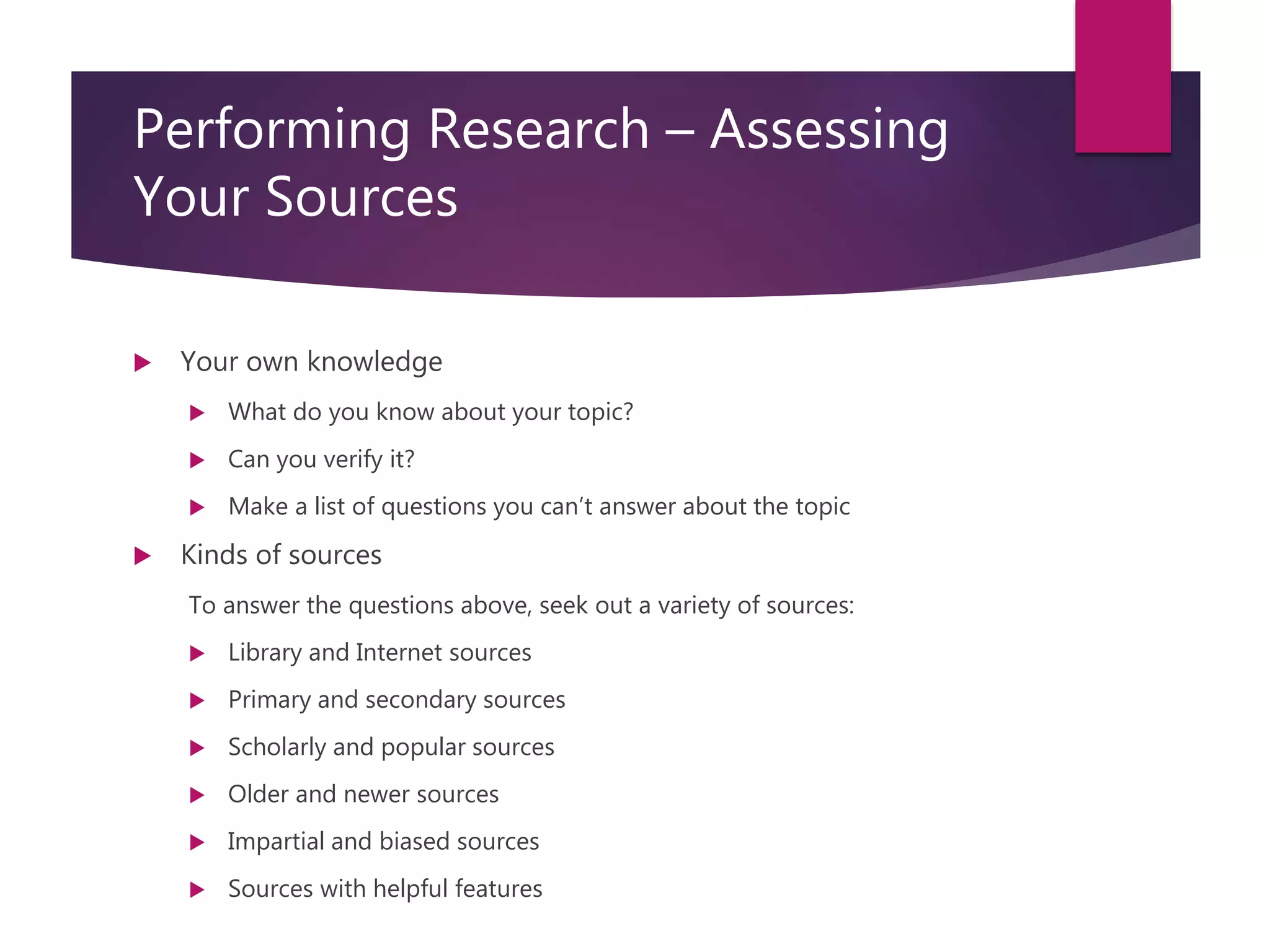
Performing Research – Assessing
Your Sources
 When you begin ask yourself:
 What information do I need?
 How do I get the information I need?
 Do I have the facts or experience to support one answer
versus another?
 Is my experience enough?
 Has someone else tried to solve the problem?
Course: RM6000- Effective Writing in InfoSec Analysis
Session 3
Performing Research – Assessing
Your Sources
 Your own knowledge
 What do you know about your topic?
 Can you verify it?
 Make a list of questions you can’t answer about the topic
 Kinds of sources
To answer the questions above, seek out a variety of sources:
 Library and Internet sources
 Primary and secondary sources
 Scholarly and popular sources
 Older and newer sources
 Impartial and biased sources
 Sources with helpful features
Course: RM6000- Effective Writing in InfoSec Analysis
Session 3
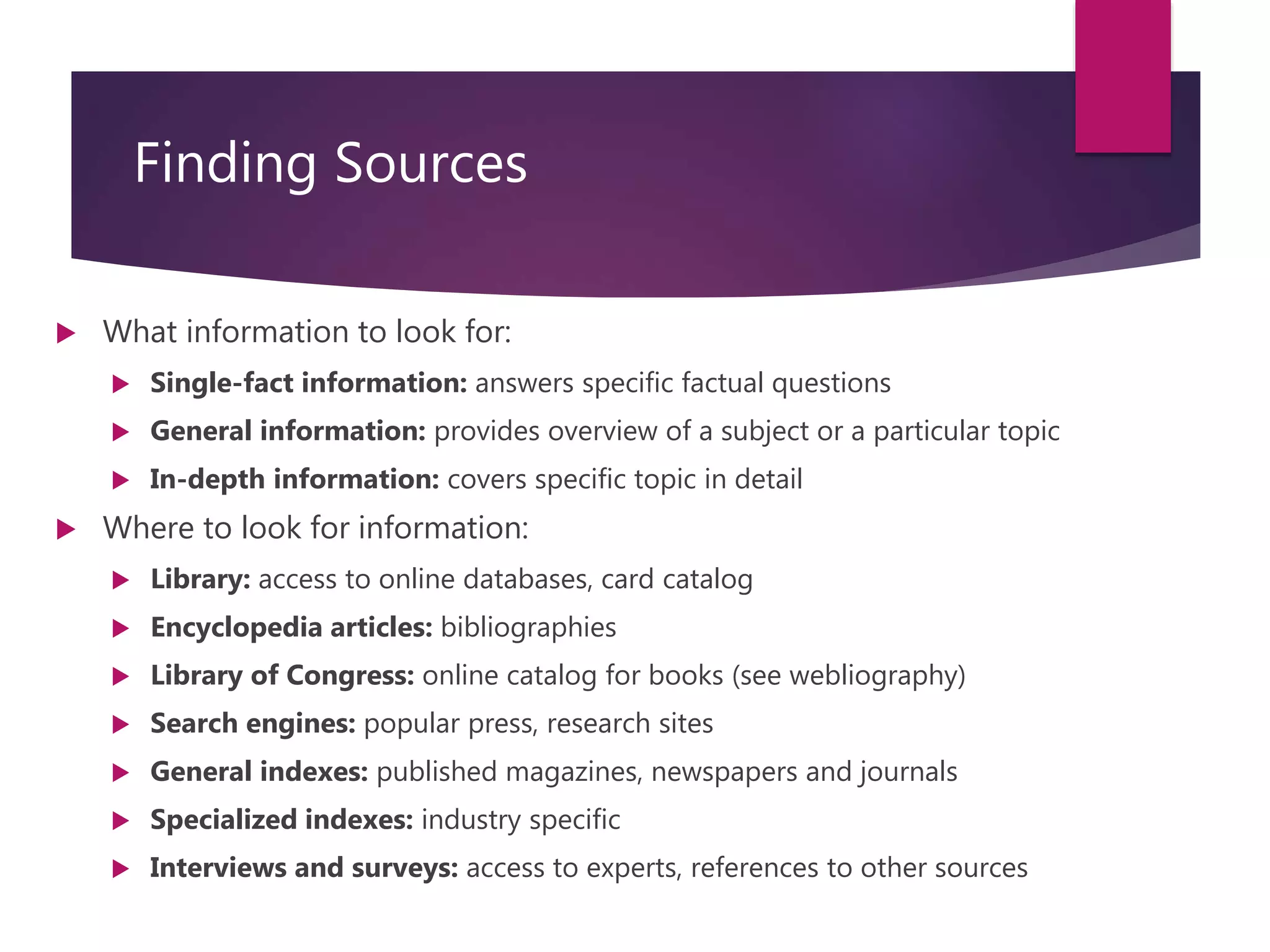
Finding Sources
 What information to look for:
 Single-fact information: answers specific factual questions
 General information: provides overview of a subject or a particular topic
 In-depth information: covers specific topic in detail
 Where to look for information:
 Library: access to online databases, card catalog
 Encyclopedia articles: bibliographies
 Library of Congress: online catalog for books (see webliography)
 Search engines: popular press, research sites
 General indexes: published magazines, newspapers and journals
 Specialized indexes: industry specific
 Interviews and surveys: access to experts, references to other sources
Course: RM6000- Effective Writing in InfoSec Analysis
Session 3
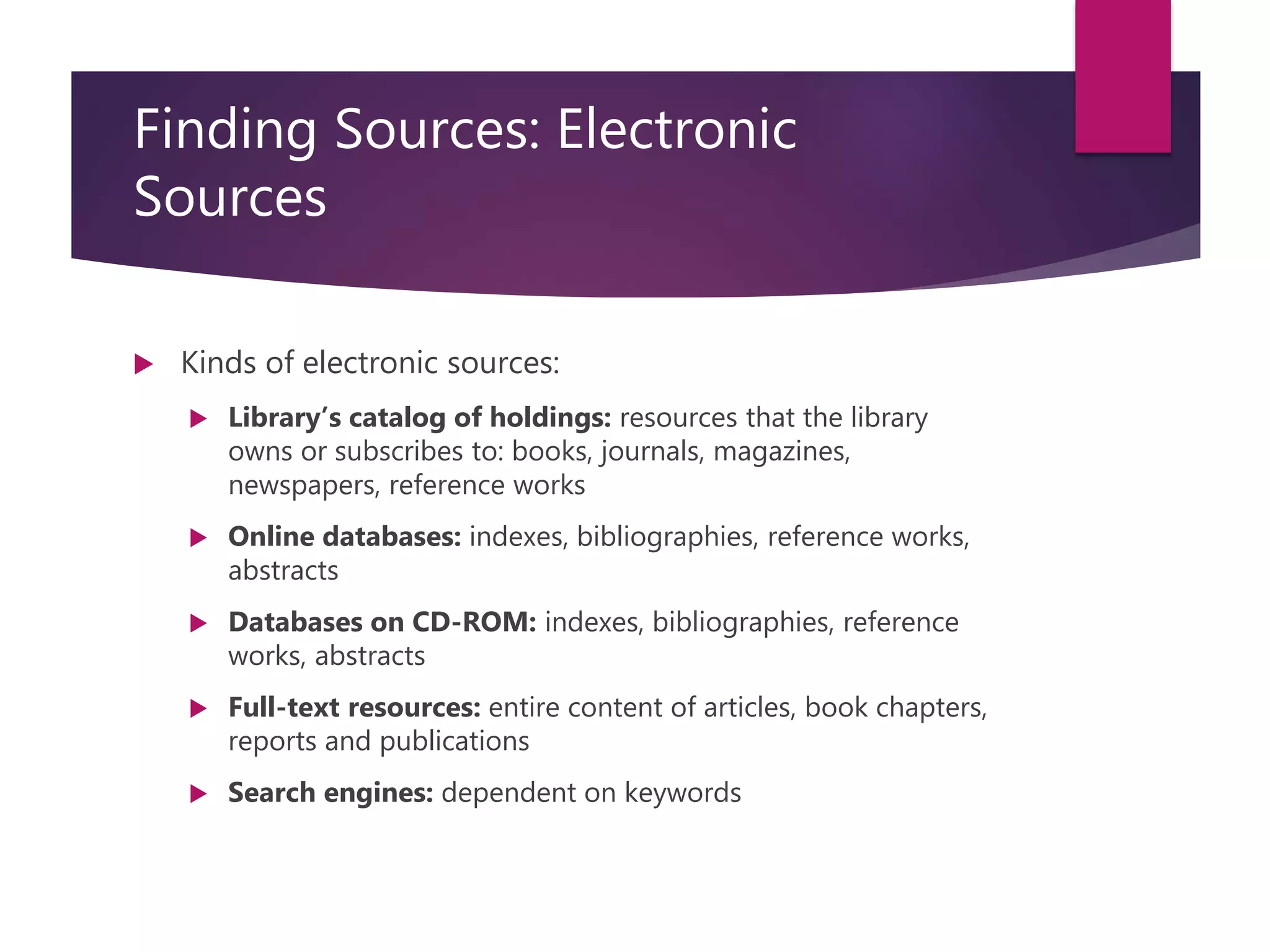
Finding Sources: Electronic
Sources
 Kinds of electronic sources:
 Library’s catalog of holdings: resources that the library
owns or subscribes to: books, journals, magazines,
newspapers, reference works
 Online databases: indexes, bibliographies, reference works,
abstracts
 Databases on CD-ROM: indexes, bibliographies, reference
works, abstracts
 Full-text resources: entire content of articles, book chapters,
reports and publications
 Search engines: dependent on keywords
Course: RM6000- Effective Writing in InfoSec Analysis
Session 3
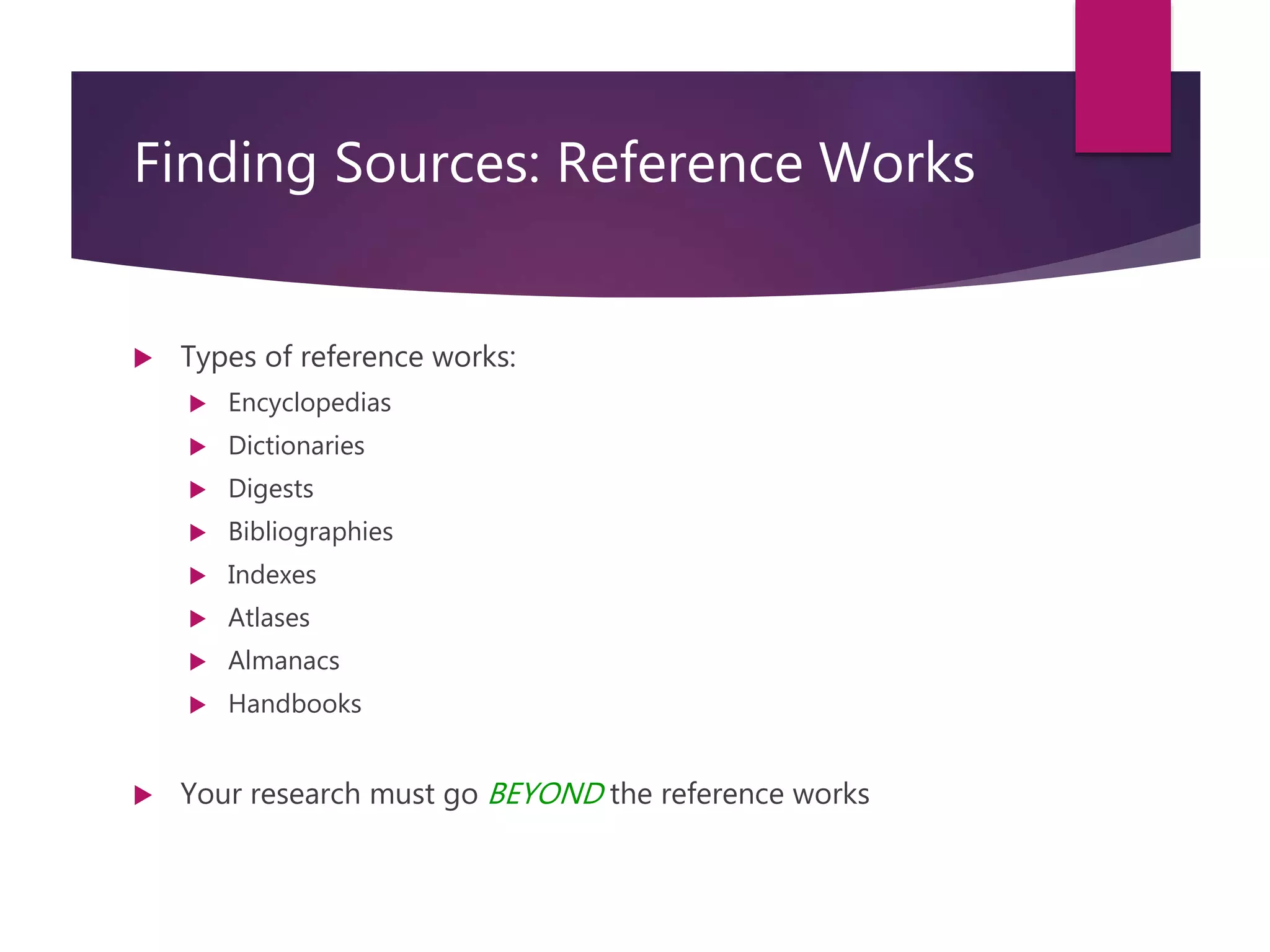
Finding Sources: Reference Works
 Types of reference works:
 Encyclopedias
 Dictionaries
 Digests
 Bibliographies
 Indexes
 Atlases
 Almanacs
 Handbooks
 Your research must go BEYOND the reference works
Course: RM6000- Effective Writing in InfoSec Analysis
Session 3
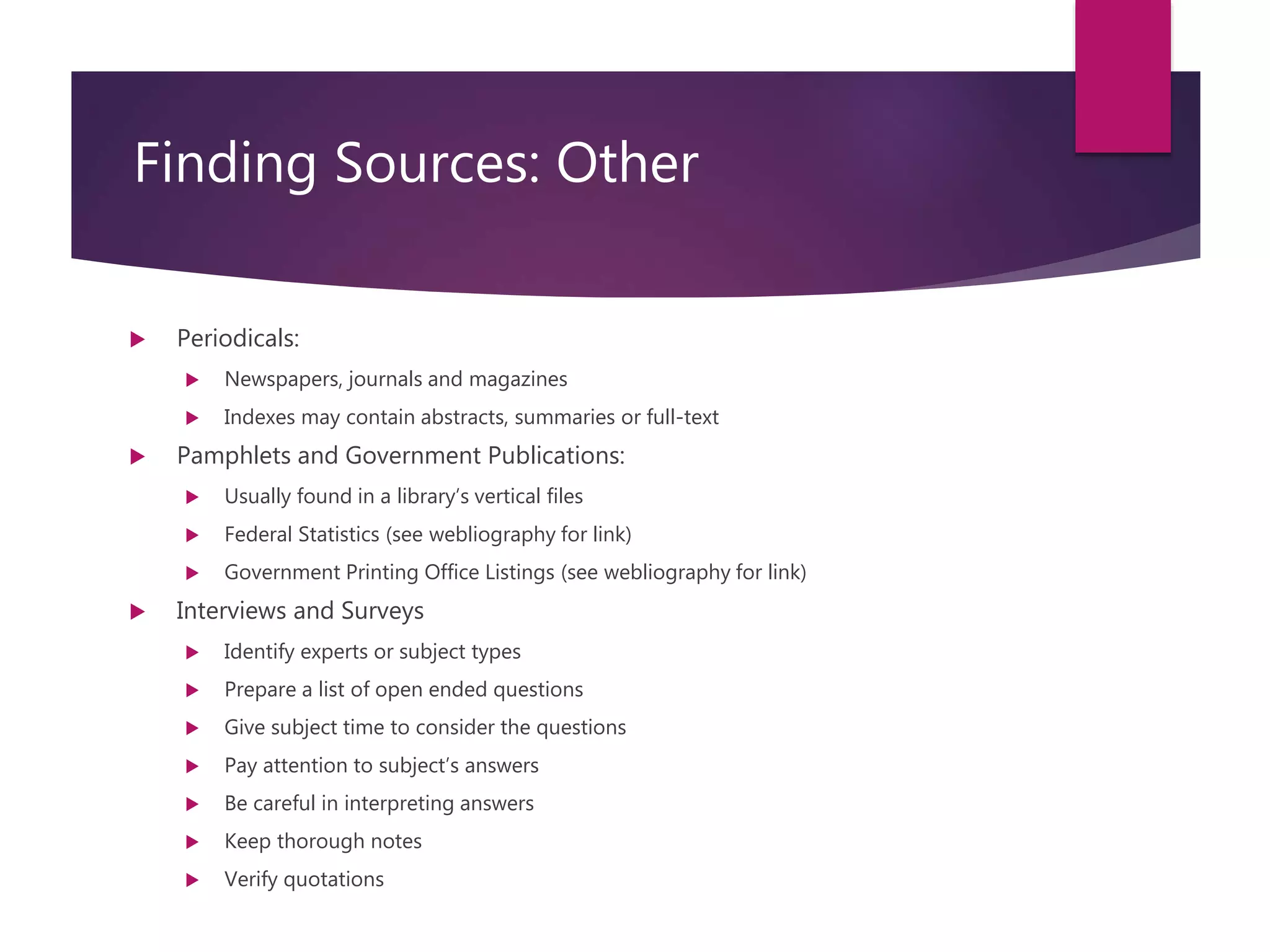
Finding Sources: Other
 Periodicals:
 Newspapers, journals and magazines
 Indexes may contain abstracts, summaries or full-text
 Pamphlets and Government Publications:
 Usually found in a library’s vertical files
 Federal Statistics (see webliography for link)
 Government Printing Office Listings (see webliography for link)
 Interviews and Surveys
 Identify experts or subject types
 Prepare a list of open ended questions
 Give subject time to consider the questions
 Pay attention to subject’s answers
 Be careful in interpreting answers
 Keep thorough notes
 Verify quotations
Course: RM6000- Effective Writing in InfoSec Analysis
Session 3
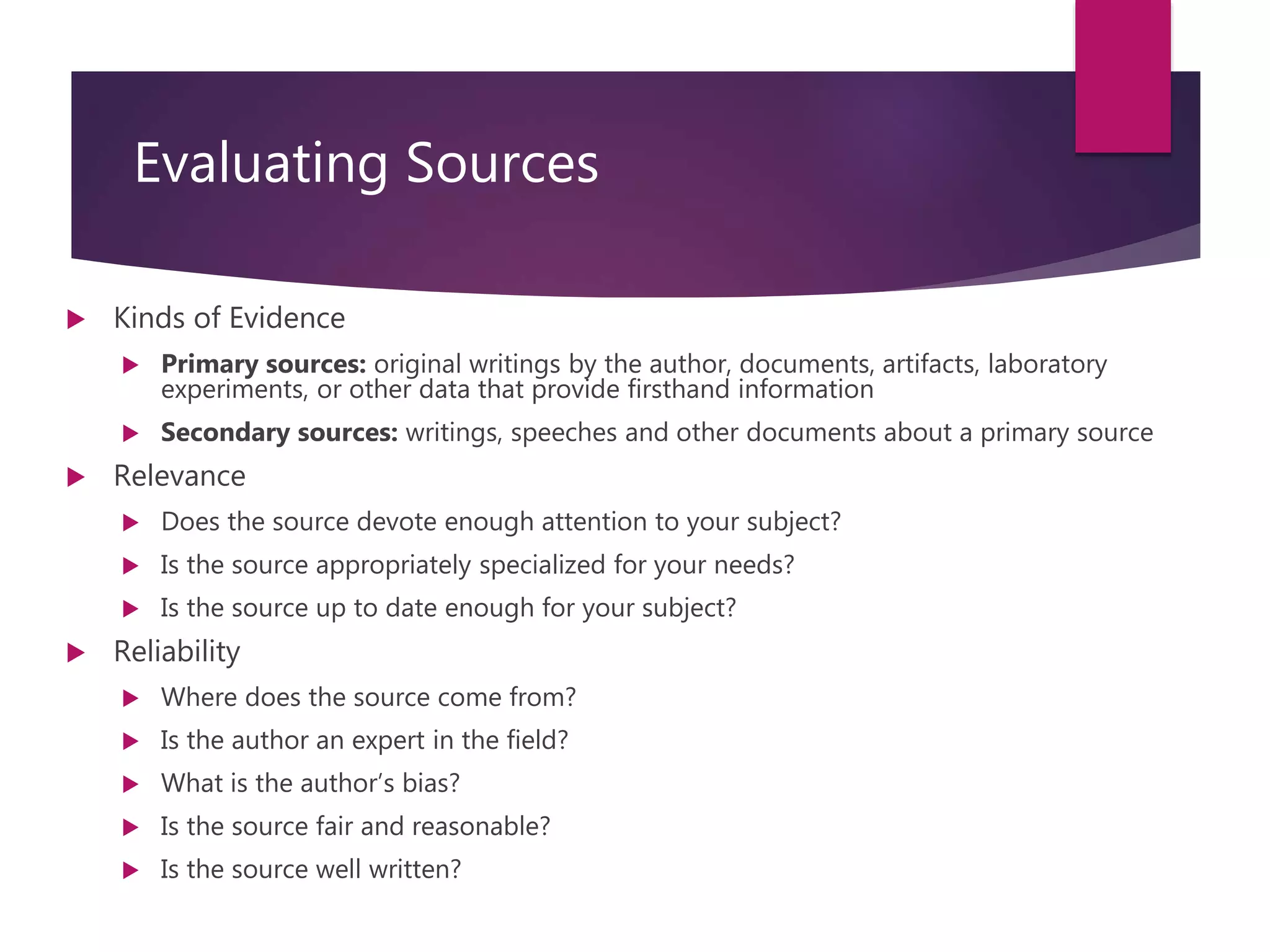
Evaluating Sources
 Kinds of Evidence
 Primary sources: original writings by the author, documents, artifacts, laboratory
experiments, or other data that provide firsthand information
 Secondary sources: writings, speeches and other documents about a primary source
 Relevance
 Does the source devote enough attention to your subject?
 Is the source appropriately specialized for your needs?
 Is the source up to date enough for your subject?
 Reliability
 Where does the source come from?
 Is the author an expert in the field?
 What is the author’s bias?
 Is the source fair and reasonable?
 Is the source well written?
Course: RM6000- Effective Writing in InfoSec Analysis
Session 3
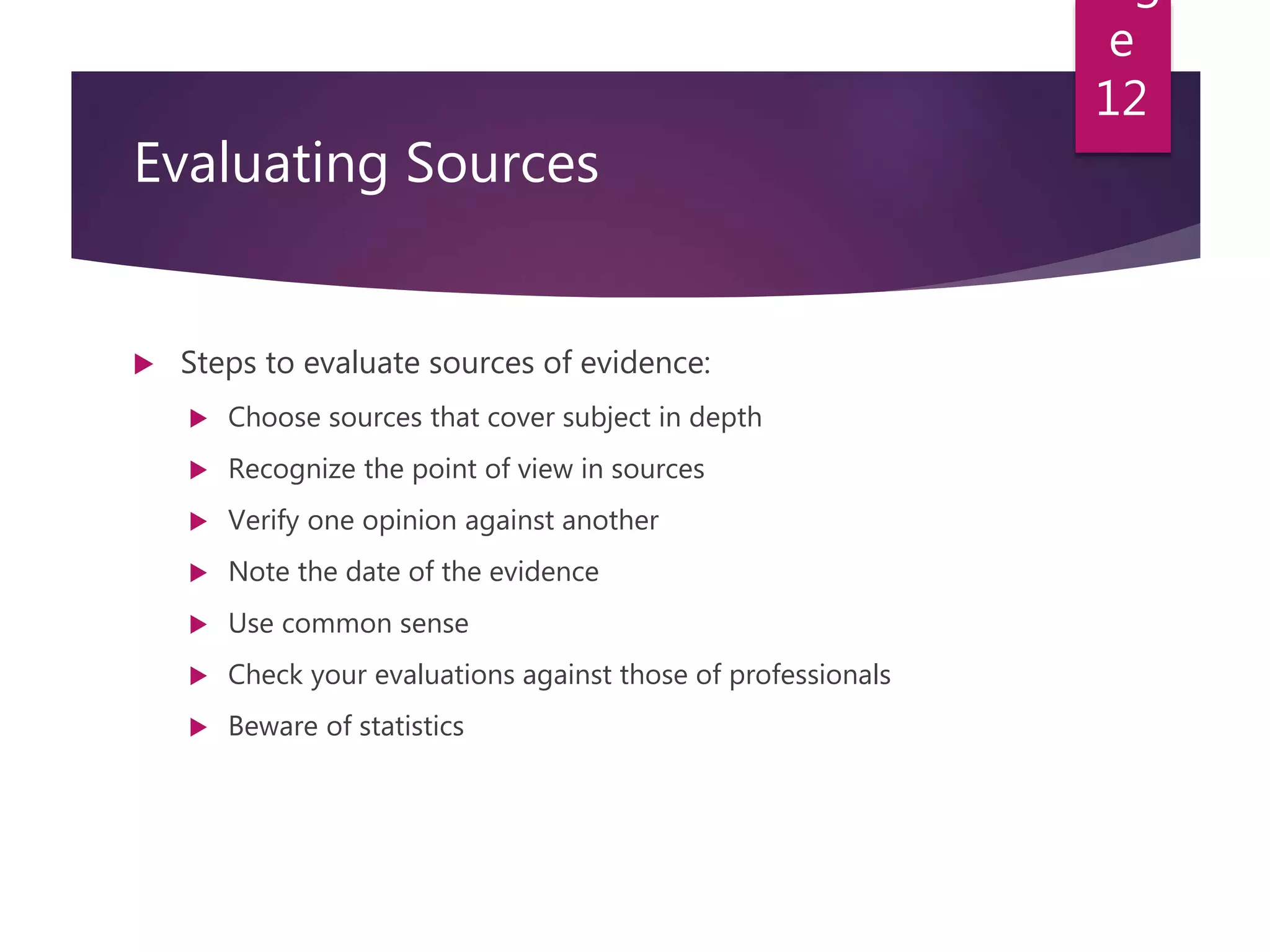
Evaluating Sources
 Steps to evaluate sources of evidence:
 Choose sources that cover subject in depth
 Recognize the point of view in sources
 Verify one opinion against another
 Note the date of the evidence
 Use common sense
 Check your evaluations against those of professionals
 Beware of statistics
e
12
Course: RM6000- Effective Writing in InfoSec Analysis
Session 3
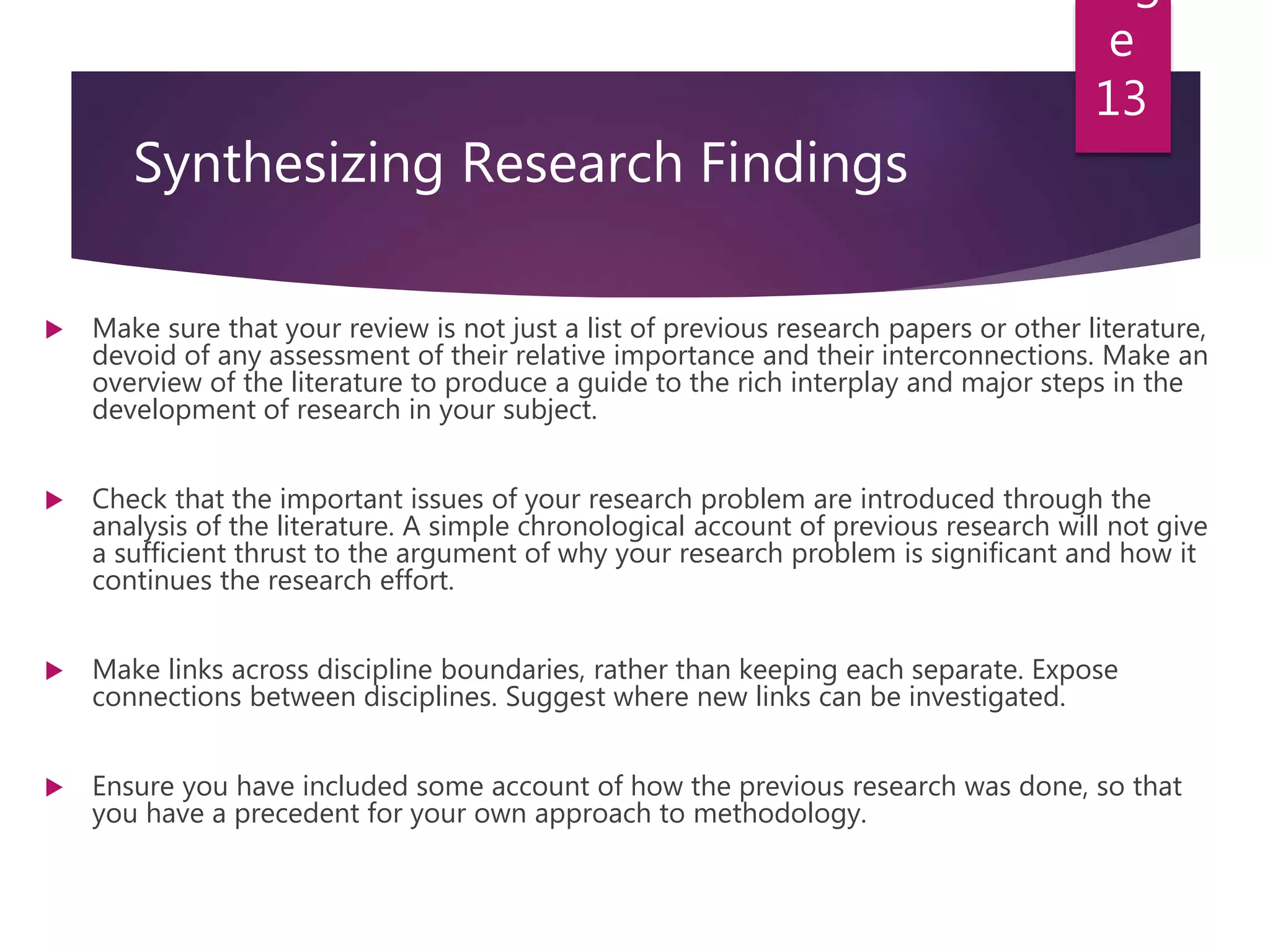
Synthesizing Research Findings
 Make sure that your review is not just a list of previous research papers or other literature,
devoid of any assessment of their relative importance and their interconnections. Make an
overview of the literature to produce a guide to the rich interplay and major steps in the
development of research in your subject.
 Check that the important issues of your research problem are introduced through the
analysis of the literature. A simple chronological account of previous research will not give
a sufficient thrust to the argument of why your research problem is significant and how it
continues the research effort.
 Make links across discipline boundaries, rather than keeping each separate. Expose
connections between disciplines. Suggest where new links can be investigated.
 Ensure you have included some account of how the previous research was done, so that
you have a precedent for your own approach to methodology.
e
13
Course: RM6000- Effective Writing in InfoSec Analysis
Session 3
Synthesizing Research Findings
 Critical reading is a skill that needs to be developed as you progress through a
review of literature related to your project. When reading you must look at the
text from different perspectives:
 Look at the structure of the argument. First detect conclusion “indicators” (e.g.,
therefore, it follows that, as a result, etc.) Does the evidence support the
conclusions? Is the logic sound?
 Evaluate the assumptions upon which the writings and arguments are based.
Understand what is assumed and what is explicitly tested for.
 Consider the wider context of the work. What factors could have influenced the
results? Are they accounted for?
 Compare with other work. Find similarities and differences between studies,
identify them, and determine the implications.
e
14

Research Process: Selecting and Evaluating Sources

  • 1.
  • 2.
    Course: RM6000- EffectiveWriting in InfoSec Analysis Session 3 Research Strategy  Research Writing is a WRITING process:  Identify subject of paper  Gather ideas and information  Focus and organize your ideas  Draft to explore your meaning  Revise and edit  Shape and polish  It’s not always a sequential process BUT you can have a plan!
  • 3.
    Course: RM6000- EffectiveWriting in InfoSec Analysis Session 3 Research Strategy  A thoughtful plan and systematic procedures can help you follow through on your research activities  A research plan can help you understand the time you need to accomplish the tasks and deliverables  Keeping a research journal (notebook, index cards, etc) can help you track information correctly
  • 4.
    Course: RM6000- EffectiveWriting in InfoSec Analysis Session 3 Research Strategy A research strategy should include the following activities with deadlines identified for each:  Finding a researchable topic  Setting goals for sources  Finding sources (print and electronic)  Creating a working bibliography  Evaluating and synthesizing sources  Gathering information from sources (summarize, paraphrase or directly quote)  Developing a thesis statement  Creating topic outline  Drafting paper  Revising and editing  Citing sources  Preparing Bibliography  Preparing final paper  Preparing presentation of topic  Submitting final paper and presentation
  • 5.
    Course: RM6000- EffectiveWriting in InfoSec Analysis Session 3 Performing Research – Assessing Your Sources  When you begin ask yourself:  What information do I need?  How do I get the information I need?  Do I have the facts or experience to support one answer versus another?  Is my experience enough?  Has someone else tried to solve the problem?
  • 6.
    Course: RM6000- EffectiveWriting in InfoSec Analysis Session 3 Performing Research – Assessing Your Sources  Your own knowledge  What do you know about your topic?  Can you verify it?  Make a list of questions you can’t answer about the topic  Kinds of sources To answer the questions above, seek out a variety of sources:  Library and Internet sources  Primary and secondary sources  Scholarly and popular sources  Older and newer sources  Impartial and biased sources  Sources with helpful features
  • 7.
    Course: RM6000- EffectiveWriting in InfoSec Analysis Session 3 Finding Sources  What information to look for:  Single-fact information: answers specific factual questions  General information: provides overview of a subject or a particular topic  In-depth information: covers specific topic in detail  Where to look for information:  Library: access to online databases, card catalog  Encyclopedia articles: bibliographies  Library of Congress: online catalog for books (see webliography)  Search engines: popular press, research sites  General indexes: published magazines, newspapers and journals  Specialized indexes: industry specific  Interviews and surveys: access to experts, references to other sources
  • 8.
    Course: RM6000- EffectiveWriting in InfoSec Analysis Session 3 Finding Sources: Electronic Sources  Kinds of electronic sources:  Library’s catalog of holdings: resources that the library owns or subscribes to: books, journals, magazines, newspapers, reference works  Online databases: indexes, bibliographies, reference works, abstracts  Databases on CD-ROM: indexes, bibliographies, reference works, abstracts  Full-text resources: entire content of articles, book chapters, reports and publications  Search engines: dependent on keywords
  • 9.
    Course: RM6000- EffectiveWriting in InfoSec Analysis Session 3 Finding Sources: Reference Works  Types of reference works:  Encyclopedias  Dictionaries  Digests  Bibliographies  Indexes  Atlases  Almanacs  Handbooks  Your research must go BEYOND the reference works
  • 10.
    Course: RM6000- EffectiveWriting in InfoSec Analysis Session 3 Finding Sources: Other  Periodicals:  Newspapers, journals and magazines  Indexes may contain abstracts, summaries or full-text  Pamphlets and Government Publications:  Usually found in a library’s vertical files  Federal Statistics (see webliography for link)  Government Printing Office Listings (see webliography for link)  Interviews and Surveys  Identify experts or subject types  Prepare a list of open ended questions  Give subject time to consider the questions  Pay attention to subject’s answers  Be careful in interpreting answers  Keep thorough notes  Verify quotations
  • 11.
    Course: RM6000- EffectiveWriting in InfoSec Analysis Session 3 Evaluating Sources  Kinds of Evidence  Primary sources: original writings by the author, documents, artifacts, laboratory experiments, or other data that provide firsthand information  Secondary sources: writings, speeches and other documents about a primary source  Relevance  Does the source devote enough attention to your subject?  Is the source appropriately specialized for your needs?  Is the source up to date enough for your subject?  Reliability  Where does the source come from?  Is the author an expert in the field?  What is the author’s bias?  Is the source fair and reasonable?  Is the source well written?
  • 12.
    Course: RM6000- EffectiveWriting in InfoSec Analysis Session 3 Evaluating Sources  Steps to evaluate sources of evidence:  Choose sources that cover subject in depth  Recognize the point of view in sources  Verify one opinion against another  Note the date of the evidence  Use common sense  Check your evaluations against those of professionals  Beware of statistics e 12
  • 13.
    Course: RM6000- EffectiveWriting in InfoSec Analysis Session 3 Synthesizing Research Findings  Make sure that your review is not just a list of previous research papers or other literature, devoid of any assessment of their relative importance and their interconnections. Make an overview of the literature to produce a guide to the rich interplay and major steps in the development of research in your subject.  Check that the important issues of your research problem are introduced through the analysis of the literature. A simple chronological account of previous research will not give a sufficient thrust to the argument of why your research problem is significant and how it continues the research effort.  Make links across discipline boundaries, rather than keeping each separate. Expose connections between disciplines. Suggest where new links can be investigated.  Ensure you have included some account of how the previous research was done, so that you have a precedent for your own approach to methodology. e 13
  • 14.
    Course: RM6000- EffectiveWriting in InfoSec Analysis Session 3 Synthesizing Research Findings  Critical reading is a skill that needs to be developed as you progress through a review of literature related to your project. When reading you must look at the text from different perspectives:  Look at the structure of the argument. First detect conclusion “indicators” (e.g., therefore, it follows that, as a result, etc.) Does the evidence support the conclusions? Is the logic sound?  Evaluate the assumptions upon which the writings and arguments are based. Understand what is assumed and what is explicitly tested for.  Consider the wider context of the work. What factors could have influenced the results? Are they accounted for?  Compare with other work. Find similarities and differences between studies, identify them, and determine the implications. e 14