Overview
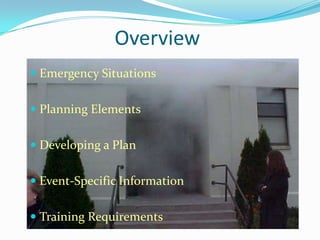
 Emergency Situations


 Planning Elements


 Developing a Plan


 Event-Specific Information


 Training Requirements
Emergency Situations
 Emergencies and disasters can strike anyone, anytime, anywhere.

 An emergency is an unforeseen situation that:

    Threatens your family, guests


    Disrupts or shuts down part or all of your home, or


    Causes physical or environmental damage.
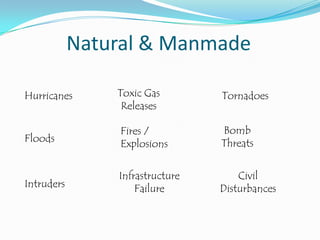
Natural & Manmade

Hurricanes      Toxic Gas        Tornadoes
                 Releases

                Fires /          Bomb
Floods                           Threats
                Explosions

                Infrastructure       Civil
Intruders           Failure      Disturbances
Emergency Response Plan
 An ERP details the actions families must take to
 ensure their safety from fire and other emergencies.

   It should be comprehensive and address all hazards
    specific to your home.

   It should be in writing and reviewed.
Minimum Plan Information
 Method for reporting fires/emergencies
 Evacuation policy & procedure
 Emergency escape routes
 Emergency contact information
 Specific roles/responsibilities
 Designated assembly point location
 Head count information
Training

 Initially when plan is developed,
 Whenever individual responsibilities change,
 Whenever the plan changes,
Training Topics
 Individual roles and responsibilities
    Ex. Shutting down electrical equipment
    Ex. Calling 911
    Ex. Assisting individuals
 Threats, hazards, and protection
    Specific issues and actions which could possibly occur in
     your home.
Training Topics
  Notification, warning, and communication
    How they will be notified of various types of
     emergencies.

  Emergency response procedures
     What immediate actions should be taken upon
      notification of an emergency.
Training Topics
  Evacuation, shelter, and accountability
     What to do once the home has been evacuated
      (action will be dependent upon the type and scale of
      emergency).
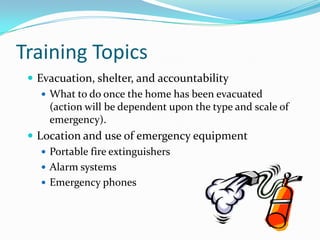
  Location and use of emergency equipment
     Portable fire extinguishers
     Alarm systems
     Emergency phones
Training Topics
 Emergency electrical shutdown procedures
    How to shutdown electrical equipment / main power
     breaker.

   Identify this equipment prior to an emergency and train
    on the specific procedures and expectations during an
    emergency.
Let’s discuss some specific
emergencies and how you
should respond.
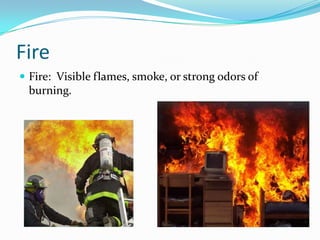
Fire
 Fire: Visible flames, smoke, or strong odors of
 burning.
IF THERE’S A FIRE

    Immediately evacuate family, pets
                 and / or guests.
                        Call   911
Give as much information as possible to the 911 operator.
                   Your family is safe!
        Type of fire, area in home fire originated.
Evacuate your home
           Report to assigned Assembly Area.
    Try to rescue others ONLY if you can do so safely.

 Move away from the building at least 50 feet away, out of
       the way of smoke and the fire department.

Don’t go back into your home until the fire department says
                     it is safe to do so.
Fire
 Immediate Actions
   For persons evacuating from the immediate area:


       Feel the door from top to bottom. If hot, do not open it.

       If door is cool, crouch low and open the door slowly. If smoke
        is present, close door quickly.
Fire
 Immediate Actions

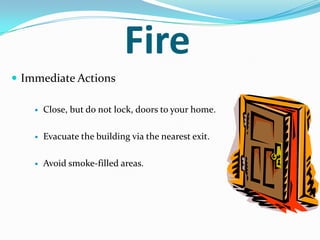
       Close, but do not lock, doors to your home.

       Evacuate the building via the nearest exit.

       Avoid smoke-filled areas.
Fire
 Immediate Actions


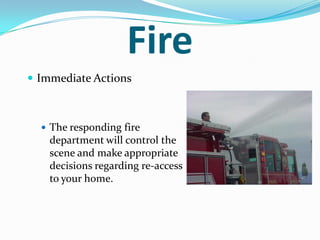
   The responding fire
    department will control the
    scene and make appropriate
    decisions regarding re-access
    to your home.
Explosions
 Explosion: Caused by a rapid expansion of gas or
  chemical reactions.
 . Signs include:
   A very loud noise or series of noises and vibrations,
   Fire, heat, smoke
   Falling glass or debris
   Building damage
Explosions
 Immediate Actions
    Evacuate the home immediately.
       Assist others on your way out, if necessary.
   Call 911.
   Take cover if debris is falling.
   If trapped under debris, tap on a pipe or wall so rescuers
    can locate you.
Explosions
 Immediate Actions
    Go to your designated assembly area.


   Do not attempt to rescue people/pets inside a collapsed
    building.

   The responding emergency services will make decisions
    regarding the control and abatement of the explosion
    incident, and will determine if it is safe to re-enter the
    home.
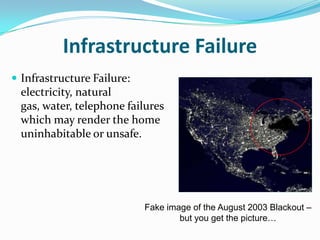
Infrastructure Failure
 Infrastructure Failure:
  electricity, natural
  gas, water, telephone failures
  which may render the home
  uninhabitable or unsafe.


                            Fake image of the August 2003 Blackout –
                                    but you get the picture…
Hurricanes
 Preparation Prior to the Storm
    Listen to radio or television for instructions.
    Set brakes on vehicles.
    Secure and brace external doors.
    To limit flood damage:
        Move valuables off the floor.
        Move furniture and computer equipment away from windows
         or cover with plastic.
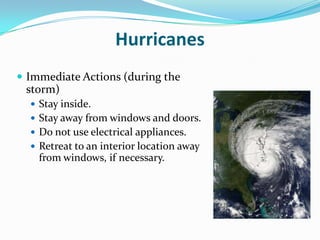
Hurricanes
 Immediate Actions (during the
 storm)
   Stay inside.
   Stay away from windows and doors.
   Do not use electrical appliances.
   Retreat to an interior location away
    from windows, if necessary.
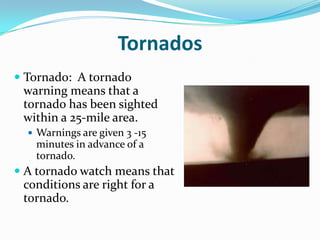
Tornados
 Tornado: A tornado
  warning means that a
  tornado has been sighted
  within a 25-mile area.
   Warnings are given 3 -15
    minutes in advance of a
    tornado.
 A tornado watch means that
  conditions are right for a
  tornado.
Tornados
 Immediate Actions

   Seek shelter in a room or corridor in the innermost part
    of your home.
       Avoid windows, corridors with windows, or large, free-
        standing spaces.


   Take cover to avoid flying debris and falling objects.


   Close all doors.
Tornados
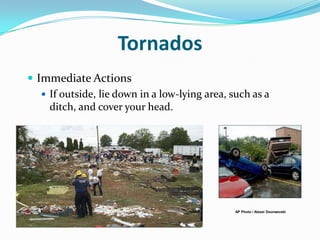
 Immediate Actions
    If outside, lie down in a low-lying area, such as a
     ditch, and cover your head.


                                                AP Photo / Alexei Dounaevski
Fire/Emergency Drills
   The key to reducing risk during an
emergency is making sure everyone knows
 what to do, when to do it, how to do it.
Fire/Emergency Drills

 Conduct drills to keep
 prepared.
   Annually for assembly

Emergency Response Plan

  • 2.
    Overview  Emergency Situations Planning Elements  Developing a Plan  Event-Specific Information  Training Requirements
  • 3.
    Emergency Situations  Emergenciesand disasters can strike anyone, anytime, anywhere.  An emergency is an unforeseen situation that:  Threatens your family, guests  Disrupts or shuts down part or all of your home, or  Causes physical or environmental damage.
  • 4.
    Natural & Manmade Hurricanes Toxic Gas Tornadoes Releases Fires / Bomb Floods Threats Explosions Infrastructure Civil Intruders Failure Disturbances
  • 5.
    Emergency Response Plan An ERP details the actions families must take to ensure their safety from fire and other emergencies.  It should be comprehensive and address all hazards specific to your home.  It should be in writing and reviewed.
  • 6.
    Minimum Plan Information Method for reporting fires/emergencies  Evacuation policy & procedure  Emergency escape routes  Emergency contact information  Specific roles/responsibilities  Designated assembly point location  Head count information
  • 7.
    Training  Initially whenplan is developed,  Whenever individual responsibilities change,  Whenever the plan changes,
  • 8.
    Training Topics  Individualroles and responsibilities  Ex. Shutting down electrical equipment  Ex. Calling 911  Ex. Assisting individuals  Threats, hazards, and protection  Specific issues and actions which could possibly occur in your home.
  • 9.
    Training Topics Notification, warning, and communication  How they will be notified of various types of emergencies.  Emergency response procedures  What immediate actions should be taken upon notification of an emergency.
  • 10.
    Training Topics Evacuation, shelter, and accountability  What to do once the home has been evacuated (action will be dependent upon the type and scale of emergency).  Location and use of emergency equipment  Portable fire extinguishers  Alarm systems  Emergency phones
  • 11.
    Training Topics  Emergencyelectrical shutdown procedures  How to shutdown electrical equipment / main power breaker.  Identify this equipment prior to an emergency and train on the specific procedures and expectations during an emergency.
  • 12.
    Let’s discuss somespecific emergencies and how you should respond.
  • 13.
    Fire  Fire: Visibleflames, smoke, or strong odors of burning.
  • 14.
    IF THERE’S AFIRE Immediately evacuate family, pets and / or guests. Call 911 Give as much information as possible to the 911 operator. Your family is safe! Type of fire, area in home fire originated.
  • 15.
    Evacuate your home Report to assigned Assembly Area. Try to rescue others ONLY if you can do so safely. Move away from the building at least 50 feet away, out of the way of smoke and the fire department. Don’t go back into your home until the fire department says it is safe to do so.
  • 16.
    Fire  Immediate Actions  For persons evacuating from the immediate area:  Feel the door from top to bottom. If hot, do not open it.  If door is cool, crouch low and open the door slowly. If smoke is present, close door quickly.
  • 17.
    Fire  Immediate Actions  Close, but do not lock, doors to your home.  Evacuate the building via the nearest exit.  Avoid smoke-filled areas.
  • 18.
    Fire  Immediate Actions  The responding fire department will control the scene and make appropriate decisions regarding re-access to your home.
  • 19.
    Explosions  Explosion: Causedby a rapid expansion of gas or chemical reactions.  . Signs include:  A very loud noise or series of noises and vibrations,  Fire, heat, smoke  Falling glass or debris  Building damage
  • 20.
    Explosions  Immediate Actions  Evacuate the home immediately.  Assist others on your way out, if necessary.  Call 911.  Take cover if debris is falling.  If trapped under debris, tap on a pipe or wall so rescuers can locate you.
  • 21.
    Explosions  Immediate Actions  Go to your designated assembly area.  Do not attempt to rescue people/pets inside a collapsed building.  The responding emergency services will make decisions regarding the control and abatement of the explosion incident, and will determine if it is safe to re-enter the home.
  • 22.
    Infrastructure Failure  InfrastructureFailure: electricity, natural gas, water, telephone failures which may render the home uninhabitable or unsafe. Fake image of the August 2003 Blackout – but you get the picture…
  • 23.
    Hurricanes  Preparation Priorto the Storm  Listen to radio or television for instructions.  Set brakes on vehicles.  Secure and brace external doors.  To limit flood damage:  Move valuables off the floor.  Move furniture and computer equipment away from windows or cover with plastic.
  • 24.
    Hurricanes  Immediate Actions(during the storm)  Stay inside.  Stay away from windows and doors.  Do not use electrical appliances.  Retreat to an interior location away from windows, if necessary.
  • 25.
    Tornados  Tornado: Atornado warning means that a tornado has been sighted within a 25-mile area.  Warnings are given 3 -15 minutes in advance of a tornado.  A tornado watch means that conditions are right for a tornado.
  • 26.
    Tornados  Immediate Actions  Seek shelter in a room or corridor in the innermost part of your home.  Avoid windows, corridors with windows, or large, free- standing spaces.  Take cover to avoid flying debris and falling objects.  Close all doors.
  • 27.
    Tornados  Immediate Actions  If outside, lie down in a low-lying area, such as a ditch, and cover your head. AP Photo / Alexei Dounaevski
  • 28.
    Fire/Emergency Drills  The key to reducing risk during an emergency is making sure everyone knows what to do, when to do it, how to do it.
  • 29.
    Fire/Emergency Drills  Conductdrills to keep prepared.  Annually for assembly