PROTEIN SEQUENCING
methods for protein sequencing
the progress of these three methods
characteristics
1
2
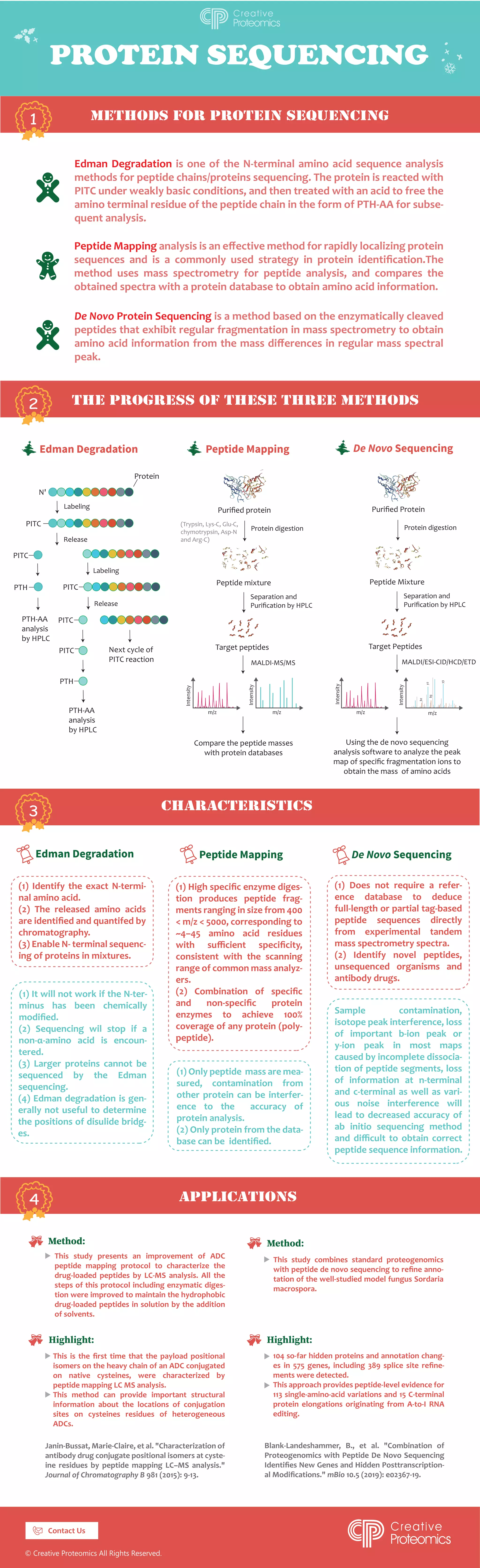
Edman Degradation is one of the N-terminal amino acid sequence analysis
methods for peptide chains/proteins sequencing. The protein is reacted with
PITC under weakly basic conditions, and then treated with an acid to free the
amino terminal residue of the peptide chain in the form of PTH-AA for subse-
quent analysis.
Peptide Mapping analysis is an effective method for rapidly localizing protein
sequences and is a commonly used strategy in protein identification.The
method uses mass spectrometry for peptide analysis, and compares the
obtained spectra with a protein database to obtain amino acid information.
De Novo Protein Sequencing is a method based on the enzymatically cleaved
peptides that exhibit regular fragmentation in mass spectrometry to obtain
amino acid information from the mass differences in regular mass spectral
peak.


N'
PITC
Protein
PITC
PITC
PTH
PITC
PTH
Labeling
Labeling
Release
Release
PTH-AA
analysis
by HPLC
PTH-AA
analysis
by HPLC
Next cycle of
PITC reaction
Protein digestion
MALDI-MS/MS MALDI/ESI-CID/HCD/ETD
Compare the peptide masses
with protein databases
Using the de novo sequencing
analysis software to analyze the peak
map of specific fragmentation ions to
obtain the mass of amino acids
Peptide mixture
Target peptides
PITC
3
Purified protein
(Trypsin, Lys-C, Glu-C,
chymotrypsin, Asp-N
and Arg-C)
Purified Protein
Separation and
Purification by HPLC
Protein digestion
Peptide Mixture
Target Peptides
Separation and
Purification by HPLC
m/z
Intensity
m/z
Intensity
m/z m/z
Intensity
Intensity
b2
y2
y3
b3
(1) Identify the exact N-termi-
nal amino acid.
(2) The released amino acids
are identified and quantifed by
chromatography.
(3) Enable N- terminal sequenc-
ing of proteins in mixtures.
(1) High specific enzyme diges-
tion produces peptide frag-
ments ranging in size from 400
 m/z  5000, corresponding to
~4–45 amino acid residues
with sufficient specificity,
consistent with the scanning
range of common mass analyz-
ers.
(2) Combination of specific
and non-specific protein
enzymes to achieve 100%
coverage of any protein (poly-
peptide).
(1) Does not require a refer-
ence database to deduce
full-length or partial tag-based
peptide sequences directly
from experimental tandem
mass spectrometry spectra.
(2) Identify novel peptides,
unsequenced organisms and
antibody drugs.
(1) It will not work if the N-ter-
minus has been chemically
modified.
(2) Sequencing wil stop if a
non-α-amino acid is encoun-
tered.
(3) Larger proteins cannot be
sequenced by the Edman
sequencing.
(4) Edman degradation is gen-
erally not useful to determine
the positions of disulide bridg-
es.
applications
4
(1) Only peptide mass are mea-
sured, contamination from
other protein can be interfer-
ence to the accuracy of
protein analysis.
(2) Only protein from the data-
base can be identified.
Sample contamination,
isotope peak interference, loss
of important b-ion peak or
y-ion peak in most maps
caused by incomplete dissocia-
tion of peptide segments, loss
of information at n-terminal
and c-terminal as well as vari-
ous noise interference will
lead to decreased accuracy of
ab initio sequencing method
and difficult to obtain correct
peptide sequence information.
© Creative Proteomics All Rights Reserved.
This study presents an improvement of ADC
peptide mapping protocol to characterize the
drug-loaded peptides by LC-MS analysis. All the
steps of this protocol including enzymatic diges-
tion were improved to maintain the hydrophobic
drug-loaded peptides in solution by the addition
of solvents.


Janin-Bussat, Marie-Claire, et al. Characterization of
antibody drug conjugate positional isomers at cyste-
ine residues by peptide mapping LC–MS analysis.
Journal of Chromatography B 981 (2015): 9-13.
Blank-Landeshammer, B., et al. Combination of
Proteogenomics with Peptide De Novo Sequencing
Identifies New Genes and Hidden Posttranscription-
al Modifications. mBio 10.5 (2019): e02367-19.
This study combines standard proteogenomics
with peptide de novo sequencing to refine anno-
tation of the well-studied model fungus Sordaria
macrospora.


104 so-far hidden proteins and annotation chang-
es in 575 genes, including 389 splice site refine-
ments were detected.
This approach provides peptide-level evidence for
113 single-amino-acid variations and 15 C-terminal
protein elongations originating from A-to-I RNA
editing.
This is the first time that the payload positional
isomers on the heavy chain of an ADC conjugated
on native cysteines, were characterized by
peptide mapping LC MS analysis.
This method can provide important structural
information about the locations of conjugation
sites on cysteines residues of heterogeneous
ADCs.
Contact Us

Three Methods for Protein Sequencing

  • 1.
    PROTEIN SEQUENCING methods forprotein sequencing the progress of these three methods characteristics 1 2 Edman Degradation is one of the N-terminal amino acid sequence analysis methods for peptide chains/proteins sequencing. The protein is reacted with PITC under weakly basic conditions, and then treated with an acid to free the amino terminal residue of the peptide chain in the form of PTH-AA for subse- quent analysis. Peptide Mapping analysis is an effective method for rapidly localizing protein sequences and is a commonly used strategy in protein identification.The method uses mass spectrometry for peptide analysis, and compares the obtained spectra with a protein database to obtain amino acid information. De Novo Protein Sequencing is a method based on the enzymatically cleaved peptides that exhibit regular fragmentation in mass spectrometry to obtain amino acid information from the mass differences in regular mass spectral peak. N' PITC Protein PITC PITC PTH PITC PTH Labeling Labeling Release Release PTH-AA analysis by HPLC PTH-AA analysis by HPLC Next cycle of PITC reaction Protein digestion MALDI-MS/MS MALDI/ESI-CID/HCD/ETD Compare the peptide masses with protein databases Using the de novo sequencing analysis software to analyze the peak map of specific fragmentation ions to obtain the mass of amino acids Peptide mixture Target peptides PITC 3 Purified protein (Trypsin, Lys-C, Glu-C, chymotrypsin, Asp-N and Arg-C) Purified Protein Separation and Purification by HPLC Protein digestion Peptide Mixture Target Peptides Separation and Purification by HPLC m/z Intensity m/z Intensity m/z m/z Intensity Intensity b2 y2 y3 b3 (1) Identify the exact N-termi- nal amino acid. (2) The released amino acids are identified and quantifed by chromatography. (3) Enable N- terminal sequenc- ing of proteins in mixtures. (1) High specific enzyme diges- tion produces peptide frag- ments ranging in size from 400 m/z 5000, corresponding to ~4–45 amino acid residues with sufficient specificity, consistent with the scanning range of common mass analyz- ers. (2) Combination of specific and non-specific protein enzymes to achieve 100% coverage of any protein (poly- peptide). (1) Does not require a refer- ence database to deduce full-length or partial tag-based peptide sequences directly from experimental tandem mass spectrometry spectra. (2) Identify novel peptides, unsequenced organisms and antibody drugs. (1) It will not work if the N-ter- minus has been chemically modified. (2) Sequencing wil stop if a non-α-amino acid is encoun- tered. (3) Larger proteins cannot be sequenced by the Edman sequencing. (4) Edman degradation is gen- erally not useful to determine the positions of disulide bridg- es. applications 4 (1) Only peptide mass are mea- sured, contamination from other protein can be interfer- ence to the accuracy of protein analysis. (2) Only protein from the data- base can be identified. Sample contamination, isotope peak interference, loss of important b-ion peak or y-ion peak in most maps caused by incomplete dissocia- tion of peptide segments, loss of information at n-terminal and c-terminal as well as vari- ous noise interference will lead to decreased accuracy of ab initio sequencing method and difficult to obtain correct peptide sequence information. © Creative Proteomics All Rights Reserved. This study presents an improvement of ADC peptide mapping protocol to characterize the drug-loaded peptides by LC-MS analysis. All the steps of this protocol including enzymatic diges- tion were improved to maintain the hydrophobic drug-loaded peptides in solution by the addition of solvents. Janin-Bussat, Marie-Claire, et al. Characterization of antibody drug conjugate positional isomers at cyste- ine residues by peptide mapping LC–MS analysis. Journal of Chromatography B 981 (2015): 9-13. Blank-Landeshammer, B., et al. Combination of Proteogenomics with Peptide De Novo Sequencing Identifies New Genes and Hidden Posttranscription- al Modifications. mBio 10.5 (2019): e02367-19. This study combines standard proteogenomics with peptide de novo sequencing to refine anno- tation of the well-studied model fungus Sordaria macrospora. 104 so-far hidden proteins and annotation chang- es in 575 genes, including 389 splice site refine- ments were detected. This approach provides peptide-level evidence for 113 single-amino-acid variations and 15 C-terminal protein elongations originating from A-to-I RNA editing. This is the first time that the payload positional isomers on the heavy chain of an ADC conjugated on native cysteines, were characterized by peptide mapping LC MS analysis. This method can provide important structural information about the locations of conjugation sites on cysteines residues of heterogeneous ADCs. Contact Us