PUNE ADVENTIST HOSPITAL
Training on:
Medication error
A preventable event that may cause or lead to
inappropriate medication use or patient harm
while the medication is in the control of the
healthcare professional, patient, or consumer
Near miss
• An event or situation that happens by chance
but doesn’t produce patient injury. A near
miss is considered an error.
Factors contributing to medication
errors
• Human related
• System related
• Medication related
Human related factors
HCP
• Over worked
• Under trained
• Competence
• Distracted
• Illness
• Stress
Patients
• In a hurry
• Health literacy level
• Do not understand
medication use
• Trust providers to not
make mistakes
System – related factors
• Lack of communication
• Poor workflow
• Disorganized workspace
• Inadequate tools to complete work
• Lack of supervision
Medication – related factors
• Look alike/ sound alike medications
• Multiple dosage forms and strengths
6 Rights
• Right drug
• Right route
• Right time
• Right dose
• Right patient
• Right dosage form
Types of medication errors
• Prescribing error
• Dispensing error
• Documentation error
• Administration error
• Transcription error
• Indent error
Prescribing error
• Occurs as a result of a faulty prescribing
decision or prescription writing process. It
includes:
i. incorrect prescription
ii. Illegible handwriting
iii. Drug allergy not identified
iv. Irrational combinations
v. Out of list abbreviations
When prescribing...
• Always use Sign. Name, Date Time (SNDT)
format, all capitals
• Always use decimal points for dosage, and 0
before the decimal point rather than after the
digit
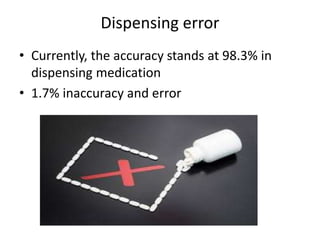
Dispensing error
• Currently, the accuracy stands at 98.3% in
dispensing medication
• 1.7% inaccuracy and error
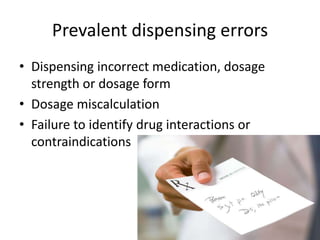
Prevalent dispensing errors
• Dispensing incorrect medication, dosage
strength or dosage form
• Dosage miscalculation
• Failure to identify drug interactions or
contraindications
LASA medication
Errors of omission
• Failure to counsel the patient
• Failure to screen for drug interactions and
contraindications
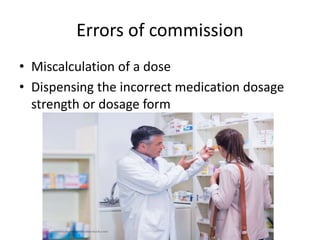
Errors of commission
• Miscalculation of a dose
• Dispensing the incorrect medication dosage
strength or dosage form
Dispending errors: common causes
• Work environment
i. Workload
ii. Distraction
iii. Work area
• Use of outdated or incorrect references
• LASA drugs
Prescribing, Dispensing error e.g.
1
• Prescription for primidone
• Interpreted as prednisone
2
• Consumption of prednisone for 4 months
• Acquires steroid induced diabetes
3
• Diabetes goes unrecognized
• Patient dies of diabetic ketoacidosis
Administration error
• A discrepancy between drug therapy received by the
patient and therapy intended by the prescriber.
• Accounts for 26% - 32% of total medication errors
• Involves discrepancy in one of the 6 - Rights
Causes of Administration Errors
• Failure to check patient’s identity
• Wrong calculation to determine correct dose
• Poor lighting
• Noise interruption
• Lack of knowledge of the preparation or
administration
• Complex design of equipment
Administration error e.g.
• The nurse is catching up on all patients
morning medication
• Patient’s condition deteriorates and he is
intubated
• The nurse decides to crush all medicines and
administer via NG tube
• Crushes an extended – release Ca channel
blocker
• Patient’s heart rate slows to asystole, patient
dies
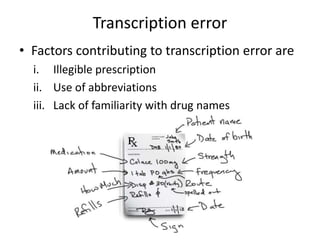
Transcription error
• Factors contributing to transcription error are
i. Illegible prescription
ii. Use of abbreviations
iii. Lack of familiarity with drug names
Indent Error
Medication error
Medication error

Medication error

  • 1.
  • 2.
    Medication error A preventableevent that may cause or lead to inappropriate medication use or patient harm while the medication is in the control of the healthcare professional, patient, or consumer
  • 3.
    Near miss • Anevent or situation that happens by chance but doesn’t produce patient injury. A near miss is considered an error.
  • 4.
    Factors contributing tomedication errors • Human related • System related • Medication related
  • 5.
    Human related factors HCP •Over worked • Under trained • Competence • Distracted • Illness • Stress Patients • In a hurry • Health literacy level • Do not understand medication use • Trust providers to not make mistakes
  • 6.
    System – relatedfactors • Lack of communication • Poor workflow • Disorganized workspace • Inadequate tools to complete work • Lack of supervision
  • 7.
    Medication – relatedfactors • Look alike/ sound alike medications • Multiple dosage forms and strengths
  • 8.
    6 Rights • Rightdrug • Right route • Right time • Right dose • Right patient • Right dosage form
  • 9.
    Types of medicationerrors • Prescribing error • Dispensing error • Documentation error • Administration error • Transcription error • Indent error
  • 10.
    Prescribing error • Occursas a result of a faulty prescribing decision or prescription writing process. It includes: i. incorrect prescription ii. Illegible handwriting iii. Drug allergy not identified iv. Irrational combinations v. Out of list abbreviations
  • 12.
    When prescribing... • Alwaysuse Sign. Name, Date Time (SNDT) format, all capitals • Always use decimal points for dosage, and 0 before the decimal point rather than after the digit
  • 13.
    Dispensing error • Currently,the accuracy stands at 98.3% in dispensing medication • 1.7% inaccuracy and error
  • 14.
    Prevalent dispensing errors •Dispensing incorrect medication, dosage strength or dosage form • Dosage miscalculation • Failure to identify drug interactions or contraindications
  • 15.
  • 16.
    Errors of omission •Failure to counsel the patient • Failure to screen for drug interactions and contraindications
  • 17.
    Errors of commission •Miscalculation of a dose • Dispensing the incorrect medication dosage strength or dosage form
  • 18.
    Dispending errors: commoncauses • Work environment i. Workload ii. Distraction iii. Work area • Use of outdated or incorrect references • LASA drugs
  • 19.
    Prescribing, Dispensing errore.g. 1 • Prescription for primidone • Interpreted as prednisone 2 • Consumption of prednisone for 4 months • Acquires steroid induced diabetes 3 • Diabetes goes unrecognized • Patient dies of diabetic ketoacidosis
  • 20.
    Administration error • Adiscrepancy between drug therapy received by the patient and therapy intended by the prescriber. • Accounts for 26% - 32% of total medication errors • Involves discrepancy in one of the 6 - Rights
  • 21.
    Causes of AdministrationErrors • Failure to check patient’s identity • Wrong calculation to determine correct dose • Poor lighting • Noise interruption • Lack of knowledge of the preparation or administration • Complex design of equipment
  • 22.
    Administration error e.g. •The nurse is catching up on all patients morning medication • Patient’s condition deteriorates and he is intubated • The nurse decides to crush all medicines and administer via NG tube • Crushes an extended – release Ca channel blocker • Patient’s heart rate slows to asystole, patient dies
  • 23.
    Transcription error • Factorscontributing to transcription error are i. Illegible prescription ii. Use of abbreviations iii. Lack of familiarity with drug names
  • 24.