Dr. ibahim Elkathiri
Anesthesia Machine Checkout
 General:
 Anesthesia Apparatus Checkout Recommendations, 1993 (Taken
from the FDA)
 This checkout, or a reasonable equivalent, should be conducted
before administration of anesthesia. These recommendations are
only valid for an anesthesia system that conforms to current and
relevant standards and includes an ascending bellows ventilator
and at least the following monitors: capnograph, pulse oximeter,
oxygen analyzer, respiratory volume monitor (spirometer) and
breathing system pressure monitor with high and low pressure
alarms. This is a guideline which users are encouraged to modify
to accommodate differences in equipment design and variations
in local clinical practice. Such local modifications should have
appropriate peer review. Users should refer to the operator's
manual for the manufacturer's specific procedures and
precautions, especially the manufacturer's low pressure leak test
(step #5).
 * If an anesthesia provider uses the same machine in successive
cases, these steps need not be repeated or may be abbreviated
after the initial checkout.
 Steps 1-3:
 Emergency Ventilation Equipment
*1. Verify Backup Ventilation Equipment is Available &
Functioning
 High Pressure System
*2. Check Oxygen Cylinder Supply
a. Open 02 cylinder and verify at least half full (about
1000 psi).
b. Close cylinder.
*3. Check Central Pipeline Supplies
a. Check that hoses are connected and pipeline
gauges read about 50 psi.
 Steps 4-7:
 Low Pressure Systems
*4. Check Initial Status of Low Pressure System
a. Close flow control valves and turn vaporizers off.
b. Check fill level and tighten vaporizers' filler caps.
*5. Perform Leak Check of Machine Low Pressure System
a. Verify that the machine master switch and flow control valves
are OFF.
b. Attach "Suction Bulb" to common Fresh gas outlet.
c. Squeeze bulb repeatedly until fully collapsed.
d. Verify bulb stays fully collapsed for at least 10 seconds.
e. Open one vaporizer at a time and repeat 'c' and 'd' as above.
f. Remove suction bulb, and reconnect fresh gas hose.
*6. Turn On Machine Master Switch and all other necessary
electrical equipment.
*7. Test Flowmeters
a. Adjust flow of all gases through their full range, checking for
smooth operation of floats and undamaged flowtubes.
b. Attempt to create a hypoxic 02/N20 mixture and verify
correct changes in flow and/or alarm.
 Scavenging System
*8. Adjust and Check Scavenging System
a. Ensure proper connections between the scavenging
system and both APL (pop-off) valve and ventilator
relief valve.
b. Adjust waste gas vacuum (if possible).
c. Fully open APL valve and occlude Y-piece.
d. With minimum 02 flow, allow scavenger reservoir
bag to collapse completely and verify that absorber
pressure gauge reads about zero.
e. With the 02 flush activated allow the scavenger
reservoir bag to distend fully, and then verify that
absorber pressure gauge reads <10 cm H20.
 Breathing System
*9. Calibrate 02 Monitor
a. Ensure monitor reads 21% in room air.
b. Verify low 02 alarm is enabled and functioning.
c. Reinstall sensor in circuit and flush breathing system with 02.
d. Verify that monitor now reads greater than 90%.
10. Check Initial Status of Breathing System
a. Set selector switch to "Bag" mode.
b. Check that breathing circuit is complete, undamaged and
unobstructed.
c. Verify that C02 absorbent is adequate.
d. Install breathing circuit accessory equipment (e.g. humidifier,
PEEP valve) to be used during the case.
11. Perform Leak Check of the Breathing System
a. Set all gas flows to zero (or minimum).
b. Close APL (pop-off) valve and occlude Y-piece.
c. Pressurize breathing system to about 30 cm H20 with 02 flush.
d. Ensure that pressure remains fixed for at least 10 seconds.
e. Open APL (Pop-off) valve and ensure that pressure decreases.
 Manual and Automatic Ventilation Systems
12. Test Ventilation Systems and Unidirectional Valves
a. Place a second breathing bag on Y-piece.
b. Set appropriate ventilator parameters for next patient.
c. Switch to automatic ventilation (Ventilator) mode.
d. Fill bellows and breathing bag with 02 flush and then turn
ventilator ON.
e. Set 02 flow to minimum, other gas flows to zero.
f. Verify that during inspiration bellows delivers appropriate tidal
volume and that during expiration bellows fills completely.
g. Set fresh gas flow to about 5 L/min.
h. Verify that the ventilator bellows and simulated lungs fill and
empty appropriately without sustained pressure at end expiration.
i. Check for proper action of unidirectional valves.
j. Exercise breathing circuit accessories to ensure proper function.
k. Turn ventilator OFF and switch to manual ventilation (Bag/APL)
mode.
l. Ventilate manually and assure inflation and deflation of artificial
lungs and appropriate feel of system resistance and compliance.
m. Remove second breathing bag from Y-piece.
 Monitors
13. Check, Calibrate and/or Set Alarm Limits of all
Monitors
Capnometer, Pulse Oximeter, Oxygen Analyzer,
Respiratory Volume Monitor (Spirometer), Pressure
Monitor with High and Low Airway Alarms
 Final Position
14. Check Final Status of Machine
a. Vaporizers off
b. AFL valve open
c. Selector switch to "Bag"
d. All flowmeters to zero
e. Patient suction level adequate
f. Breathing system ready to use
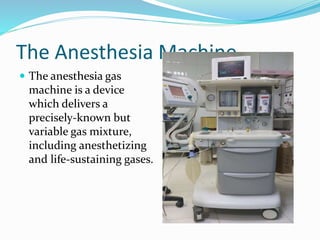
The Anesthesia Machine
 The anesthesia gas
machine is a device
which delivers a
precisely-known but
variable gas mixture,
including anesthetizing
and life-sustaining gases.
Some Numbers to Remember
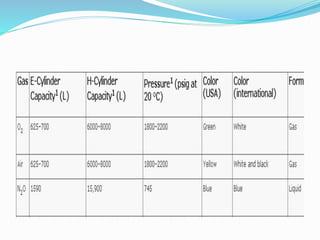
 The hospital pipeline is the primary gas source at 50 psi
(normal working pressure of most machines).
 Cylinders – O2 is supplied at around 2000 psi (regulated to
approximately 45 psi after it enters the machine).
 Oxygen flush is a "straight shot" from supply to delivery
point, 35-75 L/min.
 OSHA Fact Sheet (1991) on Waste Anesthetic Gases
(WAGs) occupational exposure should be limited to an
eight hour time-weighted average of not more than 2 ppm
halogenated agents (Halothane, Enflurane, Isoflurane,
Sevoflurane, Desflurane)
 If Halogenated agent is used in combination with nitrous
oxide, then ONLY 0.5 ppm OF THE HALOGENATED
AGENT IS ALLOWED
 No more than 25 ppm nitrous oxide can be used at all
times (with or without Halogenated Agent)
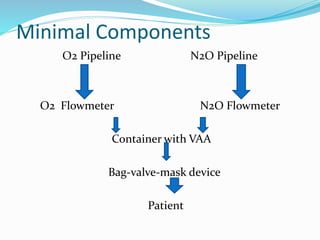
Minimal Components
O2 Pipeline N2O Pipeline
O2 Flowmeter N2O Flowmeter
Container with VAA
Bag-valve-mask device
Patient
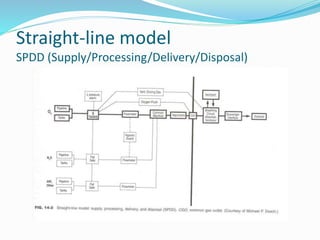
Straight-line model
SPDD (Supply/Processing/Delivery/Disposal)
O2 has 5 tasks
 It powers the ventilator driving gas
 O2 flush
 Activation of low pressure alarms
 Activation of fail-safe mechanisms (O2 pressure
sensor shut-off )
 Proceeding through the flowmeter
Other gases one task only
 Transported via flowmeter & breathing circuit to:
 Anesthetize pt (N2O)
 Sustain Life (Air)
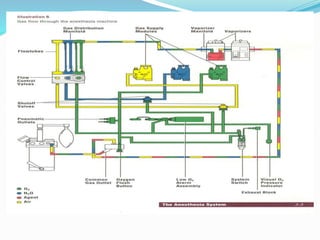
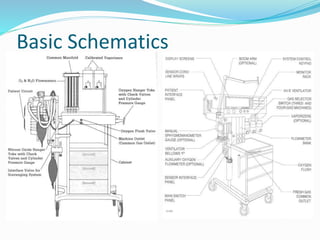
Basic Schematics
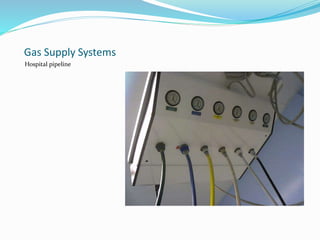
Gas Supply Systems
Hospital pipeline
DISS
 Pipeline inlets are connected with DISS (diameter
index safety system) non-interchangeable
connections.
 The check valve, located down stream from the
pipeline inlet, prevents reverse flow of gases (from
machine to pipeline, or to atmosphere), which allows
use of the gas machine when pipeline gas sources are
unavailable.
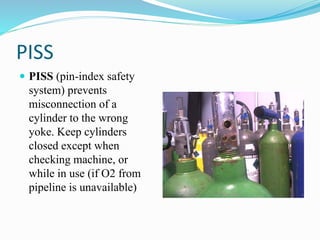
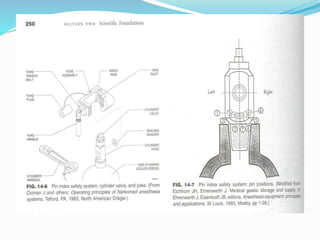
PISS
 PISS (pin-index safety
system) prevents
misconnection of a
cylinder to the wrong
yoke. Keep cylinders
closed except when
checking machine, or
while in use (if O2 from
pipeline is unavailable)
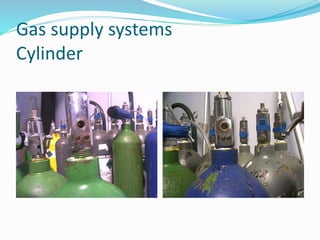
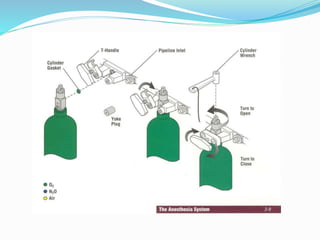
Gas supply systems
Cylinder
High Pressure System
(Parts which receive gas at cylinder pressure)
 hanger yoke (including filter and unidirectional valve)
 yoke block (with check valves)
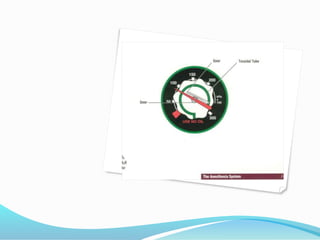
 cylinder pressure gauge
 cylinder pressure regulators
Hanger Yoke & Check Valve
Hanger Yoke
 orients cylinders
 provides
unidirectional flow
 ensures gas-tight seal.
Check Valve
 minimize trans-filling
 allows change of
cylinders during use
 minimize leaks to
atmosphere if a yoke
is empty.
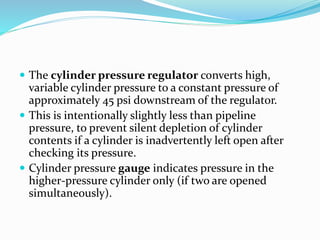
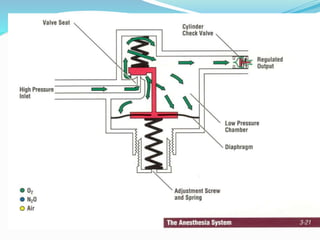
 The cylinder pressure regulator converts high,
variable cylinder pressure to a constant pressure of
approximately 45 psi downstream of the regulator.
 This is intentionally slightly less than pipeline
pressure, to prevent silent depletion of cylinder
contents if a cylinder is inadvertently left open after
checking its pressure.
 Cylinder pressure gauge indicates pressure in the
higher-pressure cylinder only (if two are opened
simultaneously).
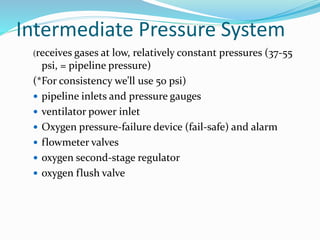
Intermediate Pressure System
(receives gases at low, relatively constant pressures (37-55
psi, = pipeline pressure)
(*For consistency we’ll use 50 psi)
 pipeline inlets and pressure gauges
 ventilator power inlet
 Oxygen pressure-failure device (fail-safe) and alarm
 flowmeter valves
 oxygen second-stage regulator
 oxygen flush valve
Oxygen pressure-failure device
(fail-safe) and alarm
 What happens if you lose oxygen pipeline pressure?
 The fail safe device ensures that "Whenever oxygen pressure is
reduced and until flow ceases, the set oxygen concentration shall
not decrease at the common gas outlet" (from ASTM F1161).
 The loss of oxygen pressure results in alarms, audible and visible, at
30 psi pipeline pressure.
 Fail-safe systems don't prevent hypoxic mixtures.
Fail-safe systems don't prevent
hypoxic mixtures
 as long as there is pressure in the O2 line, nothing in
the fail safe system prevents you from turning on a gas
mixture of 100% nitrous oxide (however, this should be
prevented by the hypoxic guard system)
 or 100% helium (which wouldn’t be prevented by the
hypoxic guard).
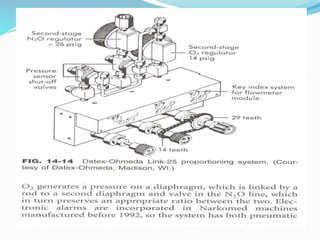
 Datex-Ohmeda terms their fail safe a "pressure sensor
shut off valve"- at 20 psi oxygen, the flow of all other
gases are shut off. Dräger's, "oxygen failure protection
device" (OFPD) threshold is proportional, unlike
Ohmeda's which is off-or-on.
Fail-safe systems don't prevent hypoxic
mixtures (Cont…)
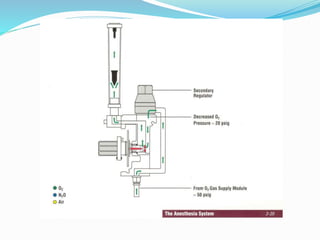
 Ohmeda uses a second-stage O2 pressure regulator
(ensures constant oxygen flowmeter input until supply
pressure is less than 12-16 psi). The oxygen ratio
monitor controller (ORM [newer] or ORMC, both by
Dräger) shuts off nitrous oxide when oxygen pressure
is less than 10 psi
Pipeline Trouble
 Pipeline sources are not trouble free:
contamination (particles, bacteria, viral, moisture),
inadequate pressure, excessive pressures, and
accidental crossover (switch between oxygen and some
other gas such as nitrous oxide or nitrogen) are all
reported.
HOW LONG BEFORE
O2 TANK IS EXHAUSTED???
-The time to exhaustion is calculated by dividing the
remaining O2 volume in the cylinder by the rate of
consumption of O2.
-Remaining volume in liters (L) in an E-cylinder is
calculated by dividing the cylinder pressure in psig
by 2000 psig and multiplying by 660 L.
 If cylinder gauge reads 1,000 psig, this represents
(1000/2000) X 660 = 330 L left in that tank. The rate
of consumption of O2 during mechanical ventilation
is the sum of the O2 flow meter setting and the
patient’s minute ventilation (VT in L x RR in
breaths/min).
 If FGF is 0.5 L/min O2 and 1.0 L/min N2O and VT is
0.7 L and RR is 10 bpm, then the minute ventilation
is
7 L/min (0.7L x 10 bpm)
* The total O2 consumption is 7.5 L/min. The expected
time to exhaustion is thus approximately 330 L
divided by 7.5 L/min = 44 min (ignoring the gas
sampled by the gas analyzer and leaks)
The Low-pressure system
(distal to flowmeter needle valve)
 flowmeter tubes
 vaporizers
 check valves (if present)
 common gas outlet
Flowmeters
 -Thorpe tube is an older term for flowmeters.
 -Components: needle valve, indicator float, knobs, valve
stops.
 -Flow increases when the knob is turned counterclockwise
(same as vaporizers).
 -At low flows, the annular-shaped orifice around the float is
(relatively) tubular so (according to Poiseuille's Law) flow is
governed by viscosity. (laminar flow)
 -At high flows (indicated on the wider top part of the float
tube), the annular opening is more like an orifice, and density
governs flows. (turbulent flow)
Low pressure system
Distal to Flowmeter Needdle Valve
Flow Meters- measures and indicates
the rate of gas flowing through it. Variable
orifice/Thorpe tube-constant press. flow
meters.
Rate of flow r/t: 1) pressure drop across the constriction
2) size of annular opening
3) Physical properties of the gas
(viscosity and density)
Indicator, float or bobbin- 1) rotometers
2) non-rotating floats
3) ball floats
Low pressure system
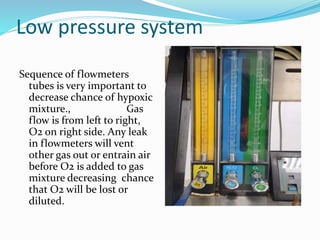
Sequence of flowmeters
tubes is very important to
decrease chance of hypoxic
mixture., Gas
flow is from left to right,
O2 on right side. Any leak
in flowmeters will vent
other gas out or entrain air
before O2 is added to gas
mixture decreasing chance
that O2 will be lost or
diluted.
Low pressure system
 Needle valve can be damaged if it is closed with force
 Flowtube (Thorpe tube) is tapered (narrower at
bottom) and gas-specific
 If gas has 2 tubes, they are connected in series with a
single control valve
Low pressure system
 Care of flowmeters includes ensuring that:
 floats spin freely
 qualified service personnel regularly maintain gas
machines
 an O2 analyzer used always (of course, the readings are
erroneous during use of nasal cannula)
 one never adjusts a flowmeter without looking at it
 one includes flowmeters in visual monitoring sweeps
 one turns flowmeters off before opening cylinders,
connecting pipelines, or turning machine "on".
Low pressure system
Safety devices: purpose to decrease risk of hypoxic mixture.
Mandatory Minimum O2 Flow- factory preset minimum O2
flow that always flows when machine is on.
Minimum O2/N2O Ratio– 1:3
Device or proportioning system: Flow valves linked
mechanically or pneumatically so O2 cannot be set below
25%.
Alarm will signal if O2/NO2 ratio falls below preset value
O2/NO2 Proportioning Device-Automatically
mixes O2 and NO2 to setting selected on dial
Hypoxic breathing is POSSIBLE
 hypoxic guard systems CAN permit hypoxic breathing
mixtures IF:
 wrong supply gas in oxygen pipeline or cylinder,
 defective pneumatic or mechanical components,
 leaks exist downstream of flow control valves, or
 if third inert gas (such as helium) is used.
Vaporizers
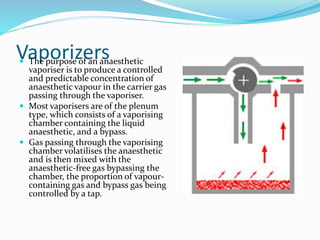
 The purpose of an anaesthetic
vaporiser is to produce a controlled
and predictable concentration of
anaesthetic vapour in the carrier gas
passing through the vaporiser.
 Most vaporisers are of the plenum
type, which consists of a vaporising
chamber containing the liquid
anaesthetic, and a bypass.
 Gas passing through the vaporising
chamber volatilises the anaesthetic
and is then mixed with the
anaesthetic-free gas bypassing the
chamber, the proportion of vapour-
containing gas and bypass gas being
controlled by a tap.
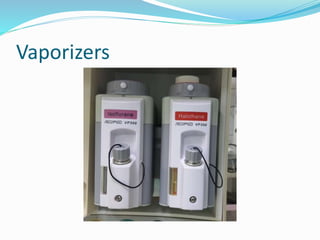
Vaporizers
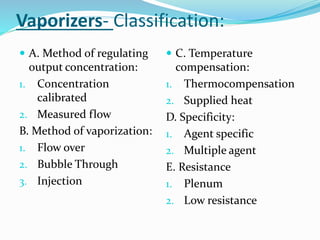
Vaporizers- Classification:
 A. Method of regulating
output concentration:
1. Concentration
calibrated
2. Measured flow
B. Method of vaporization:
1. Flow over
2. Bubble Through
3. Injection
 C. Temperature
compensation:
1. Thermocompensation
2. Supplied heat
D. Specificity:
1. Agent specific
2. Multiple agent
E. Resistance
1. Plenum
2. Low resistance
Vaporizers
 Vapor Pressure (VP) Molecules escape from a volatile
liquid to the vapor phase, creating a “saturated vapor
pressure” at equilibrium
 VP is independent of Atmospheric Press
 VP increases with Temperature
 VP depends ONLY on the Physical Characteristics of
the Liquid & on its Temperature
Classification
 Variable bypass
Fresh gas flow from the flowmeters enters the inlet of
any vaporizer which is on. The concentration control
dial setting splits this stream into bypass gas (which
does not enter the vaporizing chamber), and carrier gas
(also called chamber flow, which flows over the liquid
agent)
Classification
 Flow over
Carrier gas flows over the surface of the liquid volatile
agent in the vaporizing chamber (as opposed to
bubbling up through it (as in the copper kettle and
Vernitrol)
Classification
Temperature compensated
Equipped with automatic devices that ensure steady
vaporizer output over a wide range of ambient
temperatures
Agent-specific
Only calibrated for a single gas, usually with keyed fillers
that decrease the likelihood of filling the vaporizer with
the wrong agent
Out of circuit
As opposed to (much) older models such as the Ohio #8
(Boyle's bottle) which were inserted within the circle
system.
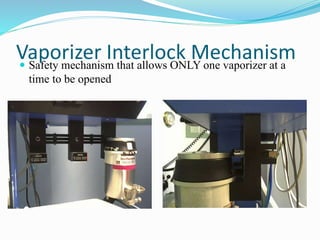
Vaporizer Interlock Mechanism
 Safety mechanism that allows ONLY one vaporizer at a
time to be opened
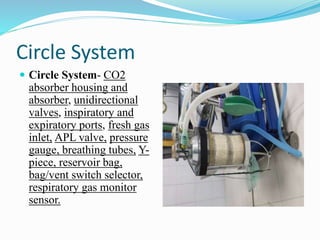
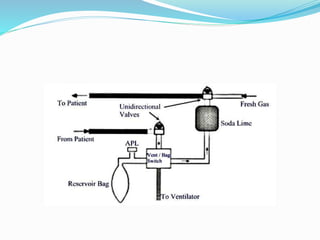
Circle System
 Circle System- CO2
absorber housing and
absorber, unidirectional
valves, inspiratory and
expiratory ports, fresh gas
inlet, APL valve, pressure
gauge, breathing tubes, Y-
piece, reservoir bag,
bag/vent switch selector,
respiratory gas monitor
sensor.
Circle system
 CO2 Absorber System: Housing (canister support), Absorbent, baffles, side tube
 Unidirectional Valves-aka Flutter valves, one way valves, check valves, directional valves,
dome valves
 Canister-Air space 50%, void space 42%, pore space 8%
 Soda Lime: 4% Sodium Hydroxide, 1% potassium hydroxide, 14-19% H2O,
and calcium hydroxide to make 100%,
Silica and kielselguhr for hardness
Indicator for color change with exhaustion of CO2 absorption capabilities
CO2+H2OH2CO3
2NaOH+2H2CO3+Ca(OH)2 CaCO3+NaCO3+4H2O
heat released 13,700 cal./mole CO2 absorbed
 Barium Hydroxide Lime: 20% Barium hydroxide, 80% calcium hydroxide, and +/-
potassium hydroxide,
 Indicator for color change with exhaustion of CO2 absorption capabilities
 Ba(OH)2
. 8H2O+CO2BaCO3+9H2O
 9H2O+9CO2 9H2CO3
 9H2CO3+9Ca(OH) 2  9CaCO3+18H2O
 2KOH+H2CO3  K2CO3+2H2O
 Ca(OH)2+K2CO3  CaCO3+2KOH
 Regeneration (color change loss) with rest can occur. Appears new but is exhausted
Granule size 4-8 mesh- 4 mesh equals strainer with 4 openings/inch
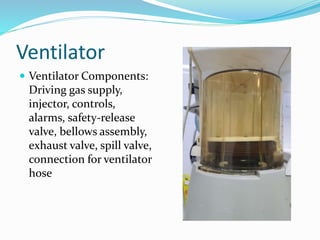
Ventilator
 Ventilator Components:
Driving gas supply,
injector, controls,
alarms, safety-release
valve, bellows assembly,
exhaust valve, spill valve,
connection for ventilator
hose
Ventilator
 Driving gas supply or power gas supply-O2 pneumatically drives
(compresses) ventilator bellows
 Injector or Venturi mechanism-Increases the flow of driving gas by using
the BERNOULLI Principle- As a gas flow meets a restriction, its lateral pressure drops.
Any opening in the tube at this constriction will entrain air (suck air in)
 Controls-Adjusts Flow, Volume, Timing, and Pressure of the driving gas that
compresses the bellows
Pneumatic-Uses pressure changes to initiate changes in respiratory cycle
Fluidic or fluid logic-Uses gas streams through channels in solid material. Allow
for compact ventilator
Electronic-Electronic control of many addition ventilation parameters
powered by a driving gas on newer machines. Must have both power and
pnuematics.
 Alarms-ASTM standards group alarms into three levels: High, Medium, Low Priority
correlates to;operator immediate action, prompt action,or awareness.
Loss of main power is the only required alarm with a required duration of at least
2 minutes
 Safety relief valve-aka pressure limiting valve, drving gas pressure relief valve.
Vents driving gas if factory pre-set pressure is reached (65-80 cm H2O) or adjustable
set pressure is reached.
Scavenger System
 Scavenger System consists of: 1) gas collecting
assembly, 2) a transfer means, 3) the interface, 4) gas
disposal tubing, 5) gas disposal assembly. (some or all
components may be combined).
 ASTM standard fitting size for scavenger hoses 19 mm
( international standard 30mm) to prevent incorrect
connection to breathing hoses (22mm).
Breathing Circuits
 Breathing circuits link the patient to the anaesthesia
machine. Therefore, The function of the circuit is to;
deliver Oxygen and anaesthetic gases to the patient,
providing humidity and warmness to inspired gases,
and to eliminate Carbon Dioxide.
 Types of Breathing Circuit:
- Insufflation
- Open-Drop Anaesthesia
- Draw-Over Anaesthesia
- Mapleson's Circuits
- The Circle System
 INSUFFLATION: the blowing of anaesthetic gases across a
patient’s face, avoiding direct connection between a breathing
circuit and a patient’s airway. It used mainly in children.
 OPEN-DROP ANESTHESIA: Ether or Chloroform dripped
onto a gauze-covered mask, then applied to the patient’s
face. Not used in modern medicine.
 DRAW-OVER ANESTHESIA: nonrebreathing circuits that
use ambient air as the carrier gas.
 The insufflation and draw-over systems have several
disadvantages:
- poor control of inspired gas concentration (poor control of
depth of anesthesia)
- mechanical drawbacks during head and neck surgery
- pollution of the operating room with large volumes of waste
gas
Mapleson's Circuits
 Is preferable than Insufflation and Draw-over
systems; as it solves some of their disadvantages.
 The relative location of these components
determines circuit performance and is the basis of the
Mapleson's classification.
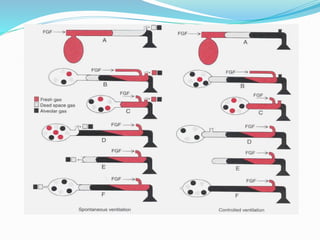
 Classified into 6 types (A, B, C, D, E, and F).
 The main goal is to assist respiration and prevent
rebreathing.
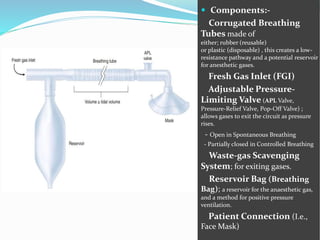
 Components:-
Corrugated Breathing
Tubes made of
either; rubber (reusable)
or plastic (disposable) , this creates a low-
resistance pathway and a potential reservoir
for anesthetic gases.
Fresh Gas Inlet (FGI)
Adjustable Pressure-
Limiting Valve (APL Valve,
Pressure-Relief Valve, Pop-Off Valve) ;
allows gases to exit the circuit as pressure
rises.
- Open in Spontaneous Breathing
- Partially closed in Controlled Breathing
Waste-gas Scavenging
System; for exiting gases.
Reservoir Bag (Breathing
Bag); a reservoir for the anaesthetic gas,
and a method for positive pressure
ventilation.
Patient Connection (I.e.,
Face Mask)
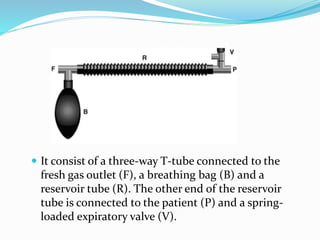
 It consist of a three-way T-tube connected to the
fresh gas outlet (F), a breathing bag (B) and a
reservoir tube (R). The other end of the reservoir
tube is connected to the patient (P) and a spring-
loaded expiratory valve (V).
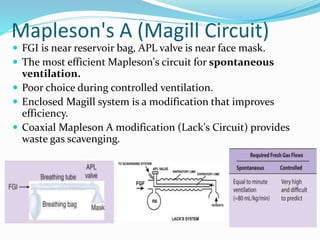
Mapleson's A (Magill Circuit)
 FGI is near reservoir bag, APL valve is near face mask.
 The most efficient Mapleson's circuit for spontaneous
ventilation.
 Poor choice during controlled ventilation.
 Enclosed Magill system is a modification that improves
efficiency.
 Coaxial Mapleson A modification (Lack's Circuit) provides
waste gas scavenging.
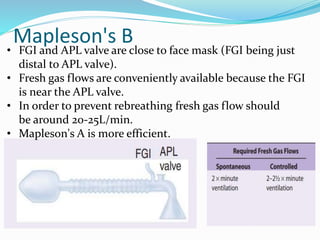
Mapleson's B
• FGI and APL valve are close to face mask (FGI being just
distal to APL valve).
• Fresh gas flows are conveniently available because the FGI
is near the APL valve.
• In order to prevent rebreathing fresh gas flow should
be around 20-25L/min.
• Mapleson's A is more efficient.
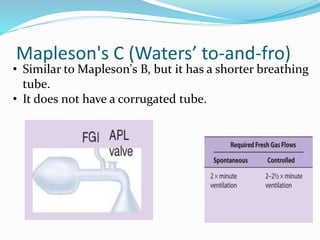
Mapleson's C (Waters’ to-and-fro)
• Similar to Mapleson's B, but it has a shorter breathing
tube.
• It does not have a corrugated tube.
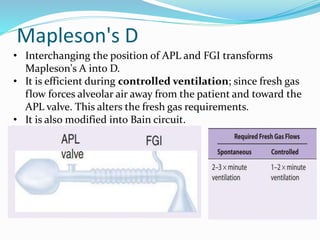
Mapleson's D
• Interchanging the position of APL and FGI transforms
Mapleson's A into D.
• It is efficient during controlled ventilation; since fresh gas
flow forces alveolar air away from the patient and toward the
APL valve. This alters the fresh gas requirements.
• It is also modified into Bain circuit.
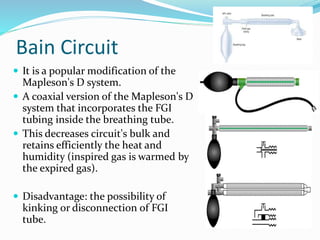
Bain Circuit
 It is a popular modification of the
Mapleson's D system.
 A coaxial version of the Mapleson's D
system that incorporates the FGI
tubing inside the breathing tube.
 This decreases circuit's bulk and
retains efficiently the heat and
humidity (inspired gas is warmed by
the expired gas).
 Disadvantage: the possibility of
kinking or disconnection of FGI
tube.
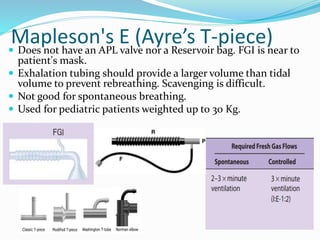
Mapleson's E (Ayre’s T-piece)
 Does not have an APL valve nor a Reservoir bag. FGI is near to
patient's mask.
 Exhalation tubing should provide a larger volume than tidal
volume to prevent rebreathing. Scavenging is difficult.
 Not good for spontaneous breathing.
 Used for pediatric patients weighted up to 30 Kg.
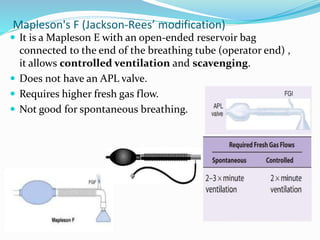
Mapleson's F (Jackson-Rees’ modification)
 It is a Mapleson E with an open-ended reservoir bag
connected to the end of the breathing tube (operator end) ,
it allows controlled ventilation and scavenging.
 Does not have an APL valve.
 Requires higher fresh gas flow.
 Not good for spontaneous breathing.
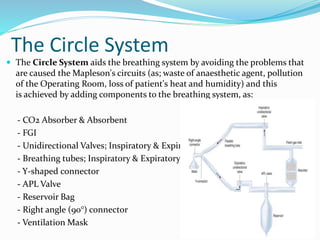
The Circle System
 The Circle System aids the breathing system by avoiding the problems that
are caused the Mapleson's circuits (as; waste of anaesthetic agent, pollution
of the Operating Room, loss of patient's heat and humidity) and this
is achieved by adding components to the breathing system, as:
- CO2 Absorber & Absorbent
- FGI
- Unidirectional Valves; Inspiratory & Expiratory
- Breathing tubes; Inspiratory & Expiratory
- Y-shaped connector
- APL Valve
- Reservoir Bag
- Right angle (90°) connector
- Ventilation Mask
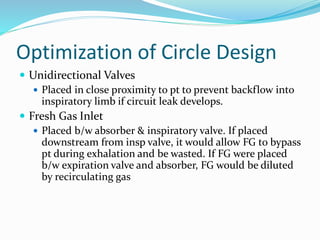
Optimization of Circle Design
 Unidirectional Valves
 Placed in close proximity to pt to prevent backflow into
inspiratory limb if circuit leak develops.
 Fresh Gas Inlet
 Placed b/w absorber & inspiratory valve. If placed
downstream from insp valve, it would allow FG to bypass
pt during exhalation and be wasted. If FG were placed
b/w expiration valve and absorber, FG would be diluted
by recirculating gas
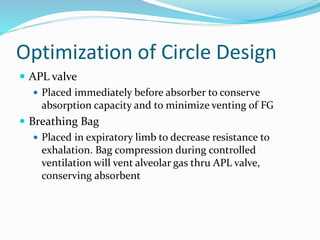
Optimization of Circle Design
 APL valve
 Placed immediately before absorber to conserve
absorption capacity and to minimize venting of FG
 Breathing Bag
 Placed in expiratory limb to decrease resistance to
exhalation. Bag compression during controlled
ventilation will vent alveolar gas thru APL valve,
conserving absorbent
Circle system can be:
 closed (fresh gas inflow exactly equal to patient
uptake, complete rebreathing after carbon dioxide
absorbed, and pop-off closed)
 semi-closed (some rebreathing occurs, FGF and
pop-off settings at intermediate values), or
 semi-open (no rebreathing, high fresh gas flow)
Anesthesia Breathing Systems
 Circle systems
 Most commonly used
 Adult and child appropriate sizes
 Can be semiopen, semiclosed, or closed dependent
solely on fresh gas flow (FGF)
 Uses chemical neutralization of CO2
 Conservation of moisture and body heat
 Low FGF’s saves money
Anesthesia Breathing Systems
 Circle systems
 Unidirectional valves
 Prevent inhalation of exhaled gases until they have passed
through the CO2 absorber (enforced pattern of flow)
 Incompetent valve will allow rebreathing of CO2
 Hypercarbia and failure of ETCO2 wave to return to baseline
 Pop off (APL) Valve
 Allows pressure control of inspiratory controlled ventilation
 Allows for manual and assisted ventilation with mask, LMA,
or ETT (anesthetist will regulate APL valve to keep breathing
bag not too deflated or inflated)
Anesthesia Breathing Systems
 Circle system
 Allows for mechanical ventilation of the lungs using the
attached ventilator
 Allows for adjustment of ventilatory pressure
 Allows for semiopen, semiclosed, and closed systems
based solely on FGF
 Is easily scavenged to avoid pollution of OR
environment
Anesthesia Breathing Systems
 Advantages of rebreathing
 Cost reduction (use less agent and O2)
 Increased tracheal warmth and humidity
 Decreased exposure of OR personnel to waste gases
 Decreased pollution of the environment
 REMEMBER that the degree of rebreathing in an
anesthesia circuit is increased as the fresh gas flow
(FGF) supplied to the circuit is decreased
Anesthesia Breathing Systems
 Dead space
 Increases with the use of any anesthesia system
 Unlike Mapleson circuits, the length of the breathing tube of
a circle system DOES NOT directly affect dead space
 Like Mapleson’s, length DOES affect circuit compliance
(affecting amount of TV lost to the circuit during mech vent)
 Increasing dead space increases rebreathing of CO2
 To avoid hypercarbia in the face of an acute increase in dead
space, a patient must increase minute ventilation
 Dead space ends where the inspiratory and expiratory gas
streams converge
 Use of a mask is associated with greater dead space than an
ETT
Anesthesia Breathing Systems
 Carbon dioxide neutralization
 Influenced by
 Size of granules
 Presence or absence of channeling in the canister (areas of
loosely packed granules, minimized by baffle system)
 Tidal volume in comparison to void space of the canister
 TV should not exceed air space between absorbent granules (1/2
absorbent capacity)
 Ph sensitive dye
 Ethyl violet indicator turns purple when soda lime exhausted
(change when 50-70% has changed color)
 Regeneration: Exhausted granules may revert to original color if
rested, no significant recovery of absorptive capacity occurs
(change canister!!)
Anesthesia Breathing Systems
 Carbon dioxide neutralization
 Maximum absorbent capacity 26L of CO2/100g granules
 Granules designated by Mesh size (4-8 mesh)
 A compromise between higher absorptive surface area of small
granules & the lower resistance to gas flow of larger granules
 Toxic byproducts
 The drier the soda lime, the more likely it will absorb &
degrade volatile anesthetics (this is bad since the absorber is
designed to absorb CO2 and not to further degradeVAA
Disadvantages of Circle System
 Greater size, less portability
 Increased complexity
 Higher risk of disconnection or malfunction
 Increased resistance (of valves during spontaneous
ventilation)
 Dissuading use in Pediatrics (unless a circle pedi system
used)
 Difficult prediction of inspired gas concentration
during low fresh gas flow
Bacterial Contamination
 Slight risk of microorganism retention in Circle system
that could (theoretically) lead to respiratory infections
in subsequent pts
 Bacterial filters are incorporated into EXPIRATORY
LIMB of the circuit
Thank you
have a great day

Anesthesia Machine.pptx

  • 1.
  • 2.
    Anesthesia Machine Checkout General:  Anesthesia Apparatus Checkout Recommendations, 1993 (Taken from the FDA)  This checkout, or a reasonable equivalent, should be conducted before administration of anesthesia. These recommendations are only valid for an anesthesia system that conforms to current and relevant standards and includes an ascending bellows ventilator and at least the following monitors: capnograph, pulse oximeter, oxygen analyzer, respiratory volume monitor (spirometer) and breathing system pressure monitor with high and low pressure alarms. This is a guideline which users are encouraged to modify to accommodate differences in equipment design and variations in local clinical practice. Such local modifications should have appropriate peer review. Users should refer to the operator's manual for the manufacturer's specific procedures and precautions, especially the manufacturer's low pressure leak test (step #5).  * If an anesthesia provider uses the same machine in successive cases, these steps need not be repeated or may be abbreviated after the initial checkout.
  • 3.
     Steps 1-3: Emergency Ventilation Equipment *1. Verify Backup Ventilation Equipment is Available & Functioning  High Pressure System *2. Check Oxygen Cylinder Supply a. Open 02 cylinder and verify at least half full (about 1000 psi). b. Close cylinder. *3. Check Central Pipeline Supplies a. Check that hoses are connected and pipeline gauges read about 50 psi.
  • 4.
     Steps 4-7: Low Pressure Systems *4. Check Initial Status of Low Pressure System a. Close flow control valves and turn vaporizers off. b. Check fill level and tighten vaporizers' filler caps. *5. Perform Leak Check of Machine Low Pressure System a. Verify that the machine master switch and flow control valves are OFF. b. Attach "Suction Bulb" to common Fresh gas outlet. c. Squeeze bulb repeatedly until fully collapsed. d. Verify bulb stays fully collapsed for at least 10 seconds. e. Open one vaporizer at a time and repeat 'c' and 'd' as above. f. Remove suction bulb, and reconnect fresh gas hose. *6. Turn On Machine Master Switch and all other necessary electrical equipment. *7. Test Flowmeters a. Adjust flow of all gases through their full range, checking for smooth operation of floats and undamaged flowtubes. b. Attempt to create a hypoxic 02/N20 mixture and verify correct changes in flow and/or alarm.
  • 5.
     Scavenging System *8.Adjust and Check Scavenging System a. Ensure proper connections between the scavenging system and both APL (pop-off) valve and ventilator relief valve. b. Adjust waste gas vacuum (if possible). c. Fully open APL valve and occlude Y-piece. d. With minimum 02 flow, allow scavenger reservoir bag to collapse completely and verify that absorber pressure gauge reads about zero. e. With the 02 flush activated allow the scavenger reservoir bag to distend fully, and then verify that absorber pressure gauge reads <10 cm H20.
  • 6.
     Breathing System *9.Calibrate 02 Monitor a. Ensure monitor reads 21% in room air. b. Verify low 02 alarm is enabled and functioning. c. Reinstall sensor in circuit and flush breathing system with 02. d. Verify that monitor now reads greater than 90%. 10. Check Initial Status of Breathing System a. Set selector switch to "Bag" mode. b. Check that breathing circuit is complete, undamaged and unobstructed. c. Verify that C02 absorbent is adequate. d. Install breathing circuit accessory equipment (e.g. humidifier, PEEP valve) to be used during the case. 11. Perform Leak Check of the Breathing System a. Set all gas flows to zero (or minimum). b. Close APL (pop-off) valve and occlude Y-piece. c. Pressurize breathing system to about 30 cm H20 with 02 flush. d. Ensure that pressure remains fixed for at least 10 seconds. e. Open APL (Pop-off) valve and ensure that pressure decreases.
  • 7.
     Manual andAutomatic Ventilation Systems 12. Test Ventilation Systems and Unidirectional Valves a. Place a second breathing bag on Y-piece. b. Set appropriate ventilator parameters for next patient. c. Switch to automatic ventilation (Ventilator) mode. d. Fill bellows and breathing bag with 02 flush and then turn ventilator ON. e. Set 02 flow to minimum, other gas flows to zero. f. Verify that during inspiration bellows delivers appropriate tidal volume and that during expiration bellows fills completely. g. Set fresh gas flow to about 5 L/min. h. Verify that the ventilator bellows and simulated lungs fill and empty appropriately without sustained pressure at end expiration. i. Check for proper action of unidirectional valves. j. Exercise breathing circuit accessories to ensure proper function. k. Turn ventilator OFF and switch to manual ventilation (Bag/APL) mode. l. Ventilate manually and assure inflation and deflation of artificial lungs and appropriate feel of system resistance and compliance. m. Remove second breathing bag from Y-piece.
  • 8.
     Monitors 13. Check,Calibrate and/or Set Alarm Limits of all Monitors Capnometer, Pulse Oximeter, Oxygen Analyzer, Respiratory Volume Monitor (Spirometer), Pressure Monitor with High and Low Airway Alarms  Final Position 14. Check Final Status of Machine a. Vaporizers off b. AFL valve open c. Selector switch to "Bag" d. All flowmeters to zero e. Patient suction level adequate f. Breathing system ready to use
  • 9.
    The Anesthesia Machine The anesthesia gas machine is a device which delivers a precisely-known but variable gas mixture, including anesthetizing and life-sustaining gases.
  • 10.
    Some Numbers toRemember  The hospital pipeline is the primary gas source at 50 psi (normal working pressure of most machines).  Cylinders – O2 is supplied at around 2000 psi (regulated to approximately 45 psi after it enters the machine).  Oxygen flush is a "straight shot" from supply to delivery point, 35-75 L/min.  OSHA Fact Sheet (1991) on Waste Anesthetic Gases (WAGs) occupational exposure should be limited to an eight hour time-weighted average of not more than 2 ppm halogenated agents (Halothane, Enflurane, Isoflurane, Sevoflurane, Desflurane)  If Halogenated agent is used in combination with nitrous oxide, then ONLY 0.5 ppm OF THE HALOGENATED AGENT IS ALLOWED  No more than 25 ppm nitrous oxide can be used at all times (with or without Halogenated Agent)
  • 11.
    Minimal Components O2 PipelineN2O Pipeline O2 Flowmeter N2O Flowmeter Container with VAA Bag-valve-mask device Patient
  • 12.
  • 13.
    O2 has 5tasks  It powers the ventilator driving gas  O2 flush  Activation of low pressure alarms  Activation of fail-safe mechanisms (O2 pressure sensor shut-off )  Proceeding through the flowmeter
  • 14.
    Other gases onetask only  Transported via flowmeter & breathing circuit to:  Anesthetize pt (N2O)  Sustain Life (Air)
  • 16.
  • 17.
  • 18.
    DISS  Pipeline inletsare connected with DISS (diameter index safety system) non-interchangeable connections.  The check valve, located down stream from the pipeline inlet, prevents reverse flow of gases (from machine to pipeline, or to atmosphere), which allows use of the gas machine when pipeline gas sources are unavailable.
  • 19.
    PISS  PISS (pin-indexsafety system) prevents misconnection of a cylinder to the wrong yoke. Keep cylinders closed except when checking machine, or while in use (if O2 from pipeline is unavailable)
  • 21.
  • 22.
    High Pressure System (Partswhich receive gas at cylinder pressure)  hanger yoke (including filter and unidirectional valve)  yoke block (with check valves)  cylinder pressure gauge  cylinder pressure regulators
  • 24.
    Hanger Yoke &Check Valve Hanger Yoke  orients cylinders  provides unidirectional flow  ensures gas-tight seal. Check Valve  minimize trans-filling  allows change of cylinders during use  minimize leaks to atmosphere if a yoke is empty.
  • 26.
     The cylinderpressure regulator converts high, variable cylinder pressure to a constant pressure of approximately 45 psi downstream of the regulator.  This is intentionally slightly less than pipeline pressure, to prevent silent depletion of cylinder contents if a cylinder is inadvertently left open after checking its pressure.  Cylinder pressure gauge indicates pressure in the higher-pressure cylinder only (if two are opened simultaneously).
  • 28.
    Intermediate Pressure System (receivesgases at low, relatively constant pressures (37-55 psi, = pipeline pressure) (*For consistency we’ll use 50 psi)  pipeline inlets and pressure gauges  ventilator power inlet  Oxygen pressure-failure device (fail-safe) and alarm  flowmeter valves  oxygen second-stage regulator  oxygen flush valve
  • 29.
    Oxygen pressure-failure device (fail-safe)and alarm  What happens if you lose oxygen pipeline pressure?  The fail safe device ensures that "Whenever oxygen pressure is reduced and until flow ceases, the set oxygen concentration shall not decrease at the common gas outlet" (from ASTM F1161).  The loss of oxygen pressure results in alarms, audible and visible, at 30 psi pipeline pressure.  Fail-safe systems don't prevent hypoxic mixtures.
  • 30.
    Fail-safe systems don'tprevent hypoxic mixtures  as long as there is pressure in the O2 line, nothing in the fail safe system prevents you from turning on a gas mixture of 100% nitrous oxide (however, this should be prevented by the hypoxic guard system)  or 100% helium (which wouldn’t be prevented by the hypoxic guard).  Datex-Ohmeda terms their fail safe a "pressure sensor shut off valve"- at 20 psi oxygen, the flow of all other gases are shut off. Dräger's, "oxygen failure protection device" (OFPD) threshold is proportional, unlike Ohmeda's which is off-or-on.
  • 31.
    Fail-safe systems don'tprevent hypoxic mixtures (Cont…)  Ohmeda uses a second-stage O2 pressure regulator (ensures constant oxygen flowmeter input until supply pressure is less than 12-16 psi). The oxygen ratio monitor controller (ORM [newer] or ORMC, both by Dräger) shuts off nitrous oxide when oxygen pressure is less than 10 psi
  • 32.
    Pipeline Trouble  Pipelinesources are not trouble free: contamination (particles, bacteria, viral, moisture), inadequate pressure, excessive pressures, and accidental crossover (switch between oxygen and some other gas such as nitrous oxide or nitrogen) are all reported.
  • 33.
    HOW LONG BEFORE O2TANK IS EXHAUSTED??? -The time to exhaustion is calculated by dividing the remaining O2 volume in the cylinder by the rate of consumption of O2. -Remaining volume in liters (L) in an E-cylinder is calculated by dividing the cylinder pressure in psig by 2000 psig and multiplying by 660 L.
  • 34.
     If cylindergauge reads 1,000 psig, this represents (1000/2000) X 660 = 330 L left in that tank. The rate of consumption of O2 during mechanical ventilation is the sum of the O2 flow meter setting and the patient’s minute ventilation (VT in L x RR in breaths/min).  If FGF is 0.5 L/min O2 and 1.0 L/min N2O and VT is 0.7 L and RR is 10 bpm, then the minute ventilation is 7 L/min (0.7L x 10 bpm) * The total O2 consumption is 7.5 L/min. The expected time to exhaustion is thus approximately 330 L divided by 7.5 L/min = 44 min (ignoring the gas sampled by the gas analyzer and leaks)
  • 35.
    The Low-pressure system (distalto flowmeter needle valve)  flowmeter tubes  vaporizers  check valves (if present)  common gas outlet
  • 36.
    Flowmeters  -Thorpe tubeis an older term for flowmeters.  -Components: needle valve, indicator float, knobs, valve stops.  -Flow increases when the knob is turned counterclockwise (same as vaporizers).  -At low flows, the annular-shaped orifice around the float is (relatively) tubular so (according to Poiseuille's Law) flow is governed by viscosity. (laminar flow)  -At high flows (indicated on the wider top part of the float tube), the annular opening is more like an orifice, and density governs flows. (turbulent flow)
  • 37.
    Low pressure system Distalto Flowmeter Needdle Valve Flow Meters- measures and indicates the rate of gas flowing through it. Variable orifice/Thorpe tube-constant press. flow meters. Rate of flow r/t: 1) pressure drop across the constriction 2) size of annular opening 3) Physical properties of the gas (viscosity and density) Indicator, float or bobbin- 1) rotometers 2) non-rotating floats 3) ball floats
  • 38.
    Low pressure system Sequenceof flowmeters tubes is very important to decrease chance of hypoxic mixture., Gas flow is from left to right, O2 on right side. Any leak in flowmeters will vent other gas out or entrain air before O2 is added to gas mixture decreasing chance that O2 will be lost or diluted.
  • 39.
    Low pressure system Needle valve can be damaged if it is closed with force  Flowtube (Thorpe tube) is tapered (narrower at bottom) and gas-specific  If gas has 2 tubes, they are connected in series with a single control valve
  • 40.
    Low pressure system Care of flowmeters includes ensuring that:  floats spin freely  qualified service personnel regularly maintain gas machines  an O2 analyzer used always (of course, the readings are erroneous during use of nasal cannula)  one never adjusts a flowmeter without looking at it  one includes flowmeters in visual monitoring sweeps  one turns flowmeters off before opening cylinders, connecting pipelines, or turning machine "on".
  • 41.
    Low pressure system Safetydevices: purpose to decrease risk of hypoxic mixture. Mandatory Minimum O2 Flow- factory preset minimum O2 flow that always flows when machine is on. Minimum O2/N2O Ratio– 1:3 Device or proportioning system: Flow valves linked mechanically or pneumatically so O2 cannot be set below 25%. Alarm will signal if O2/NO2 ratio falls below preset value O2/NO2 Proportioning Device-Automatically mixes O2 and NO2 to setting selected on dial
  • 45.
    Hypoxic breathing isPOSSIBLE  hypoxic guard systems CAN permit hypoxic breathing mixtures IF:  wrong supply gas in oxygen pipeline or cylinder,  defective pneumatic or mechanical components,  leaks exist downstream of flow control valves, or  if third inert gas (such as helium) is used.
  • 46.
    Vaporizers  The purposeof an anaesthetic vaporiser is to produce a controlled and predictable concentration of anaesthetic vapour in the carrier gas passing through the vaporiser.  Most vaporisers are of the plenum type, which consists of a vaporising chamber containing the liquid anaesthetic, and a bypass.  Gas passing through the vaporising chamber volatilises the anaesthetic and is then mixed with the anaesthetic-free gas bypassing the chamber, the proportion of vapour- containing gas and bypass gas being controlled by a tap.
  • 47.
  • 48.
    Vaporizers- Classification:  A.Method of regulating output concentration: 1. Concentration calibrated 2. Measured flow B. Method of vaporization: 1. Flow over 2. Bubble Through 3. Injection  C. Temperature compensation: 1. Thermocompensation 2. Supplied heat D. Specificity: 1. Agent specific 2. Multiple agent E. Resistance 1. Plenum 2. Low resistance
  • 49.
    Vaporizers  Vapor Pressure(VP) Molecules escape from a volatile liquid to the vapor phase, creating a “saturated vapor pressure” at equilibrium  VP is independent of Atmospheric Press  VP increases with Temperature  VP depends ONLY on the Physical Characteristics of the Liquid & on its Temperature
  • 50.
    Classification  Variable bypass Freshgas flow from the flowmeters enters the inlet of any vaporizer which is on. The concentration control dial setting splits this stream into bypass gas (which does not enter the vaporizing chamber), and carrier gas (also called chamber flow, which flows over the liquid agent)
  • 51.
    Classification  Flow over Carriergas flows over the surface of the liquid volatile agent in the vaporizing chamber (as opposed to bubbling up through it (as in the copper kettle and Vernitrol)
  • 52.
    Classification Temperature compensated Equipped withautomatic devices that ensure steady vaporizer output over a wide range of ambient temperatures Agent-specific Only calibrated for a single gas, usually with keyed fillers that decrease the likelihood of filling the vaporizer with the wrong agent Out of circuit As opposed to (much) older models such as the Ohio #8 (Boyle's bottle) which were inserted within the circle system.
  • 53.
    Vaporizer Interlock Mechanism Safety mechanism that allows ONLY one vaporizer at a time to be opened
  • 54.
    Circle System  CircleSystem- CO2 absorber housing and absorber, unidirectional valves, inspiratory and expiratory ports, fresh gas inlet, APL valve, pressure gauge, breathing tubes, Y- piece, reservoir bag, bag/vent switch selector, respiratory gas monitor sensor.
  • 55.
    Circle system  CO2Absorber System: Housing (canister support), Absorbent, baffles, side tube  Unidirectional Valves-aka Flutter valves, one way valves, check valves, directional valves, dome valves  Canister-Air space 50%, void space 42%, pore space 8%  Soda Lime: 4% Sodium Hydroxide, 1% potassium hydroxide, 14-19% H2O, and calcium hydroxide to make 100%, Silica and kielselguhr for hardness Indicator for color change with exhaustion of CO2 absorption capabilities CO2+H2OH2CO3 2NaOH+2H2CO3+Ca(OH)2 CaCO3+NaCO3+4H2O heat released 13,700 cal./mole CO2 absorbed  Barium Hydroxide Lime: 20% Barium hydroxide, 80% calcium hydroxide, and +/- potassium hydroxide,  Indicator for color change with exhaustion of CO2 absorption capabilities  Ba(OH)2 . 8H2O+CO2BaCO3+9H2O  9H2O+9CO2 9H2CO3  9H2CO3+9Ca(OH) 2  9CaCO3+18H2O  2KOH+H2CO3  K2CO3+2H2O  Ca(OH)2+K2CO3  CaCO3+2KOH  Regeneration (color change loss) with rest can occur. Appears new but is exhausted Granule size 4-8 mesh- 4 mesh equals strainer with 4 openings/inch
  • 56.
    Ventilator  Ventilator Components: Drivinggas supply, injector, controls, alarms, safety-release valve, bellows assembly, exhaust valve, spill valve, connection for ventilator hose
  • 57.
    Ventilator  Driving gassupply or power gas supply-O2 pneumatically drives (compresses) ventilator bellows  Injector or Venturi mechanism-Increases the flow of driving gas by using the BERNOULLI Principle- As a gas flow meets a restriction, its lateral pressure drops. Any opening in the tube at this constriction will entrain air (suck air in)  Controls-Adjusts Flow, Volume, Timing, and Pressure of the driving gas that compresses the bellows Pneumatic-Uses pressure changes to initiate changes in respiratory cycle Fluidic or fluid logic-Uses gas streams through channels in solid material. Allow for compact ventilator Electronic-Electronic control of many addition ventilation parameters powered by a driving gas on newer machines. Must have both power and pnuematics.  Alarms-ASTM standards group alarms into three levels: High, Medium, Low Priority correlates to;operator immediate action, prompt action,or awareness. Loss of main power is the only required alarm with a required duration of at least 2 minutes  Safety relief valve-aka pressure limiting valve, drving gas pressure relief valve. Vents driving gas if factory pre-set pressure is reached (65-80 cm H2O) or adjustable set pressure is reached.
  • 58.
    Scavenger System  ScavengerSystem consists of: 1) gas collecting assembly, 2) a transfer means, 3) the interface, 4) gas disposal tubing, 5) gas disposal assembly. (some or all components may be combined).  ASTM standard fitting size for scavenger hoses 19 mm ( international standard 30mm) to prevent incorrect connection to breathing hoses (22mm).
  • 59.
    Breathing Circuits  Breathingcircuits link the patient to the anaesthesia machine. Therefore, The function of the circuit is to; deliver Oxygen and anaesthetic gases to the patient, providing humidity and warmness to inspired gases, and to eliminate Carbon Dioxide.  Types of Breathing Circuit: - Insufflation - Open-Drop Anaesthesia - Draw-Over Anaesthesia - Mapleson's Circuits - The Circle System
  • 60.
     INSUFFLATION: theblowing of anaesthetic gases across a patient’s face, avoiding direct connection between a breathing circuit and a patient’s airway. It used mainly in children.  OPEN-DROP ANESTHESIA: Ether or Chloroform dripped onto a gauze-covered mask, then applied to the patient’s face. Not used in modern medicine.  DRAW-OVER ANESTHESIA: nonrebreathing circuits that use ambient air as the carrier gas.  The insufflation and draw-over systems have several disadvantages: - poor control of inspired gas concentration (poor control of depth of anesthesia) - mechanical drawbacks during head and neck surgery - pollution of the operating room with large volumes of waste gas
  • 61.
    Mapleson's Circuits  Ispreferable than Insufflation and Draw-over systems; as it solves some of their disadvantages.  The relative location of these components determines circuit performance and is the basis of the Mapleson's classification.  Classified into 6 types (A, B, C, D, E, and F).  The main goal is to assist respiration and prevent rebreathing.
  • 62.
     Components:- Corrugated Breathing Tubesmade of either; rubber (reusable) or plastic (disposable) , this creates a low- resistance pathway and a potential reservoir for anesthetic gases. Fresh Gas Inlet (FGI) Adjustable Pressure- Limiting Valve (APL Valve, Pressure-Relief Valve, Pop-Off Valve) ; allows gases to exit the circuit as pressure rises. - Open in Spontaneous Breathing - Partially closed in Controlled Breathing Waste-gas Scavenging System; for exiting gases. Reservoir Bag (Breathing Bag); a reservoir for the anaesthetic gas, and a method for positive pressure ventilation. Patient Connection (I.e., Face Mask)
  • 63.
     It consistof a three-way T-tube connected to the fresh gas outlet (F), a breathing bag (B) and a reservoir tube (R). The other end of the reservoir tube is connected to the patient (P) and a spring- loaded expiratory valve (V).
  • 64.
    Mapleson's A (MagillCircuit)  FGI is near reservoir bag, APL valve is near face mask.  The most efficient Mapleson's circuit for spontaneous ventilation.  Poor choice during controlled ventilation.  Enclosed Magill system is a modification that improves efficiency.  Coaxial Mapleson A modification (Lack's Circuit) provides waste gas scavenging.
  • 65.
    Mapleson's B • FGIand APL valve are close to face mask (FGI being just distal to APL valve). • Fresh gas flows are conveniently available because the FGI is near the APL valve. • In order to prevent rebreathing fresh gas flow should be around 20-25L/min. • Mapleson's A is more efficient.
  • 66.
    Mapleson's C (Waters’to-and-fro) • Similar to Mapleson's B, but it has a shorter breathing tube. • It does not have a corrugated tube.
  • 67.
    Mapleson's D • Interchangingthe position of APL and FGI transforms Mapleson's A into D. • It is efficient during controlled ventilation; since fresh gas flow forces alveolar air away from the patient and toward the APL valve. This alters the fresh gas requirements. • It is also modified into Bain circuit.
  • 68.
    Bain Circuit  Itis a popular modification of the Mapleson's D system.  A coaxial version of the Mapleson's D system that incorporates the FGI tubing inside the breathing tube.  This decreases circuit's bulk and retains efficiently the heat and humidity (inspired gas is warmed by the expired gas).  Disadvantage: the possibility of kinking or disconnection of FGI tube.
  • 69.
    Mapleson's E (Ayre’sT-piece)  Does not have an APL valve nor a Reservoir bag. FGI is near to patient's mask.  Exhalation tubing should provide a larger volume than tidal volume to prevent rebreathing. Scavenging is difficult.  Not good for spontaneous breathing.  Used for pediatric patients weighted up to 30 Kg.
  • 70.
    Mapleson's F (Jackson-Rees’modification)  It is a Mapleson E with an open-ended reservoir bag connected to the end of the breathing tube (operator end) , it allows controlled ventilation and scavenging.  Does not have an APL valve.  Requires higher fresh gas flow.  Not good for spontaneous breathing.
  • 72.
    The Circle System The Circle System aids the breathing system by avoiding the problems that are caused the Mapleson's circuits (as; waste of anaesthetic agent, pollution of the Operating Room, loss of patient's heat and humidity) and this is achieved by adding components to the breathing system, as: - CO2 Absorber & Absorbent - FGI - Unidirectional Valves; Inspiratory & Expiratory - Breathing tubes; Inspiratory & Expiratory - Y-shaped connector - APL Valve - Reservoir Bag - Right angle (90°) connector - Ventilation Mask
  • 73.
    Optimization of CircleDesign  Unidirectional Valves  Placed in close proximity to pt to prevent backflow into inspiratory limb if circuit leak develops.  Fresh Gas Inlet  Placed b/w absorber & inspiratory valve. If placed downstream from insp valve, it would allow FG to bypass pt during exhalation and be wasted. If FG were placed b/w expiration valve and absorber, FG would be diluted by recirculating gas
  • 74.
    Optimization of CircleDesign  APL valve  Placed immediately before absorber to conserve absorption capacity and to minimize venting of FG  Breathing Bag  Placed in expiratory limb to decrease resistance to exhalation. Bag compression during controlled ventilation will vent alveolar gas thru APL valve, conserving absorbent
  • 75.
    Circle system canbe:  closed (fresh gas inflow exactly equal to patient uptake, complete rebreathing after carbon dioxide absorbed, and pop-off closed)  semi-closed (some rebreathing occurs, FGF and pop-off settings at intermediate values), or  semi-open (no rebreathing, high fresh gas flow)
  • 76.
    Anesthesia Breathing Systems Circle systems  Most commonly used  Adult and child appropriate sizes  Can be semiopen, semiclosed, or closed dependent solely on fresh gas flow (FGF)  Uses chemical neutralization of CO2  Conservation of moisture and body heat  Low FGF’s saves money
  • 77.
    Anesthesia Breathing Systems Circle systems  Unidirectional valves  Prevent inhalation of exhaled gases until they have passed through the CO2 absorber (enforced pattern of flow)  Incompetent valve will allow rebreathing of CO2  Hypercarbia and failure of ETCO2 wave to return to baseline  Pop off (APL) Valve  Allows pressure control of inspiratory controlled ventilation  Allows for manual and assisted ventilation with mask, LMA, or ETT (anesthetist will regulate APL valve to keep breathing bag not too deflated or inflated)
  • 78.
    Anesthesia Breathing Systems Circle system  Allows for mechanical ventilation of the lungs using the attached ventilator  Allows for adjustment of ventilatory pressure  Allows for semiopen, semiclosed, and closed systems based solely on FGF  Is easily scavenged to avoid pollution of OR environment
  • 79.
    Anesthesia Breathing Systems Advantages of rebreathing  Cost reduction (use less agent and O2)  Increased tracheal warmth and humidity  Decreased exposure of OR personnel to waste gases  Decreased pollution of the environment  REMEMBER that the degree of rebreathing in an anesthesia circuit is increased as the fresh gas flow (FGF) supplied to the circuit is decreased
  • 81.
    Anesthesia Breathing Systems Dead space  Increases with the use of any anesthesia system  Unlike Mapleson circuits, the length of the breathing tube of a circle system DOES NOT directly affect dead space  Like Mapleson’s, length DOES affect circuit compliance (affecting amount of TV lost to the circuit during mech vent)  Increasing dead space increases rebreathing of CO2  To avoid hypercarbia in the face of an acute increase in dead space, a patient must increase minute ventilation  Dead space ends where the inspiratory and expiratory gas streams converge  Use of a mask is associated with greater dead space than an ETT
  • 82.
    Anesthesia Breathing Systems Carbon dioxide neutralization  Influenced by  Size of granules  Presence or absence of channeling in the canister (areas of loosely packed granules, minimized by baffle system)  Tidal volume in comparison to void space of the canister  TV should not exceed air space between absorbent granules (1/2 absorbent capacity)  Ph sensitive dye  Ethyl violet indicator turns purple when soda lime exhausted (change when 50-70% has changed color)  Regeneration: Exhausted granules may revert to original color if rested, no significant recovery of absorptive capacity occurs (change canister!!)
  • 83.
    Anesthesia Breathing Systems Carbon dioxide neutralization  Maximum absorbent capacity 26L of CO2/100g granules  Granules designated by Mesh size (4-8 mesh)  A compromise between higher absorptive surface area of small granules & the lower resistance to gas flow of larger granules  Toxic byproducts  The drier the soda lime, the more likely it will absorb & degrade volatile anesthetics (this is bad since the absorber is designed to absorb CO2 and not to further degradeVAA
  • 84.
    Disadvantages of CircleSystem  Greater size, less portability  Increased complexity  Higher risk of disconnection or malfunction  Increased resistance (of valves during spontaneous ventilation)  Dissuading use in Pediatrics (unless a circle pedi system used)  Difficult prediction of inspired gas concentration during low fresh gas flow
  • 85.
    Bacterial Contamination  Slightrisk of microorganism retention in Circle system that could (theoretically) lead to respiratory infections in subsequent pts  Bacterial filters are incorporated into EXPIRATORY LIMB of the circuit
  • 86.