
Accounting for Managers

Introduction to Financial Accounting:
                Unit- I
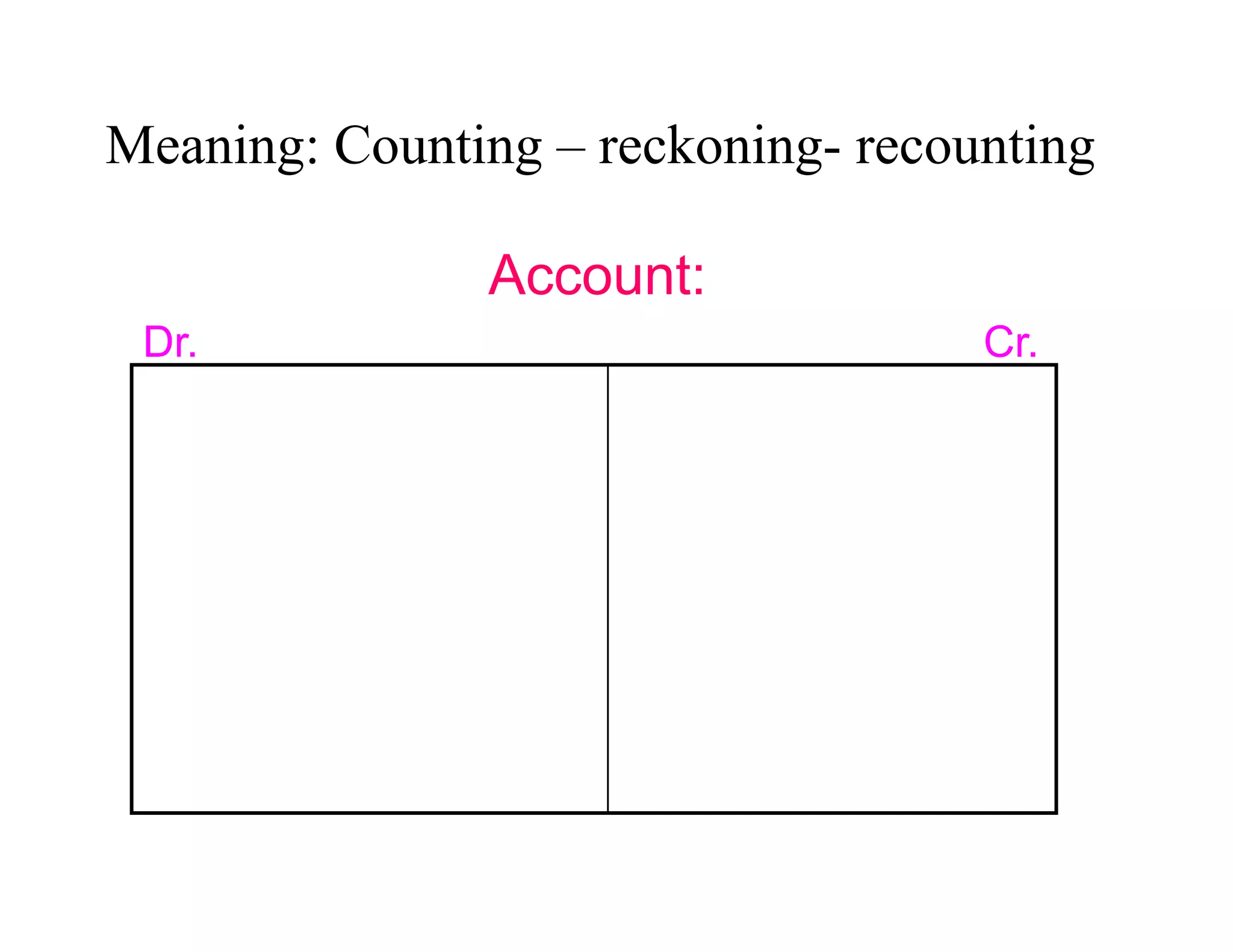
Meaning: Counting – reckoning- recounting

               Account:
 Dr.                                Cr.
Book Keeping Vs. Accounting
 Book keeping is the systematic recording of
 financial and economic transactions, while as
 accounting is the analysis and interpretation
 of book keeping records.
Definition: Accounting is the art of
recording, classifying and summarizing in a
significant manner and in terms of money
transactions and events which are, in part at
least, of a financial character, and
interpreting the results thereof.
Characteristics/ attributes:
  Only financial transactions/events
   Records should reflect the importance of
the transactions are recorded
   It should be recorded in such a way so
that the end users are able to understand it.
Basic Assumptions of Accounting:

 Accounting entity assumption
 Monetary unit assumption
 Accounting period assumption and
 Going concern assumption
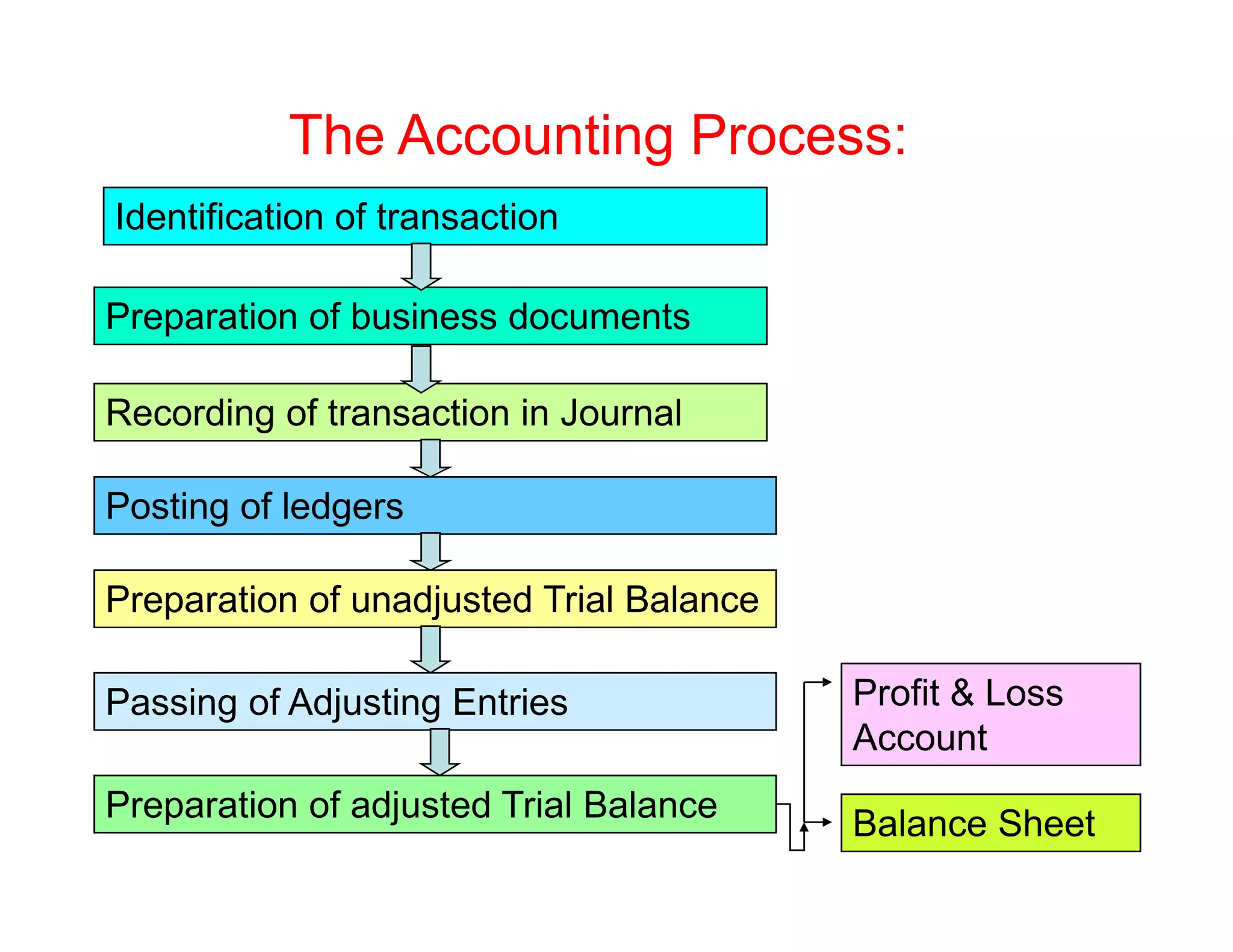
The Accounting Process:
Identification of transaction

Preparation of business documents

Recording of transaction in Journal

Posting of ledgers

Preparation of unadjusted Trial Balance

Passing of Adjusting Entries              Profit & Loss
                                          Account
Preparation of adjusted Trial Balance
                                          Balance Sheet
The Indian Accounting standards,
International Accounting Standards,
forming the theoretical base of
accountancy, and the Double Entry
Bookkeeping for recording the
transactions provide the practical base of
the system.
Financial Statements/ Final Accounts:
 Manufacturing Account/ Trading Account
  Profit and Loss Account and
  Balance Sheet
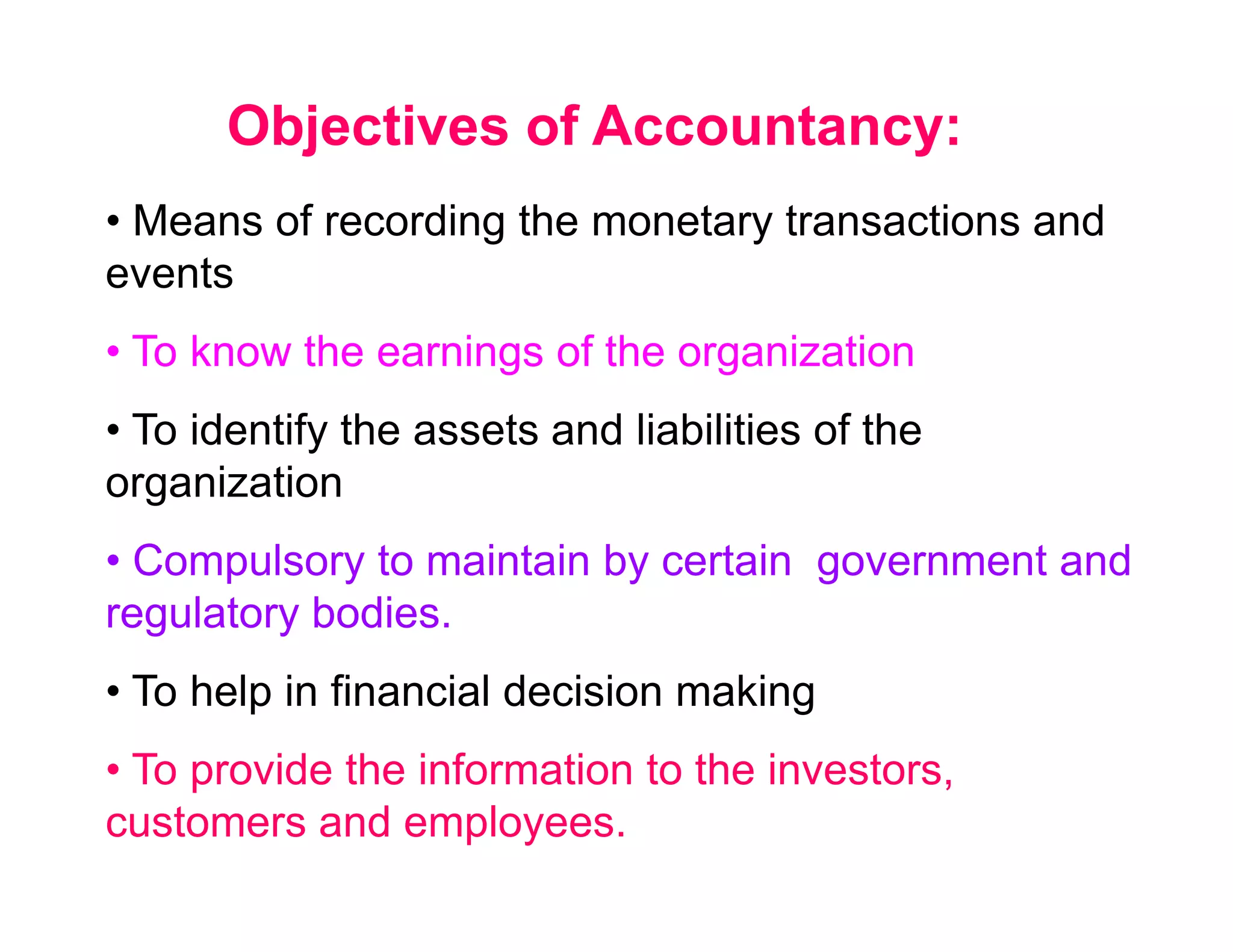
Objectives of Accountancy:
• Means of recording the monetary transactions and
events
• To know the earnings of the organization
• To identify the assets and liabilities of the
organization
• Compulsory to maintain by certain government and
regulatory bodies.
• To help in financial decision making
• To provide the information to the investors,
customers and employees.
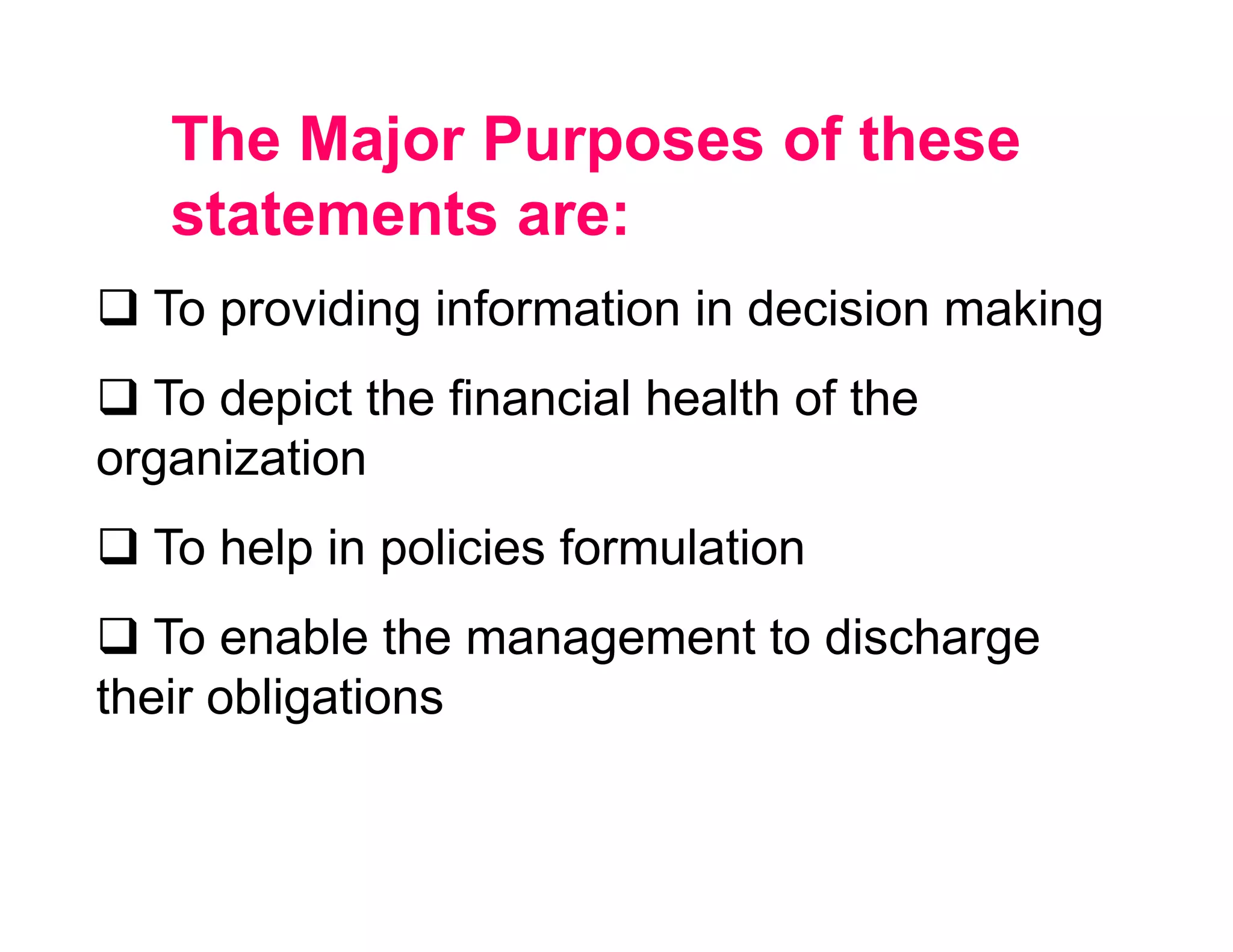
The Major Purposes of these
   statements are:
  To providing information in decision making
  To depict the financial health of the
organization
  To help in policies formulation
   To enable the management to discharge
their obligations
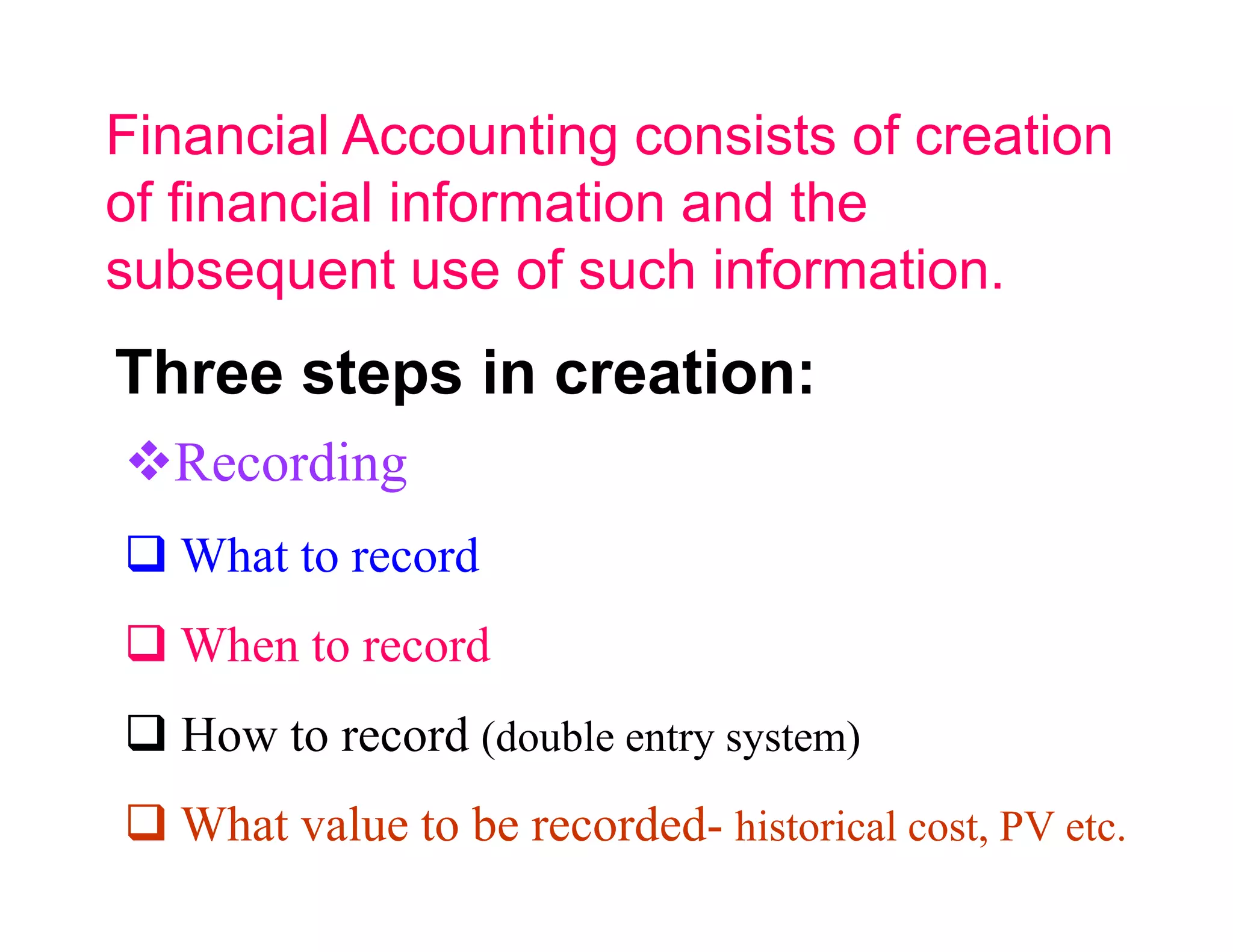
Financial Accounting consists of creation
of financial information and the
subsequent use of such information.
Three steps in creation:
  Recording
   What to record
   When to record
   How to record (double entry system)
   What value to be recorded- historical cost, PV etc.
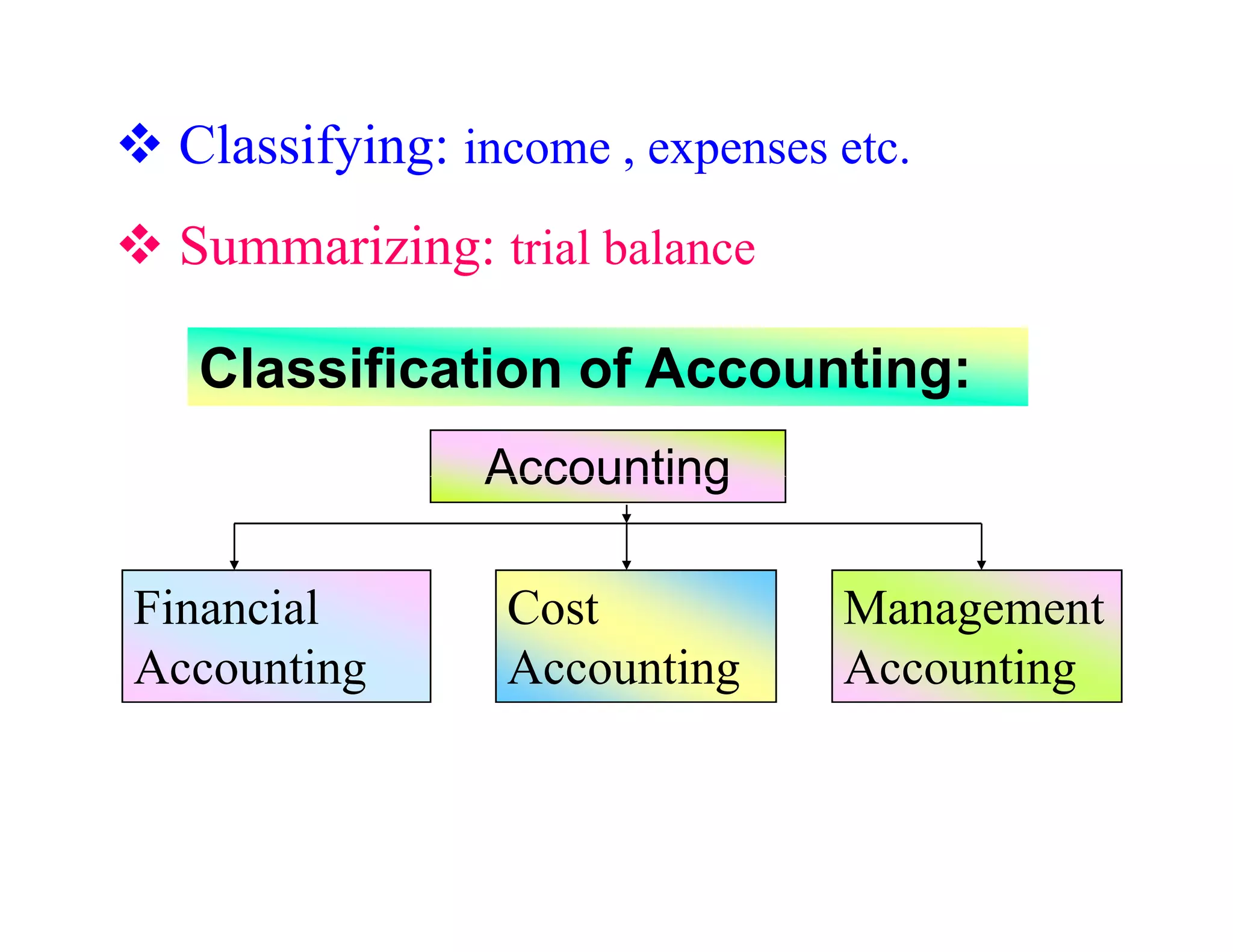
Classifying: income , expenses etc.
 Summarizing: trial balance

  Classification of Accounting:
               Accounting

Financial       Cost            Management
Accounting      Accounting      Accounting
Major Financial Statements:

 Profit and Loss Account
 Balance Sheet
 Cash Flow Statement
Financial Analysis is Meant for whom:

Usually it is carried out to study the
financial position of the organization from
the point of view of:

 o Shareholders
 o Debentures holders
 o Banks (for working capital)
o Financial Institutions (like State Finance
Corporation, IDBI, Etc.)

o Statutory Agencies (Stock exchanges,
Registrar of Companies)

o Others ( potential buyers of the
organization in takeovers or mergers)
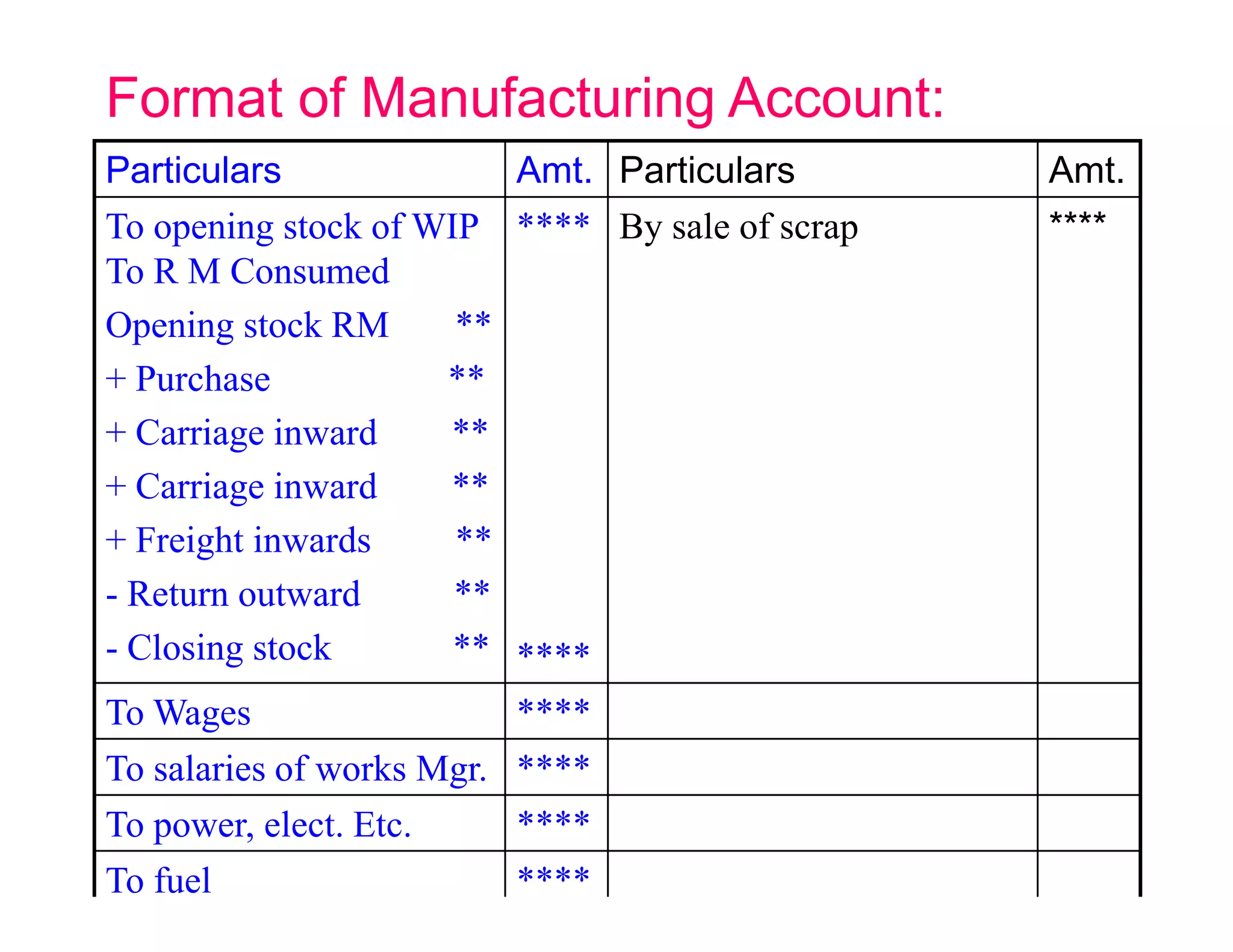
Format of Manufacturing Account:
Particulars               Amt. Particulars      Amt.
To opening stock of WIP **** By sale of scrap   ****
To R M Consumed
Opening stock RM      **
+ Purchase            **
+ Carriage inward     **
+ Freight inwards     **
- Return outward      **
- Closing stock       ** ****
To Wages                  ****
To salaries of works Mgr. ****
To power, elect. Etc.     ****
To fuel                 ****
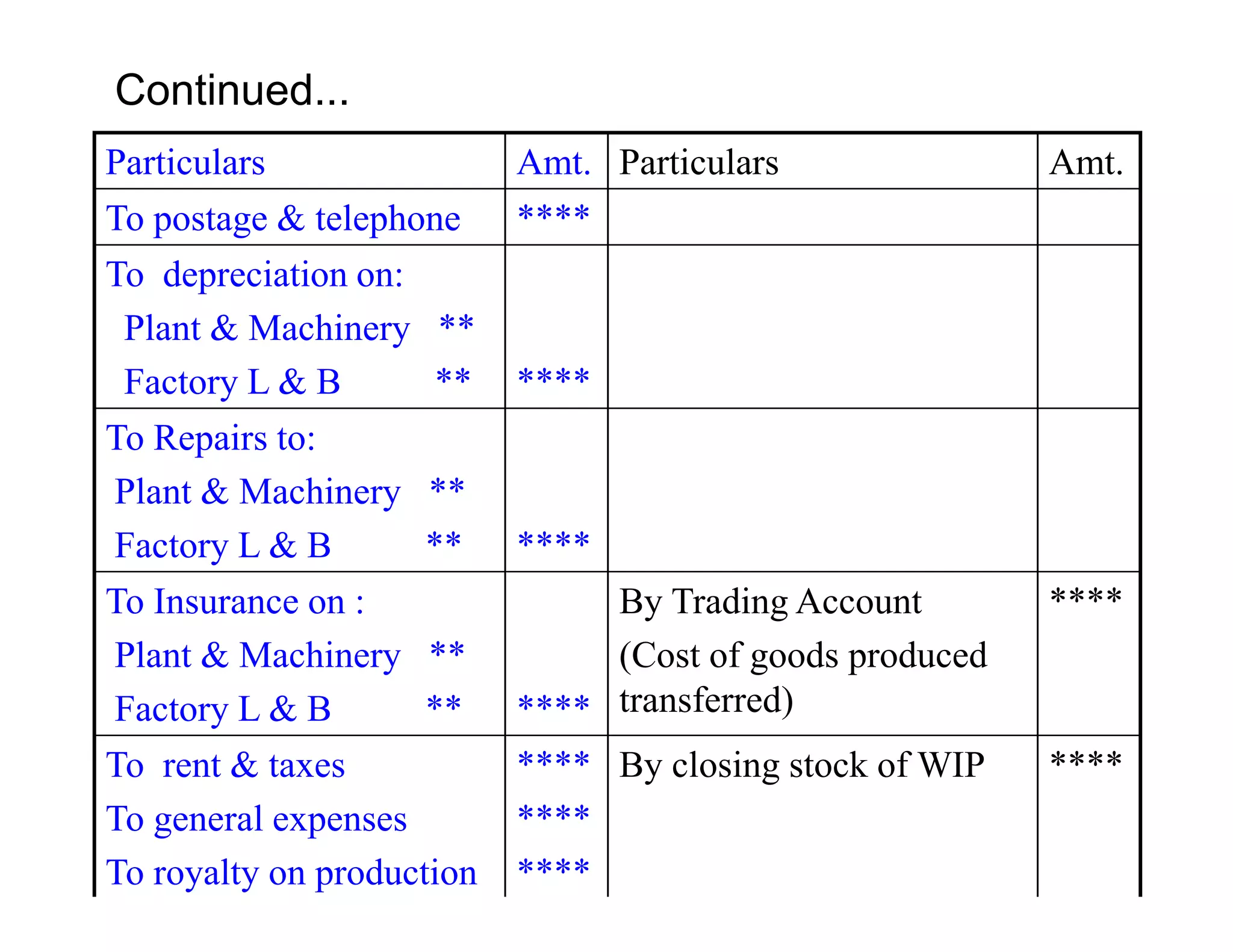
Continued...
Particulars                Amt. Particulars               Amt.
To postage & telephone     ****
To depreciation on:
 Plant & Machinery **
 Factory L & B      **     ****
To Repairs to:
Plant & Machinery   **
Factory L & B       **     ****
To Insurance on :               By Trading Account        ****
Plant & Machinery   **          (Cost of goods produced
Factory L & B       **     **** transferred)
To rent & taxes            **** By closing stock of WIP   ****
To general expenses        ****
To royalty on production   ****
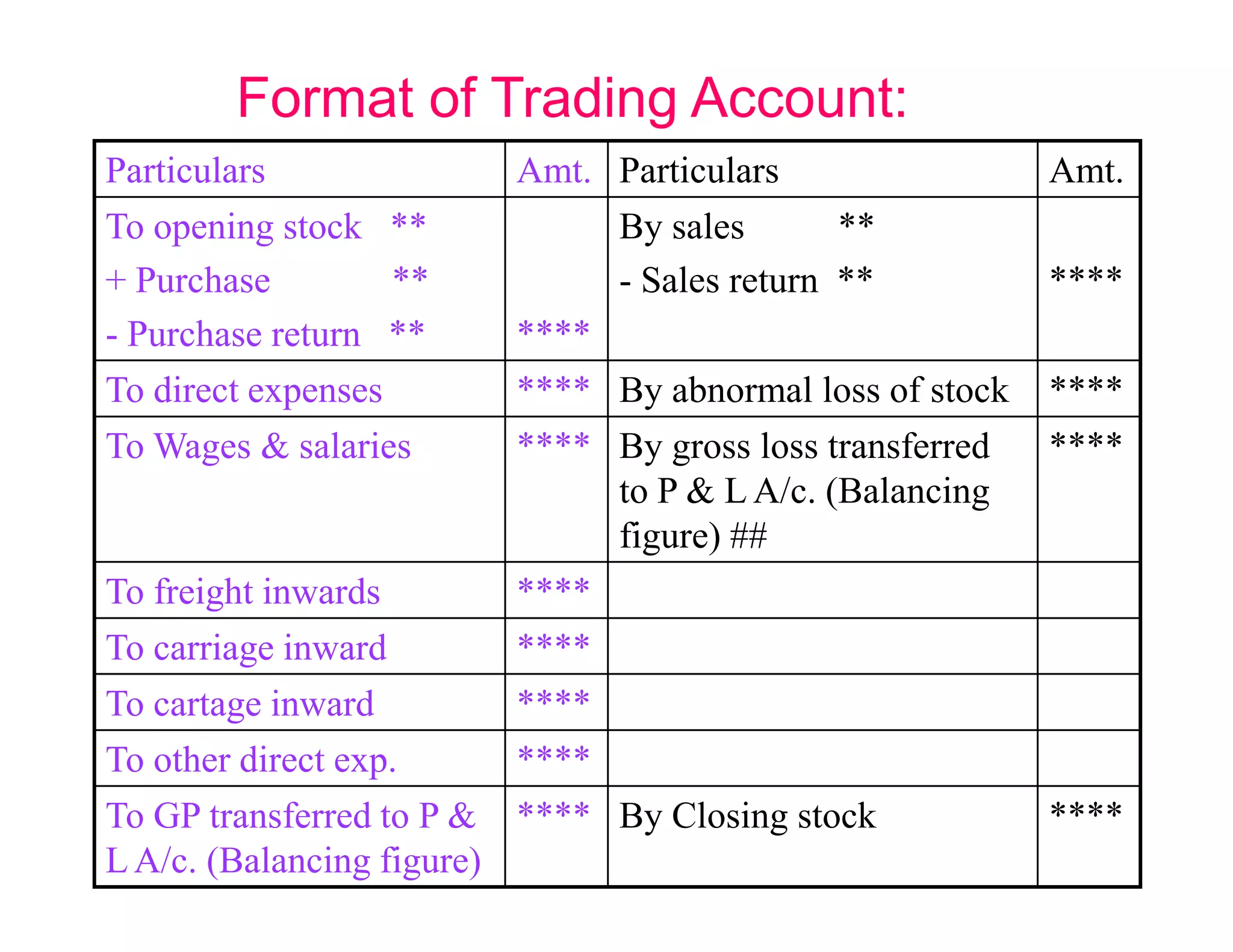
Format of Trading Account:
Particulars             Amt. Particulars                 Amt.
To opening stock **           By sales       **
+ Purchase         **         - Sales return **          ****
- Purchase return **    ****
To direct expenses      **** By abnormal loss of stock   ****
To Wages & salaries     **** By gross loss transferred   ****
                             to P & L A/c. (Balancing
                             figure) ##
To freight inwards      ****
To carriage inward      ****
To cartage inward       ****
To other direct exp.      ****
To GP transferred to P & **** By Closing stock           ****
L A/c. (Balancing figure)
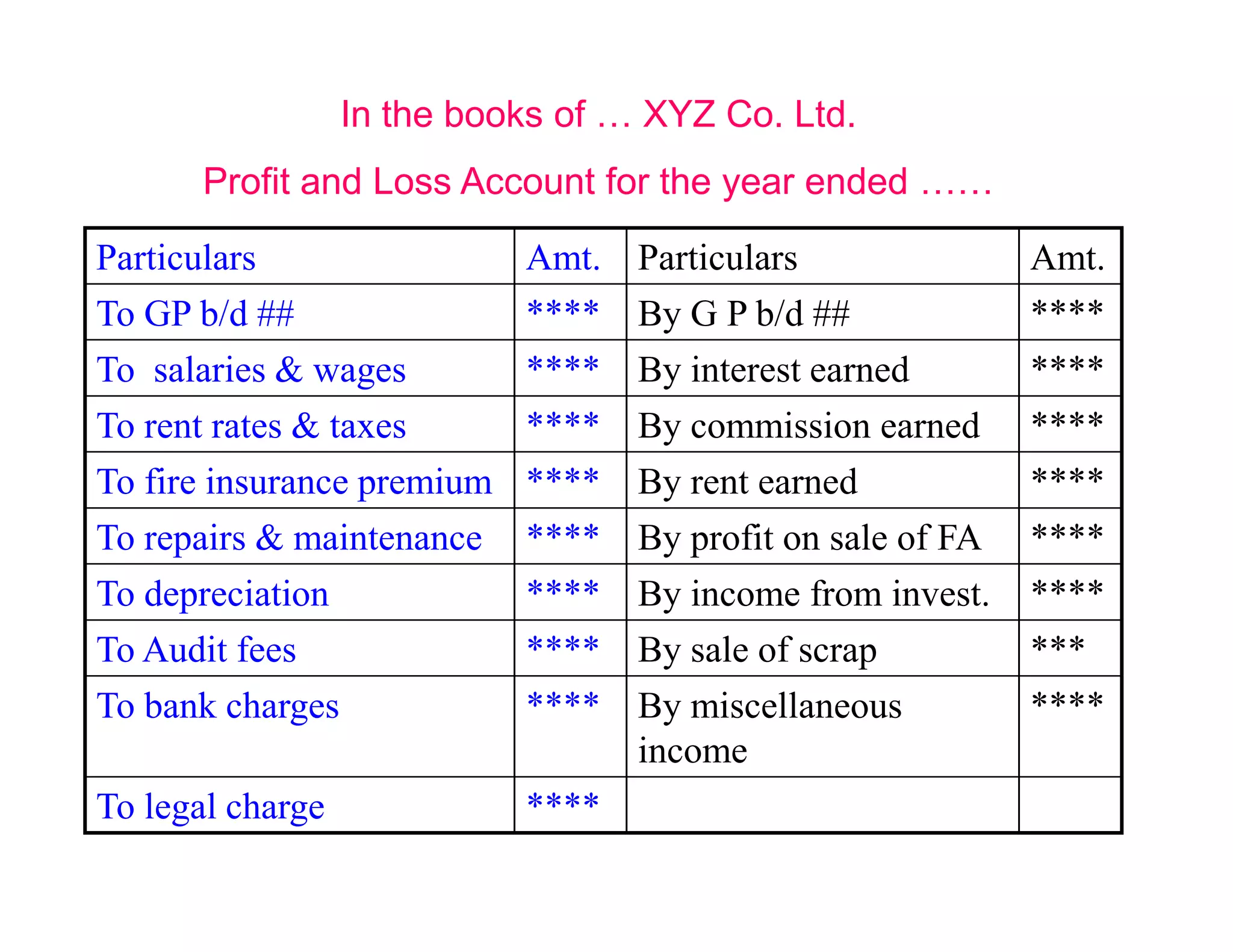
In the books of … XYZ Co. Ltd.
       Profit and Loss Account for the year ended ……

Particulars                 Amt. Particulars                 Amt.
To GP b/d ##                ****   By G P b/d ##             ****
To salaries & wages         ****   By interest earned        ****
To rent rates & taxes       ****   By commission earned      ****
To fire insurance premium   ****   By rent earned            ****
To repairs & maintenance    ****   By profit on sale of FA   ****
To depreciation             ****   By income from invest.    ****
To Audit fees               ****   By sale of scrap          ***
To bank charges             ****   By miscellaneous          ****
                                   income
To legal charge             ****
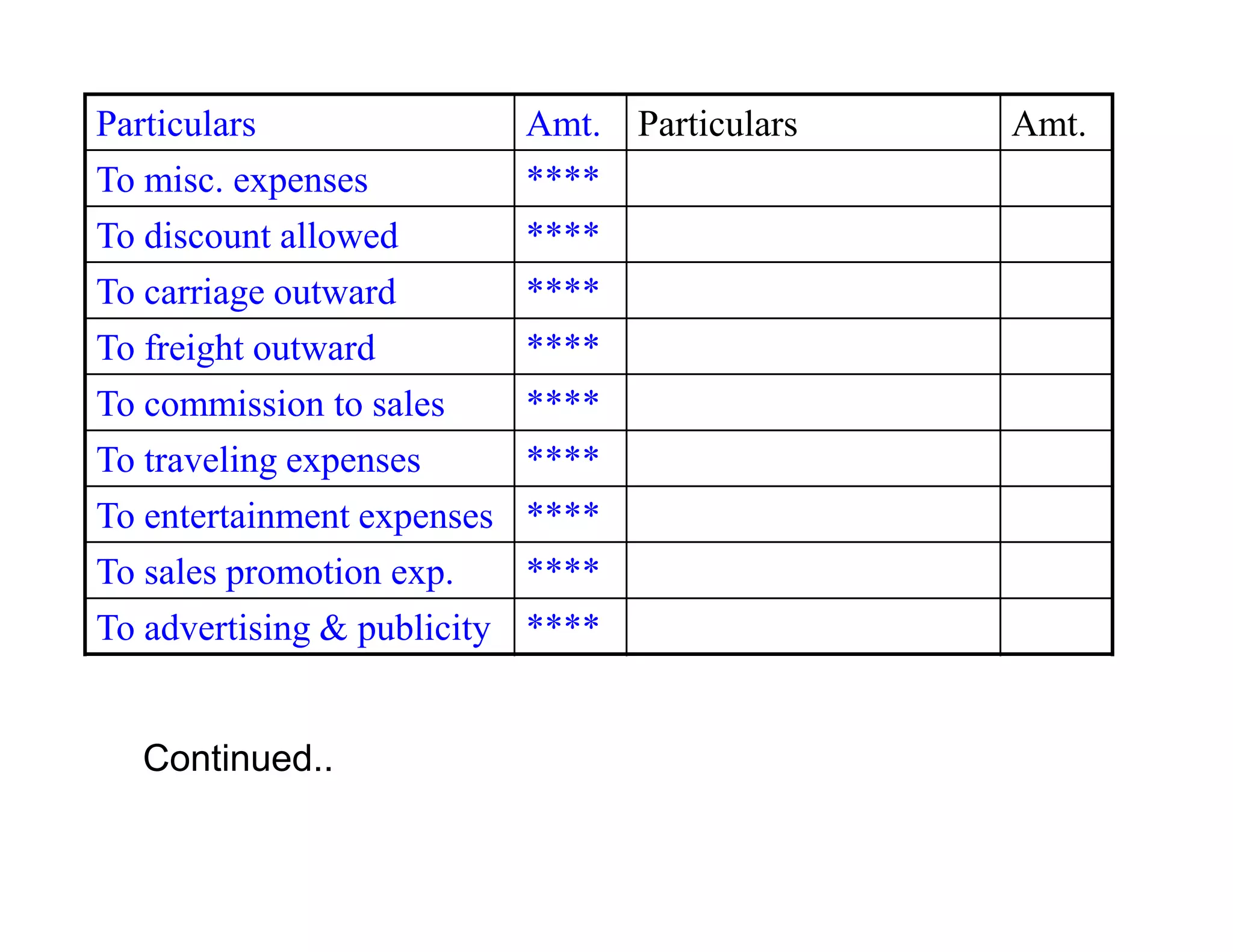
Particulars               Amt. Particulars   Amt.
To misc. expenses         ****
To discount allowed       ****
To carriage outward       ****
To freight outward        ****
To commission to sales    ****
To traveling expenses     ****
To entertainment expenses ****
To sales promotion exp.    ****
To advertising & publicity ****


  Continued..
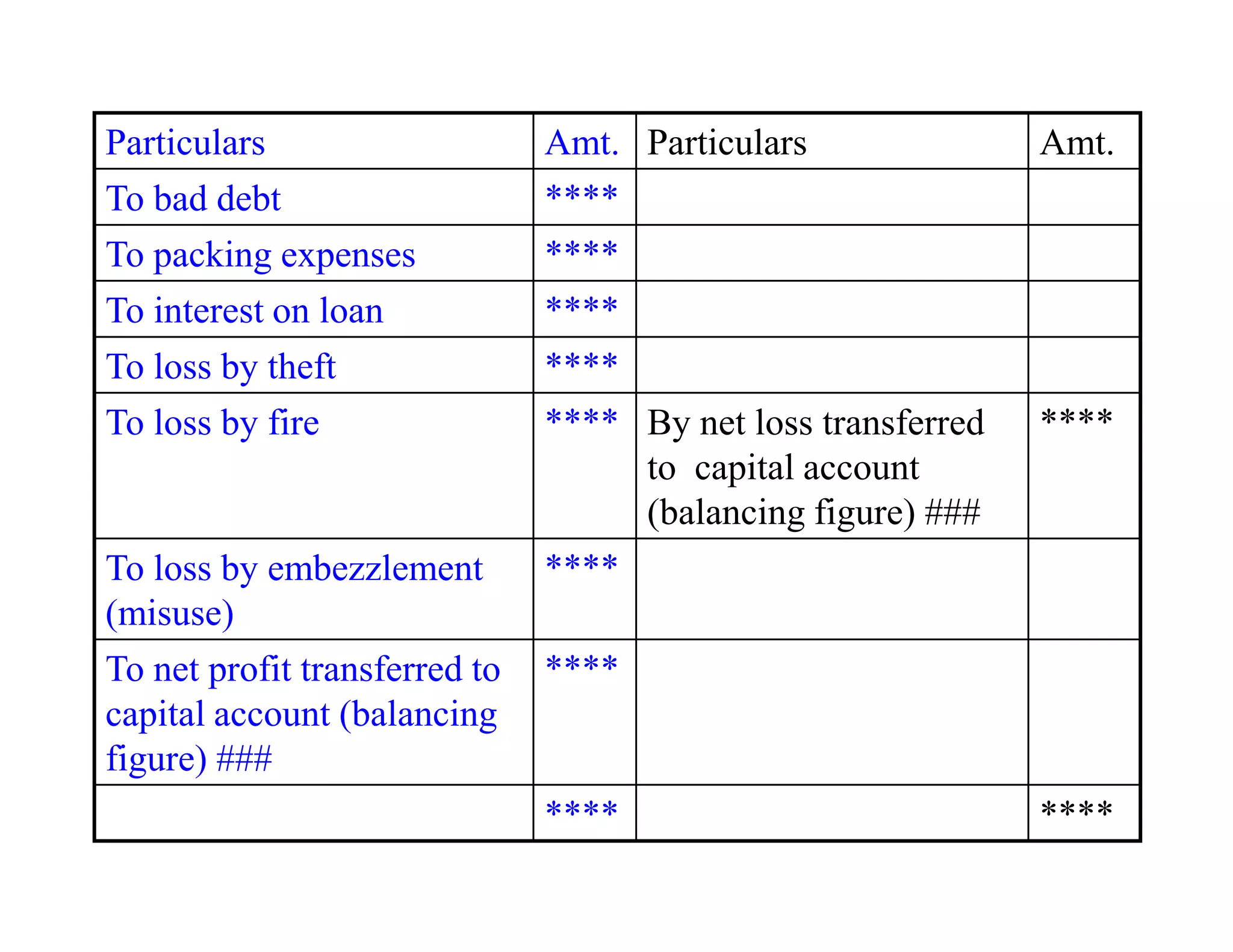
Particulars                    Amt. Particulars               Amt.
To bad debt                    ****
To packing expenses            ****
To interest on loan            ****
To loss by theft               ****
To loss by fire                **** By net loss transferred   ****
                                    to capital account
                                    (balancing figure) ###
To loss by embezzlement        ****
(misuse)
To net profit transferred to   ****
capital account (balancing
figure) ###
                               ****                           ****
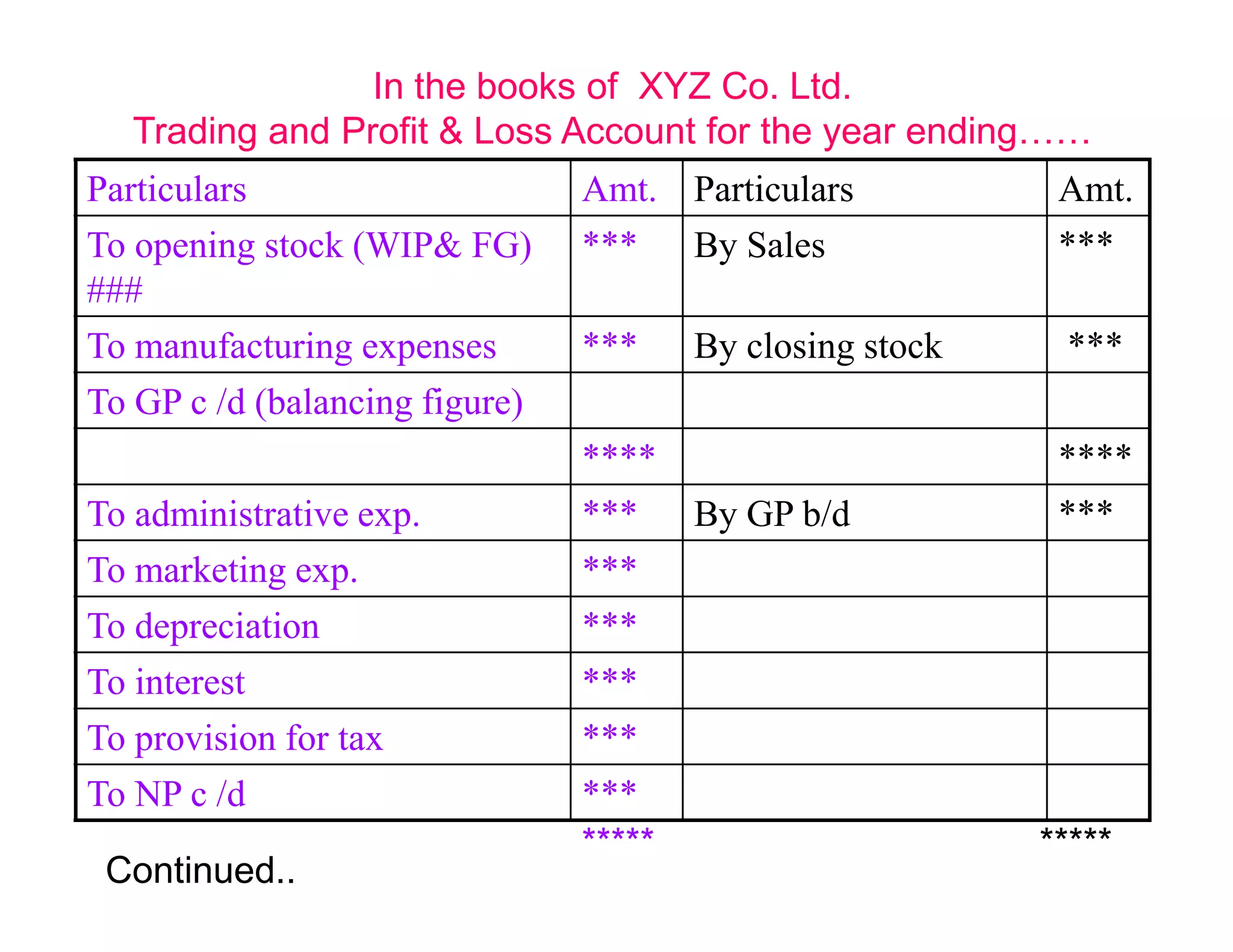
In the books of XYZ Co. Ltd.
   Trading and Profit & Loss Account for the year ending……
Particulars                     Amt. Particulars            Amt.
To opening stock (WIP& FG)      *** By Sales                ***
###
To manufacturing expenses       ***     By closing stock    ***
To GP c /d (balancing figure)
                                ****                        ****
To administrative exp.          *** By GP b/d               ***
To marketing exp.               ***
To depreciation                 ***
To interest                     ***
To provision for tax            ***
To NP c /d                      ***
                                *****                      *****
 Continued..
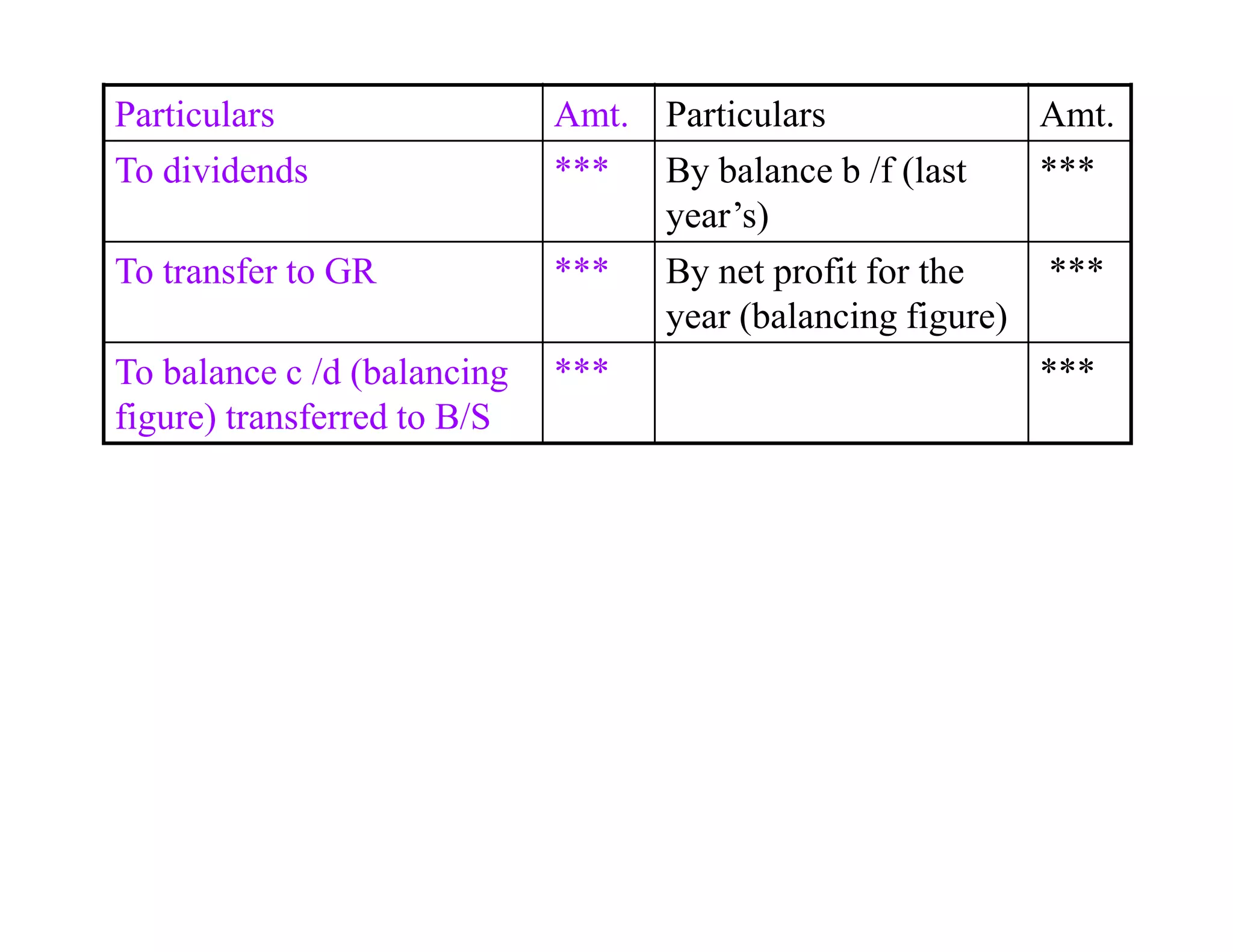
Particulars                  Amt. Particulars             Amt.
To dividends                 *** By balance b /f (last    ***
                                  year’s)
To transfer to GR            *** By net profit for the    ***
                                  year (balancing figure)
To balance c /d (balancing   ***                          ***
figure) transferred to B/S
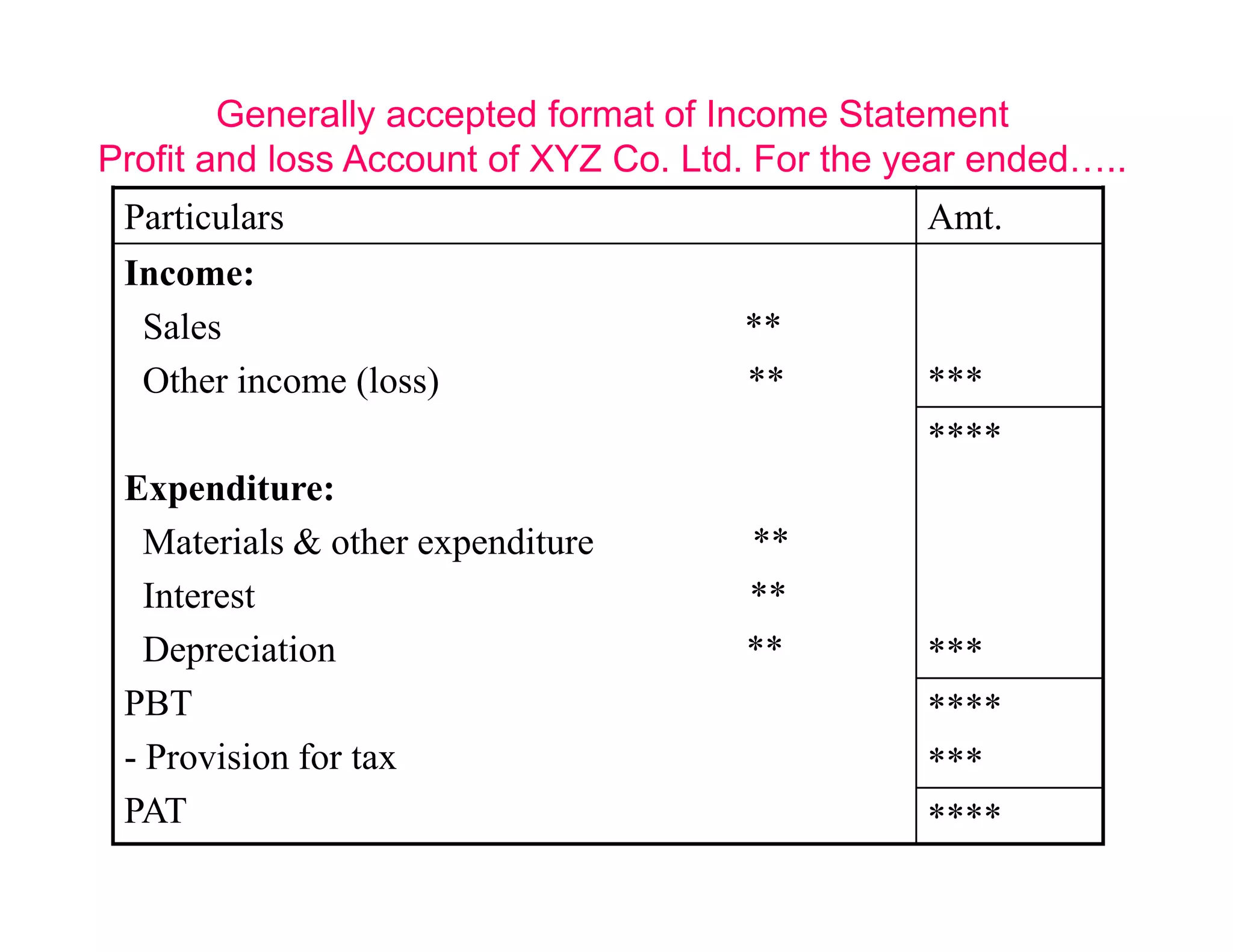
Generally accepted format of Income Statement
Profit and loss Account of XYZ Co. Ltd. For the year ended…..
 Particulars                                     Amt.
 Income:
  Sales                               **
  Other income (loss)                 **         ***
                                                 ****
 Expenditure:
   Materials & other expenditure      **
   Interest                           **
   Depreciation                       **         ***
 PBT                                             ****
 - Provision for tax                             ***
 PAT                                             ****
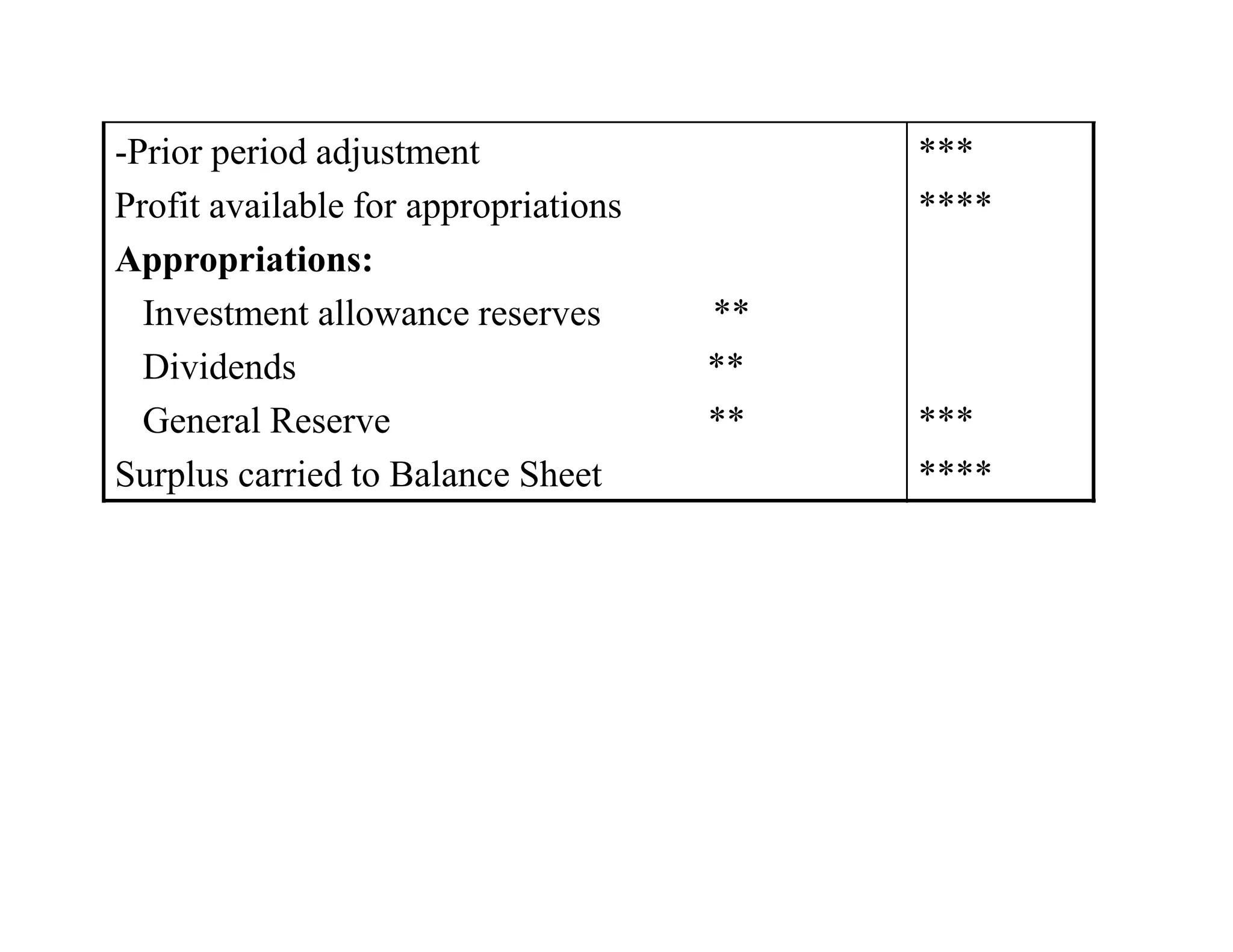
-Prior period adjustment                   ***
Profit available for appropriations        ****
Appropriations:
  Investment allowance reserves       **
  Dividends                           **
  General Reserve                     **   ***
Surplus carried to Balance Sheet           ****
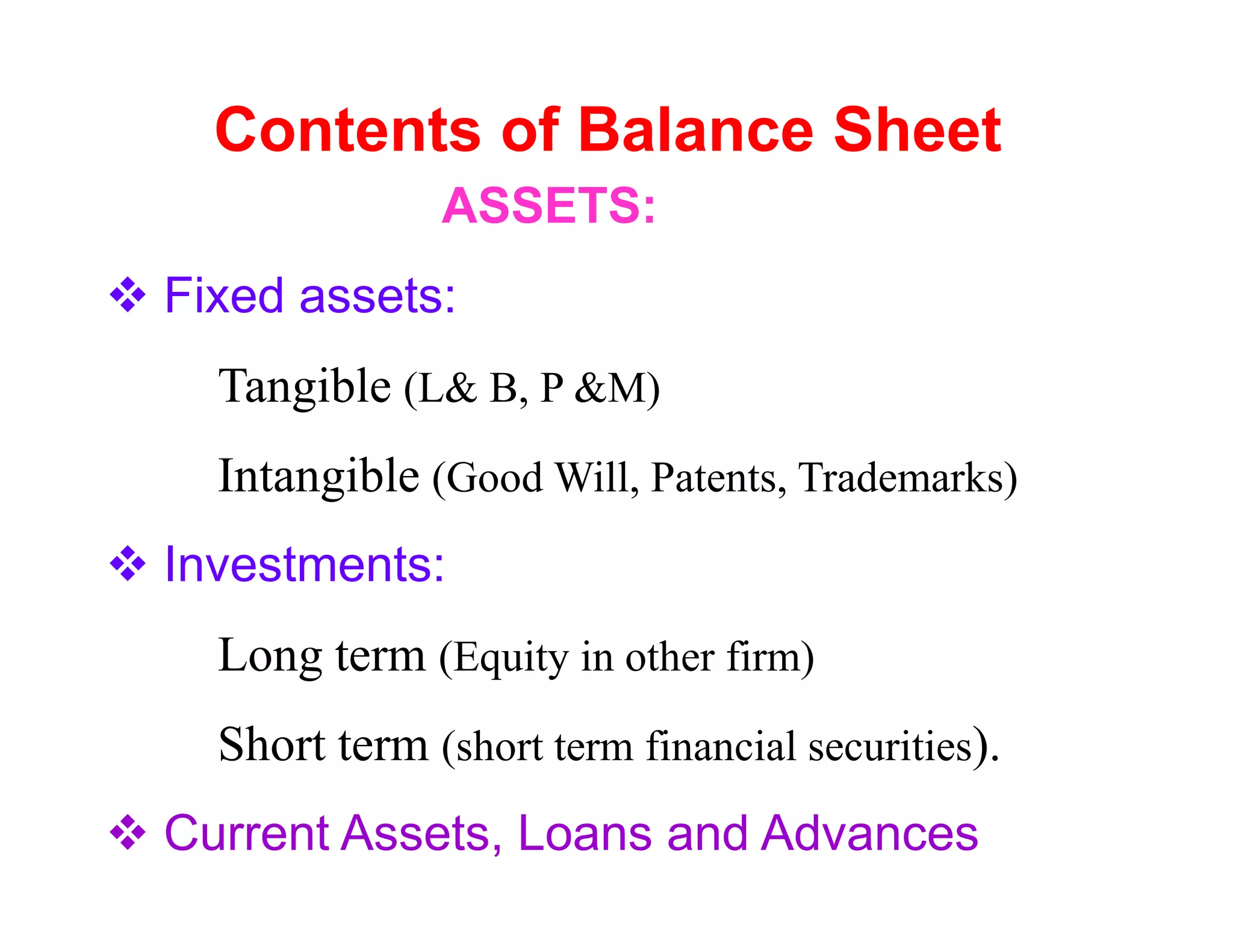
Contents of Balance Sheet
              ASSETS:
Fixed assets:
  Tangible (L& B, P &M)
  Intangible (Good Will, Patents, Trademarks)
Investments:
  Long term (Equity in other firm)
  Short term (short term financial securities).
Current Assets, Loans and Advances
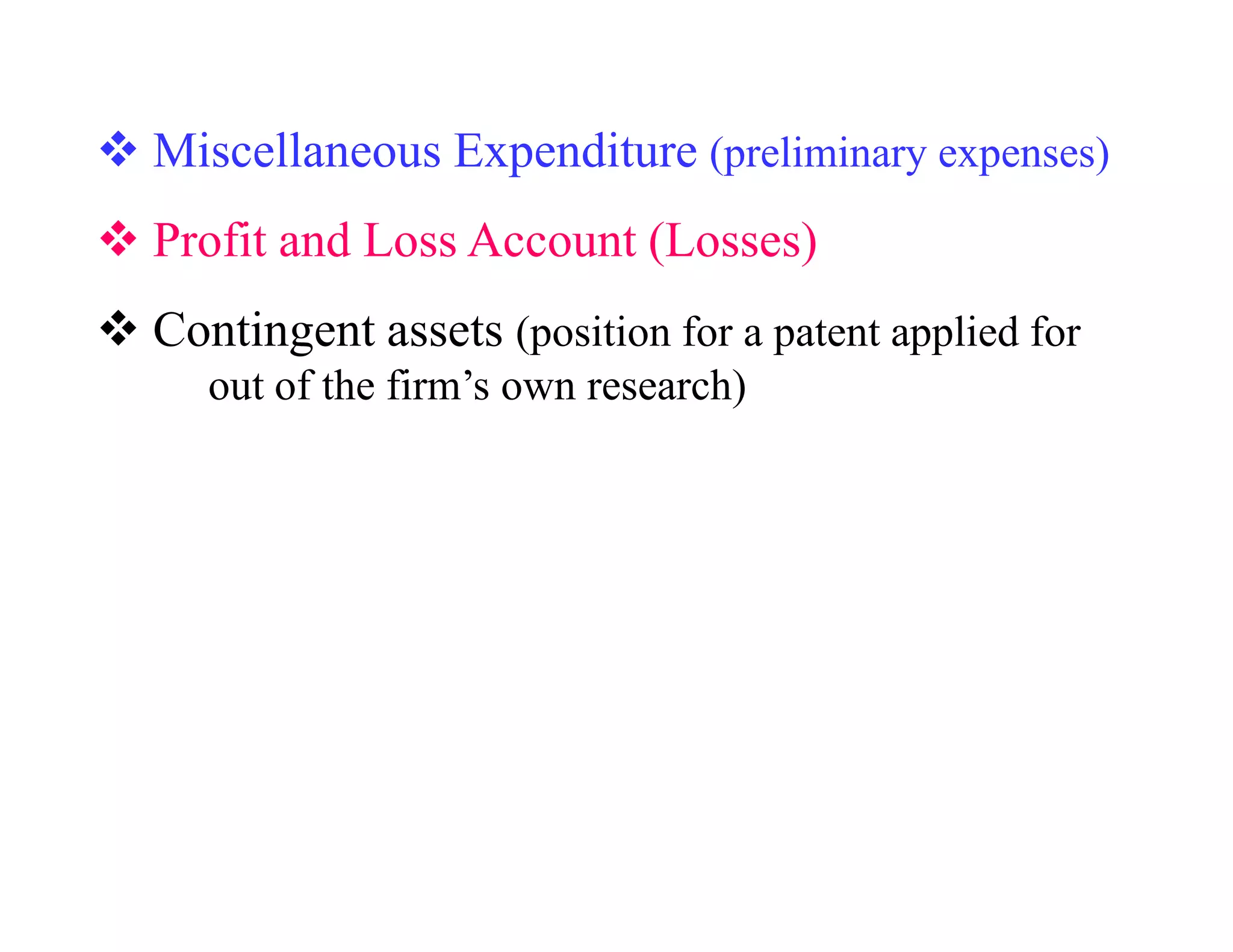
Miscellaneous Expenditure (preliminary expenses)
Profit and Loss Account (Losses)
Contingent assets (position for a patent applied for
   out of the firm’s own research)
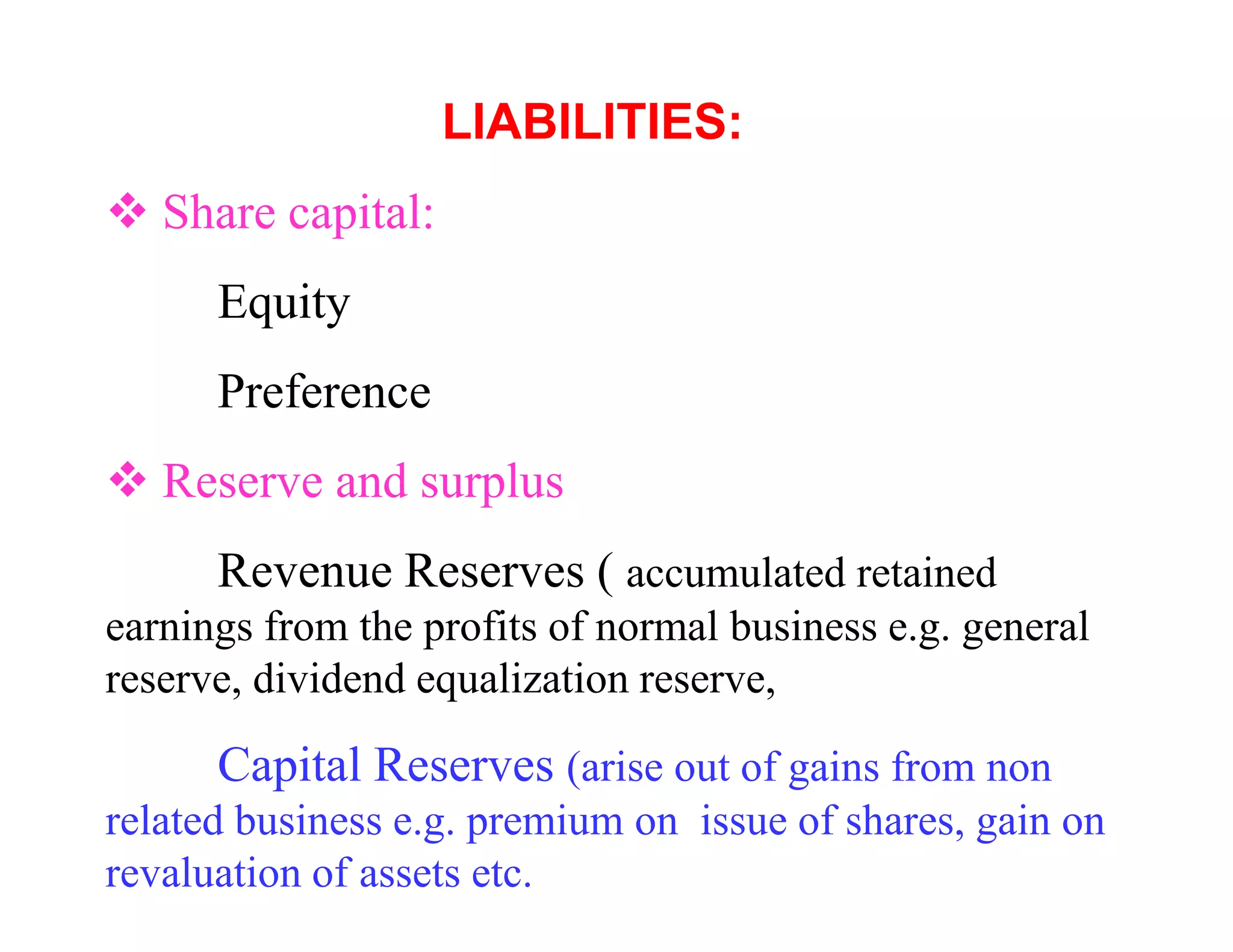
LIABILITIES:
   Share capital:
      Equity
      Preference
   Reserve and surplus
      Revenue Reserves ( accumulated retained
earnings from the profits of normal business e.g. general
reserve, dividend equalization reserve,

      Capital Reserves (arise out of gains from non
related business e.g. premium on issue of shares, gain on
revaluation of assets etc.
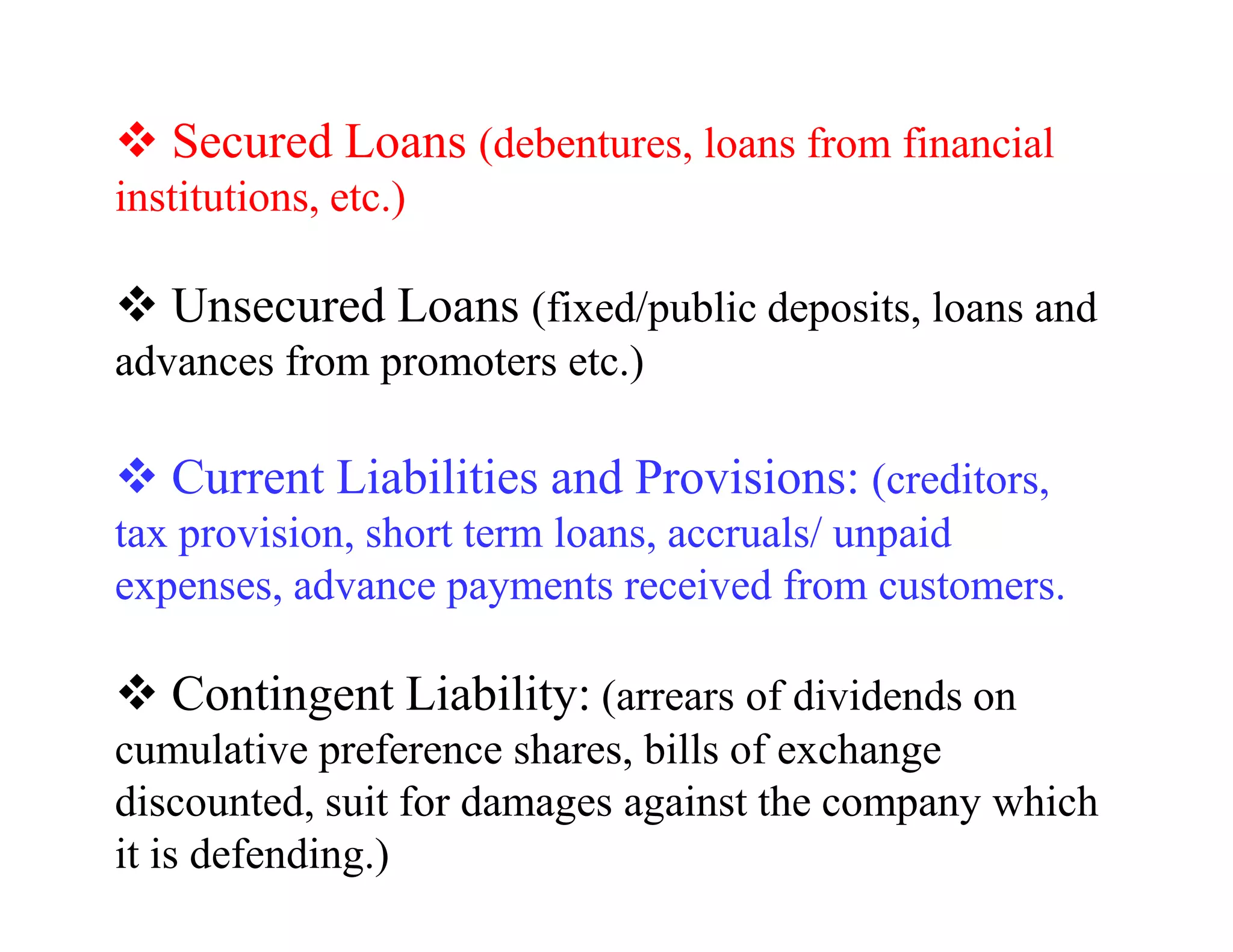
Secured Loans (debentures, loans from financial
institutions, etc.)

   Unsecured Loans (fixed/public deposits, loans and
advances from promoters etc.)

   Current Liabilities and Provisions: (creditors,
tax provision, short term loans, accruals/ unpaid
expenses, advance payments received from customers.

   Contingent Liability: (arrears of dividends on
cumulative preference shares, bills of exchange
discounted, suit for damages against the company which
it is defending.)
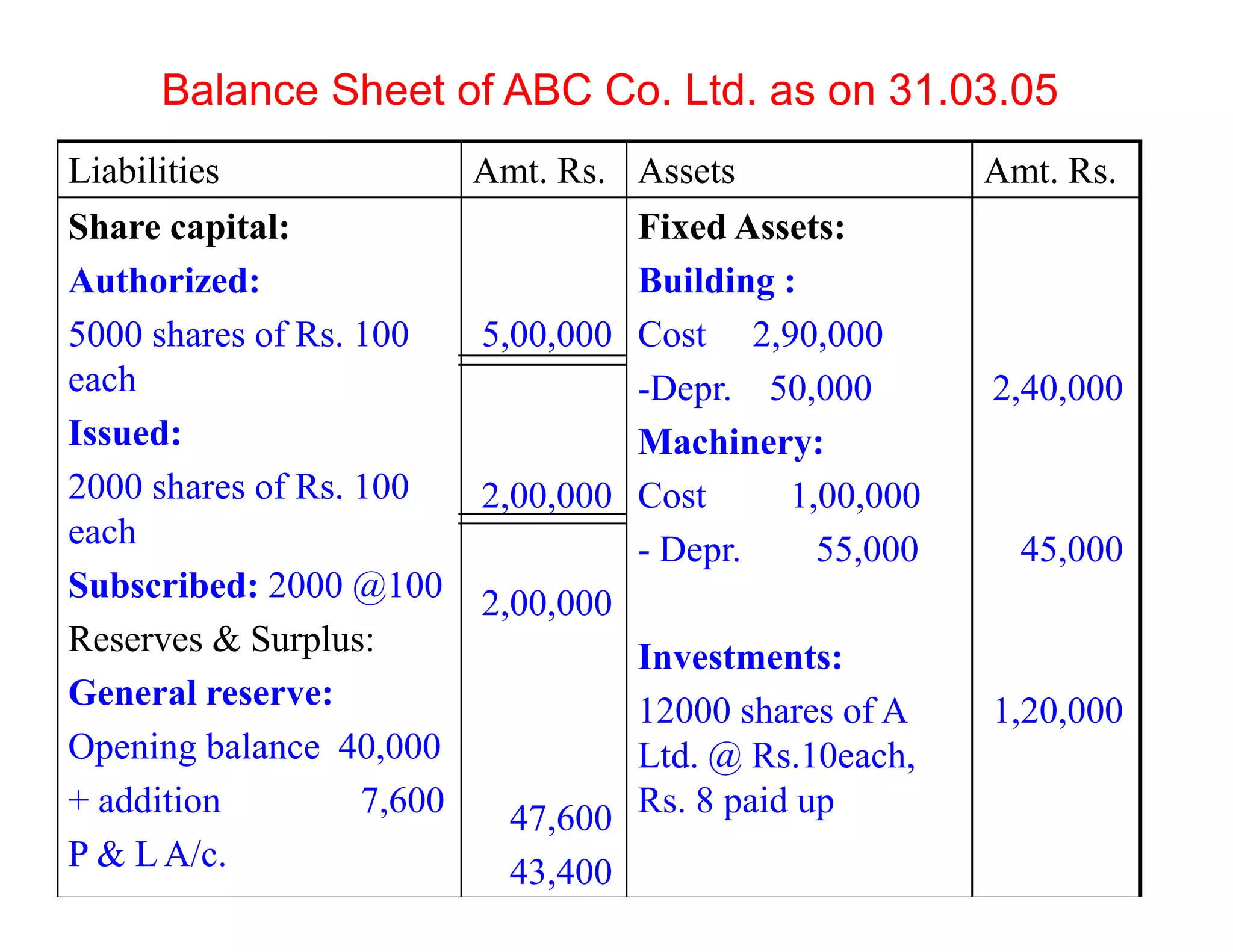
Balance Sheet of ABC Co. Ltd. as on 31.03.05
Liabilities                Amt. Rs. Assets               Amt. Rs.
Share capital:                      Fixed Assets:
Authorized:                         Building :
5000 shares of Rs. 100     5,00,000 Cost 2,90,000
each                                -Depr. 50,000        2,40,000
Issued:                             Machinery:
2000 shares of Rs. 100     2,00,000 Cost      1,00,000
each                                - Depr.     55,000     45,000
Subscribed: 2000 @100      2,00,000
Reserves & Surplus:                 Investments:
General reserve:                    12000 shares of A    1,20,000
Opening balance 40,000              Ltd. @ Rs.10each,
+ addition         7,600     47,600 Rs. 8 paid up
P & L A/c.                   43,400
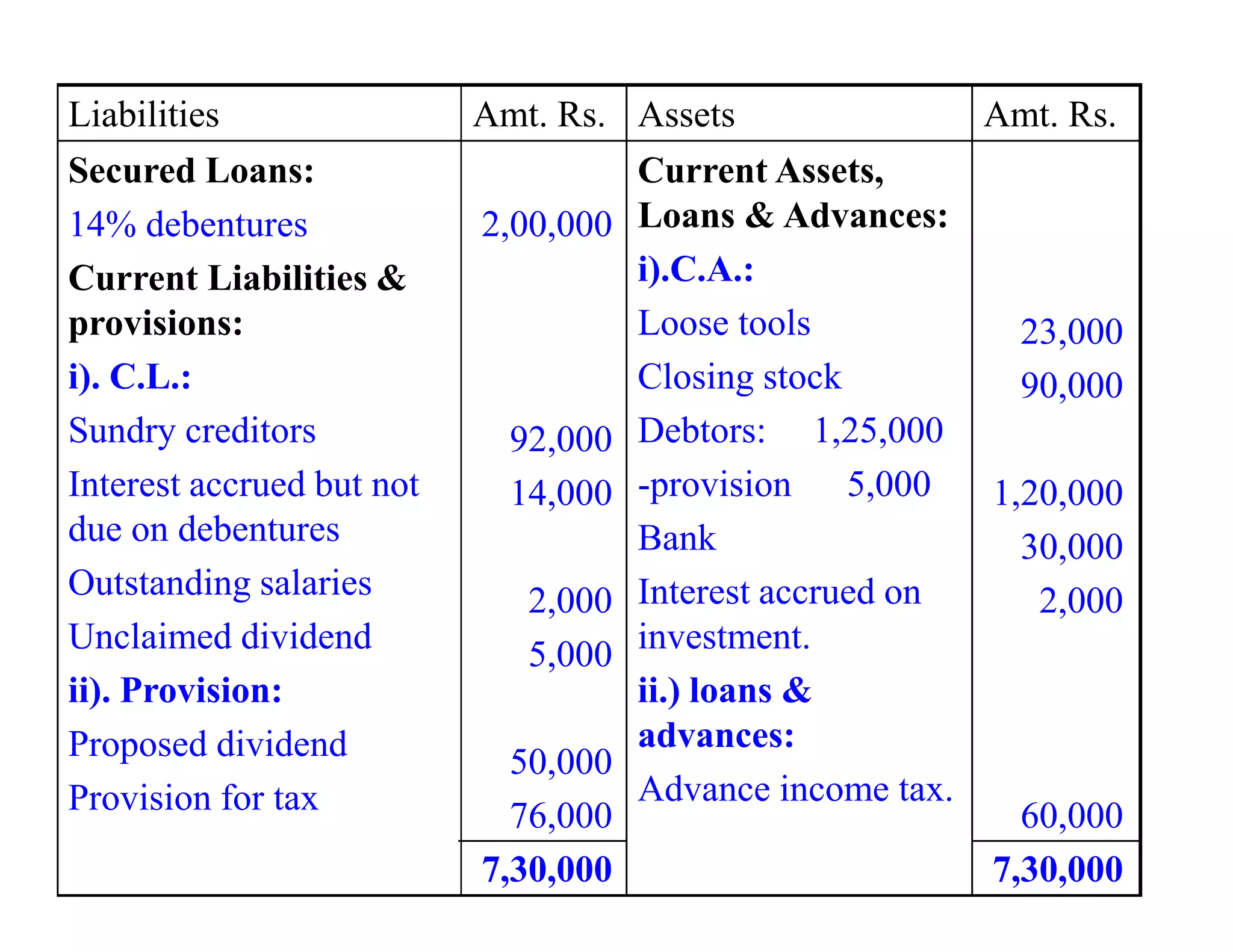
Liabilities                Amt. Rs. Assets              Amt. Rs.
Secured Loans:                      Current Assets,
14% debentures             2,00,000 Loans & Advances:
Current Liabilities &               i).C.A.:
provisions:                         Loose tools           23,000
i). C.L.:                           Closing stock         90,000
Sundry creditors             92,000 Debtors: 1,25,000
Interest accrued but not     14,000 -provision 5,000    1,20,000
due on debentures                   Bank                  30,000
Outstanding salaries          2,000 Interest accrued on    2,000
Unclaimed dividend            5,000 investment.
ii). Provision:                     ii.) loans &
Proposed dividend                   advances:
                             50,000
Provision for tax                   Advance income tax.
                             76,000                       60,000
                           7,30,000                     7,30,000
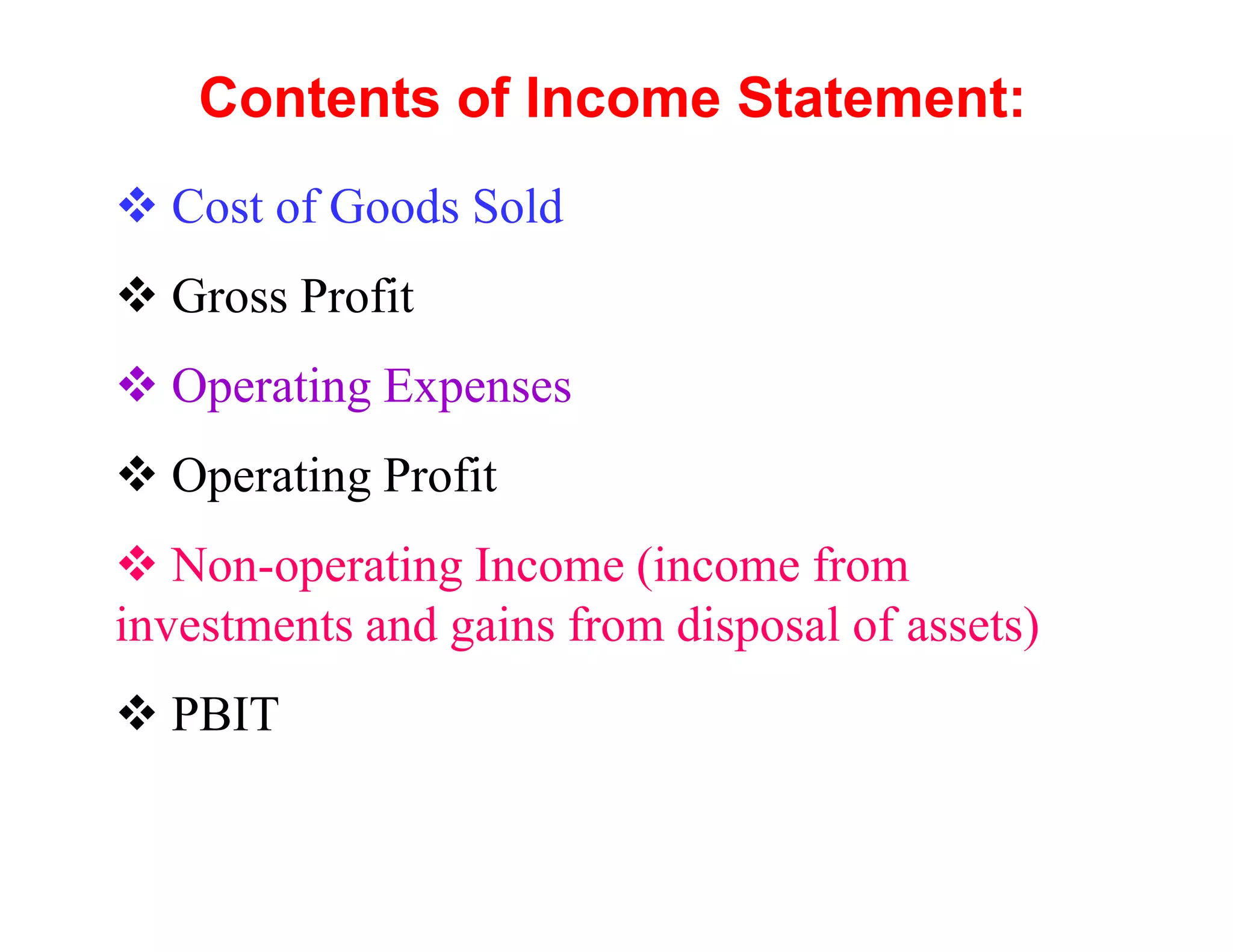
Contents of Income Statement:
  Cost of Goods Sold
  Gross Profit
  Operating Expenses
  Operating Profit
   Non-operating Income (income from
investments and gains from disposal of assets)
  PBIT
Interest

PBT

Tax

PAT

Dividends

Retained Earnings
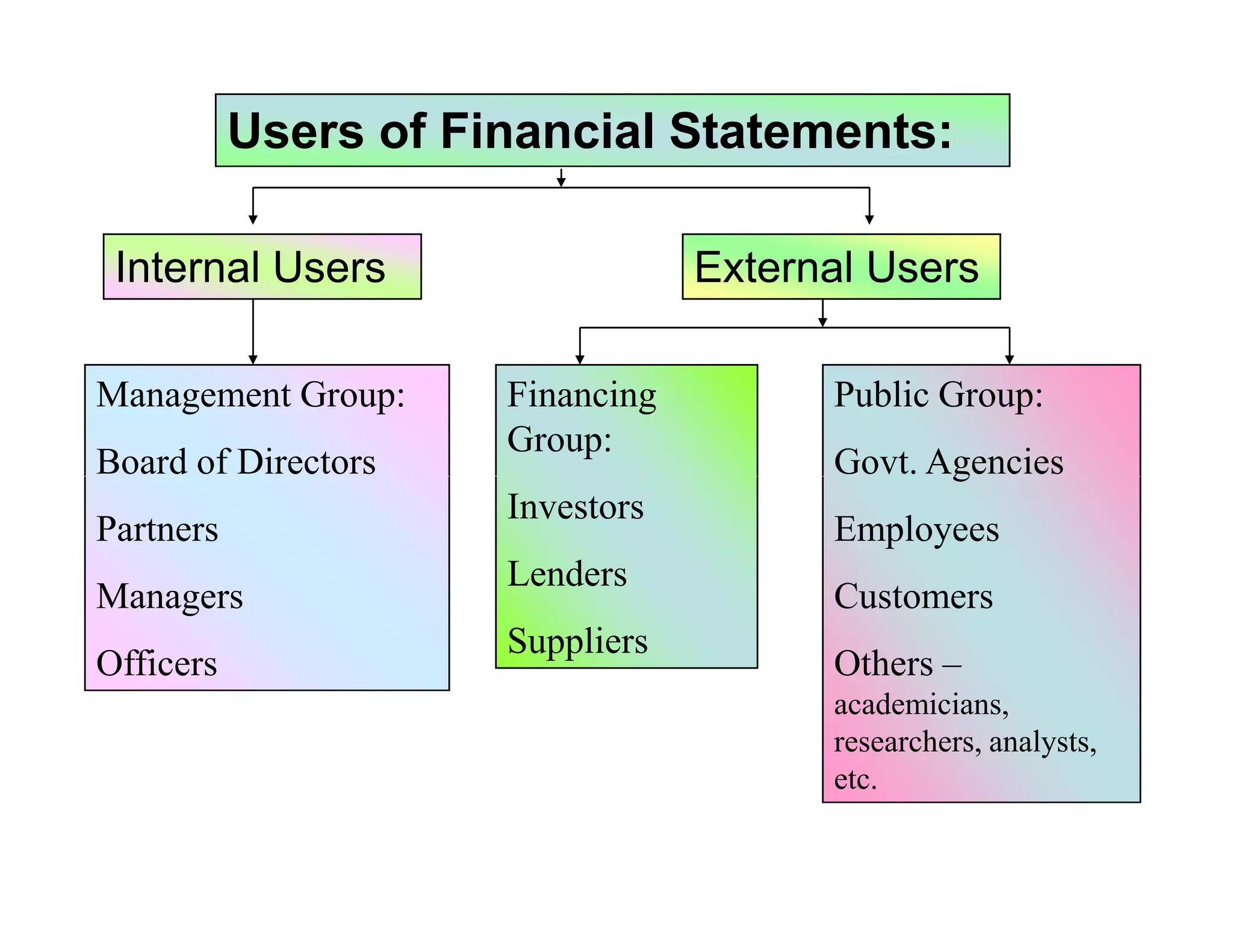
Users of Financial Statements:

 Internal Users                   External Users

Management Group:     Financing         Public Group:
                      Group:
Board of Directors                      Govt. Agencies
                      Investors
Partners                                Employees
                      Lenders
Managers                                Customers
                      Suppliers
Officers                                Others –
                                        academicians,
                                        researchers, analysts,
                                        etc.
Generally Accepted Accounting
Principles (GAAP), Conventions and
Concepts:
Accounting concepts are ideas and assumptions
which are fundamental to accounting practice.
Conventions are based on what is practicable and
based on logical considerations. E.g. dividing a
centimeter into ten equal parts is a convention rather than
a concept.
Generally Accepted Accounting
Principles which are followed in
several countries are as follows:
   Materiality Concept: True and fair preparation. All
relatively relevant items, the knowledge of which might
influence the decision of the users of the financial
statements should be disclosed in the financial statement.
Which information is more relevant than other is largely a
matter of judgment.
Information is material if its misstatement could influence
the economic decisions of user.
Both, quantity and quality of misstatements need to be
considered in determining materiality.
Money Measurement Concept: Only monetary
transactions are recorded and not the events/transactions
which can not be converted in to money e.g. death of the
chairman of the organization.

   Cost Concept: Cost price to be recorded not market
price.

   Time period concept: Income or loss is measured
for a specified interval of time, called the accounting
period.

   Conservatism Principle: It requires that in the
situation of uncertainty and doubt, the business transactions
should be recorded in such a manner that the profits and
assets are not overstated.
Consistency Concept: consistency should be
maintained in evaluating assets.

   Business Entity Concept:
   Going Concern Concept:
  Duality or Accounting Equivalence
Concept: Increase in liability and decrease in assets
represent sources of funds, and vice versa. Owners’
equity + outside liability = Assets.

   Realization Concept:
   Timeliness Principle:
Matching Concept: It is an accrual concept since,
it disregards the timing and the amount of actual cash
inflow or cash outflow and concentrates on the
occurrence of revenue and expenses. If revenue is
recognized on all goods sold during a period, cost of
those goods should also be charged to that period. This
concept calls for adjustments to be made in respect of
prepaid expenses, outstanding expenses, accrued
revenue. It is wrong to recognize revenue on all sales, but
charge expenses only on such sales as are collected in
cash till that date.

Accounting Fundamentals

  • 1.
    Accounting for Managers Introductionto Financial Accounting: Unit- I
  • 2.
    Meaning: Counting –reckoning- recounting Account: Dr. Cr.
  • 3.
    Book Keeping Vs.Accounting Book keeping is the systematic recording of financial and economic transactions, while as accounting is the analysis and interpretation of book keeping records. Definition: Accounting is the art of recording, classifying and summarizing in a significant manner and in terms of money transactions and events which are, in part at least, of a financial character, and interpreting the results thereof.
  • 4.
    Characteristics/ attributes: Only financial transactions/events Records should reflect the importance of the transactions are recorded It should be recorded in such a way so that the end users are able to understand it.
  • 5.
    Basic Assumptions ofAccounting: Accounting entity assumption Monetary unit assumption Accounting period assumption and Going concern assumption
  • 6.
    The Accounting Process: Identificationof transaction Preparation of business documents Recording of transaction in Journal Posting of ledgers Preparation of unadjusted Trial Balance Passing of Adjusting Entries Profit & Loss Account Preparation of adjusted Trial Balance Balance Sheet
  • 7.
    The Indian Accountingstandards, International Accounting Standards, forming the theoretical base of accountancy, and the Double Entry Bookkeeping for recording the transactions provide the practical base of the system.
  • 8.
    Financial Statements/ FinalAccounts: Manufacturing Account/ Trading Account Profit and Loss Account and Balance Sheet
  • 9.
    Objectives of Accountancy: •Means of recording the monetary transactions and events • To know the earnings of the organization • To identify the assets and liabilities of the organization • Compulsory to maintain by certain government and regulatory bodies. • To help in financial decision making • To provide the information to the investors, customers and employees.
  • 10.
    The Major Purposesof these statements are: To providing information in decision making To depict the financial health of the organization To help in policies formulation To enable the management to discharge their obligations
  • 11.
    Financial Accounting consistsof creation of financial information and the subsequent use of such information. Three steps in creation: Recording What to record When to record How to record (double entry system) What value to be recorded- historical cost, PV etc.
  • 12.
    Classifying: income ,expenses etc. Summarizing: trial balance Classification of Accounting: Accounting Financial Cost Management Accounting Accounting Accounting
  • 13.
    Major Financial Statements: Profit and Loss Account Balance Sheet Cash Flow Statement
  • 14.
    Financial Analysis isMeant for whom: Usually it is carried out to study the financial position of the organization from the point of view of: o Shareholders o Debentures holders o Banks (for working capital)
  • 15.
    o Financial Institutions(like State Finance Corporation, IDBI, Etc.) o Statutory Agencies (Stock exchanges, Registrar of Companies) o Others ( potential buyers of the organization in takeovers or mergers)
  • 16.
    Format of ManufacturingAccount: Particulars Amt. Particulars Amt. To opening stock of WIP **** By sale of scrap **** To R M Consumed Opening stock RM ** + Purchase ** + Carriage inward ** + Carriage inward ** + Freight inwards ** - Return outward ** - Closing stock ** **** To Wages **** To salaries of works Mgr. **** To power, elect. Etc. **** To fuel ****
  • 17.
    Continued... Particulars Amt. Particulars Amt. To postage & telephone **** To depreciation on: Plant & Machinery ** Factory L & B ** **** To Repairs to: Plant & Machinery ** Factory L & B ** **** To Insurance on : By Trading Account **** Plant & Machinery ** (Cost of goods produced Factory L & B ** **** transferred) To rent & taxes **** By closing stock of WIP **** To general expenses **** To royalty on production ****
  • 18.
    Format of TradingAccount: Particulars Amt. Particulars Amt. To opening stock ** By sales ** + Purchase ** - Sales return ** **** - Purchase return ** **** To direct expenses **** By abnormal loss of stock **** To Wages & salaries **** By gross loss transferred **** to P & L A/c. (Balancing figure) ## To freight inwards **** To carriage inward **** To cartage inward **** To other direct exp. **** To GP transferred to P & **** By Closing stock **** L A/c. (Balancing figure)
  • 19.
    In the booksof … XYZ Co. Ltd. Profit and Loss Account for the year ended …… Particulars Amt. Particulars Amt. To GP b/d ## **** By G P b/d ## **** To salaries & wages **** By interest earned **** To rent rates & taxes **** By commission earned **** To fire insurance premium **** By rent earned **** To repairs & maintenance **** By profit on sale of FA **** To depreciation **** By income from invest. **** To Audit fees **** By sale of scrap *** To bank charges **** By miscellaneous **** income To legal charge ****
  • 20.
    Particulars Amt. Particulars Amt. To misc. expenses **** To discount allowed **** To carriage outward **** To freight outward **** To commission to sales **** To traveling expenses **** To entertainment expenses **** To sales promotion exp. **** To advertising & publicity **** Continued..
  • 21.
    Particulars Amt. Particulars Amt. To bad debt **** To packing expenses **** To interest on loan **** To loss by theft **** To loss by fire **** By net loss transferred **** to capital account (balancing figure) ### To loss by embezzlement **** (misuse) To net profit transferred to **** capital account (balancing figure) ### **** ****
  • 22.
    In the booksof XYZ Co. Ltd. Trading and Profit & Loss Account for the year ending…… Particulars Amt. Particulars Amt. To opening stock (WIP& FG) *** By Sales *** ### To manufacturing expenses *** By closing stock *** To GP c /d (balancing figure) **** **** To administrative exp. *** By GP b/d *** To marketing exp. *** To depreciation *** To interest *** To provision for tax *** To NP c /d *** ***** ***** Continued..
  • 23.
    Particulars Amt. Particulars Amt. To dividends *** By balance b /f (last *** year’s) To transfer to GR *** By net profit for the *** year (balancing figure) To balance c /d (balancing *** *** figure) transferred to B/S
  • 24.
    Generally accepted formatof Income Statement Profit and loss Account of XYZ Co. Ltd. For the year ended….. Particulars Amt. Income: Sales ** Other income (loss) ** *** **** Expenditure: Materials & other expenditure ** Interest ** Depreciation ** *** PBT **** - Provision for tax *** PAT ****
  • 25.
    -Prior period adjustment *** Profit available for appropriations **** Appropriations: Investment allowance reserves ** Dividends ** General Reserve ** *** Surplus carried to Balance Sheet ****
  • 26.
    Contents of BalanceSheet ASSETS: Fixed assets: Tangible (L& B, P &M) Intangible (Good Will, Patents, Trademarks) Investments: Long term (Equity in other firm) Short term (short term financial securities). Current Assets, Loans and Advances
  • 27.
    Miscellaneous Expenditure (preliminaryexpenses) Profit and Loss Account (Losses) Contingent assets (position for a patent applied for out of the firm’s own research)
  • 28.
    LIABILITIES: Share capital: Equity Preference Reserve and surplus Revenue Reserves ( accumulated retained earnings from the profits of normal business e.g. general reserve, dividend equalization reserve, Capital Reserves (arise out of gains from non related business e.g. premium on issue of shares, gain on revaluation of assets etc.
  • 29.
    Secured Loans (debentures,loans from financial institutions, etc.) Unsecured Loans (fixed/public deposits, loans and advances from promoters etc.) Current Liabilities and Provisions: (creditors, tax provision, short term loans, accruals/ unpaid expenses, advance payments received from customers. Contingent Liability: (arrears of dividends on cumulative preference shares, bills of exchange discounted, suit for damages against the company which it is defending.)
  • 30.
    Balance Sheet ofABC Co. Ltd. as on 31.03.05 Liabilities Amt. Rs. Assets Amt. Rs. Share capital: Fixed Assets: Authorized: Building : 5000 shares of Rs. 100 5,00,000 Cost 2,90,000 each -Depr. 50,000 2,40,000 Issued: Machinery: 2000 shares of Rs. 100 2,00,000 Cost 1,00,000 each - Depr. 55,000 45,000 Subscribed: 2000 @100 2,00,000 Reserves & Surplus: Investments: General reserve: 12000 shares of A 1,20,000 Opening balance 40,000 Ltd. @ Rs.10each, + addition 7,600 47,600 Rs. 8 paid up P & L A/c. 43,400
  • 31.
    Liabilities Amt. Rs. Assets Amt. Rs. Secured Loans: Current Assets, 14% debentures 2,00,000 Loans & Advances: Current Liabilities & i).C.A.: provisions: Loose tools 23,000 i). C.L.: Closing stock 90,000 Sundry creditors 92,000 Debtors: 1,25,000 Interest accrued but not 14,000 -provision 5,000 1,20,000 due on debentures Bank 30,000 Outstanding salaries 2,000 Interest accrued on 2,000 Unclaimed dividend 5,000 investment. ii). Provision: ii.) loans & Proposed dividend advances: 50,000 Provision for tax Advance income tax. 76,000 60,000 7,30,000 7,30,000
  • 32.
    Contents of IncomeStatement: Cost of Goods Sold Gross Profit Operating Expenses Operating Profit Non-operating Income (income from investments and gains from disposal of assets) PBIT
  • 33.
  • 34.
    Users of FinancialStatements: Internal Users External Users Management Group: Financing Public Group: Group: Board of Directors Govt. Agencies Investors Partners Employees Lenders Managers Customers Suppliers Officers Others – academicians, researchers, analysts, etc.
  • 35.
    Generally Accepted Accounting Principles(GAAP), Conventions and Concepts: Accounting concepts are ideas and assumptions which are fundamental to accounting practice. Conventions are based on what is practicable and based on logical considerations. E.g. dividing a centimeter into ten equal parts is a convention rather than a concept.
  • 36.
    Generally Accepted Accounting Principleswhich are followed in several countries are as follows: Materiality Concept: True and fair preparation. All relatively relevant items, the knowledge of which might influence the decision of the users of the financial statements should be disclosed in the financial statement. Which information is more relevant than other is largely a matter of judgment. Information is material if its misstatement could influence the economic decisions of user. Both, quantity and quality of misstatements need to be considered in determining materiality.
  • 37.
    Money Measurement Concept:Only monetary transactions are recorded and not the events/transactions which can not be converted in to money e.g. death of the chairman of the organization. Cost Concept: Cost price to be recorded not market price. Time period concept: Income or loss is measured for a specified interval of time, called the accounting period. Conservatism Principle: It requires that in the situation of uncertainty and doubt, the business transactions should be recorded in such a manner that the profits and assets are not overstated.
  • 38.
    Consistency Concept: consistencyshould be maintained in evaluating assets. Business Entity Concept: Going Concern Concept: Duality or Accounting Equivalence Concept: Increase in liability and decrease in assets represent sources of funds, and vice versa. Owners’ equity + outside liability = Assets. Realization Concept: Timeliness Principle:
  • 39.
    Matching Concept: Itis an accrual concept since, it disregards the timing and the amount of actual cash inflow or cash outflow and concentrates on the occurrence of revenue and expenses. If revenue is recognized on all goods sold during a period, cost of those goods should also be charged to that period. This concept calls for adjustments to be made in respect of prepaid expenses, outstanding expenses, accrued revenue. It is wrong to recognize revenue on all sales, but charge expenses only on such sales as are collected in cash till that date.