Pinworms
Hye Won
Dejan
Jepal
Overview
• Pathophysiology
• Drug Therapy Problem
• Goals of Therapy
• Patient assessment
• Diagnosis of pinworms
• Prevention
• Nonpharmacologic Therapy
• Pharmacologic Therapy
• Case discussion
• Monitoring
• Mrs. Pedersen, a single mother, comes into the pharmacy and asks
for your help.
• She seems a bit embarrassed. She says her only child, 6-year old
Erik, has worms.
• She tells you that he has had an itchy rectum for about the last 2
weeks, particularly at night, and he hasn’t been sleeping well at all.
• When she took Erik to the doctor, he told her that Erik has
pinworms and to get some medication from the pharmacy.
• What do you recommend for Mrs. Pedersen.
PathophysiologyPathophysiology
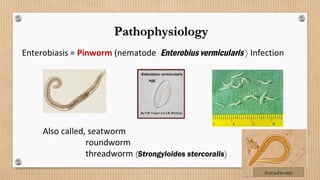
Enterobiasis = Pinworm (nematode Enterobius vermicularis ) Infection
Also called, seatworm
roundworm
threadworm (Strongyloides stercoralis)
threadworm
• Types of
Parasitic
Infections
• NematodesNematodes
Whipworm Pinworm Threadworm
Roundworm Filarialworm Guineaworm
Transmission of E.vermicularis
• At night
• On perianal
skin
Humans are the only natural host of Enterobius vermicularis.
• The most common helminthic infection in all over the world
• Usually affects all family members when one member is infected.
All household residents must be treated simultaneously.
• Do not cause any serious intestinal pathology.
Usual symptoms : loss of sleep, discomfort, embarrassment
• A heavy load of worms : anorexia, restlessness, insomnia
• Rare pathology : cystitis, appendicitis, chronic salpingitis, ulcer in the intestine
PathophysiologyPathophysiology
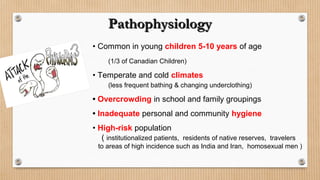
• Common in young children 5-10 years of age
(1/3 of Canadian Children)
• Temperate and cold climates
(less frequent bathing & changing underclothing)
• Overcrowding in school and family groupings
• Inadequate personal and community hygiene
• High-risk population
( institutionalized patients, residents of native reserves, travelers
to areas of high incidence such as India and Iran, homosexual men )
Drug Therapy Problem
Erik is experiencing symptoms of pinworm infection
(itchy rectum, loss of sleep) secondary to lack of
therapy and would benefit from reassessment.
Goals of Therapy
• Relieve itching so that Erik can sleep well
• Eliminate the infection
• Promote good hygiene
• Prevent reinfection
• Prevent pinworm infection of Mrs. Pedersen
• Prevent dermatitis and secondary bacterial infections
Reference
• Anandan J.V. Parasitic Infections. In: Alldredge B, Corelli R, Ernst M, Guglielmo B, Jacobson P,
Kradjan W. (ed.) Koda-Kimble & Young’s Applied Therapeutics. 10th
ed. Philadelphia, USA:
Lippincott Williams & Wilkins; 2013. P1839
• Carruthers-Czyzewski P. Pinworms. In: Repchinsky C (ed.) Therapeutic Choices for Minor
Ailments. 1st
ed. Ottawa: Canadian Pharmacist Association;2013 P360-364
• Healthline Networks. Parasitic Infections.
http://www.healthline.com/health/parasitic-infections#Overview1 (accessed 06 July 2014)
• O’Donoghue P. Faculty of Science. The University of Queensland. PARA-SITE.
http://parasite.org.au/para-site/introduction/introduction.html (accessed 06 July 2014)

Pinworms[Hye Won]

  • 1.
  • 2.
    Overview • Pathophysiology • DrugTherapy Problem • Goals of Therapy • Patient assessment • Diagnosis of pinworms • Prevention • Nonpharmacologic Therapy • Pharmacologic Therapy • Case discussion • Monitoring
  • 3.
    • Mrs. Pedersen,a single mother, comes into the pharmacy and asks for your help. • She seems a bit embarrassed. She says her only child, 6-year old Erik, has worms. • She tells you that he has had an itchy rectum for about the last 2 weeks, particularly at night, and he hasn’t been sleeping well at all. • When she took Erik to the doctor, he told her that Erik has pinworms and to get some medication from the pharmacy. • What do you recommend for Mrs. Pedersen.
  • 4.
    PathophysiologyPathophysiology Enterobiasis = Pinworm(nematode Enterobius vermicularis ) Infection Also called, seatworm roundworm threadworm (Strongyloides stercoralis) threadworm
  • 5.
  • 6.
    • NematodesNematodes Whipworm PinwormThreadworm Roundworm Filarialworm Guineaworm
  • 7.
    Transmission of E.vermicularis •At night • On perianal skin
  • 8.
    Humans are theonly natural host of Enterobius vermicularis. • The most common helminthic infection in all over the world • Usually affects all family members when one member is infected. All household residents must be treated simultaneously. • Do not cause any serious intestinal pathology. Usual symptoms : loss of sleep, discomfort, embarrassment • A heavy load of worms : anorexia, restlessness, insomnia • Rare pathology : cystitis, appendicitis, chronic salpingitis, ulcer in the intestine PathophysiologyPathophysiology
  • 9.
    PathophysiologyPathophysiology • Common inyoung children 5-10 years of age (1/3 of Canadian Children) • Temperate and cold climates (less frequent bathing & changing underclothing) • Overcrowding in school and family groupings • Inadequate personal and community hygiene • High-risk population ( institutionalized patients, residents of native reserves, travelers to areas of high incidence such as India and Iran, homosexual men )
  • 10.
    Drug Therapy Problem Erikis experiencing symptoms of pinworm infection (itchy rectum, loss of sleep) secondary to lack of therapy and would benefit from reassessment.
  • 11.
    Goals of Therapy •Relieve itching so that Erik can sleep well • Eliminate the infection • Promote good hygiene • Prevent reinfection • Prevent pinworm infection of Mrs. Pedersen • Prevent dermatitis and secondary bacterial infections
  • 12.
    Reference • Anandan J.V.Parasitic Infections. In: Alldredge B, Corelli R, Ernst M, Guglielmo B, Jacobson P, Kradjan W. (ed.) Koda-Kimble & Young’s Applied Therapeutics. 10th ed. Philadelphia, USA: Lippincott Williams & Wilkins; 2013. P1839 • Carruthers-Czyzewski P. Pinworms. In: Repchinsky C (ed.) Therapeutic Choices for Minor Ailments. 1st ed. Ottawa: Canadian Pharmacist Association;2013 P360-364 • Healthline Networks. Parasitic Infections. http://www.healthline.com/health/parasitic-infections#Overview1 (accessed 06 July 2014) • O’Donoghue P. Faculty of Science. The University of Queensland. PARA-SITE. http://parasite.org.au/para-site/introduction/introduction.html (accessed 06 July 2014)