What Is Inventory Management?
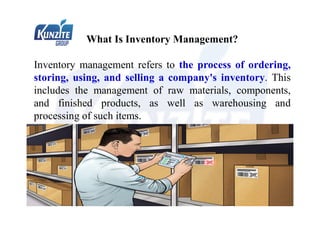
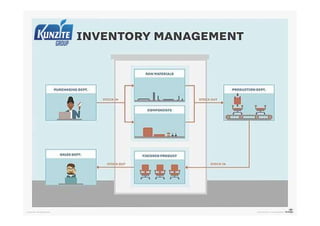
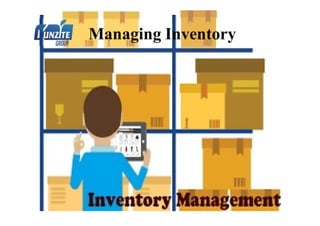
Inventory management refers to the process of ordering,
storing, using, and selling a company's inventory. This
includes the management of raw materials, components,
and finished products, as well as warehousing and
processing of such items.
 Inventory management is an important function
in controlling assets in the supply chain.
Individuals working in the supply chain should
have at least a basic understanding of the roles,
costs, and benefits of inventories. This
certification track is intended to provide students
with an understanding of the basics of inventory
management and to enable effective contributions
to an organization.
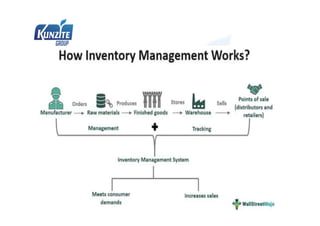
Inventory is a function in the overall supply
chain processes of an organization.
Inventory is often obtained from suppliers
in the form of raw materials and other
goods and materials through the
procurement department. Inventory also
includes work in process and finished
products from manufacturing operations.
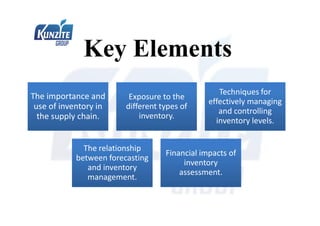
Key Elements
The importance and
use of inventory in
the supply chain.
The importance and
use of inventory in
the supply chain.
Exposure to the
different types of
inventory.
Exposure to the
different types of
inventory.
Techniques for
effectively managing
and controlling
inventory levels.
Techniques for
effectively managing
and controlling
inventory levels.
The relationship
between forecasting
and inventory
management.
The relationship
between forecasting
and inventory
management.
Financial impacts of
inventory
assessment.
Financial impacts of
inventory
assessment.
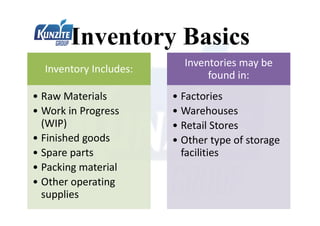
Inventory Basics
Inventory Includes:
• Raw Materials
• Work in Progress
(WIP)
• Finished goods
• Spare parts
• Packing material
• Other operating
supplies
Inventories may be
found in:
• Factories
• Warehouses
• Retail Stores
• Other type of storage
facilities
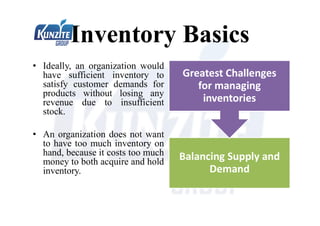
Inventory Basics
• Ideally, an organization would
have sufficient inventory to
satisfy customer demands for
products without losing any
revenue due to insufficient
stock.
• An organization does not want
to have too much inventory on
hand, because it costs too much
money to both acquire and hold
inventory.
Balancing Supply and
Demand
Greatest Challenges
for managing
inventories
Problematic Reasons for Carrying
Inventory
Examples of supply chain problems include
 Poor demand planning, poor forecasting, and high forecasting
error
 Product theft
 Poor supplier performance (inaccurate lead time, late delivery,
poor quality, etc.)
 Poor production yields that require greater inputs for the desired
output
 Poor or non-existent inventory planning and tracking systems
 Poor inventory counting systems that reduce stock accuracy
 Large-quantity purchases to obtain lower unit prices that are
outweighed by higher carrying costs
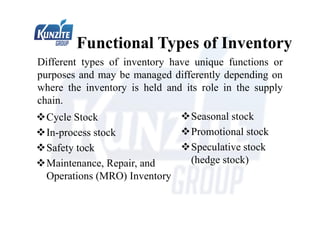
Functional Types of Inventory
Different types of inventory have unique functions or
purposes and may be managed differently depending on
where the inventory is held and its role in the supply
chain.
Cycle Stock
In-process stock
Safety tock
Maintenance, Repair, and
Operations (MRO) Inventory
Seasonal stock
Promotional stock
Speculative stock
(hedge stock)
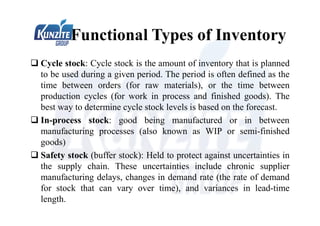
 Cycle stock: Cycle stock is the amount of inventory that is planned
to be used during a given period. The period is often defined as the
time between orders (for raw materials), or the time between
production cycles (for work in process and finished goods). The
best way to determine cycle stock levels is based on the forecast.
 In-process stock: good being manufactured or in between
manufacturing processes (also known as WIP or semi-finished
goods)
 Safety stock (buffer stock): Held to protect against uncertainties in
the supply chain. These uncertainties include chronic supplier
manufacturing delays, changes in demand rate (the rate of demand
for stock that can vary over time), and variances in lead-time
length.
Functional Types of Inventory
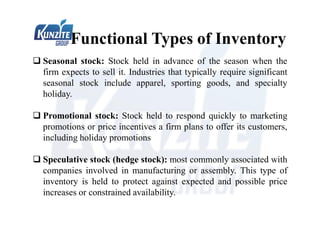
 Seasonal stock: Stock held in advance of the season when the
firm expects to sell it. Industries that typically require significant
seasonal stock include apparel, sporting goods, and specialty
holiday.
 Promotional stock: Stock held to respond quickly to marketing
promotions or price incentives a firm plans to offer its customers,
including holiday promotions
 Speculative stock (hedge stock): most commonly associated with
companies involved in manufacturing or assembly. This type of
inventory is held to protect against expected and possible price
increases or constrained availability.
Functional Types of Inventory
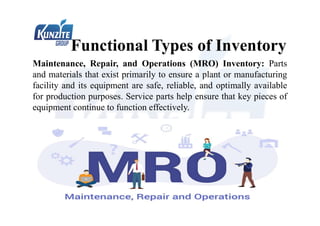
Maintenance, Repair, and Operations (MRO) Inventory: Parts
and materials that exist primarily to ensure a plant or manufacturing
facility and its equipment are safe, reliable, and optimally available
for production purposes. Service parts help ensure that key pieces of
equipment continue to function effectively.
Managing Inventory
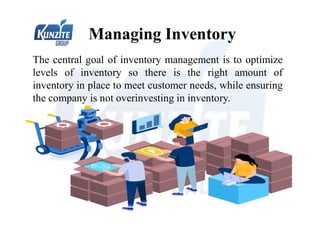
The central goal of inventory management is to optimize
levels of inventory so there is the right amount of
inventory in place to meet customer needs, while ensuring
the company is not overinvesting in inventory.
 Demand Planning
 Deciding How Much Inventory to Hold
 Counting Inventory
 Tracking and Controlling Inventory
Managing Inventory
Managing Inventory
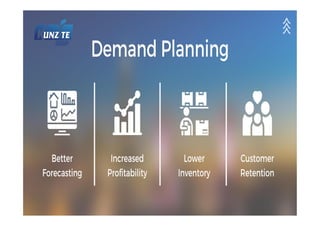
Demand Planning:--
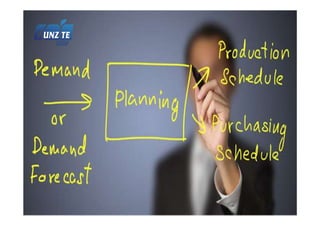
Demand planning is a supply chain management
process of forecasting, or predicting, the demand
for products to ensure they can be delivered and
satisfy customers. The goal is to strike a balance
between having sufficient inventory levels to meet
customer needs without having a surplus.
Deciding How Much Inventory to Hold:-
Managing Inventory
Rightsizing the inventory is dependent on the specific industry.
Retailers may want a one- or two-month supply on hand, while food
businesses will want to have much less inventory because of their
products’ limited shelf life, especially fresh foods, to minimize loss
and spoilage.
Companies carrying maintenance spares may carry inventory for
months or even years until demand arises. Several tools, techniques,
and strategies exist for determining how much inventory to hold
Deciding How Much Inventory to
Hold:-
Managing Inventory
Counting Inventory: For inventory control
purposes, it is necessary to compare the on-hand
levels with inventory records by performing a
physical count of all items.
 Inventory counts are usually done either by counting
the entire inventory at one time, known as a physical
inventory, or by counting items at varying times on a
prescheduled basis, which is called cycle counting
Managing Inventory
Managing Inventory
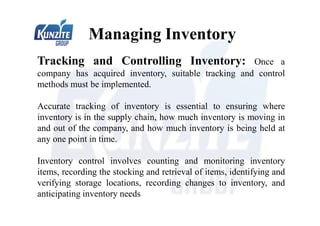
Tracking and Controlling Inventory: Once a
company has acquired inventory, suitable tracking and control
methods must be implemented.
Accurate tracking of inventory is essential to ensuring where
inventory is in the supply chain, how much inventory is moving in
and out of the company, and how much inventory is being held at
any one point in time.
Inventory control involves counting and monitoring inventory
items, recording the stocking and retrieval of items, identifying and
verifying storage locations, recording changes to inventory, and
anticipating inventory needs
Managing Inventory
Inventory Management/
Control Employee Tasks
 Inventory management personnel classify, label, and maintain
inventory and keep accurate inventory records, including the
location of inventory for easy retrieval
 Management personnel communicate inventory locations and levels
to department managers, and keep records of inventory for disposal
or transfer (implementing a control system can help reduce
breakage, damage, and obsolescence).
 Inventory control personnel may also be responsible for recording
incoming inventory purchases and outgoing inventory types and
quantities in the shipping and receiving department.
 Companies also require physical inventory counts to help ensure
accuracy of inventory.
 Through stock counts, inventory control employees must
reconcile inventory records with physical inventory on-hand; this
occurs either once a year, when stock is physically counted and
compared to inventory records, or on an ongoing basis, using
cycle counting.
Inventory Management/
Control Employee Tasks
Inventory management

Inventory management

  • 2.
    What Is InventoryManagement? Inventory management refers to the process of ordering, storing, using, and selling a company's inventory. This includes the management of raw materials, components, and finished products, as well as warehousing and processing of such items.
  • 4.
     Inventory managementis an important function in controlling assets in the supply chain. Individuals working in the supply chain should have at least a basic understanding of the roles, costs, and benefits of inventories. This certification track is intended to provide students with an understanding of the basics of inventory management and to enable effective contributions to an organization.
  • 7.
    Inventory is afunction in the overall supply chain processes of an organization. Inventory is often obtained from suppliers in the form of raw materials and other goods and materials through the procurement department. Inventory also includes work in process and finished products from manufacturing operations.
  • 8.
    Key Elements The importanceand use of inventory in the supply chain. The importance and use of inventory in the supply chain. Exposure to the different types of inventory. Exposure to the different types of inventory. Techniques for effectively managing and controlling inventory levels. Techniques for effectively managing and controlling inventory levels. The relationship between forecasting and inventory management. The relationship between forecasting and inventory management. Financial impacts of inventory assessment. Financial impacts of inventory assessment.
  • 9.
    Inventory Basics Inventory Includes: •Raw Materials • Work in Progress (WIP) • Finished goods • Spare parts • Packing material • Other operating supplies Inventories may be found in: • Factories • Warehouses • Retail Stores • Other type of storage facilities
  • 10.
    Inventory Basics • Ideally,an organization would have sufficient inventory to satisfy customer demands for products without losing any revenue due to insufficient stock. • An organization does not want to have too much inventory on hand, because it costs too much money to both acquire and hold inventory. Balancing Supply and Demand Greatest Challenges for managing inventories
  • 11.
    Problematic Reasons forCarrying Inventory Examples of supply chain problems include  Poor demand planning, poor forecasting, and high forecasting error  Product theft  Poor supplier performance (inaccurate lead time, late delivery, poor quality, etc.)  Poor production yields that require greater inputs for the desired output  Poor or non-existent inventory planning and tracking systems  Poor inventory counting systems that reduce stock accuracy  Large-quantity purchases to obtain lower unit prices that are outweighed by higher carrying costs
  • 12.
    Functional Types ofInventory Different types of inventory have unique functions or purposes and may be managed differently depending on where the inventory is held and its role in the supply chain. Cycle Stock In-process stock Safety tock Maintenance, Repair, and Operations (MRO) Inventory Seasonal stock Promotional stock Speculative stock (hedge stock)
  • 13.
     Cycle stock:Cycle stock is the amount of inventory that is planned to be used during a given period. The period is often defined as the time between orders (for raw materials), or the time between production cycles (for work in process and finished goods). The best way to determine cycle stock levels is based on the forecast.  In-process stock: good being manufactured or in between manufacturing processes (also known as WIP or semi-finished goods)  Safety stock (buffer stock): Held to protect against uncertainties in the supply chain. These uncertainties include chronic supplier manufacturing delays, changes in demand rate (the rate of demand for stock that can vary over time), and variances in lead-time length. Functional Types of Inventory
  • 14.
    Functional Types ofInventory  Seasonal stock: Stock held in advance of the season when the firm expects to sell it. Industries that typically require significant seasonal stock include apparel, sporting goods, and specialty holiday.  Promotional stock: Stock held to respond quickly to marketing promotions or price incentives a firm plans to offer its customers, including holiday promotions  Speculative stock (hedge stock): most commonly associated with companies involved in manufacturing or assembly. This type of inventory is held to protect against expected and possible price increases or constrained availability.
  • 15.
    Functional Types ofInventory Maintenance, Repair, and Operations (MRO) Inventory: Parts and materials that exist primarily to ensure a plant or manufacturing facility and its equipment are safe, reliable, and optimally available for production purposes. Service parts help ensure that key pieces of equipment continue to function effectively.
  • 17.
    Managing Inventory The centralgoal of inventory management is to optimize levels of inventory so there is the right amount of inventory in place to meet customer needs, while ensuring the company is not overinvesting in inventory.
  • 18.
     Demand Planning Deciding How Much Inventory to Hold  Counting Inventory  Tracking and Controlling Inventory Managing Inventory
  • 19.
    Managing Inventory Demand Planning:-- Demandplanning is a supply chain management process of forecasting, or predicting, the demand for products to ensure they can be delivered and satisfy customers. The goal is to strike a balance between having sufficient inventory levels to meet customer needs without having a surplus.
  • 22.
    Deciding How MuchInventory to Hold:- Managing Inventory Rightsizing the inventory is dependent on the specific industry. Retailers may want a one- or two-month supply on hand, while food businesses will want to have much less inventory because of their products’ limited shelf life, especially fresh foods, to minimize loss and spoilage. Companies carrying maintenance spares may carry inventory for months or even years until demand arises. Several tools, techniques, and strategies exist for determining how much inventory to hold
  • 23.
    Deciding How MuchInventory to Hold:-
  • 24.
    Managing Inventory Counting Inventory:For inventory control purposes, it is necessary to compare the on-hand levels with inventory records by performing a physical count of all items.  Inventory counts are usually done either by counting the entire inventory at one time, known as a physical inventory, or by counting items at varying times on a prescheduled basis, which is called cycle counting
  • 25.
  • 26.
    Managing Inventory Tracking andControlling Inventory: Once a company has acquired inventory, suitable tracking and control methods must be implemented. Accurate tracking of inventory is essential to ensuring where inventory is in the supply chain, how much inventory is moving in and out of the company, and how much inventory is being held at any one point in time. Inventory control involves counting and monitoring inventory items, recording the stocking and retrieval of items, identifying and verifying storage locations, recording changes to inventory, and anticipating inventory needs
  • 27.
  • 28.
    Inventory Management/ Control EmployeeTasks  Inventory management personnel classify, label, and maintain inventory and keep accurate inventory records, including the location of inventory for easy retrieval  Management personnel communicate inventory locations and levels to department managers, and keep records of inventory for disposal or transfer (implementing a control system can help reduce breakage, damage, and obsolescence).  Inventory control personnel may also be responsible for recording incoming inventory purchases and outgoing inventory types and quantities in the shipping and receiving department.
  • 29.
     Companies alsorequire physical inventory counts to help ensure accuracy of inventory.  Through stock counts, inventory control employees must reconcile inventory records with physical inventory on-hand; this occurs either once a year, when stock is physically counted and compared to inventory records, or on an ongoing basis, using cycle counting. Inventory Management/ Control Employee Tasks