





WHY DO SOME
STARTUPS FAIL
WHILE OTHERS
SUCCEED?
#AUTOPSY
Agenda
Introduction
1.Methodology
2.Autopsy: causes of startup failure
3.Success factors
4.Key takeaways
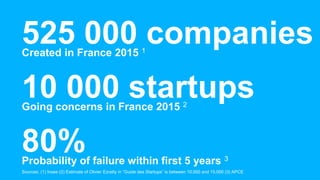
525 000 companiesCreated in France 2015 1
80%Probability of failure within first 5 years 3
10 000 startupsGoing concerns in France 2015 2
Sources: (1) Insee (2) Estimate of Olivier Ezratty in “Guide des Startups” is between 10,000 and 15,000 (3) APCE
REASONS FOR
FAILURE
1. METHODOLOGY
1. Analysis of 78 failures in USA (autopsy.io)
2. List of factors of failure
3. Survey of 108 entrepreneurs
We analyzed 58 failures of French startups,
enabling us to draw significant conclusions
METHODOLOGY
2. CAUSES OF
STARTUP FAILURE
CAUSES OF FAILURE
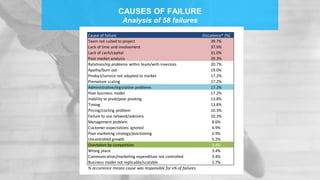
Analysis of 58 failures
.
Cause of failure Occurence* (%)
Team not suited to project 39.7%
Lack of time and involvement 37.9%
Lack of cash/capital 31.0%
Poor market analysis 29.3%
Relationship problems within team/with investors 20.7%
Apathy/burn out 19.0%
Product/service not adapted to market 17.2%
Premature scaling 17.2%
Administrative/legislative problems 17.2%
Poor business model 17.2%
Inability to pivot/poor pivoting 13.8%
Timing 13.8%
Pricing/costing problem 10.3%
Failure to use network/advisers 10.3%
Management problem 8.6%
Customer expectations ignored 6.9%
Poor marketing strategy/positioning 6.9%
Uncontrolled growth 5.2%
Overtaken by competition 3.4%
Wrong place 3.4%
Communication/marketing expenditure not controlled 3.4%
Business model not replicable/scalable 1.7%
% occurrence means cause was responsible for x% of failures
CAUSES OF FAILURE
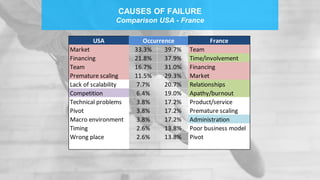
Comparison USA - France
.
USA France
Market 33.3% 39.7% Team
Financing 21.8% 37.9% Time/involvement
Team 16.7% 31.0% Financing
Premature scaling 11.5% 29.3% Market
Lack of scalability 7.7% 20.7% Relationships
Competition 6.4% 19.0% Apathy/burnout
Technical problems 3.8% 17.2% Product/service
Pivot 3.8% 17.2% Premature scaling
Macro environment 3.8% 17.2% Administration
Timing 2.6% 13.8% Poor business model
Wrong place 2.6% 13.8% Pivot
Occurrence
CAUSES OF FAILURE
Analysis of 58 French failures
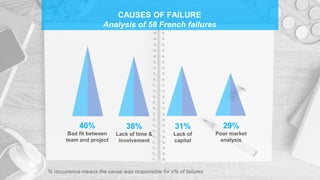
40%
Bad fit between
team and project
38%
Lack of time &
involvement
31%
Lack of
capital
29%
Poor market
analysis
% occurrence means the cause was responsible for x% of failures
CAUSES OF FAILURE
Analysis of 58 French failures
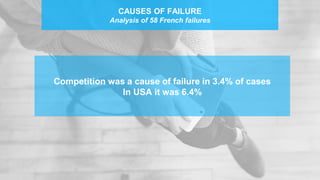
Competition was a cause of failure in 3.4% of cases
In USA it was 6.4%
3. SUCCESS
FACTORS
SUCCESS FACTORS
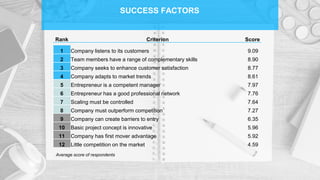
Rank Criterion Score
1 Company listens to its customers 9.09
2 Team members have a range of complementary skills 8.90
3 Company seeks to enhance customer satisfaction 8.77
4 Company adapts to market trends 8.61
5 Entrepreneur is a competent manager 7.97
6 Entrepreneur has a good professional network 7.76
7 Scaling must be controlled 7.64
8 Company must outperform competition 7.27
9 Company can create barriers to entry 6.35
10 Basic project concept is innovative 5.96
11 Company has first mover advantage 5.92
12 Little competition on the market 4.59
Average score of respondents
DIVERGENCE
Sex
Number of
startups
Age
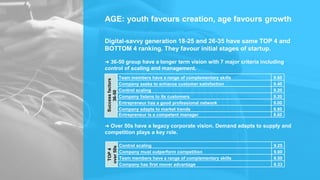
AGE: youth favours creation, age favours growth
Digital-savvy generation 18-25 and 26-35 have same TOP 4 and
BOTTOM 4 ranking. They favour initial stages of startup.
➜ 36-50 group have a longer term vision with 7 major criteria including
control of scaling and management.
➜ Over 50s have a legacy corporate vision. Demand adapts to supply and
competition plays a key role.
Successfactors
36-50
Team members have a range of complementary skills 9.60
Company seeks to enhance customer satisfaction 9.40
Control scaling 9.20
Company listens to its customers 9.20
Entrepreneur has a good professional network 9.00
Company adapts to market trends 8.80
Entrepreneur is a competent manager 8.60
TOP4
over50s
Control scaling 9.25
Company must outperform competition 9.00
Team members have a range of complementary skills 8.50
Company has first mover advantage 8.33
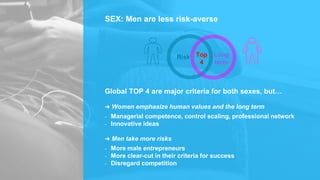
SEX: Men are less risk-averse
Global TOP 4 are major criteria for both sexes, but…
➜ Women emphasize human values and the long term
- Managerial competence, control scaling, professional network
- Innovative ideas
➜ Men take more risks
- More male entrepreneurs
- More clear-cut in their criteria for success
- Disregard competition
Risk Top
4
Long
term
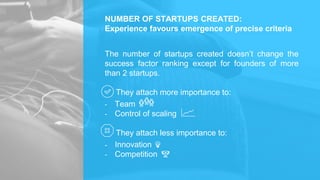
NUMBER OF STARTUPS CREATED:
Experience favours emergence of precise criteria
The number of startups created doesn’t change the
success factor ranking except for founders of more
than 2 startups.
They attach more importance to:
- Team
- Control of scaling
They attach less importance to:
- Innovation
- Competition
4. KEY TAKEAWAYS
KEY LEARNING OUTCOMES
Competition GenderCulture
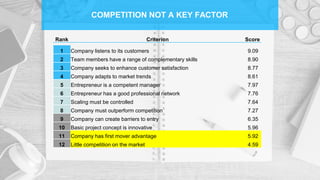
COMPETITION NOT A KEY FACTOR
Rank Criterion Score
1 Company listens to its customers 9.09
2 Team members have a range of complementary skills 8.90
3 Company seeks to enhance customer satisfaction 8.77
4 Company adapts to market trends 8.61
5 Entrepreneur is a competent manager 7.97
6 Entrepreneur has a good professional network 7.76
7 Scaling must be controlled 7.64
8 Company must outperform competition 7.27
9 Company can create barriers to entry 6.35
10 Basic project concept is innovative 5.96
11 Company has first mover advantage 5.92
12 Little competition on the market 4.59
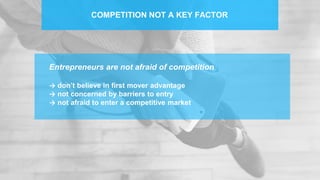
COMPETITION NOT A KEY FACTOR
Entrepreneurs are not afraid of competition
→ don’t believe in first mover advantage
→ not concerned by barriers to entry
→ not afraid to enter a competitive market
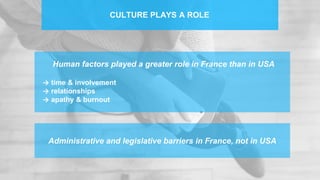
CULTURE PLAYS A ROLE
Human factors played a greater role in France than in USA
→ time & involvement
→ relationships
→ apathy & burnout
Administrative and legislative barriers in France, not in USA
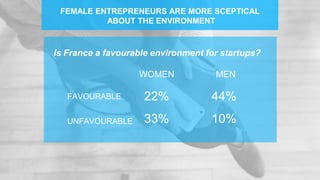
FEMALE ENTREPRENEURS ARE MORE SCEPTICAL
ABOUT THE ENVIRONMENT
Is France a favourable environment for startups?
WOMEN MEN
22% 44%
33% 10%
FAVOURABLE
UNFAVOURABLE
Are success factors
universal or
culture-specific?
Thanks!
Ines de Beaucorps
Jonas Bouaouli
Leslie Shaw

Startup Failure

  • 1.
    WHY DO SOME STARTUPSFAIL WHILE OTHERS SUCCEED? #AUTOPSY
  • 2.
    Agenda Introduction 1.Methodology 2.Autopsy: causes ofstartup failure 3.Success factors 4.Key takeaways
  • 3.
    525 000 companiesCreatedin France 2015 1 80%Probability of failure within first 5 years 3 10 000 startupsGoing concerns in France 2015 2 Sources: (1) Insee (2) Estimate of Olivier Ezratty in “Guide des Startups” is between 10,000 and 15,000 (3) APCE
  • 4.
  • 5.
  • 6.
    1. Analysis of78 failures in USA (autopsy.io) 2. List of factors of failure 3. Survey of 108 entrepreneurs We analyzed 58 failures of French startups, enabling us to draw significant conclusions METHODOLOGY
  • 7.
  • 8.
    CAUSES OF FAILURE Analysisof 58 failures . Cause of failure Occurence* (%) Team not suited to project 39.7% Lack of time and involvement 37.9% Lack of cash/capital 31.0% Poor market analysis 29.3% Relationship problems within team/with investors 20.7% Apathy/burn out 19.0% Product/service not adapted to market 17.2% Premature scaling 17.2% Administrative/legislative problems 17.2% Poor business model 17.2% Inability to pivot/poor pivoting 13.8% Timing 13.8% Pricing/costing problem 10.3% Failure to use network/advisers 10.3% Management problem 8.6% Customer expectations ignored 6.9% Poor marketing strategy/positioning 6.9% Uncontrolled growth 5.2% Overtaken by competition 3.4% Wrong place 3.4% Communication/marketing expenditure not controlled 3.4% Business model not replicable/scalable 1.7% % occurrence means cause was responsible for x% of failures
  • 9.
    CAUSES OF FAILURE ComparisonUSA - France . USA France Market 33.3% 39.7% Team Financing 21.8% 37.9% Time/involvement Team 16.7% 31.0% Financing Premature scaling 11.5% 29.3% Market Lack of scalability 7.7% 20.7% Relationships Competition 6.4% 19.0% Apathy/burnout Technical problems 3.8% 17.2% Product/service Pivot 3.8% 17.2% Premature scaling Macro environment 3.8% 17.2% Administration Timing 2.6% 13.8% Poor business model Wrong place 2.6% 13.8% Pivot Occurrence
  • 10.
    CAUSES OF FAILURE Analysisof 58 French failures 40% Bad fit between team and project 38% Lack of time & involvement 31% Lack of capital 29% Poor market analysis % occurrence means the cause was responsible for x% of failures
  • 11.
    CAUSES OF FAILURE Analysisof 58 French failures Competition was a cause of failure in 3.4% of cases In USA it was 6.4%
  • 12.
  • 13.
    SUCCESS FACTORS Rank CriterionScore 1 Company listens to its customers 9.09 2 Team members have a range of complementary skills 8.90 3 Company seeks to enhance customer satisfaction 8.77 4 Company adapts to market trends 8.61 5 Entrepreneur is a competent manager 7.97 6 Entrepreneur has a good professional network 7.76 7 Scaling must be controlled 7.64 8 Company must outperform competition 7.27 9 Company can create barriers to entry 6.35 10 Basic project concept is innovative 5.96 11 Company has first mover advantage 5.92 12 Little competition on the market 4.59 Average score of respondents
  • 14.
  • 15.
    AGE: youth favourscreation, age favours growth Digital-savvy generation 18-25 and 26-35 have same TOP 4 and BOTTOM 4 ranking. They favour initial stages of startup. ➜ 36-50 group have a longer term vision with 7 major criteria including control of scaling and management. ➜ Over 50s have a legacy corporate vision. Demand adapts to supply and competition plays a key role. Successfactors 36-50 Team members have a range of complementary skills 9.60 Company seeks to enhance customer satisfaction 9.40 Control scaling 9.20 Company listens to its customers 9.20 Entrepreneur has a good professional network 9.00 Company adapts to market trends 8.80 Entrepreneur is a competent manager 8.60 TOP4 over50s Control scaling 9.25 Company must outperform competition 9.00 Team members have a range of complementary skills 8.50 Company has first mover advantage 8.33
  • 16.
    SEX: Men areless risk-averse Global TOP 4 are major criteria for both sexes, but… ➜ Women emphasize human values and the long term - Managerial competence, control scaling, professional network - Innovative ideas ➜ Men take more risks - More male entrepreneurs - More clear-cut in their criteria for success - Disregard competition Risk Top 4 Long term
  • 17.
    NUMBER OF STARTUPSCREATED: Experience favours emergence of precise criteria The number of startups created doesn’t change the success factor ranking except for founders of more than 2 startups. They attach more importance to: - Team - Control of scaling They attach less importance to: - Innovation - Competition
  • 18.
  • 19.
  • 20.
    COMPETITION NOT AKEY FACTOR Rank Criterion Score 1 Company listens to its customers 9.09 2 Team members have a range of complementary skills 8.90 3 Company seeks to enhance customer satisfaction 8.77 4 Company adapts to market trends 8.61 5 Entrepreneur is a competent manager 7.97 6 Entrepreneur has a good professional network 7.76 7 Scaling must be controlled 7.64 8 Company must outperform competition 7.27 9 Company can create barriers to entry 6.35 10 Basic project concept is innovative 5.96 11 Company has first mover advantage 5.92 12 Little competition on the market 4.59
  • 21.
    COMPETITION NOT AKEY FACTOR Entrepreneurs are not afraid of competition → don’t believe in first mover advantage → not concerned by barriers to entry → not afraid to enter a competitive market
  • 22.
    CULTURE PLAYS AROLE Human factors played a greater role in France than in USA → time & involvement → relationships → apathy & burnout Administrative and legislative barriers in France, not in USA
  • 23.
    FEMALE ENTREPRENEURS AREMORE SCEPTICAL ABOUT THE ENVIRONMENT Is France a favourable environment for startups? WOMEN MEN 22% 44% 33% 10% FAVOURABLE UNFAVOURABLE
  • 24.
    Are success factors universalor culture-specific?
  • 25.
    Thanks! Ines de Beaucorps JonasBouaouli Leslie Shaw