Antiallergic activity by
mast cell stabilization assay
Presented by:-
HIMIKA RATHI
BACKGROUND
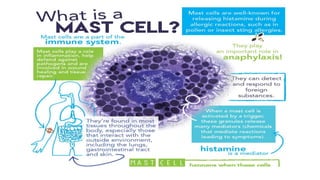
• In allergic diseases mast cells plays an important role by defending
the antigens.
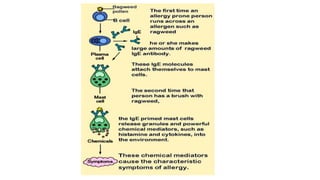
• IgE antibodies formed in response to antigen antibody complex
attaches to the surface receptors of mast cells and rises calcium influx
leading to degranulation of mast cells which releases some pro-
inflammatory mediators.
REQUIREMENTS
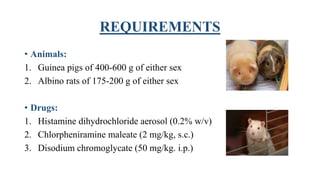
• Animals:
1. Guinea pigs of 400-600 g of either sex
2. Albino rats of 175-200 g of either sex
• Drugs:
1. Histamine dihydrochloride aerosol (0.2% w/v)
2. Chlorpheniramine maleate (2 mg/kg, s.c.)
3. Disodium chromoglycate (50 mg/kg. i.p.)
REQUIREMENTS
• Reagents:
1. Saline solution (0.9%)
2. RPMI 1640 buffer medium
3. egg albumin (100 µg/mL)
4. toludine blue solution (1%)
INSTRUMENTS
• Microscope with 10X magnification lens.
PROCEDURE
• Evaluation of bronchoconstriction in guinea pigs by using
histamine aerosol:
• Selected guinea pigs are divided into two groups consisting of 3
animals in each.
• Animals have to be fasted overnight.
• Group-1 receives normal saline.
• Group-2 animals receive Chlorpheniramine maleate (2 mg/kg, S.C.).
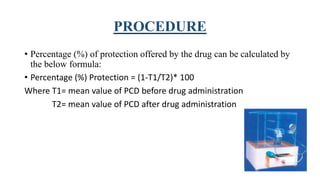
• Before the drug treatment animals should be exposed to histamine
aerosol (0.2%) in histamine chamber.
PROCEDURE
• Then determine the end point i.e. pre-convulsion dyspnea (PCD) is the
time of time of exposure of histamine aerosol to onset of dyspnea that
leads to convulsion.
• As early as PCD is observed the animals should be removed from
chamber and placed in fresh air and time of onset of PCD is to be
noted on day zero.
• Then animals have to treat with drug after 24 hours.
• After 1 hr of drug administration once again animals are exposed to
histamine aerosol and PCD is determined.
PROCEDURE
• Percentage (%) of protection offered by the drug can be calculated by
the below formula:
• Percentage (%) Protection = (1-T1/T2)* 100
Where T1= mean value of PCD before drug administration
T2= mean value of PCD after drug administration
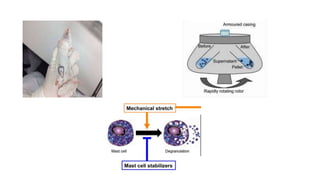
Mast cell stabilization activity
• Albino rats of either sex are divided into two groups consisting of 3
animals in each.
• Group-1 receives normal saline, and Group-2 receives Disodium
chromoglycate (50 mg/kg. i.p.) for 3 days.
• Inject 10 ml/kg of 0.9% saline into peritoneal cavity on 4th day to each
animal.
• Massage the peritoneal region of the animal gently for 5 min, then
collect the peritoneal fluid and transfer to the test tube which is
carrying 7-10 ml of RPMI buffer.
Mast cell stabilization activity
• Centrifuge the fluid for 400-500 RPM.
• Discard the supernatant and wash the pellets of mast cells twice with
same buffer by centrifugation.
• Add egg albumin to the above cell suspension and incubate at 37˚C for
10 min.
• Later the suspension has to stain with 1% toluidine blue solution and
observe the slide under microscope for calculating number of
granulated and degranulated mast cells in each group (total 100 cells
are has to be counted from different visual areas).
CONCLUSION
• Pretreatment of animals with standard drugs stabilizes mast cell
membrane and generates nitric oxide as defensive mechanism that
inhibits the release of chemokines, which are responsible for
vasoconstriction.
REFERENCES
• Prussin C, Metcalfe DD. IgE, Mast cells, Basophils and Eosinophils. J
Allergy Clin Immunol. 2003;111(2):486-94.
• Choudhary GP. Mast Cell Stabilizing Activity of Piper longum Linn.
Indian J Allergy Asthma Immunol. 2006;20:112-6.
• Hajare R, Darvhekar VM, Shewale A, Patil V. Evaluation of
antihistaminic activity of Piper betel leaf in guinea pig. African J
Pharmacy Pharmacol. 2011;5(2):113-7.
• Taur DJ, Patil RY. Mast cell stabilizing and antiallergic activity of
Abrus precatorius in the management of asthma. Asian Pacific J Trop
Med. 2011; 4(1):46-9.
16

Antiallergic activity by mast cell stabilization assay

  • 1.
    Antiallergic activity by mastcell stabilization assay Presented by:- HIMIKA RATHI
  • 2.
    BACKGROUND • In allergicdiseases mast cells plays an important role by defending the antigens. • IgE antibodies formed in response to antigen antibody complex attaches to the surface receptors of mast cells and rises calcium influx leading to degranulation of mast cells which releases some pro- inflammatory mediators.
  • 5.
    REQUIREMENTS • Animals: 1. Guineapigs of 400-600 g of either sex 2. Albino rats of 175-200 g of either sex • Drugs: 1. Histamine dihydrochloride aerosol (0.2% w/v) 2. Chlorpheniramine maleate (2 mg/kg, s.c.) 3. Disodium chromoglycate (50 mg/kg. i.p.)
  • 6.
    REQUIREMENTS • Reagents: 1. Salinesolution (0.9%) 2. RPMI 1640 buffer medium 3. egg albumin (100 µg/mL) 4. toludine blue solution (1%)
  • 7.
    INSTRUMENTS • Microscope with10X magnification lens.
  • 8.
    PROCEDURE • Evaluation ofbronchoconstriction in guinea pigs by using histamine aerosol: • Selected guinea pigs are divided into two groups consisting of 3 animals in each. • Animals have to be fasted overnight. • Group-1 receives normal saline. • Group-2 animals receive Chlorpheniramine maleate (2 mg/kg, S.C.). • Before the drug treatment animals should be exposed to histamine aerosol (0.2%) in histamine chamber.
  • 9.
    PROCEDURE • Then determinethe end point i.e. pre-convulsion dyspnea (PCD) is the time of time of exposure of histamine aerosol to onset of dyspnea that leads to convulsion. • As early as PCD is observed the animals should be removed from chamber and placed in fresh air and time of onset of PCD is to be noted on day zero. • Then animals have to treat with drug after 24 hours. • After 1 hr of drug administration once again animals are exposed to histamine aerosol and PCD is determined.
  • 10.
    PROCEDURE • Percentage (%)of protection offered by the drug can be calculated by the below formula: • Percentage (%) Protection = (1-T1/T2)* 100 Where T1= mean value of PCD before drug administration T2= mean value of PCD after drug administration
  • 11.
    Mast cell stabilizationactivity • Albino rats of either sex are divided into two groups consisting of 3 animals in each. • Group-1 receives normal saline, and Group-2 receives Disodium chromoglycate (50 mg/kg. i.p.) for 3 days. • Inject 10 ml/kg of 0.9% saline into peritoneal cavity on 4th day to each animal. • Massage the peritoneal region of the animal gently for 5 min, then collect the peritoneal fluid and transfer to the test tube which is carrying 7-10 ml of RPMI buffer.
  • 12.
    Mast cell stabilizationactivity • Centrifuge the fluid for 400-500 RPM. • Discard the supernatant and wash the pellets of mast cells twice with same buffer by centrifugation. • Add egg albumin to the above cell suspension and incubate at 37˚C for 10 min. • Later the suspension has to stain with 1% toluidine blue solution and observe the slide under microscope for calculating number of granulated and degranulated mast cells in each group (total 100 cells are has to be counted from different visual areas).
  • 14.
    CONCLUSION • Pretreatment ofanimals with standard drugs stabilizes mast cell membrane and generates nitric oxide as defensive mechanism that inhibits the release of chemokines, which are responsible for vasoconstriction.
  • 15.
    REFERENCES • Prussin C,Metcalfe DD. IgE, Mast cells, Basophils and Eosinophils. J Allergy Clin Immunol. 2003;111(2):486-94. • Choudhary GP. Mast Cell Stabilizing Activity of Piper longum Linn. Indian J Allergy Asthma Immunol. 2006;20:112-6. • Hajare R, Darvhekar VM, Shewale A, Patil V. Evaluation of antihistaminic activity of Piper betel leaf in guinea pig. African J Pharmacy Pharmacol. 2011;5(2):113-7. • Taur DJ, Patil RY. Mast cell stabilizing and antiallergic activity of Abrus precatorius in the management of asthma. Asian Pacific J Trop Med. 2011; 4(1):46-9.
  • 16.