
Class-
Made by-”enter name here
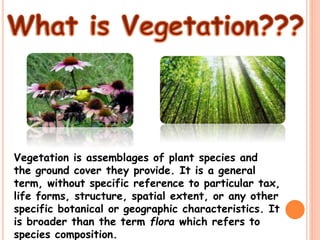
Vegetation is assemblages of plant species and
the ground cover they provide. It is a general
term, without specific reference to particular tax,
life forms, structure, spatial extent, or any other
specific botanical or geographic characteristics. It
is broader than the term flora which refers to
species composition.
Natural vegetation are gifts of nature. They
grow naturally. They follow the climatic
variables. Due to a variety of climates, a
wide range of natural vegetation grows in
India. Types of natural vegetation vary
according to climate, soil and altitude. A
study of the distribution of the forests in
India reveals that there is a marked
relation between the rainfall zones and
their belts of natural vegetation
oTropical Evergreen Forests
oDeciduous or Monsoon Type of Forests
oDry Deciduous Forests and Scrubs
oSemi Desert and Desert Vegetation
oTidal or Mangrove Forests
oMountain Forests
These forests grow in areas where rainfall is
more than 200 cm. They are mainly found on
the slopes of the Western Ghats and the
north-eastern regions of Arunachal Pradesh,
Meghalaya, Assam, Nagaland, the Tarai areas
of the Himalayas and the Andaman groups of
Islands. The trees in these forests never shed
their leaves all at a time in any part of the
year. Under humid tropical condition, sub-
soil water never dries up completely. So that
during the dry-season, trees in these forests
do not shed their leaves due to lack of sub-
soil water supply.
HOME
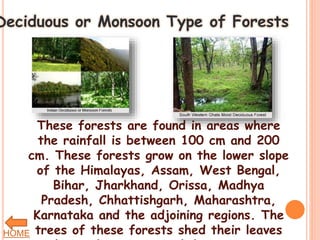
Deciduous or Monsoon Type of Forests
These forests are found in areas where
the rainfall is between 100 cm and 200
cm. These forests grow on the lower slope
of the Himalayas, Assam, West Bengal,
Bihar, Jharkhand, Orissa, Madhya
Pradesh, Chhattishgarh, Maharashtra,
Karnataka and the adjoining regions. The
trees of these forests shed their leavesHOME
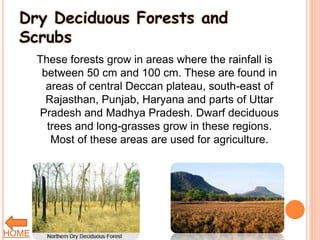
Dry Deciduous Forests and
Scrubs
These forests grow in areas where the rainfall is
between 50 cm and 100 cm. These are found in
areas of central Deccan plateau, south-east of
Rajasthan, Punjab, Haryana and parts of Uttar
Pradesh and Madhya Pradesh. Dwarf deciduous
trees and long-grasses grow in these regions.
Most of these areas are used for agriculture.
HOME
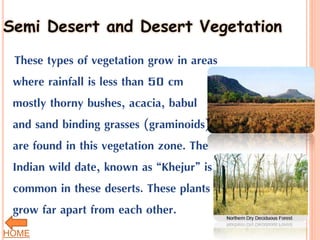
Semi Desert and Desert Vegetation
These types of vegetation grow in areas
where rainfall is less than 50 cm
mostly thorny bushes, acacia, babul
and sand binding grasses (graminoids)
are found in this vegetation zone. The
Indian wild date, known as “Khejur” is
common in these deserts. These plants
grow far apart from each other.
HOME
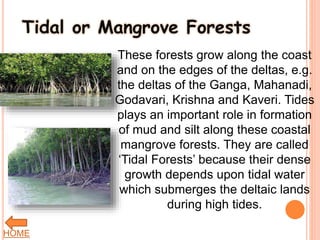
Tidal or Mangrove Forests
These forests grow along the coast
and on the edges of the deltas, e.g.
the deltas of the Ganga, Mahanadi,
Godavari, Krishna and Kaveri. Tides
plays an important role in formation
of mud and silt along these coastal
mangrove forests. They are called
‘Tidal Forests’ because their dense
growth depends upon tidal water
which submerges the deltaic lands
during high tides.
HOME
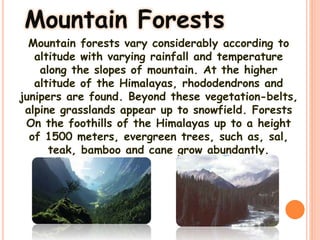
Mountain Forests
Mountain forests vary considerably according to
altitude with varying rainfall and temperature
along the slopes of mountain. At the higher
altitude of the Himalayas, rhododendrons and
junipers are found. Beyond these vegetation-belts,
alpine grasslands appear up to snowfield. Forests
On the foothills of the Himalayas up to a height
of 1500 meters, evergreen trees, such as, sal,
teak, bamboo and cane grow abundantly.
Submittedto –AlpanaChoudharyMam

Natural vegetation

  • 1.
  • 2.
    Vegetation is assemblagesof plant species and the ground cover they provide. It is a general term, without specific reference to particular tax, life forms, structure, spatial extent, or any other specific botanical or geographic characteristics. It is broader than the term flora which refers to species composition.
  • 3.
    Natural vegetation aregifts of nature. They grow naturally. They follow the climatic variables. Due to a variety of climates, a wide range of natural vegetation grows in India. Types of natural vegetation vary according to climate, soil and altitude. A study of the distribution of the forests in India reveals that there is a marked relation between the rainfall zones and their belts of natural vegetation
  • 4.
    oTropical Evergreen Forests oDeciduousor Monsoon Type of Forests oDry Deciduous Forests and Scrubs oSemi Desert and Desert Vegetation oTidal or Mangrove Forests oMountain Forests
  • 5.
    These forests growin areas where rainfall is more than 200 cm. They are mainly found on the slopes of the Western Ghats and the north-eastern regions of Arunachal Pradesh, Meghalaya, Assam, Nagaland, the Tarai areas of the Himalayas and the Andaman groups of Islands. The trees in these forests never shed their leaves all at a time in any part of the year. Under humid tropical condition, sub- soil water never dries up completely. So that during the dry-season, trees in these forests do not shed their leaves due to lack of sub- soil water supply. HOME
  • 6.
    Deciduous or MonsoonType of Forests These forests are found in areas where the rainfall is between 100 cm and 200 cm. These forests grow on the lower slope of the Himalayas, Assam, West Bengal, Bihar, Jharkhand, Orissa, Madhya Pradesh, Chhattishgarh, Maharashtra, Karnataka and the adjoining regions. The trees of these forests shed their leavesHOME
  • 7.
    Dry Deciduous Forestsand Scrubs These forests grow in areas where the rainfall is between 50 cm and 100 cm. These are found in areas of central Deccan plateau, south-east of Rajasthan, Punjab, Haryana and parts of Uttar Pradesh and Madhya Pradesh. Dwarf deciduous trees and long-grasses grow in these regions. Most of these areas are used for agriculture. HOME
  • 8.
    Semi Desert andDesert Vegetation These types of vegetation grow in areas where rainfall is less than 50 cm mostly thorny bushes, acacia, babul and sand binding grasses (graminoids) are found in this vegetation zone. The Indian wild date, known as “Khejur” is common in these deserts. These plants grow far apart from each other. HOME
  • 9.
    Tidal or MangroveForests These forests grow along the coast and on the edges of the deltas, e.g. the deltas of the Ganga, Mahanadi, Godavari, Krishna and Kaveri. Tides plays an important role in formation of mud and silt along these coastal mangrove forests. They are called ‘Tidal Forests’ because their dense growth depends upon tidal water which submerges the deltaic lands during high tides. HOME
  • 10.
    Mountain Forests Mountain forestsvary considerably according to altitude with varying rainfall and temperature along the slopes of mountain. At the higher altitude of the Himalayas, rhododendrons and junipers are found. Beyond these vegetation-belts, alpine grasslands appear up to snowfield. Forests On the foothills of the Himalayas up to a height of 1500 meters, evergreen trees, such as, sal, teak, bamboo and cane grow abundantly.
  • 11.