NATURAL
VEGETATION
Content-:
 Point of econony
 Distribution of Forest land
 Development of Forest
Comedy-1,2,3,4……..
 Types of Forest
i. Tropical Evergreen Forest
ii. Tropical Moist Deciduous Forest
iii.Tropical Dry Deciduous Forest
iv.Thorn Forest
v. Tidal forest
vi.The Himalayan Temperate Forest
Importance of natural vegetation and forests :
Forest constitute one of the most important basic
natural resources of the country.
Ecological view :
Forests help in occurrence of rainfall, promote soil
conservation in catchment areas, regulate runoff, improve
moisture holding capacity of the soils and maintain
ecological balance.
Point of economy :
Forest lands can be utilized as grazing
grounds for livestock. Great demand for
timber which resulted into development of
commercial forestry. Many products like
charcoal wood, pulp and matchwood, canes,
rose wood, sandal wood, lac, resins, honey,
herb, fruits, dyes, tans, kendu are obtained
from forest which highly commercial value
both conservation and development of forest
resource is as important as agriculture and
industry.
FOREST TYPES
AND THEIR
DISTRIBUTION IN
INDIA
Forest Types :
Terrain, climate, soil and water conditions
greatly influence the character and type of
vegetation. The Himalayan region, possesses a
variety of vegetation with a distinctive character
of alpine type at higher altitudes and this region
is clearly distinguished from the rest of the
country. Climatic factors mainly temperature and
rainfall determine which plant community can
flourish in a specific habitat. Soils and drainage
considerably introduce modifications, and thus
we have edaphic types such as the tidal forests.
Tropical wet evergreen and semi
evergreen forests are found in Southern
Western Ghats, north-eastern India
and Plains of West Bengal with
altitude ranging from 500-1500 mts
and rainfall exceeding 200cms. Height
of trees is from 45-60mts.Vegetation is
very dense. Variety of species is very
large consists of rose wood, paan, aini,
telsur.
Tropical moist deciduous forests are
found in Western ghats and
ChotaNagpur plateau and Siwaliks of
Himalayas. These forests have hilly
terrains and plateau regions with
rainfall between 100-200cms. These are
tropical monsoon forests with tall trees
which rise upto 25-60mts. Teak is a
dominant species and other species are
sandal wood, sal and shisham
Tropical dry deciduous forests occupy
the large part of peninsular plateau,
Ganga plain and area between the
Thar, the Himalayas and the Western
Ghats. They cover vast areas of plateau
and plain areas with rainfall between
70-100cms. This type of forest is found
with open formations and the
important species are teak, bamboo, sal
and khair.
Thorn forests are found in the plains of
Punjab, seaside's of Western ghats and
the drier parts of the Deccan plateau,
this type forests are found in dry areas
with rainfall less than 70cms. The
vegetation consists of open stunted
forests and xerophytic bushes and trees
are just 6-7mts high. Acacias and
euphoria's are common species
everywhere.
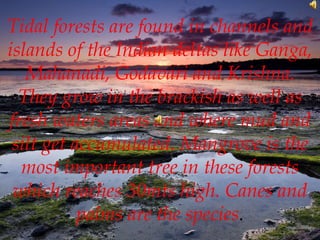
Tidal forests are found in channels and
islands of the Indian deltas like Ganga,
Mahanadi, Godavari and Krishna.
They grow in the brackish as well as
fresh waters areas and where mud and
silt get accumulated. Mangrove is the
most important tree in these forests
which reaches 30mts high. Canes and
palms are the species.
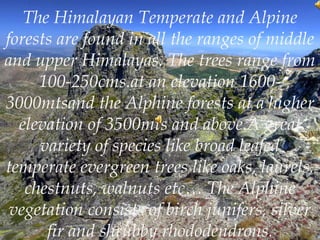
The Himalayan Temperate and Alpine
forests are found in all the ranges of middle
and upper Himalayas. The trees range from
100-250cms.at an elevation 1600-
3000mtsand the Alphine forests at a higher
elevation of 3500mts and above.A great
variety of species like broad leafed
temperate evergreen trees like oaks, laurels,
chestnuts, walnuts etc… The Alphine
vegetation consists of birch junifers, silver
fir and shrubby rhododendrons.
Distribution of Forest Lands :
According to 2000-01 statistics, the
forest land occupied about 675538 Sq.K.m. which
accounts for 20.55% per cent of the total
geographical area of the country. The largest
area forest land 77265 Sq.K.m. is seen in Madhya
Pradesh while the lowest 1745 Sq.K.m is in
Haryana.
Highest concentration of forest land
is registered I Arunachal Pradesh state with 62.1
per cent of its geographical area while the lowest
concentration is in Haryana state with 3.8 per
cent. The Andaman and Nicobar islands are also
found with high concentration of forest cover.
Development of Forests :
Problems:
The continuous chaotic growth of population
and greed of the present man’s short sighted and
unplanned commercial and subsistence gathering
activities like indiscriminate lumbering, charcoal
burning, firewood collection, over grazing and
jhumming type of cultivation and annual forest fires
have been causing considerable damage to forest
wealth system in our country. Forests in India have
been degenerated and degraded into barren and
unproductive lands. To alleviate this serious concern,
the development of different kinds of forests on war-
foot lines is an important means at this end.

Natural vegetation

  • 1.
  • 2.
    Content-:  Point ofeconony  Distribution of Forest land  Development of Forest Comedy-1,2,3,4……..  Types of Forest i. Tropical Evergreen Forest ii. Tropical Moist Deciduous Forest iii.Tropical Dry Deciduous Forest iv.Thorn Forest v. Tidal forest vi.The Himalayan Temperate Forest
  • 3.
    Importance of naturalvegetation and forests : Forest constitute one of the most important basic natural resources of the country. Ecological view : Forests help in occurrence of rainfall, promote soil conservation in catchment areas, regulate runoff, improve moisture holding capacity of the soils and maintain ecological balance.
  • 4.
    Point of economy: Forest lands can be utilized as grazing grounds for livestock. Great demand for timber which resulted into development of commercial forestry. Many products like charcoal wood, pulp and matchwood, canes, rose wood, sandal wood, lac, resins, honey, herb, fruits, dyes, tans, kendu are obtained from forest which highly commercial value both conservation and development of forest resource is as important as agriculture and industry.
  • 5.
  • 6.
    Forest Types : Terrain,climate, soil and water conditions greatly influence the character and type of vegetation. The Himalayan region, possesses a variety of vegetation with a distinctive character of alpine type at higher altitudes and this region is clearly distinguished from the rest of the country. Climatic factors mainly temperature and rainfall determine which plant community can flourish in a specific habitat. Soils and drainage considerably introduce modifications, and thus we have edaphic types such as the tidal forests.
  • 7.
    Tropical wet evergreenand semi evergreen forests are found in Southern Western Ghats, north-eastern India and Plains of West Bengal with altitude ranging from 500-1500 mts and rainfall exceeding 200cms. Height of trees is from 45-60mts.Vegetation is very dense. Variety of species is very large consists of rose wood, paan, aini, telsur.
  • 9.
    Tropical moist deciduousforests are found in Western ghats and ChotaNagpur plateau and Siwaliks of Himalayas. These forests have hilly terrains and plateau regions with rainfall between 100-200cms. These are tropical monsoon forests with tall trees which rise upto 25-60mts. Teak is a dominant species and other species are sandal wood, sal and shisham
  • 10.
    Tropical dry deciduousforests occupy the large part of peninsular plateau, Ganga plain and area between the Thar, the Himalayas and the Western Ghats. They cover vast areas of plateau and plain areas with rainfall between 70-100cms. This type of forest is found with open formations and the important species are teak, bamboo, sal and khair.
  • 11.
    Thorn forests arefound in the plains of Punjab, seaside's of Western ghats and the drier parts of the Deccan plateau, this type forests are found in dry areas with rainfall less than 70cms. The vegetation consists of open stunted forests and xerophytic bushes and trees are just 6-7mts high. Acacias and euphoria's are common species everywhere.
  • 12.
    Tidal forests arefound in channels and islands of the Indian deltas like Ganga, Mahanadi, Godavari and Krishna. They grow in the brackish as well as fresh waters areas and where mud and silt get accumulated. Mangrove is the most important tree in these forests which reaches 30mts high. Canes and palms are the species.
  • 13.
    The Himalayan Temperateand Alpine forests are found in all the ranges of middle and upper Himalayas. The trees range from 100-250cms.at an elevation 1600- 3000mtsand the Alphine forests at a higher elevation of 3500mts and above.A great variety of species like broad leafed temperate evergreen trees like oaks, laurels, chestnuts, walnuts etc… The Alphine vegetation consists of birch junifers, silver fir and shrubby rhododendrons.
  • 14.
    Distribution of ForestLands : According to 2000-01 statistics, the forest land occupied about 675538 Sq.K.m. which accounts for 20.55% per cent of the total geographical area of the country. The largest area forest land 77265 Sq.K.m. is seen in Madhya Pradesh while the lowest 1745 Sq.K.m is in Haryana. Highest concentration of forest land is registered I Arunachal Pradesh state with 62.1 per cent of its geographical area while the lowest concentration is in Haryana state with 3.8 per cent. The Andaman and Nicobar islands are also found with high concentration of forest cover.
  • 15.
    Development of Forests: Problems: The continuous chaotic growth of population and greed of the present man’s short sighted and unplanned commercial and subsistence gathering activities like indiscriminate lumbering, charcoal burning, firewood collection, over grazing and jhumming type of cultivation and annual forest fires have been causing considerable damage to forest wealth system in our country. Forests in India have been degenerated and degraded into barren and unproductive lands. To alleviate this serious concern, the development of different kinds of forests on war- foot lines is an important means at this end.